語彙集

英単語辞書 | 単語の意味、定義、例文

noun
/ˈpærəmʊr/
愛人 (aijin)

a lover, especially an illicit one

"The secret paramour was finally revealed."

"秘密の愛人はついに明らかにされました。" (Himitsu no aijin wa tsuini akiraka ni saremashita.)
noun
/ˌpærəˈnɔɪə/
人々があなたに害を与えようとしているか、常にあなたを監視しているという非合理的で持続的な感覚 (hitobito ga anata ni gai o atae yō to shite iru ka, jō ni anata o kanshi shite iru to iu higariteki de jizokuteki na kankaku)

an irrational and persistent feeling that people are 'out to get you' or are constantly watching you

"His constant paranoia made it hard for him to trust anyone."

"彼の絶え間ないパラノイアは、誰も信じることを難しくさせていた。" (Kare no tae manai paranoia wa, dare mo shinjiru koto o muzukashiku sasete ita.)
noun
/ˌpærəˈnɔɪæk/
パラノイア的な人 (paranoia-tekina hito)

A person who suffers from paranoia or exhibits extreme, irrational distrust and suspicion.

"The paranoiac refused to leave his house, fearing everyone was against him."

"そのパラノイア的な人は、みんなが自分に反対していると恐れて家を出ることを拒んだ。" (Sono paranoia-tekina hito wa, minna ga jibun ni hantai shite iru to osorete ie o deru koto o kobanda.)
adjective
/ˈpær.ə.nɔɪd/
他人に対して不合理な恐怖や疑いを持つこと (tanin ni taishite fugōri na kyōfu ya utagai o motsu koto)

having an unreasonable fear or suspicion of others

"She became paranoid after hearing strange noises outside."

"彼女は外で奇妙な音を聞いた後、パラノイアになった。" (Kanojo wa soto de kimyō na oto o kiita ato, paranoya ni natta.)
noun
/ˈpærəpɛt/
防護壁 (bougobari)

A low protective wall along the edge of a roof, balcony, or bridge.

"The soldier hid behind the parapet for protection."

"兵士は防護壁の後ろに隠れて安全を守りました。" (Heishi wa bougobari no ushiro ni kakurete anzen o mamorimashita.)
noun
/ˌpærəfəˈneɪliə/
道具一式 (dougu isshiki)

Miscellaneous articles, especially equipment needed for a particular activity.

"The fisherman carried all his fishing paraphernalia in a large box."

"漁師はすべての釣り道具を大きな箱に入れて運びました。" (Ryoushi wa subete no tsuri dougu o ookina hako ni irete hakobimashita.)
verb
/ˈpærəfreɪz/
幸福 (kōfuku)

To express the meaning of something using different words, often to make it clearer.

"The teacher asked the students to paraphrase the poem in their own words."

"彼女は賞を受け取ったとき、自分の幸せを隠せなかった。" (Kanojo wa shō o uketotta toki, jibun no kōfuku o kakusenakatta.)
noun
/ˈpærəsaɪt/
寄生虫 (kiseichū)

An organism that lives in or on another organism and benefits at the host’s expense.

"The parasite weakened the tree by feeding on its nutrients."

"寄生虫は栄養を吸収して木を弱らせました。" (Kiseichū wa eiyō o kyūshū shite ki o yowarasemashita.)
noun
/ˈpɑr.bəl/
尖ったウリ (togatta uri)

A green vegetable also known as pointed gourd, commonly used in South Asian cuisine

"Mother prepared parbal curry with fish."

"母は魚と一緒に尖ったウリのカレーを作りました。" (Haha wa sakana to issho ni togattta uri no karē o tsukurimashita)
noun
/ˈpɑr.səl/
小包; 土地の一区画 (kobako; tochi no ikuka)

an object or collection of objects wrapped in paper for carrying or sending by mail; a piece of land

"The postman delivered a parcel to our door."

"郵便配達員が私たちのドアに小包を届けました。" (Yubin haitatsuin ga watashitachi no doa ni kobako o todokemashita.)
verb
/pɑːrtʃ/
乾かす (kawakasu)

to make something extremely dry, especially by exposure to heat

"The scorching sun began to parch the fields."

"焼けつくような太陽が畑を乾かし始めました。" (Yaketukuyouna taiyou ga hatake o kawakashi hajimemashita.)
adjective
/pɑːrtʃt/
極度に喉が渇いた (kyokudo ni nodo ga kawaita)

extremely dry, especially because of heat or thirst

"After walking in the desert, he was parched with thirst."

"砂漠を歩いた後、彼は極度に喉が渇いていた。" (Sabaku o aruita ato, kare wa kyokudo ni nodo ga kawaita.)
noun
/ˈpɑːrtʃmənt/
羊皮紙 (yōhishi)

a thin material made from animal skin, used in the past for writing

"The ancient manuscript was written on parchment."

"古代の写本は羊皮紙に書かれていました。" (Kodai no shahon wa yōhishi ni kakarete imashita.)
noun
/ˈpɑr.dən/
許し; 謝罪; (yurushi)

forgiveness; the action of forgiving or being forgiven for an error or offense

"I beg your pardon for interrupting the meeting."

"会議を中断したことをお詫び申し上げます。" (kaigi o chudan shita koto o owabi moushiagemasu.)
adjective
/ˈpɑːr.dən.ə.bəl/
許容可能な (kyoryo kanno na)

able to be forgiven; excusable

"His mistake was pardonable given the difficult circumstances."

"彼の誤りは許容可能でした、困難な状況を考慮すると。" (kare no ayamari wa kyoryo kanou deshita, konnan na joukyou o kouryo suru to.)
verb
/per/
皮をむく (kawa wo muku)

to cut away the outer covering or reduce something gradually

"She pared the apple before eating it."

"彼女はリンゴを食べる前に皮をむいた。" (Kanojo wa ringo wo taberu mae ni kawa wo muita.)
noun
/ˌpærəˈɡɔːrɪk/
アヘンを含む薬 (ahen wo fukumu kusuri)

a medicine containing opium, once used to relieve pain and diarrhea

"Doctors once prescribed paregoric to treat diarrhea in children."

"医師はかつて子供の下痢を治療するためにパレゴリックを処方していた。" (Ishi wa katsute kodomo no geri wo chiryo suru tame ni paregoric wo shohou shite ita.)
noun
/ˈpɛərənt/
(oya)

a mother or father of a person or animal

"Both of his parents are teachers."

"彼の両親は教師です。" (Kare no ryōshin wa kyōshi desu.)
noun
/ˈpɛrəntɪdʒ/
家系 (kakei)

The identity and origins of one's parents; descent or lineage.

"Her noble parentage gave her access to the royal court."

"彼女の高貴な家系は、彼女に王室へのアクセスを与えた。" (Kanojo no kōkina kakei wa, kanojo ni ōshitsu e no akusesu o ataeta.)
adjective
/pəˈrɛntəl/
親に関連する (oya ni kanren suru)

relating to a parent or parents; characteristic of a mother or father

"Parental guidance is important for a child's development."

"子供の成長には親のガイダンスが重要です。" (Kodomo no seichō ni wa oya no gaidansu ga jūyō desu.)
noun
/pəˈrɛnθəsɪs/
括弧 (kakko)

A pair of curved marks ( ) used to enclose words or numbers; also an interruption or digression in speech or writing.

"The explanation was given in a parenthesis within the text."

"説明はテキスト内の括弧に含まれていました。" (Setsumei wa tekisuto nai no kakko ni fukumareteimashita.)
adjective
/ˌpɛrənˈθɛtɪkəl/
括弧内のコメント (kakkonai no komento)

Relating to or expressed in parentheses; a side remark or digression.

"He added a parenthetical comment during the lecture."
"彼は講義中に括弧内のコメントを追加しました。" (Kare wa kōgijū ni kakkonai no komento o tsuika shimashita.)
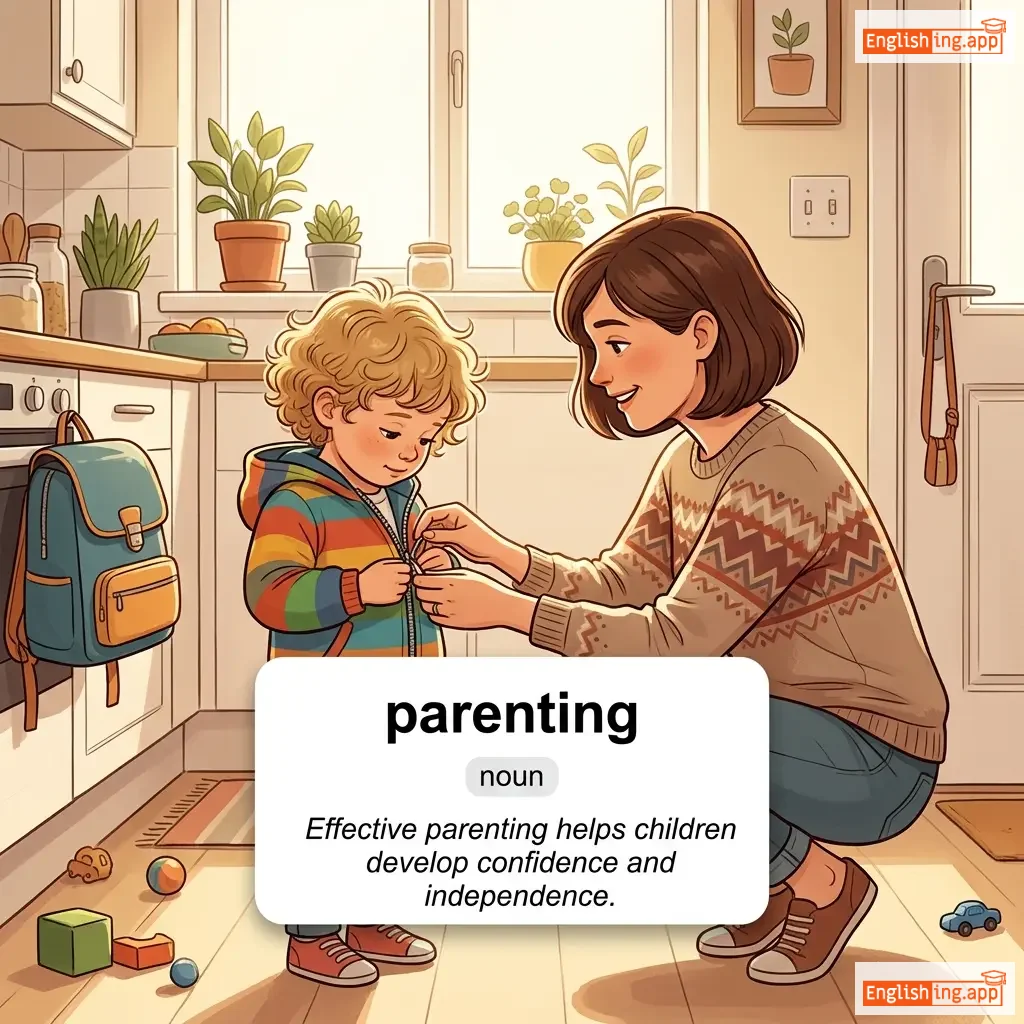
parenting definition card — visual illustration of the meaning
👨‍👩‍👧‍👦

parenting (parenting)

noun
/ˈpeə.rən.tɪŋ/
育児 (ikuji)

The care and training a child receives while growing up, involving the development of their mental, physical, and social aspects.

"Effective parenting helps children develop confidence and independence."
"効果的な育児は、子供たちが自信と独立心を育むのを助けます。" (Kōkateki na ikuji wa, kodomotachi ga jishin to dokuritsushin o hagukumu no o tasukemasu.)
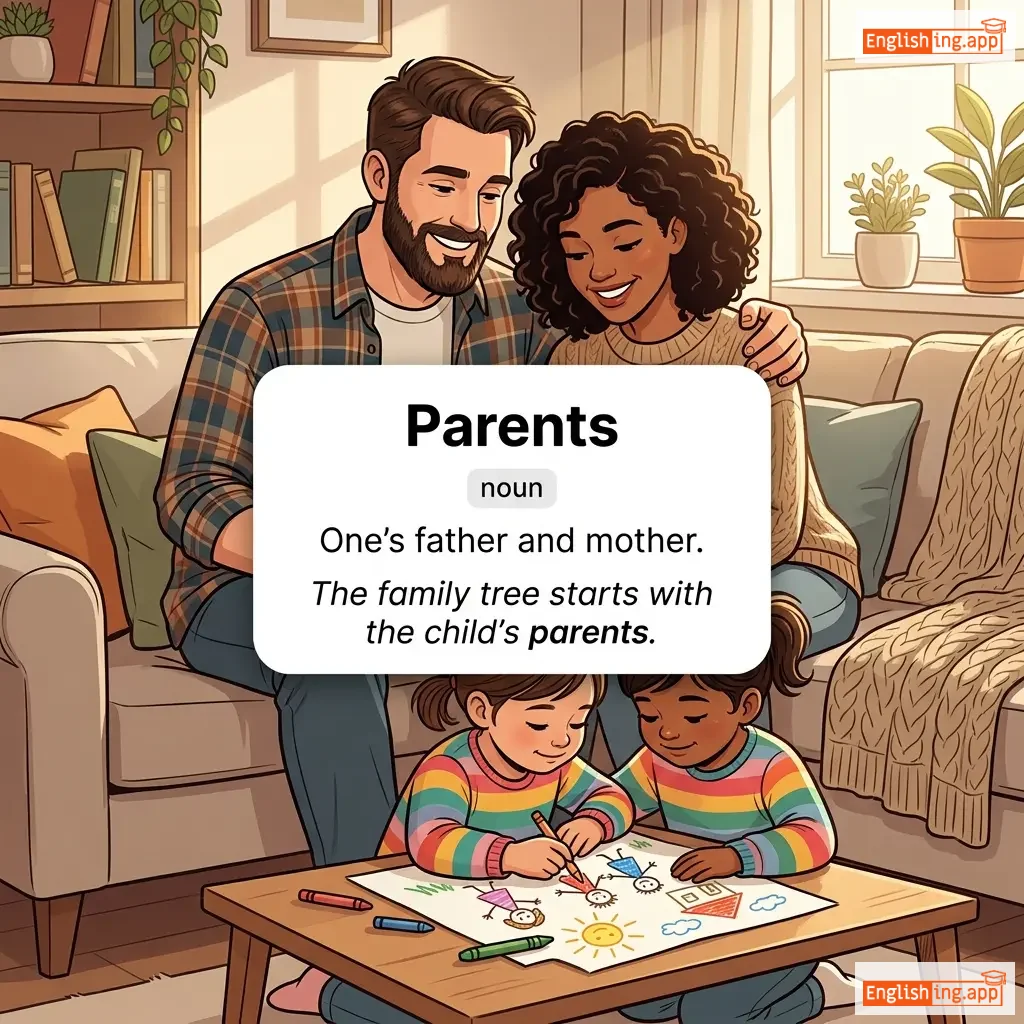
Parents definition card — visual illustration of the meaning
noun
ˈpɛrənts
(oya)

One's father and mother.

"The family tree starts with the child's parents."

"家系図は子供の親から始まります。" (Kakeizu wa kodomo no oya kara hajimarimasu.)
noun
/pəˈraɪə/
社会的に追放された人 (shakai-teki ni tsuihō sareta hito)

An outcast; someone who is rejected by society or a social group.

"After the scandal, he became a social pariah."

"スキャンダルの後、彼は社会的なパリアになった。" (Sukyandaru no ato, kare wa shakai-teki na paria ni natta.)
noun
/ˈpærɪʃ/
教区 (kyōku)

A local church community or the area served by a parish church.

"The parish gathered for Sunday service."

"教区は日曜礼拝のために集まりました。" (kyōku wa nichiyō reihai no tame ni atsumarimashita.)
adjective
/pəˈrɪʒən/
パリに関連する (pari ni kanren suru)

relating to Paris or its people

"She wore a Parisian style dress at the party."

"彼女はパリジャンスタイルのドレスをパーティーで着ていた。" (Kanojo wa parijan sutairu no doresu o pātī de kiteita.)
noun
/ˈpærɪti/
平等 (byoudou)

the state or condition of being equal, especially in status or pay

"The campaign aims to achieve pay parity between men and women."

"キャンペーンは男性と女性の間で給与の平等を達成することを目指しています。" (Kyanpēn wa dansei to josei no aida de kyūyo no byōdō o tassei suru koto o mezashiteimasu.)
noun
/pɑːrk/
パーク (pāku)

a large public area of land with grass, trees, and paths, where people can walk or relax

"The children were playing in the park."

"子供たちは公園で遊んでいました。" (Kodomotachi wa kōen de asonde imashita.)
noun
/ˈpɑːrkɪŋ/
駐車場 (chūshajō)

the action or practice of leaving a vehicle in a particular place for a period of time

"There was no available parking near the restaurant."

"レストランの近くには駐車場がありませんでした。" (Resutoran no chikaku ni wa chūshajō ga arimasen deshita.)
noun
/ˈpɑːrləns/
専門用語 (senmon yougo)

a particular way of speaking or using words, common to a group

"In legal parlance, the term has a different meaning."

"法律用語では、この言葉は異なる意味を持っています。" (Hōritsu yōgo de wa, kono kotoba wa kotonaru imi o motteimasu.)
noun, verb
/ˈpɑːrli/
交渉 (koushou)

a discussion between opposing sides, especially to negotiate terms

"The generals met to parley over the terms of surrender."

"将軍たちは降伏条件について話し合うために会った。" (Shougun-tachi wa koufuku jouken ni tsuite hanashiau tame ni atta.)
noun
/ˈpɑːrləmənt/
議会 (gikai)

the highest legislative body in a country

"The bill was passed in parliament after a long debate."

"その法案は議会で長時間の議論の後に通過しました。" (Sono hōan wa gikai de chō jikan no giron no ato ni tsūka shimashita.)
adjective
/ˌpɑːrləˈmɛntri/
議会の (gikai no)

relating to a parliament or its members; relating to a system of government with parliamentary authority

"The country follows a parliamentary form of government."

"その国は議会制の政府を採用している。" (Sono kuni wa gikaisei no seifu o saiyo shite iru)
noun
/ˈpɑːrlər/
サロン、店 (parlor)

A sitting room in a private house, or a shop providing specified services.

"They welcomed the guests into the front parlor."

"彼らは前のパーラーでゲストを迎えました。" (Karera wa mae no pāra de gesuto o mukaemashita.)
adjective
/ˈpɑːrləs/
危険な (parlus)

Full of danger or risk; precarious.

"The company is in a parlous financial state."

"その会社は危険な財政状態にあります。" (Sono kaisha wa kiken na zaisei jōtai ni arimasu.)
adjective
/pəˈroʊkiəl/
狭い (parokial)

Having a limited or narrow outlook; relating to a parish.

"His parochial view prevented him from understanding global issues."

"彼の狭い視点は、彼が世界的な問題を理解するのを妨げました。" (Kare no semai shiten wa, kare ga sekaiteki na mondai o rikai suru no o samatagemashita.)
noun
/ˈpærədi/
パロディ (parodi)

A humorous or satirical imitation of a serious piece of literature, music, or style.

"The comedian performed a parody of the president’s speech."

"コメディアンは大統領の演説のパロディを演じた。" (Komedian wa daitōryō no enzetsu no parodi o enjita.)
adjective
/pəˈrɒnɪməs/
同義語 (dōgigo)

Words that are derived from the same root or sound alike.

"The words 'effect' and 'effective' are paronymous."

"‘Effect’ と ‘Effective’ は同義語です。" ('Effect' to 'Effective' wa dōgigo desu.)
noun
/ˈpær.əkˌsɪz.əm/
突然の爆発的な感情 (totsuzen no bakuhatsuteki na kanjō)

A sudden, violent outburst of emotion or activity.

"She was seized by a paroxysm of laughter."

"彼女は突然の笑いの爆発に襲われた。" (Kanojo wa totsuzen no warai no bakuhatsu ni osowareta.)
noun
/ˈpɑːr.keɪ/
木製の床 (mokusei no yuka)

A floor made of wooden blocks arranged in a geometric pattern.

"The old mansion had a beautiful parquet floor."

"その古い邸宅には美しい木製の床がありました。" (Sono furui teitaku ni wa utsukushii mokusei no yuka ga arimashita.)
noun
/ˈpɑːr.kə.tri/
パーケットフローリングの技術 (pāketto furōringu no gijutsu)

The art or technique of laying parquet floors.

"The craftsman specialized in parquetry for luxury homes."

"職人は高級住宅のためにパーケット工芸を専門にしていました。" (Shokunin wa kōkyū jūtaku no tame ni pāketto kōgei o senmon ni shite imashita.)
noun
/ˈpær.ɪ.saɪd/
親殺し (oyagoroshi)

The act of killing one's father, mother, or other close relative.

"The court tried him for parricide after the tragic incident."

"悲劇的な事件の後、裁判所は彼を親殺しの罪で裁いた。" (Higeki-tekina jiken no ato, saiban-sho wa kare wo oyagoroshi no tsumi de sabaita.)
noun/verb
/ˈpær.ət/
オウム (oumu)

A brightly colored bird that can imitate human speech; to repeat words mechanically without understanding.

"The child parroted the teacher's words without thinking."

"子供は考えずに先生の言葉を繰り返しました。" (Kodomo wa kangaezu ni sensei no kotoba wo kurikaeshimashita.)
noun
/ˈpær.ət biːk/
パロットビーク (parotto bīku)

a climbing plant with curved red and orange flowers resembling a parrot's beak

"The parrot beak flower's unique curved shape makes it a fascinating addition to any garden."

"パロットビークの花はユニークな曲線を持っており、どんな庭にも魅力的な追加要素となります。" (Parotto bīku no hana wa yunikuna kyokusen o motteori, donna niwa ni mo miryokuteki na tsuika yōso to narimasu.)
verb
/ˈpæri/
攻撃をかわす (kōgeki o kawasu)

to ward off or deflect an attack, especially in fencing or conversation

"He managed to parry the opponent’s sword with quick reflexes."

"彼は素早い反応で相手の剣をかわすことができた。" (Kare wa subayai hannō de aite no ken o kawasu koto ga dekita.)
verb
/pɑːrs/
文法解析 (bunpou kaiseki)

to analyze a sentence or text grammatically or logically

"The software can parse large amounts of text data efficiently."

"ソフトウェアは、大量のテキストデータを効率的に解析できます。" (Sofutowea wa, tairyou no tekisuto dēta o kōritsuteki ni kaiseki dekimasu.)
adjective
/ˌpɑːrsɪˈmoʊniəs/
けち (kechi)

unwilling to spend money or use resources; stingy

"The company was too parsimonious to invest in better equipment."

"その会社は良い設備に投資するにはあまりにもけちだった。" (Sono kaisha wa yoi setsubi ni tōshi suru ni wa amari ni mo kechi datta.)
noun
/ˈpɑːrsɪmoʊni/
けち (kechi)

extreme unwillingness to spend money or use resources

"His parsimony was evident in the way he avoided any unnecessary expenses."
"彼のけちは、どんな無駄な出費も避ける様子に表れていた。" (Kare no kechi wa, donna muda na shuppi mo sakeru yosu ni arawarete ita.)
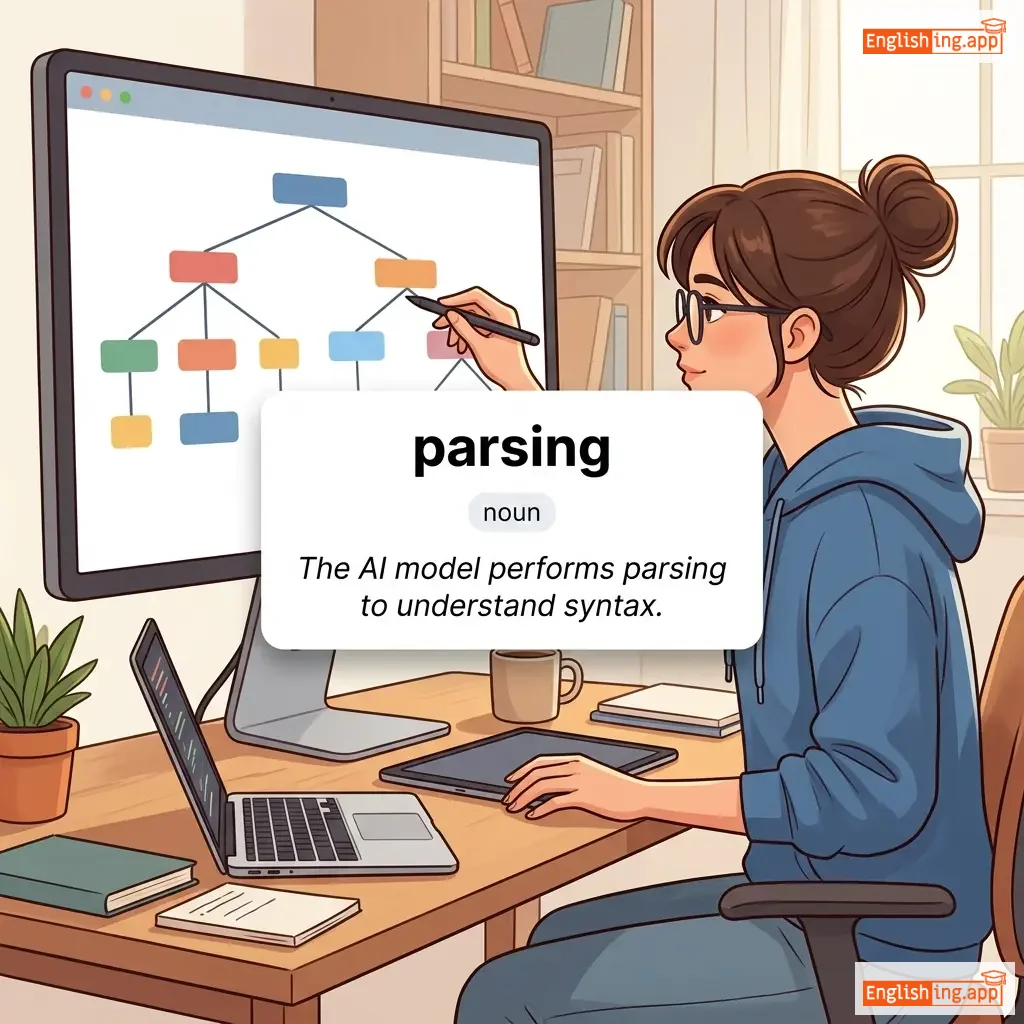
parsing definition card — visual illustration of the meaning
noun
ˈpɑː.sɪŋ
文の構造解析 (parsing)

The process of analyzing sentence structure to understand grammatical relationships.

"The AI model performs parsing to understand syntax."

"AIモデルは構文解析を行い、構造を理解します。" (AI moderu wa koubun kaiseki wo okonai, kouzou wo rikai shimasu.)