वोकैबुलरीज

इंग्लिश वोकैबुलरी डिस्कवर, लर्न और मास्टर करें

noun
/ɪˈfɛmɪnəsi/
स्त्रीत्व (stritva)

The quality of showing traits traditionally associated with women, such as delicacy or softness.

"In ancient times, effeminacy was often criticized as a sign of weakness."

"प्राचीन काल में, स्त्रीत्व को अक्सर कमजोरी का संकेत माना जाता था।" (Prachin kaal mein, stritva ko aksar kamzori ka sanket mana jata tha.)
adjective
/ɪˈfɛmɪnət/
नारीसुलभ (narisulabh)

Having traits, tastes, or habits traditionally considered feminine, often used negatively for men.

"The critics described him as effeminate due to his gentle manner."

"आलोचकों ने उसकी कोमल व्यवहार के कारण उसे नारीसुलभ कहा।" (Aalochako ne uski komal vyavhaar ke kaaran use narisulabh kaha.)
verb
/ˌɛfəˈvɛs/
बबल्स छोड़ना (bubbles chhodna)

To give off bubbles of gas; to show excitement, liveliness, or enthusiasm.

"The soda began to effervesce as soon as it was opened."

"सोड़ा खुलते ही वह बबल्स उठने लगा।" (Soda khulte hi wah bubbles uthne laga.)
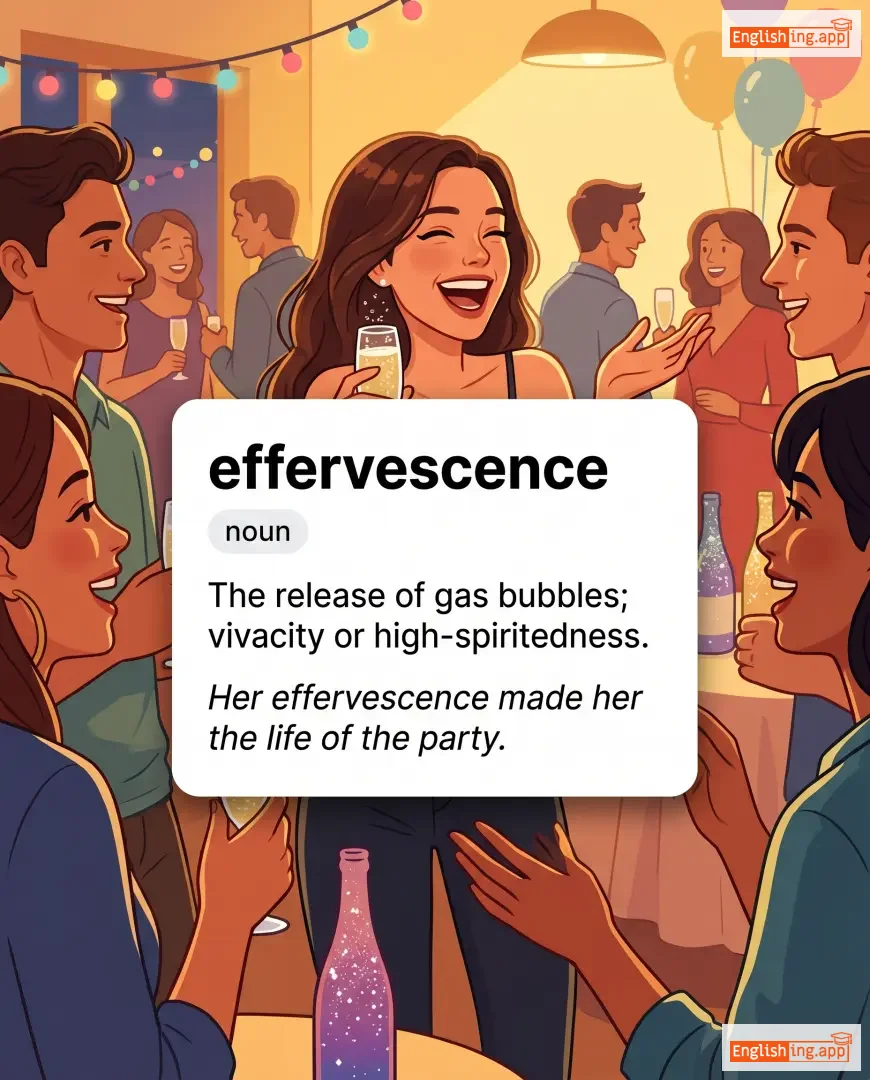
effervescence definition card — visual illustration of the meaning
noun
/ˌɛfəˈvɛsəns/
उत्साह (utsah)

The release of gas bubbles; vivacity or high-spiritedness.

"Her effervescence made her the life of the party."

"उसकी उत्साह ने उसे पार्टी की जान बना दिया।" (Uski utsah ne use party ki jaan bana diya.)
adjective
/ˌɛfəˈvɛsənt/
उत्साही (utsahi)

Giving off bubbles; lively, enthusiastic, and full of energy.

"She had an effervescent personality that brightened every room."

"उसकी उत्साही व्यक्तित्व ने हर कमरे को रोशन कर दिया।" (Uski utsahi vyaktitva ne har kamre ko roshan kar diya.)
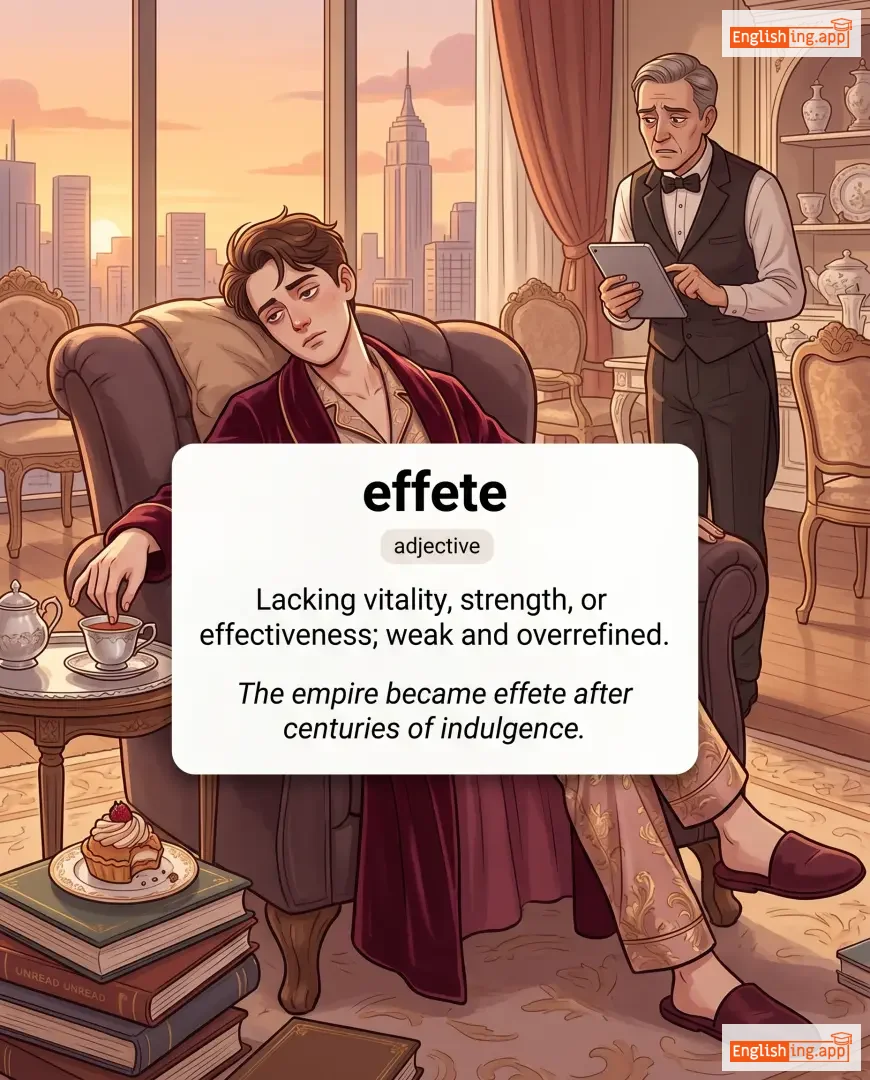
effete definition card — visual illustration of the meaning
adjective
/ɪˈfiːt/
नम्र (namra)

Lacking vitality, strength, or effectiveness; weak and overrefined.

"The empire became effete after centuries of indulgence."

"सदियों की विलासिता के बाद साम्राज्य कमजोर हो गया।" (Sadiyon ki vilaasita ke baad saamrajya kamzor ho gaya.)
efficacious definition card — visual illustration of the meaning
adjective
/ˌɛfɪˈkeɪʃəs/
प्रभावी (prabhavi)

Effective in producing the desired result.

"The medicine proved efficacious in treating the disease."

"दवा ने रोग उपचार में प्रभावी साबित हुआ।" (Dawa ne rog upchaar mein prabhavi saabit hua.)
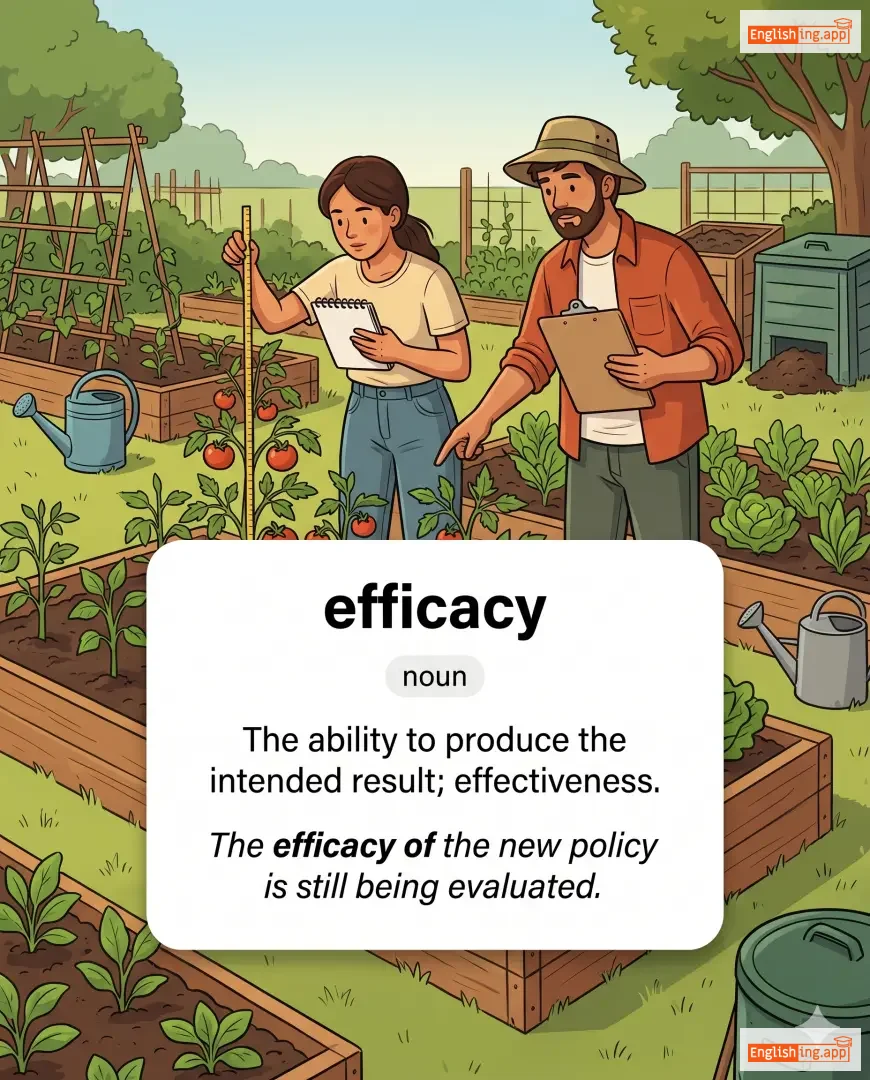
efficacy definition card — visual illustration of the meaning
noun
/ˈɛfɪkəsi/
प्रभावकारिता (prabhavkaarita)

The ability to produce the intended result; effectiveness.

"The efficacy of the new policy is still being evaluated."

"नई नीति की प्रभावकारिता अभी भी मूल्यांकन की जा रही है।" (Nayi neeti ki prabhavkaarita abhi bhi mulyankan ki ja rahi hai.)
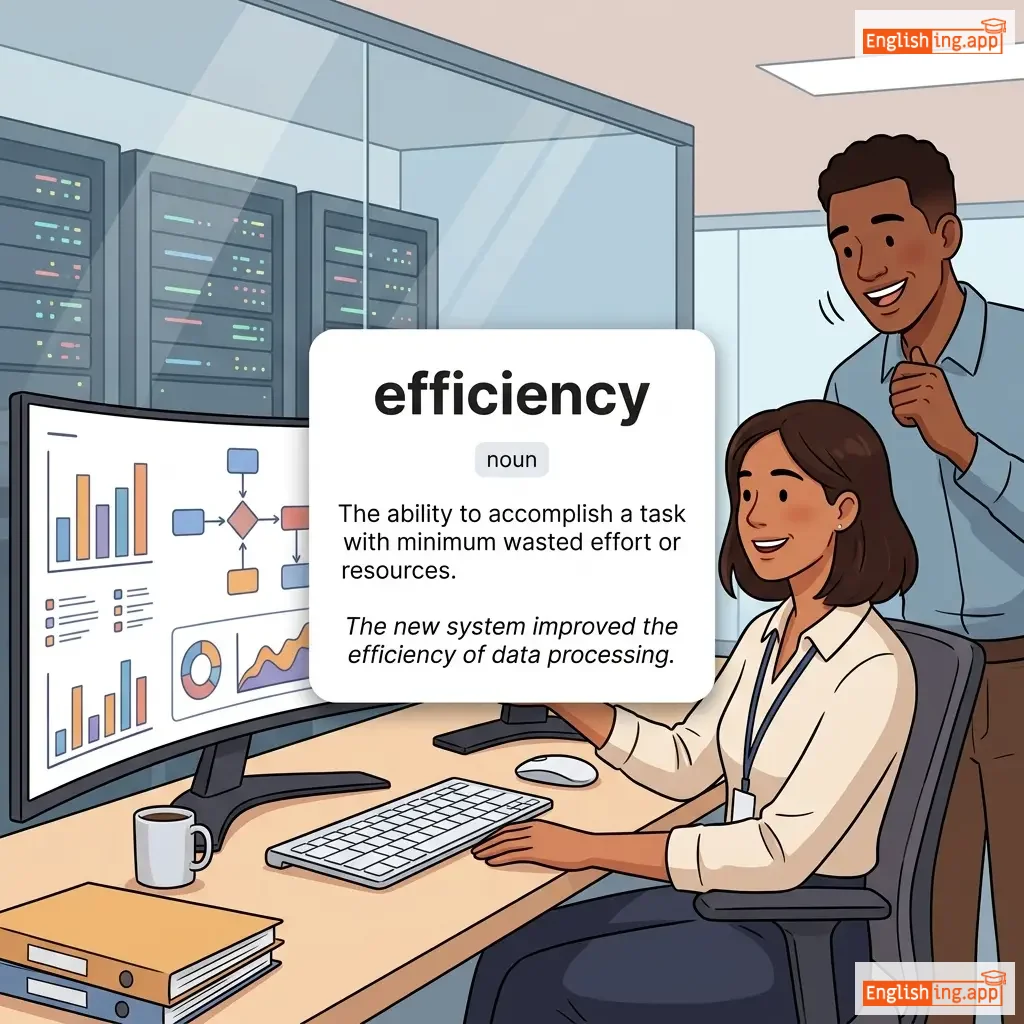
efficiency definition card — visual illustration of the meaning
noun
/ɪˈfɪʃənsi/
कुशलता (kushalta)

The ability to accomplish a task with minimum wasted effort or resources.

"The new system improved the efficiency of data processing."

"नया सिस्टम डेटा प्रोसेसिंग की कुशलता में सुधार किया।" (Naya system data processing ki kushalta mein sudhar kiya.)
efficient definition card — visual illustration of the meaning
adjective
/ɪˈfɪʃənt/
कुशल (kushal)

Working in a well-organized and productive way, without wasting time or effort.

"She is an efficient manager who gets things done quickly."

"वह एक कुशल प्रबंधक हैं जो जल्दी काम पूरा करती हैं।" (Vah ek kushal prabandhak hain jo jaldi kaam poora karti hain.)
adverb
/ɪˈfɪʃəntli/
कुशलता से (kushalta se)

in a way that achieves maximum productivity with minimum wasted effort or expense

"She managed to complete the task efficiently within the deadline."

"वह समय सीमा के भीतर कार्य को कुशलता से पूरा करने में सक्षम थी।" (Vah samay seema ke bhitar kary ko kushalta se poora karne mein saksham thi.)
noun
/ˈɛfɪdʒi/
मूरत (murat)

a sculpture or model of a person, often made to be destroyed in protest or anger

"The protesters burned an effigy of the corrupt politician."

"विरोधकर्ताओं ने भ्रष्ट राजनेता की एक मूरत जलायी।" (Virodhkartao ne bhrasht rajneeta ki ek murat jalaayi.)
noun
/ˌɛfləˈrɛsəns/
फूलनिग्रह (phoolnigrah)

the process of flowering or reaching an optimal stage of development

"The garden was at the peak of its efflorescence in spring."

"बग़ीचे में वसंत में अपने फूलनिग्रह के शिखर पर था।" (Bagiche mein basant mein apne phoolnigrah ke shikhar par tha.)
adjective
/ˌɛfləˈrɛsənt/
फूलों से भरा (phoolon se bhara)

in the process of blooming or flourishing

"The efflorescent trees made the park look beautiful."

"फूलों से भरे पेड़ ने पार्क को सुंदर बना दिया।" (Phoolon se bhare ped ne park ko sundar bana diya.)
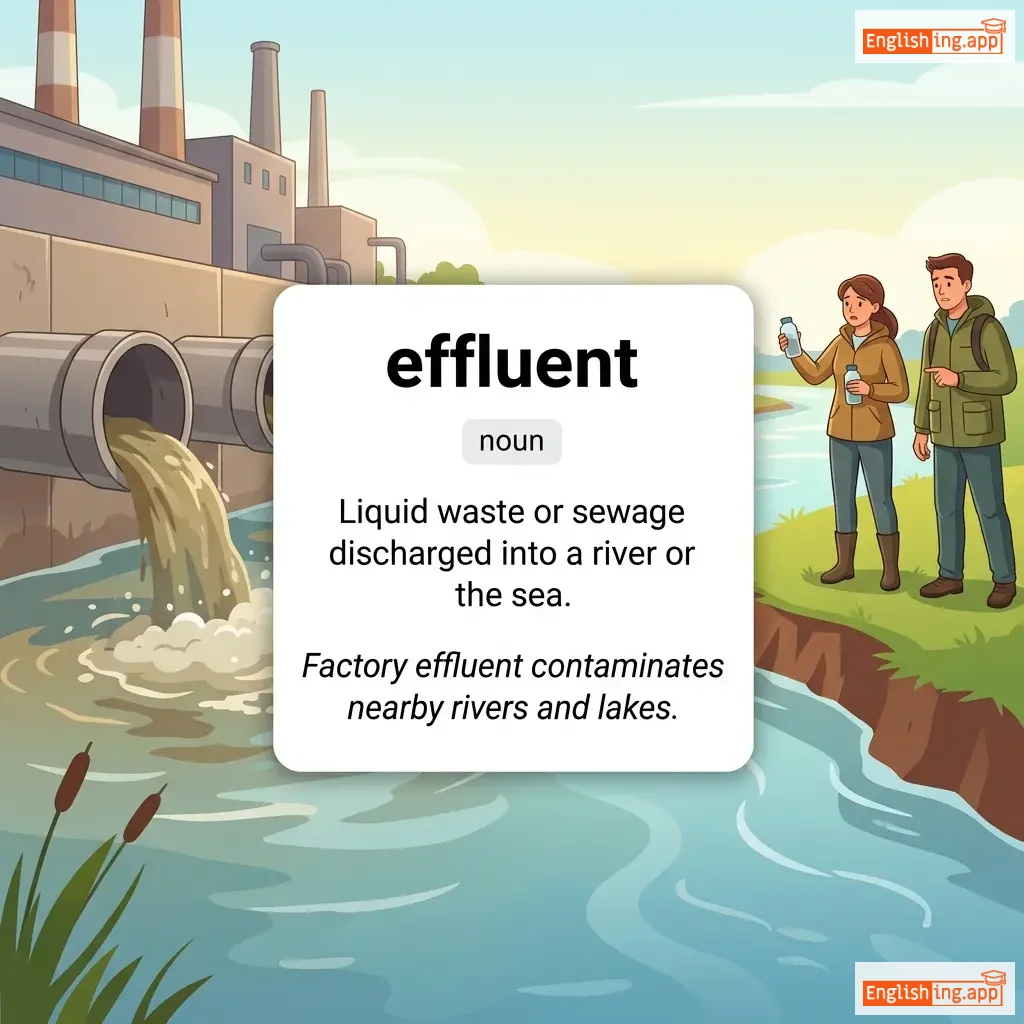
effluent definition card — visual illustration of the meaning
noun
ˈɛf.lu.ənt
द्रव अपशिष्ट या गंदा पानी (drav apshisht ya ganda pani)

Liquid waste or sewage discharged into a river or the sea.

"Factory effluent contaminates nearby rivers and lakes."

"फैक्ट्री का अपशिष्ट पास की नदियों और झीलों को प्रदूषित करता है।" (Factory ka apshisht paas ki nadiyon aur jheelo ko pradushit karta hai.)
noun
/ɪˈfluːviəm/
दुर्गंध (durgandh)

an unpleasant or harmful odor, secretion, or discharge

"The effluvium from the factory spread across the neighborhood."

"फैक्ट्री से आने वाली दुर्गंध पूरे इलाके में फैल गई थी।" (Factory se aane wali durgandh pure ilaake mein phail gayi thi.)
Effort definition card — visual illustration of the meaning
noun
/ˈɛfərt/
प्रयास (prayas)

the use of physical or mental energy to do something; attempt

"He made a great effort to improve his English skills."

"उसने अपनी अंग्रेजी कौशल सुधारने के लिए एक बड़ी कोशिश की।" (Usne apni angrezi kaushal sudharne ke liye ek badi koshish ki.)
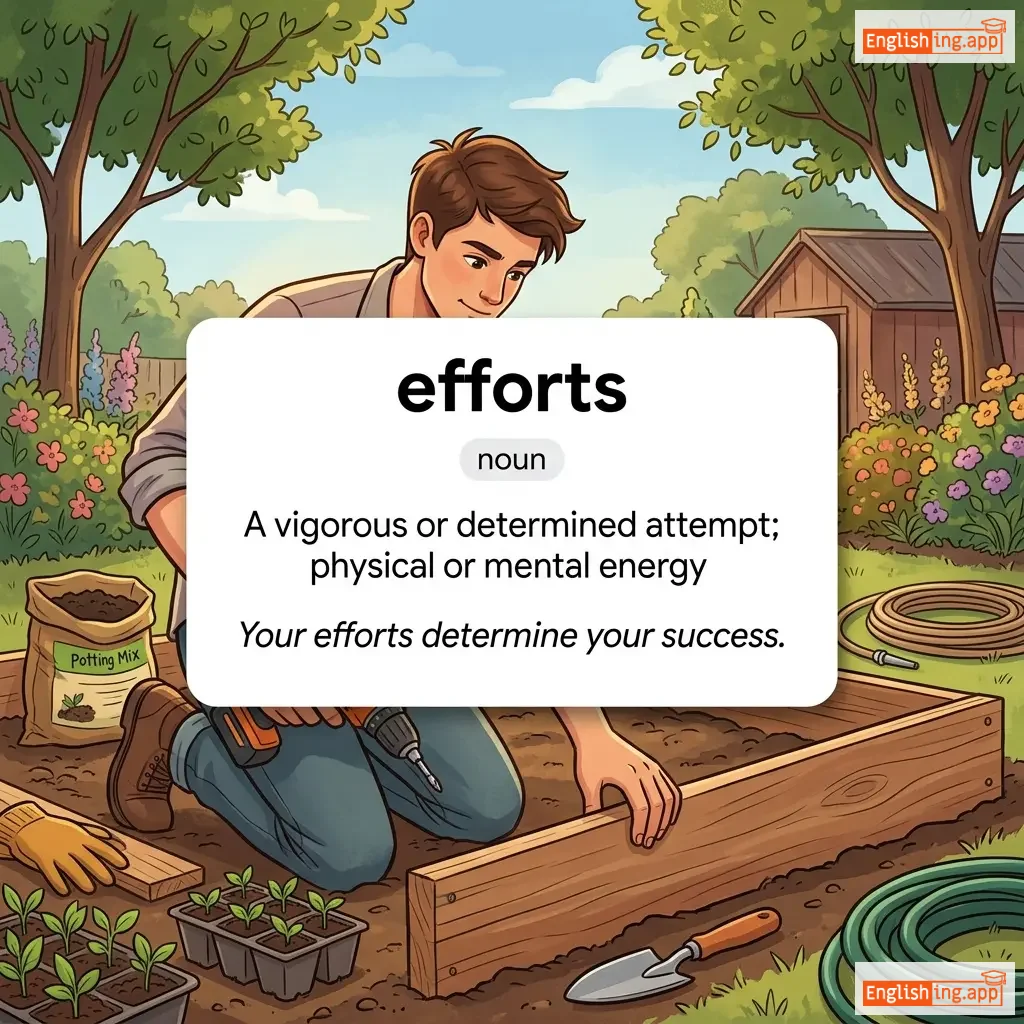
efforts definition card — visual illustration of the meaning
noun
ˈefərts
प्रयास (prayas)

A vigorous or determined attempt; physical or mental energy

"Your efforts determine your success."

"आपके प्रयास आपकी सफलता तय करते हैं।" (Aapke prayaas aapki safalta tay karte hain.)
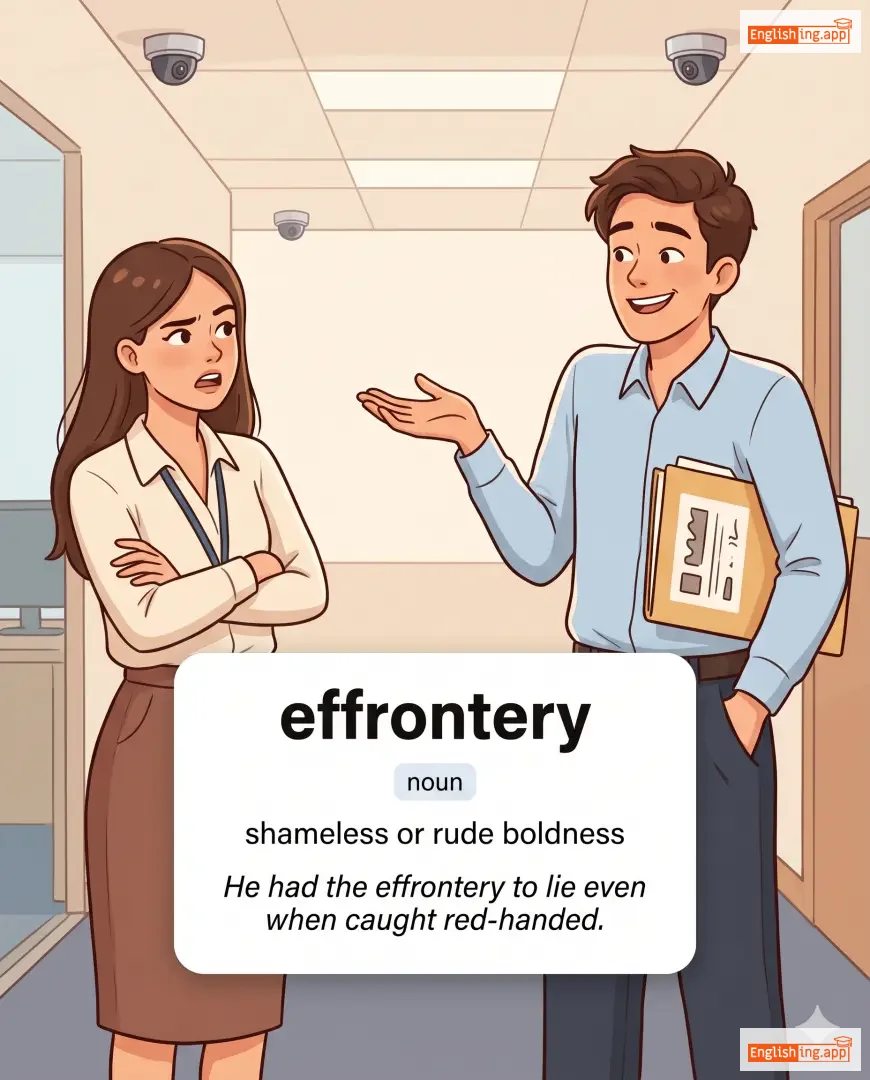
effrontery definition card — visual illustration of the meaning
noun
/ɪˈfrʌntəri/
बेशर्म या रुखी साहस (besharm ya rukhi sahas)

shameless or rude boldness

"He had the effrontery to lie even when caught red-handed."

"उसके पास पकड़े जाने के बावजूद झूठ बोलने का बेशर्म साहस था।" (Uske paas pakde jaane ke baavajood jhoot bolne ka besharm sahas tha.)
noun
/ɪˈfʌldʒəns/
दीप्ति (deepti)

Brilliant radiance or shining brightness.

"The effulgence of the sunrise lit up the entire valley."

"सूर्योदय की दीप्ति ने पूरे घाटी को रोशन कर दिया।" (Suryauday ki deepti ne poore ghaati ko roshan kar diya.)
adjective
/ɪˈfʌldʒənt/
दीप्तिमान (diptimaan)

Shining brilliantly; radiant.

"Her effulgent smile brightened everyone's mood."

"उसकी दीप्तिमान मुस्कान ने सबका मूड रोशन कर दिया।" (Uski diptimaan muskaan ne sabka mood roshan kar diya.)
verb
/ɪˈfjuːz/
प्रकट करना (prakat karna)

To pour out or express feelings freely and openly.

"She effused gratitude for the help she received."

"उसने प्राप्त मदद के लिए आभार व्यक्त किया।" (Usne prapt madad ke liye abhaar vyakt kiya.)
noun
/ɪˈfjuːʒən/
प्रवाह (pravaah)

An unrestrained outpouring of words, feelings, or emotions.

"His letter was an effusion of love and longing."

"उसका पत्र प्रेम और तड़प का एक प्रवाह था।" (Uska patra prem aur tadap ka ek pravaah tha.)
adjective
/ɪˈfjuːsɪv/
अतिवादी (ativaadi)

Expressing feelings of gratitude, pleasure, or approval in an unrestrained or heartfelt manner.

"She gave him an effusive welcome after his long journey."

"उसने अपनी लंबी यात्रा के बाद उसे अतिवादी स्वागत दिया।" (Usne apni lambi yatra ke baad use ativaadi swagat diya.)
abbreviation
/iː ˈdʒiː/
उदाहरण के लिए (udarhan ke liye)

For example (from Latin 'exempli gratia').

"You should eat more fruits, e.g., apples and bananas."

"आपको अधिक फल खाना चाहिए, उदाहरण के लिए, सेब और केले।" (Aapko adhik phal khana chahiye, udaharan ke liye, seb aur kele.)
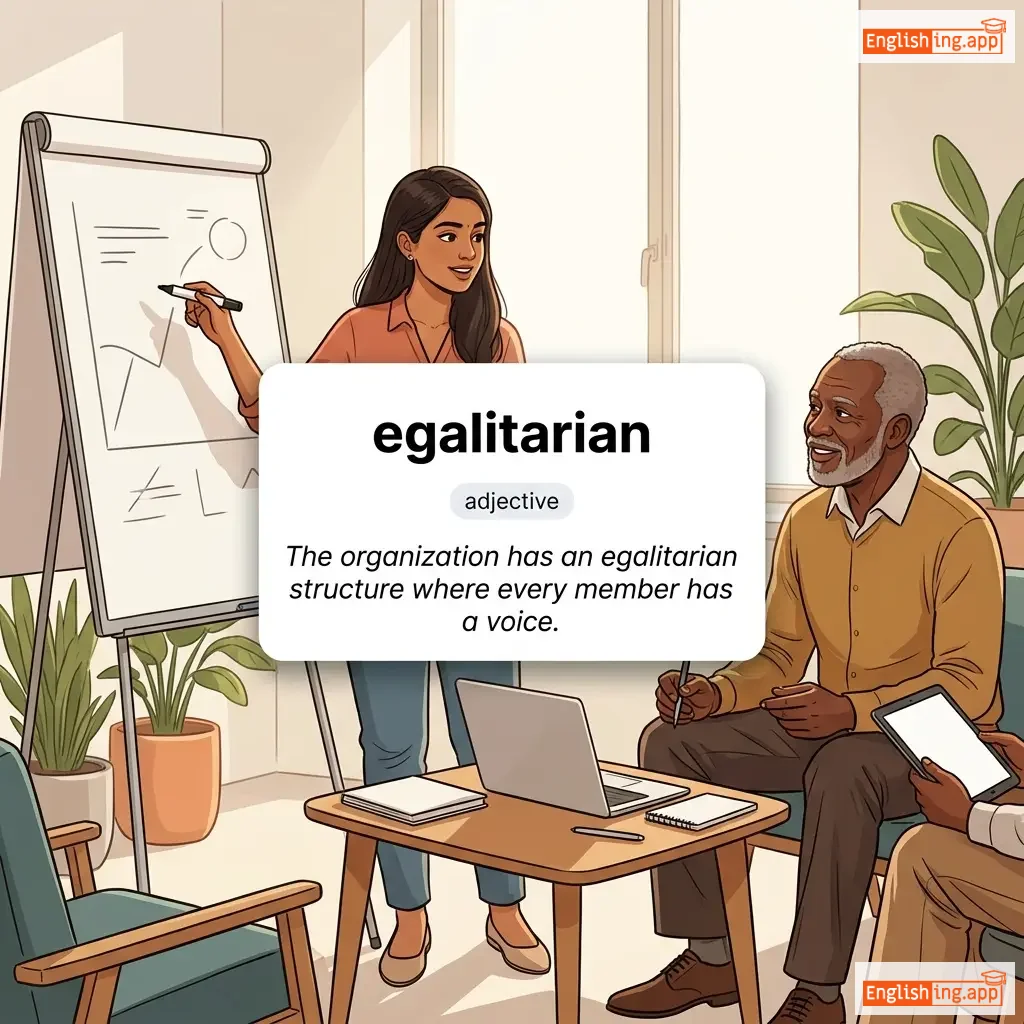
egalitarian definition card — visual illustration of the meaning
adjective
/ɪˌɡælɪˈtɛəriən/
समानतावादी (samanatavadi)

Believing in or promoting the principle that all people are equal and deserve equal rights and opportunities.

"The organization has an egalitarian structure where every member has a voice."

"संगठन में एक समानतावादी संरचना है जहाँ हर सदस्य की आवाज़ है।" (Sangathan mein ek samanatavadi sanrachna hai jahan har sadasya ki awaaz hai.)
noun
/ɛɡ/
अंडा (anda)

an oval or round object laid by a female bird, often eaten as food

"She had a boiled egg for breakfast."

"उसने नाश्ते में एक उबला हुआ अंडा खाया था।" (Usne nashtay mein ek ubla hua anda khaya tha.)
noun
/ˈiːɡoʊ/
अहंकार (ahankaar)

A person's sense of self-importance or self-esteem.

"His fragile ego was hurt by the criticism."

"आलोचना से उसका नाजुक अहंकार चोटिल हो गया।" (aalochana se uska naazuk ahankaar chotil ho gaya)
adjective
/ˌiːɡoʊˈsentrɪk/
आत्मकेंद्रित (aatmkendrit)

thinking only about yourself and not about others

"His egocentric behavior annoyed everyone at the meeting."

"उसका आत्मकेंद्रित व्यवहार मीटिंग में सभी को चिढ़ा दिया।" (Uska aatmkendrit vyavhaar meeting mein sabhi ko chidha diya.)
egoism definition card — visual illustration of the meaning
noun
/ˈiːɡoʊˌɪzəm/
अहंकारवाद (ahankaarvaad)

An ethical theory that treats self-interest as the foundation of morality; also, excessive preoccupation with oneself.

"His decisions were often driven by egoism rather than concern for others."

"उसके फैसले अक्सर दूसरों की चिंता के बजाय अहंकारवाद द्वारा प्रेरित होते थे।" (Uske faisle aksar doosron ki chinta ke bajaye ahankaarvaad dwara prerit hote the.)
noun
/ˈiːɡoʊɪst/
अहंवादी (ahmvaadi)

A person who is excessively concerned with themselves; someone who believes in or practices egoism.

"She avoided him because he was a selfish egoist."

"वह उससे बचती थी क्योंकि वह एक स्वार्थी अहंवादी था।" (vah usse bachti thi kyonki vah ek swarthi ahmvaadi tha.)
noun
/ˈiːɡoʊˌtɪzəm/
अहंकार (ahankaar)

The practice of talking and thinking about oneself excessively because of an inflated sense of self-importance.

"His constant boasting revealed his egotism."

"उसकी निरंतर बड़ाई ने उसके अहंकार को उजागर किया।" (Uski nirantar badaai ne uske ahankaar ko ujagar kiya.)
noun
/ˈiːɡətɪst/
आत्मकेंद्रित व्यक्ति (aatmkendrit vyakti)

A person who is excessively self-centered or talks too much about themselves.

"The egotist dominated the conversation by talking only about his own achievements."

"आत्मकेंद्रित व्यक्ति केवल अपनी उपलब्धियों के बारे में बात करता था।" (Aatmkendrit vyakti keval apni uplabdhiyon ke baare mein baat karta tha.)
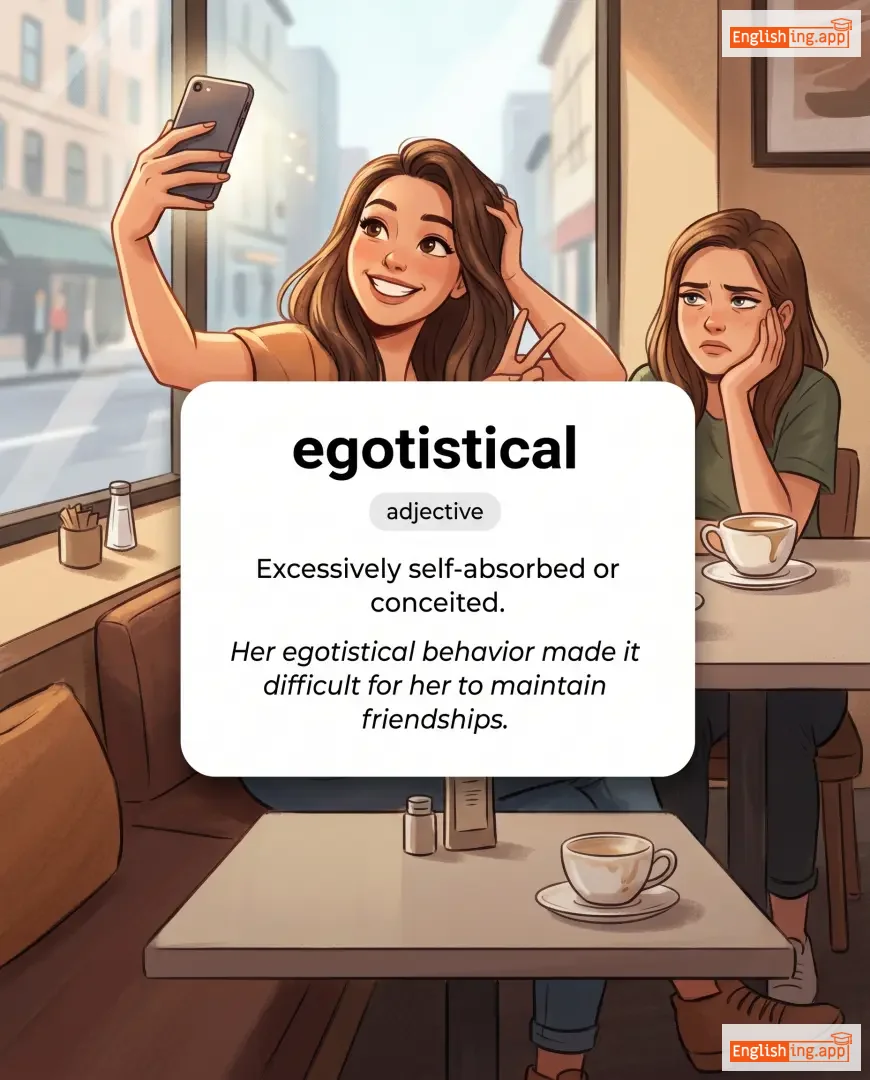
egotistical definition card — visual illustration of the meaning
adjective
/ˌiːɡəˈtɪstɪkəl/
अहंकारी (ahankari)

Excessively self-absorbed or conceited.

"Her egotistical behavior made it difficult for her to maintain friendships."

"उसका अहंकारी व्यवहार उसके लिए दोस्ती बनाए रखना मुश्किल बना देता था।" (Uska ahankari vyavhaar uske liye dosti banaye rakhna mushkil bana deta tha.)
adjective
/ɪˈɡriːdʒəs/
भयंकर (bhayankar)

Outstandingly bad; shocking.

"The company was fined for its egregious safety violations."

"कंपनी को इसके भयंकर सुरक्षा उल्लंघनों के लिए जुर्माना किया गया।" (Kampani ko iske bhayankar suraksha ullanghano ke liye jurmana kiya gaya.)
noun
/ˈiːɡres/
निर्गमन (nirmaman)

The action of going out or leaving a place; an exit.

"The emergency door provided an egress for the trapped workers."

"आपातकालीन द्वार ने फंसे हुए कर्मचारियों के लिए एक निर्गमन प्रदान किया।" (Apatkalin dwaar ne fanse hue karmachariyon ke liye ek nirmaman pradan kiya.)
number
/eɪt/
आठ (aath)

The number equivalent to the product of two and four; one more than seven.

"There are eight apples in the basket."

"टोकरी में आठ सेब हैं।" (Tokri mein aath seb hain.)
adjective
/eɪtθ/
आठवां (aathvã)

coming after the seventh position in a sequence; one of eight equal parts

"She finished in eighth place in the race."

"वह दौड़ में आठवें स्थान पर finish हुई।" (vah daur mein āṭhvein sthān par finish hui.)
determiner/pronoun/conjunction/adverb
/ˈaɪðər/ or /ˈiːðər/
किसी एक (kisi ek)

Used to indicate a choice between two alternatives.

"You can either call me tonight or send me an email."

"आप आज रात मुझे कॉल कर सकते हैं या मुझे एक ईमेल भेज सकते हैं।" (Aap aaj raat mujhe call kar sakte hain ya mujhe ek email bhej sakte hain.)
noun
/ɪˌdʒækjʊˈleɪʃən/
शीघ्र उच्चारण / वीर्यस्राव (sheeghr uchcharan / veeryasraav)

The action of suddenly saying something or the release of semen during sexual climax.

"His sudden ejaculation of joy surprised everyone in the room."

"उसकी अचानक खुशी की उच्छ्वास ने कमरे में सभी को हैरान कर दिया।" (Uski achanak khushi ki uchhwas ne kamre mein sabhi ko hairan kar diya.)
verb
/ɪˈdʒɛkt/
बाहर करना (baahar karna)

to force someone or something out, usually from a place or position

"The referee had to eject the player for unsportsmanlike behavior."

"रेफरी को असंस्कृत व्यवहार के कारण खिलाड़ी को बाहर करना पड़ा।" (Referee ko asanskrit vyavhaar ke kaaran khiladi ko baahar karna pada.)
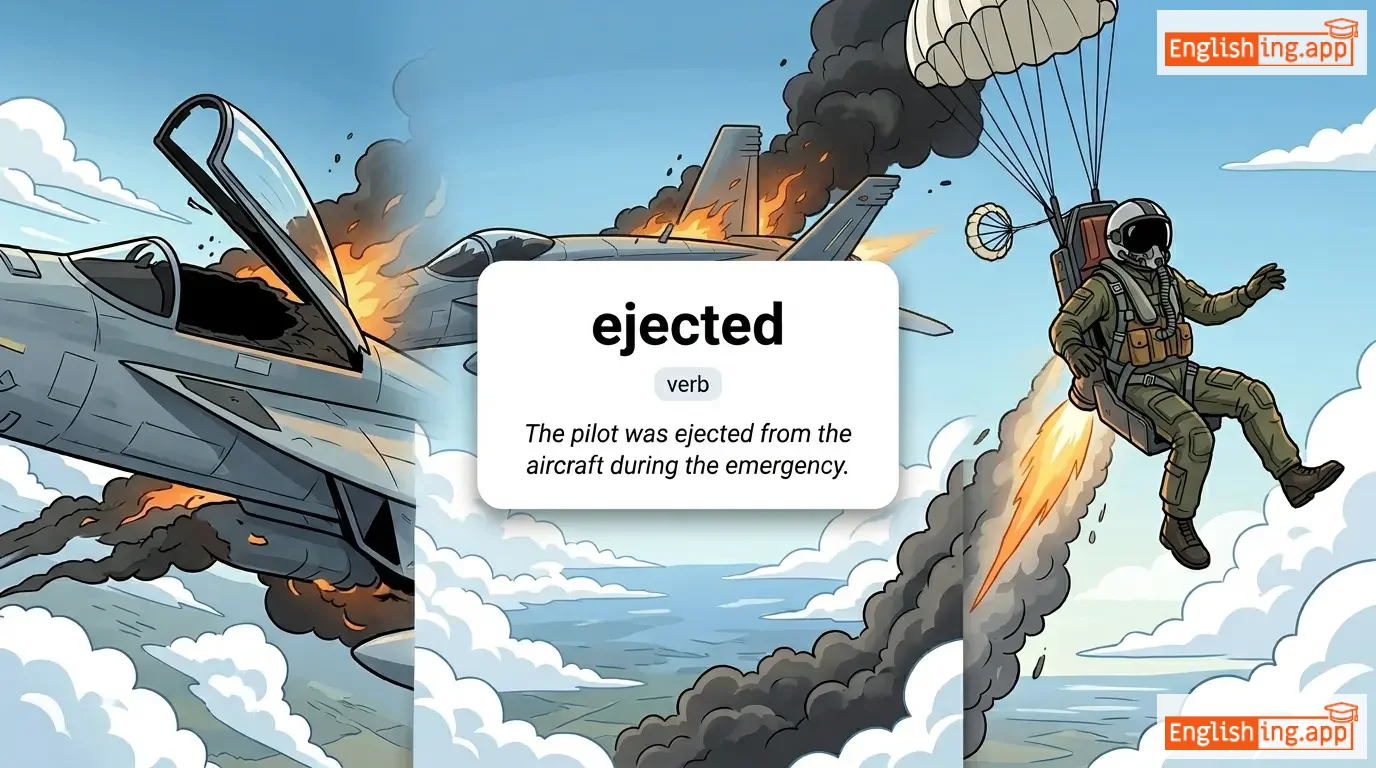
ejected definition card — visual illustration of the meaning
verb
/ɪˈdʒektɪd/
निकालना (nikalna)

to force someone or something to leave a place; to push or throw something out forcefully

"The pilot was ejected from the aircraft during the emergency."

"आपातकाल के दौरान पायलट को विमान से बाहर कर दिया गया था।" (Apaatkal ke dauran pilot ko vimaan se baahar kar diya gaya tha.)
verb
/iːk/
सावधानी से उपयोग करना (savdhani se upyog karna)

to make a small amount of something last longer by using it sparingly

"The family tried to eke out their savings during the tough months."

"परिवार ने कठिन महीनों के दौरान अपनी बचत को सावधानी से उपयोग करने की कोशिश की।" (Parivar ne kathin mahino ke dauran apni bachat ko savdhani se upyog karne ki koshish ki.)
verb, adjective
/ɪˈlæbəreɪt/ (verb), /ɪˈlæbərət/ (adjective)
विस्तृत रूप से समझाना / जटिल रूप से डिज़ाइन किया गया (vistrit roop se samjhana / jatil roop se design kiya gaya)

verb: to explain something in detail; adjective: detailed and complicated in design

"She asked him to elaborate on his proposal."

"उसने उससे अपने प्रस्ताव पर विस्तार से समझाने को कहा।" (Usne usse apne prastaav par vistaar se samjhane ko kaha.)
noun
/ɪˌlæbəˈreɪʃən/
विस्तार / विस्तृत व्याख्या (vistar / vistṛt vyākhyā)

the process of adding more detail or expanding on something

"The teacher appreciated the student's elaboration of the topic."

"टीचर ने छात्र के विषय पर विस्तार से व्याख्या की सराहना की।" (ṭīcar ne chātr ke viṣay par vistār se vyākhyā kī sarāhanā kī.)
verb
/ɪˈlæps/
गुज़रना (guzarna)

to pass or go by, usually referring to time

"Several hours elapsed before he finally returned home."

"कई घंटे बीत गए जब वह आखिरकार घर लौटा।" (Kai ghante beet gaye jab vah aakhirkaar ghar lautaa.)
adjective
/ɪˈlæstɪk/
इलास्टिक (ilastik)

Able to return to its original shape or size after being stretched or compressed.

"The waistband of the pants is made of elastic material."

"पैंट की कमरबंद इलास्टिक सामग्री से बनी है।" (Pant ki kamarband ilastik samagri se bani hai.)
elasticity definition card — visual illustration of the meaning
noun
/ɪˌlæˈstɪsɪti/
लचीलापन (lacheelapan)

The ability of an object or material to resume its normal shape after being stretched or compressed.

"Rubber has a high degree of elasticity."

"रबर में उच्च स्तर का लचीलापन होता है." (rubar mein uchcha star ka lachheelapan hota hai)
verb
/ɪˈleɪt/
खुश करना (khush karna)

To make someone very happy or proud.

"The success of the project elated the whole team."

"प्रोजेक्ट की सफलता ने पूरी टीम को खुश कर दिया।" (Project ki safalta ne poori team ko khush kar diya.)
adjective
/ɪˈleɪtɪd/
बेहद खुश (behad khush)

Extremely happy and excited.

"She was elated when she heard the good news."

"वह खुश थी जब उसे खुशखबरी मिली।" (Wah khush thi jab use khushkhabri mili.)