वोकैबुलरीज

इंग्लिश वोकैबुलरी डिस्कवर, लर्न और मास्टर करें

adjective
/ʌnˈseɪf/
असुरक्षित; खतरनाक; (asurakshit, khatarnak)

involving or causing danger or risk; not protected from harm

"It is unsafe to walk alone in this neighborhood at night."

"रात में इस मोहल्ले में अकेले चलना असुरक्षित है।" (Raat mein is mohalle mein akele chalna asurakshit hai.)
adjective
/ˈvɪtriəs/
काँच जैसा (kaanch jaisa)

having a glass-like appearance or quality

"The mineral has a vitreous shine."

"खनिज में काँच जैसा चमक है।" (Khanij mein kaanch jaisa chamak hai.)
adjective
/ˌʌnrɪˈlaɪəbl/
विश्वसनीय नहीं; जिस पर भरोसा या निर्भर नहीं किया जा सकता (vishwasneey nahin; jis par bharosa ya nirbhar nahin kiya ja sakta)

not dependable; not able to be trusted or relied upon

"The old car is unreliable and breaks down frequently."

"पुराना कार अविश्वसनीय है और अक्सर खराब हो जाता है।" (Purana car avishwasneey hai aur aksar kharab ho jata hai.)
adjective
/ˌʌnrɪˈzɒlvd/
अनसुलझा (ansuljha)

not solved or settled; remaining undecided or unclear

"The dispute remains unresolved despite several meetings."

"कई बैठकों के बावजूद विवाद अनसुलझा रहा।" (kai baithakon ke bawajood vivaad ansuljha raha)
adjective
/ˈvɜːrtʃuəs/
गुणी (guni)

Having or showing high moral standards.

"She is known as a virtuous woman who helps the poor."

"वह एक गुणी महिला के रूप में जानी जाती है जो गरीबों की मदद करती है।" (Wah ek guni mahila ke roop mein jani jati hai jo gareebon ki madad karti hai.)
noun
/ˈvaɪpər/
विषैला सांप (vishaila saap)

a type of poisonous snake; metaphorically, a spiteful or treacherous person

"The viper lay hidden in the tall grass."

"वाइपर ऊंचे घास में छिपा हुआ था।" (Viper unche ghaas mein chhupa hua tha.)
adjective
/ʌnˈriːzənəbəl/
अयुक्तिसंगत (ayuktisangath)

not guided by reason or fairness; excessive or extreme beyond what is acceptable

"The manager made an unreasonable demand that no one could realistically meet."

"मैनेजर ने एक अयुक्तिसंगत माँग रखी जिसे पूरा करना मुश्किल था।" (manager ne ek ayuktisangath maang rakhi jise pura karna mushkil tha)
adjective
/ˈvɪndɪkətɔːri/
न्यायसंगत (nyayasangat)

Serving to justify, clear of blame, or defend.

"His vindicatory remarks restored his reputation."

"उसके न्यायसंगत टिप्पणियाँ ने उसकी प्रतिष्ठा को बहाल किया।" (uske nyayasangat tippaniyon ne uski pratishtha ko bahaal kiya.)
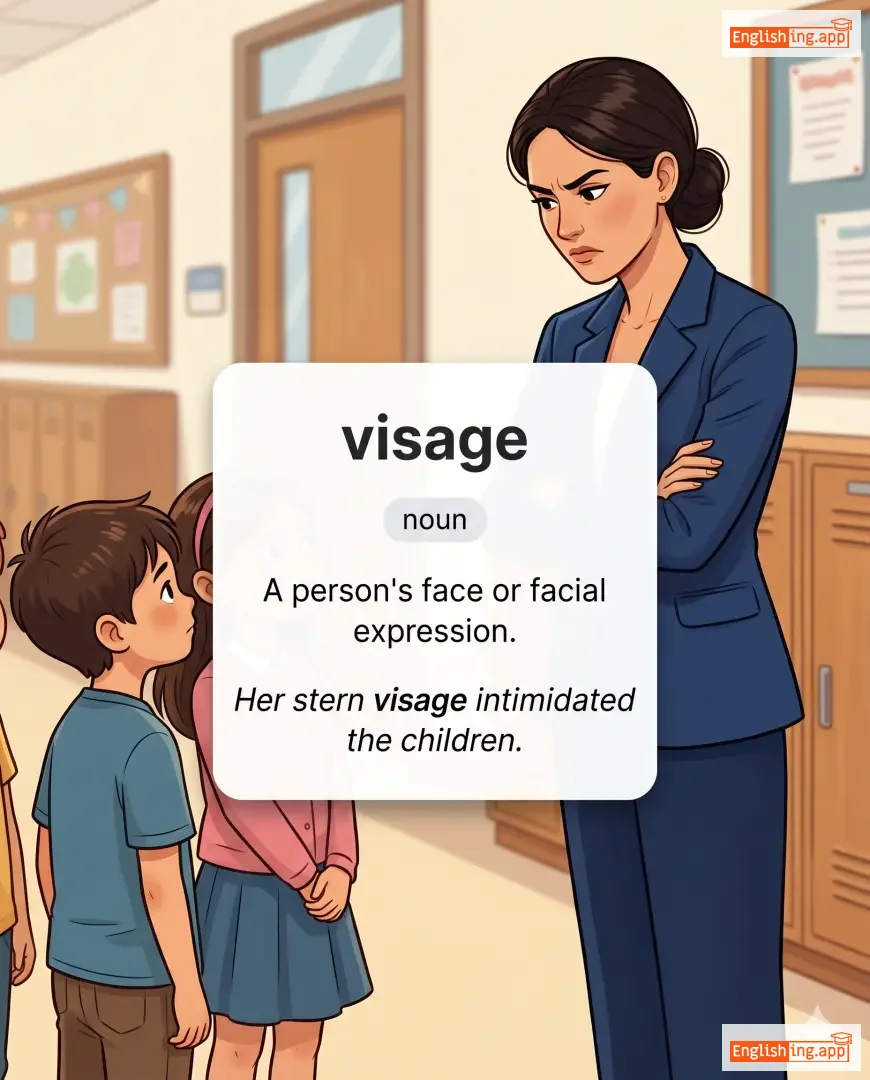
visage definition card — visual illustration of the meaning
noun
/ˈvɪzɪdʒ/
ख़ुशी (khushi)

A person's face or facial expression.

"Her stern visage intimidated the children."

"वह पुरस्कार प्राप्त करते समय अपनी खुशी को छिपा नहीं सकी।" (vah puraskaar praapt karte samay apni khushi ko chhupa nahi sakee.)
adjective
/ˌʌnrɪˈkwaɪtɪd/
अप्रत्युत्तरित (apratyuttarit)

Not returned or reciprocated, especially in the context of love or affection.

"He suffered from unrequited love for years."

"वह वर्षों से प्रत्युत्तरित प्रेम में दुखी था।" (vah varsho se pratyuttarit prem mein dukhi tha.)
adjective
/ʌnˈplɛz.ənt/
अप्रिय (apriya)

not giving or causing pleasure; disagreeable

"The medicine had an unpleasant taste."

"दवाइयों का स्वाद अप्रिय था।" (dawaiyon ka swaad apriya tha)
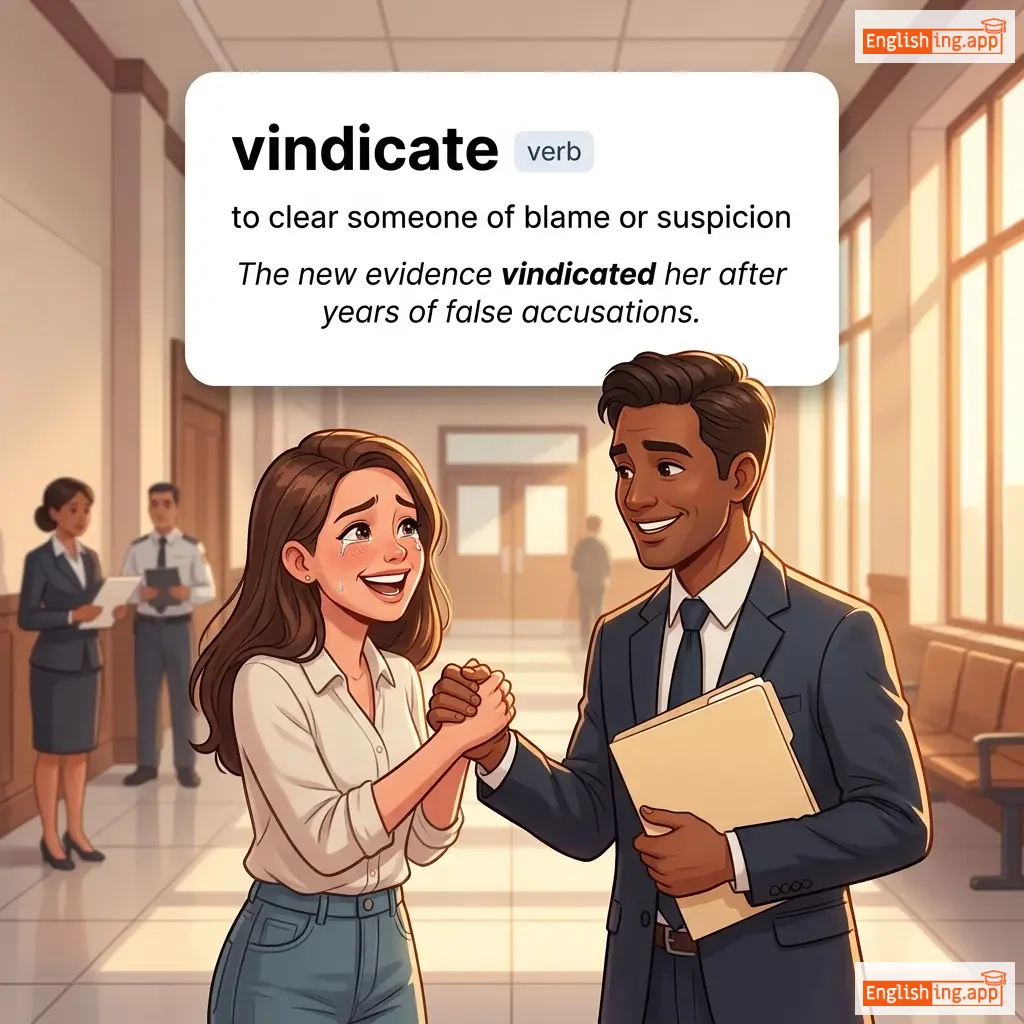
vindicate definition card — visual illustration of the meaning
verb
/ˈvɪndɪkeɪt/
निर्दोष प्रमाणित करना (nirdosh pramanit karna)

to clear someone of blame or suspicion

"The new evidence vindicated her after years of false accusations."

"नए सबूतों ने वर्षों की झूठी आरोपों के बाद उसे निर्दोष प्रमाणित किया।" (Naye sabuton ne varsho ki jhoothi aaropon ke baad use nirdosh pramanit kiya.)
noun
/ˈvaɪəl/
एक प्रकार का प्राचीन तार वाद्ययंत्र (ek prakar ka prachin taar vaadyayantra)

A stringed musical instrument of the Renaissance and Baroque periods, played with a bow and similar to but distinct from the violin family.

"The musician played an old viol in the chamber music concert."

"संगीतकार ने चेंबर म्यूज़िक कॉन्सर्ट में एक पुराना वायल बजाया।" (sangeetkar ne chamber music concert mein ek purana viol bajaya.)
adjective
/ˌʌnpriːpəˈzɛsɪŋ/
आकर्षक नहीं (aakarshak nahin)

not attractive or appealing in appearance

"Despite his unprepossessing looks, he was very kind and intelligent."

"उसकी आकर्षक नहीं दिखने के बावजूद, वह बहुत दयालु और बुद्धिमान था।" (Uski aakarshak nahin dikhne ke bawjood, woh bahut dayaalu aur buddhimaan tha.)
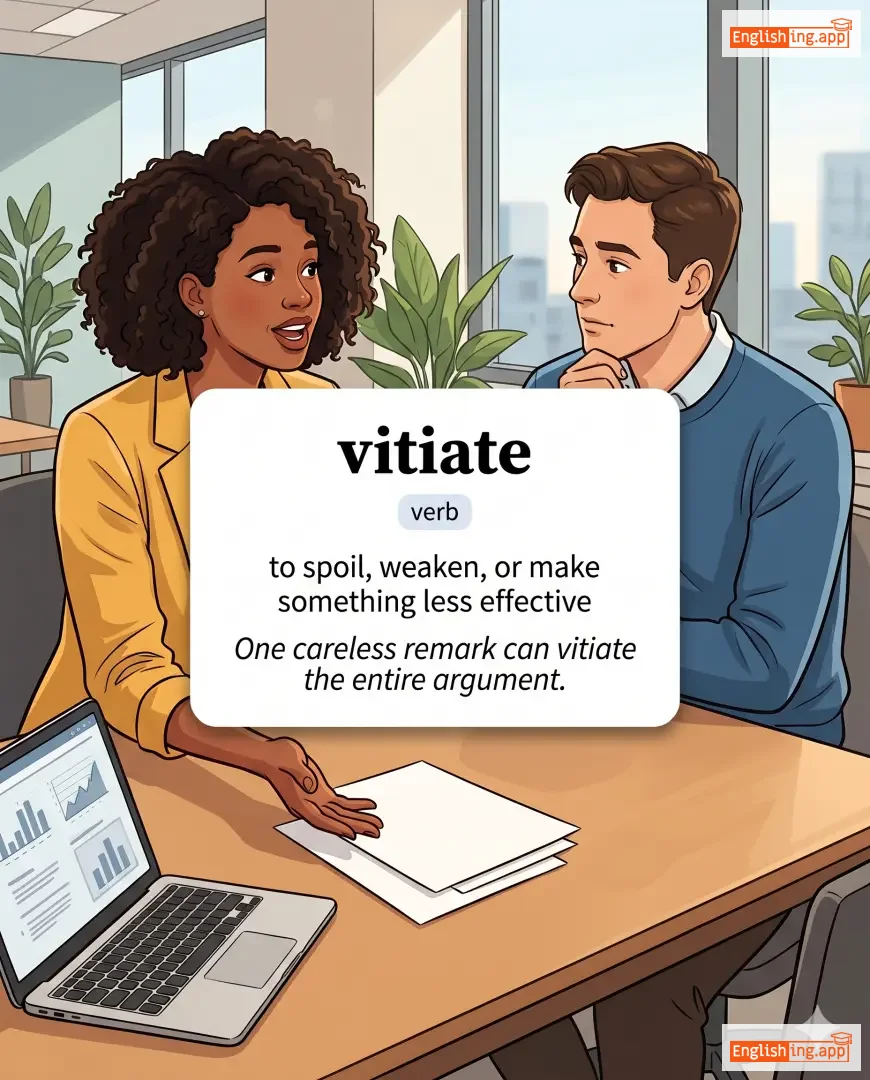
vitiate definition card — visual illustration of the meaning
verb
/ˈvɪʃieɪt/
नष्ट करना (nasht karna)

to spoil, weaken, or make something less effective

"One careless remark can vitiate the entire argument."

"एक असावधान टिप्पणी सम्पूर्ण तर्क को नष्ट कर सकती है।" (Ek asavdhan tipanni sampoorn tark ko nasht kar sakti hai.)
adjective
/ˈvɪʒuəl/
दृश्यात्मक (dṛśyātmaka)

Relating to seeing or sight.

"The movie was praised for its stunning visual effects."

"फिल्म को इसके शानदार दृश्यात्मक प्रभावों के लिए सराहा गया था।" (Film ko iske shandaar dṛśyātmaka prabhāvon ke liye sarāhā gayā thā.)
adverb
/ˈvaɪtəli/
अत्यंत महत्वपूर्ण रूप से (atyant mahatvapurn rup se)

in an extremely important or essential way; in a manner relating to life or vitality

"Access to clean water is vitally important for public health."

"स्वास्थ्य के लिए साफ पानी तक पहुंच अत्यंत महत्वपूर्ण रूप से आवश्यक है।" (swasthya ke liye saaf pani tak pahunch atyant mahatvapurn rup se avashyak hai)
adjective
/ˈvɪʒəneri/
दूरदर्शी (durdarshi)

Thinking about or planning the future with imagination and wisdom.

"She is considered a visionary leader in technology."

"उसे तकनीकी में एक दूरदर्शी नेता माना जाता है।" (use takneeki mein ek durdarshi neta maana jaata hai.)
noun
/ˈvɜːrtʃuː/
गुण (gun)

High moral standards or a good quality considered morally good.

"Patience is considered a great virtue."

"धैर्य को एक महान गुण माना जाता है।" (Dhairya ko ek mahaan gun maana jaata hai.)
noun
/ˈvaɪnəri/
मद्य उत्पादन स्थल (madya utpadan sthal)

A place where vines are cultivated, especially a vineyard or greenhouse for vines.

"The old vinery was filled with grapevines."

"पुरानी वाइनरी अंगूर की लताओं से भरी हुई थी।" (purani winery angur ki lataon se bhari hui thi.)
adjective
/ʌn.rɪˈleɪ.tɪd/
अप्रासंगिक; बिना किसी संबंध के (aprasangik; bina kisi sambandh ke)

having no connection or relationship; not connected by family ties

"The two incidents were completely unrelated to each other."

"दो घटनाएँ एक-दूसरे से पूरी तरह अप्रासंगिक थीं।" (do ghatnayein ek-doosre se puri tarah aprasangik thin.)
noun
/ˈvaɪəˌleɪtər/
उल्लंघनकर्ता (ullanghankarta)

A person who breaks or disregards a law, rule, or agreement.

"The police caught the traffic violator at the intersection."

"पुलिस ने ट्रैफिक उल्लंघनकर्ता को चौराहे पर पकड़ा।" (police ne traffic ullanghankarta ko chaurahe par pakda.)
viscous definition card — visual illustration of the meaning
adjective
/ˈvɪskəs/
गाढ़ा चिपचिपा (gadha chipchipa)

Having a thick, sticky consistency between solid and liquid.

"Honey is a viscous liquid that flows slowly."

"शहद एक चिपचिपा तरल है जो धीरे-धीरे बहता है।" (shahad ek chipchipa taral hai jo dheere-dheere bahta hai.)
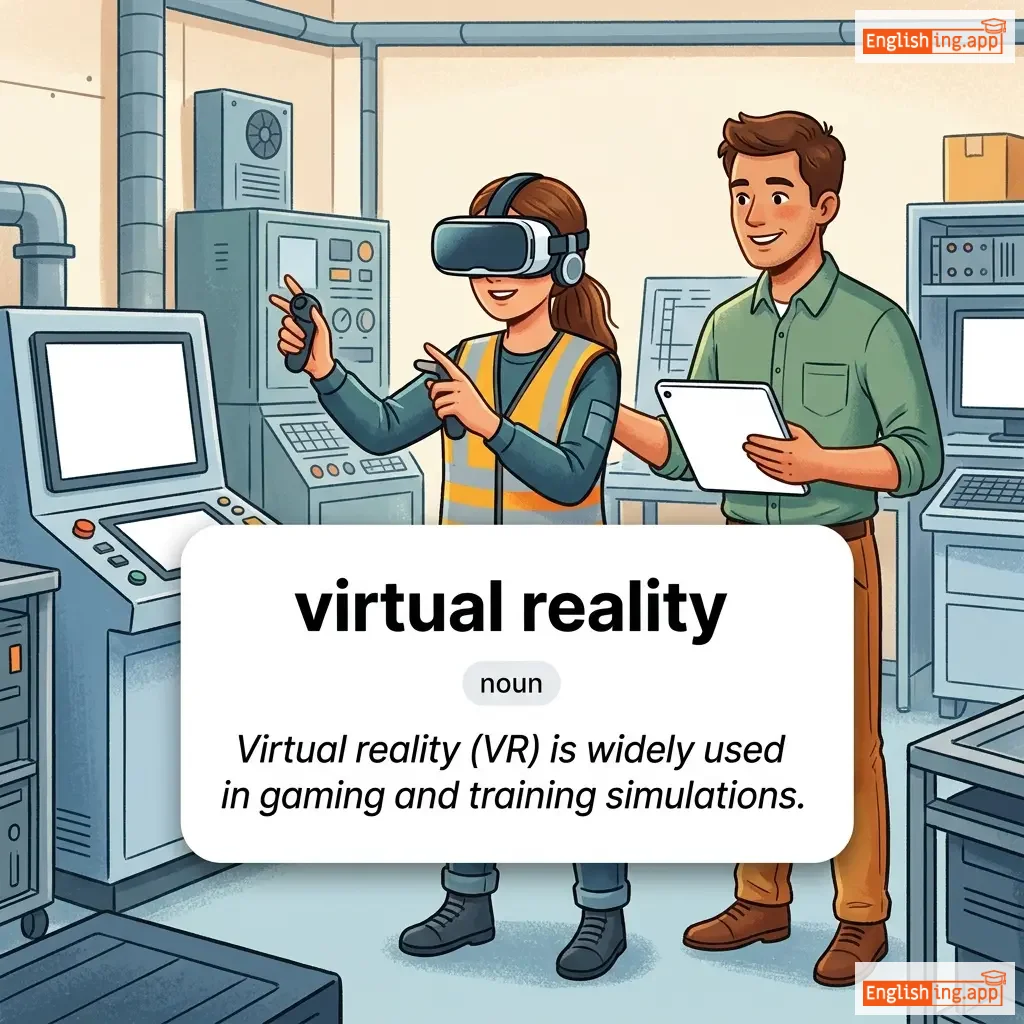
virtual reality definition card — visual illustration of the meaning
noun
/ˈvɜː.tʃu.əl riˈæl.ɪ.ti/
आभासी वास्तविकता (aabhaasee vastavikata)

Computer technology that creates an artificial three-dimensional environment where users can feel like they are in a real environment.

"Virtual reality (VR) is widely used in gaming and training simulations."

"आभासी वास्तविकता (VR) गेमिंग और प्रशिक्षण सिमुलेशनों में व्यापक रूप से उपयोग की जाती है।" (Aabhaasee vastavikata (VR) gaming aur prashikshan simulationon mein vyapak roop se upayog kee jaatee hai.)
adjective
/ˈvɪrəl/
पुरुषोचित (purushocit)

having traditionally masculine qualities, such as strength, energy, and sexual vigor

"The actor was admired for his virile appearance."

"अभिनेता को उसके पुरुषोचित रूप के लिए सराहा गया।" (Abhineta ko uske purushocit roop ke liye saraha gaya.)
adjective
/ʌnˈpɒpjʊlə/
अलोकप्रिय (alokpriya)

not liked or supported by many people

"The decision was unpopular with the public."

"यह निर्णय जनता में अलोकप्रिय था।" (yah nirnay janta mein alokpriya tha)
adjective
/ˈvɜːrtʃuəl/
वर्चुअल / काल्पनिक (varchual / kalpnik)

existing or simulated on a computer or online rather than physically; almost but not exactly the same as

"The company held a virtual meeting with employees worldwide."

"कंपनी ने दुनिया भर के कर्मचारियों के साथ एक वर्चुअल बैठक की।" (Company ne duniya bhar ke karyakartao ke saath ek varchual baithak ki.)
noun
/vɜːrˈtuː/
कला के प्रति रुचि (kala ke prati ruchi)

a love of or taste for fine art, antiques, or curiosities

"The collector’s house was filled with objects of virtu."

"कलेक्टर का घर कला के वस्तुओं से भरा हुआ था।" (Collector ka ghar kala ke vastuon se bhara hua tha.)
adjective
/ˌʌnrɪˈfaɪnd/
अपरिष्कृत (aparishkrit)

not processed or purified; lacking polish or sophistication

"The unrefined oil must be processed before it can be used as fuel."

"अपरिष्कृत तेल को ईंधन के रूप में उपयोग से पहले संसाधित करना पड़ता है।" (aparishkrit tel ko indhan ke roop mein upyog se pahle sansadhit karna padta hai)
noun
/vəˈrɑːɡoʊ/
कर्कश या हठी महिला (karkash ya hathi mahila)

a loud, overbearing woman; historically, a strong or courageous woman

"The play depicted the heroine as a fierce virago who defied tradition."

"नाटक में नायिका को एक साहसी विरागो के रूप में दिखाया गया था जो परंपरा को चुनौती देती थी।" (Natak mein nayika ko ek sahasi virago ke roop mein dikhaya gaya tha jo parampara ko chunauti deti thi.)
noun
/ˈvaɪ.ə.ləns/
हिंसा (hinsa)

behavior involving physical force intended to hurt or damage

"The protest turned into an act of violence."

"प्रदर्शन एक हिंसक कृत्य में बदल गया।" (Pradarshan ek hinsak krity mein badal gaya.)
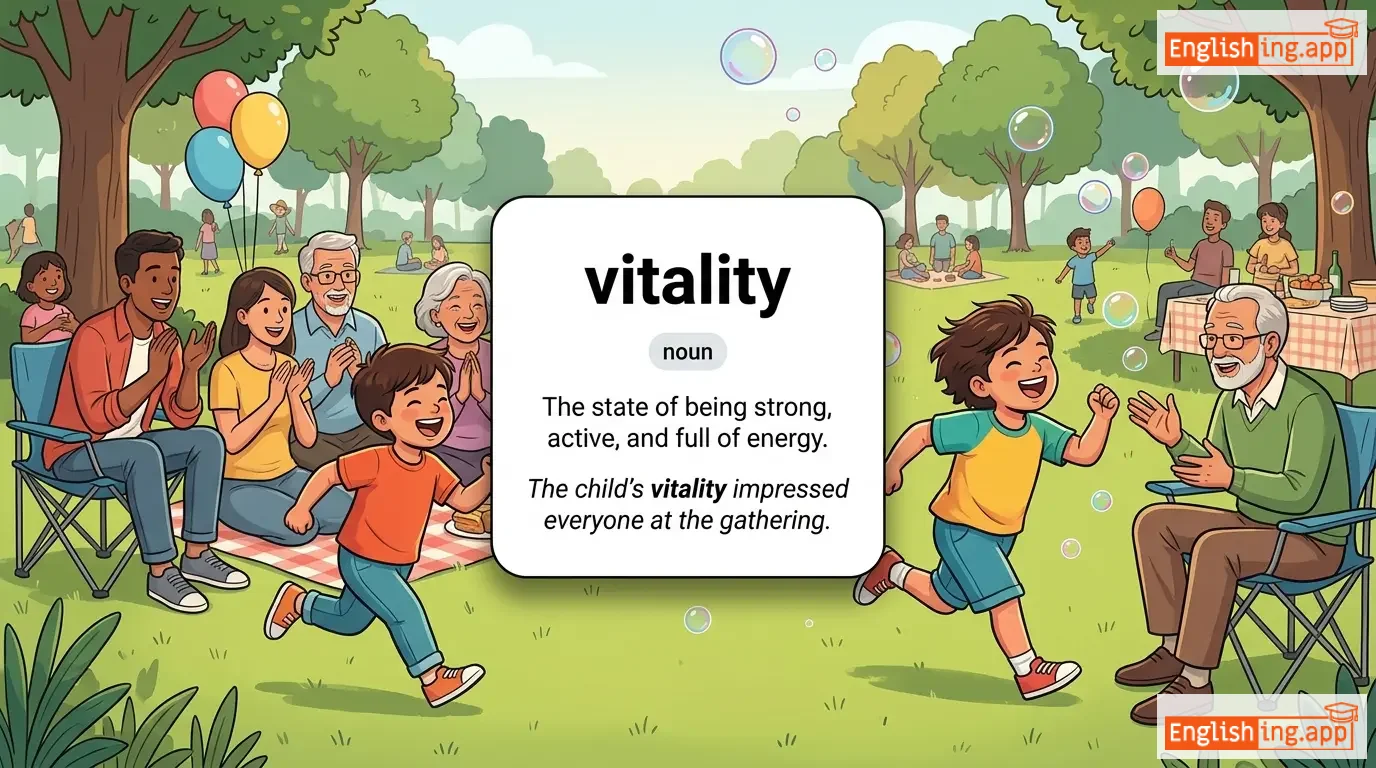
vitality definition card — visual illustration of the meaning
noun
/vaɪˈtæləti/
जीवंतता (jeevantata)

The state of being strong, active, and full of energy.

"The child’s vitality impressed everyone at the gathering."

"बच्चे की जीवंतता ने सभा में सभी को प्रभावित किया।" (bachche ki jeevantata ne sabha mein sabhi ko prabhavit kiya.)
noun
/ˈvɪn.ɪ.ɡər/
सिरका (sirka)

a sour liquid made from fermented alcohol, used for cooking and preserving

"I added vinegar to the salad dressing for extra flavor."

"मैंने सलाद ड्रेसिंग में अतिरिक्त स्वाद के लिए सिरका डाला।" (maine salad dressing mein atirikt swad ke liye sirka dala.)
noun/adjective
/ˈvɪntɪdʒ/
प्राचीन / पुरानी मूल्यवान (prachin / purani mulyavan)

Relating to high quality from the past; classic; also the year of a wine harvest.

"She wore a vintage dress from the 1950s."

"उसने 1950 के दशक का एक विंटेज ड्रेस पहना था।" (usne 1950 ke dashak ka ek vintage dress pehna tha.)
adjective
/ˌʌnprəˈdʌktɪv/
निष्क्रिय (nishkriy)

Not producing or achieving much; not effective or useful.

"The meeting was unproductive and wasted everyone's time."

"बैठक निष्क्रिय थी और इसने सभी का समय बर्बाद किया।" (Baithak nishkriy thi aur isne sabhi ka samay barbaad kiya.)
adjective
/ʌnˈkwaɪ.ət/
बेचैन; चंचल; परेशान (bechain; chanchal; pareshan)

restless; unable to remain still or quiet; anxious or troubled

"She spent an unquiet night worrying about the exam results."

"उसने परीक्षा के परिणामों को लेकर एक बेचैन रात बिताई।" (usne pareeksha ke parinaamon ko lekar ek bechain raat bitayi.)
noun
/viˈoʊlə/ or /ˈvaɪələ/
वायोला (viola)

A stringed instrument slightly larger than a violin, with a deeper and mellower tone.

"She chose to play the viola in the school orchestra."

"उसने स्कूल ऑर्केस्ट्रा में वायोला बजाने का चयन किया।" (usne school orchestra mein viola bajane ka chayan kiya.)
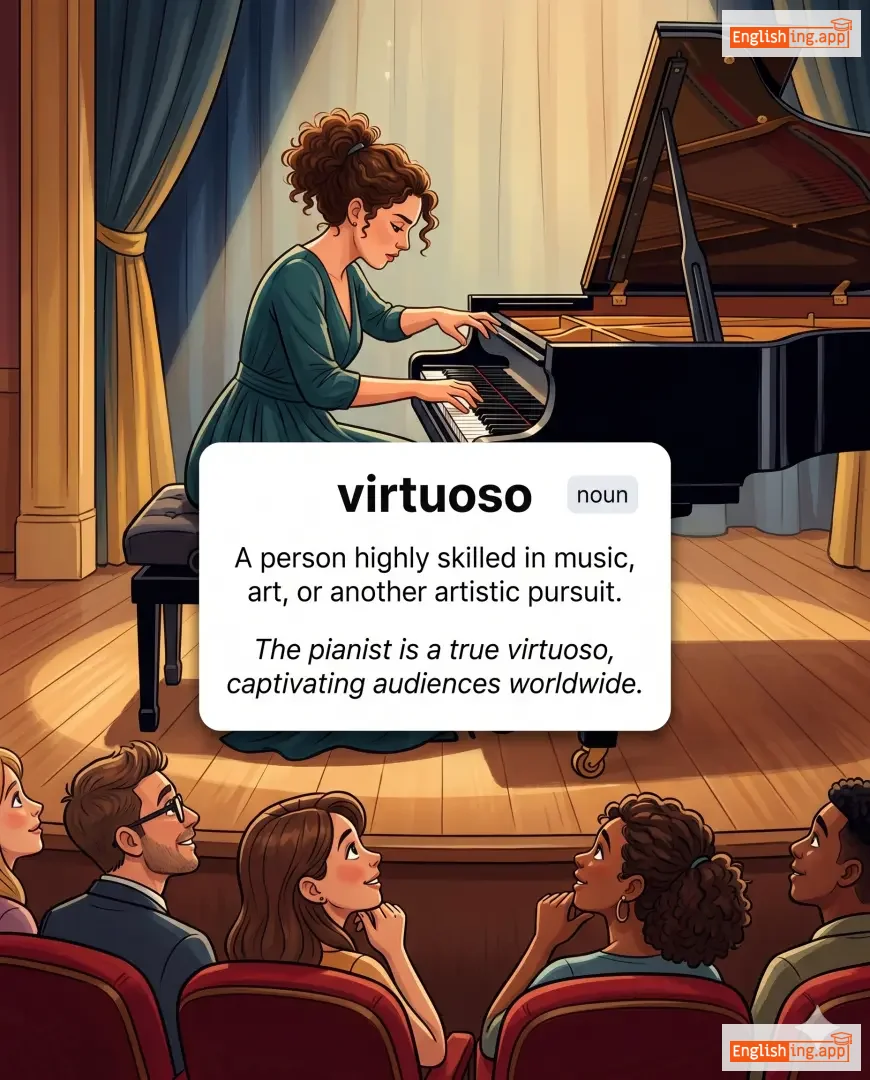
virtuoso definition card — visual illustration of the meaning
noun
/ˌvɜːrtʃuˈoʊsoʊ/
विशेषज्ञ कलाकार (visheshagya kalakar)

A person highly skilled in music, art, or another artistic pursuit.

"The pianist is a true virtuoso, captivating audiences worldwide."

"पियानोवादक एक सच्चे विशेषज्ञ कलाकार हैं, जो दुनिया भर के दर्शकों को मंत्रमुग्ध करते हैं।" (Piyanovadak ek sachche visheshagya kalakar hain, jo duniya bhar ke darshako ko mantramugdh karte hain.)
adjective
/ˈvɪndɪkeɪtɪv/
न्यायप्रमाणात्मक (nyaypramanatmak)

showing a tendency to vindicate or justify; inclined to defend

"Her vindicative tone showed that she strongly believed in her innocence."

"उसकी विंडिकेटिव ध्वनि ने दिखाया कि वह अपनी निर्दोषता में पूरी तरह विश्वास करती थी।" (Uski vindicative dhvani ne dikhaya ki vah apni nirdoshata mein puri tarah vishwas karti thi.)
noun
/ˈvaɪkaʊnt/
वाइस्काउंट (vaiskaunt)

A British nobleman ranking below an earl and above a baron.

"The viscount inherited the estate from his father."

"वाइस्काउंट ने अपने पिता से संपत्ति विरासत में प्राप्त की।" (Vaiskaunt ne apne pita se sampatti virasat mein prapt ki.)
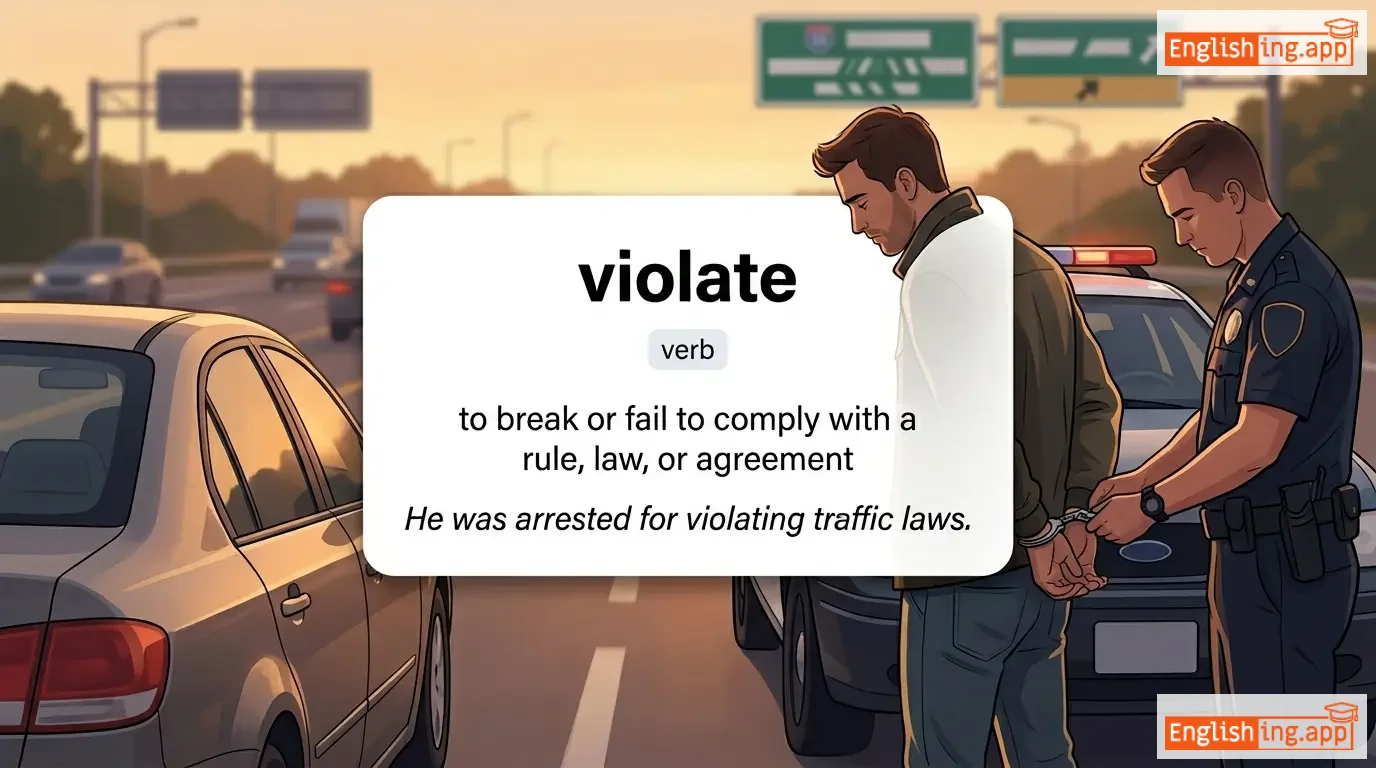
violate definition card — visual illustration of the meaning
verb
/ˈvaɪ.ə.leɪt/
उल्लंघन करना (ullanghan karna)

to break or fail to comply with a rule, law, or agreement

"He was arrested for violating traffic laws."

"उसे ट्रैफिक कानून उल्लंघन करने पर गिरफ्तार किया गया था।" (Use traffic kanoon ullanghan karne par giraftaar kiya gaya tha.)
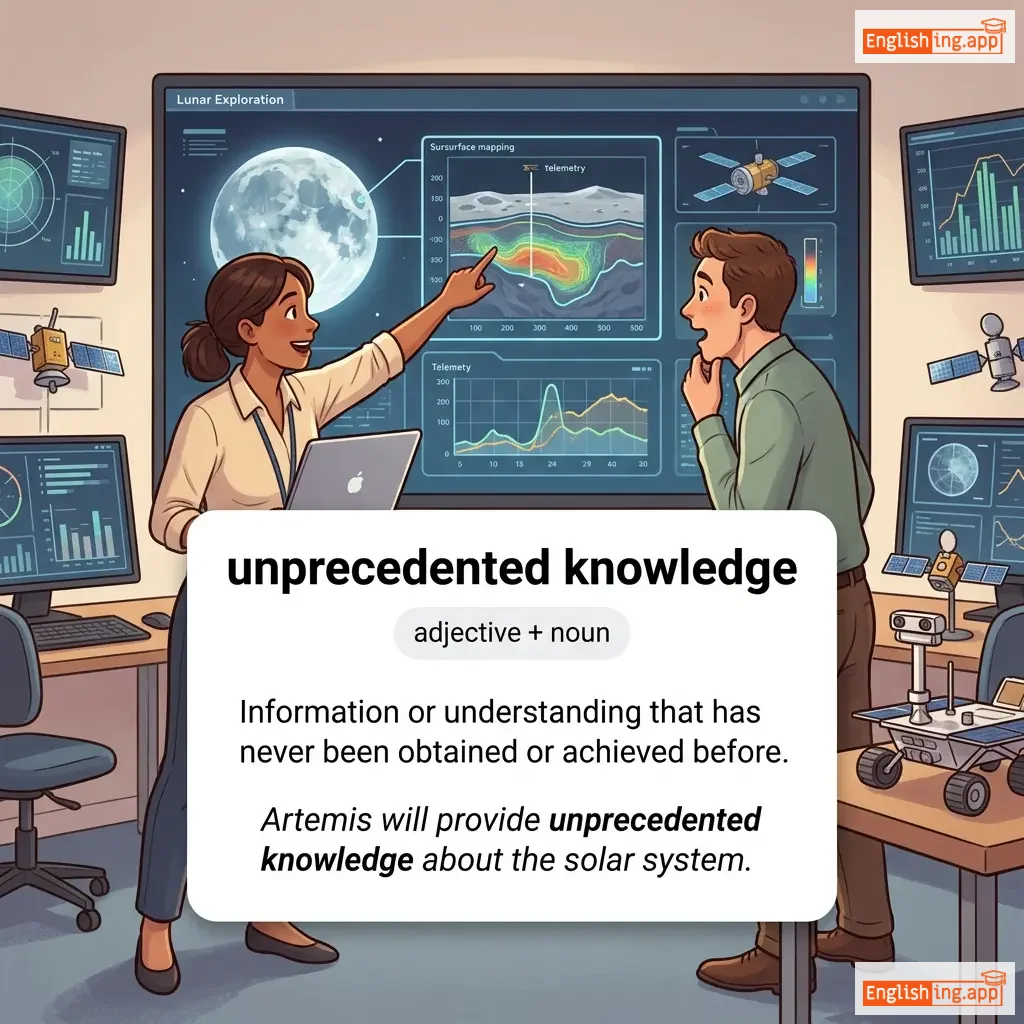
unprecedented knowledge definition card — visual illustration of the meaning
adjective + noun
ʌnˈpresɪdentɪd ˈnɒlɪdʒ
अभूतपूर्व ज्ञान (abhootpoorv gyaan)

Information or understanding that has never been obtained or achieved before.

"Artemis will provide unprecedented knowledge about the solar system."

"आर्टेमिस सौरमंडल के बारे में अभूतपूर्व ज्ञान प्रदान करेगा।" (Artemis saurmandal ke baare mein abhootpoorv gyaan pradan karega.)
adjective
/ʌnˈprɒf.ɪ.tə.bl̩/
नुकसानदेह (nuksandeh)

not yielding profit or gain; not producing financial benefit

"The unprofitable business was forced to close down after three years."

"नुकसानदेह व्यापार को तीन साल बाद बंद होने के लिए मजबूर किया गया था।" (nuksandeh vyapar ko teen saal baad band hone ke liye majboor kiya gaya tha.)
noun
/ˈvɪtrioʊl/
कठोर आलोचना (kathor alochna)

harsh and bitter criticism

"The politician faced vitriol from the public."

"राजनीतिक नेता को जनता से कठोर आलोचना का सामना करना पड़ा।" (Rajnitiik neta ko janta se kathor alochna ka samna karna pada.)
noun
/ˌviːələnsɛloʊ/
चेलो (chelo)

The full name of the cello, a large string instrument played with a bow and held between the knees.

"He practiced the violoncello for hours each day."

"उसने हर दिन घंटों तक वायोलोंचेलो का अभ्यास किया।" (usne har din ghanton tak violoncello ka abhyas kiya.)
noun
/ˌʌnriˈælɪti/
अवास्तविकता (avastavikta)

the state or quality of being unreal; lack of reality or truth

"The dreamlike setting gave the story a sense of unreality."

"सपनों जैसे माहौल ने कहानी को अवास्तविकता का एहसास दिया।" (sapnon jaise mahaul ne kahani ko avastavikta ka ehsaas diya)
visiting definition card — visual illustration of the meaning
verb
/ˈvɪzɪtɪŋ/
दौरा करना (daura karna)

Going to see and spend time with someone or at a place.

"The group is visiting islands during the expedition."

"समूह अभियान के दौरान द्वीपों का दौरा कर रहा है।" (Samuh abhiyan ke dauran dweepo ka daura kar raha hai.)
noun
/ˈvɪzɪtər/
यात्री (yatri)

a person who goes to see a place or someone for a short time

"The museum had many visitors last weekend."

"म्यूज़ियम में पिछले सप्ताहांत में कई यात्री आए थे।" (Myujiyam mein pichhle saptahant mein kai yatri aaye the.)
adjective
/ˈvɪzəbl/
दृश्यमान (drishyamaan)

able to be seen; perceptible by the eye

"The stars were clearly visible in the night sky."

"तारें रात के आकाश में स्पष्ट रूप से दृश्यमान थीं।" (Tare raat ke aakaash mein spashṭ roop se drishyamaan thiin.)
adverb
/ˈvɜː.tʃu.ə.li/
लगभग, ऑनलाइन (lagbhag, online)

almost or nearly, but not completely; by means of computer technology

"The meeting was held virtually due to travel restrictions."

"यात्रा प्रतिबंधों के कारण बैठक वर्चुअली आयोजित की गई थी।" (Yatra pratibandhon ke karan baithak virtually aayojit ki gayi thi.)