Vocabularios

Descubra, aprenda y domine el vocabulario en inglés

adjective
/ʌnˈseɪf/
inseguro; peligroso; (inseguro, peligroso)

involving or causing danger or risk; not protected from harm

"It is unsafe to walk alone in this neighborhood at night."

"Es inseguro caminar solo en este vecindario por la noche." (Es inseguro caminar solo en este vecindario por la noche.)
adjective
/ˈvɪtriəs/
vítreo (vitreo)

having a glass-like appearance or quality

"The mineral has a vitreous shine."

"El mineral tiene un brillo vítreo." (El mineral tiene un brillo vitreo.)
adjective
/ˌʌnrɪˈlaɪəbl/
no confiable; no se puede confiar ni depender de él (no confiable; no se puede confiar ni depender de él)

not dependable; not able to be trusted or relied upon

"The old car is unreliable and breaks down frequently."

"El coche viejo no es confiable y se descompone con frecuencia." (El coche viejo no es confiable y se descompone con frecuencia.)
adjective
/ˌʌnrɪˈzɒlvd/
no resuelto (no resuelto)

not solved or settled; remaining undecided or unclear

"The dispute remains unresolved despite several meetings."

"La disputa sigue sin resolverse a pesar de varias reuniones." (la disputa sigue sin resolverse a pesar de varias reuniones)
adjective
/ˈvɜːrtʃuəs/
virtuoso (virtuoso)

Having or showing high moral standards.

"She is known as a virtuous woman who helps the poor."

"Ella es conocida como una mujer virtuosa que ayuda a los pobres." (Ella es conocida como una mujer virtuosa que ayuda a los pobres.)
noun
/ˈvaɪpər/
víbora venenosa (vibora venenosa)

a type of poisonous snake; metaphorically, a spiteful or treacherous person

"The viper lay hidden in the tall grass."

"La víbora estaba escondida en la hierba alta." (La vibora estaba escondida en la hierba alta.)
adjective
/ʌnˈriːzənəbəl/
irrazonable (irrazonable)

not guided by reason or fairness; excessive or extreme beyond what is acceptable

"The manager made an unreasonable demand that no one could realistically meet."

"El gerente hizo una exigencia irrazonable." (el gerente hizo una exigencia irrazonable)
adjective
/ˈvɪndɪkətɔːri/
vindicativo (vindicativo)

Serving to justify, clear of blame, or defend.

"His vindicatory remarks restored his reputation."

"Sus comentarios vindicatorios restauraron su reputación." (Sus comentarios vindicatorios restauraron su reputación.)
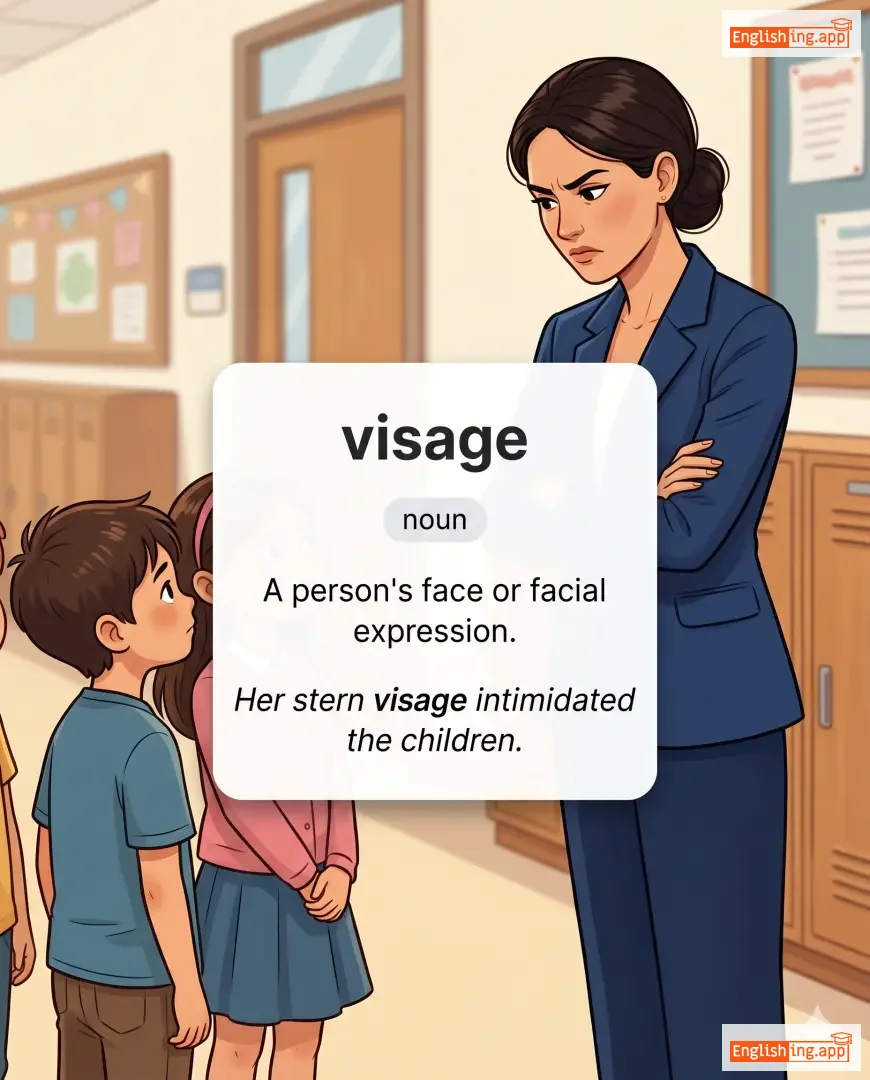
visage definition card — visual illustration of the meaning
noun
/ˈvɪzɪdʒ/
felicidad (felicidad)

A person's face or facial expression.

"Her stern visage intimidated the children."

"Ella no pudo ocultar su felicidad cuando recibió el premio." (Ella no pudo ocultar su felicidad cuando recibió el premio.)
adjective
/ˌʌnrɪˈkwaɪtɪd/
no correspondido (no correspondido)

Not returned or reciprocated, especially in the context of love or affection.

"He suffered from unrequited love for years."

"Él sufrió de amor no correspondido durante años." (Él sufrió de amor no correspondido durante años.)
adjective
/ʌnˈplɛz.ənt/
desagradable (desagradable)

not giving or causing pleasure; disagreeable

"The medicine had an unpleasant taste."

"El medicamento tenía un sabor desagradable." (El medicamento tenía un sabor desagradable)
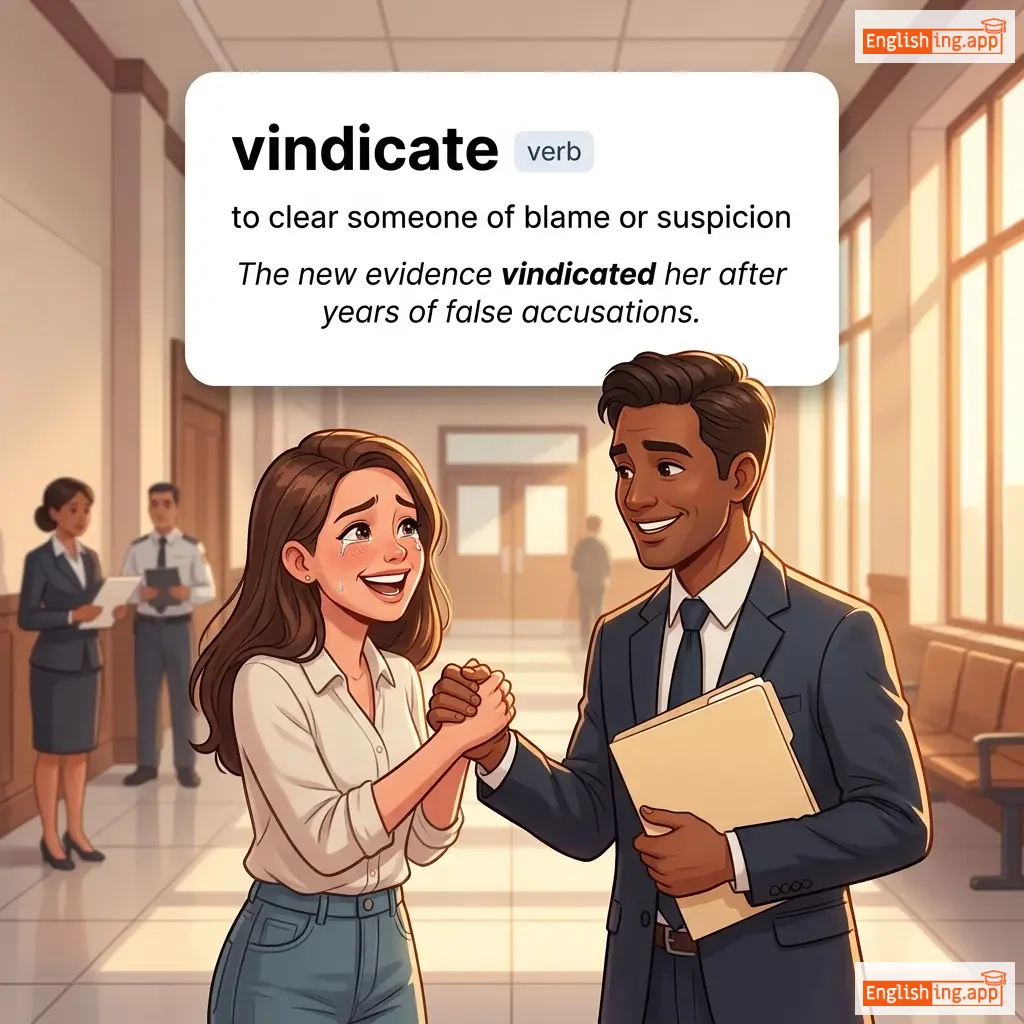
vindicate definition card — visual illustration of the meaning
verb
/ˈvɪndɪkeɪt/
vindicar (vindicar)

to clear someone of blame or suspicion

"The new evidence vindicated her after years of false accusations."

"Las nuevas pruebas la vindicaron después de años de falsas acusaciones." (Las nuevas pruebas la vindicaron despues de anos de falsas acusaciones.)
noun
/ˈvaɪəl/
un tipo de instrumento de cuerdas antiguo (un tipo de instrumento de cuerdas antiguo)

A stringed musical instrument of the Renaissance and Baroque periods, played with a bow and similar to but distinct from the violin family.

"The musician played an old viol in the chamber music concert."

"El músico tocó un viejo váil en el concierto de música de cámara." (El músico tocó un viejo váil en el concierto de música de cámara.)
adjective
/ˌʌnpriːpəˈzɛsɪŋ/
poco atractivo (poco atractivo)

not attractive or appealing in appearance

"Despite his unprepossessing looks, he was very kind and intelligent."

"A pesar de sus poco atractivos rasgos, era muy amable e inteligente." (A pesar de sus poco atractivos rasgos, era muy amable e inteligente.)
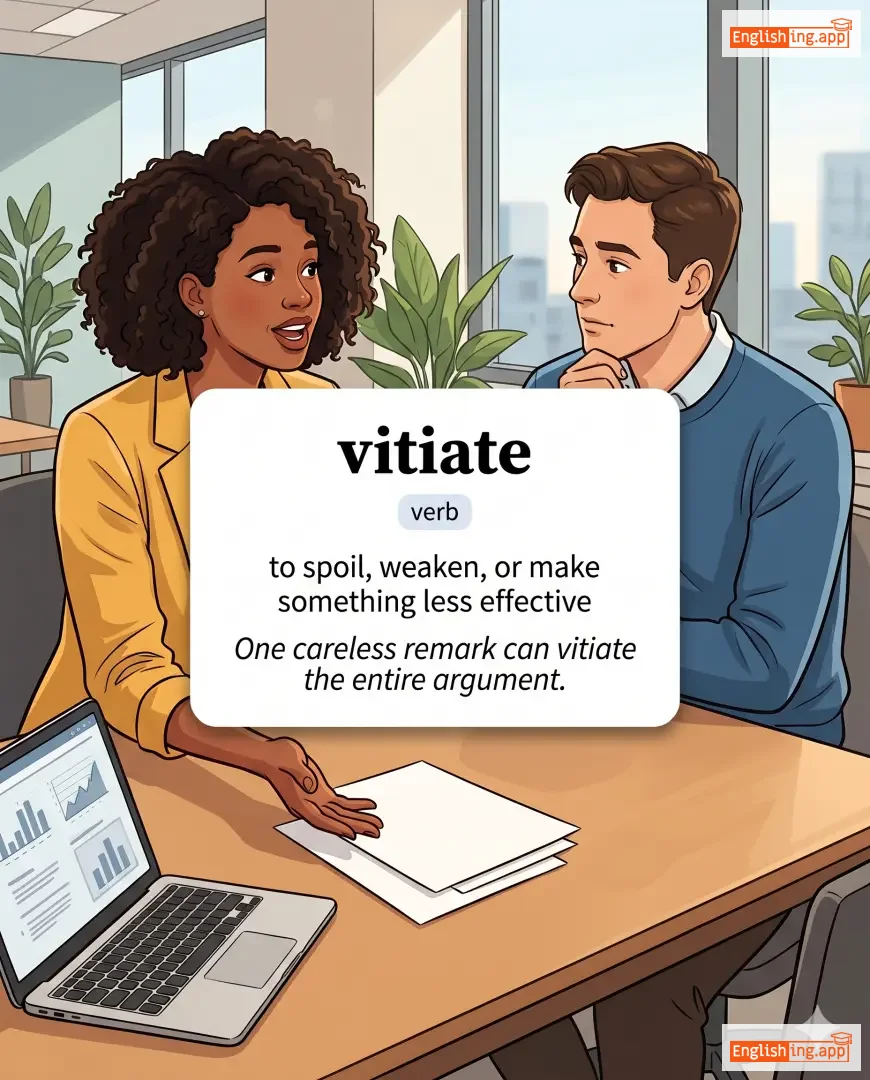
vitiate definition card — visual illustration of the meaning
verb
/ˈvɪʃieɪt/
viciar (viciar)

to spoil, weaken, or make something less effective

"One careless remark can vitiate the entire argument."

"Un comentario imprudente puede viciar todo el argumento." (Un comentario imprudente puede viciar todo el argumento.)
adjective
/ˈvɪʒuəl/
visual (visual)

Relating to seeing or sight.

"The movie was praised for its stunning visual effects."

"La película fue elogiada por sus impresionantes efectos visuales." (La película fue elogiada por sus impresionantes efectos visuales.)
adverb
/ˈvaɪtəli/
vitalmente (vitalmente)

in an extremely important or essential way; in a manner relating to life or vitality

"Access to clean water is vitally important for public health."

"El acceso al agua limpia es vitalmente importante para la salud pública." (El acceso al agua limpia es vitalmente importante para la salud publica)
adjective
/ˈvɪʒəneri/
visionario (visionario)

Thinking about or planning the future with imagination and wisdom.

"She is considered a visionary leader in technology."

"Se le considera un líder visionario en tecnología." (Se le considera un lider visionario en tecnologia.)
noun
/ˈvɜːrtʃuː/
virtud (virtud)

High moral standards or a good quality considered morally good.

"Patience is considered a great virtue."

"La paciencia es considerada una gran virtud." (La paciencia es considerada una gran virtud.)
noun
/ˈvaɪnəri/
bodega de vino (bodega de vino)

A place where vines are cultivated, especially a vineyard or greenhouse for vines.

"The old vinery was filled with grapevines."

"La vieja bodega de vino estaba llena de vides." (La vieja bodega de vino estaba llena de vides.)
adjective
/ʌn.rɪˈleɪ.tɪd/
irrelevante; no relacionado (irrelevante; no relacionado)

having no connection or relationship; not connected by family ties

"The two incidents were completely unrelated to each other."

"Los dos incidentes estaban completamente no relacionados entre sí." (Los dos incidentes estaban completamente no relacionados entre sí.)
noun
/ˈvaɪəˌleɪtər/
infractor (infractor)

A person who breaks or disregards a law, rule, or agreement.

"The police caught the traffic violator at the intersection."

"La policía atrapó al infractor de tráfico en la intersección." (La policía atrapó al infractor de tráfico en la intersección.)
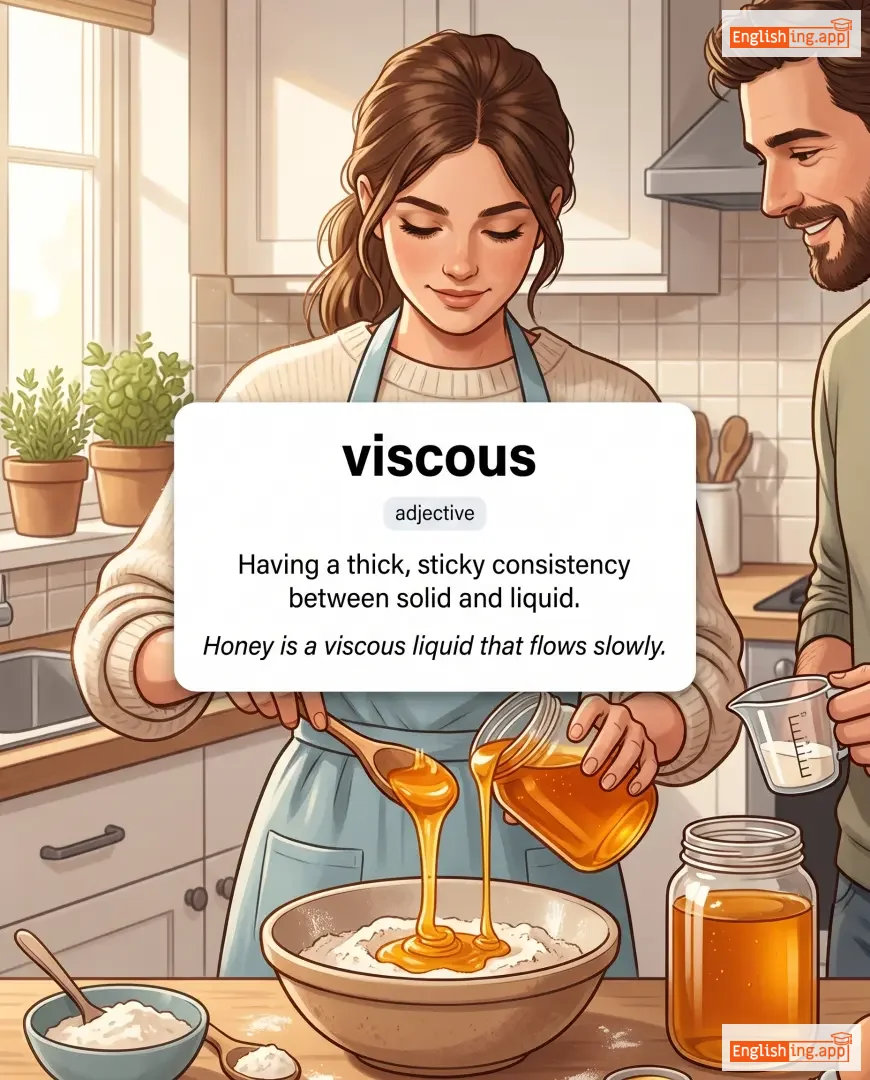
viscous definition card — visual illustration of the meaning
adjective
/ˈvɪskəs/
viscoso (viscoso)

Having a thick, sticky consistency between solid and liquid.

"Honey is a viscous liquid that flows slowly."

"La miel es un líquido viscoso que fluye lentamente." (La miel es un liquido viscoso que fluye lentamente.)
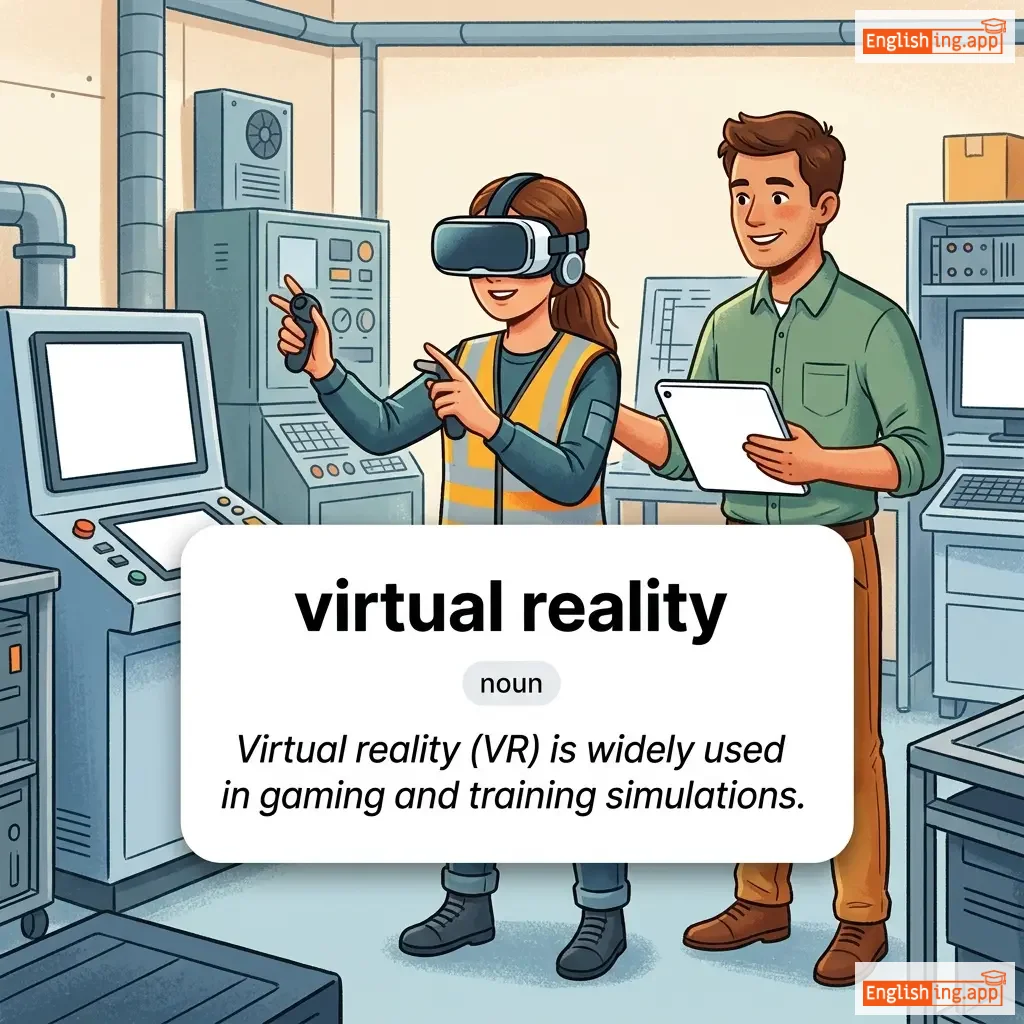
virtual reality definition card — visual illustration of the meaning
noun
/ˈvɜː.tʃu.əl riˈæl.ɪ.ti/
realidad virtual (realidad virtual)

Computer technology that creates an artificial three-dimensional environment where users can feel like they are in a real environment.

"Virtual reality (VR) is widely used in gaming and training simulations."

"La realidad virtual (VR) se usa ampliamente en juegos y simulaciones de entrenamiento." (La realidad virtual (VR) se usa ampliamente en juegos y simulaciones de entrenamiento.)
adjective
/ˈvɪrəl/
viril (viril)

having traditionally masculine qualities, such as strength, energy, and sexual vigor

"The actor was admired for his virile appearance."

"El actor fue admirado por su apariencia viril." (El actor fue admirado por su apariencia viril.)
adjective
/ʌnˈpɒpjʊlə/
impopular (impopular)

not liked or supported by many people

"The decision was unpopular with the public."

"La decisión fue impopular entre el público." (la decision fue impopular entre el publico)
adjective
/ˈvɜːrtʃuəl/
virtual / simulado (virtual / simulado)

existing or simulated on a computer or online rather than physically; almost but not exactly the same as

"The company held a virtual meeting with employees worldwide."

"La empresa realizó una reunión virtual con empleados de todo el mundo." (La empresa realizó una reunión virtual con empleados de todo el mundo.)
noun
/vɜːrˈtuː/
gusto por el arte (gusto por el arte)

a love of or taste for fine art, antiques, or curiosities

"The collector’s house was filled with objects of virtu."

"La casa del coleccionista estaba llena de objetos de virtu." (La casa del coleccionista estaba llena de objetos de virtu.)
adjective
/ˌʌnrɪˈfaɪnd/
sin refinar (sin refinar)

not processed or purified; lacking polish or sophistication

"The unrefined oil must be processed before it can be used as fuel."

"El aceite sin refinar debe procesarse antes de usarse como combustible." (el aceite sin refinar debe procesarse antes de usarse como combustible)
👩‍🎤

virago (virágo)

noun
/vəˈrɑːɡoʊ/
mujer autoritaria o ruda (mujer autoritaria o ruda)

a loud, overbearing woman; historically, a strong or courageous woman

"The play depicted the heroine as a fierce virago who defied tradition."

"La obra retrató a la heroína como una virago feroz que desafiaba la tradición." (La obra retrató a la heroína como una virago feroz que desafiaba la tradición.)
noun
/ˈvaɪ.ə.ləns/
violencia (violencia)

behavior involving physical force intended to hurt or damage

"The protest turned into an act of violence."

"La protesta se convirtió en un acto de violencia." (La protesta se convirtio en un acto de violencia.)
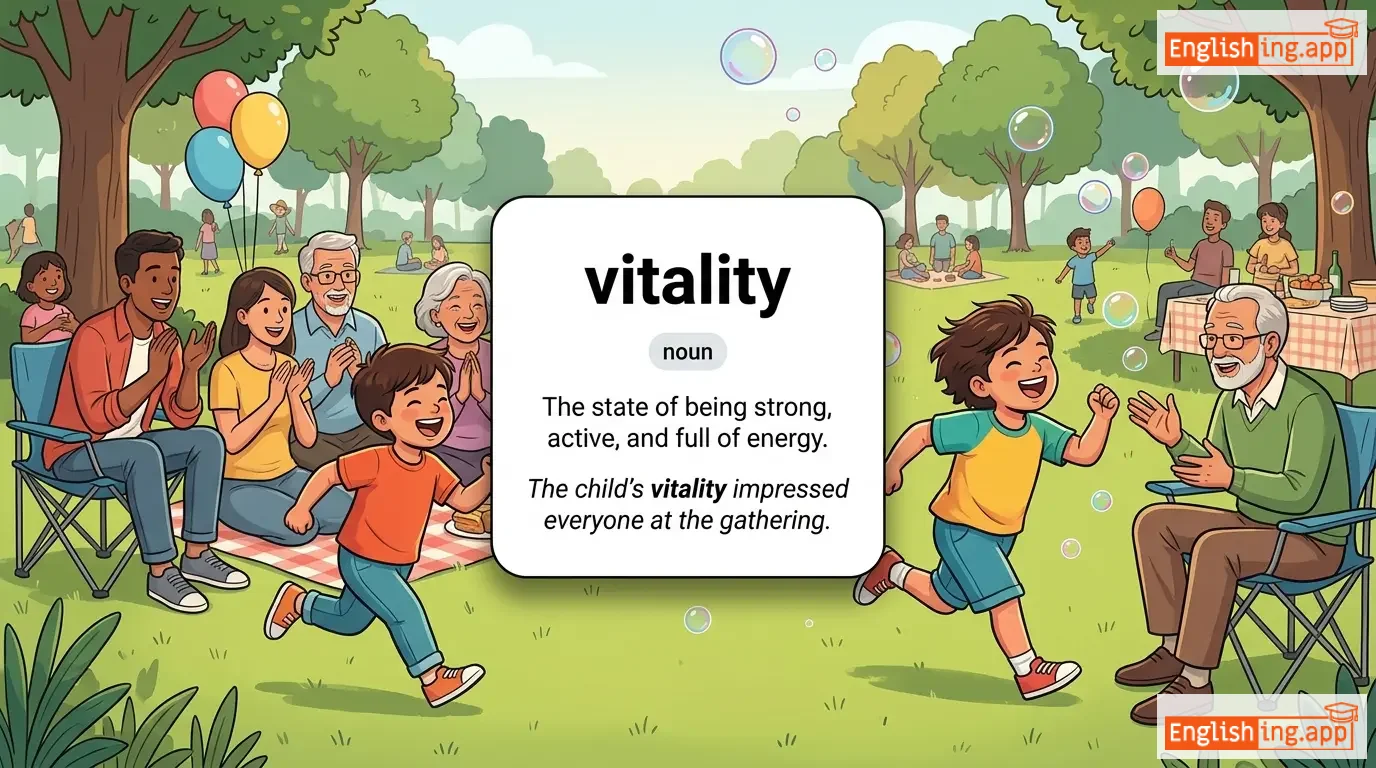
vitality definition card — visual illustration of the meaning
noun
/vaɪˈtæləti/
vitalidad (vitalidad)

The state of being strong, active, and full of energy.

"The child’s vitality impressed everyone at the gathering."

"La vitalidad del niño impresionó a todos en la reunión." (La vitalidad del niño impresionó a todos en la reunión.)
noun
/ˈvɪn.ɪ.ɡər/
vinagre (vinagre)

a sour liquid made from fermented alcohol, used for cooking and preserving

"I added vinegar to the salad dressing for extra flavor."

"Añadí vinagre a la salsa de ensalada para más sabor." (Añadí vinagre a la salsa de ensalada para más sabor.)
noun/adjective
/ˈvɪntɪdʒ/
vintage / clásico (vintage / clasico)

Relating to high quality from the past; classic; also the year of a wine harvest.

"She wore a vintage dress from the 1950s."

"Ella llevaba un vestido vintage de los años 50." (Ella llevaba un vestido vintage de los anos 50.)
adjective
/ˌʌnprəˈdʌktɪv/
improductivo (improductivo)

Not producing or achieving much; not effective or useful.

"The meeting was unproductive and wasted everyone's time."

"La reunión fue improductiva y desperdició el tiempo de todos." (La reunion fue improductiva y desperdicio el tiempo de todos.)
adjective
/ʌnˈkwaɪ.ət/
inquieto; ansioso; perturbado (inquieto; ansioso; perturbado)

restless; unable to remain still or quiet; anxious or troubled

"She spent an unquiet night worrying about the exam results."

"Pasó una noche inquieta preocupada por los resultados del examen." (Paso una noche inquieta preocupada por los resultados del examen.)
noun
/viˈoʊlə/ or /ˈvaɪələ/
viola (viola)

A stringed instrument slightly larger than a violin, with a deeper and mellower tone.

"She chose to play the viola in the school orchestra."

"Ella eligió tocar la viola en la orquesta escolar." (Ella eligió tocar la viola en la orquesta escolar.)
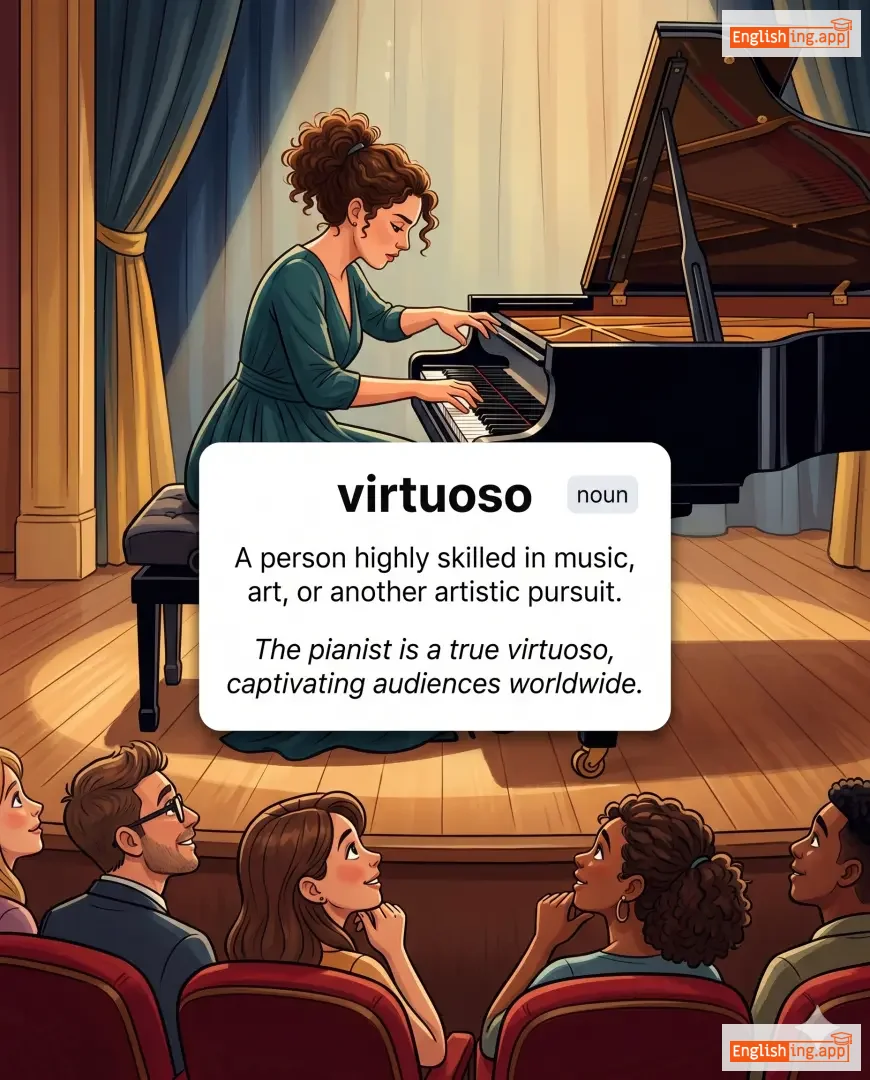
virtuoso definition card — visual illustration of the meaning
noun
/ˌvɜːrtʃuˈoʊsoʊ/
artista virtuoso (artista virtuoso)

A person highly skilled in music, art, or another artistic pursuit.

"The pianist is a true virtuoso, captivating audiences worldwide."

"El pianista es un verdadero artista virtuoso, cautivando a audiencias en todo el mundo." (El pianista es un verdadero artista virtuoso, cautivando a audiencias en todo el mundo.)
adjective
/ˈvɪndɪkeɪtɪv/
vindicatorio (vindicatorio)

showing a tendency to vindicate or justify; inclined to defend

"Her vindicative tone showed that she strongly believed in her innocence."

"Su tono vindicatorio mostró que creía firmemente en su inocencia." (Su tono vindicatorio mostró que creía firmemente en su inocencia.)
noun
/ˈvaɪkaʊnt/
vizconde (visconde)

A British nobleman ranking below an earl and above a baron.

"The viscount inherited the estate from his father."

"El vizconde heredó la finca de su padre." (El vizconde heredó la finca de su padre.)
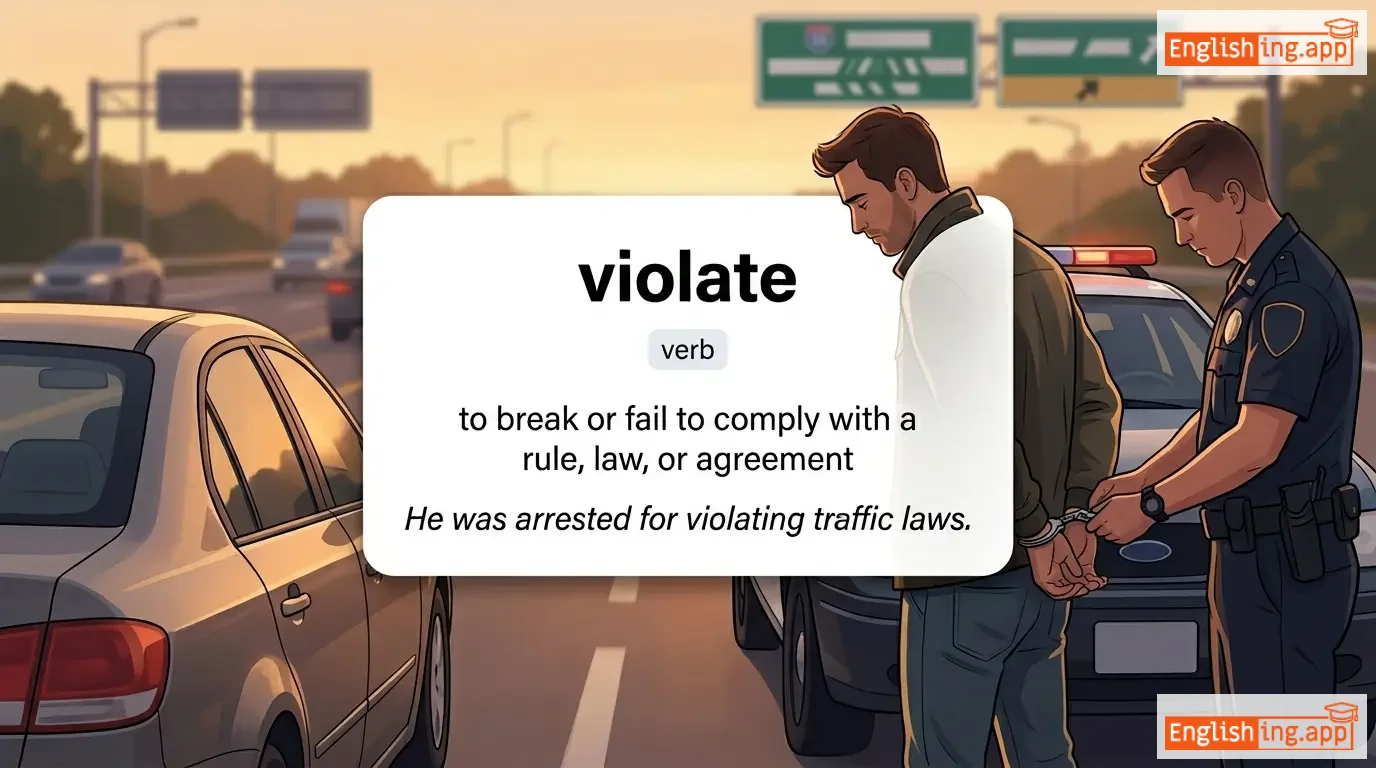
violate definition card — visual illustration of the meaning
verb
/ˈvaɪ.ə.leɪt/
violar (violar)

to break or fail to comply with a rule, law, or agreement

"He was arrested for violating traffic laws."

"fue arrestado por violar las leyes de tráfico." (fue arrestado por violar las leyes de tráfico.)
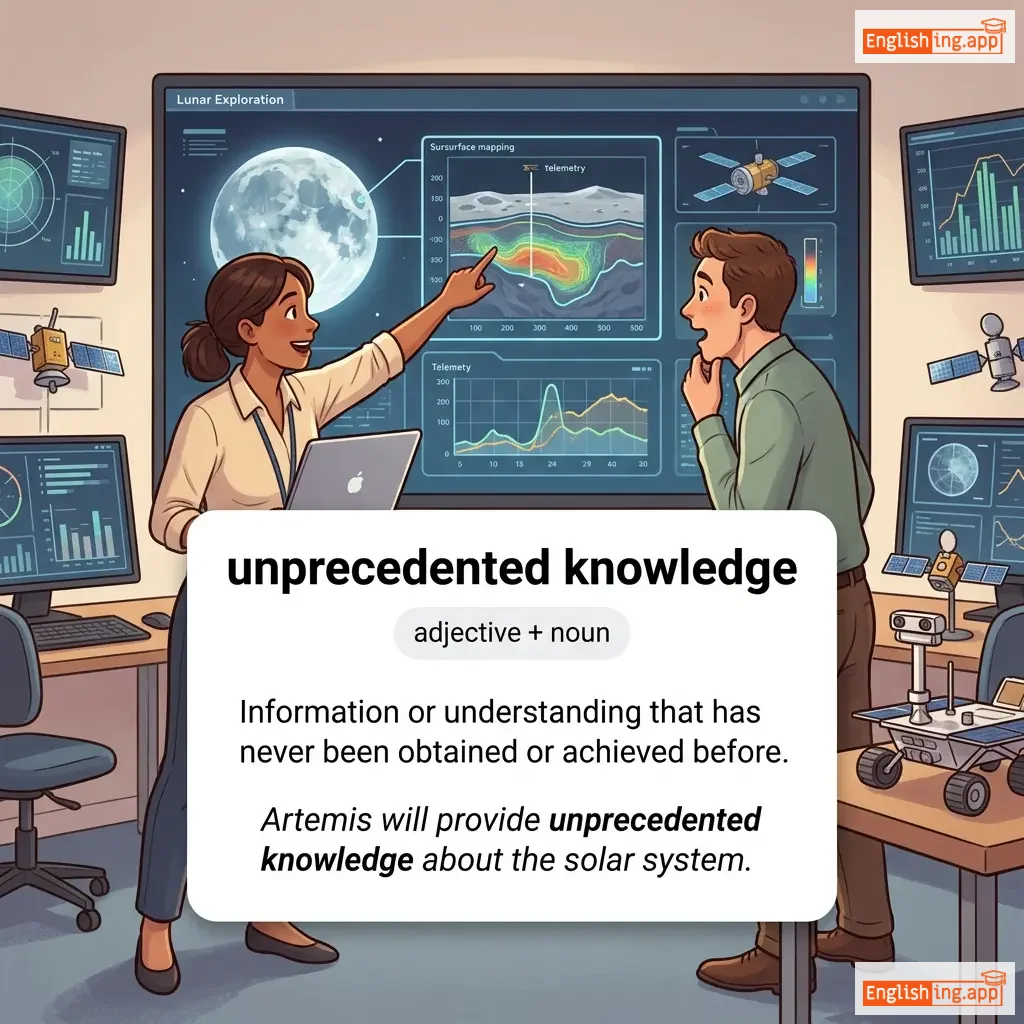
unprecedented knowledge definition card — visual illustration of the meaning
adjective + noun
ʌnˈpresɪdentɪd ˈnɒlɪdʒ
conocimiento sin precedentes (conocimiento sin precedentes)

Information or understanding that has never been obtained or achieved before.

"Artemis will provide unprecedented knowledge about the solar system."

"Artemis proporcionará un conocimiento sin precedentes sobre el sistema solar." (Artemis proporcionara un conocimiento sin precedentes sobre el sistema solar.)
adjective
/ʌnˈprɒf.ɪ.tə.bl̩/
no rentable (no rentable)

not yielding profit or gain; not producing financial benefit

"The unprofitable business was forced to close down after three years."

"El negocio no rentable se vio obligado a cerrar después de tres años." (El negocio no rentable se vio obligado a cerrar después de tres años.)
noun
/ˈvɪtrioʊl/
crítica mordaz (kritika mordaz)

harsh and bitter criticism

"The politician faced vitriol from the public."

"El político enfrentó críticas mordaces del público." (El político enfrentó críticas mordaces del público.)
noun
/ˌviːələnsɛloʊ/
chelo (chelo)

The full name of the cello, a large string instrument played with a bow and held between the knees.

"He practiced the violoncello for hours each day."

"Practicó el violonchelo durante horas cada día." (Practico el violonchelo durante horas cada dia.)
noun
/ˌʌnriˈælɪti/
irrealidad (irrealidad)

the state or quality of being unreal; lack of reality or truth

"The dreamlike setting gave the story a sense of unreality."

"El escenario onírico dio a la historia una sensación de irrealidad." (El escenario onirico dio a la historia una sensacion de irrealidad)
visiting definition card — visual illustration of the meaning
verb
/ˈvɪzɪtɪŋ/
visitar (visitar)

Going to see and spend time with someone or at a place.

"The group is visiting islands during the expedition."

"El grupo está visitando islas durante la expedición." (El grupo está visitando islas durante la expedición.)
noun
/ˈvɪzɪtər/
visitante (visitante)

a person who goes to see a place or someone for a short time

"The museum had many visitors last weekend."

"El museo tuvo muchos visitantes el fin de semana pasado." (El museo tuvo muchos visitantes el fin de semana pasado.)
adjective
/ˈvɪzəbl/
visible (visible)

able to be seen; perceptible by the eye

"The stars were clearly visible in the night sky."

"Las estrellas eran claramente visibles en el cielo nocturno." (Las estrellas eran claramente visibles en el cielo nocturno.)
adverb
/ˈvɜː.tʃu.ə.li/
casi, virtualmente (kasi, virtualmente)

almost or nearly, but not completely; by means of computer technology

"The meeting was held virtually due to travel restrictions."

"La reunión se celebró virtualmente debido a las restricciones de viaje." (La reunion se celebro virtualmente debido a las restricciones de viaje.)