वोकैबुलरीज

इंग्लिश वोकैबुलरी डिस्कवर, लर्न और मास्टर करें

noun
/ˌpɪə.riˈɒd.ɪ.kəl/
प périodical (piriodikāl)

a magazine or journal published at regular intervals

"She subscribed to a science periodical."

"उसने एक विज्ञान पत्रिका की सदस्यता ली।" (Usne ek vijñān patrikā kī sadasyatā lī.)
noun
/ˌpɪəriəˈdɪsɪti/
आवृत्ति (avritti)

The quality or state of being regular or recurring at intervals.

"The periodicity of the moon’s phases has fascinated humans for centuries."

"चाँद के चरणों की आवृत्ति सदियों से मनुष्यों को मोहित करती आई है।" (Chand ke charanon ki avritti sadiyon se manushyon ko mohit karti aai hai.)
adjective
/ˌpɛrɪpəˈtɛtɪk/
यात्री (yatri)

Traveling from place to place, especially for work or based on lifestyle.

"He led a peripatetic life as a traveling teacher."

"वह एक यात्री शिक्षक के रूप में एक यात्रा आधारित जीवन जीता था।" (vah ek yatri shikshak ke roop mein ek yatra aadharit jeevan jeeta tha.)
adjective
/pəˈrɪfərəl/
परिधीय (paridhiya)

Relating to or situated on the edge or outer parts of something.

"The town is located on the peripheral area of the city."

"शहर शहर के परिधीय क्षेत्र में स्थित है।" (shahar shahar ke paridhiye kshetra mein sthit hai.)
noun
/pəˈrɪfəri/
परिधि (paridhi)

The outer edge or boundary of an area or object.

"The soldiers were stationed at the periphery of the camp."

"सैनिकों को शिविर की परिधि पर तैनात किया गया था।" (Sainiko ko shivir ki paridhi par tainat kiya gaya tha.)
verb
/ˈpɛrɪʃ/
मर जाना (mar jana)

To die, especially in a sudden or violent way.

"Many soldiers perished in the war."

"कई सैनिक युद्ध में मारे गए।" (Kai sainik yudh mein maare gaye.)
adjective
/ˈperɪʃəbəl/
सड़नशील (saddansheel)

liable to decay quickly; short-lived

"Store perishable foods in the refrigerator."

"सड़ने वाले खाद्य पदार्थों को फ्रिज में स्टोर करें।" (sadhne wale khadya padarthon ko fridge mein store karein.)
noun
/ˈpɛrɪstaɪl/
स्तंभ से घिरी बरामदा (stambh se giri baraamda)

A continuous porch formed by a row of columns surrounding the perimeter of a building or courtyard.

"The Roman villa featured a beautiful peristyle garden."

"रोमन विला में एक सुंदर पेरीस्टाइल बग़ीचा था।" (Roman villa mein ek sundar peristyle bagicha tha.)
Periwinkle definition card — visual illustration of the meaning
noun
/ˈper.ɪ.wɪŋ.kəl/
पेरिविंकल (periwinkle)

a small trailing plant with violet-blue or white flowers

"Purple periwinkles covered the garden ground beautifully."

"बैंगनी पेरिविंकल्स ने बग़ीचे की ज़मीन को सुंदरता से ढक दिया।" (baingani periwinkles ne bageeche ki zameen ko sundarta se dhak diya)
verb
/ˈpɜːrdʒər/
झूठी शपथ लेना (jhuthi shapath lena)

To knowingly tell a lie in a court of law after swearing to tell the truth.

"He was accused of trying to perjure himself during the trial."

"उसे मुकदमे के दौरान खुद को झूठी शपथ लेने का आरोप लगाया गया था।" (Use mukadme ke dauran khud ko jhoothi shapath lene ka aarop lagaya gaya tha.)
noun
/ˈpɜːrdʒəri/
झूठी शपथ (jhoothi shapath)

The offense of willfully telling an untruth in a court after taking an oath.

"She was convicted of perjury after giving false evidence."

"वह झूठा सबूत देने के बाद पर्जरी का दोषी ठहराई गई थी।" (Vah jhootha saboot dene ke baad parjari ka doshi thahraai gayi thi.)
noun/verb
/pɜːrk/
सुविधा (suvidha)

A benefit or advantage associated with a job; or to become more lively or cheerful.

"One of the perks of working here is free lunch every Friday."

"यहाँ काम करने का एक फायदा है हर शुक्रवार को मुफ्त लंच मिलना।" (Yahan kaam karne ka ek faayda hai har shukravaar ko muft lunch milna.)
adjective
/pəˈsɪs.tənt/
अडिग (adig)

continuing to exist or endure over a prolonged period

"Despite many setbacks, her persistent efforts led to success."

"कई बाधाओं के बावजूद, उसकी अडिग कोशिशों ने सफलता दिलाई।" (Kai baadhayon ke bawjood, uski adig koshishon ne safalta dilayi.)
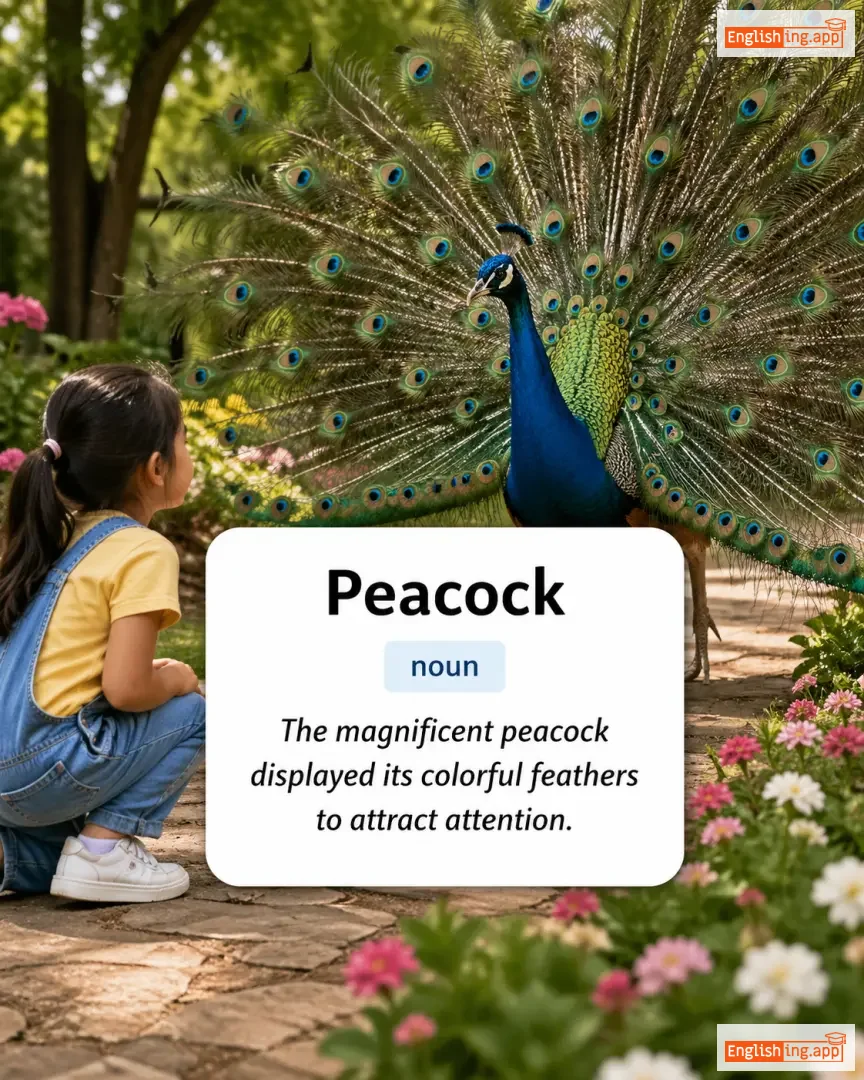
Peacock definition card — visual illustration of the meaning
noun
/ˈpiː.kɒk/
मोर (mor)

a large bird with beautiful colorful tail feathers that can spread out like a fan

"The magnificent peacock displayed its colorful feathers to attract attention."

"उस शानदार मोर ने ध्यान आकर्षित करने के लिए अपने रंगीन पंख फैलाए।" (us shandaar mor ne dhyaan aakarshit karne ke liye apne rangeen pankh phailaaye.)
noun
/ˌpɜːrtərˈbeɪʃn/
चिंता (chinta)

A state of anxiety, disturbance, or disorder.

"The announcement caused a perturbation in the financial markets."

"घोषणा ने वित्तीय बाजारों में चिंता पैदा कर दी।" (Ghoshna ne vittiya bazaron mein chinta paida kar di.)
verb
/pərˈtɜːrb/
चिंतित करना (chintit karna)

To disturb or unsettle greatly in mind.

"The sudden noise perturbed the students during the exam."

"अचानक शोर ने परीक्षा के दौरान छात्रों को चिंतित कर दिया।" (Achanak shor ne pareeksha ke dauran chatron ko chintit kar diya.)
noun
/ˈpɜːrtnəs/
हिम्मत (himmat)

boldness or forwardness in speech or behavior; sauciness

"Her pertness during the meeting surprised everyone."

"मीटिंग के दौरान उसकी हिम्मत ने सभी को चौंका दिया।" (Meeting ke dauran uski himmat ne sabhi ko chauka diya.)
adjective
/ˈpɜːrtɪnənt/
प्रासंगिक (prasangik)

Relevant or applicable to a particular matter.

"She asked a pertinent question during the meeting."

"उसने बैठक के दौरान एक प्रासंगिक सवाल पूछा।" (Usne baithak ke dauran ek prasangik sawal poocha.)
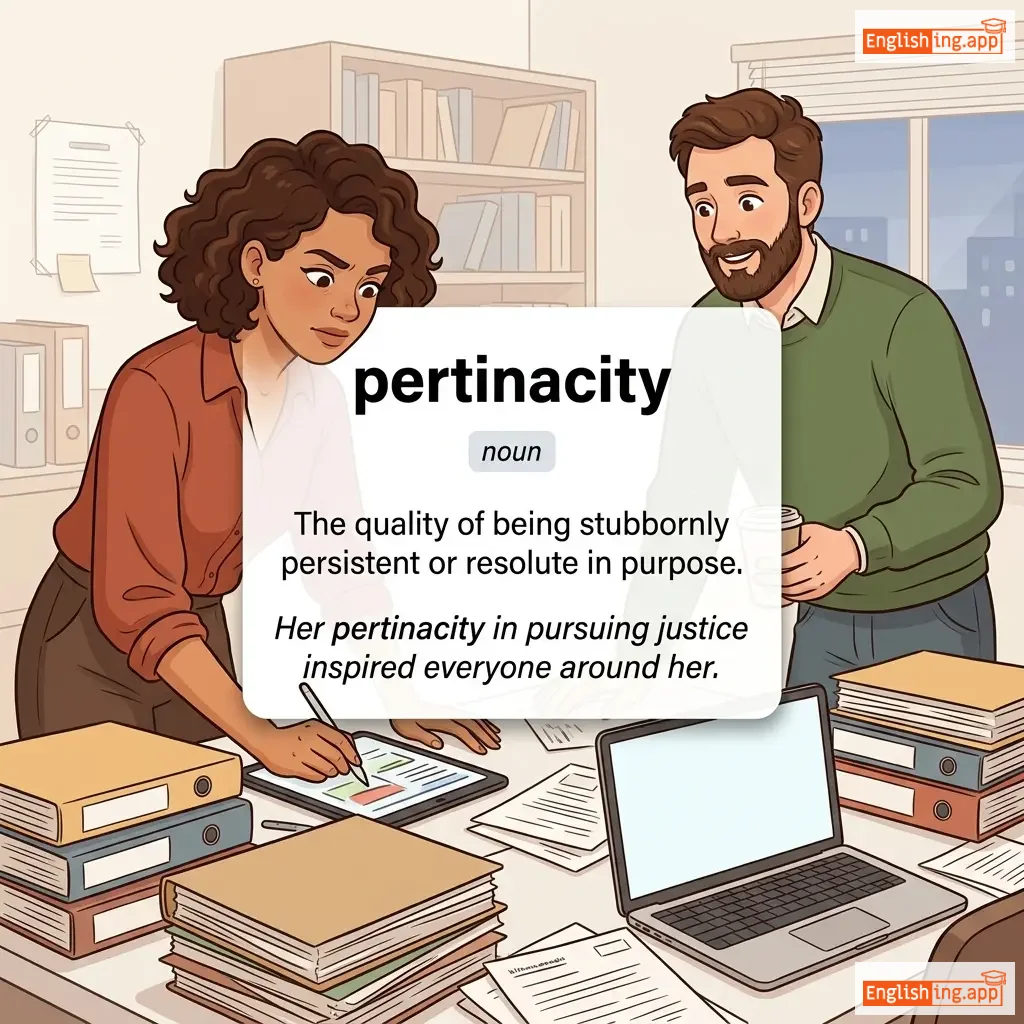
pertinacity definition card — visual illustration of the meaning
noun
/ˌpɜːrtɪˈnæsɪti/
हठी दृढ़ता (hathi dridhata)

The quality of being stubbornly persistent or resolute in purpose.

"Her pertinacity in pursuing justice inspired everyone around her."

"न्याय की खोज में उसकी हठी दृढ़ता ने आसपास सभी को प्रेरित किया।" (nyay ki khoj me uski hathi dridhata ne aas paas sabhi ko prerit kiya)
adjective
/ˌpɜːrtɪˈneɪʃəs/
अडिग (adig)

holding firmly to an opinion, purpose, or course of action; stubbornly persistent

"The pertinacious lawyer refused to give up the case."

"अडिग वकील ने मामले को छोड़ने से इंकार कर दिया।" (Adig vakil ne mamle ko chhodne se inkaar kar diya.)
verb
/pərˈteɪn/
संबंधित होना (sambandhit hona)

to relate or have reference to something

"The rules pertain to all students in the school."

"नियम सभी छात्रों से संबंधित हैं।" (Niyam sabhi chhatron se sambandhit hain.)
adjective
/pɜːrt/
चंचल लेकिन आकर्षक (chanchal lekin aakarshak)

attractively lively or cheeky in manner or style

"She gave a pert reply that made everyone laugh."

"उसने एक चंचल उत्तर दिया जिसने सभी को हंसी में डाल दिया।" (Usne ek chanchal uttar diya jisne sabhi ko hansi mein daal diya.)
persuasiveness definition card — visual illustration of the meaning
noun
/pərˈsweɪ.sɪv.nəs/
प्रभाविता (prabhavita)

The quality of being able to persuade someone to do or believe something.

"His persuasiveness helped secure the deal."

"उसकी प्रभाविता ने सौदे को सुरक्षित करने में मदद की।" (Uski prabhavita ne saudey ko surakshit karne mein madad ki.)
persuasion definition card — visual illustration of the meaning
noun
/pɜːˈsweɪ.ʒən/
मनाने की क्षमता (manaane ki kshamata)

The ability to convince someone to believe or do something through reasoning or argument.

"His persuasion skills helped close the business deal."

"उसकी पर्सुएशन स्किल्स ने व्यापारिक सौदा पूरा करने में मदद की।" (Uski persuasion skills ne vyaparik sauda poora karne mein madad ki.)
verb
/pərˈsweɪd/
खुशी (khushi)

to convince someone to do or believe something through reasoning or argument

"He persuaded his friend to join the club."

"वह पुरस्कार प्राप्त करते समय अपनी खुशी को छिपा नहीं सकी।" (Vah puraskar prapt karte samay apni khushi ko chhupa nahi sakee.)
adjective
/pərˈsweɪdəbl̩/
जो आसानी से मनाया जा सकता है (jo aasani se manaya ja sakta hai)

capable of being convinced or influenced to do something

"She was easily persuadable when it came to trying new foods."

"वह नए खाद्य पदार्थों को आजमाने में आसानी से राजी हो जाती थी।" (Vah naye khadya padarthon ko aazmane mein aasani se raji ho jati thi.)
verb
/pərˈspaɪər/
पसीना आना (paseena aana)

To give out sweat through the pores of the skin as a result of heat, physical exertion, or stress.

"He began to perspire after running for 10 minutes."

"वह 10 मिनट दौड़ने के बाद पसीना आना शुरू हो गया।" (vah 10 minute daudne ke baad paseena aana shuru ho gaya.)
noun
/ˌpɜːrspəˈreɪʃn/
पसीना (paseena)

The process of sweating.

"Heavy exercise causes perspiration."

"भारी व्यायाम पसीना उत्पन्न करता है।" (bhaari vyaayam paseena utpann karta hai.)
adjective
/pərˈspɪkjuəs/
स्पष्ट (spasht)

Clearly expressed and easily understood; lucid.

"The teacher gave a perspicuous explanation of the theory."

"शिक्षक ने सिद्धांत का स्पष्ट विवरण दिया।" (shikshak ne siddhant ka spasht vivaran diya.)
noun
/ˌpɜːrspɪˈkjuːəti/
स्पष्टता (spashtata)

Clarity and ease in speech or writing; the quality of being clearly expressed.

"The perspicuity of his lecture made it easy for students to understand complex topics."

"उसकी व्याख्यान की स्पष्टता ने छात्रों के लिए जटिल विषयों को समझना आसान बना दिया।" (uski vyakhyan ki spashtata ne chhatron ke liye jatil vishayon ko samajhna aasan bana diya.)
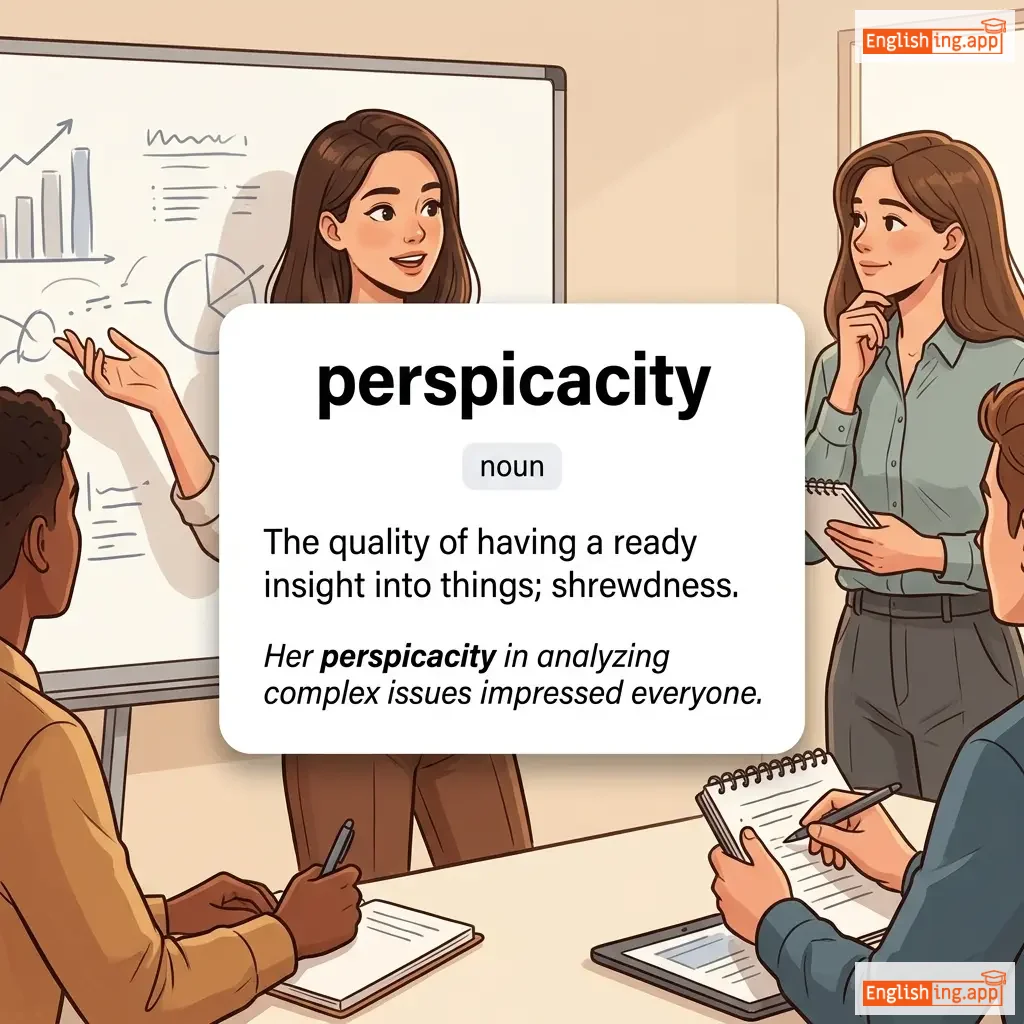
perspicacity definition card — visual illustration of the meaning
noun
/ˌpɜːrspɪˈkæsəti/
तीव्र बुद्धि (teevra buddhi)

The quality of having a ready insight into things; shrewdness.

"Her perspicacity in analyzing complex issues impressed everyone."

"उसकी पर्सपिकासिटी ने जटिल मुद्दों का विश्लेषण करते हुए सभी को प्रभावित किया।" (uski perspicacity ne jatil muddon ka vishleshan karte hue sabhi ko prabhavit kiya.)
perspicacious definition card — visual illustration of the meaning
adjective
/ˌpɜːrspɪˈkeɪʃəs/
तेज दृष्टि वाला (tej drishti wala)

Having a ready insight into and understanding of things.

"The perspicacious student quickly understood the complex problem."

"तेज दृष्टि वाला छात्र जल्दी ही जटिल समस्या को समझ गया।" (tej drishti wala chatra jaldi hi jatil samasya ko samajh gaya.)
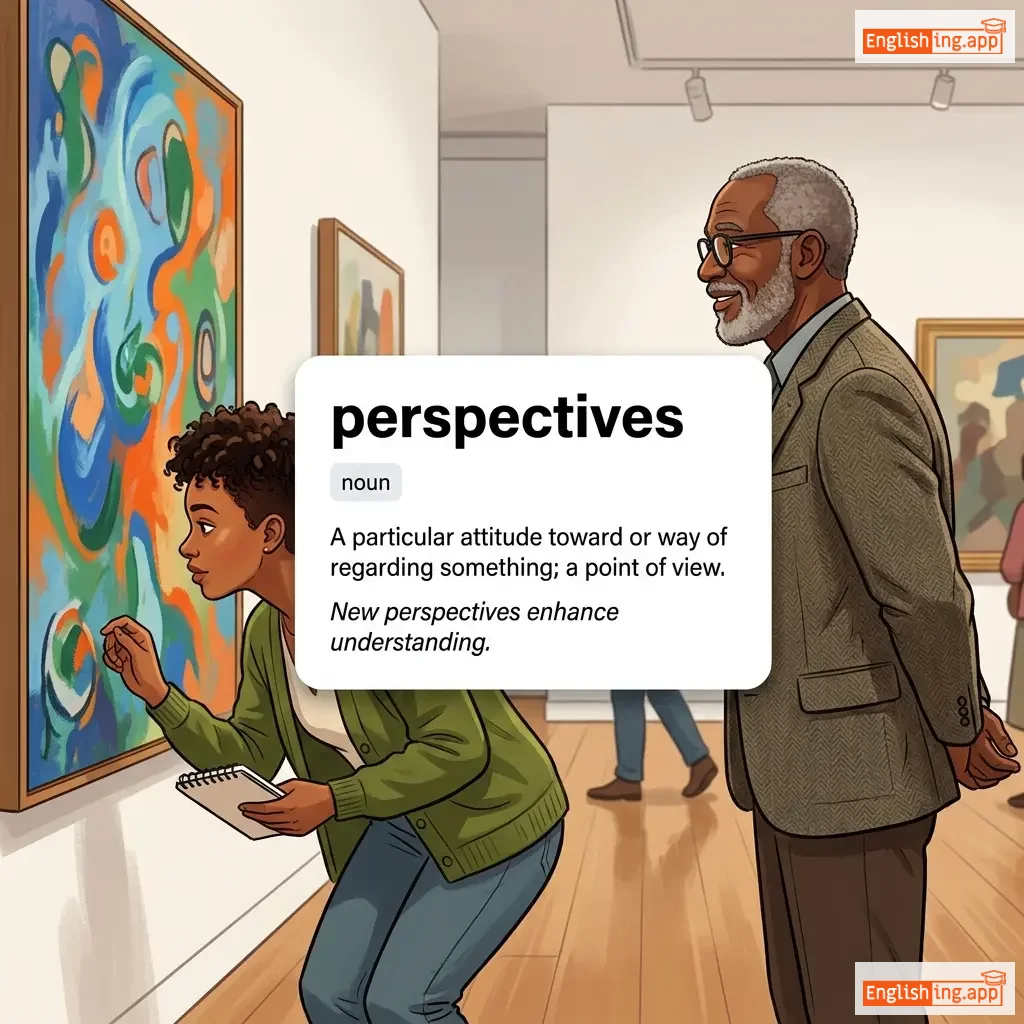
perspectives definition card — visual illustration of the meaning
noun
pəˈspek.tɪvz
दृष्टिकोण (drishtikon)

A particular attitude toward or way of regarding something; a point of view.

"New perspectives enhance understanding."

"नई दृष्टिकोण समझ को बढ़ाती हैं।" (Nayi drishtikon samajh ko badhati hain.)
noun
/pərˈspɛktɪv/
दृष्टिकोण (drishtikon)

A particular attitude toward or way of regarding something; a point of view.

"From her perspective, the plan seemed risky."

"उसके दृष्टिकोण से, योजना जोखिमपूर्ण लग रही थी।" (uske drishtikon se, yojana jokhimpoorṇ lag rahi thi.)
noun
/ˌpɜːrsəˈnel/
कर्मचारी (karmachari)

People employed in an organization or engaged in an organized undertaking such as military service.

"The company is hiring more personnel for its new branch."

"कंपनी अपनी नई शाखा के लिए अधिक कर्मचारी भर्ती कर रही है।" (kampani apni nai shakha ke liye adhik karmachari bharti kar rahi hai.)
verb
/pərˈsɑːnɪfaɪ/
खुशी (khushi)

To represent or embody a quality, idea, or concept in human form.

"She personifies kindness and generosity."

"जब उसे पुरस्कार मिला, तो वह अपनी खुशी को छिपा नहीं सकी।" (Jab use puraskar mila, to vah apni khushi ko chhupa nahin saki.)
adverb
/ˈpɜːsənəli/
व्यक्तिगत रूप से (vyaktigat roop se)

in a way that relates to the individual personally

"I personally believe in the importance of hard work."

"मैं व्यक्तिगत रूप से कठिन मेहनत के महत्व में विश्वास करता हूँ।" (Main vyaktigat roop se kathin mehnat ke mahatva mein vishwas karta hoon.)
personalization definition card — visual illustration of the meaning
noun
ˌpɜː.sən.ə.laɪˈzeɪ.ʃən
व्यक्तिगतरण (vyaktigatran)

Customizing services or products according to user preferences.

"Online stores use personalization to improve customer experience."

"ऑनलाइन स्टोर ग्राहक अनुभव को सुधारने के लिए व्यक्तिगतरण का उपयोग करते हैं।" (Online store grahak anubhav ko sudharne ke liye vyaktigatran ka upayog karte hain.)
noun
/ˌpɜːrsəˈnæləti/
व्यक्तित्व (vyaktitva)

The combination of qualities or characteristics that form an individual's distinctive character.

"Her cheerful personality makes her very popular."

"उसकी खुशमिजाज पर्सनैलिटी उसे बहुत लोकप्रिय बनाती है।" (uski khushmijaaz vyaktitva use bahut lokpriya banati hai.)
personal data definition card — visual illustration of the meaning
noun
/ˈpɜː.sən.əl ˈdeɪ.tə/
व्यक्तिगत डेटा (vyaktigat data)

Information that relates to an individual's private, sensitive, or identifiable data

"Protecting personal data is crucial in the digital age."

"डिजिटल युग में व्यक्तिगत डेटा की सुरक्षा करना महत्वपूर्ण है।" (Digital yug mein vyaktigat data ki suraksha karna mahatvapurn hai.)
adjective
/ˈpɜːrsənl/
व्यक्तिगत (vyaktigat)

relating to a particular person rather than anyone else

"She shared some personal details about her family."

"उसने अपने परिवार के बारे में कुछ व्यक्तिगत जानकारी साझा की।" (Usne apne parivar ke baare mein kuch vyaktigat jaankari saanjha ki.)
noun
/ˈpɜːrsənɪdʒ/
महत्वपूर्ण व्यक्ति (mahatvapoorn vyakti)

an important or famous person

"He is considered a great personage in the world of literature."

"उन्हें साहित्य की दुनिया में एक महान व्यक्ति माना जाता है।" (Unhein sahitya ki duniya mein ek mahan vyakti mana jata hai.)
adjective
/ˈpɜːrsənəbl/
आकर्षक (aakarshak)

having a pleasant appearance and manner; attractive and friendly

"The new teacher is very personable and easy to talk to."

"नया शिक्षक बहुत आकर्षक और बातचीत करने में आसान है।" (Naya shikshak bahut aakarshak aur baatcheet karne mein aasan hai.)
noun
/ˈpɜːrsən/
व्यक्ति (vyakti)

an individual human being

"She is a kind person who always helps others."

"वह एक दयालु व्यक्ति है जो हमेशा दूसरों की मदद करता है।" (Vah ek dayalu vyakti hai jo hamesha doosron ki madad karta hai.)
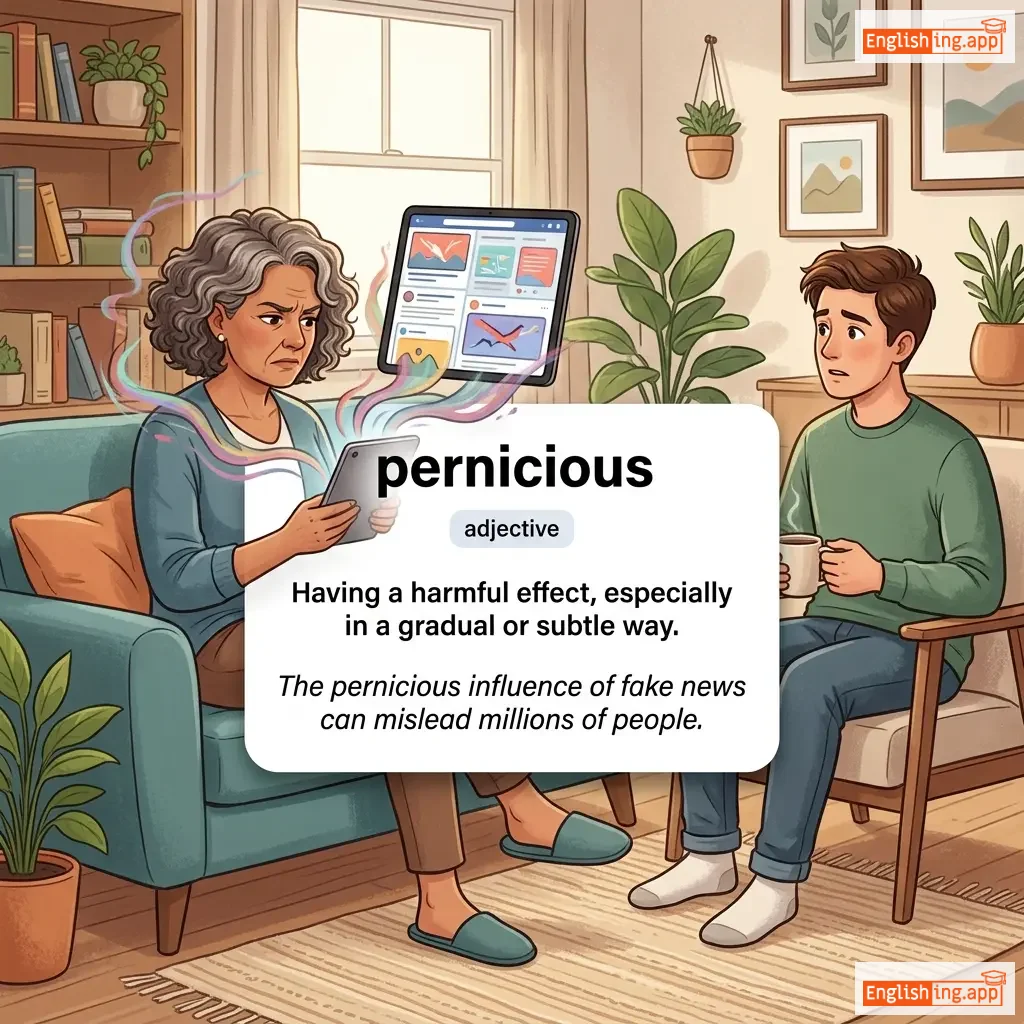
pernicious definition card — visual illustration of the meaning
adjective
/pərˈnɪʃəs/
हानिकारक (hanikarak)

Having a harmful effect, especially in a gradual or subtle way.

"The pernicious influence of fake news can mislead millions of people."

"फेक न्यूज का हानिकारक प्रभाव लाखों लोगों को गुमराह कर सकता है।" (Fake news ka hanikarak prabhav lakhon logon ko gumrah kar sakta hai.)
permissive definition card — visual illustration of the meaning
adjective
/pərˈmɪsɪv/
अनुकूल (anukool)

allowing or characterized by great freedom of behavior; tolerant

"Her parents were very permissive and rarely punished her."

"उसके माता-पिता बहुत अनुकूल थे और शायद ही कभी उसे सजा देते थे।" (Uske mata-pita bahut anukool the aur shayad hi kabhi use saza dete the.)
permit definition card — visual illustration of the meaning
verb
/pərˈmɪt/
अनुमति देना (anumati dena)

to allow or give consent for something to happen

"The manager permitted the team to leave early."

"मैनेजर ने टीम को जल्दी जाने की अनुमति दी।" (Manager ne team ko jaldi jaane ki anumati di.)
noun
/ˌpɜːrmjuˈteɪʃən/
परिवर्तन (parivartan)

An arrangement or reordering of elements, often in mathematics or logic.

"The puzzle can be solved by trying all possible permutations of the tiles."

"पहेली को टाइल्स के सभी संभव परिवर्तन की कोशिश करके हल किया जा सकता है।" (Pehli ko tiles ke sabhi sambhav parivartan ki koshish karke hal kiya ja sakta hai.)
adjective
/ˌpɜːrpənˈdɪkjələr/
लंब (lamb)

At an angle of 90 degrees to a given line, plane, or surface.

"The ladder was placed perpendicular to the ground for safety."

"सीढ़ी को सुरक्षा के लिए जमीन के प्रति लंबवत रखा गया था।" (Seedi ko suraksha ke liye zameen ke prati lambvat rakha gaya tha.)
verb
/ˈpɜːrpətreɪt/
अपराध करना (apraadh karna)

To commit or carry out, typically a harmful, illegal, or immoral act.

"The hackers perpetrated a massive cyber attack on the company."

"हैकर्स ने कंपनी पर एक बड़ा साइबर हमला किया।" (Hackers ne company par ek bada cyber hamla kiya.)