Vocabulaires

Découvrez, apprenez et maîtrisez le vocabulaire anglais

noun
/ˈpʌblɪʃɪŋ/
l'édition (ledisyon)

the business or activity of preparing and issuing books, journals, or other material for sale

"He works in the publishing industry as an editor."

"Il travaille dans l'industrie de l'édition en tant qu'éditeur." (Il travaille dans lindustrie de ledition en tant qu editeur)
verb
/ˈpʌkər/
froncer (froncer)

to tighten or contract into small folds or wrinkles

"She puckered her lips before kissing the child."

"Elle a froncé les lèvres avant d'embrasser l'enfant." (Elle a froncé les lèvres avant d'embrasser l'enfant.)
adjective
/ˈpʌkɪʃ/
espiègle (espiègle)

playfully mischievous

"The child gave a puckish grin before hiding the toy."

"L'enfant a donné un sourire espiègle avant de cacher le jouet." (L'enfant a donné un sourire espiègle avant de cacher le jouet.)
noun
/ˈpʊdɪŋ/
pouding (puding)

a sweet or savory dish, often soft and creamy, eaten as dessert

"She made chocolate pudding for dessert."

"Elle a préparé du pudding au chocolat pour le dessert." (Elle a préparé du pudding au chocolat pour le dessert.)
adjective
/ˈpʌdʒi/
rond (rond)

slightly fat or chubby in a way that is often cute

"The baby had pudgy cheeks that everyone adored."

"Le bébé avait des joues rondes que tout le monde adorait." (Le bébé avait des joues rondes que tout le monde adorait.)
adjective
/ˈpjʊəraɪl/
infantile (infantile)

childishly silly or immature

"His puerile jokes annoyed the audience."

"Ses blagues infantiles ont agacé le public." (Ses blagues infantiles ont agacé le public.)
noun
/ˈpjuːdʒɪlɪzəm/
boxe (boxe)

The practice or sport of boxing.

"He studied the art of pugilism in his youth."

"Il a étudié l'art de la boxe dans sa jeunesse." (Il a étudié l'art de la boxe dans sa jeunesse.)
noun
/ˈpjuːdʒɪlɪst/
boxeur (boxeur)

A professional or skilled boxer.

"The pugilist entered the ring with confidence."

"Le boxeur est entré dans le ring avec confiance." (Le boxeur est entré dans le ring avec confiance.)
adjective
/pʌɡˈneɪʃəs/
agressif (agressif)

Having a quarrelsome or combative nature; eager to fight.

"His pugnacious attitude often got him into trouble."

"Son attitude agressive le mettait souvent dans des ennuis." (Son attitude agressive le mettait souvent dans des ennuis.)
noun
/pʌɡˈnæsɪti/
pugnacité (pugnacite)

A natural disposition to be combative or aggressive.

"The coach admired the player's pugnacity on the field."

"L'entraîneur admirait la pugnacité du joueur sur le terrain." (L'entraîneur admirait la pugnacité du joueur sur le terrain.)
noun
/ˈpjuːɪsəns/
puissance (puissance)

Great power, strength, or influence.

"The empire showed its puissance through vast armies."

"L'empire a montré sa puissance à travers de vastes armées." (L'empire a montré sa puissance à travers de vastes armées.)
adjective
/ˈpjuːɪsənt/
puissant (puissant)

having great power or influence; mighty

"The king was a puissant ruler whose word was law."

"Le roi était un souverain puissant dont la parole faisait loi." (Le roi était un souverain puissant dont la parole faisait loi.)
noun
/ˈpʌlkrɪˌtjuːd/
beauté (beaute)

physical beauty

"The actress was admired for her pulchritude as well as her talent."

"L'actrice a été admirée pour sa beauté et son talent." (L'actrice a été admirée pour sa beauté et son talent.)
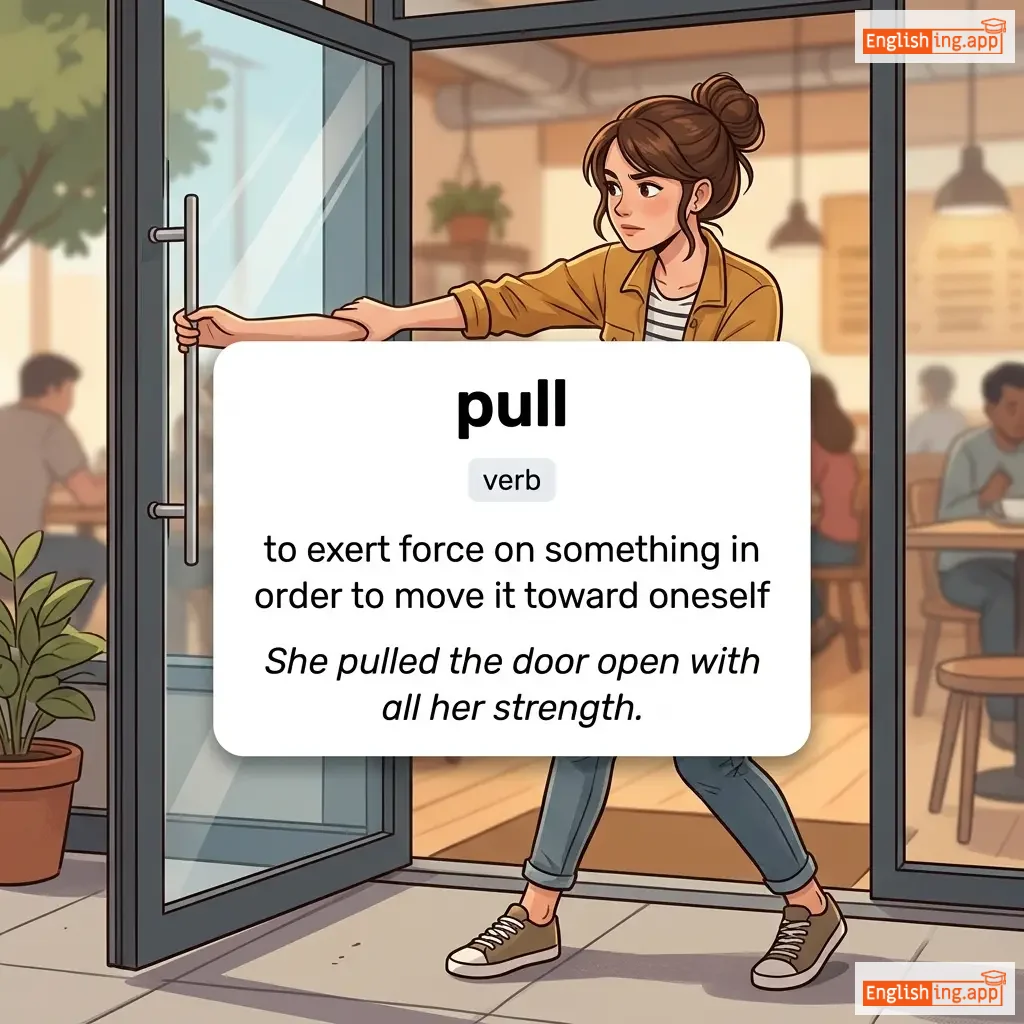
pull definition card — visual illustration of the meaning
verb
/pʊl/
tirer (tirer)

to exert force on something in order to move it toward oneself

"She pulled the door open with all her strength."

"Elle a ouvert la porte avec toute sa force." (Elle a ouvert la porte avec toute sa force.)
noun
/ˈpʊl.oʊ.vər/
pull (pull)

a knitted garment worn on the upper body, typically pulled on over the head

"She wore a warm pullover during the cold winter evening."

"Elle a porté un pull chaud lors de la froide soirée d'hiver." (Elle a porte un pull chaud lors de la froide soiree d'hiver.)
adjective
/ˈpʌlməˌneri/
pulmonaire (pulmonaire)

relating to the lungs

"The patient suffered from a serious pulmonary infection."

"The patient suffered from a serious pulmonary infection." (Le patient souffrait dune grave infection pulmonaire.)
noun
/ˈpʊlpɪt/
chaire (chaire)

a raised platform in a church from which the preacher delivers a sermon

"The pastor stood at the pulpit to address the congregation."

"Le pasteur s'est tenu à la chaire pour s'adresser à l'assemblée." (Le pasteur s'est tenu à la chaire pour s'adresser à l'assemblée.)
verb
/ˈpʌlseɪt/
pulsar (pulsar)

to expand and contract rhythmically; to throb or beat

"The neon lights pulsated with a steady rhythm."

"Les lumières au néon pulsaient avec un rythme constant." (Les lumieres au neon pulsaient avec un rythme constant.)
noun/verb
/pʌls/
pouls (pouls)

A rhythmic beat or vibration, especially the heartbeat; to throb or move with a rhythm.

"The doctor checked her pulse after the long run."

"Le médecin a vérifié son pouls après la longue course." (Le médecin a verifié son pouls après la longue course.)
verb
/ˈpʌlvəraɪz/
pulvériser (pulveriser)

To crush or grind something into a fine powder; to completely defeat or destroy.

"The machine can pulverize stones into dust."

"La machine peut pulvériser des pierres en poussière." (La machine peut pulveriser des pierres en poussiere.)
verb
/ˈpʌməl/
rouer de coups (rouer de coups)

To strike repeatedly with the fists; to beat or hit forcefully.

"The boxer pummeled his opponent in the final round."

"Le boxeur a roué son adversaire de coups dans le dernier round." (Le boxeur a roué son adversaire de coups dans le dernier round.)
verb
/pʌmp/
pomper (pomper)

to force liquid or gas to move in a particular direction using a device

"They pumped water from the well into the tank."

"Ils ont pompé l'eau du puits dans le réservoir." (Ils ont pompé l'eau du puits dans le réservoir.)
noun
/'pʌmp.kɪn/
citrouille (citrouille)

a large round orange fruit with thick skin and edible flesh

"We carved a jack-o'-lantern from a big pumpkin."

"Nous avons sculpté une lanterne de citrouille à partir d'une grosse citrouille." (Nous avons sculpté une lanterne de citrouille à partir d'une grosse citrouille)
noun
/pʌn/
jeu de mots (jeu de mots)

A humorous use of words that suggests different meanings or words that sound alike.

"He made a clever pun about the bakery's bread rising."

"Il a fait un jeu de mots intelligent sur la montée du pain à la boulangerie." (Il a fait un jeu de mots intelligent sur la montée du pain à la boulangerie.)
verb
/pʌntʃ/
donner un coup de poing (donner un coup de poing)

to hit someone or something hard with your fist

"He punched the wall in frustration."

"Il a frappé le mur par frustration." (Il a frappé le mur par frustration.)
noun
/ˈpʌntʃ laɪn/
chute finale (chute finale)

The final part of a joke or story that makes it funny.

"Everyone laughed loudly at the punch line of his joke."

"Tout le monde a ri fortement à la chute finale de sa blague." (Tout le monde a ri fortement à la chute finale de sa blague.)
adjective
/pʌŋkˈtɪliəs/
pointilleux (pointilleux)

Showing great attention to detail or correct behavior.

"She was punctilious in her attention to etiquette."

"Elle était pointilleuse dans son attention à l'étiquette." (Elle etait pointilleuse dans son attention a l'etiquette.)
adjective
/ˈpʌŋktʃuəl/
ponctuel (ponktyel)

Happening or doing something at the agreed or proper time; on time.

"He is always punctual for meetings."

"Il est toujours ponctuel pour les réunions." (Il est toujours ponctuel pour les reunions.)
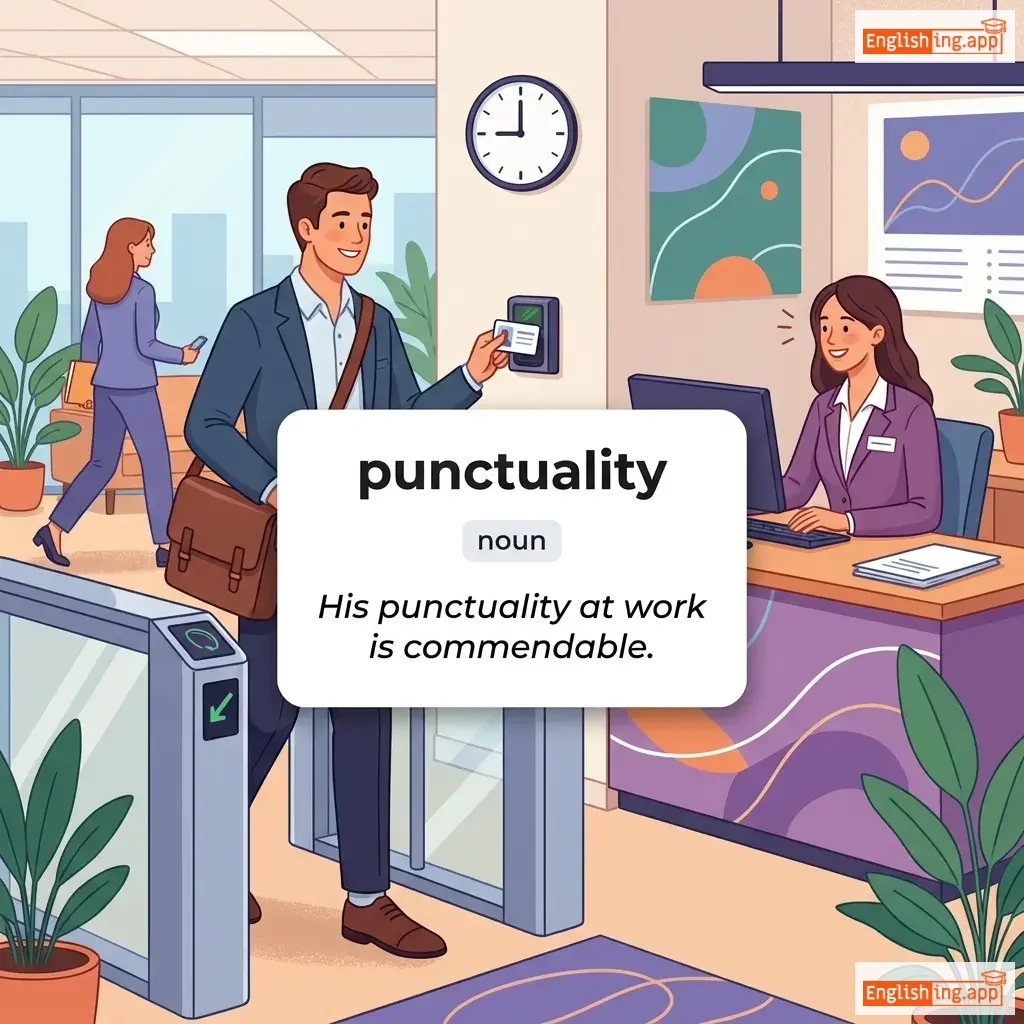
punctuality definition card — visual illustration of the meaning
noun
/ˌpʌŋk.tʃuˈæl.ə.ti/
ponctualité (ponctualité)

The quality or habit of being on time; arriving or occurring at the scheduled time.

"His punctuality at work is commendable."

"Sa ponctualité au travail est admirable." (Sa ponctualité au travail est admirable.)
adverb
/ˈpʌŋk.tʃu.əl.i/
ponctuellement (ponctuellement)

at the exact time arranged; on time; not late

"She always arrives punctually for meetings."

"Elle arrive toujours ponctuellement aux réunions." (Elle arrive toujours ponctuellement aux réunions.)
noun
/ˈpʌŋk.tʃər/
crevaison (crevaison)

a small hole in a tire that causes air to escape

"I had to fix a puncture in my bicycle tire this morning."

"J'ai dû réparer un pneu crevé sur mon vélo ce matin." (j'ai du reparer un pneu creve sur mon velo ce matin.)
noun
/ˈpʌndɪt/
expert (expert)

An expert in a particular subject or field who is frequently called upon to give opinions to the public.

"Political pundits debated the election results on television."

"Les experts politiques ont débattu des résultats des élections à la télévision." (Les experts politiques ont débattu des résultats des élections à la télévision.)
noun
/ˈpʌndʒənsi/
pungence (pungens)

The quality of having a strong, sharp taste or smell.

"The pungency of garlic filled the kitchen."

"La pungence de l'ail a rempli la cuisine." (La pungence de l'ail a rempli la cuisine.)
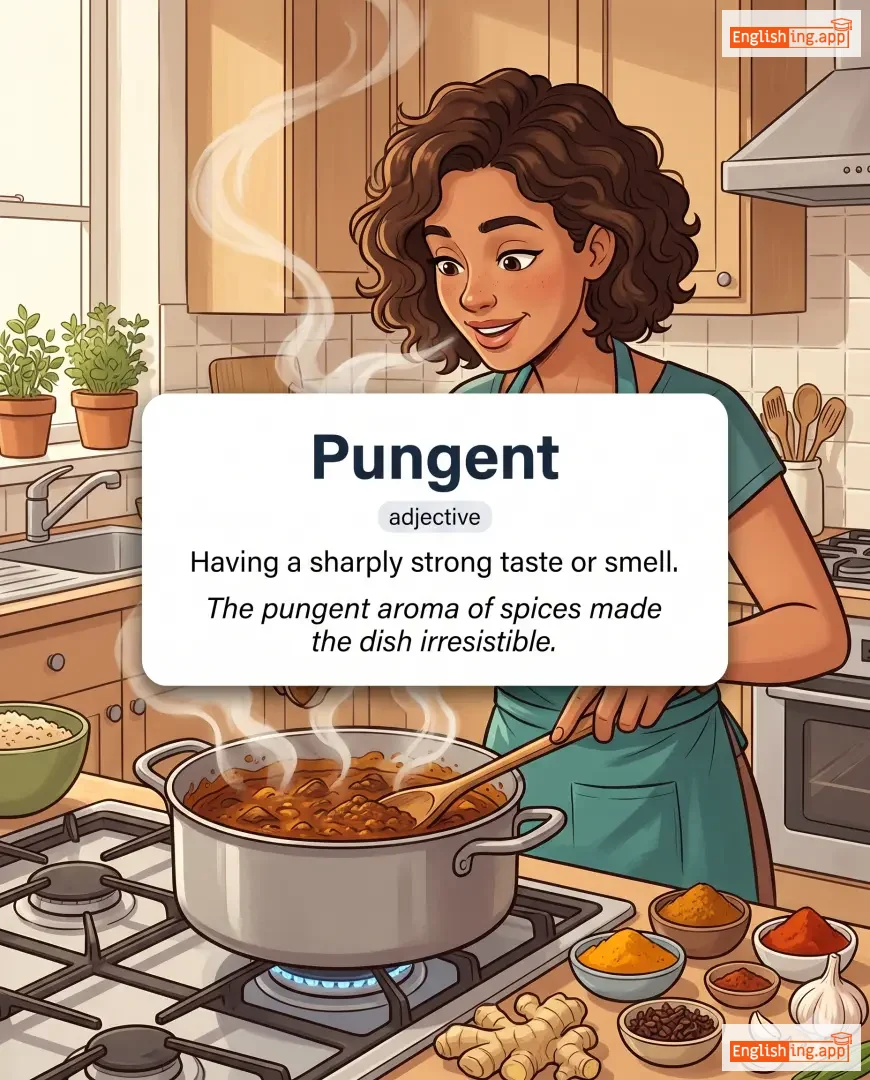
Pungent definition card — visual illustration of the meaning
adjective
/ˈpʌndʒənt/
forte odeur ou saveur (forte odeur ou saveur)

Having a sharply strong taste or smell.

"The pungent aroma of spices made the dish irresistible."

"L'arôme fort des épices rendait le plat irrésistible." (L'arôme fort des épices rendait le plat irrésistible.)
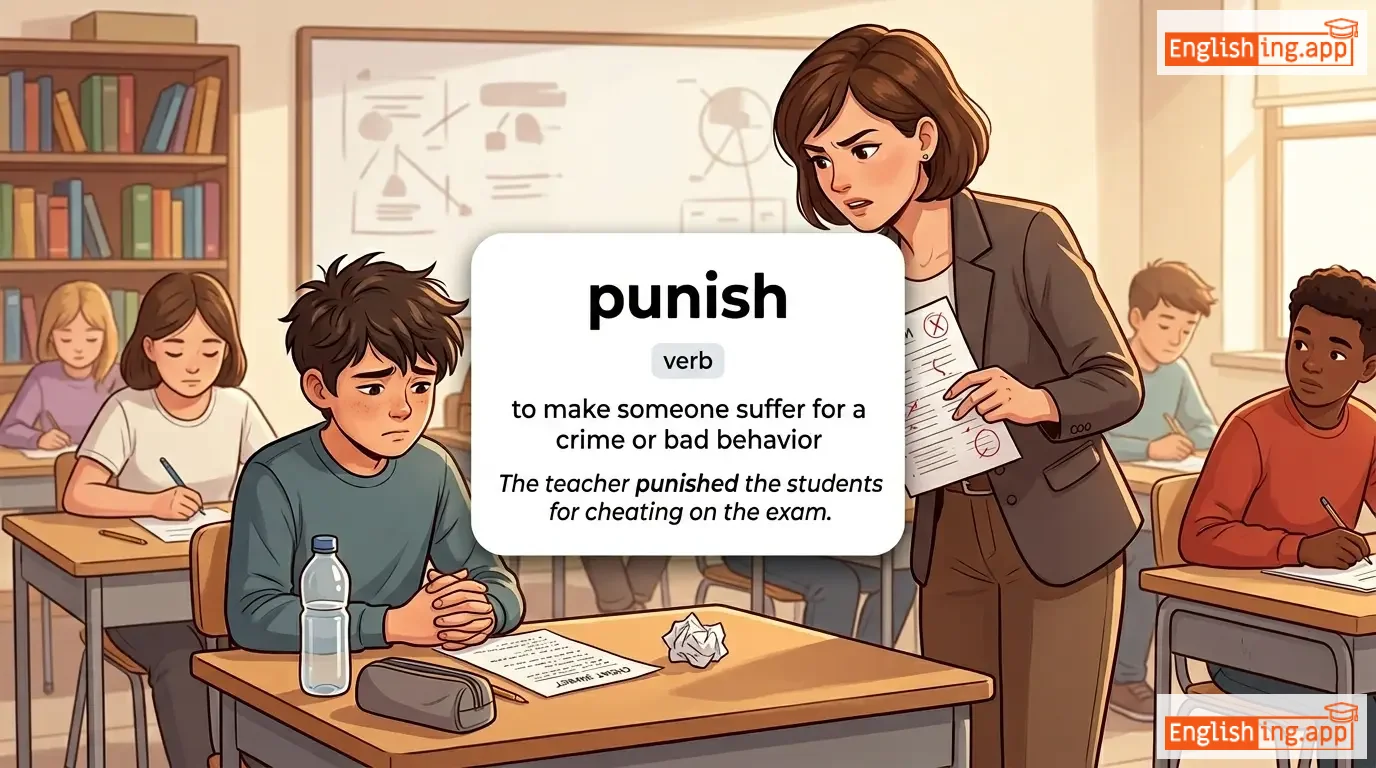
punish definition card — visual illustration of the meaning
verb
/ˈpʌnɪʃ/
punir (punir)

to make someone suffer for a crime or bad behavior

"The teacher punished the students for cheating on the exam."

"Le professeur a puni les étudiants pour avoir triché à l'examen." (Le professeur a puni les étudiants pour avoir triché à l'examen.)
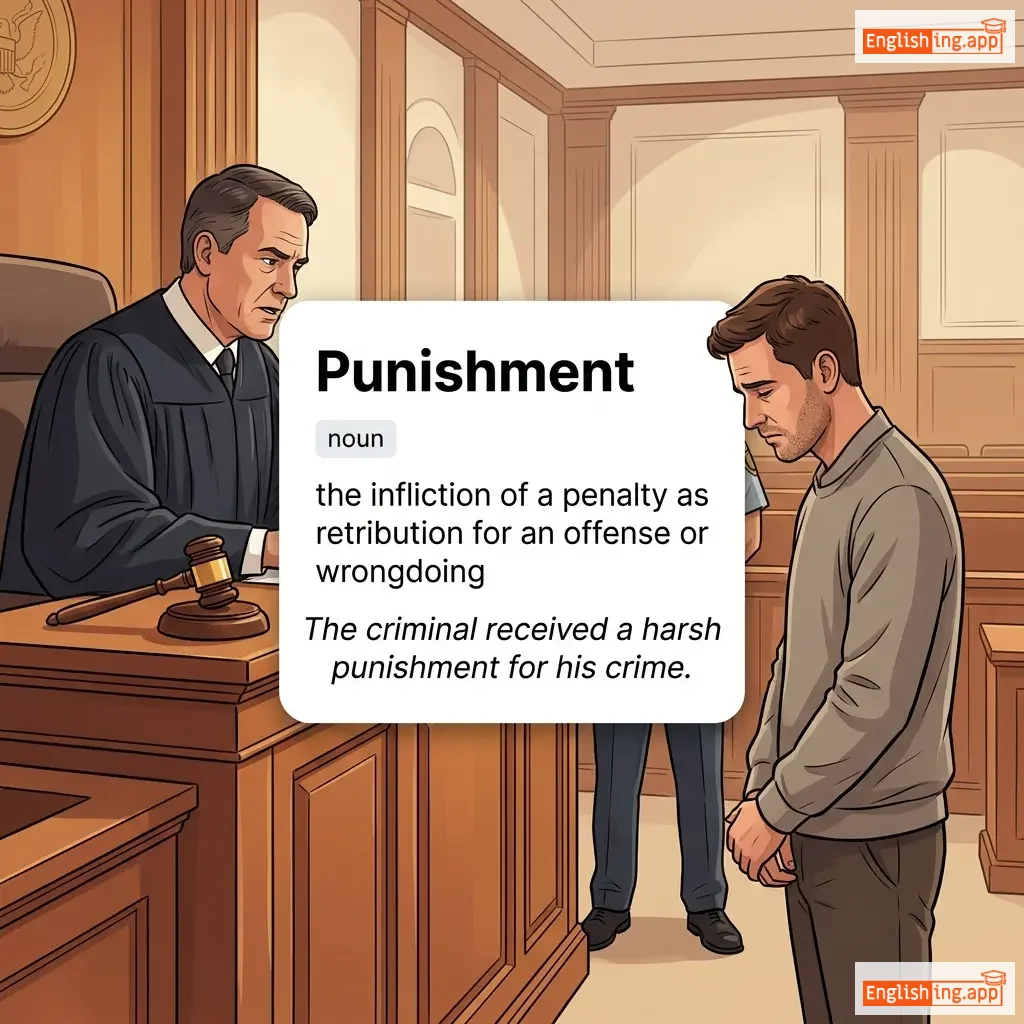
Punishment definition card — visual illustration of the meaning
noun
/ˈpʌnɪʃmənt/
punition (punition)

the infliction of a penalty as retribution for an offense or wrongdoing

"The criminal received a harsh punishment for his crime."

"Le criminel a reçu une punition sévère pour son crime." (Le criminel a recu une punition severe pour son crime.)
adjective
/ˈpjuː.nɪ.tɪv/
punitif (punitif)

Inflicting or intended as punishment.

"The company faced punitive measures for violating the law."

"L'entreprise a dû faire face à des mesures punitives pour avoir violé la loi." (L'entreprise a du faire face a des mesures punitives pour avoir viole la loi.)
noun
/pʌnˈdʒɑː.bi/
punjabi (punjabi)

a traditional long shirt worn in South Asia, typically loose-fitting

"He wore a white punjabi for the festival celebration."

"Il portait un punjabi blanc pour la célébration du festival." (Il portait un punjabi blanc pour la célébration du festival.)
noun
/pʌŋk/
punk (punk)

a type of popular music, or the culture associated with it, characterized by loud, fast rhythms and rebellious attitudes

"He’s always been into punk music and fashion."

"Il a toujours été passionné par la musique punk et la mode." (Il a toujours ete passionne par la musique punk et la mode.)
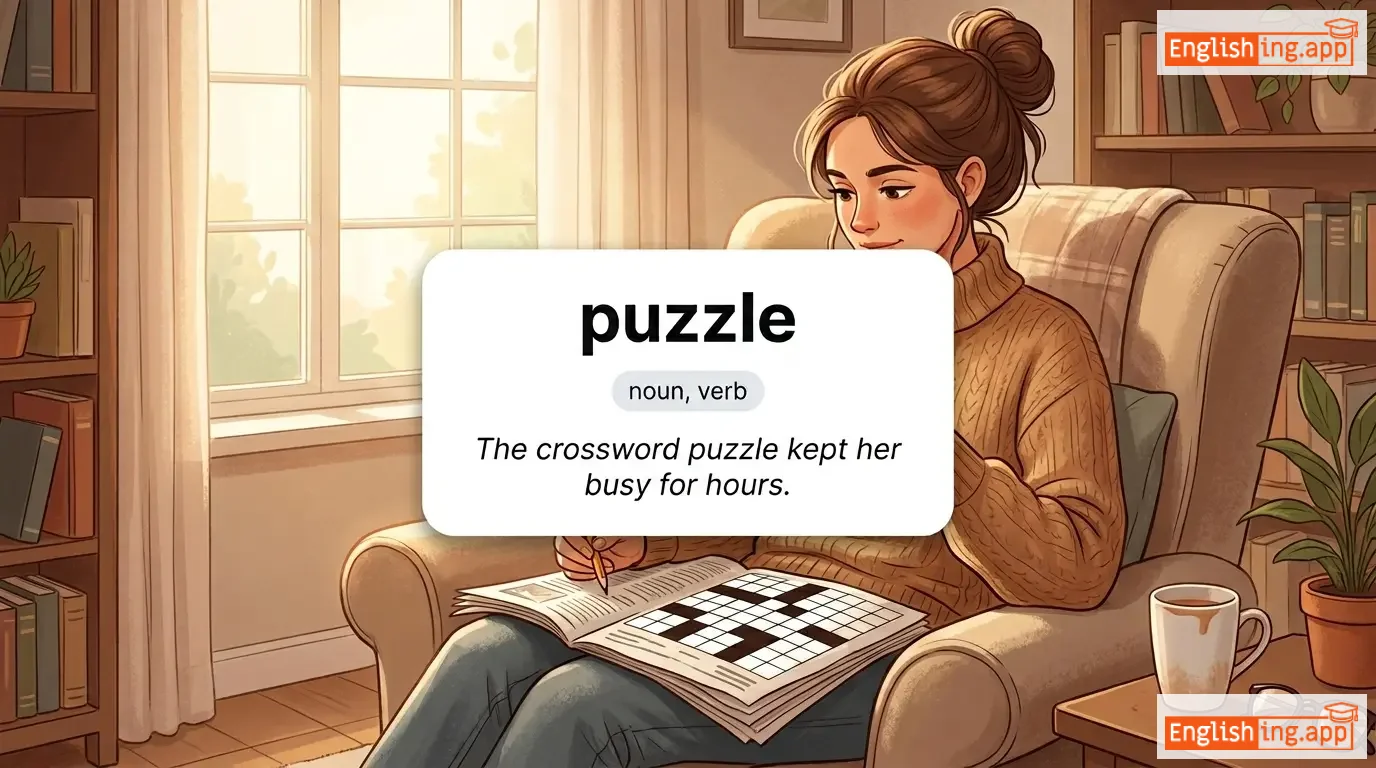
puzzle definition card — visual illustration of the meaning
noun, verb
/ˈpʌzl/
casse-tête / troubler (casse-tête / troubler)

a game, toy, or problem designed to test ingenuity; to cause someone to be confused

"The crossword puzzle kept her busy for hours."

"Le mot croisé l'a occupée pendant des heures." (Le mot croisé l'a occupée pendant des heures.)
adjective
/ˈpɪrɪk/
victoire pyrrhique (victoire pyrrhique)

A victory won at such a great cost that it is almost equivalent to defeat.

"The general declared the battle a pyrrhic victory due to heavy losses."

"Le général a déclaré la bataille comme une victoire pyrrhique en raison des lourdes pertes." (Le général a déclaré la bataille comme une victoire pyrrhique en raison des lourdes pertes.)
adjective
/ˌpaɪroʊˈtɛknɪk/
pyrotechnique (pyrotekniik)

Relating to fireworks or spectacular displays involving fire.

"The city celebrated with a grand pyrotechnic display on New Year's Eve."

"La ville a célébré avec un grand spectacle pyrotechnique lors de la veille du Nouvel An." (La ville a célébré avec un grand spectacle pyrotechnique lors de la veille du Nouvel An.)
noun
/ˌpaɪroʊˈmeɪniæk/
personne avec un désir incontrôlable d'incendier des choses (personne avec un désir incontrôlable d'incendier des choses)

A person with an uncontrollable desire to set things on fire.

"The pyromaniac was arrested for setting several buildings ablaze."

"Le pyromane a été arrêté pour avoir incendié plusieurs bâtiments." (Le pyromane a été arrêté pour avoir incendié plusieurs bâtiments.)
noun
/ˌpaɪrəˈmeɪniə/
désir incontrôlable de mettre le feu à des choses (desir incontrôlable de mettre le feu à des choses)

An uncontrollable desire to set things on fire.

"The suspect was diagnosed with pyromania after repeated incidents of arson."

"Le suspect a été diagnostiqué avec la pyromanie après plusieurs incidents d'incendie criminel." (Le suspect a été diagnostiqué avec la pyromanie après plusieurs incidents d'incendie criminel.)
noun
/paɪər/
bûcher funéraire (bucher funeraire)

A heap of combustible material, especially one used for burning a corpse as part of a funeral ceremony.

"The villagers built a pyre to honor the deceased."

"Les villageois ont construit un bûcher pour honorer le défunt." (Les villageois ont construit un bucheron pour honorer le defunt.)
adjective
/ˈpʌz.lɪŋ/
déroutant (deroutant)

confusing; perplexing;

"The scientist found the results puzzling."

"Le scientifique a trouvé les résultats déroutants." (Le scientifique a trouve les resultats deroutants.)
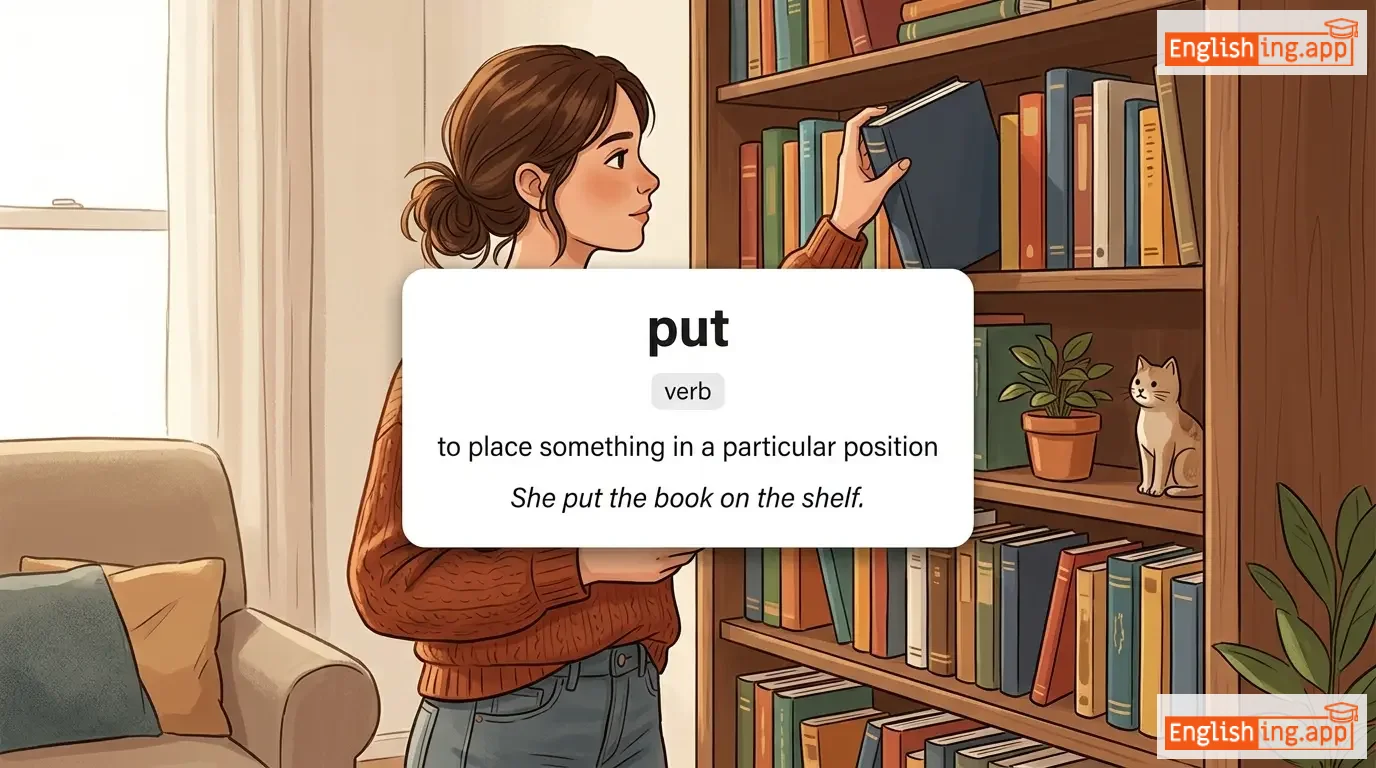
put definition card — visual illustration of the meaning
verb
/pʊt/
mettre (mettre)

to place something in a particular position

"She put the book on the shelf."

"Elle a mis le livre sur l'étagère." (Elle a mis le livre sur l'étagère.)
adjective
/ˈpjuːtətɪv/
présumé (presume)

commonly accepted or supposed; generally regarded as such

"He is the putative father of the child."

"Il est le père présumé de l'enfant." (Il est le père présumé de l'enfant.)
verb
/ˈpjuːtrɪfaɪ/
putréfier (putrefier)

to decay or rot, producing a foul smell

"The meat began to putrefy in the heat."

"La viande a commencé à pourrir sous la chaleur." (La viande a commence a pourrir sous la chaleur.)
adjective
/ˌpjuːsɪˈlænɪməs/
timoré (timore)

showing a lack of courage or determination; timid

"The pusillanimous leader avoided making tough decisions."

"Le leader timoré évitait de prendre des décisions difficiles." (Le leader timore evitait de prendre des decisions difficiles.)