Vocabulaires

Découvrez, apprenez et maîtrisez le vocabulaire anglais

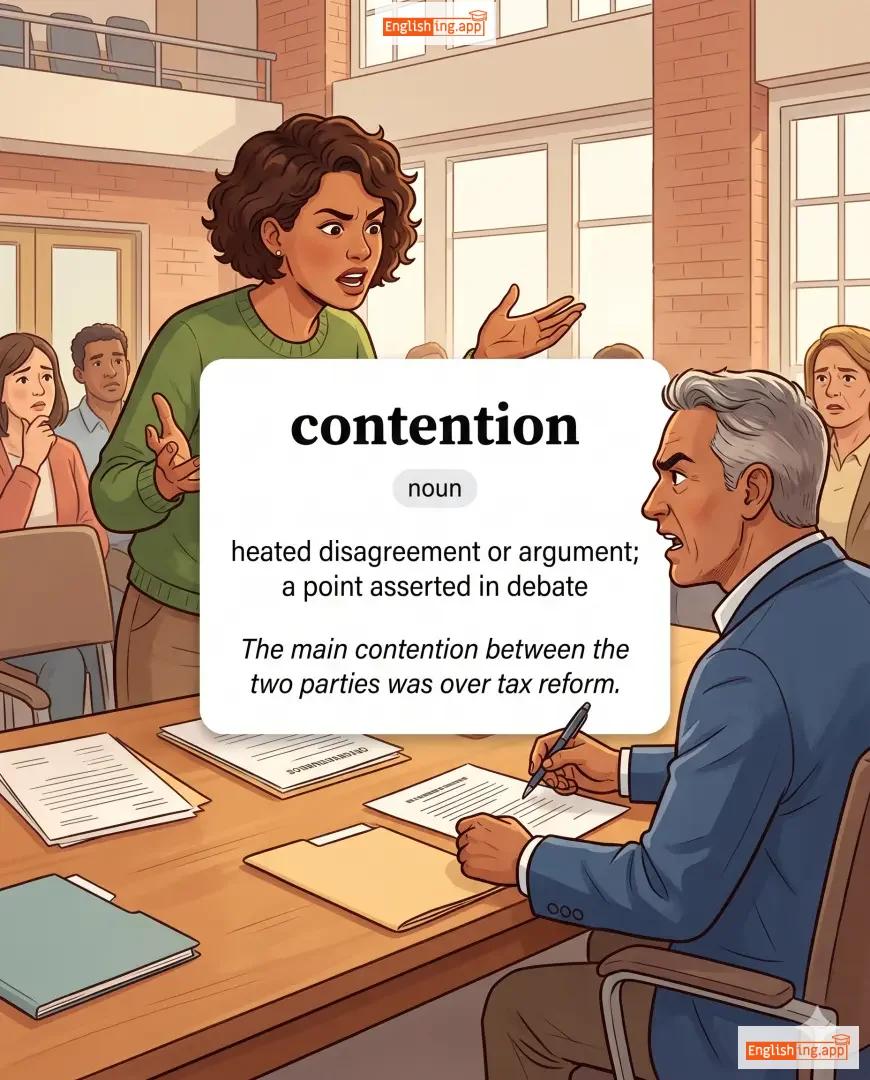
contention definition card — visual illustration of the meaning
noun
/kənˈtɛnʃən/
contestation, désaccord (contestation, désaccord)

heated disagreement or argument; a point asserted in debate

"The main contention between the two parties was over tax reform."

"La principale contestation entre les deux parties concernait la réforme fiscale." (La principale contestation entre les deux parties concernait la réforme fiscale.)
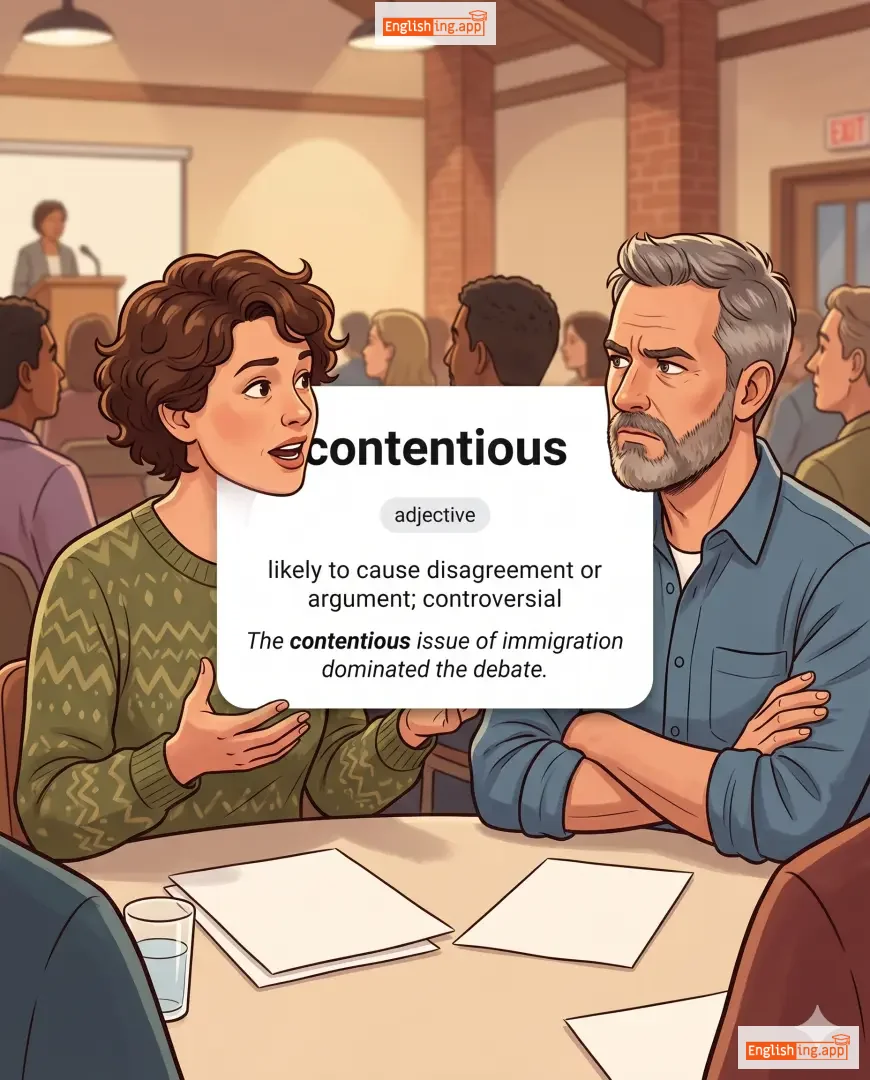
contentious definition card — visual illustration of the meaning
adjective
/kənˈtɛnʃəs/
controversé (controversé)

likely to cause disagreement or argument; controversial

"The contentious issue of immigration dominated the debate."

"La question controversée de l'immigration a dominé le débat." (La question controversée de l'immigration a dominé le débat.)
noun
/kənˈtentmənt/
satisfaction (satisfaction)

a state of happiness and satisfaction with what one has

"She felt a deep sense of contentment after helping others."

"Elle a ressenti une profonde satisfaction après avoir aidé les autres." (elle a ressenti une profonde satisfaction apres avoir aide les autres)
verb, noun
/ˈkɒntɛst/
contester, défier (contester, défier)

verb: to compete or challenge; noun: a competition or dispute

"She decided to contest the election against the incumbent."

"Elle a décidé de contester les élections contre le titulaire." (Elle a décidé de contester les élections contre le titulaire.)
noun
/ˈkɒntɛkst/
contexte (contexte)

the circumstances or background relevant to an event, statement, or idea

"To understand the quote, you need to know the context in which it was said."

"Pour comprendre la citation, vous devez connaître le contexte dans lequel elle a été dite." (Pour comprendre la citation, vous devez connaître le contexte dans lequel elle a été dite.)
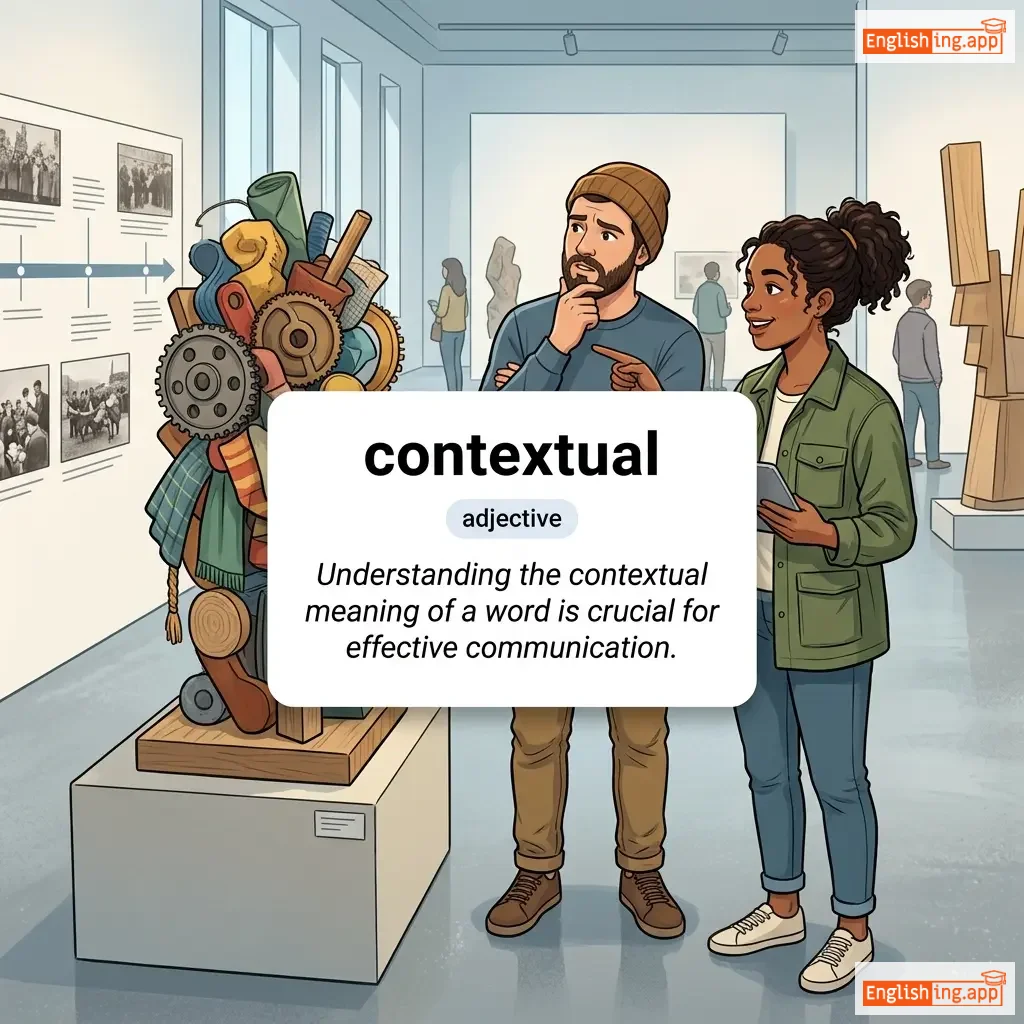
contextual definition card — visual illustration of the meaning
adjective
/kənˈtɛkstʃʊəl/
contextuel, en fonction du contexte (contextuel, en fonction du contexte)

Depending on or relating to the circumstances that form the setting for an event or statement.

"Understanding the contextual meaning of a word is crucial for effective communication."

"Comprendre la signification contextuelle d'un mot est crucial pour une communication efficace." (Comprendre la signification contextuelle d'un mot est crucial pour une communication efficace.)
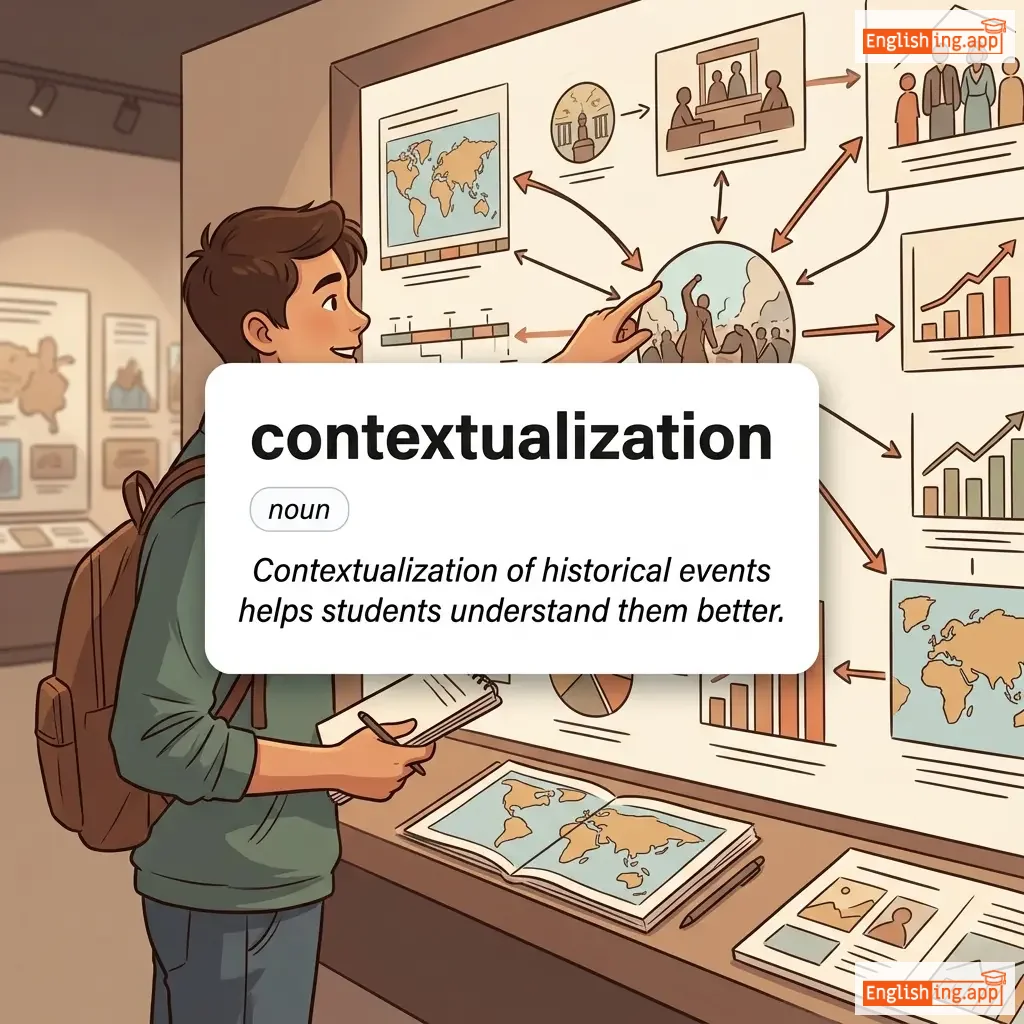
contextualization definition card — visual illustration of the meaning
noun
/kɒnˌtek.stʃu.ə.laɪˈzeɪ.ʃən/
contextualisation (contextualisation)

The process of placing something in its proper context or setting to understand it better.

"Contextualization of historical events helps students understand them better."

"La contextualisation des événements historiques aide les étudiants à mieux les comprendre." (La contextualisation des événements historiques aide les étudiants à mieux les comprendre.)
verb
/kənˈtɛkstʃuəlaɪz/
contextualiser (contextualiser)

to place something in a context or interpret it in relation to its surroundings

"The teacher contextualized the historical event to make it more relevant for students."

"Le professeur a contextualisé l'événement historique pour le rendre plus pertinent pour les étudiants." (Le professeur a contextualisé l'événement historique pour le rendre plus pertinent pour les étudiants.)
noun
/kɒn.tɪˈɡjuː.ɪ.ti/
contiguïté (contiguite)

the state of being in direct contact or next to each other

"The contiguity of the two countries facilitates trade."

"La contiguïté des deux pays facilite le commerce." (La contiguïté des deux pays facilite le commerce.)
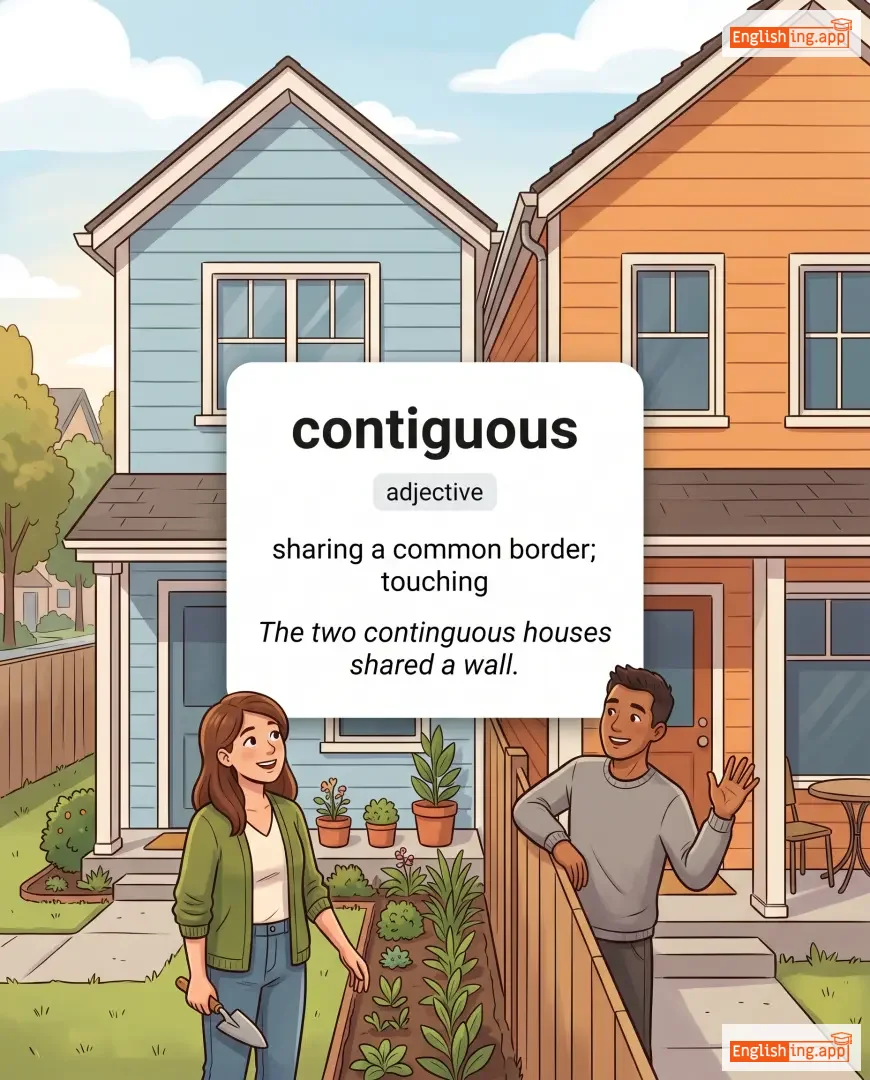
contiguous definition card — visual illustration of the meaning
adjective
/kənˈtɪɡ.ju.əs/
contigu (contigu)

sharing a common border; touching

"The two continguous houses shared a wall."

"Les deux maisons contiguës ont partagé un mur." (Le deux maisons contigues ont partage un mur.)
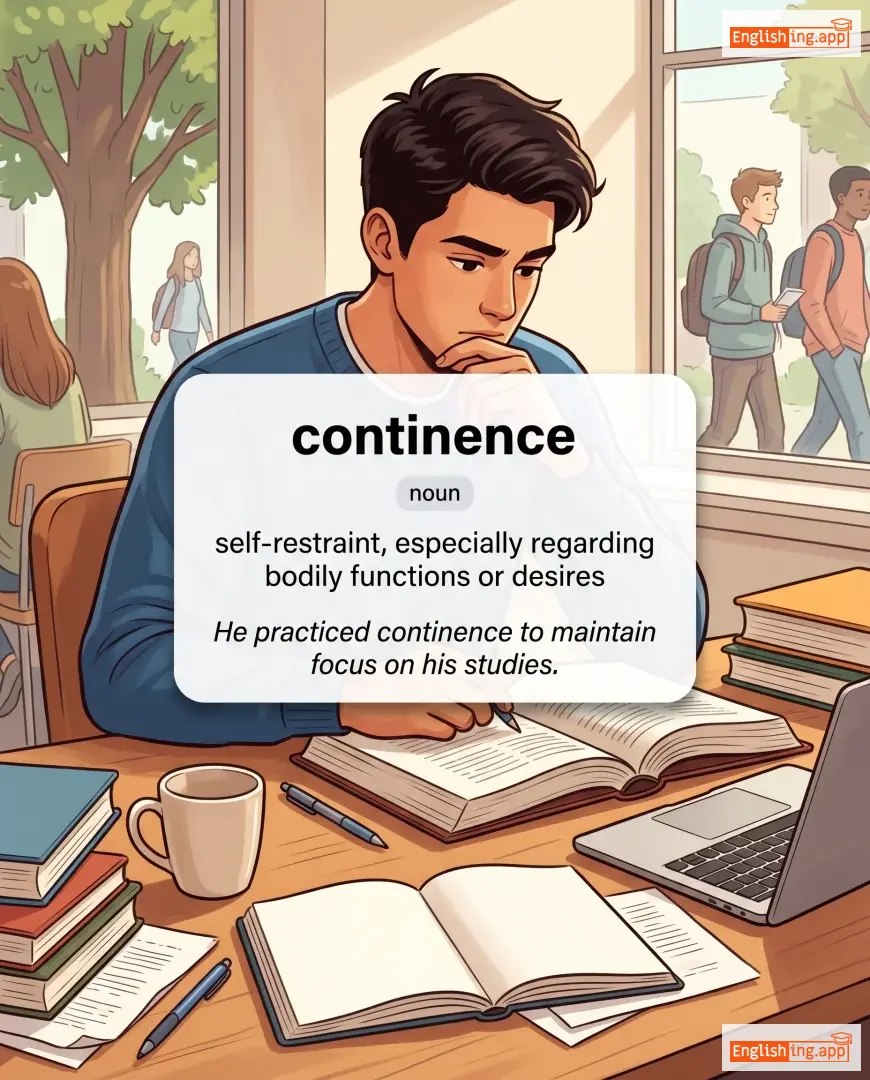
continence definition card — visual illustration of the meaning
noun
/ˈkɒn.tɪ.nəns/
continence (continence)

self-restraint, especially regarding bodily functions or desires

"He practiced continence to maintain focus on his studies."

"Il a pratiqué la continence pour maintenir son attention sur ses études." (Il a pratiqué la continence pour maintenir son attention sur ses études.)
noun
/ˈkɒntɪnənt/
continent (continent)

one of the large landmasses on Earth such as Asia, Africa, or Europe

"Asia is the largest continent in the world."

"L'Asie est le plus grand continent du monde." (L'Asie est le plus grand continent du monde.)
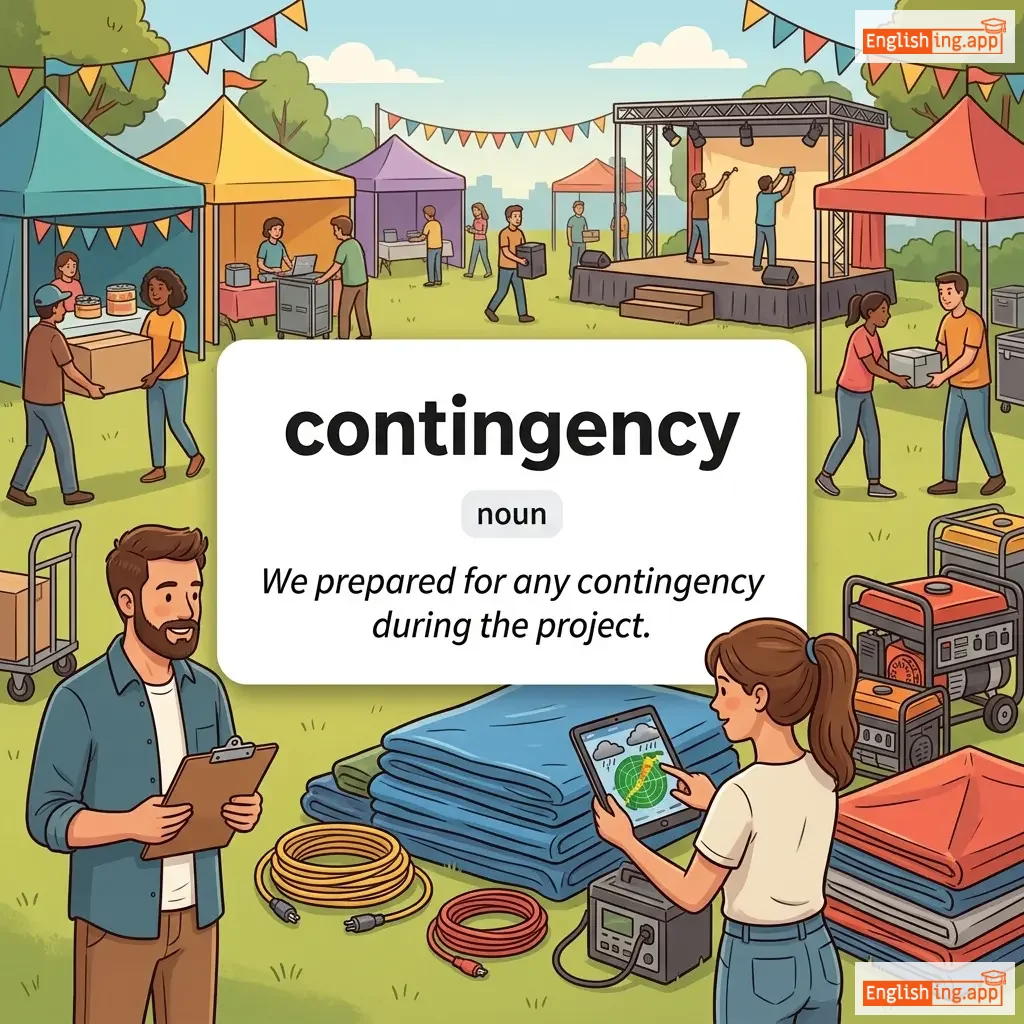
contingency definition card — visual illustration of the meaning
noun
/kənˈtɪn.dʒən.si/
contingence (contingence)

a future event or circumstance that is possible but cannot be predicted with certainty

"We prepared for any contingency during the project."

"Nous nous sommes préparés à toute contingence pendant le projet." (Nous nous sommes prepares a toute contingence pendant le projet.)
adjective,noun
/kənˈtɪn.dʒənt/
dépendant / contingent (depan-dɑ̃ / kɔ̃tɛ̃ʒɑ̃)

dependent on something else; a group of people representing an organization

"Attendance is contingent on prior registration. / A contingent of students attended the conference."

"La présence dépend de l'inscription préalable. / Un contingent d'étudiants a assisté à la conférence." (La présence dépend de l'inscription préalable. / Un contingent d'étudiants a assisté à la conférence.)
adjective
/kənˈtɪn.ju.əl/
continu; ininterrompu; (continu; ininterrompu;)

happening repeatedly over a long period of time; constant and uninterrupted

"The continual noise from the construction site was very annoying."

"Le bruit continu du chantier de construction était très ennuyeux." (Le bruit continu du chantier de construction etait tres ennuyeux.)
adverb
/kənˈtɪnjuəli/
continuellement (continuellement)

in a continuous and uninterrupted way

"The rain has been falling continually for hours."

"La pluie tombe continuellement depuis des heures." (La pluie tombe continuellement depuis des heures.)
noun
/kənˈtɪn.ju.əns/
continuité (continuité)

the state of continuing or being prolonged; persistence

"The continuance of the project depended on securing additional funding."

"La continuité du projet dépendait de l'obtention de financements supplémentaires." (La continuité du projet dépendait de l'obtention de financements supplémentaires.)
noun
/kənˌtɪn.juˈeɪ.ʃən/
continuité (continuite)

the action of carrying something on over time; extension

"The continuation of the series was announced after the finale."

"La continuation de la série a été annoncée après la finale." (La continuation de la serie a ete annoncee apres la finale.)
verb
/kənˈtɪnjuː/
continuer (continuer)

To keep happening, existing, or doing something without stopping.

"The rain will continue throughout the night."

"La pluie continuera toute la nuit." (La pluie continuera toute la nuit.)
verb
/kənˈtɪn.juːd/
continué (continue)

Kept happening or carried on without stopping.

"She continued working despite the challenges."

"Elle a continué de travailler malgré les défis." (Elle a continue de travailler malgre les defis.)
verb
/kənˈtɪnjuɪŋ/
continuant (continuant)

to keep doing something without stopping

"They are continuing their journey despite the rain."

"Ils continuent leur voyage malgré la pluie." (Ils continuent leur voyage malgré la pluie.)
noun
/ˌkɒn.tɪˈnjuː.ɪ.ti/
continuité (continuite)

the state of being continuous or connected; consistency over time

"Maintaining continuity in leadership is essential for organizational stability."

"Maintenir la continuité dans le leadership est essentiel pour la stabilité organisationnelle." (Maintenir la continuite dans le leadership est essentiel pour la stabilite organisationnelle.)
adjective
/kənˈtɪn.ju.əs/
continu (continu)

forming an unbroken whole; without interruption

"The factory operates on a continuous 24-hour schedule."

"L'usine fonctionne selon un emploi du temps continu de 24 heures." (L'usine fonctionne selon un emploi du temps continu de 24 heures.)
adverb
/kənˈtɪnjuəsli/
continuellement; sans interruption; de manière ininterrompue (continuellement; sans interruption; de maniere ininterrompue)

without interruption; in an unbroken sequence

"The machine operates continuously for 24 hours."

"La machine fonctionne continuellement pendant 24 heures." (La machine fonctionne continuellement pendant 24 heures)
noun
/kənˈtɪnjuəm/
continuum (continuum)

A continuous sequence in which adjacent elements are not perceptibly different from each other, but the extremes are quite distinct.

"Life and death are often seen as part of the same continuum."

"La vie et la mort sont souvent considérées comme faisant partie du même continuum." (La vie et la mort sont souvent considerees comme faisant partie du meme continuum.)
verb
/kənˈtɔːrt/
tordre (tordre)

to twist or bend out of the normal shape

"She contorted her face in pain after the injury."

"Elle tordit son visage de douleur après la blessure." (Elle tordit son visage de douleur après la blessure.)
noun
/kənˈtɔːrʃən/
une forme tordue ou pliée; l'action de tordre hors de la forme normale (une forme tordue ou pliée; l'action de tordre hors de la forme normale)

a twisted or bent shape; the act of twisting out of the normal shape

"The gymnast's contortion amazed the audience."

"La contorsion du gymnaste a étonné le public." (La contorsion du gymnaste a étonné le public.)
noun
/kənˈtɔːrʃənz/
pluriel de contorsion; plusieurs formes tordues ou déformées (pluriel de contorsion; plusieurs formes tordues ou déformées)

plural form of contortion; multiple twisted or bent shapes

"The magician's contortions left the crowd in awe."

"Les contorsions du magicien ont laissé la foule bouche bée." (Les contorsions du magicien ont laissé la foule bouche bée.)
noun
/ˈkɒntrəbænd/
marchandises illégales (marchandises illegales)

goods that are illegal to import, export, or possess

"The police seized a shipment of contraband cigarettes."

"La police a saisi une cargaison de cigarettes de contrebande." (La police a saisi une cargaison de cigarettes de contrebande.)
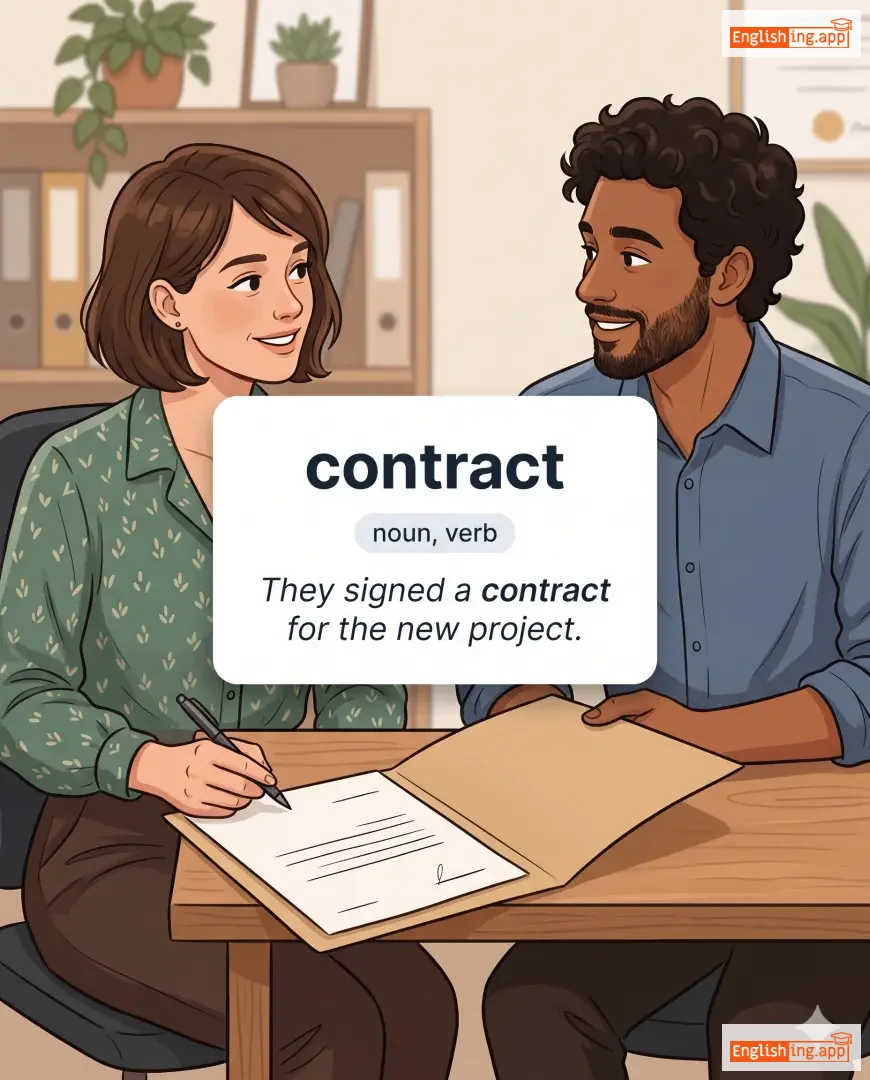
contract definition card — visual illustration of the meaning
noun, verb
/ˈkɒntrækt/
contrat, accord écrit ou oral (contrat, accord écrit ou oral)

noun: a written or spoken agreement; verb: to enter into an agreement or to reduce in size

"They signed a contract for the new project."

"Ils ont signé un contrat pour le nouveau projet." (Ils ont signé un contrat pour le nouveau projet.)
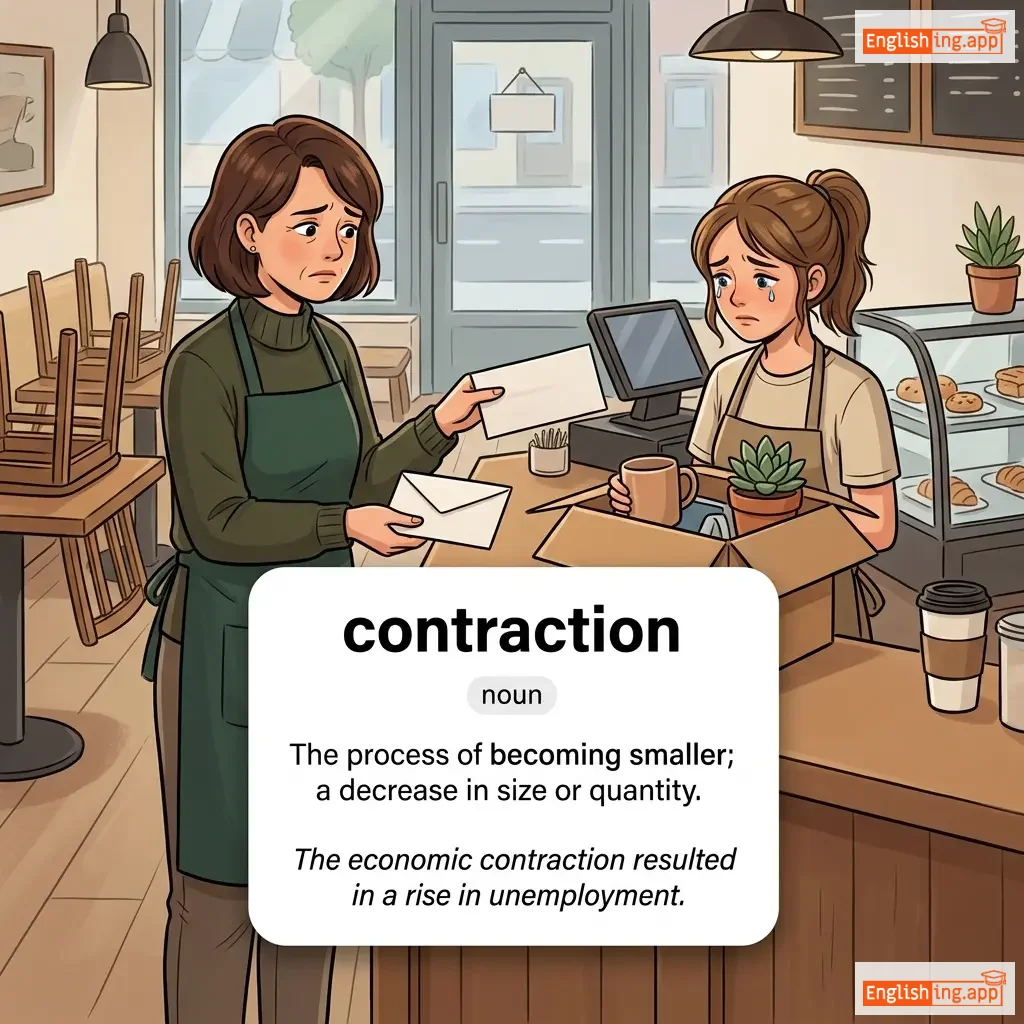
contraction definition card — visual illustration of the meaning
noun
kənˈtrækʃən
contraction (kontraksion)

The process of becoming smaller; a decrease in size or quantity.

"The economic contraction resulted in a rise in unemployment."

"La contraction économique a entraîné une augmentation du chômage." (La contraction économique a entraîné une augmentation du chômage.)
noun
/ˈkɒntræktər/
entrepreneur (entrepreneur)

a person or company that agrees to provide materials or labor to perform a service or do a job

"The contractor completed the building project on time."

"L'entrepreneur a terminé le projet de construction à temps." (L'entrepreneur a termine le projet de construction a temps.)
verb
/ˌkɒn.trəˈdɪkt/
contredire (contredire)

to say or show the opposite of something that has been said or believed

"His actions contradict his words."

"Ses actions contredisent ses paroles." (Ses actions contredisent ses paroles.)
noun
/ˌkɒntrəˈdɪkʃən/
contradiction, incohérence (contradiction, incoherence)

a statement or situation that is opposed to another, inconsistency

"Her actions are in clear contradiction to her words."

"Ses actions sont en claire contradiction avec ses paroles." (Ses actions sont en claire contradiction avec ses paroles.)
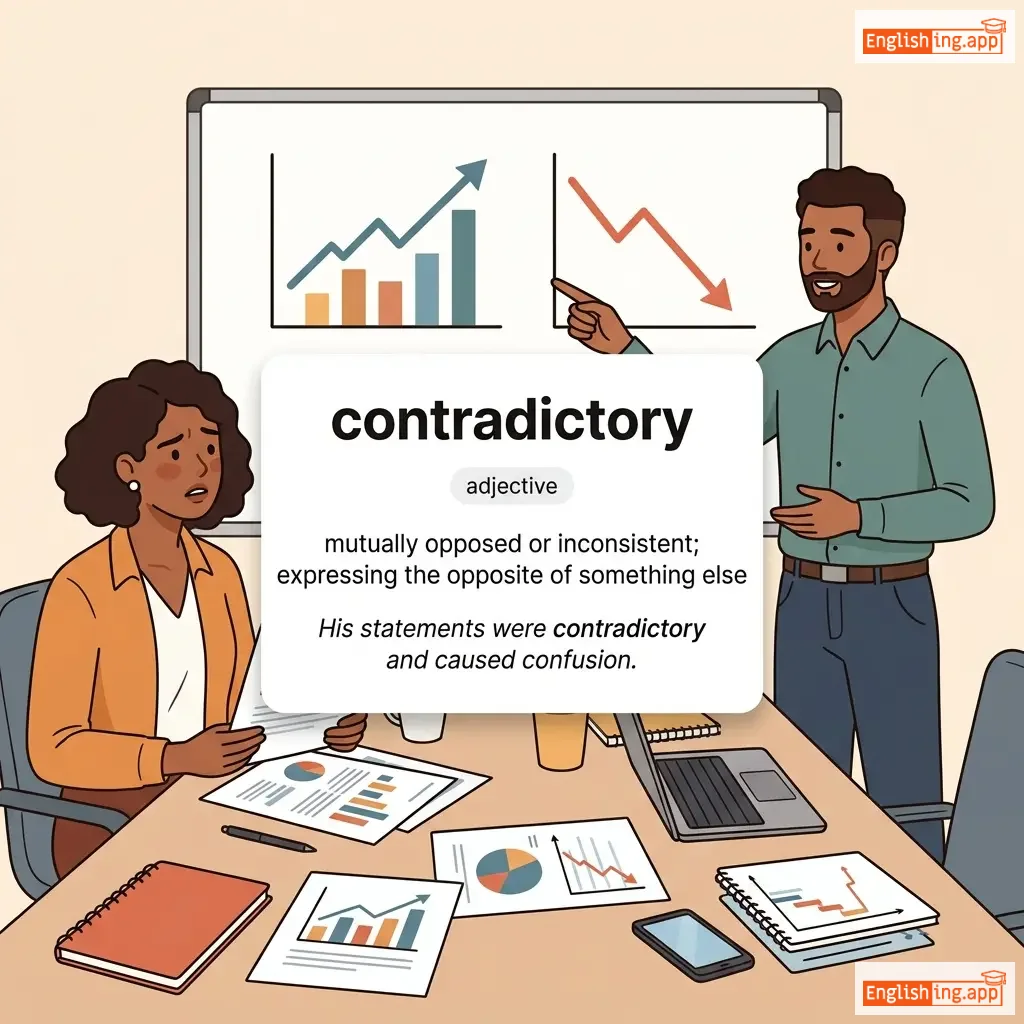
contradictory definition card — visual illustration of the meaning
adjective
/ˌkɒntrəˈdɪktəri/
contradictoire (contradictoire)

mutually opposed or inconsistent; expressing the opposite of something else

"His statements were contradictory and caused confusion."

"Ses déclarations étaient contradictoires et ont causé de la confusion." (Ses déclarations étaient contradictoires et ont causé de la confusion.)
noun
/ˌkɒntrəpəˈzɪʃən/
contraposition (contraposizion)

the act of placing two things in opposition for contrast or comparison

"The contraposition of the two theories highlighted their differences."

"La contraposition des deux théories a mis en lumière leurs différences." (La contraposition des deux theories a mis en lumiere leurs differences.)
noun
/ˈkɒntrəriz/
choses opposées (choses opposees)

things that are completely different or opposite to each other

"Freedom and slavery are contraries in every sense."

"La liberté et l'esclavage sont des contraires dans tous les sens." (La liberte et l'esclavage sont des contraires dans tous les sens.)
adjective
/ˈkɒn.trəri/
contraire (contraire)

opposite in nature, direction, or meaning

"Her views are contrary to mine."

"Ses opinions sont contraires aux miennes." (Ses opinions sont contraires aux miennes.)
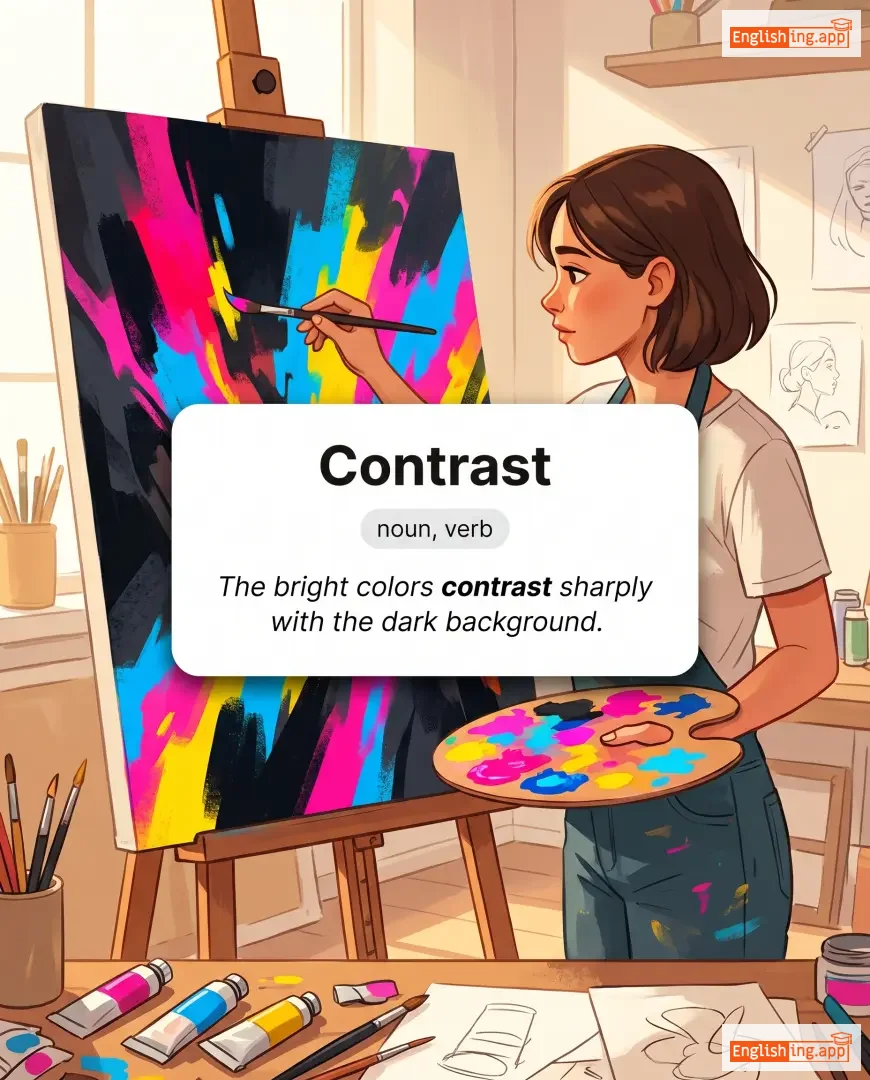
Contrast definition card — visual illustration of the meaning
noun, verb
/ˈkɒn.trɑːst/ (noun), /kənˈtræst/ (verb)
bonheur (bonheur)

A difference between two or more things; to compare two things to show how they are different.

"The bright colors contrast sharply with the dark background."

"Elle ne pouvait pas cacher son bonheur quand elle a reçu le prix." (Elle ne pouvait pas cacher son bonheur quand elle a recu le prix.)
verb
/ˌkɒntrəˈviːn/
contrevenir (contrevenir)

to go against or act in opposition to a law, rule, or agreement

"He contravened the safety regulations and was fined."

"Il a contrevenu aux règles de sécurité et a été amende." (Il a contrevenu aux règles de sécurité et a été amende.)
noun
/ˈkɒntrətɑː̃/
malentendu inattendu (malentendu inattendu)

an unexpected and unfortunate event or disagreement; a minor dispute

"There was a small contretemps between the two colleagues during the meeting."

"Il y a eu un petit malentendu entre les deux collègues pendant la réunion." (Il y a eu un petit malentendu entre les deux collègues pendant la réunion.)
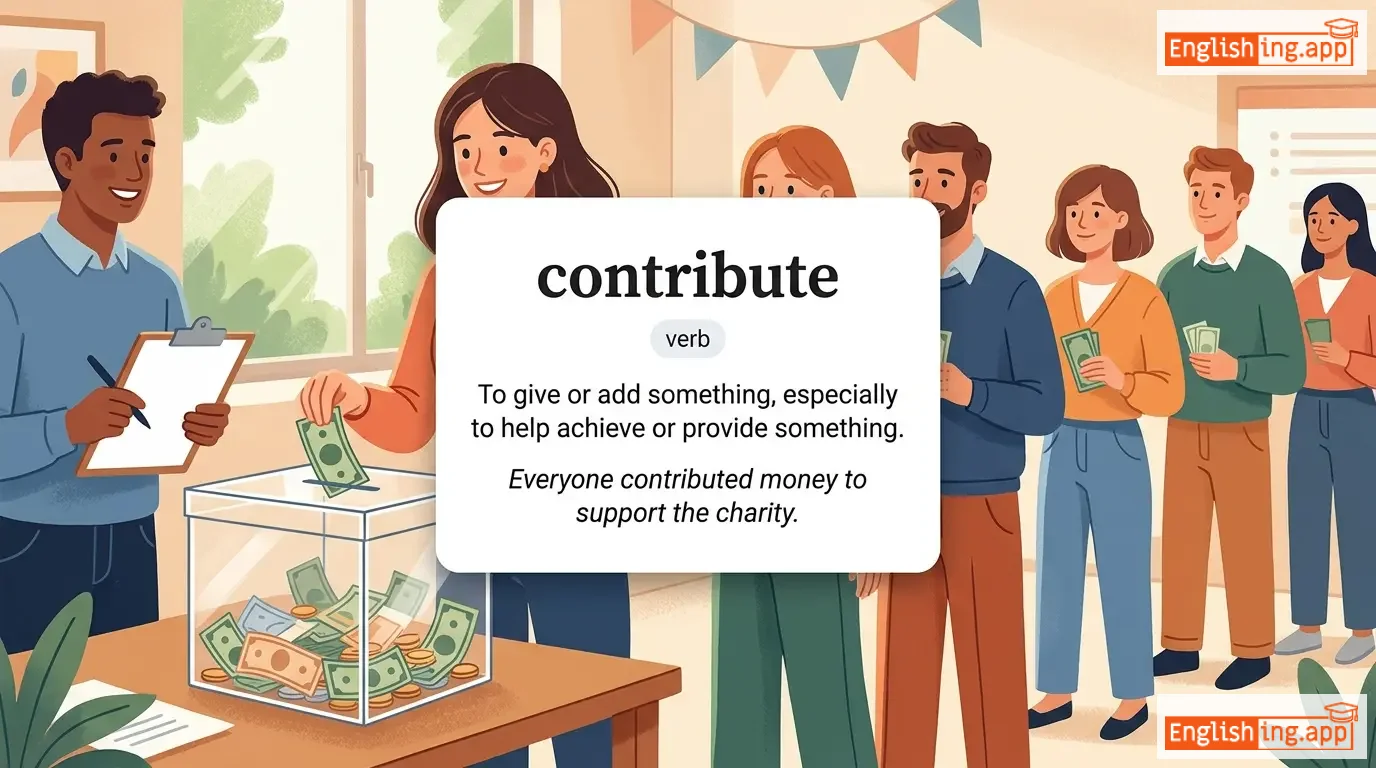
contribute definition card — visual illustration of the meaning
verb
/kənˈtrɪbjuːt/
contribuer (contribuer)

To give or add something, especially to help achieve or provide something.

"Everyone contributed money to support the charity."

"Tout le monde a contribué de l'argent pour soutenir la charité." (Tout le monde a contribué de l'argent pour soutenir la charité.)
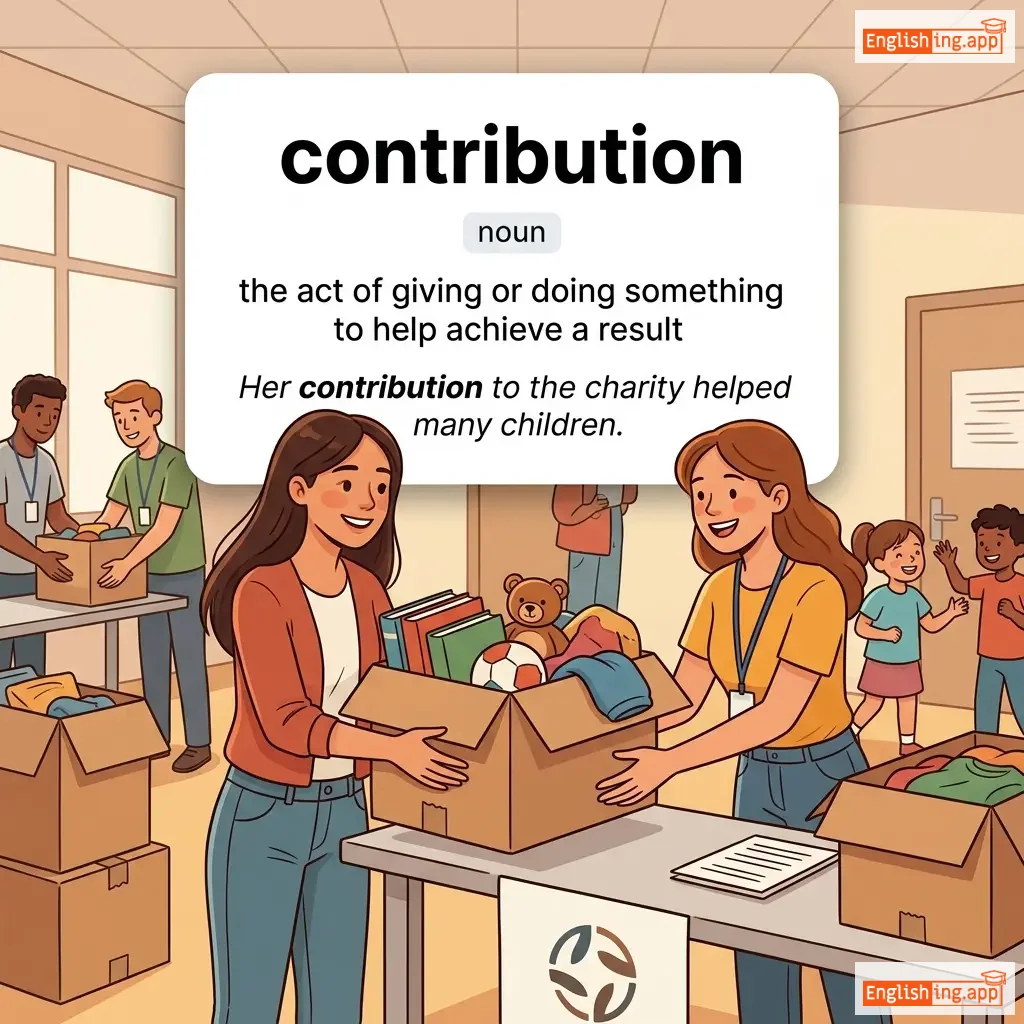
contribution definition card — visual illustration of the meaning
noun
/ˌkɒn.trɪˈbjuː.ʃən/
contribution (contribution)

the act of giving or doing something to help achieve a result

"Her contribution to the charity helped many children."

"Sa contribution à la charité a aidé de nombreux enfants." (Sa contribution à la charité a aidé de nombreux enfants.)
noun
/ˈkɒn.trɪ.bjʊ.tər/
contributeur (contributeur)

a person who gives something to help achieve a result

"He was a regular contributor to the local newspaper."

"Il était un contributeur régulier au journal local." (Il était un contributeur régulier au journal local.)
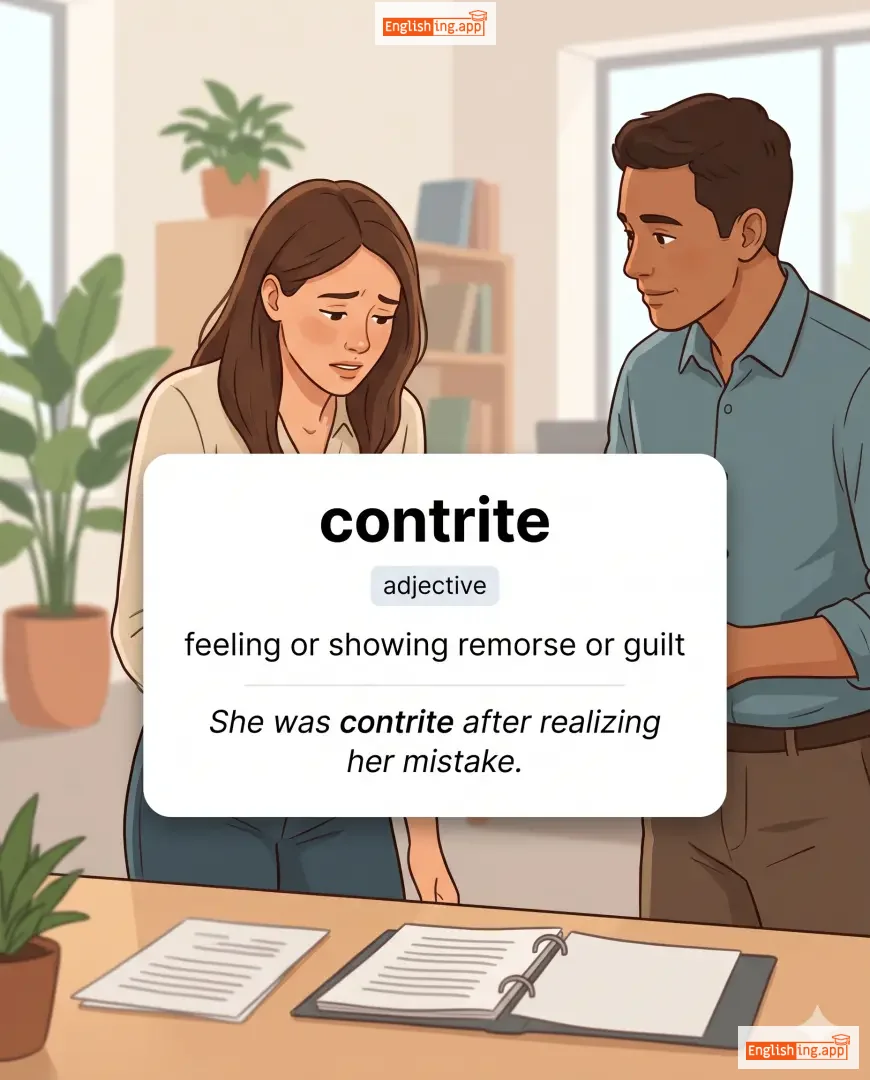
contrite definition card — visual illustration of the meaning
adjective
/kənˈtraɪt/
contrit (contrit)

feeling or showing remorse or guilt

"She was contrite after realizing her mistake."

"Elle était contrite après avoir réalisé son erreur." (Elle était contrite après avoir réalisé son erreur.)
noun
/kənˈtrɪʃ.ən/
contrition (contrition)

the state of feeling remorseful and repentant

"His contrition was evident after the apology."

"Sa contrition était évidente après des excuses." (Sa contrition etait evidente apres des excuses.)
noun
/kənˈtraɪ.vəns/
appareil ou plan (appareil ou plan)

a device or plan that is cleverly or artificially created

"The clock was an intricate contrivance of gears and springs."

"L'horloge était un dispositif complexe de rouages et de ressorts." (L'horloge était un dispositif complexe de rouages et de ressorts.)
verb
/kənˈtraɪv/
concevoir (concevoir)

to plan or devise cleverly or skillfully

"She contrived a clever plan to surprise her friends."

"Elle a conçu un plan ingénieux pour surprendre ses amis." (Elle a conçu un plan ingénieux pour surprendre ses amis.)
noun
/ˈklævɪkəl/
clavicule (clavicule)

the collarbone, a long bone that serves as a strut between the shoulder blade and the sternum

"He fractured his clavicle in the accident."

"Il a fracturé sa clavicule dans l'accident." (Il a fracture sa clavicule dans l'accident.)
noun
/klɔː/
griffe (griffe)

sharp curved nail on the foot of an animal or bird

"The cat extended its sharp claws to climb the tree."

"Le chat a étendu ses griffes acérées pour grimper à l'arbre." (Le chat a étendu ses griffes acérées pour grimper à l'arbre.)