Vocabularios

Descubra, aprenda y domine el vocabulario en inglés

noun
/ˌɒp.əˈtjuː.nə.ti/
oportunidad (oportunidad)

A favorable chance or set of circumstances that makes it possible to do something.

"She seized the opportunity to study abroad."

"Ella aprovechó la oportunidad de estudiar en el extranjero." (Ella aprovechó la oportunidad de estudiar en el extranjero.)
opportunities definition card — visual illustration of the meaning
noun
ˌɒpəˈtjuːnɪtiz
oportunidades (oportunidades)

A set of circumstances that makes it possible to do something.

"Investing in emerging markets provides new opportunities."

"Invertir en mercados emergentes ofrece nuevas oportunidades." (Invertir en mercados emergentes ofrece nuevas oportunidades.)
noun
/ˌɑːpərˈtuːnɪst/
oportunista (oportunista)

A person who takes advantage of situations for personal gain, often disregarding principles.

"He is seen as an opportunist who always puts his interests first."

"Se le ve como un oportunista que siempre pone sus intereses primero." (Se le ve como un oportunista que siempre pone sus intereses primero.)
noun
/ˌɑːpərˈtuːnɪzəm/
oportunismo (oportunismo)

The practice of taking advantage of opportunities regardless of principles or ethics.

"His decision was driven by opportunism, not values."

"Su decisión fue impulsada por el oportunismo, no por los valores." (Su decision fue impulsada por el oportunismo, no por los valores.)
adjective
/ˌɑːpərˈtuːn/
momento oportuno (momento oportuno)

Happening at a suitable or convenient time.

"She arrived at an opportune moment to help."

"Llegó en un momento oportuno para ayudar." (Llegó en un momento oportuno para ayudar.)
noun
/əˈpoʊnənt/
felicidad (felicidad)

A person who competes against or disagrees with another.

"The boxer defeated his opponent in the final round."

"Ella no pudo ocultar su felicidad cuando recibió el premio." (Ella no pudo ocultar su felicidad cuando recibio el premio.)
noun
/əˈpɪnjən/
opinión (opinion)

A belief, judgment, or viewpoint about something, not necessarily based on fact.

"Everyone is entitled to their own opinion."

"Todos tienen derecho a su propia opinión." (Todos tienen derecho a su propia opinion.)
verb
/oʊˈpaɪn/
expresar una opinión (expresar una opinion)

to express an opinion or belief

"The professor opined that the policy would fail."

"El profesor opinó que la política fracasaría." (El profesor opino que la politica fracasaria.)
noun
/ˈoʊpiət/
opiáceo (opiate)

a drug containing opium or its derivatives, used to relieve pain or cause sleep

"The doctor prescribed an opiate to relieve the patient's pain."

"El médico recetó un opiáceo para aliviar el dolor del paciente." (El medico receto un opiaceo para aliviar el dolor del paciente.)
noun
/ˌɒpəˈrɛtə/
ópera ligera (opera ligera)

a short opera with light and humorous themes

"The theater staged a famous operetta by Gilbert and Sullivan."

"El teatro presentó una famosa opereta de Gilbert y Sullivan." (El teatro presentó una famosa opereta de Gilbert y Sullivan.)
noun
/ˈɒpəreɪtər/
operador (operador)

a person who operates equipment, a business, or controls something

"The machine operator ensured that everything ran smoothly."

"El operador de la máquina se aseguró de que todo funcionara sin problemas." (El operador de la máquina se aseguró de que todo funcionara sin problemas.)
adjective
/ˈɒpərətɪv/
operativo (operativo)

functioning, having effect, or relating to a secret agent or worker

"The new law is now operative across the country."

"La nueva ley ya está operativa en todo el país." (La nueva ley ya está operativa en todo el país.)
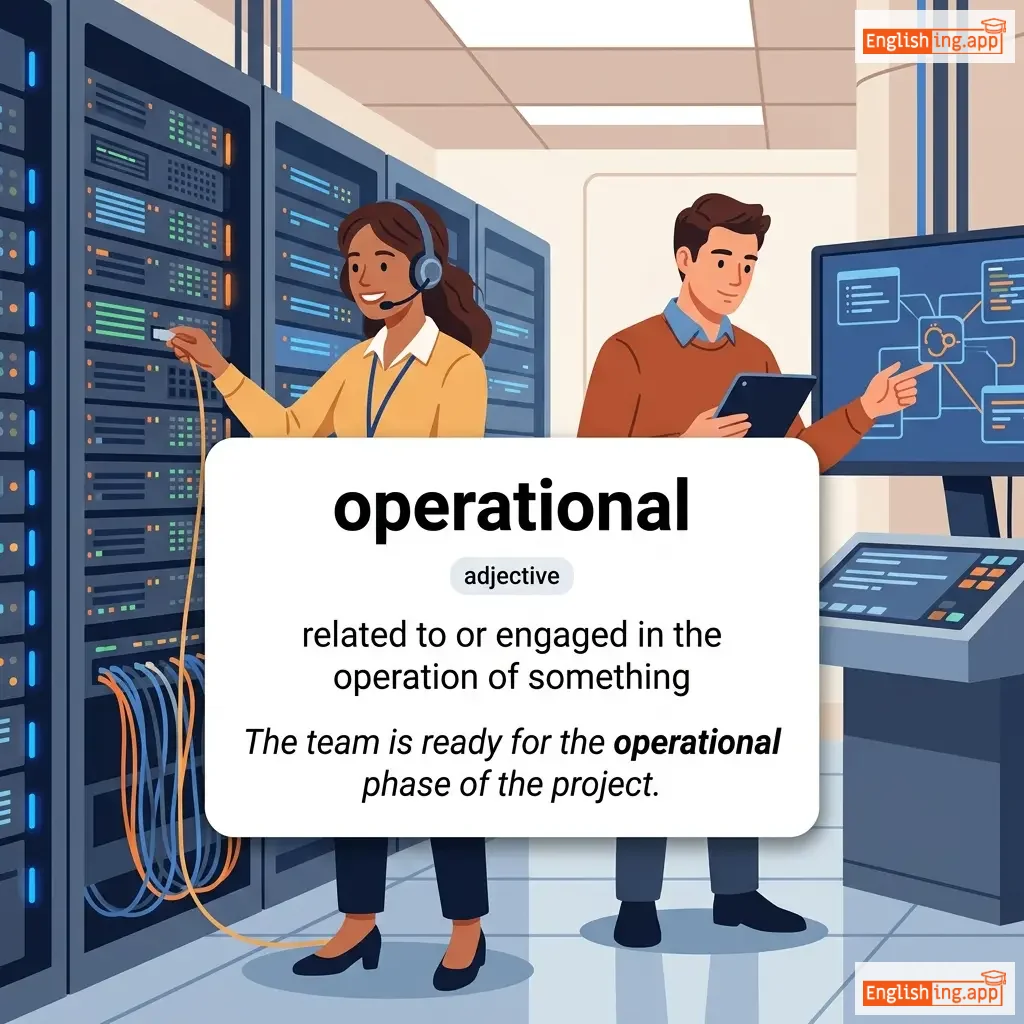
operational definition card — visual illustration of the meaning
adjective
/ˌɒpəˈreɪʃənl/
operacional (operational)

related to or engaged in the operation of something

"The team is ready for the operational phase of the project."

"El equipo está listo para la fase operacional del proyecto." (El equipo esta listo para la fase operacional del proyecto.)
noun
/ˌɒpəˈreɪʃən/
operación (operacion)

an act or process of functioning or operating

"The hospital performed a successful operation."

"El hospital realizó una operación exitosa." (El hospital realizo una operacion exitosa.)
verb
/ˈɒpəreɪtɪŋ/
operando (operando)

to control or manage the functioning of something

"The company has been operating in this market for five years."

"La compañía ha estado operando en este mercado durante cinco años." (La compañia ha estado operando en este mercado durante cinco años.)
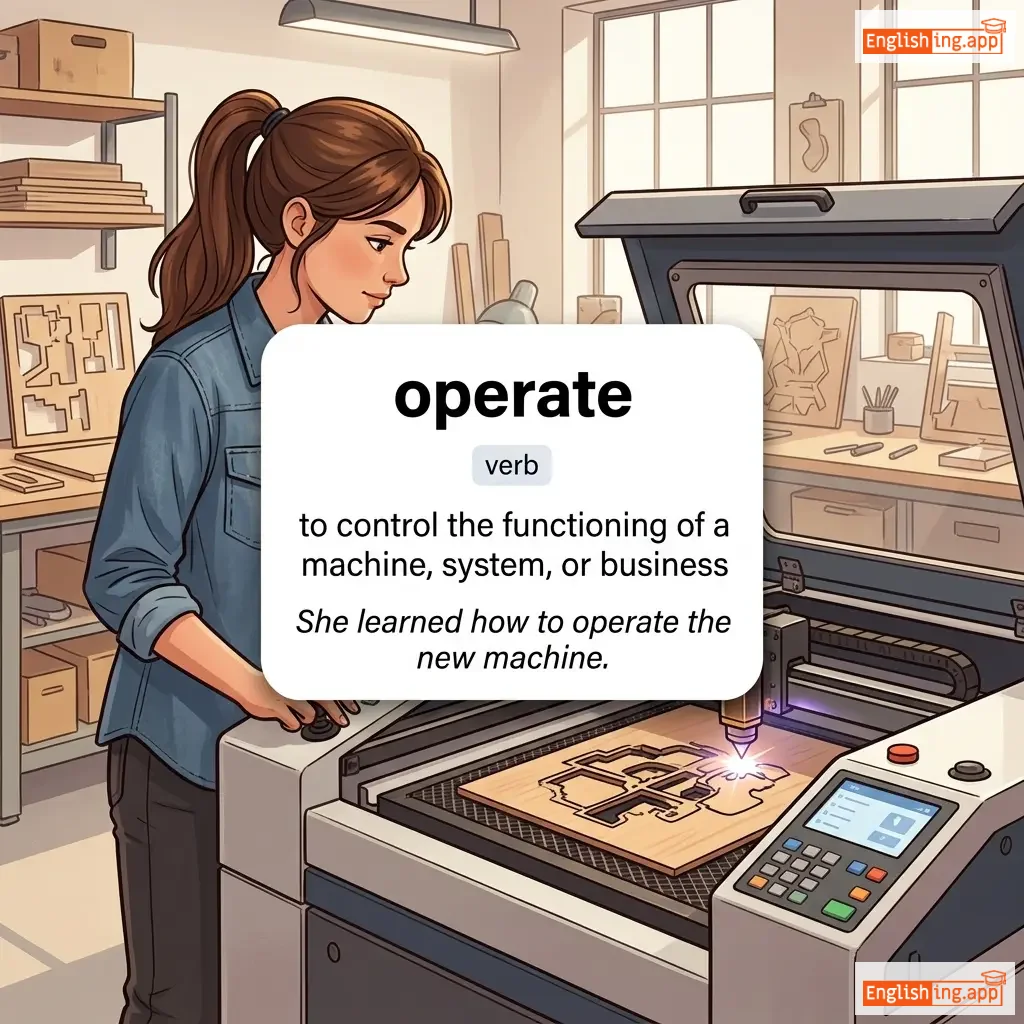
operate definition card — visual illustration of the meaning
verb
/ˈɑːpəˌreɪt/
operar (operar)

to control the functioning of a machine, system, or business

"She learned how to operate the new machine."

"Ella aprendió a operar la nueva máquina." (Ella aprendo a operar la nueva maquina.)
noun
/ˈɒpərə/
ópera (opera)

a dramatic performance in which the actors sing most of their lines

"We watched a beautiful opera at the theater last night."

"Vimos una hermosa ópera en el teatro anoche." (Vimos una hermosa opera en el teatro anoche.)
adverb
/ˈəʊpənli/
abiertamente (abiertamente)

in a way that is not secret or hidden

"He spoke openly about his past mistakes."

"Él habló abiertamente sobre sus errores pasados." (Él habló abiertamente sobre sus errores pasados.)
noun
/ˈoʊpənɪŋ/
apertura (apertura)

an act or instance of beginning something

"The opening of the new store was a huge success."

"La apertura de la nueva tienda fue un gran éxito." (La apertura de la nueva tienda fue un gran éxito.)
noun
/ˈoʊ.dər/
olor (olor)

a distinctive smell, especially an unpleasant one

"The odour of fresh bread filled the kitchen."

"El olor de pan fresco llenó la cocina." (El olor de pan fresco llenó la cocina.)
noun
/ˈɒktɪv/
octava (oktava)

A series of eight musical notes, or the interval between one musical pitch and another with double its frequency.

"The singer's voice could easily reach the higher octave."

"La voz del cantante podría alcanzar fácilmente la octava más alta." (La voz del cantante podria alcanzar facilmente la octava mas alta.)
noun
/ɒkˈteɪvoʊ/
octavo (tamaño de libro resultante de doblar una hoja en ocho partes) (oktavo)

A size of book page resulting from folding a sheet of paper into eight leaves (sixteen pages).

"The old library contained rare octavo editions of Shakespeare."

"La antigua biblioteca contenía ediciones raras de octavo de Shakespeare." (La antigua biblioteca contenía ediciones raras de octavo de Shakespeare.)
noun
/ɒkˈtoʊbər/
octubre (octubre)

the tenth month of the year in the Gregorian calendar

"The weather becomes cooler in October."

"El clima se vuelve más fresco en octubre." (el clima se vuelve mas fresco en octubre)
noun
/ˌɒktədʒəˈnɛəriən/
octogenario (octogenario)

A person who is between 80 and 89 years old.

"The octogenarian still jogs every morning to stay healthy."

"El octogenario aún corre todas las mañanas para mantenerse saludable." (El octogenario aun corre todas las mañanas para mantenerse saludable.)
adjective
/ˈɒkjʊlər/
ocular (ocular)

Relating to the eye or vision.

"The patient was referred to a specialist for ocular treatment."

"El paciente fue referido a un especialista para tratamiento ocular." (El paciente fue referido a un especialista para tratamiento ocular.)
noun
/ˈɒkjʊlɪst/
optometrista (optometrista)

An old-fashioned term for an eye doctor or ophthalmologist.

"The village oculist was known for treating various eye diseases."

"El oculista del pueblo era conocido por tratar diversas enfermedades oculares." (El oculista del pueblo era conocido por tratar diversas enfermedades oculares.)
adjective
/ɒd/
extraño (extrano)

different from what is usual or expected; strange or peculiar

"He has some odd habits that surprise everyone."

"Él tiene algunas costumbres extrañas que sorprenden a todos." (El tiene algunas costumbres extrañas que sorprenden a todos.)
noun
/ˈɒdəti/
rareza (rareza)

Something strange or unusual.

"The bright pink building was an oddity in the small town."

"El edificio rosa brillante era una rareza en el pequeño pueblo." (El edificio rosa brillante era una rareza en el pequeño pueblo.)
adverb
/ˈɒdli/
extrañamente (extraniamente)

in a strange or unusual way; unexpectedly

"Oddly, he didn’t seem upset by the bad news."

"Extrañamente, no parecía molesto por la mala noticia." (Extraniamente, no parecia molesto por la mala noticia)
noun
/ɒdz/
probabilidad (probabilidad)

the likelihood or probability of something happening; chances for or against something

"The odds of winning the lottery are very low."

"Las probabilidades de ganar la lotería son muy bajas." (Las probabilidades de ganar la lotería son muy bajas.)
noun
/oʊd/
oda (oda)

a lyrical poem, often expressing praise or strong emotions

"The poet wrote an ode to the beauty of nature."

"El poeta escribió una oda a la belleza de la naturaleza." (El poeta escribió una oda a la belleza de la naturaleza.)
adjective
/ˈoʊdiəs/
odioso (odioso)

extremely unpleasant or repulsive

"The dictator was remembered for his odious crimes."

"El dictador fue recordado por sus odiosos crímenes." (El dictador fue recordado por sus odiosos crimenes.)
noun
/ˈoʊdiəm/
odio (odio)

general or widespread hatred or disgust directed toward someone as a result of their actions

"The scandal brought public odium on the corrupt minister."

"El escándalo trajo odio público al ministro corrupto." (El escándalo trajo odio público al ministro corrupto.)
adjective
/ˌoʊdəˈrɪfərəs/
fragante (fragante)

having or giving off a smell, especially a strong or pleasant one

"The garden was filled with odoriferous flowers."

"El jardín estaba lleno de flores fragantes." (El jardín estaba lleno de flores fragantes.)
adjective
/ˈoʊdərəs/
maloliente (maloliente)

having or giving off a smell, often unpleasant

"The odorous garbage had to be taken out immediately."

"La basura maloliente tuvo que ser sacada inmediatamente." (La basura maloliente tuvo que ser sacada inmediatamente.)
verb
/əˈfɛnd/
ofender (ofender)

to cause someone to feel upset, insulted, or annoyed

"She didn’t mean to offend anyone with her remarks."

"Ella no quería ofender a nadie con sus comentarios." (Ella no quería ofender a nadie con sus comentarios.)
adjective/adverb
/ˌɒfˈhænd/
sin pensar (sin pensar)

Without previous thought or preparation; casual and sometimes dismissive.

"She gave an offhand reply to his serious question."

"Ella dio una respuesta sin pensarlo a su seria pregunta." (Ella dio una respuesta sin pensarlo a su seria pregunta.)
noun
/ˈɒfərtɔːri/
ofrenda (ofrenda)

The part of a religious service when offerings are collected; the offering itself.

"The offertory was taken during the Sunday service."

"La ofrenda fue tomada durante el servicio del domingo." (La ofrenda fue tomada durante el servicio del domingo.)
noun
/ˈɒfərɪŋ/
oferta (oferta)

something that is given, especially as a gift or contribution

"The company’s latest offering is an eco-friendly car."

"La última oferta de la empresa es un coche ecológico." (La ultima oferta de la empresa es un coche ecologico.)
offer definition card — visual illustration of the meaning
verb
/ˈɔːfər/
ofrecer (ofrecer)

to present or give something to someone

"She offered him a gift for his birthday."

"Ella le ofreció un regalo para su cumpleaños." (Ella le ofreció un regalo para su cumpleaños.)
adjective
/əˈfɛnsɪv/
ofensivo (ofensivo)

Causing hurt, anger, or annoyance; also relating to attacking in sports or war.

"His offensive remarks upset everyone at the meeting."

"Sus comentarios ofensivos molestaron a todos en la reunión." (Sus comentarios ofensivos molestaron a todos en la reunion.)
noun
/əˈfɛns/
delito (delito)

an illegal act; a crime

"The offense was committed in broad daylight."

"El delito fue cometido a plena luz del día." (El delito fue cometido a plena luz del día.)
noun
/əˈfɛndər/
delincuente (delincuente)

a person who commits a crime or does something wrong

"The police caught the offender quickly."

"La policía atrapó al delincuente rápidamente." (La policía atrapó al delincuente rápidamente.)
adjective
/ˌɔːfˈkiː/
desafinado (desafinado)

out of tune; not in accordance with expected standards

"The singer was slightly off-key during the performance."

"El cantante estaba ligeramente desafinado durante la actuación." (El cantante estaba ligeramente desafinado durante la actuacion.)
odyssey definition card — visual illustration of the meaning
noun
/ˈɑːdəsi/
viaje largo (viaje largo)

a long, adventurous journey; a series of experiences

"Her career has been an odyssey of challenges and achievements."

"Su carrera ha sido una odisea de desafíos y logros." (Su carrera ha sido una odisea de desafíos y logros.)
preposition
/ʌv/
de (de)

expressing the relationship between a part and a whole

"The book is on the table, in front of the window."

"El libro está sobre la mesa, frente a la ventana." (El libro esta sobre la mesa, frente a la ventana.)
⏹️

off (of)

adverb
/ɔːf/
apagado (apagado)

away from a place, position, or time; not functioning

"He turned off the light before leaving the room."

"Apagó la luz antes de salir de la habitación." (Apago la luz antes de salir de la habitacion.)
adjective
/ˈɒf.biːt/
inusual (inusual)

Unusual, unconventional, or different from the norm.

"She has a very offbeat sense of humor."

"Ella tiene un sentido del humor muy inusual." (Ella tiene un sentido del humor muy inusual.)
noun
/əˈfens/
delito; infracción; agravio (delito; infraccion; agravio)

a breach of law or rule; an annoyance or resentment

"Stealing is a serious offence punishable by law."

"El robo es un delito grave castigado por la ley." (El robo es un delito grave castigado por la ley.)
noun
/ˈɒktəɡən/
octágono (octagono)

A polygon with eight sides and eight angles.

"The stop sign is shaped like an octagon."

"La señal de alto tiene forma de octágono." (La señal de alto tiene forma de octágono.)