词汇表

英语词汇词典 | 单词含义、定义和示例

adverb
/rɪˈpɔːtɪdli/
据报道 (ju baodao)

according to what is said or believed, although not confirmed

"The company has reportedly agreed to the new terms."

"公司 reportedly 已同意新的条款。" (Gongsi reportedly yi tongyi xin de tiaokuan.)
noun
/rɪˈpɔːrtər/
记者 (jizhe)

a person who reports news or information

"The reporter interviewed several people at the scene."

"记者在现场采访了几个人。" (Jizhe zai xianchang caifang le ji ge ren.)
noun
/rɪˈpɔːtɪŋ/
报道 (baodao)

the act of giving news or information about something

"Good reporting is essential for public awareness."

"好的报道对公众意识至关重要。" (Hao de baodao dui gongzhong yishi zhiguo zhongyao.)
noun/verb
/rɪˈpoʊz/
休息 (xiuxi)

a state of rest, sleep, or tranquility; to rest or lie in a peaceful position

"After the long journey, she sought repose in the quiet garden."

"长途旅行后,她在安静的花园里寻求休息。" (Changtu lvxing hou, ta zai anjing de huayuan li xunqiu xiuxi.)
noun
/rɪˈpɑːzɪtɔːri/
仓库 (cāngkù)

a place where things are stored or kept for safekeeping

"The library serves as a repository of knowledge."

"图书馆作为知识的仓库。" (Túshūguǎn zuòwéi zhīshì de cāngkù.)
verb
/ˌrɛprɪˈhɛnd/
谴责 (qianze)

to express disapproval or criticism of someone or something

"The teacher reprehended the student for being dishonest."

"老师因学生不诚实而批评了他。" (Laoshi yin xuesheng bu chengshi er piping le ta.)
adjective
/ˌrɛprɪˈhɛnsəbl̩/
可耻的 (kěchǐ de)

Deserving strong criticism or blame.

"His dishonest actions were truly reprehensible."

"他的不诚实行为真是可耻的。" (Tā de bù chéngshí xíngwéi zhēnshi kěchǐ de.)
noun
/ˌrɛprɪˈhɛnʃən/
斥责 (chizhe)

The act of rebuking or criticizing severely.

"The teacher’s reprehension of the student’s behavior was justified."

"老师对学生行为的斥责是有道理的。" (Laoshi dui xuesheng xingwei de chizhe shi you daoli de.)
verb
/ˌrɛprɪˈzɛnt/
代表 (dàibiǎo)

to act or speak on behalf of someone or something

"He will represent our company at the conference."

"他将在会议中代表我们的公司。" (Tā jiāng zài huìyì zhōng dàibiǎo wǒmen de gōngsī.)
noun
/ˌrɛprɪzɛnˈteɪʃən/
代表 (dàibiǎo)

the action of speaking or acting on behalf of someone or something

"Her representation of the team was impeccable."

"她对团队的代表非常出色。" (Tā duì tuánduì de dàibiǎo fēicháng chū sè.)
adjective
/ˌrɛprɪzɛnˈteɪʃənl̩/
表现性 (biaoxianxing)

Relating to or depicting something in a realistic or symbolic way.

"The artist preferred a representational style of painting."

"艺术家更喜欢表现主义的绘画风格。" (Yishu jia geng xihuan biaoxianshuzhu de huihua fengge.)
representative definition card — visual illustration of the meaning
noun/adjective
/ˌrɛprɪˈzɛntətɪv/
代表 (dàibiǎo)

a person chosen to act or speak for others; acting on behalf of others

"She is the representative of the workers in the negotiation."

"她是工人在谈判中的代表。" (Tā shì gōngrén zài tánpàn zhōng de dàibiǎo.)
verb
/rɪˈprɛs/

To restrain, suppress, or keep under control, especially emotions or desires.

"He tried to repress his anger during the meeting."

adjective
/rɪˈprɛsəbl̩/
可抑制的 (ke yizhi de)

Capable of being restrained or suppressed.

"The movement proved to be hardly repressible."

"这个运动被证明几乎是可以抑制的。" (Zhe ge yundong bei zhengming jihu shi ke yizhi de.)
noun
/rɪˈpreʃən/
压制 (li pu rui shen)

the action of subduing someone or something by force; the restraint, prevention, or inhibition of a feeling, impulse, etc.

"The government's repression of free speech sparked widespread protests."

"政府对言论自由的压制引发了广泛的抗议。" (zheng fu dui yan lun zi you de ya zhi yin fa le guang fan de kang yi)
adjective
/rɪˈpres.ɪv/
压制性的 (yāzhìxìng de)

restraining freedom or preventing self-expression; oppressive

"The repressive government banned all forms of protest."

"压制性的政府禁止了所有形式的抗议。" (yāzhìxìng de zhèngfǔ jìnzhǐle suǒyǒu xíngshì de kàngyì)
noun/verb
/rɪˈpriːv/

A temporary relief or delay from something unpleasant; to postpone or cancel punishment.

"The prisoner was granted a last-minute reprieve from execution."

noun/verb
/ˈrɛprɪˌmænd/

A formal expression of disapproval; to scold or criticize someone officially.

"The teacher reprimanded the student for being late."

noun
/rɪˈpraɪzəl/
报复 (baofu)

An act of retaliation or revenge, especially in a conflict.

"The attack was carried out as a reprisal for the bombing."

"攻击是作为对轰炸的报复而进行的。" (Gongji shi zuo wei dui hongzha de baofu er jinxing de.)
reprise definition card — visual illustration of the meaning
noun/verb
/rɪˈpriːz/
重现 (chongxian)

A repetition or return to an earlier theme, role, or action.

"The actor reprised his role in the sequel."

"演员在续集中重新扮演了他的角色。" (Yǎnyuán zài xùjí zhōng chóngxīn bàn yǎnle tā de juésè.)
reproach definition card — visual illustration of the meaning
noun/verb
/rɪˈproʊtʃ/
指责 / 批评 (zhize / piping)

An expression of disapproval or disappointment; to criticize someone for doing wrong.

"She reproached him for arriving late to the meeting."

"她因迟到而责备了他。" (Ta yin chidao er zhebei le ta.)
reprobate definition card — visual illustration of the meaning
noun, adjective, verb
/ˈrɛprəˌbeɪt/

A person of immoral character; to express disapproval of; morally corrupt.

"The old reprobate spent his days gambling and drinking."

noun
/ˌrɛprəˈbeɪʃən/

Strong disapproval or condemnation; rejection by God as beyond salvation.

"The teacher’s face showed clear reprobation at the student’s rude remark."

verb
/ˌriːprəˈdjuːs/
再生产, 繁殖 (zài shēngchǎn, fánzhí)

To make a copy of something; to generate offspring.

"Many animals reproduce rapidly in favorable conditions."

"许多动物在有利的条件下快速繁殖。" (Xǔduō dòngwù zài yǒulì de tiáojiàn xià kuàisù fánzhí.)
noun
/ˌriːprəˈdʌkʃən/
繁殖, 再生产 (fánzhí, zàishēngchǎn)

The process of producing offspring; the act of copying or duplicating.

"The textbook included a detailed diagram of human reproduction."
"课本中包含了人类繁殖的详细图表。" (Kèběn zhōng bāokuòle rénlèi fánzhí de xiángxì túbiǎo.)
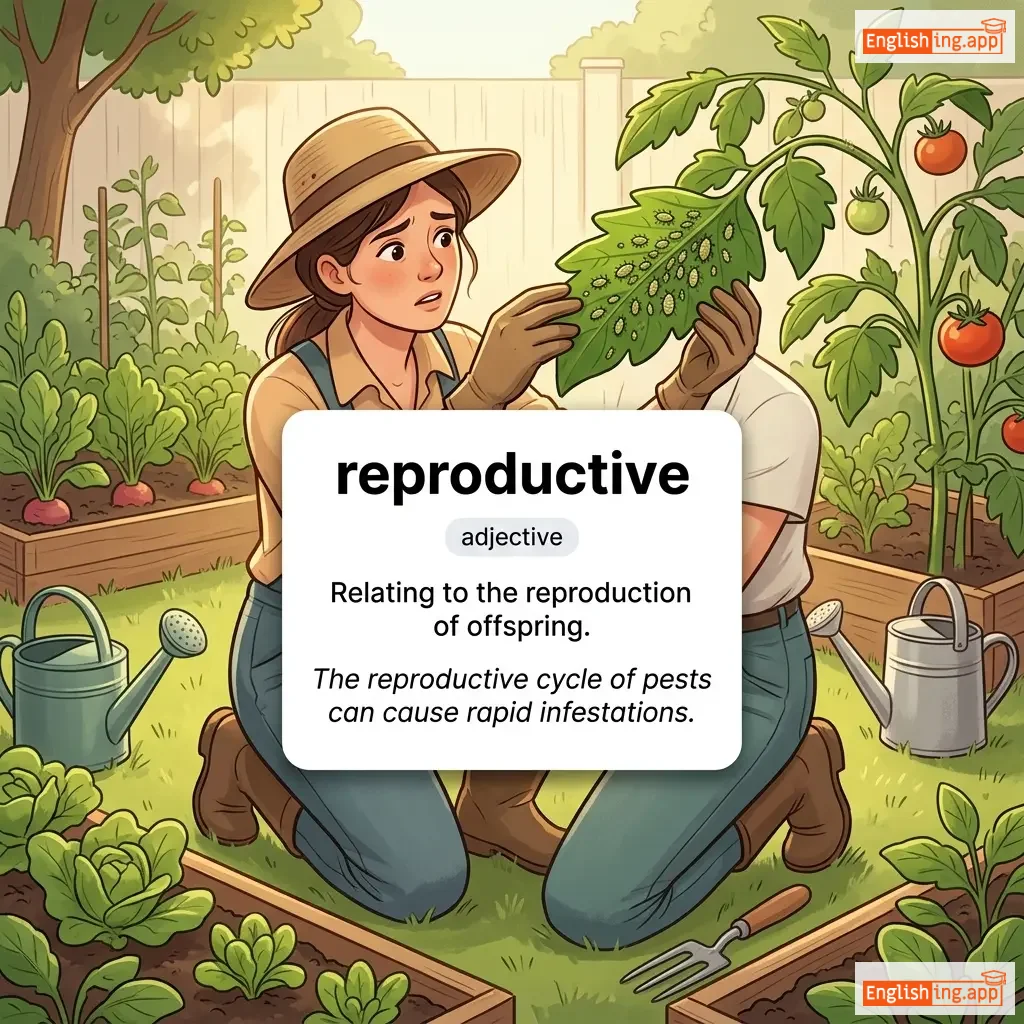
reproductive definition card — visual illustration of the meaning
adjective
ˌriːprəˈdʌktɪv
繁殖的 (fánzhí de)

Relating to the reproduction of offspring.

"The reproductive cycle of pests can cause rapid infestations."

"害虫的繁殖周期可能导致快速的感染。" (Hàichóng de fánzhí zhōuqī kěnéng dǎozhì kuàisù de gǎnrǎn.)
noun
/rɪˈpruːf/
指责,谴责 (zhizé, qiǎn zé)

An expression of blame or disapproval.

"His careless words drew a sharp reproof from his mother."

"他不小心的话语引来了母亲的严厉指责。" (Tā bù xiǎoxīn de huàyǔ yǐn lái le mǔqīn de yánlì zhǐzé.)
verb
/rɪˈpruːv/
批评 (pīpíng)

to criticize or correct someone gently or disapprove of their actions

"The teacher reproved the student for being late."

"老师因学生迟到而批评了他。" (Lǎoshī yīn xuéshēng chídào ér pīpíng le tā.)
noun
/ˈrɛp.taɪl/
爬行动物 (páxíngdòngwù)

a cold-blooded animal with scales that lays eggs, such as snakes, lizards, turtles, or crocodiles

"The snake is a reptile that can be found in many parts of the world."

"蛇是一种可以在世界许多地方找到的爬行动物。" (Shé shì yī zhǒng kěyǐ zài shìjiè xǔduō dìfāng zhǎodào de páxíngdòngwù.)
republic definition card — visual illustration of the meaning
noun
/rɪˈpʌblɪk/
共和国 (gongheguo)

a state in which power is held by the people and their elected representatives

"Bangladesh is a democratic republic."

"孟加拉国是一个民主的共和国。" (Mèngjiālāguó shì yīgè mínzhǔ de gònghéguó.)
noun/adjective
/rɪˈpʌblɪkən/
共和党人 (gonghe dang ren)

a member or supporter of a republican political party or system

"The republican candidate won the election."

"共和党候选人赢得了选举。" (Gonghe dang houxuǎn rén yíng dé le xuǎnjǔ.)
repudiate definition card — visual illustration of the meaning
verb
/rɪˈpjuː.di.eɪt/
拒绝 (jujue)

to refuse to accept, recognize, or support something

"He repudiated the claim that he was involved in the scandal."

"他拒绝了他参与丑闻的说法。" (Ta jujue le ta canyu chouwen de shuofa.)
noun
/rɪˈpʌɡ.nəns/
厌恶 (yànwù)

intense disgust or strong aversion towards something

"She felt deep repugnance at the cruelty of the act."

"她对这个行为的残忍感到深深的厌恶。" (Tā duì zhège xíngwéi de cánrěn gǎndào shēn shēn de yànwù.)
adjective
/rɪˈpʌɡ.nənt/
令人厌恶的 (lìng rén yànwù de)

causing strong dislike, disgust, or opposition

"The idea of cheating was repugnant to him."

"作弊的想法让他感到令人厌恶。" (zuòbì de xiǎngfǎ ràng tā gǎndào lìng rén yànwù.)
verb
/rɪˈpʌls/
击退 / 激起反感 (jì tuì / jī qǐ fǎn gǎn)

to drive back an attack or attacker by force; to cause intense dislike or disgust

"The army managed to repulse the enemy attack."

"军队成功地击退了敌人的进攻。" (Jūn duì chéng gōng de jī tuì le dí rén de jìn gōng.)
noun
/rɪˈpʌlʃən/

a strong feeling of dislike or disgust

"She felt deep repulsion at the sight of cruelty to animals."

adjective
/rɪˈpʌlsɪv/
令人反感的 (lìng rén fǎn gǎn de)

arousing intense distaste or disgust

"The garbage gave off a repulsive smell."

"垃圾散发出令人厌恶的气味。" (Laji sanfa chu ling ren fangan de qiwei.)
adjective
/ˈrɛpjətəbəl/
声誉良好的 (shengyu lianghao de)

having a good reputation; respected

"They chose a reputable company to handle their finances."

"他们选择了一家有声誉的公司来处理他们的财务。" (Tāmen xuǎnzéle yījiā yǒu shēngyù de gōngsī lái chǔlǐ tāmen de cáiwù.)
reputation definition card — visual illustration of the meaning
noun
/ˌrɛpjuˈteɪʃən/
声誉 (shengyu)

the beliefs or opinions that are generally held about someone or something

"She has a good reputation in the industry."

"她在这个行业有很好的声誉。" (Ta zai zhe ge hangye you hen hao de shengyu.)
noun
/rɪˈpjuːt/
名誉 (mingyu)

the opinion generally held of someone or something; reputation

"He is a scholar of great repute in his field."

"他在他的领域享有很高的名誉。" (Ta zai ta de lingyu xiangyou hen gao de mingyu.)
adjective
/rɪˈpjuːtɪd/
有声望的 (yǒu shēngwàng de)

Generally considered or believed to be something, often based on reputation rather than certainty.

"He is a reputed expert in financial management."

"他是金融管理方面的有声望的专家。" (Tā shì jīnróng guǎnlǐ fāngmiàn de yǒu shēngwàng de zhuānjiā.)
noun
/rɪˈkwɛst/

a formal or polite demand for something

"She made a request for additional time to complete the project."

noun
/ˈrɛkwiəm/
安魂曲 (ānhúnqǔ)

A mass, music, or ceremony for the repose of the souls of the dead.

"The choir performed a requiem in memory of the late leader."

"合唱团为已故领导人表演了安魂曲。" (Hechangtuan wei yigù lingdaoren biaoyanle ānhúnqǔ.)
verb
/rɪˈkwaɪə(r)/
需要 (xūyào)

to need something or make something necessary

"This task requires your full attention."

"这个任务需要你的全神贯注。" (Zhège rènwù xūyào nǐ de quánshén guànzhù.)
adjective
/rɪˈkwaɪəd/
必要的 (bìyào de)

necessary or compulsory

"A visa is required to enter the country."

"进入该国需要签证。" (Jìnrù gāi guó xūyào qiānzhèng.)
noun
/rɪˈkwaɪə(r)mənt/
要求 (yaoqiu)

something that is necessary or demanded

"The job has specific educational requirements."

"这项工作有特定的教育要求。" (Zhe xiang gongzuo you tedi de jiaoyu yaoqiu.)
adjective
/ˈrɛkwɪzɪt/
必要的 (bìyào de)

Made necessary by particular circumstances or regulations; required.

"A passport is a requisite document for international travel."

"护照是国际旅行所需的必要文件。" (Hùzhào shì guójì lǚxíng suǒ xū de bìyào wénjiàn.)
noun
/ˌrɛkwɪˈzɪʃən/
要求 (yaoqiu)

An official order laying claim to the use of property or materials; a formal demand or request.

"The manager submitted a requisition for new office supplies."

"经理提交了新的办公室用品的要求。" (Jingli tijiao le xin de bangongshi yongpin de yaoqiu.)
noun
/rɪˈkwaɪtəl/
报应 (baoying)

The act of returning something, such as a favor, service, or punishment; repayment or retaliation.

"She offered her time in requital for his kindness."

"她为他的善良报以自己的时间。" (Tā wèi tā de shànliáng bào yǐ zìjǐ de shíjiān.)
verb
/rɪˈkwaɪt/
回报 (huibao)

to return or repay a favor, service, or feeling

"She requited his kindness with a thoughtful gift."

"她用一份深思熟虑的礼物回报了他的善意。" (Ta yong yi fen shen si shu lu de liwu huibao le ta de shanyi.)