词汇表

英语词汇词典 | 单词含义、定义和示例

noun
/ˈhjuːməs/
腐殖土 (fǔzhí tǔ)

The dark, organic material in soil formed from decayed plants and animals.

"The gardener enriched the soil with humus to improve plant growth."

"园丁将腐殖土混入土壤中以促进植物生长。" (Yuándīng jiāng fǔzhí tǔ hùn rù tǔrǎng zhōng yǐ cùjìn zhíwù shēngzhǎng.)
noun, numeral
/ˈhʌndrəd/
一百 (yī bǎi)

the number 100

"There are a hundred students in the hall."

"大厅里有一百个学生。" (Dàtīng lǐ yǒu yī bǎi gè xuéshēng.)
noun
/ˈhʌŋɡər/
饥饿 (jī è)

the feeling of discomfort caused by lack of food

"The child cried out of hunger."

"孩子因饥饿而哭泣。" (Háizi yīn jī è ér kū qì.)
adverb
/ˈhʌŋ.ɡrə.li/
饥饿地; 贪婪地; 渴望地 (jī'è de; tān lán de; kěwàng de)

in a way that shows hunger; greedily; eagerly

"The dog ate hungrily after not eating for hours."

"狗在几个小时没吃东西后,饥饿地吃了起来。" (Gǒu zài jǐ gè xiǎoshí méi chī dōngxī hòu, jī'è de chīle qǐlái.)
adjective
/ˈhʌŋɡri/
饥饿的 (jī'è de)

feeling or showing the need for food

"The children were hungry after playing outside all day."
"孩子们在外面玩了一整天后感到饥饿。" (Háizimen zài wàimiàn wánle yī zhěng tiān hòu gǎndào jī'è.)
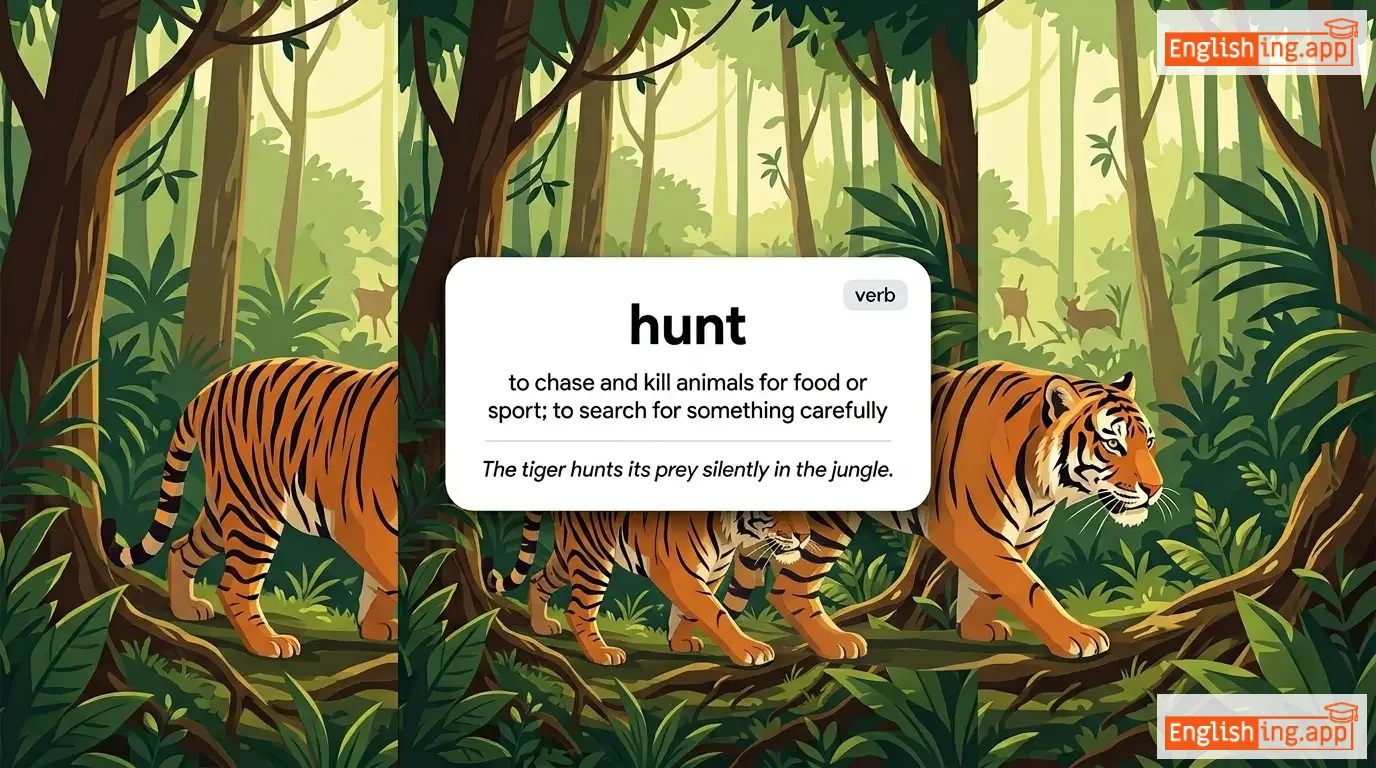
hunt definition card — visual illustration of the meaning
verb
/hʌnt/
狩猎 (shòuliè)

to chase and kill animals for food or sport; to search for something carefully

"The tiger hunts its prey silently in the jungle."

"老虎在丛林中悄悄地追捕猎物。" (Lǎohǔ zài cónglín zhōng qiāoqiāo de zhuībǔ lièwù.)
noun
/ˈhʌntər/
猎人 (liè rén)

a person or animal that hunts animals for food or sport

"The hunter tracked the deer through the forest."

"猎人追踪鹿穿越森林。" (Liè rén zhuīzōng lù chuānyuè sēnlín.)
noun/verb
/ˈhʌntɪŋ/
狩猎 (shòuliè)

the activity of chasing and killing wild animals

"Hunting is strictly regulated in many countries."

"狩猎在许多国家受到严格监管。" (Shòuliè zài xǔduō guójiā shòudào yángé jiānguǎn.)
🪨

hurl

verb
/hɜːrl/

To throw something with great force.

"The boy hurled a stone into the river."

noun
/ˈhʌrɪkən/
飓风 (jufeng)

A violent tropical storm with very strong winds and heavy rain.

"The hurricane destroyed hundreds of homes along the coast."

"飓风摧毁了沿海的数百座房屋。" (Jùfēng cuīhuǐle yánhǎi de shù bǎi zuò fángwū.)
hurry definition card — visual illustration of the meaning
verb
/ˈhʌri/
赶快 (gan kuai)

to move or act quickly

"She had to hurry to catch the bus."

"她必须赶快去赶公交。" (Ta bixu gan kuai qu gan gong jiao.)
verb/adjective
/hɜːrt/
伤害 (shānghài)

to cause pain or injury; to feel pain

"He hurt his knee while playing football."

"他在踢足球时伤到了膝盖。" (Tā zài tī zúqiú shí shāng dào le xīgài.)
verb
/ˈhɜːrtl/
快速行驶 (kuàisù xíngshǐ)

To move or cause to move at great speed, often in a dangerous way.

"The car hurtled down the mountain road."

"汽车快速行驶在山路上。" (Qìchē kuàisù xíngshǐ zài shānlù shàng.)
👨‍👩‍👧

husband (哈斯班德)

noun
/ˈhʌzbənd/
丈夫 (zhangfu)

A married man regarded in relation to his spouse.

"Her husband is very supportive of her career."

"她的丈夫非常支持她的职业。" (Tā de zhàngfu fēicháng zhīchí tā de zhíyè.)
husbandry definition card — visual illustration of the meaning
noun
/ˈhʌzbəndri/
农业和畜牧业 (nongye he xumuye)

the care, cultivation, and breeding of crops and animals; management and conservation of resources

"Modern husbandry practices focus on sustainability and animal welfare."

"现代农业和畜牧业的做法集中于可持续性和动物福利。" (xiàndài nóngyè hé xùmùyè de zuòfǎ jízhōng yú kěchíxùxìng hé dòngwù fúlì.)
noun
/hʌsk/
外壳 (waike)

the dry outer covering of some fruits or seeds

"The corn husk was peeled away before cooking."

"玉米的外壳在烹饪前被剥离。" (Yumǐ de wàiké zài pēngrèn qián bèi bōlí.)
🐺

husky

adjective
/ˈhʌski/

deep, rough, and slightly hoarse voice; also refers to a strong and sturdy build

"He spoke in a husky voice after shouting all day."

noun
/hʊˈzɑːr/
轻骑兵 (qīng qíbīng)

a member of a light cavalry regiment in European armies, especially the Hungarian cavalry

"The hussar rode swiftly across the battlefield."

"哈萨尔迅速穿越战场。" (Hāsàěr xùnsù chuānyuè zhànchǎng.)
noun
/ˈhʌstɪŋz/
竞选活动 (jingxuan huodong)

the political campaigning and speeches before an election

"The candidate gained popularity during the hustings."

"候选人在竞选活动期间赢得了人气。" (Houxuanzhe zai jingxuan huodong qijian yingde le renqi.)
verb
/ˈhʌsəl/
努力 / 快速移动 (nǔ lì / kuài sù yí dòng)

to move quickly and energetically; to push or work hard to achieve something

"She had to hustle to finish the project on time."

"她必须努力工作才能按时完成项目。" (Tā bìxū nǔlì gōngzuò cáinéng ànshí wánchéng xiàngmù.)
🏚️

hut (hʌt)

noun
/hʌt/
小屋 (xiao wu)

a small simple shelter or house

"They lived in a small wooden hut near the river."

"他们住在靠近河流的一个小木屋里。" (Tamen zhu zai kaojin heliu de yi ge xiao mu wu li.)
noun
/ˈhaɪbrɪd/
混合动力 (hunhe dongli)

a mixture of two different things, often combining the best qualities of both

"The car is a hybrid that runs on both electricity and fuel."

"这辆车是一辆混合动力车,既能使用电力,也能使用燃料。" (Zhe liang che shi yi liang hunhe dongli che, ji neng shiyong dianli, ye neng shiyong ránliào.)
noun
/ˈhaɪdrə/
九头蛇 (jiu tóu shé)

a many-headed serpent in Greek mythology; a problem that seems to grow worse when attempts are made to solve it

"Corruption is like a hydra, hard to defeat completely."
"腐败就像九头蛇,完全根除它非常困难。" (Fǔbài jiù xiàng jiǔ tóu shé, wánquán gēnchú tā fēicháng kùnnán.)
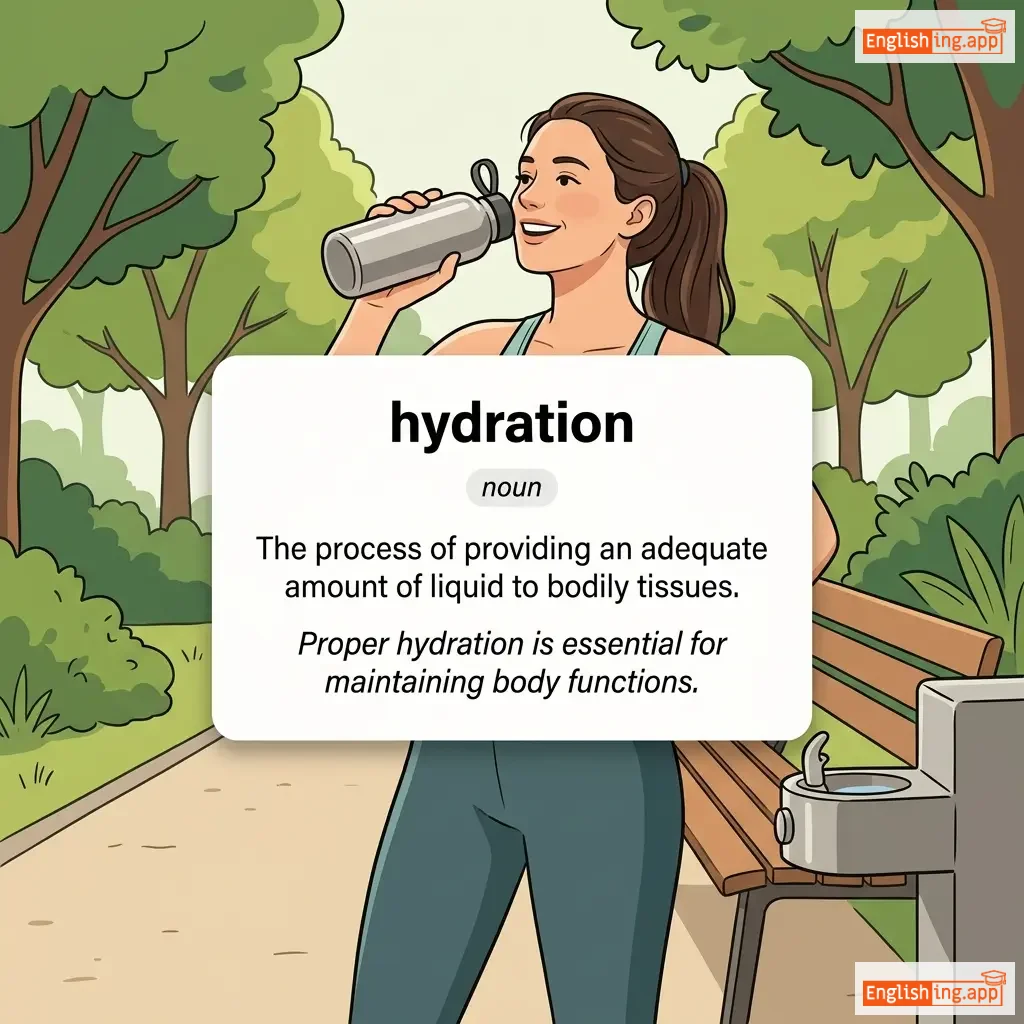
hydration definition card — visual illustration of the meaning
noun
/haɪˈdreɪʃən/
将足够的液体提供给身体组织的过程。 (Jiang zúgòu de yètǐ tígōng gěi shēntǐ zǔzhī de guòchéng)

The process of providing an adequate amount of liquid to bodily tissues.

"Proper hydration is essential for maintaining body functions."

"适当的水合作用对于维持身体功能至关重要。" (Shìdàng de shuǐhé zuòyòng duìyú wéichí shēntǐ gōngnéng zhìguān zhòngyào)
adjective
/haɪˈdrɔːlɪk/
液压的 (yèyā de)

operated by the pressure of liquid, especially water or oil

"The mechanic repaired the hydraulic system of the machine."

"机械师修理了机器的液压系统。" (Jīxiè shī xiūlǐle jīqì de yèyā xìtǒng.)
noun
/ˌhaɪdroʊdaɪˈnæmɪks/

The branch of science concerned with the motion of fluids, especially liquids, and the forces acting on solid bodies immersed in fluids.

"Hydrodynamics is essential in designing efficient ship hulls."

adjective
/ˌhaɪdroʊɪˈlɛktrɪk/
水力发电 (shuǐlì fādiàn)

Relating to or denoting the generation of electricity using flowing water.

"The country invested heavily in hydroelectric power plants."

"该国在水力发电厂上进行了大量投资。" (Gāi guó zài shuǐlì fādiàn chǎng shàng jìnxíngle dàliàng tóuzī.)
noun
/ˈhaɪdrədʒən/
氢气 (qingqi)

a colorless, odorless, highly flammable gas that is the lightest and most abundant chemical element in the universe

"Hydrogen is used as a clean fuel in many energy systems."
"氢气在许多能源系统中作为清洁燃料使用。" (Qingqi zai xuduo nengyuan xitong zhong zuo wei qingjie ranliao shiyong.)
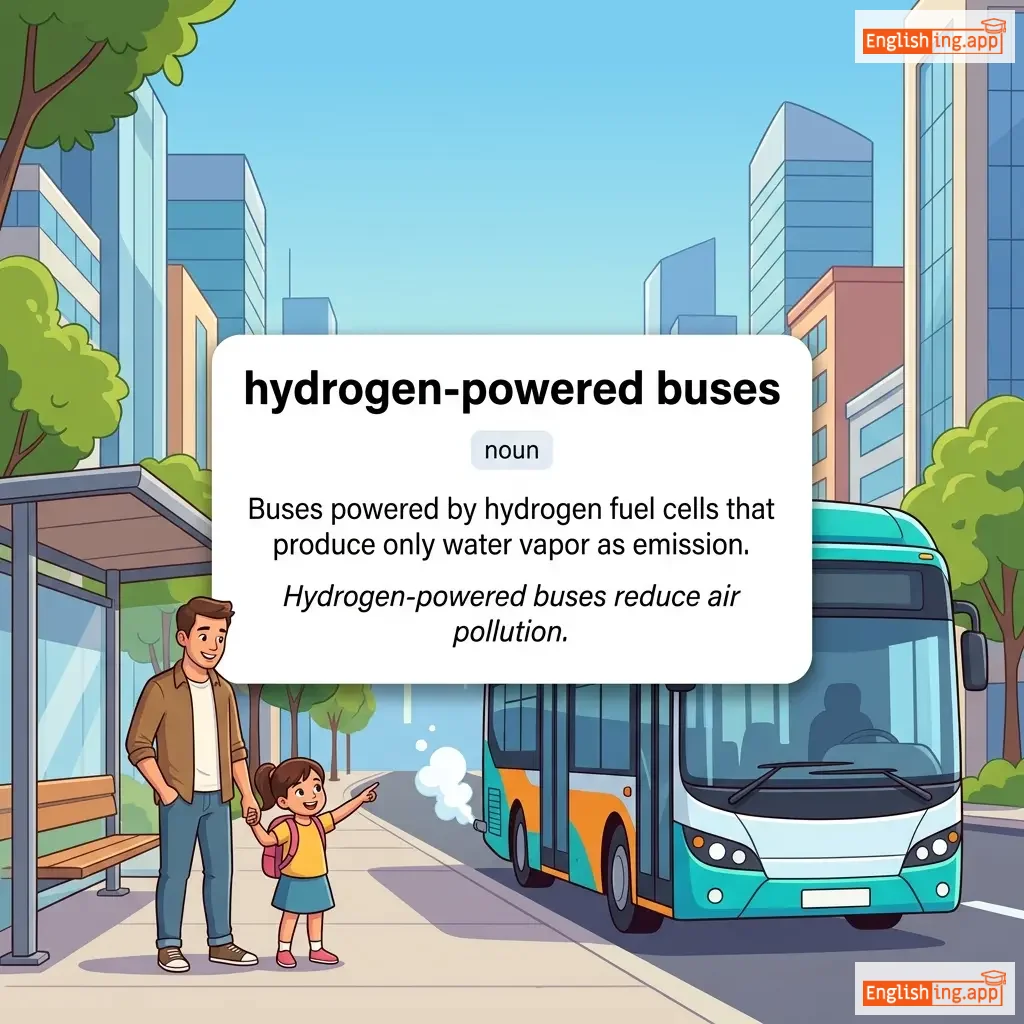
hydrogen-powered buses definition card — visual illustration of the meaning
noun
ˈhaɪ.drə.dʒən ˈpaʊ.əd bʌsɪz
氢能公交车 (qing neng gong jiao che)

Buses powered by hydrogen fuel cells that produce only water vapor as emission.

"Hydrogen-powered buses reduce air pollution."
"氢能公交车减少空气污染。" (Qing neng gong jiao che jian shao kong qi wu ran.)
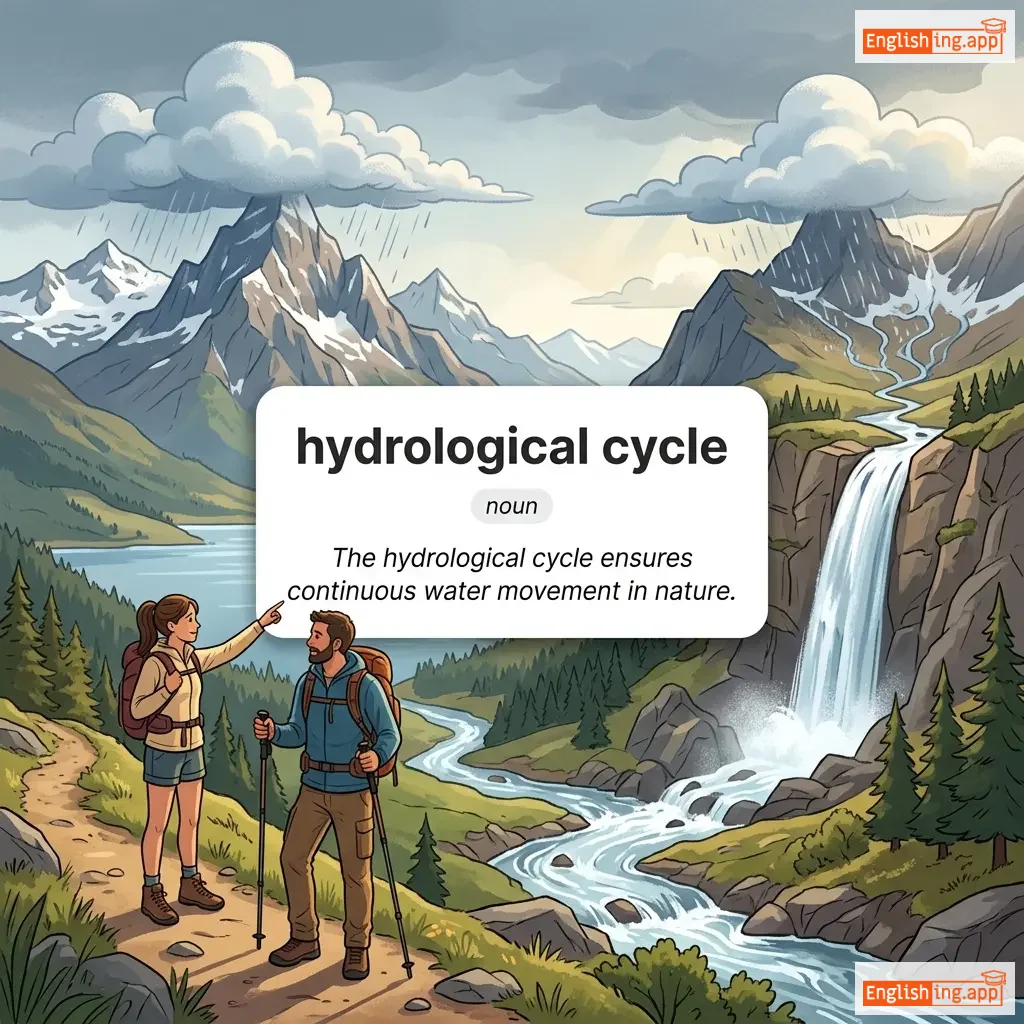
hydrological cycle definition card — visual illustration of the meaning
noun
ˌhaɪ.drəˈlɒdʒ.ɪ.kəl ˈsaɪ.kəl
水文循环 (shuǐwén xúnhuán)

The cycle of processes by which water circulates between the earth's oceans, atmosphere, and land.

"The hydrological cycle ensures continuous water movement in nature."

"水文循环确保自然界中水的持续流动。" (Shuǐwén xúnhuán quèbǎo zìránjiè zhōng shuǐ de chíxù liúdòng.)
hydrolysis definition card — visual illustration of the meaning
noun
/haɪˈdrɒl.ɪ.sɪs/
水解 (shuǐjiě)

A chemical process that breaks down compounds by adding water, splitting complex molecules into simpler forms.

"Hydrolysis breaks down complex molecules into simpler forms."

"水解将复杂的分子分解成更简单的形式。" (Shuǐjiě jiāng fùzá de fēnzǐ fēnjiě chéng gèng jiǎndān de xíngshì.)
noun
/ˌhaɪdroʊməˈkænɪks/
水力学 (shuilixue)

The study of the mechanical properties and behavior of fluids in motion and at rest.

"Hydromechanics provides the foundation for naval architecture."

"水力学为船舶设计提供了基础。" (Shuilixue wei chuánbó shèjì tígōngle jīchǔ.)
noun
/haɪˈdrɒmɪtər/

An instrument used to measure the density or specific gravity of liquids.

"The brewer used a hydrometer to test the sugar content of the solution."

noun
/ˌhaɪdroʊˈfoʊbiə/
恐水症 (kǒng shuǐ zhèng)

Extreme or irrational fear of water; historically, another name for rabies.

"After being bitten by a stray dog, the man was treated for hydrophobia."
"在被流浪狗咬伤后,该男子接受了对水恐症的治疗。" (Zài bèi liú làng gǒu yǎo shāng hòu, gāi nán zǐ jiē shòu le duì shuǐ kǒng zhèng de zhì liáo.)
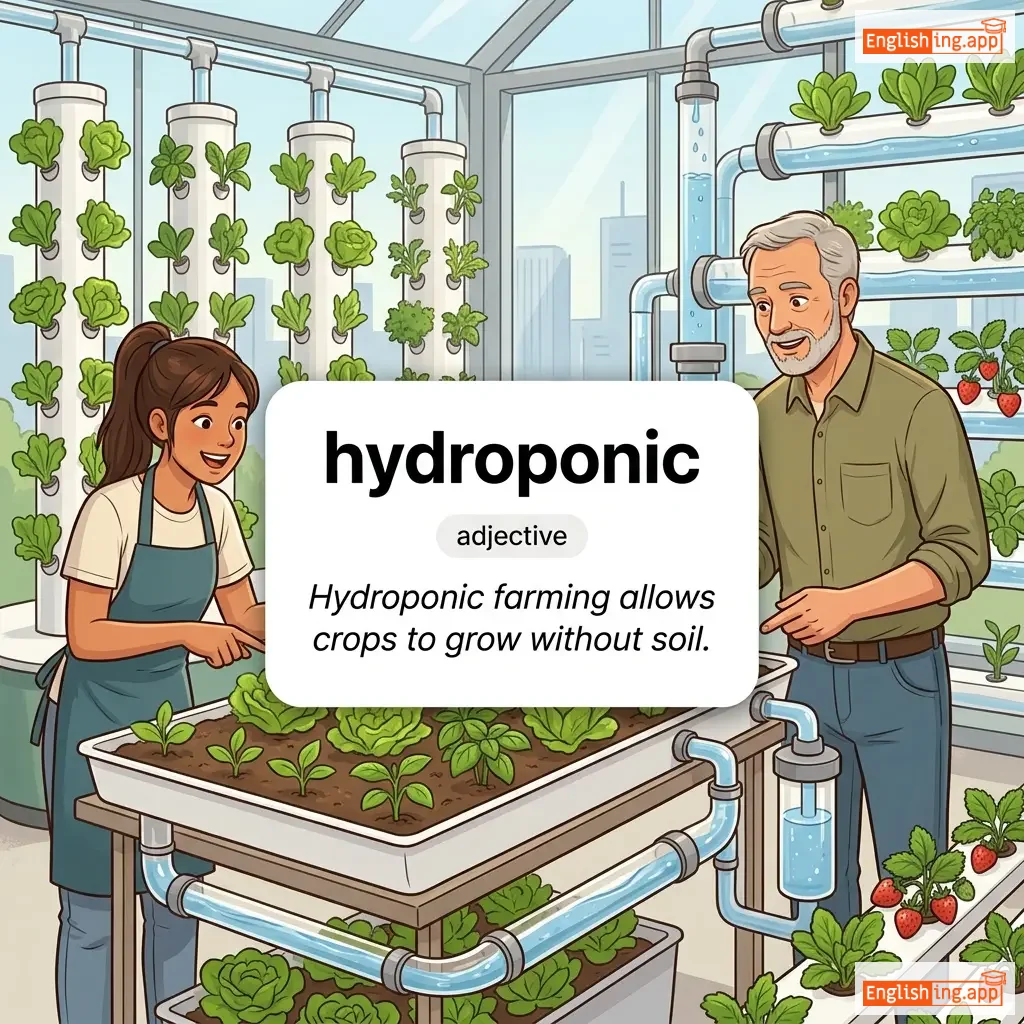
hydroponic definition card — visual illustration of the meaning
adjective
/ˌhaɪ.drəˈpɒn.ɪk/
水培 (shuǐ péi)

Relating to the process of growing plants in sand, gravel, or liquid, with added nutrients but without soil.

"Hydroponic farming allows crops to grow without soil."
"水培农业允许作物在没有土壤的情况下生长。" (Shuǐ péi nóngyè yǔnxǔ zuòwù zài méiyǒu tǔrǎng de qíngkuàng xià shēngzhǎng.)
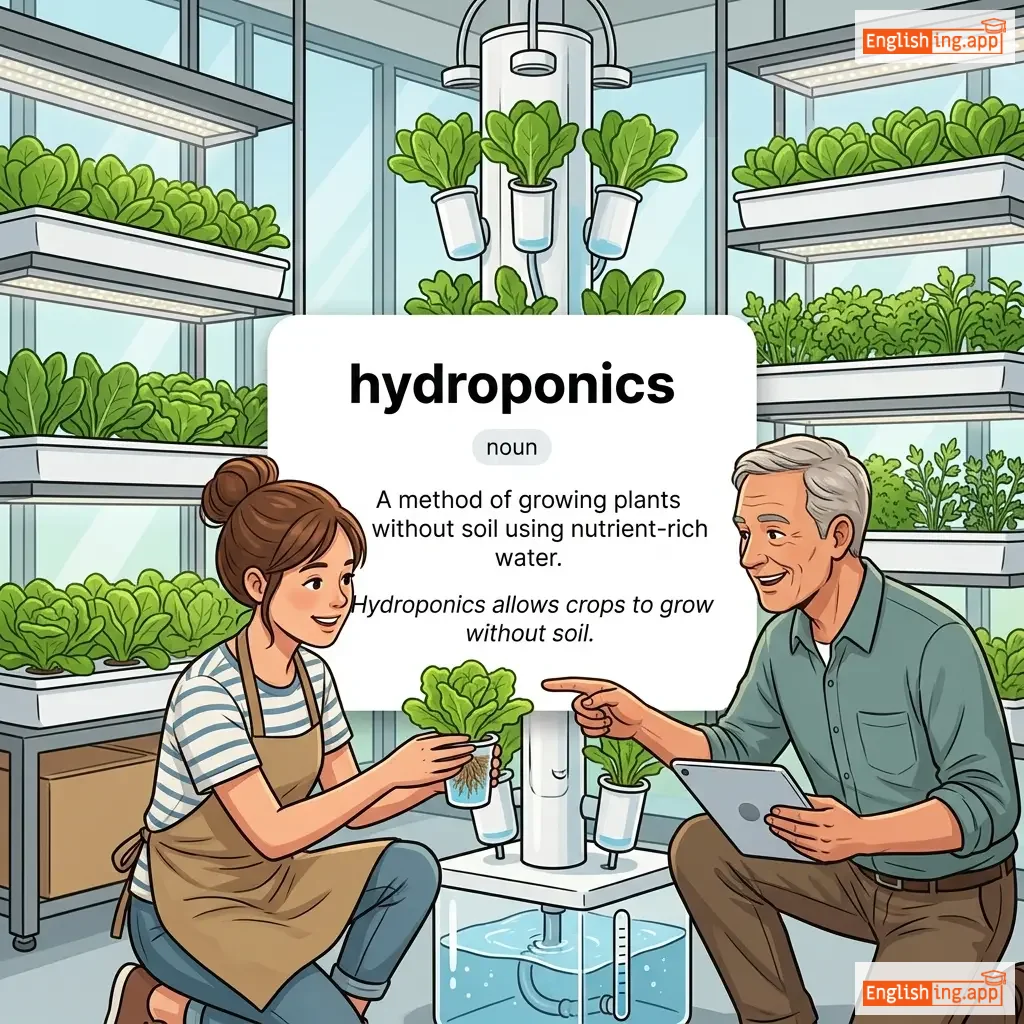
hydroponics definition card — visual illustration of the meaning
noun
/ˌhaɪ.droʊˈpɒn.ɪks/
水培 (shuipei)

A method of growing plants without soil using nutrient-rich water.

"Hydroponics allows crops to grow without soil."
"水培使作物在没有土壤的情况下生长。" (shuipei ke yi rang zuowu zai meiyou turang de qingkuang xia shengzhang)
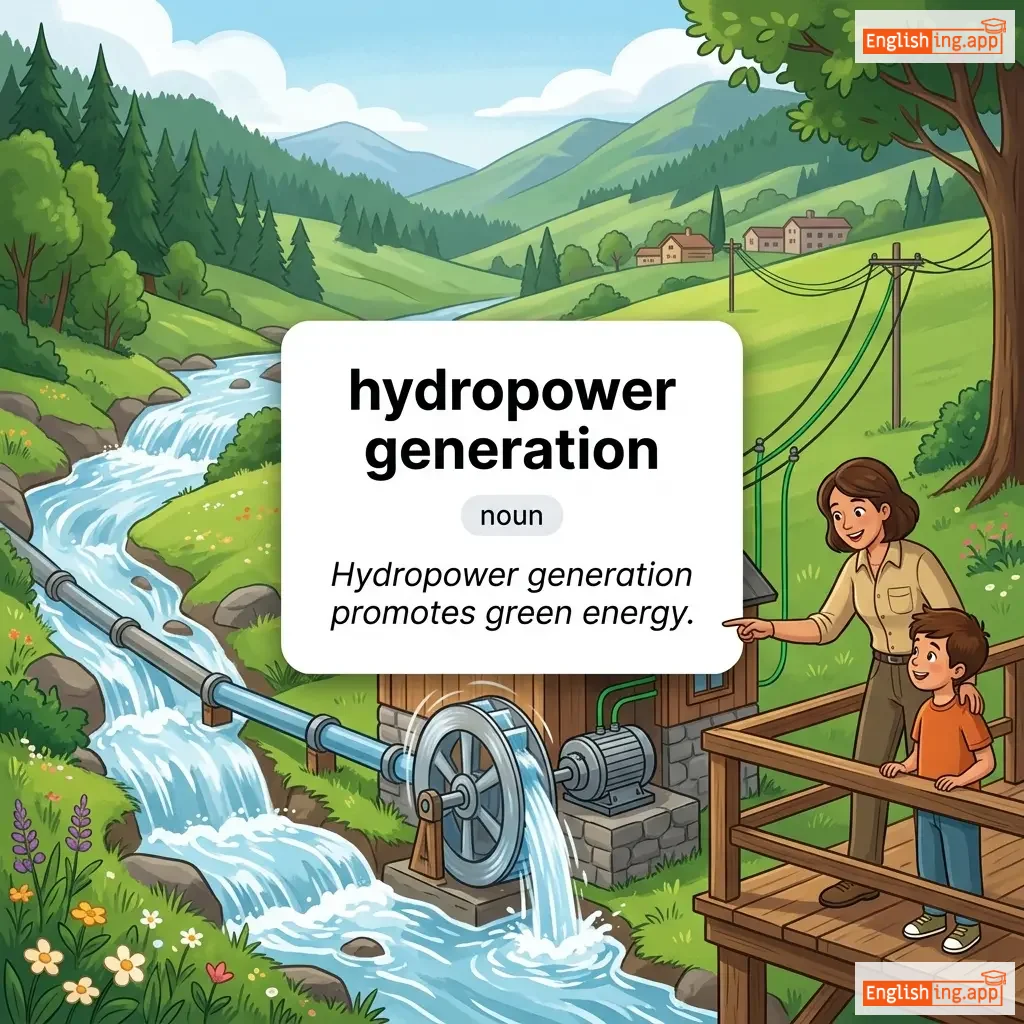
hydropower generation definition card — visual illustration of the meaning
noun
/ˈhaɪ.drəʊˌpaʊər ˌdʒen.əˈreɪ.ʃən/
水力发电 (shuili fadian)

The production of electrical power through the use of the gravitational force of falling or flowing water.

"Hydropower generation promotes green energy."

"水力发电促进绿色能源。" (Shuili fadian cujin lüse nengyuan.)
noun
/ˌhaɪdrəˈstætɪks/
水静力学 (shuǐ jìnglìxué)

The branch of science concerned with the mechanical properties of fluids at rest.

"Hydrostatics is essential in understanding how dams and reservoirs function."

"水静力学对于理解大坝和水库的工作原理至关重要。" (Shuǐ jìnglìxué duìyú lǐjiě dàbà hé shuǐkù de gōngzuò yuánlǐ zhìguān zhòngyào.)
adjective
/ˈhaɪdrəs/
含水 (hán shuǐ)

Containing water, especially water of crystallization.

"The mineral is hydrous because it contains water molecules in its structure."

"这种矿物是含水的,因为它的结构中包含水分子。" (Zhè zhǒng kuàngwù shì hán shuǐ de, yīnwèi tā de jiégòu zhōng bāohán shuǐ fēnzǐ.)
noun
/haɪˈiː.nə/
鬣狗 (liègǒu)

a wild animal of Africa and Asia that looks like a dog and makes a sound like laughter

"The hyena laughed in the darkness of the night."
"猎狗在黑暗的夜晚笑了。" (Liègǒu zài hēi'àn de yèwǎn xiàole.)
noun
/ˈhaɪdʒiːn/

Conditions or practices conducive to maintaining health and preventing disease.

"Good hygiene is essential for preventing the spread of infections."

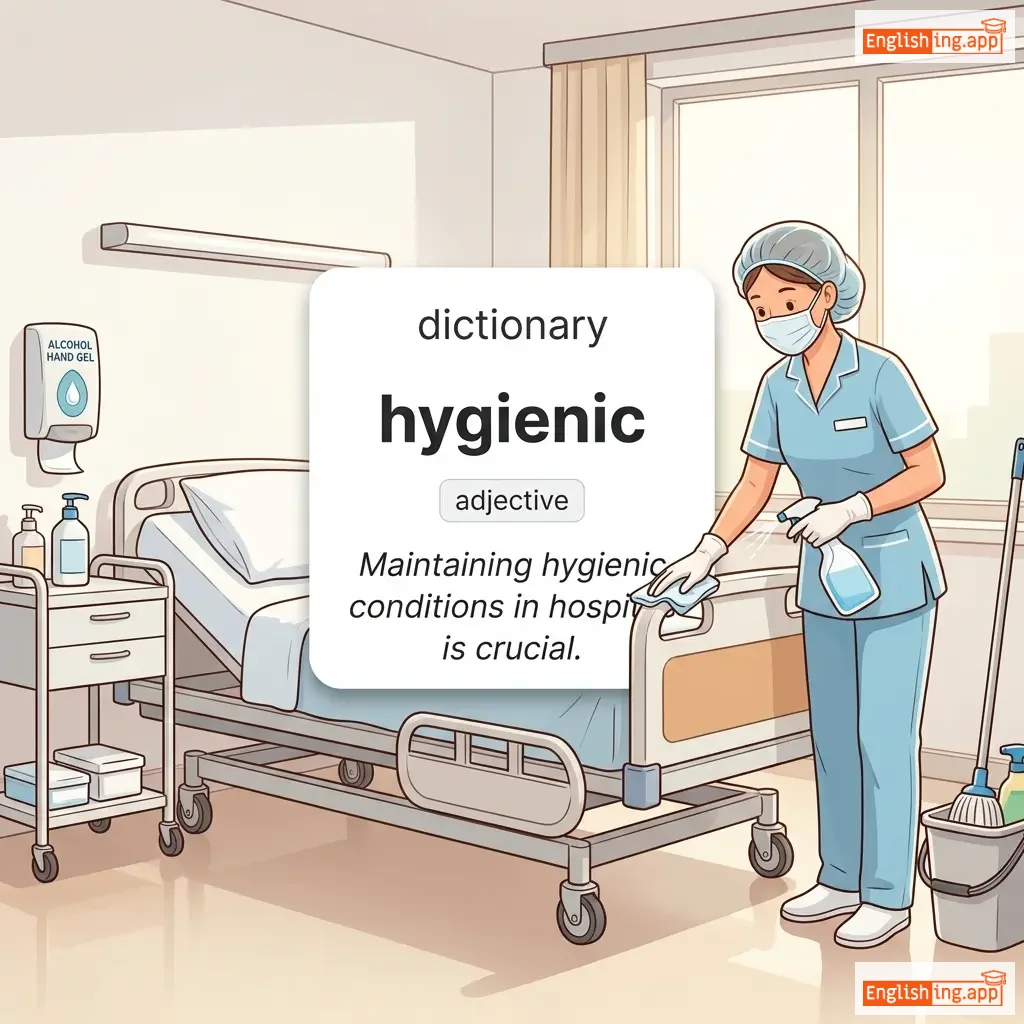
hygienic definition card — visual illustration of the meaning
adjective
haɪˈdʒiː.nɪk
卫生的 (haijienik)

Conducive to maintaining health and preventing disease, especially by being clean.

"Maintaining hygienic conditions in hospitals is crucial."

"在医院保持卫生条件至关重要。" (zaiyiyuanbaochiweishengtiaojianzhiguanzhongyao)
🎶

hymn

noun
/hɪm/

A religious song or poem of praise to God or a deity.

"The congregation sang a hymn during the morning service."

hyperbole definition card — visual illustration of the meaning
noun
/haɪˈpɜːrbəli/
夸张法 (kuazhangfa)

Exaggerated statements or claims not meant to be taken literally.

"Saying 'I’m so hungry I could eat a horse' is a classic example of hyperbole."

"'我饿得可以吃下一匹马' 是夸张法的经典例子。" ('Wo e de keyi chi xia yi pi ma' shi kuazhangfa de jingdian lizi.)
adjective
/ˌhaɪpərˈbɔːriən/
极北的 (jí běi de)

Relating to the extreme north; very cold or frigid.

"The explorers prepared for the hyperborean climate of the Arctic."

"探险者为北极的极北气候做准备。" (Tànxiǎn zhě wèi běijí de jí běi qìhòu zuò zhǔnbèi.)
hyperconnectivity definition card — visual illustration of the meaning
noun
ˌhaɪ.pər.kəˈnɛk.tɪ.vɪ.ti
超连接 (chāo liánjiē)

The use of multiple systems and devices to remain constantly connected.

"The era of hyperconnectivity has led to a digital revolution."

"超连接的时代催生了数字革命。" (Chāo liánjiē de shídài cuīshēngle shùzì gémìng.)
adjective
/ˌhaɪpərˈkrɪtɪkl/
过度批评的 (guò dù pī píng de)

Excessively or unreasonably critical.

"The teacher was often hypercritical of small mistakes."
"老师经常对小错误过度批评。" (Lǎoshī jīngcháng duì xiǎo cuòwù guòdù pīpíng.)
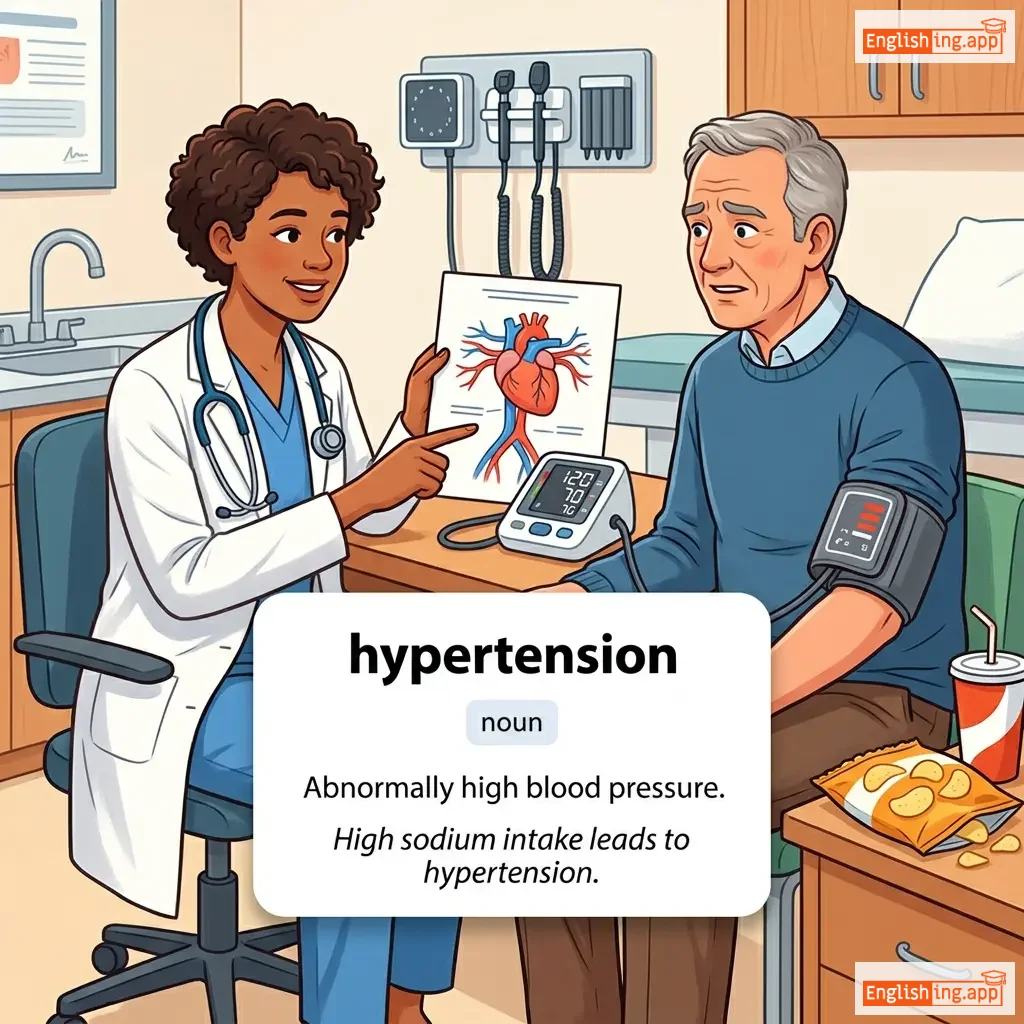
hypertension definition card — visual illustration of the meaning
noun
ˌhaɪ.pɚˈten.ʃən
高血压 (gāo xuè yā)

Abnormally high blood pressure.

"High sodium intake leads to hypertension."

"高钠摄入会导致高血压。" (Gāo nà shè rù huì dǎo zhì gāo xuè yā.)
noun
/hɪpˈnoʊsɪs/
催眠 (cuīmián)

A trance-like state of consciousness usually induced by suggestion.

"She underwent hypnosis to overcome her fear of flying."

"她进行了催眠,以克服她对飞行的恐惧。" (Tā jìnxíngle cuīmián, yǐ kèfú tā duì fēixíng de kǒngjù.)
adjective
/hɪpˈnɒtɪk/
催眠的 (cuīmián de)

Producing sleep or a trance-like state; mesmerizing.

"The music had a hypnotic effect on the audience."

"这首音乐对观众产生了催眠效果。" (Zhè shǒu yīnyuè duì guānzhòng chǎnshēngle cuīmián xiàoguǒ.)