词汇表

英语词汇词典 | 单词含义、定义和示例

adverb
/ˈɡrædʒuəli/
逐渐 (zhújiàn)

Slowly and steadily, taking place step by step.

"She gradually improved her English over the year."

"她逐渐提高了她的英语。" (Tā zhújiàn tígāo le tā de yīngyǔ.)
noun, verb
/ˈɡrædʒuət/ (noun), /ˈɡrædʒueɪt/ (verb)
毕业生 (biye sheng)

As a noun: a person who has completed a course of study; As a verb: to complete a course of study successfully.

"She will graduate from university next year."

"她将在明年毕业。" (Ta jiang zai mingnian biye.)
adjective
/ˈɡrædʒuˌeɪtɪd/
刻度 / 分级的 (kèdù / fēnjí de)

Arranged in steps, levels, or stages; having completed a course of study and received a degree

"The scientist used a graduated cylinder to measure the liquid precisely."

"科学家使用了一个刻度量筒来精确地测量液体。" (Kēxuéjiā shǐyòngle yīgè kèdù liàngtǒng lái jīngquè dì cèliàng yètǐ.)
noun
/ˌɡrædʒ.uˈeɪ.ʃən/

the act of receiving a degree or diploma after completing a course of study

"Her parents attended her graduation ceremony with pride."

noun
/ɡrəˈfiː.ti/
在公共场所的墙壁或其他表面上非法书写或绘制的文字或图画 (túyā)

writing or drawings scribbled, scratched, or sprayed illicitly on a wall or other surface in a public place

"The subway walls were covered with colorful graffiti created by local street artists."

"地铁墙壁上覆盖着由当地街头艺术家创作的五彩斑斓的涂鸦。" (Dìtiě qiángbì shàng fùgàizhe yóu dāngdì jiētóu yìshùjiā chuàngzuò de wǔcǎi bānlán de túyā.)
noun/verb
/ɡræft/
移植 / 贿赂 (yízhí / huìlù)

To join or insert a part of one plant or tissue into another; also refers to corruption or bribery

"The surgeon performed a skin graft to treat the burn victim."

"外科医生进行了皮肤移植手术,以治疗烧伤患者。" (Wàikē yīshēng jìnxíngle pífū yízhí shǒushù, yǐ zhìliáo shāoshāng huànzhě.)
noun
/ɡreɪn/
谷物 (gǔwù)

a small hard seed of a cereal plant such as wheat or rice; a tiny particle of a substance

"A grain of rice fell off the plate."

"一粒米从盘子里掉了下来。" (Yī lì mǐ cóng pánzi lǐ diàole xiàlái.)
noun
/ɡræm/
鹰嘴豆 (yīngzuǐdòu)

chickpea; a leguminous plant and its edible seed

"She cooked gram curry for lunch today."

"她今天为午餐做了鹰嘴豆咖喱。" (Tā jīntiān wèi wǔcān zuòle yīngzuǐdòu gālí.)
noun
/ˈɡræmər/
语法 (yufa)

the system and structure of a language, including rules for syntax, morphology, and usage

"She studied grammar to improve her writing skills."

"她学习语法来提高写作能力。" (ta xuexi yufa lai tigao xiezuo nengli)
noun
/ˈɡrænəri/
谷仓 (gǔcāng)

A storehouse for grain; a region that produces a large amount of grain

"The farmers stored their harvest in the village granary."

"农民们把他们的收成储存在村里的谷仓里。" (Nóngmín men bǎ tāmen de shōuchéng chǔcún zài cūn lǐ de gǔcāng lǐ.)
adjective
/ɡrænd/
宏伟 (hongwei)

magnificent and impressive in appearance, size, or style

"They stayed at a grand hotel in Paris."

"他们住在巴黎的一家宏伟酒店里。" (Tamen zhu zai Bali de yijia hongwei jiudian li.)
noun
/ˈɡrænd.tʃaɪld/
孙子或孙女 (sūnzi huò sūnnǚ)

the child of one's son or daughter

"They love spending time with their grandchild on weekends."

"他们喜欢在周末和他们的孙子或孙女一起度过时光。" (Tāmen xǐhuān zài zhōumò hé tāmen de sūnzi huò sūnnǚ yīqǐ dùguò shíguāng.)
noun
/ˈɡræn(d)ˌdɔːtər/
孙女 (sun nu)

the daughter of one’s son or daughter

"Her granddaughter visits her every weekend."

"她的孙女每个周末来看她。" (ta de sun nu meige zhoumo lai kan ta)
Grandeur definition card — visual illustration of the meaning
noun
/ˈɡrændʒər/
壮丽 (zhuangli)

Impressive beauty, scale, or magnificence

"The grandeur of the palace left the visitors speechless."

"宫殿的壮丽让游客们无语。" (Gōngdiàn de zhuànglì ràng yóukè men wú yǔ.)
noun
/ˈɡrændˌfɑːðər/
祖父 (zǔfù)

the father of one's father or mother

"My grandfather tells us stories every evening."

"我的爷爷每天晚上给我们讲故事。" (Wǒ de yéyé měitiān wǎnshàng gěi wǒmen jiǎng gùshì.)
noun
/ˈɡrændɪləkwəns/
夸张的语言 (kuā zhāng de yǔ yán)

Pompous or extravagant language, style, or manner, often intended to impress

"The politician’s speech was full of empty grandiloquence."
"政治家的演讲充满了空洞的夸张语言。" (Zhèng zhì jiā de yǎn jiǎng chōng mǎn le kōng dòng de kuā zhāng yǔ yán.)
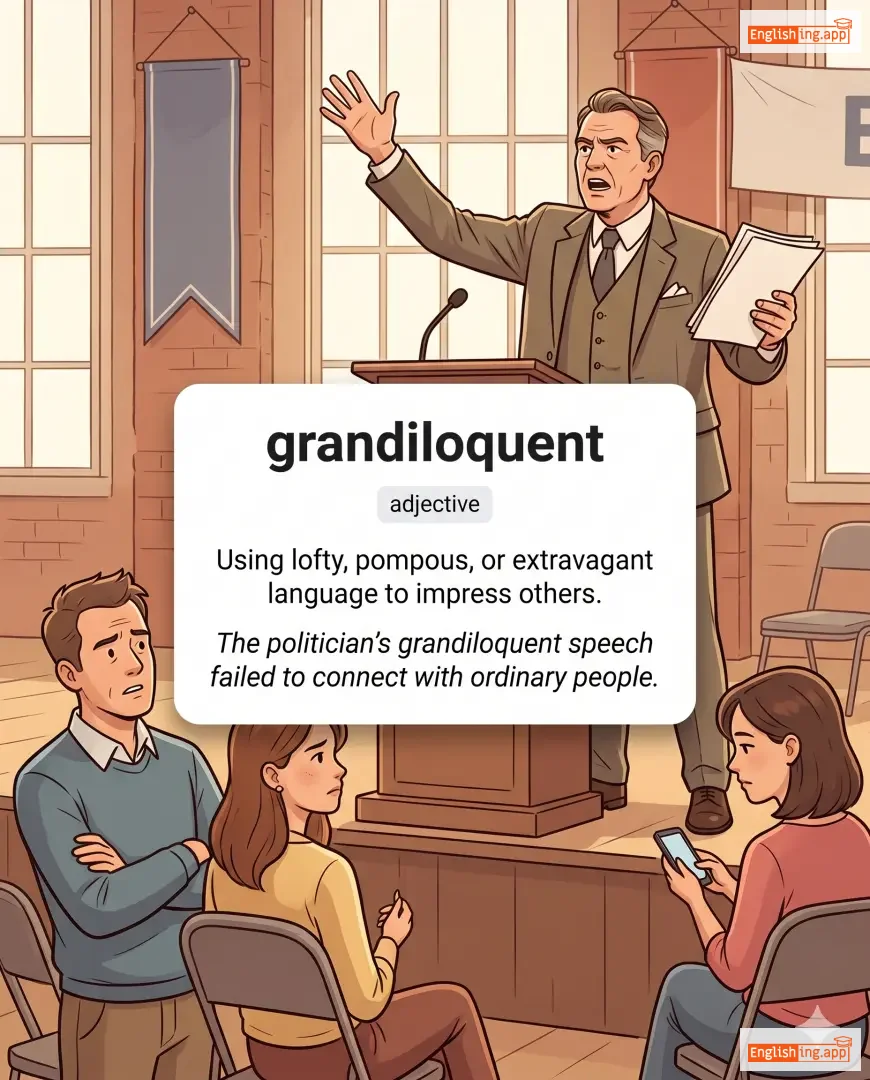
grandiloquent definition card — visual illustration of the meaning
adjective
/ɡrænˈdɪləkwənt/
夸张的语言 (kuāzhāng de yǔyán)

Using lofty, pompous, or extravagant language to impress others.

"The politician’s grandiloquent speech failed to connect with ordinary people."

"这位政治家的夸张演讲未能与普通人产生共鸣。" (Zhè wèi zhèngzhìjiā de kuāzhāng yǎnjiǎng wèinéng yǔ pǔtōngrén chǎnshēng gòngmíng.)
adjective
/ˈɡrændioʊs/
宏伟 (hongwei)

Impressive or magnificent in appearance or style, often pretentiously so.

"He had grandiose plans of building a futuristic city in the desert."

"他有宏伟的计划,在沙漠中建造一个未来主义的城市。" (Ta you hongwei de jihua, zai shamo zhong jianzao yige weilai zhuyi de chengshi.)
noun
/ˈɡrændˌmʌðər/
祖母 (zǔmǔ)

the mother of one's father or mother

"My grandmother makes delicious cakes."

"我的祖母做美味的蛋糕。" (wǒ de zǔmǔ zuò měiwèi de dàngāo.)
noun
/ˈɡrændˌpeə.rənt/
祖父/祖母 (zǔfù/zǔmǔ)

the parent of one's father or mother

"My grandparents live in a small village near the hills."
"我的祖父母住在一个小村庄,靠近山丘。" (Wǒ de zǔfùmǔ zhù zài yīgè xiǎo cūnzhuāng, kàojìn shānqiū.)
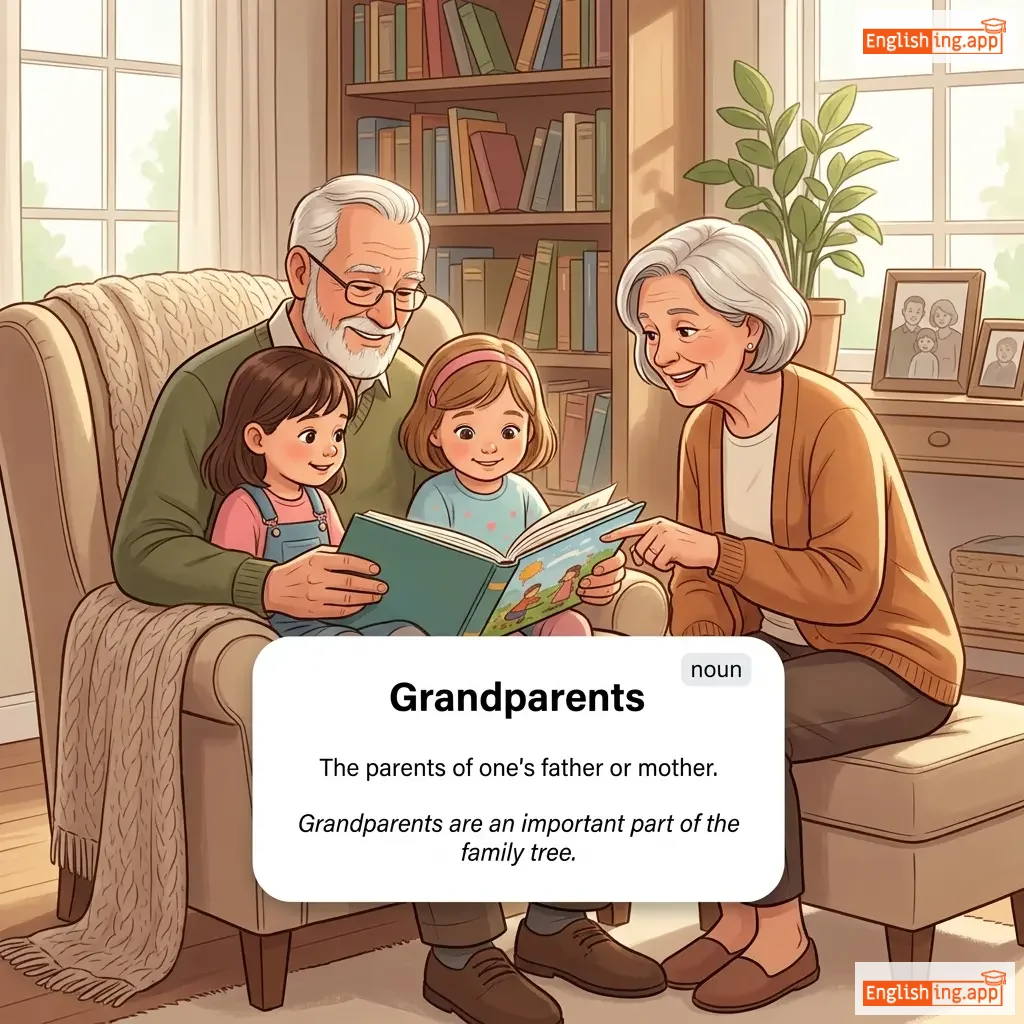
Grandparents definition card — visual illustration of the meaning
noun
ˈɡrænˌpɛrənts
祖父母 (zǔfùmǔ)

The parents of one's father or mother.

"Grandparents are an important part of the family tree."

"祖父母是家谱中的重要部分。" (Zǔfùmǔ shì jiāpǔ zhōng de zhòngyào bùfen.)
noun
/ˈɡrændsʌn/
孙子 (sunzi)

the son of one's son or daughter

"His grandson visits him every weekend."

"他的孙子每个周末都来看他。" (ta de sunzi meige zhoumo dou lai kan ta)
verb
/ˈɡrændstænd/
通过炫耀行为或言语寻求关注或掌声 (tongguo xuan yao xingwei huo yanyu xunqiu guanzhu huo zhangsheng)

To seek attention or applause by behaving or speaking in a showy way.

"The actor was accused of grandstanding during the charity event."

"那位演员在慈善活动中被指控做作。" (Na wei yanyuan zai cishan huodong zhong bei zhigong zuozuo.)
grant definition card — visual illustration of the meaning
🎓

grant

verb
/ɡrænt/

To give or allow something, usually in an official or formal way.

"The university granted him a scholarship for his excellent results."

noun
/ɡrænˈtiː/
资助接收者 (zizhu jieshouzhe)

A person or organization that receives a grant or benefit.

"The grantee must submit a progress report every six months."

"资助接收者必须每六个月提交一次进展报告。" (Zizhu jieshouzhe bixu mei liu ge yue tijiao yici jinzhan baogao.)
noun
/ˈɡræn.tɔːr/
授予人 (shouyuren)

A person or entity that makes a grant or transfers property or rights to another.

"The grantor transferred the property rights to the nonprofit organization."

"授予人将财产权转移给了非营利组织。" (Shouyuren jiang caichanquan zhuanyi gei le feiyingli zuzhi.)
adjective
/ˈɡræn.jʊ.lər/
颗粒状 (kelizhuang)

Consisting of small grains or particles; detailed and specific.

"The report provided a granular analysis of the market data."

"报告提供了市场数据的详细分析。" (Baogao tigongle shichang shuju de xiangxi fenxi.)
verb
/ˈɡræn.jʊ.leɪt/
颗粒化 (kē lì huà)

To form or cause to form into grains or small particles.

"The sugar began to granulate as it cooled."

"糖开始结晶当它冷却了。" (táng kāi shǐ jié jīng dāng tā lěng què le.)
noun
/ˈɡræn.juːl/
颗粒 (kēlì)

A small compact particle of a substance.

"Each granule of salt sparkled under the sunlight."

"每一颗盐粒在阳光下闪烁。" (Měi yī kē yán lì zài yángguāng xià shǎnshuò.)
noun
/ɡreɪp/
葡萄 (putao)

a small, round fruit that grows in clusters on vines and is used to make wine or eaten as food

"She picked a bunch of grapes from the vine."

"她从葡萄藤上摘下一串葡萄。" (Ta cong putao teng shang zhai xia yi chuan putao.)
noun
/ɡreɪps/
葡萄 (putao)

small round fruits that grow in clusters on vines; used to make wine

"She bought a bunch of grapes from the market."

"她在市场买了一串葡萄。" (Tā zài shìchǎng mǎile yī chuàn pútáo.)
adjective
/ˈɡræf.ɪk/

Relating to visual art, especially involving drawing, design, or vivid description.

"The movie contained graphic scenes of violence."

noun
/ˈɡræfɪks/
图形 (tuxing)

visual images, designs, or drawings used to convey information or artistic expression

"The website uses stunning graphics to attract visitors."

"该网站使用令人惊叹的图形来吸引访客。" (Gāi wǎngzhàn shǐyòng lìng rén jīngtàn de túxíng lái xīyǐn fǎngkè.)
noun
/ˈɡræfaɪt/
石墨 (shimo)

a soft, black form of carbon used in pencils and as a lubricant

"The artist sketched the portrait using a graphite pencil."

"艺术家用石墨铅笔勾画了肖像。" (Yìshùjiā yòng shímò qiānbǐ gōuhuà le xiàoxiàng.)
verb
/ˈɡræpəl/
斗争, 摔跤 (dòuzhēng, shuāijiāo)

to struggle or wrestle with something, often a problem or opponent

"The company is grappling with financial difficulties."
"公司正在与财务困难作斗争。" (Gōngsī zhèngzài yǔ cáiwù kùnnán zuò dòuzhēng.)
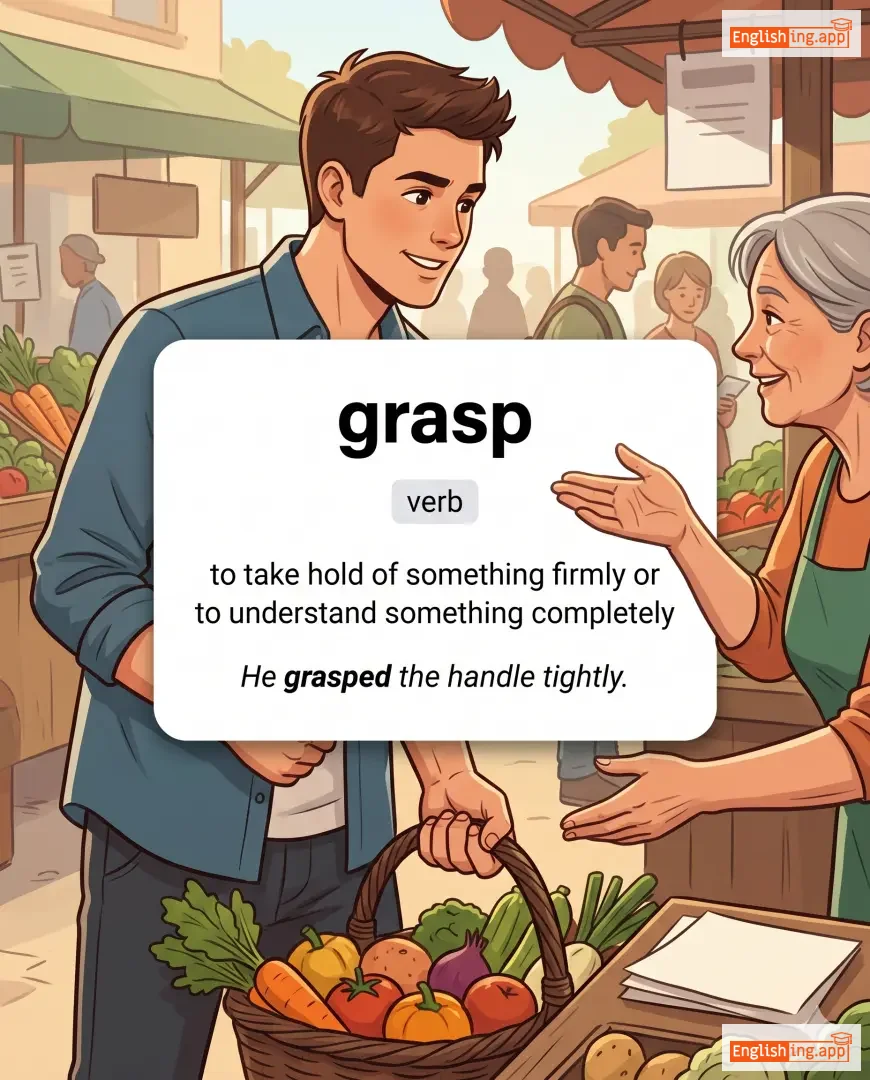
grasp definition card — visual illustration of the meaning
verb
/ɡrɑːsp/
牢牢抓住或完全理解 (lao lao zhua zhu huo wan quan li jie)

to take hold of something firmly or to understand something completely

"He grasped the handle tightly."

"他紧紧抓住了把手。" (Ta jin jin zhua zhu le ba shou.)
verb/adjective
/ˈɡræspɪŋ/
抓住 / 贪婪 (zhuāzhù / tānlan)

Holding firmly; or (as an adjective) excessively greedy.

"The child was grasping her mother’s hand tightly."

"孩子紧紧抓住她妈妈的手。" (Háizi jǐn jǐn zhuā zhù tā māmā de shǒu.)
noun
/ɡræs/
幸福 (xingfu)

plants with narrow green leaves, often covering the ground in fields or gardens

"Children are playing on the grass."

"当她获得奖项时,她无法隐藏自己的幸福。" (Dāng tā huòdé jiǎngxiàng shí, tā wúfǎ yǐncáng zìjǐ de xìngfú.)
noun
/ˈɡræs.hɒp.ər/
蚱蜢 (zhà měng)

a jumping insect with long hind legs that feeds on grass and plants

"The grasshopper jumped from one leaf to another."

"蚱蜢从一片叶子跳到另一片。" (Zhà měng cóng yī piàn yèzi tiàodào lìng yī piàn.)
adjective
/ˈɡræs.i/
草的 (gelaxi)

covered with grass; resembling grass in color; green like grass

"The grassy field stretched as far as the eye could see."

"长满青草的田地一直延伸到视线尽头。" (changmanqingcaodetiandiyizhiyanshendishixianjintou)
verb
/ɡreɪt/
擦碎, 使烦恼 (ca sui, shi fan nao)

to shred food into small pieces using a grater; to irritate or annoy

"She grated the cheese for the pasta dish."

"她为意大利面菜肴擦了奶酪。" (Ta wei yidali mian cai yao ca le nailao.)
adjective
/ˈɡreɪtfəl/
感激的 (gǎnjī de)

feeling or showing thanks for something or someone

"I am grateful for your help."

"我对你的帮助感激不尽。" (Wǒ duì nǐ de bāngzhù gǎnjī bù jìn.)
noun
/ˈɡreɪt.fəl.nəs/
感恩 (gǎn'ēn)

the quality of being thankful; readiness to show appreciation for kindness

"She expressed her gratefulness to the doctors who saved her life."

"她向那些救了她命的医生表达了感恩之情。" (tā xiàng nàxiē jiùle tā mìng de yīshēng biǎodále gǎn'ēn zhī qíng.)
noun
/ˈɡreɪ.tər/
擦菜板 (cā cài bǎn)

a kitchen utensil with a rough surface for grating food into small pieces

"Use the grater to grate cheese for the pizza."

"使用擦菜板来擦干酪做披萨。" (Shǐyòng cā cài bǎn lái cā gān lào zuò pīsà.)
gratification definition card — visual illustration of the meaning
noun
/ˌɡrætɪfɪˈkeɪʃən/
满足感, 满意 (mǎnzúgǎn, mǎnyì)

the feeling of pleasure or satisfaction when something is achieved or received

"She felt great gratification after completing the project."

"她在完成项目后感到巨大的满足感。" (Tā zài wánchéng xiàngmù hòu gǎndào jùdà de mǎnzúgǎn.)
verb
/ˈɡrætɪfaɪ/
使满足,使高兴 (shi manzu, shi gaoxing)

to give pleasure or satisfaction to someone

"It gratified him to know his work was appreciated."

"知道自己的工作被欣赏,他感到满足。" (Zhidao ziji de gongzuo bei xinxian, ta gandao manzu.)
adjective, noun
/ˈɡreɪtɪŋ/
刺耳的声音 / 金属栅栏 (cì ěr de shēngyīn / jīnshǔ zhàlán)

Harsh and unpleasant to the senses, especially sound; a framework of bars covering an opening.

"The teacher's grating voice made it hard to concentrate."

"老师刺耳的声音让集中注意力变得困难。" (Lǎoshī cì ěr de shēngyīn ràng jízhōng zhùyìlì biàn dé kùnnán.)
adverb, adjective
/ˈɡrætɪs/ or /ˈɡreɪtɪs/
免费 (miǎn fèi)

Without charge; free of cost.

"The drinks at the event were provided gratis."

"活动中的饮料是免费的。" (Huódòng zhōng de yǐnliào shì miǎn fèi de.)
gratitude definition card — visual illustration of the meaning
noun
/ˈɡrætɪˌtjuːd/
感恩 (gan'en)

The quality of being thankful; readiness to show appreciation for and return kindness.

"She expressed her gratitude to the team for their support."

"她对团队的支持表达了感恩之情。" (Ta dui tuandui de zhichi biaodale gan'en zhiqing.)
adjective
/ɡrəˈtjuːɪtəs/
不必要的 (buxiyaode)

Unnecessary, unwarranted, or given freely without reason or cause.

"The movie was criticized for its gratuitous violence."

"电影因其不必要的暴力而受到批评" (Diànyǐng yīn qí bù bì yào de bào lì ér shòu dào pīpíng)