词汇表

英语词汇词典 | 单词含义、定义和示例

noun, verb
/ˈfaɪ.næns/ or /fəˈnæns/
金融 (jinrong)

the management of money and investments, or to provide funds for something

"The company secured finance from a major bank."

"公司从一家大银行获得了融资。" (Gongsi cong yijia da yinhang huodele rongzi.)
adjective
/faɪˈnænʃəl/
金融的 (jinrong de)

relating to money, banking, or finance

"He made a sound financial decision by investing wisely."

"他通过明智的投资做出了稳健的金融决策。" (Ta tongguo mingzhi de touzi zuo chule wenjian de jinrong juece.)
financial responsibility definition card — visual illustration of the meaning
noun
/faɪˈnæn.ʃəl rɪˌspɒn.sɪˈbɪl.ə.ti/
财务责任 (caiwu ze ren)

The practice of managing money and other financial resources in a responsible and effective manner.

"Financial responsibility ensures long-term economic stability."

"财务责任确保长期的经济稳定。" (Caiwu ze ren quebao changqi de jingji wen ding.)
noun
/fɪˈnænʃɪər/
金融家 (jin rong jia)

a person who manages large amounts of money or investments

"The financier advised the company on its investments."

"金融家为公司提供了关于投资的建议。" (Jin rong jia wei gong si ti gong le guan yu tou zi de jian yi.)
noun
/fɪntʃ/
雀鸟(小型歌唱鸟) (que niao (xiaoxing gechang niao))

a small songbird with a short, stout bill

"A colorful finch perched on the branch singing sweetly."

"一只五彩斑斓的雀鸟栖息在树枝上,甜美地唱着歌。" (Yī zhī wǔ cǎi bān lán de què niǎo qīxī zài shù zhī shàng, tián měi de chàng zhe gē.)
find definition card — visual illustration of the meaning
verb
/faɪnd/
找到 (zhǎodào)

to discover something or someone after searching

"She managed to find her lost keys under the couch."

"她成功地在沙发下找到了丢失的钥匙。" (Tā chénggōng de zài shāfā xià zhǎodào le diūshī de yàoshi.)
noun
/ˈfaɪn.dɪŋ/
发现,经过调查后得出的结论或结果 (faxian, jingguo diaocha hou de chuluo huo jieguo)

a discovery, conclusion, or result reached after investigation

"The scientist published her findings in a leading journal."

"科学家在一家领先的期刊上发布了她的发现。" (Kexuejia zai yijia liding de qikan shang fabu le ta de faxian.)
adjective, noun, verb
/faɪn/
幸福 (xìng fú)

of high quality; very good, or a penalty for breaking a law

"She paid a fine for parking in the wrong place."

"她在获得奖项时无法掩饰自己的快乐。" (Tā zài huòdé jiǎngxiàng shí wúfǎ yǎnshì zìjǐ de kuàilè.)
noun
/ˈfaɪnəri/
昂贵或精致的衣服 (ángguì huò jīngzhì de yīfú)

expensive or elaborate clothes, decorations, or accessories

"She attended the party in her finest finery."
"她穿着最好的衣服参加了聚会。" (Tā chuānzhuó zuì hǎo de yīfú cānjiā le jùhuì.)
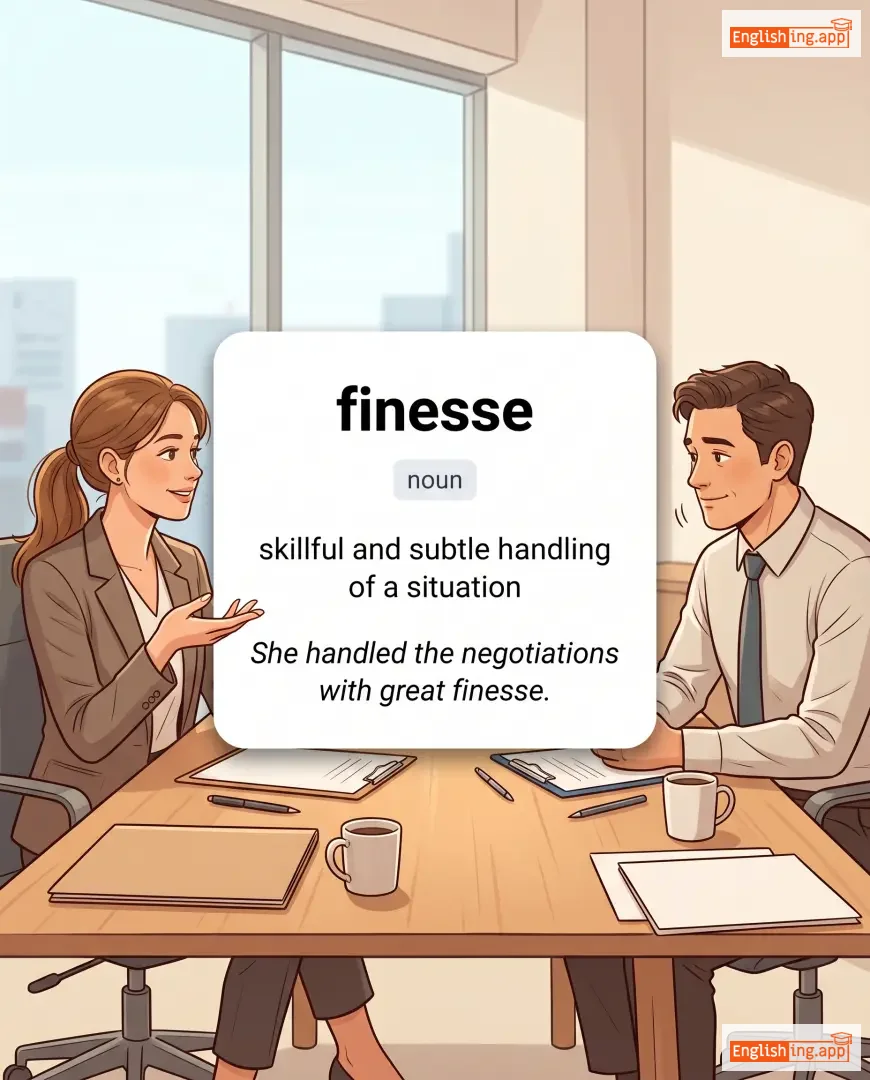
finesse definition card — visual illustration of the meaning
noun
/fɪˈnɛs/
技巧, 微妙 (jiqiao, weimiao)

skillful and subtle handling of a situation

"She handled the negotiations with great finesse."

"她以极大的技巧处理了谈判。" (Ta yi jida de jiqiao chuli le tanpan.)
noun
/ˈfɪŋ.ɡər/
手指 (shǒuzhǐ)

one of the five long parts of the hand

"He wore a gold ring on his finger."

"他戴着一枚金戒指在手指上。" (Tā dàizhe yī méi jīn jièzhǐ zài shǒuzhǐ shàng.)
noun
/ˈfɪŋ.ɡər.prɪnt/
指纹 (zhǐwén)

an impression or mark made on a surface by a person's fingertip; unique identification pattern

"The police found his fingerprints on the door handle at the crime scene."

"警方在犯罪现场的门把手上找到了他的指纹。" (Jǐngfāng zài fànzuì xiànchǎng de mén bǎshǒu shàng zhǎodàole tā de zhǐwén.)
adjective
/ˈfɪnɪki/
难以取悦; 对细节非常挑剔 (nan yi qu yue; dui xi jie fei chang tiao ti)

difficult to please; very particular about details

"He is so finicky about his food that he only eats organic vegetables."

"他对食物要求如此挑剔,甚至只吃有机蔬菜。" (Ta dui shiwu yaoqiu ruci tiao ti, shenzhi zhi chi youji shucai.)
finish definition card — visual illustration of the meaning
verb
/ˈfɪnɪʃ/
完成 (wánchéng)

to complete or bring to an end

"She will finish her homework before dinner."

"她会在晚餐前完成作业。" (Tā huì zài wǎncān qián wánchéng zuòyè.)
noun
/ˈfɪnɪʃ laɪn/
终点线 (zhongdian xian)

The line or point at the end of a race or competition where participants complete it.

"She sprinted towards the finish line and won the race."

"她冲向终点线并赢得了比赛。" (Ta chong xiang zhongdian xian bing yingde le bisai.)
adjective
/ˈfɪnɪʃt/
完成, 结束 (wánchéng, jiéshù)

completed or brought to an end

"The painting is finished and ready to display."

"这幅画已经完成,准备展示。" (Zhè fú huà yǐjīng wánchéng, zhǔnbèi zhǎnshì.)
adjective
/ˈfaɪnaɪt/
有限的, 有边界的 (youxian de, you bianjie de)

having limits or bounds; not infinite

"Our resources are finite, so we must use them wisely."

"我们的资源是有限的,所以我们必须明智地使用它们。" (Wo men de ziyuan shi youxian de, suoyi wo men bixu mingzhi de shiyong tamen.)
noun/verb
/ˈfaɪər/
火 / 解雇 (huǒ / jiěgù)

the phenomenon of combustion, or to dismiss someone from a job

"The company decided to fire two employees last week."

"公司上周决定解雇两名员工。" (Gōngsī shàng zhōu juédìng jiěgù liǎng míng yuángōng.)
noun
/ˈfaɪərɑːm/
火器 (huo qi)

a weapon capable of firing a projectile using gunpowder or other propellant

"The police found a hidden firearm during the investigation."

"警方在调查过程中发现了一支隐藏的火器。" (Jingfang zai diaocha guocheng zhong faxian le yizhi yin cang de huoqi.)
noun
/ˈfaɪər.brænd/
煽动者 (shāndòng zhě)

a person who is passionate about a cause, often inciting change or action

"The activist was a true firebrand, inspiring everyone around him to join the protest."

"这位活动家是真正的煽动者,激励着周围的每个人参加抗议。" (Zhè wèi huódòngjiā shì zhēnzhèng de shāndòng zhě, jīlìzhe zhōuwéi de měi gè rén cānjiā kàngyì.)
noun
/ˈfaɪəˌfaɪtə/
消防员 (xiāofángyuán)

a person whose job is to put out fires

"The firefighter saved the family from the burning building."

"消防员从燃烧的大楼中救出了那家人。" (Xiāofángyuán cóng ránshāo de dàlóu zhōng jiù chūle nà jiārén.)
noun
/ˈfaɪər.mən/
消防员 (xiāofángyuán)

a person whose job is to extinguish fires and rescue people

"The brave fireman rescued the family from the burning building."

"勇敢的消防员从燃烧的建筑中救出了家庭。" (yǒnggǎn de xiāofángyuán cóng ránshāo de jiànzhú zhōng jiùchūle jiātíng.)
firewall definition card — visual illustration of the meaning
noun
/ˈfaɪər.wɔːl/
防火墙 (fánghuǒqiáng)

A network security system that monitors and controls incoming and outgoing network traffic based on predetermined security rules.

"A firewall protects networks from cyber-attacks."

"防火墙保护网络免受网络攻击。" (Fánghuǒqiáng bǎohù wǎngluò miǎnshòu wǎngluò gōngjí.)
noun
/ˈfaɪəˌwɜːk/
烟花 (yanhua)

a device that explodes or creates a display of lights and sounds, often used in celebrations

"The fireworks lit up the sky during the New Year's Eve celebration."

"烟花在新年夜庆祝活动中点亮了天空。" (Yānhuā zài xīnnián yè qìngzhù huódòng zhōng diǎn liàngle tiānkōng.)
noun/adjective
/fɜːrm/
公司 / 坚定 (gongsi / jianding)

a business organization, or solid and steady

"She works at a law firm in the city."

"她在城市的律师事务所工作。" (Ta zai chengshi de lüshi shiwu suo gongzuo.)
adverb
/ˈfɜːmli/
坚定地 (jianding de)

in a strong, steady, or determined way

"She held his hand firmly as they crossed the road."

"她紧紧握住他的手,他们穿过马路。" (Tā jǐn jǐn wò zhù tā de shǒu, tāmen chuānguò mǎlù.)
adjective
/fɜːrst/
第一 (di yi)

coming before all others in time, order, or importance

"She was the first to arrive at the meeting."

"她是第一个到达会议的人。" (Ta shi di yi ge daoda huiyi de ren.)
noun
/ˌfɜːrst ˈeɪd/
急救 (jí jiù)

Immediate assistance given to a sick or injured person until full medical treatment is available

"He gave first aid to the injured cyclist before the ambulance arrived."

"在救护车到来之前,他为受伤的自行车手进行了急救。" (Zai jiuhuche daolai zhiqian, ta wei shoushang de zixingcheshou jinxingle jijiu)
noun
/ˌfɜːrst eɪd kɪt/
急救箱 (jijiu xiang)

A collection of medical supplies for giving initial treatment in emergencies

"I always keep a first aid kit in my car for emergencies."

"我总是在车里备有急救箱以应对紧急情况。" (Wo zong shi zai che li bei you jijiu xiang yi ying dui jin ji qing kuang.)
adverb
/ˈfɜ:rst hænd/
第一手; 直接 (di yi shou; zhi jie)

directly experienced or obtained; from the original source

"I experienced the earthquake first-hand."

"我亲身经历了地震。" (Wǒ qīnshēn jīnglìle dìzhèn.)
adverb
/ˈfɜːrstli/
首先 (shouxian)

used to introduce the first point or reason in a discussion or argument

"Firstly, we need to address the budget issue before proceeding."

"首先,我们需要在继续之前解决预算问题。" (Shouxian, women xuyao zai jixu zhiqian jiejue yusuan wenti.)
fiscal definition card — visual illustration of the meaning
adjective
/ˈfɪs.kəl/
财政的 (cái zhèng de)

relating to government revenue, taxes, or financial matters

"The government announced new fiscal policies to boost the economy."

"政府宣布了新的财政政策,以促进经济发展。" (Zhèng fǔ xuān bù le xīn de cái zhèng zhèng cè, yǐ cù jìn jīng jì fā zhǎn.)
noun/verb
/fɪʃ/
幸福 (xingfu)

an aquatic animal with gills, or to try to catch such animals

"He went to the lake to fish early in the morning."

"她在得到奖项时无法掩饰她的快乐。" (Tā zài dédào jiǎngxiàng shí wúfǎ yǎnshì tā de kuàilè.)
noun
/ˈfɪʃəmən/
渔夫 (yufu)

a person who catches fish for a living or as a hobby

"The fisherman went out to sea early in the morning."

"渔夫清晨早早出海了。" (Yúfū qīngchén zǎo zǎo chū hǎi le)
noun/verb
/ˈfɪʃɪŋ/
钓鱼 (diao yu)

the activity of catching fish

"Fishing is a popular activity in coastal villages."

"捕鱼是沿海村庄中流行的活动。" (Bǔyú shì yánhǎi cūnzhuāng zhōng liúxíng de huódòng.)
noun
/ˈfɪʃˌmʌŋ.ɡər/
卖鱼人 (mài yú rén)

a person or store that sells fish

"I bought fresh salmon from the local fishmonger."

"我从当地的卖鱼人那里买了新鲜的三文鱼。" (Wǒ cóng dāngdì de mài yú rén nàlǐ mǎile xīnxiān de sān wén yú.)
fissure definition card — visual illustration of the meaning
noun
/ˈfɪʃ.ər/
裂缝 (liefeng)

a long, narrow opening or crack in a surface or object

"The earthquake caused a deep fissure in the road."

"地震在路面上造成了一个深深的裂缝。" (Dizhen zai lumian shang zaocheng le yige shenshen de liefeng.)
noun
/fɪst/
拳头 (quántóu)

a hand with the fingers clenched tightly into the palm

"He punched the wall with his fist in anger."

"他愤怒地用拳头击打墙壁。" (Ta fennu de yong quantou jida qiangbi.)
verb, adjective, noun
/fɪt/
合适,适合 (heshi, shihe)

to be of the right size, shape, or type; suitable or healthy

"These shoes fit me perfectly."

"这些鞋子完全适合我的脚。" (Zhexie xiezi wanquan shihe wode jiao.)
adjective
/ˈfɪt.fəl/
间歇性 (jianxiexing)

occurring in irregular bursts; not continuous or steady

"He had a fitful sleep due to the storm."
"由于暴风雨,他有间歇性的睡眠。" (Youyu baofengyu, ta you jianxiexing de shuimian.)
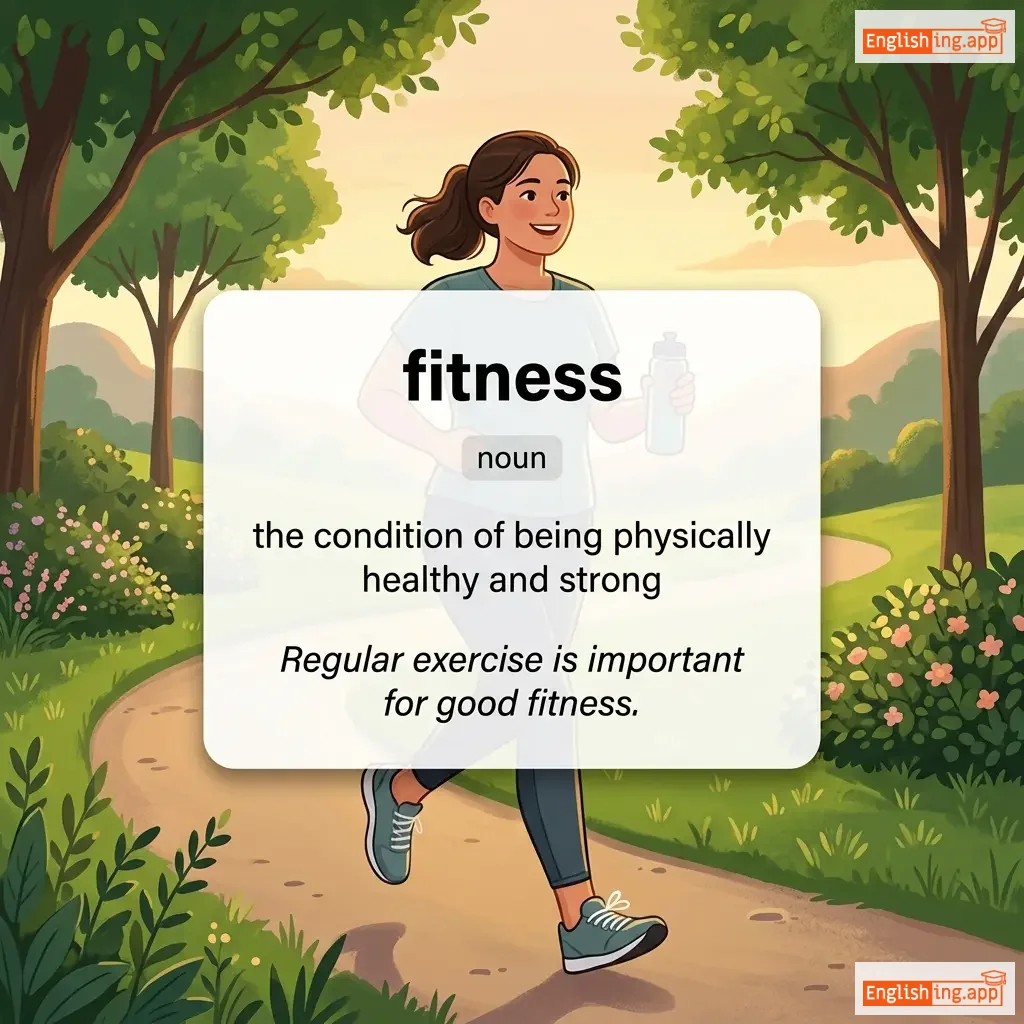
fitness definition card — visual illustration of the meaning
noun
/ˈfɪtnəs/
体能 (tǐnéng)

the condition of being physically healthy and strong

"Regular exercise is important for good fitness."

"定期运动对保持良好的体能非常重要。" (Dìngqī yùndòng duì bǎochí liánghǎo de tǐnéng fēicháng zhòngyào.)
noun
/faɪv/
(wu)

The number 5; one more than four and one less than six.

"She bought five apples from the market."

"她从市场买了五个苹果。" (Ta cong shichang mai le wu ge pingguo.)
🔧

fix

verb
/fɪks/

To repair or make something work again.

"The mechanic fixed the broken car."

fixation definition card — visual illustration of the meaning
noun
/fɪkˈseɪ.ʃən/
固执的兴趣或对某事或某人的执念 (gùzhí de xìngqù huò duì mǒu shì huò mǒu rén de zhí niàn)

An obsessive interest in or feeling about someone or something.

"His fixation on perfectionism delayed project completion."

"他对完美主义的固执导致项目完成的延迟。" (Tā duì wánměi zhǔyì de gùzhí dǎozhì xiàngmù wánchéng de yánchí.)
adjective
/fɪkst/
固定的,稳定的 (gùdìng de, wěndìng de)

firmly in place; not changing or movable

"The schedule for the meeting is fixed for Monday morning."

"会议时间表已定于周一早上。" (Huìyì shíjiān biǎo yǐ dìng yú zhōuyī zǎoshang.)
fixed income definition card — visual illustration of the meaning
noun
fɪkst ˈɪnkʌm
固定收入 (gù dìng shōu rù)

Investment that provides a return in the form of fixed periodic payments.

"Fixed income investments provide reliable returns."

"固定收益投资提供可靠的回报。" (Gù dìng shōu rù tóu zī tí gōng kě kào de huí bào.)
adverb
/ˈfɪksɪdli/
专心地 (zhuānxīn de)

in a steady, unmoving manner; with intense concentration

"He stared fixedly at the painting."

"他专心地盯着画作。" (Tā zhuānxīn de dīngzhe huàzuò.)
noun
/ˈfɪks.tʃər/
固定物,安装设备 (gùdìng wù, ānzhuāng shèbèi)

a permanent or fixed object, often in a house or building

"The bathroom fixture was installed yesterday."

"浴室设备昨天已安装。" (Yùshì shèbèi zuótiān yǐ ānzhuāng.)
adjective
/ˈflæb.i/
松软且松弛; 缺乏紧实或肌肉张力; 虚弱 (flabi)

soft and loose; lacking firmness or muscle tone; weak

"His flabby arms showed he needed to exercise more."

"他松弛的手臂显示他需要更多的锻炼。" (Ta song chi de shou bi xian shi ta xu yao geng duo de duan lian.)
adjective
/ˈflæks.ɪd/
柔软、松弛或缺乏坚固性 (róuruǎn, sōngchí huò quēfá jiāngùxìng)

soft, limp, or lacking firmness

"The fruit was overripe and flaccid."

"水果过熟且松弛。" (shuǐguǒ guòshú qiě sōngchí.)