词汇表

英语词汇词典 | 单词含义、定义和示例

verb
/dɪˈsɛkt/

to cut apart an animal, plant, or other organism to study its internal parts; to analyze something in detail

"In biology class, students had to dissect a frog to learn about its anatomy."

noun
/daɪˈsɛkʃən/
解剖 (jie po)

the act of cutting apart or analyzing something in detail, especially a body or structure

"The dissection of the specimen revealed important details about its structure."

"样本的解剖揭示了关于其结构的重要细节。" (Yangben de jiepo jieshi le guanyu qi jiegou de zhongyao xijie.)
dissemble definition card — visual illustration of the meaning
verb
/dɪˈsɛmbəl/
假装 (jia zhuang)

to conceal one's true motives, feelings, or beliefs; to pretend

"He tried to dissemble his anger with a forced smile."

"他试图用强颜欢笑来掩饰自己的愤怒。" (Ta shitu yong qiangyan huanxiao lai yanshi ziji de fennu.)
noun
/dɪˈsɛmbələr/
伪君子 (wěi jūn zǐ)

a person who conceals their real feelings or intentions; a hypocrite or pretender

"The politician was accused of being a dissembler who never revealed his true plans."
"那位政治家被指控是一个从不透露自己真实计划的伪君子。" (Nà wèi zhèng zhì jiā bèi zhǐ kòng shì yí gè cóng bù tòu lù zì jǐ zhēn shí jì huà de wěi jūn zǐ.)
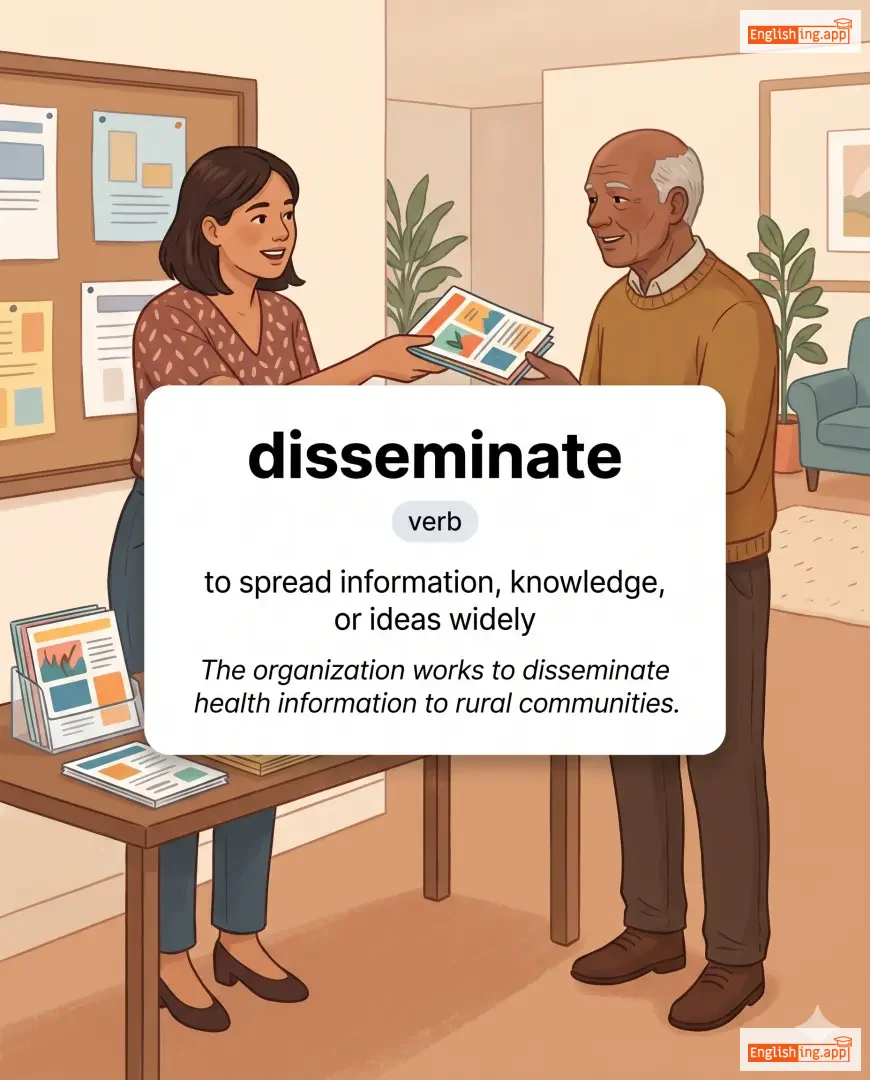
disseminate definition card — visual illustration of the meaning
verb
/dɪˈsɛmɪˌneɪt/
传播 (chuanbo)

to spread information, knowledge, or ideas widely

"The organization works to disseminate health information to rural communities."
"该组织致力于向农村社区传播健康信息。" (Gai zuzhi zhiliyu xiang nongcun shequ chuanbo jiankang xinxi.)
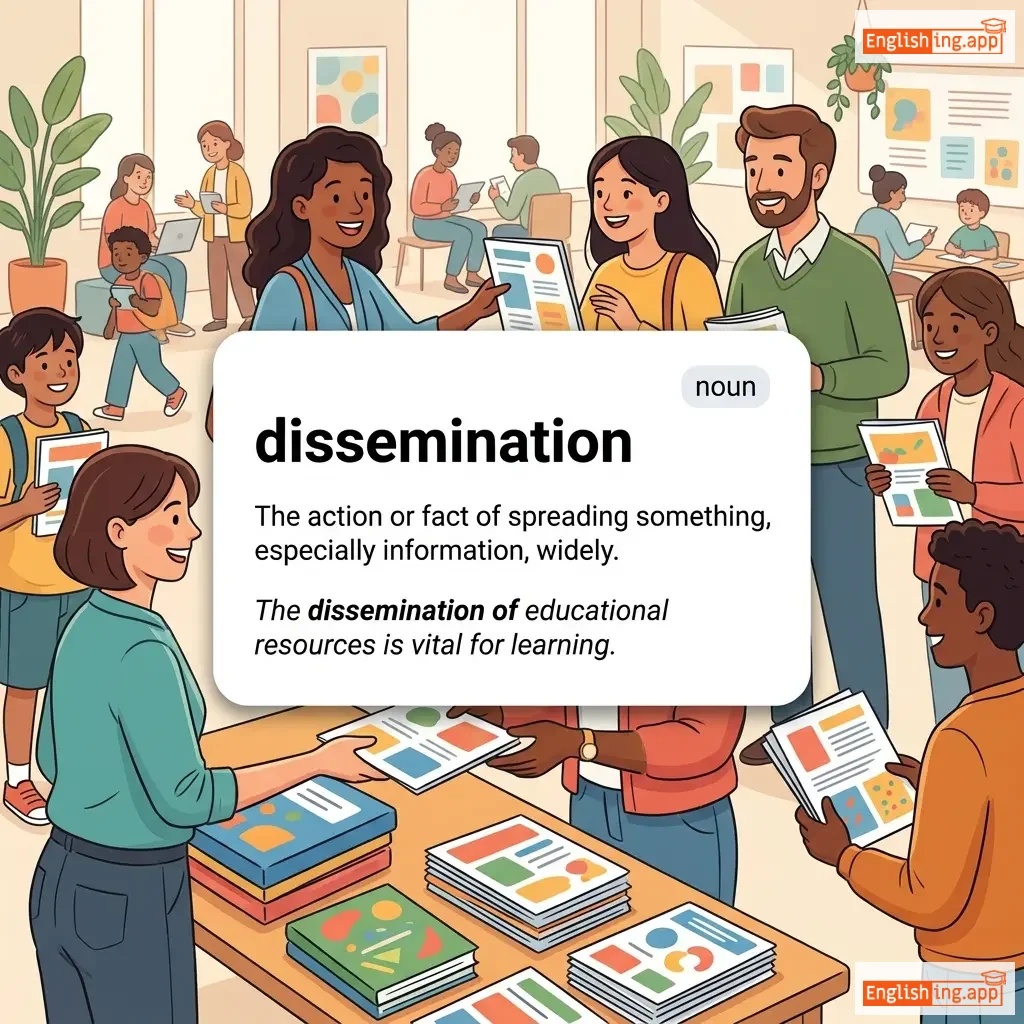
dissemination definition card — visual illustration of the meaning
noun
dɪˌsɛm.ɪˈneɪ.ʃən
传播 (chuanbo)

The action or fact of spreading something, especially information, widely.

"The dissemination of educational resources is vital for learning."

"教育资源的传播对学习至关重要。" (Jiaoyu ziyuande chuanbo dui xuexi zhiguan zhongyao.)
noun
/dɪˈsɛnʃən/
分歧 (fenqi)

Strong disagreement or difference of opinion, especially leading to discord within a group.

"The meeting ended in dissension among the committee members."

"会议在委员会成员之间的分歧中结束。" (Huiyi zai weiyuanhui chengyuan zhijian de fenqi zhong jieshu.)
verb
/dɪˈsɛnt/

To hold or express opinions that are different from those officially accepted.

"Several members dissented from the majority decision."

adjective
/dɪˈsɛnʃənt/
持不同政见者 (chí bù tóng zhèng jiàn zhě)

Expressing or holding opinions that are opposed to the majority or official view.

"Only a few dissentient voices were heard during the debate."

"在辩论期间,只听到了少数持不同政见者的声音。" (Zài biàn lùn qī jiān, zhī tīng dào le shǎo shù chí bù tóng zhèng jiàn zhě de shēng yīn.)
adjective
/dɪˈsɛnʃəs/
引起分裂的 (yǐnqǐ fēnliè de)

Causing or likely to cause disagreement and conflict.

"His dissentious remarks divided the group further."

"他那具有分裂性的评论使得小组更加分裂。" (Tā nà jùyǒu fēnliè xìng de pínglùn shǐdé xiǎozǔ gèngjiā fēnliè.)
noun
/ˌdɪsərˈteɪʃən/
学位论文 (xuéwèi lùnwén)

A long piece of writing on a particular subject, usually written for a university degree.

"She spent two years writing her doctoral dissertation."

"她花了两年时间写她的博士论文。" (Tā huāle liǎng nián shíjiān xiě tā de bóshì lùnwén.)
noun
/dɪsˈsɜːrvɪs/
损害 (sunhai)

A harmful action; something that does damage rather than help.

"Spreading false information is a disservice to the community."

"传播虚假信息对社区是一种损害。" (Chuanbo xujia xinxi dui shequ shi yizhong sunhai.)
verb
/dɪˈsɛvər/
分开 (fēnkāi)

To separate or cut apart.

"The treaty sought to dissever the two hostile regions."
"条约试图分裂这两个敌对的地区。" (Tiáoyuē shìtú fēnliè zhè liǎng gè díduì de dìqū.)
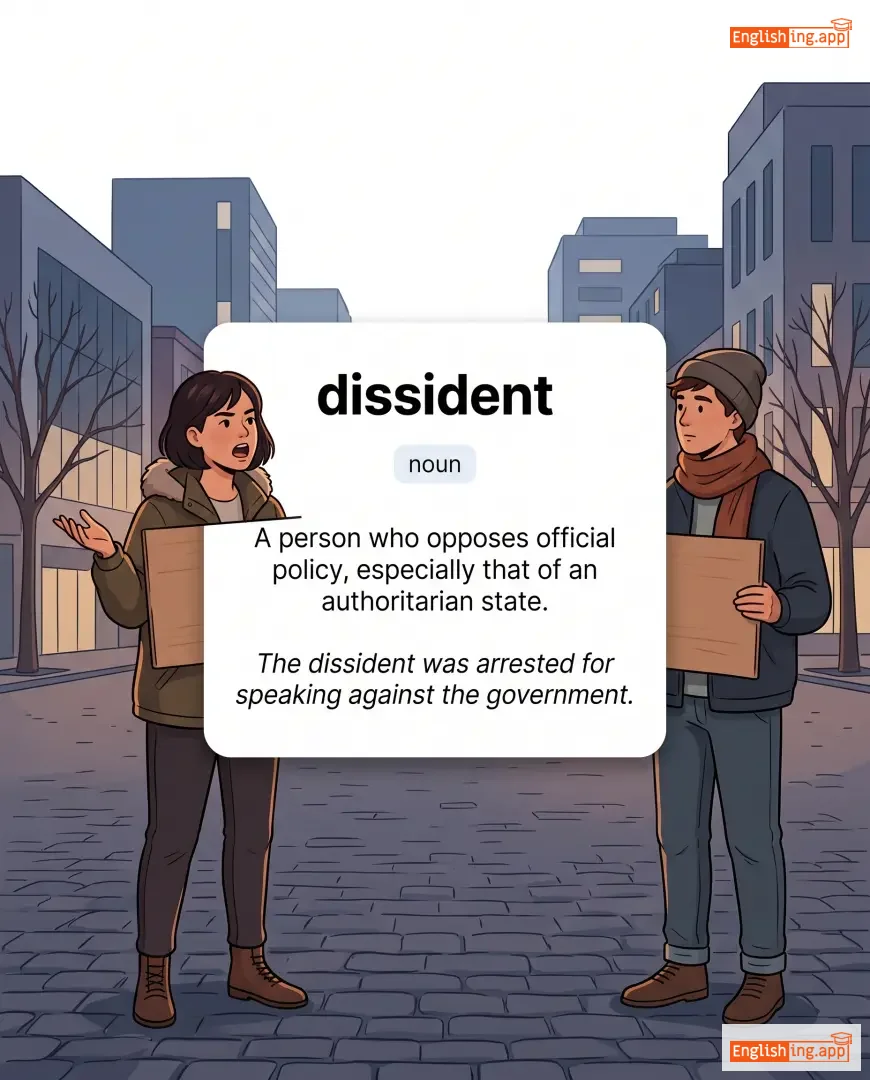
dissident definition card — visual illustration of the meaning
noun
/ˈdɪsɪdənt/
异见者 (yìjiànzhě)

A person who opposes official policy, especially that of an authoritarian state.

"The dissident was arrested for speaking against the government."

"异见者因反对政府而被逮捕。" (Yìjiànzhě yīn fǎnduì zhèngfǔ ér bèi dàibǔ.)
adjective
/dɪsˈsɪmɪlər/
不同 (butong)

Not alike; different.

"Though they are twins, their personalities are dissimilar."

"虽然他们是双胞胎,但他们的个性不同。" (suiran tamen shi shuangbaotai, dan tamen de gexing butong.)
verb
/dɪˈsɪmjʊˌleɪt/
伪装 (weizhuang)

To disguise or conceal one's true feelings or intentions.

"He tried to dissimulate his fear with a smile."
"他试图用微笑掩饰他的恐惧。" (Tā shìtú yòng wēixiào yǎnshì tā de kǒngjù.)
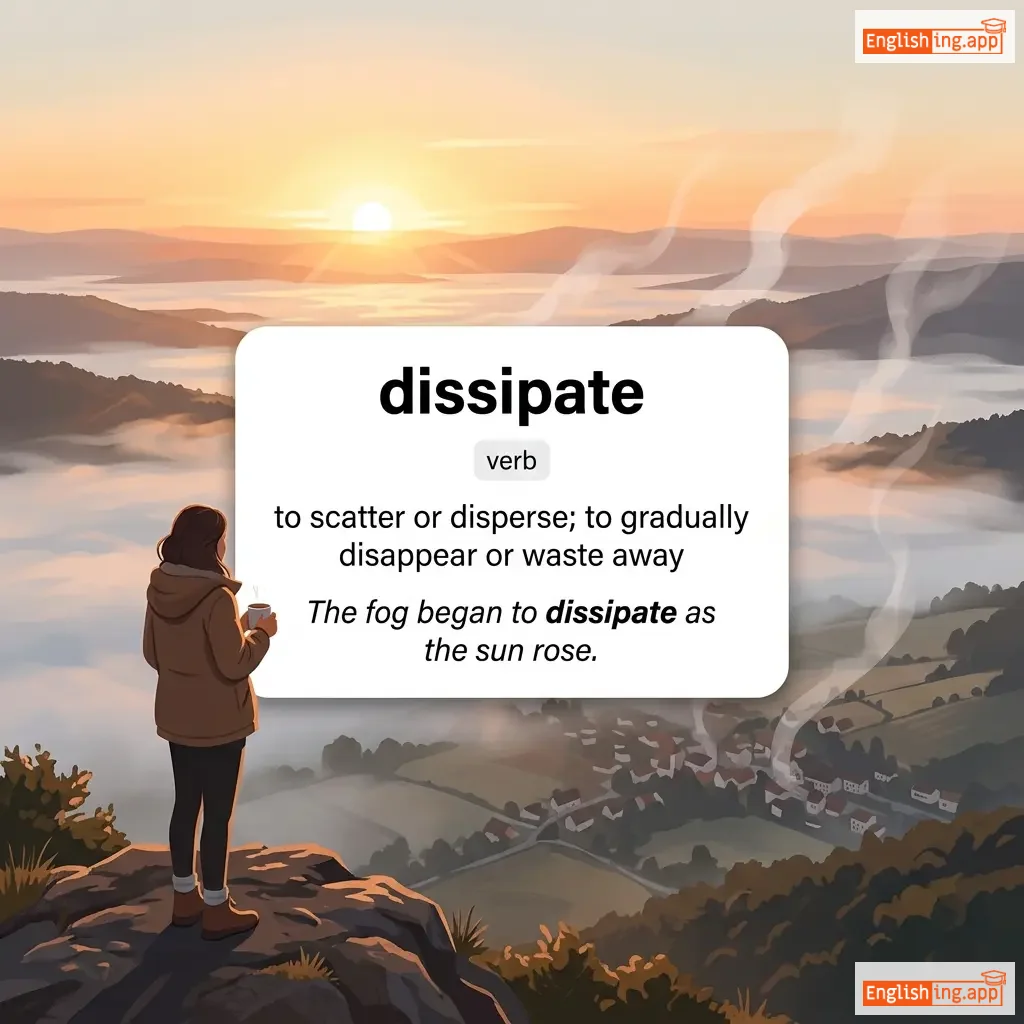
dissipate definition card — visual illustration of the meaning
verb
/ˈdɪsɪpeɪt/
消散 (xiaosan)

to scatter or disperse; to gradually disappear or waste away

"The fog began to dissipate as the sun rose."

"雾气开始消散,随着太阳升起。" (Wuqi kaishi xiaosan, suizhe taiyang shengqi.)
noun
/ˌdɪsɪˈpeɪʃən/
挥霍 (huīhuò)

the process of disappearing or wasting; excessive indulgence in pleasure

"The dissipation of his fortune left him in poverty."

"他财富的挥霍让他陷入贫困。" (Tā cáifù de huīhuò ràng tā xiànrù pínkùn.)
adjective
/ˈdɪsəluːt/
放荡 (fangdang)

lacking moral restraint; indulging excessively in sensual pleasures

"He led a dissolute life filled with parties and gambling."
"他过着充满派对和赌博的放荡生活。" (Ta guo zhe chongman paidui he duba de fangdang shenghuo.)
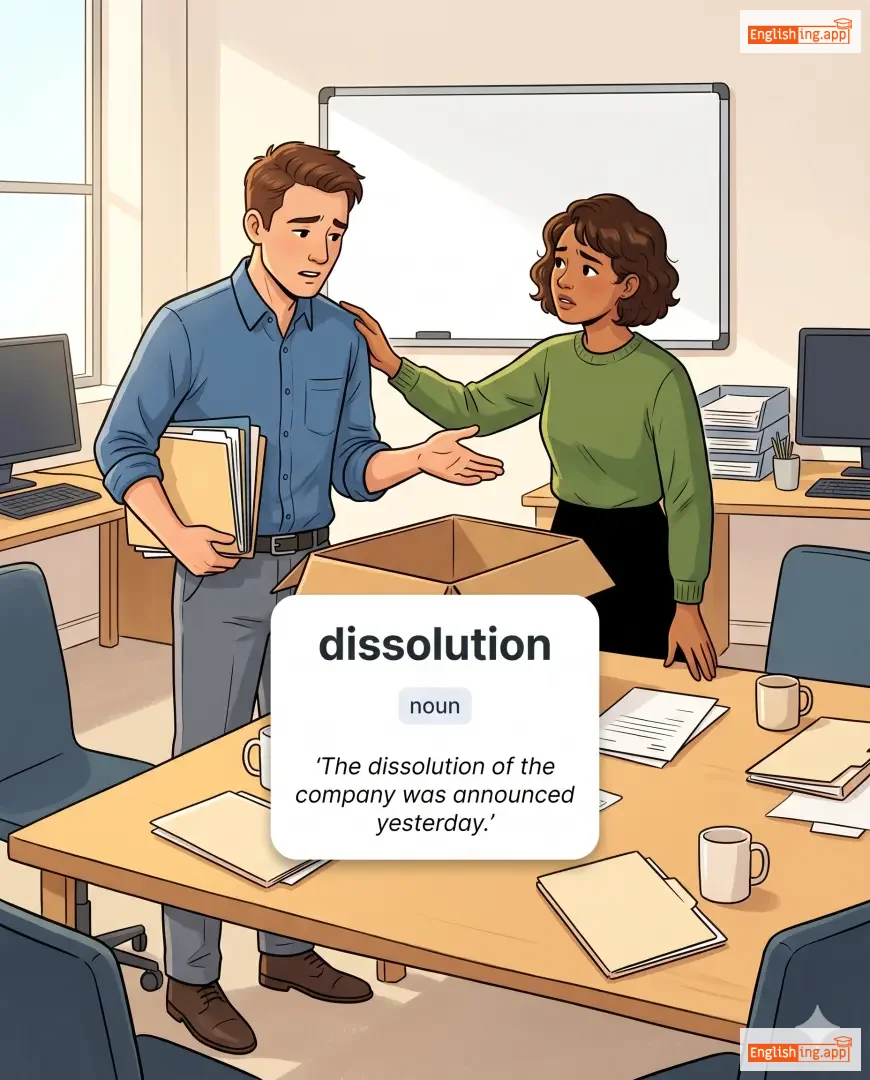
dissolution definition card — visual illustration of the meaning
noun
/ˌdɪsəˈluːʃən/
解散 (jiesan)

the act of formally ending or breaking apart something, such as an organization or marriage

"The dissolution of the company was announced yesterday."
"公司解散的消息昨天公布。" (Gongsi jiesan de xiaoxi zuotian gongbu.)
verb
/dɪˈzɒlv/

to melt or become liquid; to officially end or break up an agreement or organization

"The sugar will dissolve quickly in hot tea."

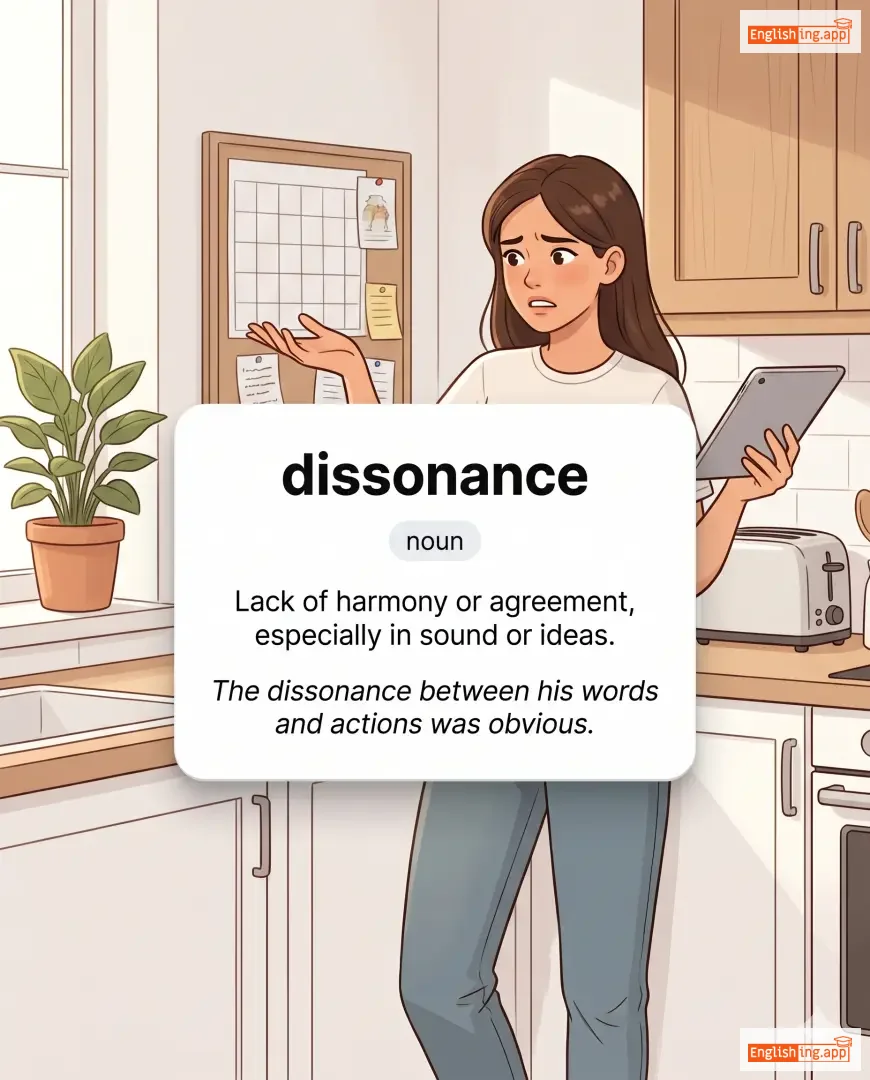
dissonance definition card — visual illustration of the meaning
noun
/ˈdɪsənəns/
不和谐 (bùhéxié)

Lack of harmony or agreement, especially in sound or ideas.

"The dissonance between his words and actions was obvious."

"他的话与行动之间的矛盾显而易见。" (Tā de huà yǔ xíngdòng zhī jiān de máodùn xiǎn'ér yìjiàn.)
adjective
/ˈdɪsənənt/
不和谐 (bù héxié)

Harsh and lacking harmony; conflicting.

"The orchestra produced a dissonant sound during rehearsal."

"乐队在排练中发出了不和谐的声音。" (Yuèduì zài pái liàn zhōng fāchūle bù héxié de shēngyīn.)
verb
/dɪˈsweɪd/
劝阻 (quànzǔ)

To persuade someone not to do something.

"She tried to dissuade him from quitting his job."

"她试图劝阻他辞去工作。" (Tā shìtú quànzǔ tā cíqù gōngzuò.)
noun
/dɪˈsweɪʒən/
劝阻 (quànzǔ)

The act of persuading someone not to take a course of action.

"Her dissuasion prevented him from making a bad investment."

"她的劝阻阻止了他做一个糟糕的投资。" (tā de quànzǔ zǔzhǐle tā zuò yīgè zāogāo de tóuzī.)
noun/adjective
/ˈdɪstæf/
与女性相关,母系 (yu nuxing xiangguan, mǔxì)

Relating to women or the maternal side of a family; also a tool for spinning thread.

"She came from the distaff side of a noble family."

"她来自一个贵族家庭的母系。" (Tā láizì yīgè guìzú jiātíng de mǔxì.)
verb
/dɪsˈteɪn/
鄙视 (bishi)

to treat with scorn or contempt (archaic form of disdain)

"He would never distain those who had less fortune than him."

"他从未鄙视那些比他更不幸运的人。" (Ta cong wei bishi naxie bi ta geng bu xingyun de ren.)
adjective
/ˈdɪstəl/
远端 (yuǎn duān)

situated away from the center of the body or from the point of attachment

"The doctor examined the distal end of the patient’s arm."

"医生检查了病人手臂的远端。" (Yīshēng jiǎnchále bìngrén shǒubì de yuǎn duān.)
noun
/ˈdɪstəns/
距离 (juli)

The amount of space between two points or places.

"The distance between Dhaka and Chittagong is about 250 kilometers."

"达卡和吉大港之间的距离大约为250公里。" (Daka he Jidagang zhijian de juli dayue wei 250 gongli.)
adjective
/ˈdɪstənt/
遥远的 (yaoyuan de)

far away in space or time

"They could see the distant mountains from their home."

"他们从家里能看到遥远的山脉。" (Tamen cong jiali neng kandao yaoyuan de shanmai.)
noun
/dɪsˈtɛmpər/
一种影响动物的病毒性疾病,特别是狗 (yī zhǒng yǐngxiǎng dòngwù de bìngdú xìng jíbìng, tèbié shì gǒu)

a viral disease affecting animals, especially dogs; also refers to a state of disorder

"The dog was diagnosed with distemper and needed immediate care."
"这只狗被诊断为患有犬瘟热,需要立即治疗。" (Zhè zhī gǒu bèi zhěnduàn wéi huàn yǒu quǎn wēn rè, xūyào lìjí zhìliáo.)
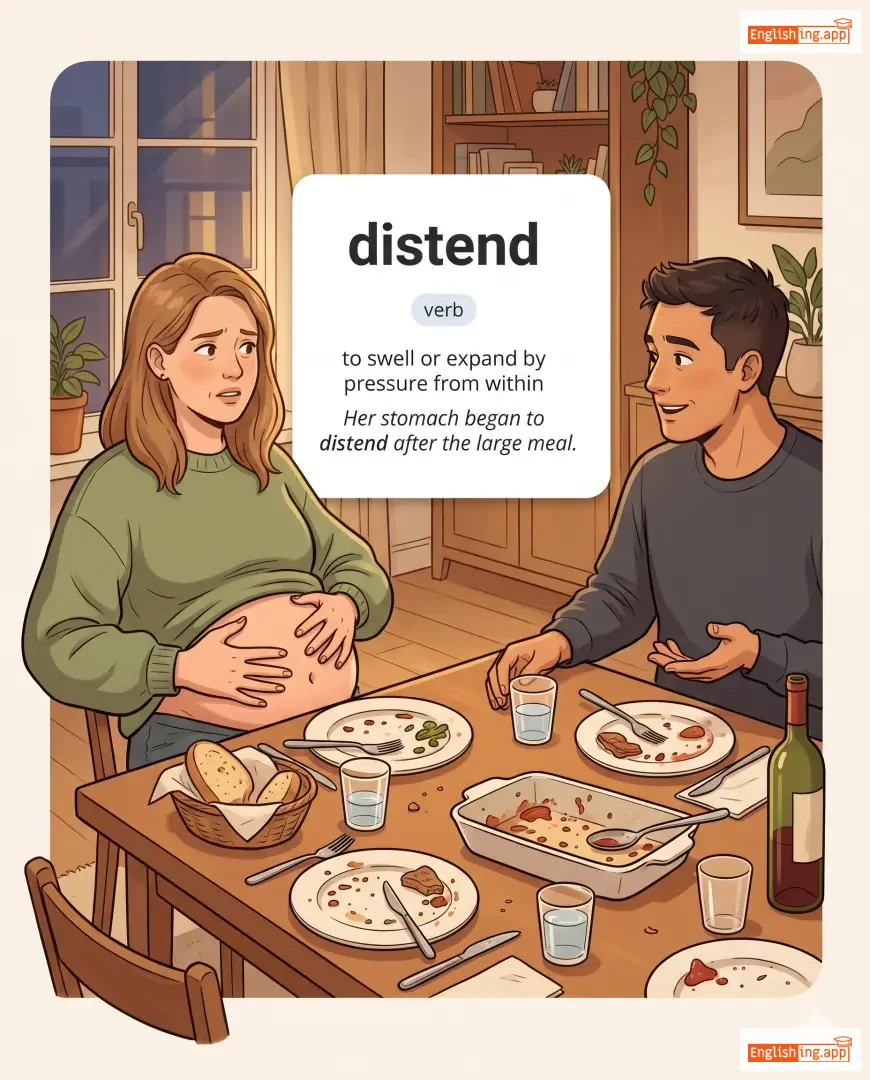
distend definition card — visual illustration of the meaning
verb
/dɪsˈtɛnd/
膨胀 (péngzhàng)

to swell or expand by pressure from within

"Her stomach began to distend after the large meal."

"她的肚子在大餐后开始膨胀。" (Tā de dùzi zài dà cān hòu kāishǐ péngzhàng.)
adjective
/dɪˈstɛnsəbl̩/
可伸展的 (kě shēnzhǎn de)

Capable of being stretched or expanded.

"The stomach is a distensible organ that can expand after eating."

"胃是一个可伸展的器官,在进食后可以膨胀。" (wèi shì yīgè kě shēnzhǎn de qìguān, zài jìnshí hòu kěyǐ péngzhàng.)
noun
/dɪˈstɛnʃən/
膨胀 (péngzhàng)

The state of being swollen due to internal pressure.

"The patient complained of abdominal pain and distention."

"病人抱怨腹部疼痛和膨胀。" (Bìngrén bàoyuàn fùbù téngtòng hé péngzhàng.)
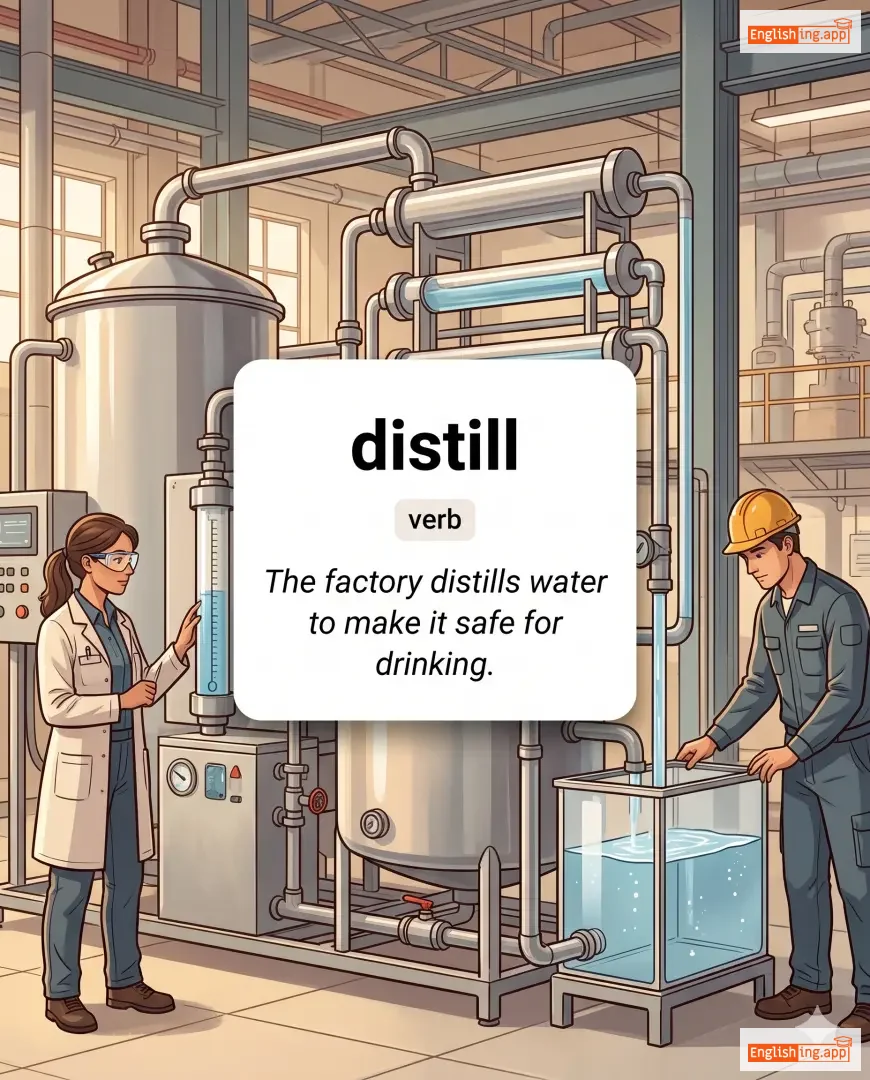
distill definition card — visual illustration of the meaning
verb
/dɪˈstɪl/

To purify a liquid by heating and cooling; to extract the essential meaning or most important aspects.

"The factory distills water to make it safe for drinking."

noun
/ˌdɪstɪˈleɪʃən/
蒸馏 (zhēng liú)

The process of purifying a liquid by heating and cooling; the extraction of the essential meaning.

"Distillation is commonly used to produce alcoholic beverages."

"蒸馏通常用于生产酒精饮料。" (Zhēng liú tōngcháng yòng yú shēngchǎn jiǔjīng yǐnliào.)
noun
/dɪˈstɪlər/
蒸馏师 (zhēngliú shī)

A person or company that makes alcoholic drinks or purified liquids by distillation.

"The distiller introduced a new brand of whiskey last year."

"蒸馏师在去年推出了一款新品牌的威士忌。" (Zhēngliú shī zài qùnián tuīchūle yī kuǎn xīn pǐnpái de wēishìjì.)
adjective
/dɪˈstɪŋkt/
独特 (dútè)

clearly different or separate from others of its kind

"The twins have distinct personalities."

"这对双胞胎有着独特的个性。" (Zhè duì shuāngbāotāi yǒuzhe dútè de gèxìng.)
noun
/dɪˈstɪŋkʃən/

a difference or contrast between similar things or people; excellence that sets someone apart

"She graduated with distinction from the university."

adjective
/dɪˈstɪŋktɪv/
独特的 (dútè de)

having a quality or characteristic that makes something different and easily noticed

"The restaurant is known for its distinctive flavors."

"餐厅以其独特的味道而闻名。" (Cāntīng yǐ qí dútè de wèidào ér wénmíng.)
verb
/dɪˈstɪŋɡwɪʃ/
区分 (qūfēn)

to recognize or show the differences between two or more things; to set apart as different

"It can be difficult to distinguish between truth and rumor."

"区分真相和谣言可能很困难。" (Qūfēn zhēnxiàng hé yáoyán kěnéng hěn kùnnán.)
adjective
/dɪˈstɪŋɡwɪʃt/
杰出; 荣誉的; 著名的; 拥有尊严的外观或举止 (jiechu; rongyu de; zhuming de)

notable; honored; famous; having a dignified appearance or manner

"He is a distinguished professor at the university."

"他是大学里一位杰出的教授。" (Ta shi daxue li yi wei jiechu de jiaoshou.)
verb
/dɪˈstɔːrt/

to twist or change the shape, appearance, or meaning of something so it is not true or accurate

"The mirror distorted her reflection."

noun
/dɪˈstɔːrʃən/
扭曲,错误呈现 (niuqiao, cuowu chengxian)

the action of twisting, changing, or misrepresenting the shape, sound, or truth of something

"There was a distortion in the radio signal."

"广播信号中存在扭曲。" (Guangbo xinhao zhong cunzai niuqiao.)
verb
/dɪˈstrækt/
分心 (fēn xīn)

to take someone's attention away from what they are doing or focusing on

"The loud noise distracted her during the exam."
"大声噪音让她在考试中分心。" (dà shēng zào yīn ràng tā zài kǎo shì zhōng fēn xīn)
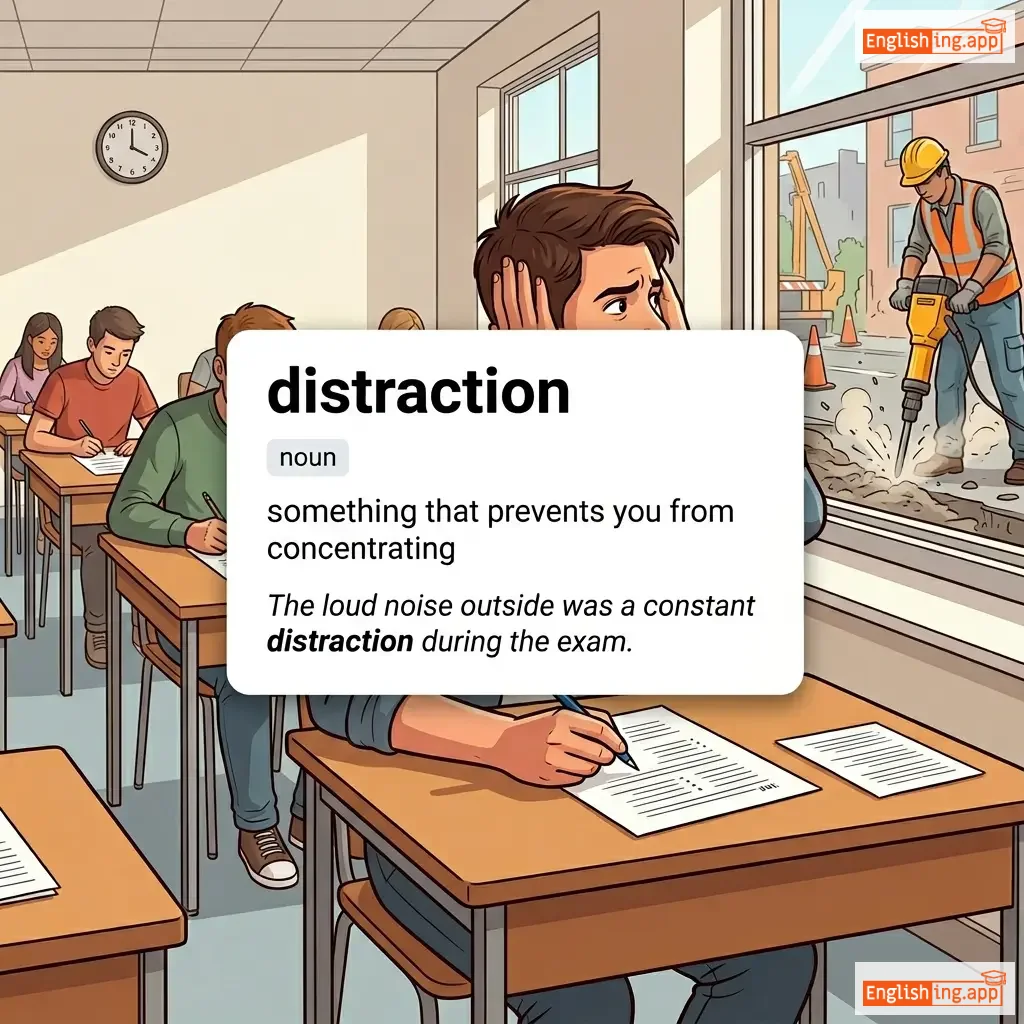
distraction definition card — visual illustration of the meaning
noun
/dɪˈstrækʃən/
干扰 (ganrao)

something that prevents you from concentrating

"The loud noise outside was a constant distraction during the exam."
"外面的喧闹声在考试期间是持续的干扰。" (Wàimiàn de xuānnào shēng zài kǎoshì qíjiān shì chíxù de gānrǎo.)
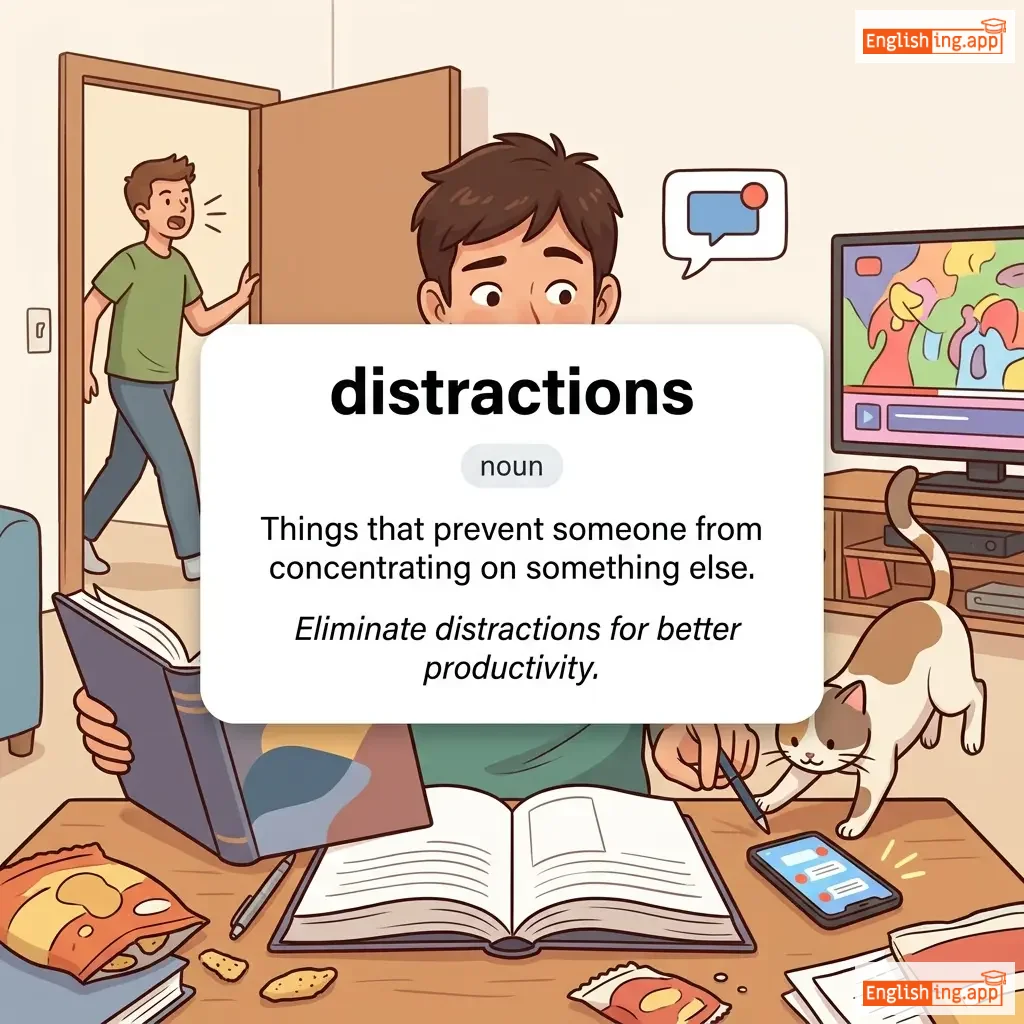
distractions definition card — visual illustration of the meaning
noun
/dɪˈstrækʃənz/
干扰 (gān rǎo)

Things that prevent someone from concentrating on something else.

"Eliminate distractions for better productivity."

"消除干扰以提高生产力。" (Xiāo chú gānrǎo yǐ tígāo shēngchǎnlì.)
verb
/dɪˈstreɪn/
扣押 (kouya)

to seize someone's property in order to obtain payment of rent or other money owed

"The landlord distrained the tenant's furniture for unpaid rent."

"房东因租金未付扣押了租客的家具。" (Fangdong yin zujin wei fu kouya le zu ke de jiaju.)
noun
/dɪˈstreɪnər/
财产征收人 (caichan zhengshouren)

a person, usually a landlord, who seizes another's property for unpaid debt or rent

"The distrainor took possession of the tenant's car until the debt was cleared."
"财产征收人扣押了租户的车,直到债务清偿。" (Caichan zhengshouren kòu yā le zūhù de chē, zhídào zhàiwù qīngcháng.)
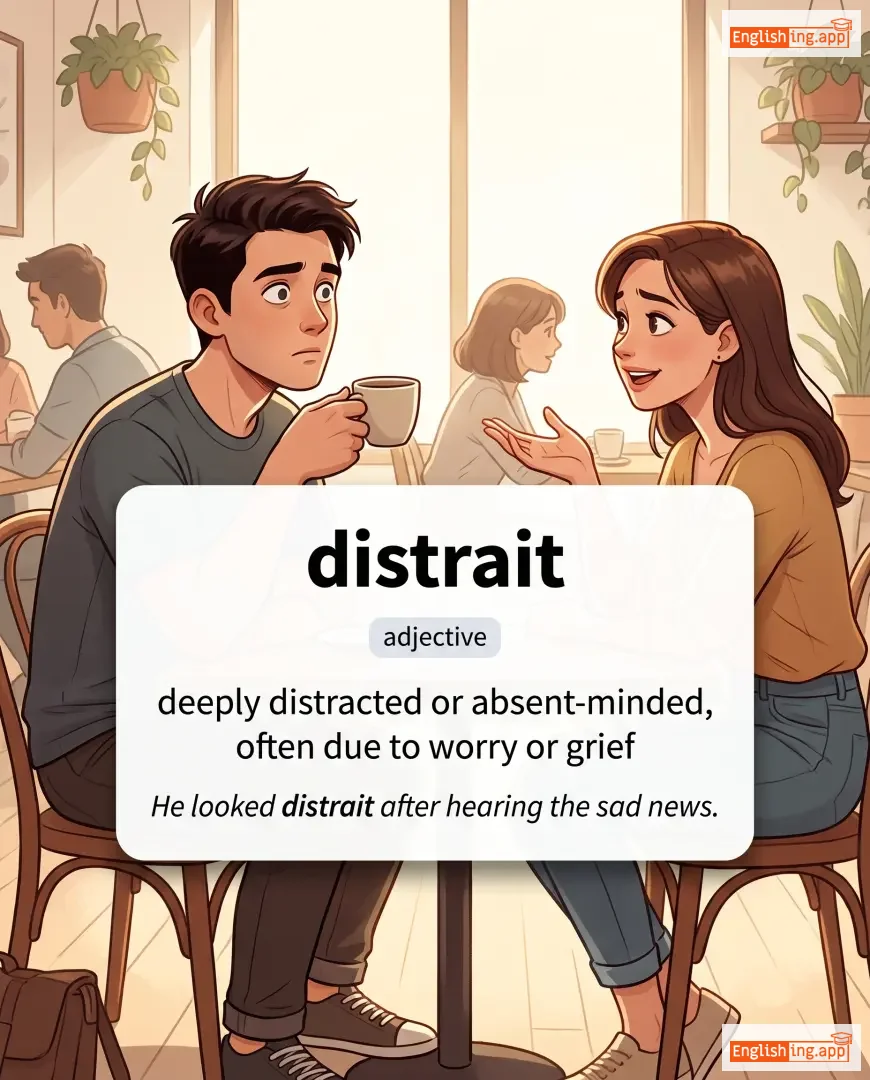
distrait definition card — visual illustration of the meaning
adjective
/dɪˈstreɪ/
心不在焉 (xin bu zai yan)

deeply distracted or absent-minded, often due to worry or grief

"He looked distrait after hearing the sad news."

"在听到悲伤的消息后,他看起来心不在焉。" (Zai tingdao beishang de xiaoxi hou, ta kankan qi lai xin bu zai yan.)