词汇表

英语词汇词典 | 单词含义、定义和示例

adjective
/ˈbaɪ.fərˌkeɪ.tɪd/
分成两部分 (fēn chéng liǎng bùfen)

Divided into two branches or parts.

"The river became bifurcated as it flowed around the island."

"河流分成两部分,当它绕过岛屿时。" (Héliú fēn chéng liǎng bùfen, dāng tā rào guò dǎo yǔ shí.)
adjective
/bɪɡ/
(da)

large in size, extent, or importance

"They moved into a big house with plenty of space."

"他们搬进了一座大房子,那里有很多空间。" (Tāmen bān jìnle yīzuò dà fángzi, nàlǐ yǒu hěn duō kōngjiān.)
noun
/bɪɡ boʊl/
大碗 (da wan)

a large, round, shallow container used for serving food, mixing ingredients, or washing

"She mixed the ingredients in a big bowl."

"她在一个大碗里混合了食材。" (Tā zài yīgè dà wǎn lǐ hùnhéle shícái.)
noun
/ˈbɪɡ.ə.mɪst/
重婚罪犯 (chóng hūn zuì fàn)

A person who commits the crime of marrying someone while already married to another.

"The man was arrested for being a bigamist."

"这个人因大婚而被逮捕。" (Zhège rén yīn dà hūn ér bèi dàibǔ.)
noun
/ˈbɪɡ.ə.mi/
重婚 (chónghūn)

The act of marrying one person while still legally married to another.

"He was charged with bigamy after his second marriage was discovered."

"在他第二次婚姻被发现后,他因重婚被指控。" (Zài tā dì èr cì hūnyīn bèi fāxiàn hòu, tā yīn chónghūn bèi zhǐkòng.)
adjective
/ˈbɪɡɪst/
最大的 (zui da de)

largest in size, amount, degree, or importance; superlative form of big

"This is the biggest challenge we have ever faced."

"这是我们面临过的最大挑战。" (zhe shi women mianlin guo de zui da tiaozhan)
noun
/baɪt/
海湾 (haiwan)

A bend or curve in a geographical feature, especially a coastline, or a loop in a rope.

"The sailors anchored in the calm waters of the bight."

"水手们在海湾的平静水域中抛锚。" (Shuǐshǒumen zài hǎiwān de píngjìng shuǐyù zhōng pāo mǎo.)
noun
/ˈbɪɡ.ət/
偏执者 (pian zhi zhe)

A person who is intolerant toward those holding different opinions or beliefs.

"He was called a bigot for refusing to listen to others' views."

"因为拒绝听取他人的观点,他被称为偏执者。" (Yīnwèi jùjué tīngqǔ tārén de guāndiǎn, tā bèi chēng wéi piānzhí zhě.)
noun
/ˈbɪɡətri/
偏执 (pian zhi)

Intolerance toward those who hold different opinions or lifestyles.

"Her bigotry prevented her from accepting people with different beliefs."

"她的偏执阻止她接受拥有不同信仰的人。" (Tā de piānzhí zǔzhǐ tā jiēshòu yǒngyǒu bùtóng xìnyǎng de rén.)
noun, verb
/baɪk/
自行车 (zìxíngchē)

a bicycle or motorcycle; to ride a bicycle

"He biked to school every day."
"他每天骑自行车去学校。" (Tā měitiān qí zìxíngchē qù xuéxiào.)
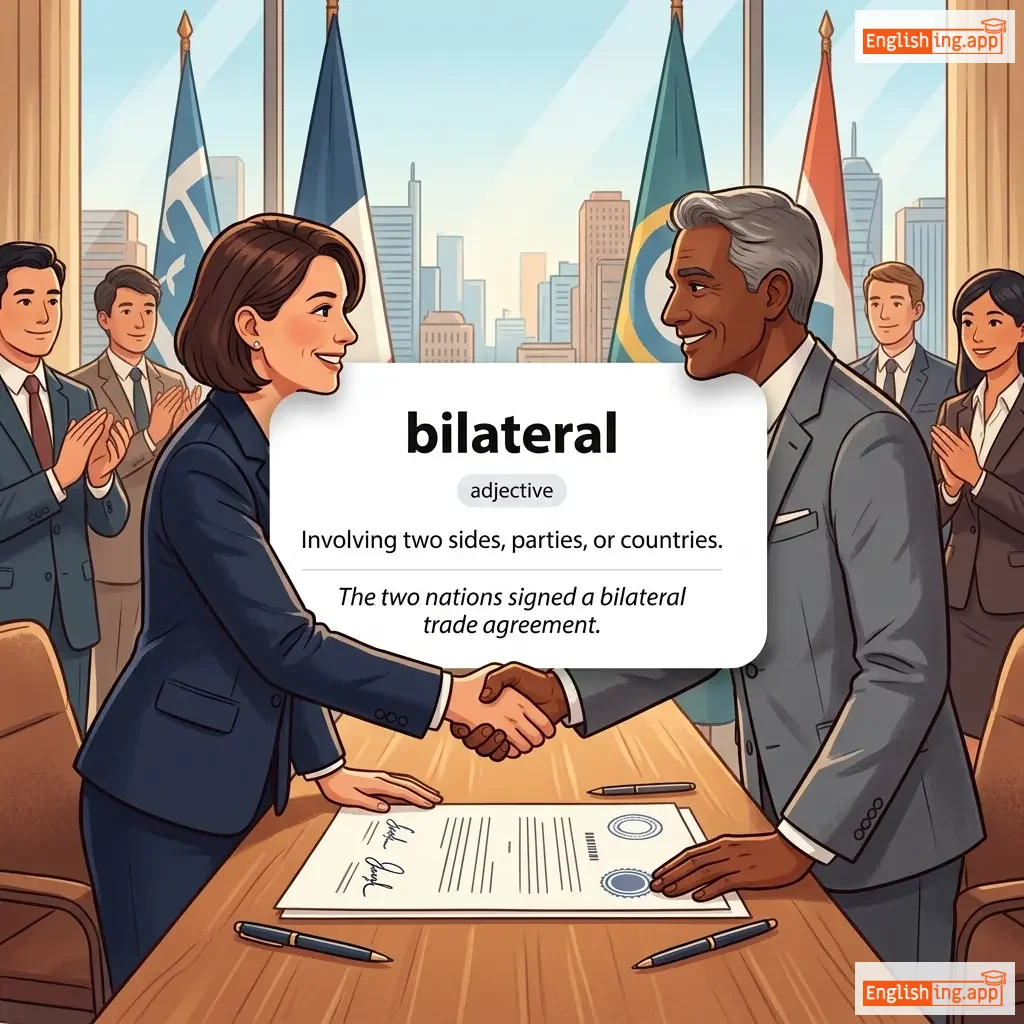
bilateral definition card — visual illustration of the meaning
adjective
/ˌbaɪˈlætərəl/
双边的 (shuāngbiān de)

Involving two sides, parties, or countries.

"The two nations signed a bilateral trade agreement."

"这两个国家签署了双边贸易协议。" (zhè liǎng gè guójiā qiānshǔle shuāngbiān màoyì xiéyì.)
bilateral negotiations definition card — visual illustration of the meaning
noun
/ˌbaɪˈlæt.ər.əl nɪˌɡəʊ.ʃiˈeɪ.ʃənz/
双边谈判 (shuāngbiān tánpàn)

Negotiations or discussions between two parties, typically countries or organizations.

"Bilateral negotiations resolve disputes."

"双边谈判解决争议。" (Shuāngbiān tánpàn jiějué zhēngyì.)
noun
/baɪl/
胆汁 (dan zhi)

a bitter greenish-brown alkaline fluid that aids digestion and is secreted by the liver and stored in the gallbladder

"The liver produces bile to help digest fats."

"肝脏产生胆汁来帮助消化脂肪。" (Gan zang chan sheng dan zhi lai bang zhu xiao hua zhi fang)
adjective
/ˌbaɪˈlɪŋɡwəl/
双语的 (shuangyu de)

Able to speak two languages fluently.

"She grew up in a bilingual household speaking both English and Spanish."

"她在一个双语家庭中长大,既说英语也说西班牙语。" (tā zài yī gè shuāngyǔ jiātíng zhōng zhǎng dà, jì shuō yīngyǔ yě shuō xībānyá yǔ.)
adjective
/ˈbɪliəs/
胆汁的 (dǎnzhī de)

Relating to bile or an ill-tempered, irritable disposition.

"He became bilious after hearing the unfair criticism."

"他在听到不公正的批评后变得暴躁。" (Tā zài tīngdào bù gōngzhèng de pīpíng hòu biàn dé bàozào.)
verb
/bɪlk/
诈骗 (zhàpiàn)

To cheat or defraud someone of money or rights.

"The scammer tried to bilk elderly people out of their savings."

"骗子试图通过诈骗拿走老年人的积蓄。" (piànzì shìtú tongguo zhàpiàn názǒu lǎonián rén de jīxù.)
🧾

Bill

noun
/bɪl/

a written statement of money owed for goods or services; also a proposed law presented to a legislature

"He received the electricity bill yesterday."

noun
/ˈbɪlɪŋzˌɡeɪt/
粗俗或侮辱性的语言 (cūsú huò wǔrǔxìng de yǔyán)

Coarse or abusive language; vulgar or offensive speech.

"The heated argument quickly descended into billingsgate."

"激烈的争论迅速转化为粗俗的语言。" (Jīliè de zhēnglùn xùnsù zhuǎnhuà wéi cūsú de yǔyán.)
noun
/ˈbɪljən/

the number 1,000,000,000 (one thousand million)

"The company is worth more than a billion dollars."

verb
/ˈbɪloʊ/
像波浪一样膨胀 (xiàng bōlàng yīyàng péngzhàng)

To swell or rise in large waves or surges; to flow outward in a rolling motion.

"Smoke billowed from the burning building."

"烟雾像波浪一样从燃烧的建筑中升腾而起。" (Yān wù xiàng bōlàng yīyàng cóng ránshāo de jiànzhú zhōng shēngténg érqǐ.)
adjective
/ˈbɪloʊɪŋ/
波动的 (bodong de)

Describing something that swells or surges outward in waves or large masses.

"She walked through the billowing curtains."

"她穿过波动的窗帘走了。" (Tā chuānguò bōdòng de chuānglián zǒu le.)
noun
/baɪˈmɛstər/
两个月的时间段 (liang ge yue de shijian duan)

A period of two months.

"The academic program is divided into six bimesters."

"学术项目分为六个学期。" (Xueshu xiangmu fen wei liu ge xueqi.)
bind definition card — visual illustration of the meaning
verb
/baɪnd/
捆绑 (kunbang)

to tie or fasten tightly; to unite or restrict

"The contract will bind both parties to the agreement."

"合同将使双方受协议约束。" (Hetong jiang shi shuangfang shou xieyi yueshu.)
noun
/ˈbaɪoʊ ˌdeɪtə/
简历 (jianli)

biographical data; a resume or curriculum vitae containing personal and professional information

"Please submit your bio-data along with the job application."
"请将您的简历与求职申请一起提交。" (Qǐng jiāng nín de jiǎnlì yǔ qiúzhí shēnqǐng yīqǐ tíjiāo.)
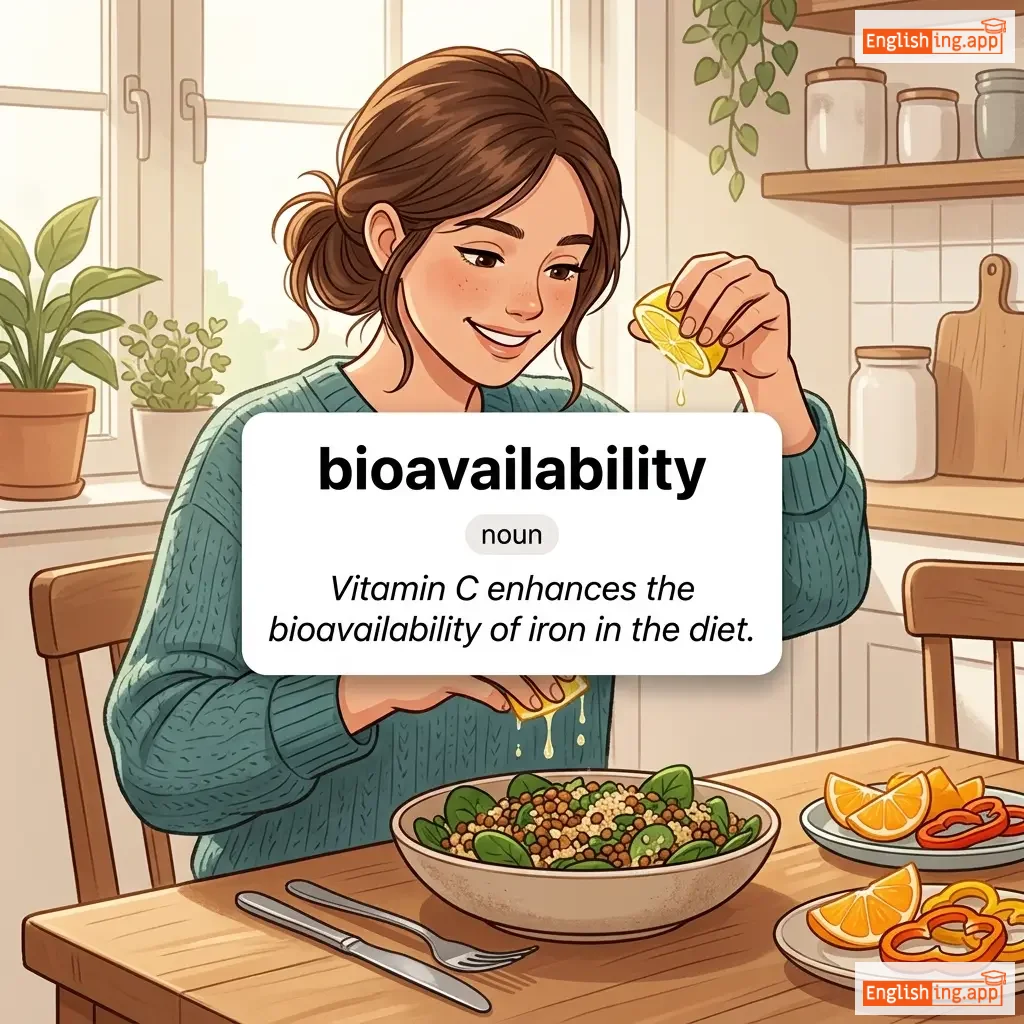
bioavailability definition card — visual illustration of the meaning
noun
/ˌbaɪ.oʊ.əˌveɪ.ləˈbɪl.ə.ti/
生物利用度 (shengwu liyongdu)

The degree and rate at which a substance is absorbed or becomes available at the site of physiological activity.

"Vitamin C enhances the bioavailability of iron in the diet."

"维生素C增加了饮食中铁的生物利用度。" (Wéishēngsù C zēngjiāle yǐnshí zhōng tiě de shēngwù lìyòngdù.)
noun
ˈbaɪəʊˌsaɪd
生物杀灭剂 (shengwu shamiè jì)

A chemical substance or microorganism intended to destroy, deter, render harmless, or exert a controlling effect on any harmful organism.

"Biocides help control pests and reduce the spread of diseases."
"生物杀灭剂帮助控制害虫,并减少疾病传播。" (Shengwu shamiè jì bāngzhù kòngzhì hàichóng, bìng jiǎnshǎo jíbìng chuánbò.)
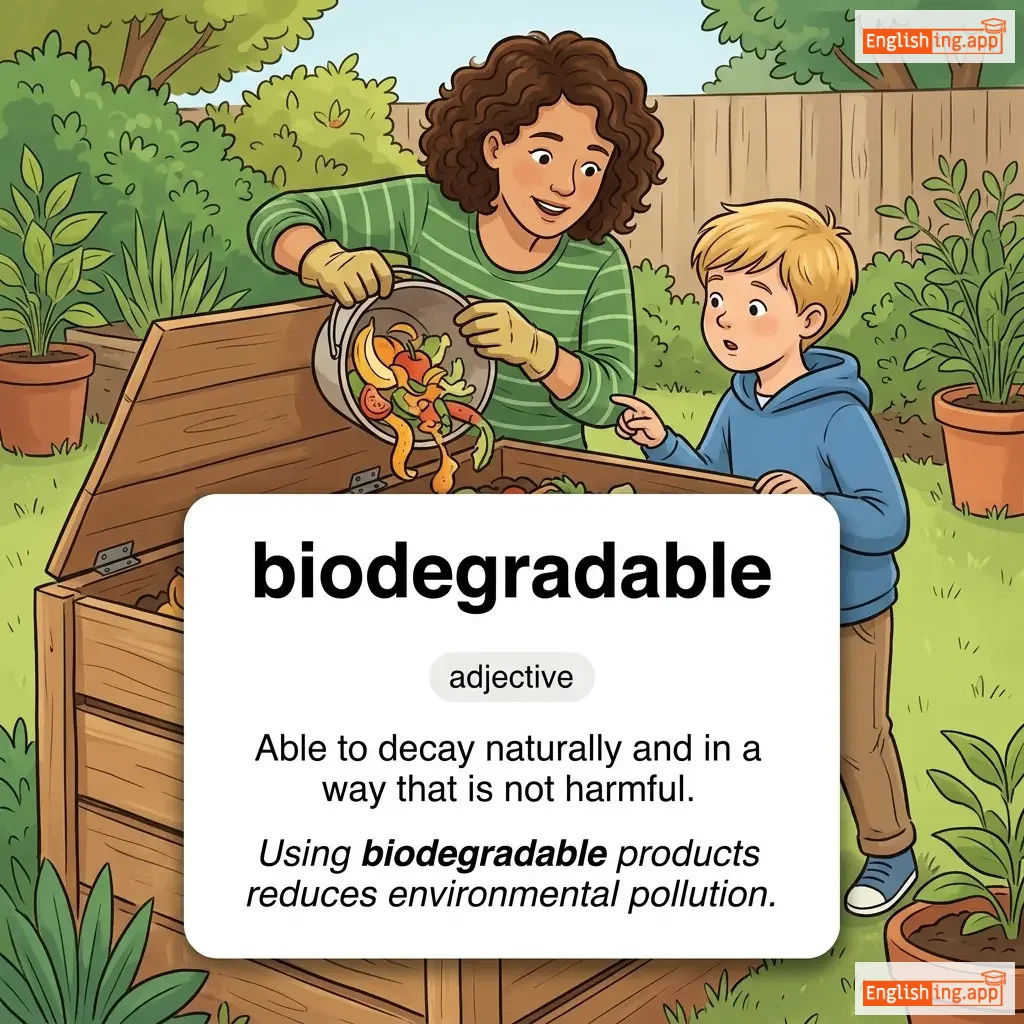
biodegradable definition card — visual illustration of the meaning
adjective
/ˌbaɪ.oʊ.dɪˈɡreɪ.də.bəl/
可生物降解 (ke shengwu xiangjie)

Able to decay naturally and in a way that is not harmful.

"Using biodegradable products reduces environmental pollution."
"使用可生物降解的产品可减少环境污染。" (Shiyong ke shengwu xiangjie de chanpin ke jianshao huanjing wuran.)
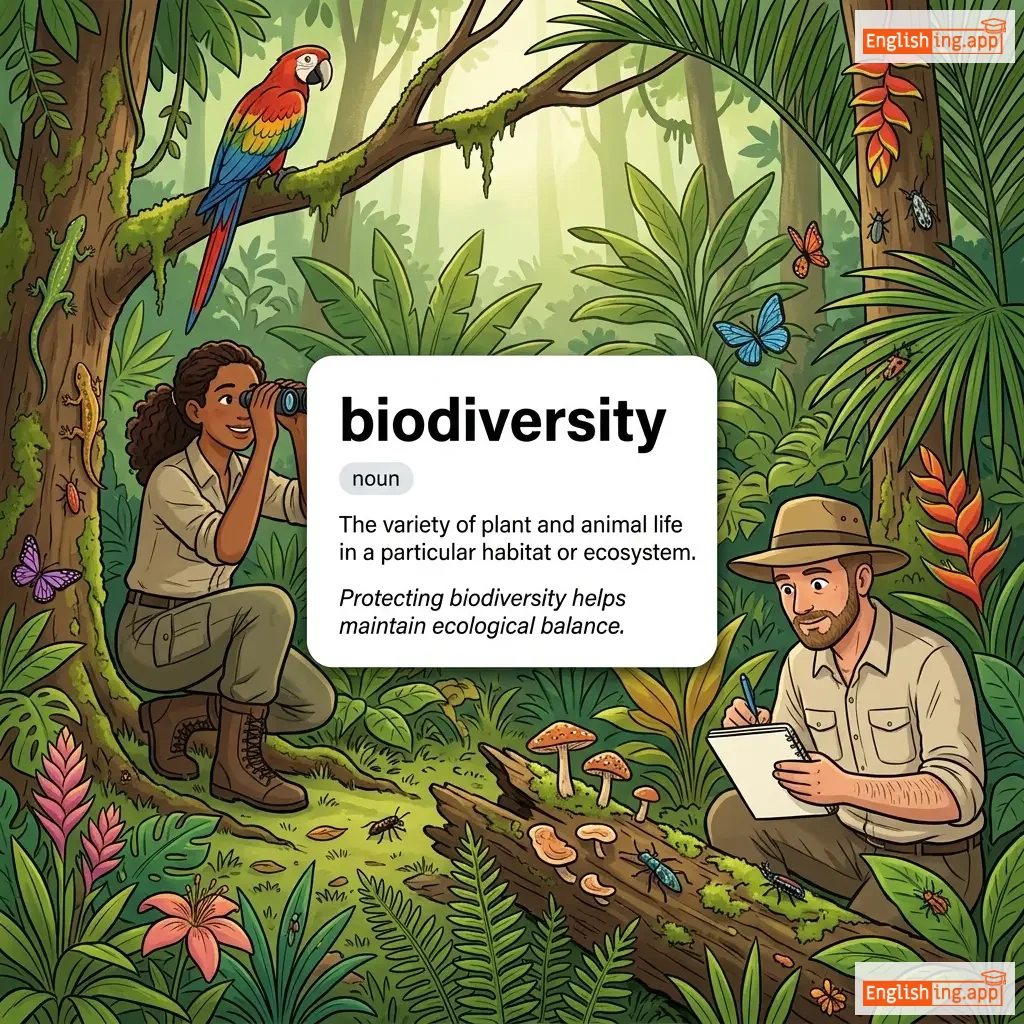
biodiversity definition card — visual illustration of the meaning
noun
/ˌbaɪ.oʊ.daɪˈvɜː.sɪ.ti/
生物多样性 (shengwu duoxiangxing)

The variety of life in the world or in a particular habitat or ecosystem.

"Deforestation is a major threat to biodiversity."
"森林砍伐是生物多样性的重大威胁。" (Senlin kanfa shi shengwu duoxiangxing de zhongda weixie.)
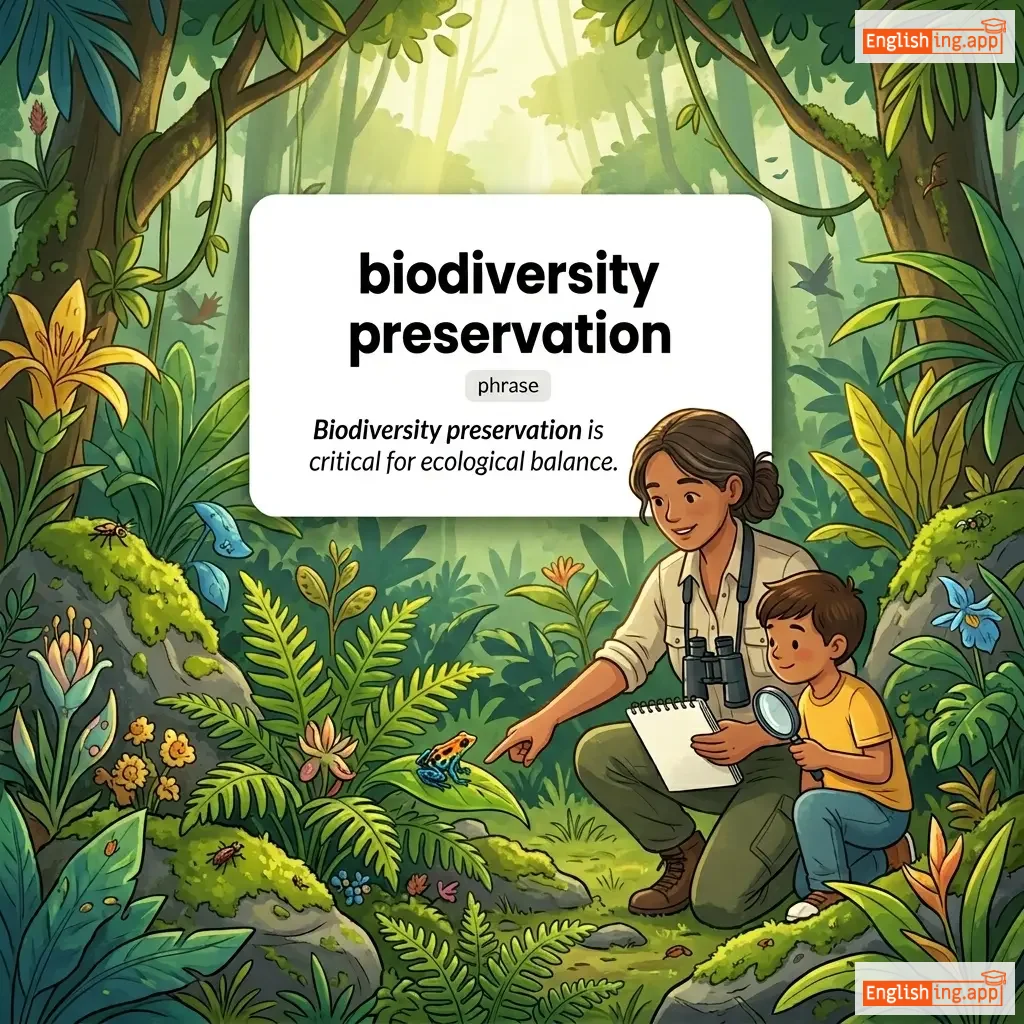
biodiversity preservation definition card — visual illustration of the meaning
phrase
ˌbaɪ.oʊ.daɪˈvɜː.sɪ.ti ˌprez.əˈveɪ.ʃən
生物多样性保护 (shengwu duoxiangxing baohu)

The protection and conservation of the variety of life in all its forms, including different species, genetic diversity, and ecosystems.

"Biodiversity preservation is critical for ecological balance."

"生物多样性保护对生态平衡至关重要。" (Shengwu duoxiangxing baohu dui shengtai pingheng zhiguang zhongyao.)
biofuel definition card — visual illustration of the meaning
noun
ˈbaɪ.əʊˌfjuː.əl
生物燃料 (shengwu ranshao)

A fuel derived immediately from living matter, as opposed to fossil fuels derived from long-dead biological matter.

"Biofuels reduce dependence on conventional energy sources."

"生物燃料减少了对传统能源来源的依赖。" (Shēngwù ránliào jiǎnshǎo le duì chuántǒng néngyuán láiyuán de yīlài.)
noun
/ˈbaɪəˌɡræf/
传记 (zhuànjì)

A written account of a person's life; an early motion-picture projector (historical use).

"The library holds an old biograph of the poet."

"图书馆里有一位诗人的旧传记。" (Túshūguǎn lǐ yǒu yī wèi shīrén de jiù zhuànjì.)
noun
/baɪˈɒɡrəfi/
传记 (zhuanji)

A written account of someone's life.

"She is writing a biography of the famous poet."

"她正在写这位著名诗人的传记。" (Ta zhèngzài xiě zhè wèi zhùmíng shīrén de zhuànjì.)
adjective
/ˌbaɪəˈlɒdʒɪkl̩/
生物学的 (shengwuxuede)

relating to the science of biology or to life and living organisms

"She is studying biological sciences at university."

"她在大学学习生物科学。" (Ta zai daxue xuexi shengwu kexue.)
noun
/baɪˈɒlədʒi/
生物学 (shengwuxue)

The scientific study of living organisms.

"Biology explains how plants and animals function."
"生物学解释了植物和动物是如何运作的。" (Shengwuxue jieshi le zhiwu he dongwu shi ruhe yunzuo de.)
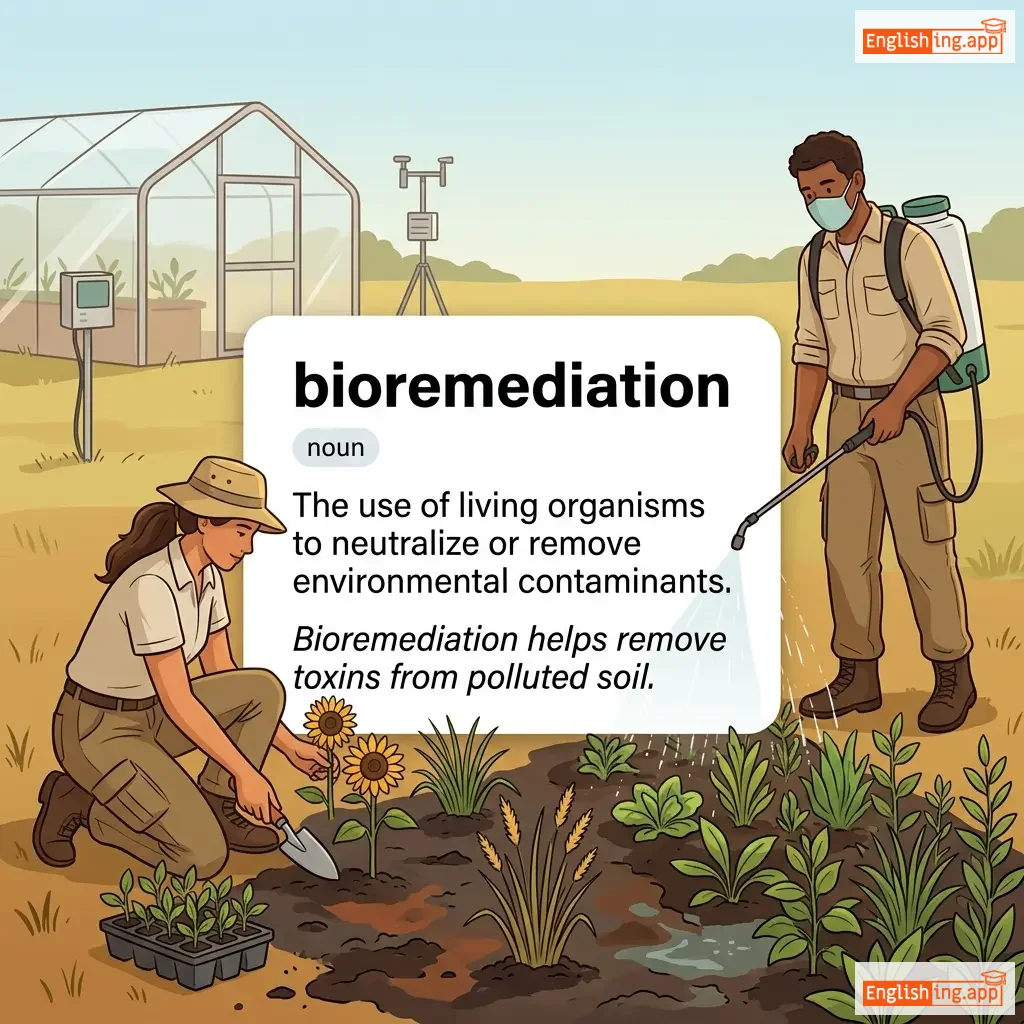
bioremediation definition card — visual illustration of the meaning
noun
/ˌbaɪ.oʊ.rɪˌmiː.diˈeɪ.ʃən/
生物修复 (shengwu xiufu)

The use of living organisms to neutralize or remove environmental contaminants.

"Bioremediation helps remove toxins from polluted soil."

"生物修复帮助清除污染土壤中的毒素。" (Shēngwù xiūfù bāngzhù qīngchú wūrǎn tǔrǎng zhōng de dúsù.)
noun
/ˈbaɪoʊˌsfɪr/
生物圈 (shengwuquan)

the regions of the surface and atmosphere of the earth occupied by living organisms

"Climate change is affecting the entire biosphere."

"气候变化正在影响整个生物圈。" (qihou bianhua zhengzai yingxiang zhengge shengwuquan.)
noun
/ˈbaɪpɛd/
双足动物 (shuangzu dongwu)

An animal that walks on two feet.

"Humans are examples of biped creatures."

"人类是双足动物的例子。" (Renlei shi shuangzu dongwu de lizi.)
noun
/bɜːrd/
(niao)

a warm-blooded animal with feathers and wings that usually lays eggs and can often fly

"A bird was singing on the tree branch."

"一只鸟在树枝上唱歌。" (Yi zhi niao zai shuzhi shang changge.)
noun
/bɜːrθ/
出生 (chūshēng)

the process of being born; the start of life

"The birth of a child brings joy to the whole family."

"孩子的出生给整个家庭带来喜悦。" (Háizi de chūshēng gěi zhěnggè jiātíng dàilái xǐyuè.)
noun
/ˈbɜːrθ.deɪ/

the anniversary of the day on which a person was born, typically celebrated annually

"We are planning a surprise birthday party for her."

noun
/ˈbɜːrθraɪt/
出生权利 (chūshēng quánlì)

A privilege or possession that a person has from birth.

"Freedom is considered a birthright of every individual."

"自由被认为是每个人的出生权利。" (Zìyóu bèi rènwéi shì měi gè rén de chūshēng quánlì.)
noun
/ˈbɪs.kɪt/
饼干 (binggan)

a small, hard, dry cake; a cookie

"Children love to eat chocolate biscuits with milk."

"孩子们喜欢吃巧克力饼干配牛奶。" (Háizimen xǐhuān chī qiǎokèlì bǐnggān pèi niúnǎi.)
noun
/ˈbɪʃəp/
主教 (zhǔjiào)

a senior member of the Christian clergy, usually in charge of a diocese and empowered to confer holy orders.

"The bishop delivered a powerful sermon during Sunday service."

"主教在星期天的礼拜中做了一个有力的布道。" (Zhǔjiào zài xīngqītiān de lǐbài zhōng zuòle yīgè yǒulì de bùdào.)
noun
/bɪsk/
海鲜浓汤 (haixian nongtang)

A rich, creamy soup made from shellfish.

"We ordered lobster bisque at the restaurant."

"我们在餐厅点了龙虾浓汤。" (Wo men zai cāntīng diǎnle lóngxiā nóngtāng.)
noun
/bɪt/
一小块 (yi xiao kuai)

a small piece, amount, or portion of something

"She ate a bit of the cake before leaving."

"她在离开之前吃了一小块蛋糕。" (Ta zai likai zhi qian chi le yi xiao kuai dangao.)
noun
/bɪtʃ/
母狗 (mǔ gǒu)

a female dog

"The bitch gave birth to five puppies."
"母狗生下了五只小狗。" (Mǔ gǒu shēng xiàle wǔ zhī xiǎo gǒu.)
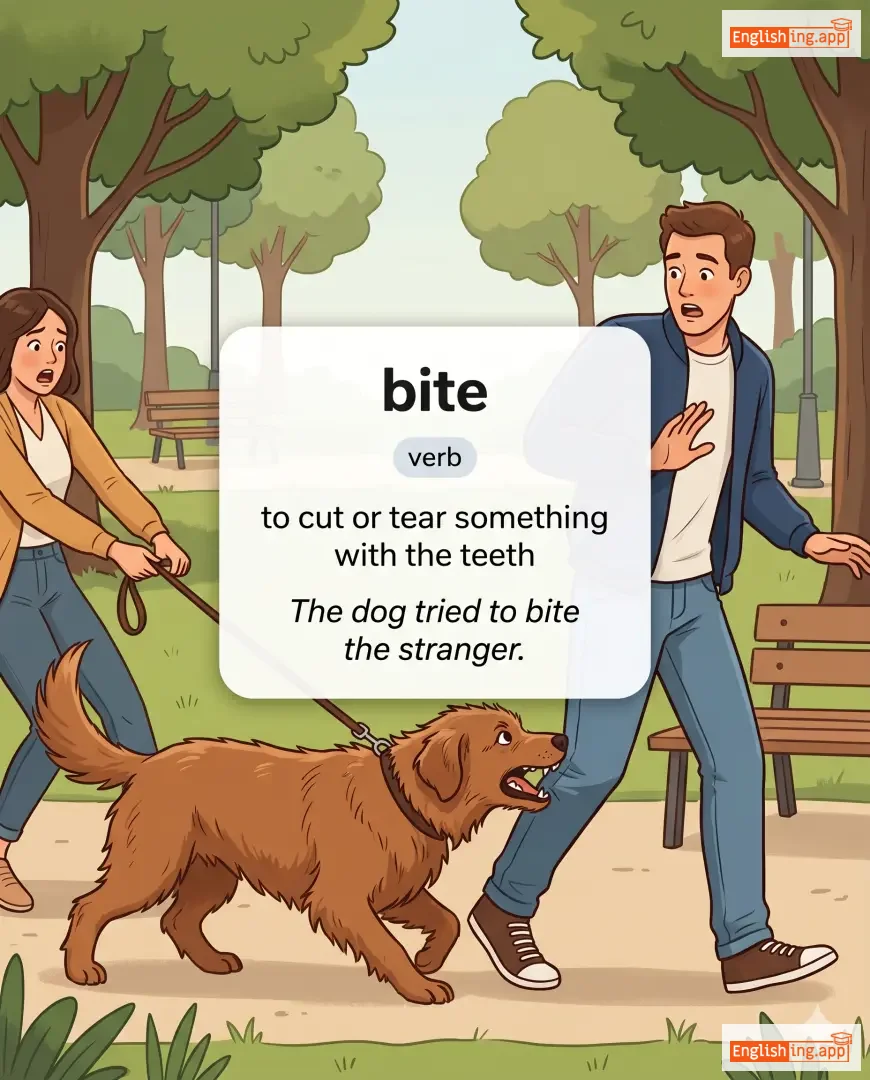
bite definition card — visual illustration of the meaning
verb
/baɪt/
(yǎo)

to cut or tear something with the teeth

"The dog tried to bite the stranger."

"狗试图咬陌生人。" (Gǒu shìtú yǎo mòshēngrén.)
adjective
/ˈbaɪtɪŋ/
尖锐 / 刺激 (jianrui / ciji)

harsh, sharp, or severely critical; capable of causing physical or emotional pain

"The critic’s biting remarks left the actor speechless."

"评论家的尖锐评论让演员哑口无言。" (Pinglùn jiā de jiānruì pínglùn ràng yǎnyuán yǎ kǒu wú yán.)
adjective
/ˈbɪtər/
苦涩 (kuse)

having a sharp, unpleasant taste or showing strong hostility or resentment

"She felt bitter about losing the competition."

"她在失去比赛后感到苦涩。" (Tā zài shīqù bǐsài hòu gǎndào kǔsè.)
noun
/ˈbɪtər ɡɔːrd/
苦瓜 (kù guā)

a green, bumpy vegetable with a very bitter taste, known for its medicinal properties

"Bitter gourd is excellent for controlling blood sugar levels."

"苦瓜对于控制血糖水平非常有效。" (Kù guā duì yú kòngzhì xuètáng shuǐpíng fēicháng yǒuxiào.)