词汇表

英语词汇词典 | 单词含义、定义和示例

babble definition card — visual illustration of the meaning
🗣️

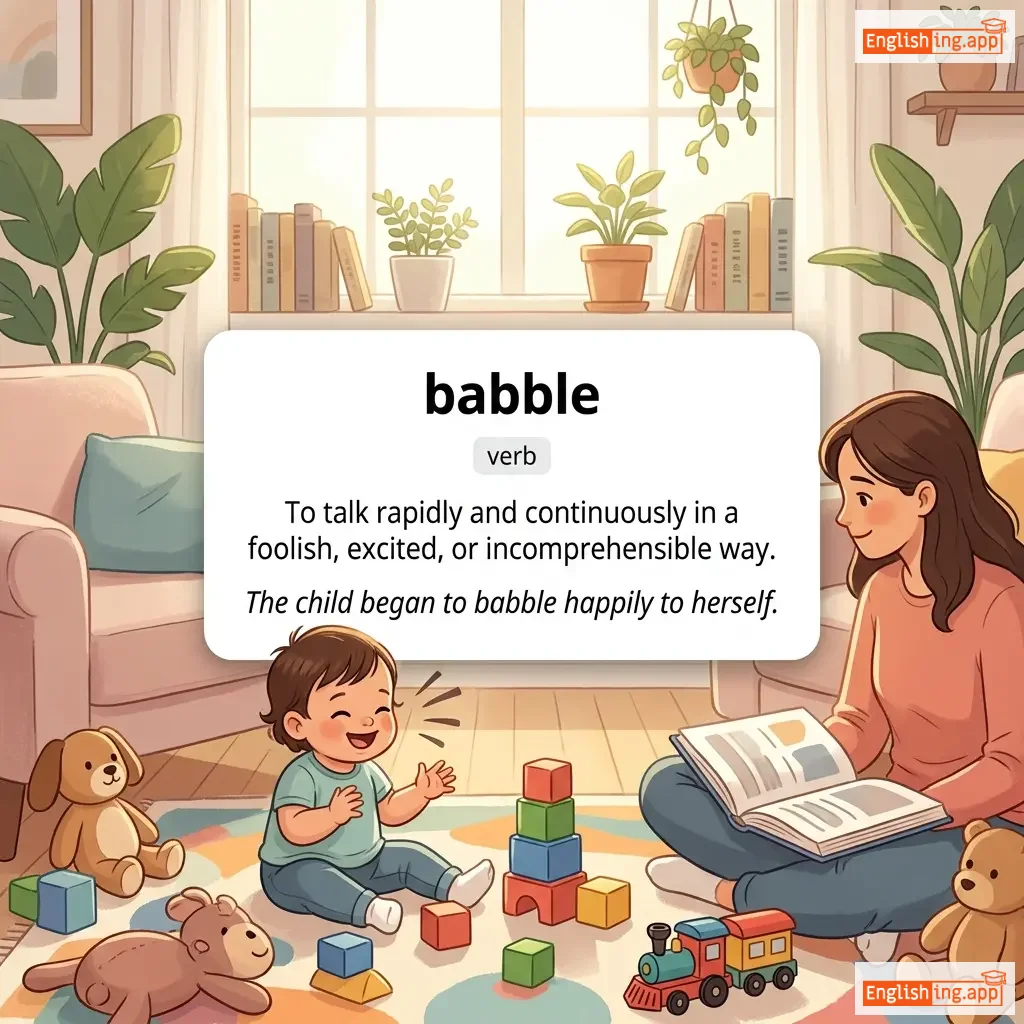
babble

verb
/ˈbæbəl/

To talk rapidly and continuously in a foolish, excited, or incomprehensible way.

"The child began to babble happily to herself."

noun
/bəˈbuːn/
狒狒 (feifei)

a large African and Arabian primate with a dog-like snout and colorful buttocks

"The baboon troop gathered around the watering hole in the savanna."

"狒狒群聚集在大草原的水坑旁。" (Feifei qun jujizai da caoyuan de shuikeng pang.)
noun
/ˈbeɪbi/
婴儿 (ying er)

a very young child, especially one newly or recently born

"The baby is sleeping peacefully in the crib."

"婴儿正在婴儿床上安静地睡觉。" (ying er zheng zai ying er chuang shang an jing di shui jiao.)
noun
/ˈbækənæl/
狂欢派对 (kuánghuān pàiduì)

A noisy party involving drinking and revelry.

"The festival turned into a wild bacchanal by midnight."

"节日到半夜变成了一个狂欢派对。" (Jiérì dào bànyè biàn chéngle yī gè kuánghuān pàiduì.)
noun
/ˌbækəˈneɪliə/
纵酒狂欢 (zongjiu kuanghuan)

A Roman festival of Bacchus celebrated with dancing, drinking, and revelry; any occasion of wild and drunken revelry.

"The novel describes the party as a bacchanalia of excess and joy."

"小说将这个派对描述为一个过度和欢乐的巴卡纳利亚。" (Xiaoshuo jiang zhege paidui miaoshu wei yi ge guodu he huanle de Bakkanaliya.)
bacchanalian definition card — visual illustration of the meaning
adjective
/ˌbækəˈneɪliən/
与酗酒相关的 (yǔ xùjiǔ xiāngguān de)

Characterized by or involving drunken revelry.

"The students threw a bacchanalian party after the exams."

"学生们在考试后举办了一场与酗酒相关的派对。" (Xuéshēngmen zài kǎoshì hòu jǔbànle yī chǎng yǔ xùjiǔ xiāngguān de pàiduì.)
noun
/ˈbætʃələr/
单身汉; 拥有大学学位的人 (dānshēn hàn; yǒngyǒu dàxué xuéwèi de rén)

an unmarried man; a person who holds a first degree from a university

"He remained a bachelor all his life and earned a bachelor's degree in engineering."

"他一生都保持单身,并获得了工程学位。" (Tā yīshēng dōu bǎochí dānshēn, bìng huòdéle gōngchéng xuéwèi.)
noun/verb/adverb/adjective
/bæk/
背部 / 返回 (bèi bù / fǎn huí)

the rear surface of the human body; to support; to return to a place

"He turned back to help his friend."

"他回头去帮助他的朋友。" (Tā huítóu qù bāngzhù tā de péngyǒu.)
phrasal verb
/bæk ʌp/
支持;备份;后退 (zhichi; beifen; houtui)

to support or help someone; to make a copy of data for safety; to move backward

"Please back up your files before updating the system."

"在更新系统之前,请备份你的文件。" (Zai gengxin xitong zhiqian, qing beifen ni de wenjian)
verb
/ˈbækbaɪt/
背后说坏话 (beihou shuo huaihua)

to speak negatively about someone who is not present; to slander behind someone’s back

"It is wrong to backbite your colleagues behind their backs."

"在背后说同事的坏话是不对的。" (zai beihou shuo tongshi de huaihua shi bu duide)
noun
/ˈbækboʊn/
脊柱 (jizhui)

the spine; the chief support or mainstay; strength of character

"Education is the backbone of a nation."

"教育是一个国家的脊柱。" (Jiaoyu shi yige guo jia de jizhui.)
noun
/ˈbækdrɒp/
背景 (beijing)

a painted cloth or other structure used behind a stage

"The backdrop for the play was a beautiful mountain scene."

"戏剧的背景是一幅美丽的山景。" (Xìjù de bèijǐng shì yī fú měilì de shānjǐng.)
noun
/ˈbækɡraʊnd/
背景 (beijǐng)

the circumstances, environment, or past history of a person or thing; the part behind the main subject in an image

"She comes from a strong academic background."

"她来自一个强大的学术背景。" (Tā láizì yīgè qiángdà de xuéshù bèijǐng.)
adjective
/ˈbækˌhændɪd/
间接或讽刺的 (jianjie huo fengci de)

Indirect or sarcastic, often appearing as praise but actually insulting.

"She gave him a backhanded compliment about his work."

"她给了他一个间接的赞美,关于他的工作。" (Tā gěile tā yīgè jiànjiē de zànměi, guānyú tā de gōngzuò.)
noun
/ˈbækɪŋ/
支持 (zhichi)

support or approval for a plan, person, or idea

"The project received strong backing from the investors."

"该项目得到了投资者的强力支持。" (Gai xiangmu dedaole touzizhe de qiangli zhichi.)
noun
/ˈbækˌsaɪd/
背部 (bèi bù)

the rear part or surface of something; informal term for the buttocks

"The kids slid down the hill on their backside."

"孩子们从山坡上滑下来,屁股着地。" (Háizimen cóng shānpō shàng huá xiàlái, pìgu zhuó dì.)
verb
/ˈbækˌslaɪd/
倒退 (dàotuì)

To relapse into bad habits, undesirable practices, or moral decline.

"After months of progress, he began to backslide into old habits."

"经过几个月的进展,他开始回到旧习惯中。" (Jīngguò jǐ gè yuè de jìnzhǎn, tā kāishǐ huí dào jiù xíguàn zhōng.)
noun
/ˈbækʌp/
备份 (beifen)

a copy of data stored separately to protect against loss

"Make sure to have a backup of your important files."

"确保备份您的重要文件。" (Quebao beifen ninde zhongyao wenjian.)
adverb
/ˈbækwərdz/
向后 (xiang hou)

Toward the back or in the reverse direction.

"He accidentally fell backwards into the chair."

"他不小心倒退到椅子里。" (Ta bu xiaoxin daotui dao yizi li.)
noun
/ˌbækˈjɑːrd/
幸福 (xingfu)

an area of land behind a house, typically used for recreation or gardening

"The children played football in the backyard."

"当她收到奖项时,她无法掩饰自己的幸福。" (Dāng tā shōudào jiǎngxiàng shí, tā wúfǎ yǎnshì zìjǐ de xìngfú.)
adjective
/beɪˈkoʊniən/
贝科尼安 (Bèikēní'ān)

Relating to the philosopher Francis Bacon or his method of scientific reasoning.

"The researcher followed a Baconian approach to observation and experimentation."

"研究人员遵循了一种贝科尼安的方法来进行观察和实验。" (Yánjiū rényuán zūnxúnle yī zhǒng Bèikēní'ān de fāngfǎ lái jìnxíng guānchá hé shíyàn.)
bacteria definition card — visual illustration of the meaning
noun
/bækˈtɪəriə/
细菌 (xijun)

Microscopic single-celled organisms that can be beneficial or harmful.

"Some bacteria in the human gut help with digestion."

"一些细菌在人体肠道中有助于消化。" (Yixie xijun zai ren ti changdao zhong you zhu yu xiaohua.)
noun
/bækˈtɪəriəm/
细菌 (xijun)

A single microscopic organism belonging to the group of bacteria.

"The doctor explained that a single bacterium can multiply rapidly under the right conditions."

"医生解释说,一个单一的细菌在适当的条件下可以迅速繁殖。" (Yisheng jieshi shuo, yi ge dan yi de xijun zai shidang de tiaojian xia keyi xunsu fan zhi.)
adjective
/bæd/
(huai)

not good; unpleasant, harmful, or of poor quality

"The milk smells bad, so don’t drink it."

"牛奶闻起来很糟,所以不要喝。" (Niunai wen qilai hen zao, suoyi bu yao he.)
noun
/bædʒ/
徽章 (huīzhāng)

A small emblem or sign worn to show membership, authority, or achievement.

"The police officer showed his badge to identify himself."

"警察展示了他的徽章来证明自己的身份。" (Jǐngchá zhǎnshìle tā de huīzhāng lái zhèngmíng zìjǐ de shēnfèn.)
verb
/ˈbædʒər/
烦扰, 打扰 (fánrǎo, dǎrǎo)

To repeatedly ask or annoy someone with demands or questions.

"The reporter kept badgering the politician with questions."

"记者不断用问题打扰政治人物。" (Jìzhě bùduàn yòng wèntí dǎrǎo zhèngzhì rénwù.)
noun
/ˌbædɪˈnɑːʒ/
玩笑,幽默对话 (wanxiao, youmo duihua)

Playful and humorous conversation; banter.

"The friends enjoyed a light badinage over coffee."

"朋友们在咖啡旁享受轻松的玩笑。" (Péngyǒu men zài kāfēi páng xiǎngshòu qīngsōng de wánxiào.)
adverb
/ˈbædli/
糟糕 (zaogao)

in a way that is not good; poorly or severely

"He performed badly in the exam."
"他在考试中表现得很差。" (Ta zai kao shi zhong biao xian de hen cha.)
baffle definition card — visual illustration of the meaning
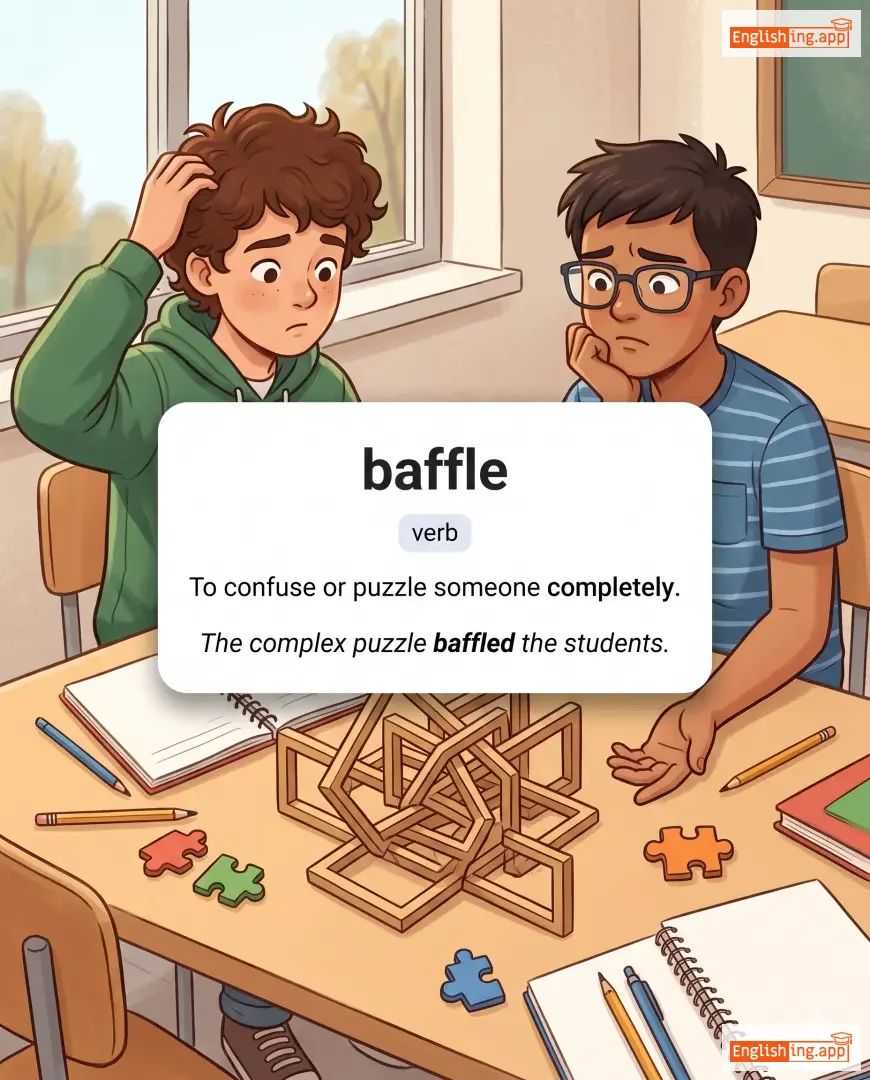
verb
/ˈbæfəl/
使困惑 (shǐ kùnhuò)

To confuse or puzzle someone completely.

"The complex puzzle baffled the students."

"复杂的难题让学生们困惑不已。" (Fùzá de nántí ràng xuéshēngmen kùnhuò bù yǐ.)
noun
/bæɡ/
(bao)

a container made of flexible material, used for carrying items

"She carried her books in a bag."

"她把书放在包里。" (Ta ba shu fang zai bao li.)
noun
/ˈbæɡɪdʒ/
行李; 个人物品; (xínglǐ; gèrén wùpǐn;)

suitcases and bags containing personal belongings; past experiences or problems that affect behavior

"Please collect your baggage from the conveyor belt at the airport."

"请从机场的传送带上取回您的行李。" (Qǐng cóng jīchǎng de chuánsòngdài shàng qǔ huí nín de xínglǐ.)
noun
/beɪl/
保释 (baoshi)

the temporary release of an accused person awaiting trial, often with a financial guarantee

"He was granted bail after his arrest."

"他在被捕后获得了保释。" (Ta zai beibu hou huodele baoshi.)
noun
/ˌbeɪˈliː/
受托人 (shoutuoren)

a person or party who temporarily receives possession of goods or property from another under a legal agreement

"The bailee must take reasonable care of the goods while they are in his possession."

"受托人必须合理地保管财产。" (shoutuoren bixu heli di baoguan caichan)
noun
/ˈbeɪlɪf/
法警 (fǎ jǐng)

An official who keeps order in a court, carries out court orders, or collects debts.

"The bailiff asked everyone to rise as the judge entered the courtroom."

"当法官进入法庭时,法警要求大家起立。" (Dāng fǎguān jìnrù fǎtíng shí, fǎ jǐng yāoqiú dàjiā qǐlì.)
noun
/ˈbeɪlɔːr/
寄托人 (jituoren)

a person who temporarily transfers possession of goods or property to another under a bailment agreement

"The bailor entrusted the valuable artwork to the museum for safekeeping."

"寄托人把艺术品交给了博物馆。" (Jituoren ba yishupin jiao gei le bowuguan)
🎣

bait

noun/verb
/beɪt/

Food or lure used to attract fish or animals; to deliberately provoke or annoy.

"He used worms as bait to catch fish."

noun
/beɪz/
一种粗糙的羊毛布料 (yī zhǒng cūcāo de yángmáo bùliào)

A type of coarse woolen cloth, often green, used for covering tables such as billiard tables.

"The old card table was covered with worn baize."

"旧的扑克牌桌上覆盖着磨损的贝兹布料。" (Jiù de pū zhōu kǎ zhūo shàng fùgài zhe mó sǔn de bèi zī bù liào.)
verb
/beɪk/
(kǎo)

to cook food using dry heat, usually in an oven

"She baked a cake for her friend's birthday."

"她为她朋友的生日烤了一个蛋糕。" (Tā wèi tā péngyǒu de shēngrì kǎo le yīgè dàngāo.)
noun
/beɪkt miːt/
烤肉 (kao rou)

meat that has been cooked in an oven using dry heat

"The baked meat was tender and flavorful."

"烤肉嫩滑且味道鲜美。" (Kao rou nen hua qie wei dao xian mei.)
noun
/ˈbeɪ.kɪŋ ˈpaʊ.dər/
泡打粉 (pàodǎ fěn)

a dry chemical leavening agent used to increase volume and lighten texture in baked goods

"The recipe calls for two teaspoons of baking powder."

"这个食谱需要两茶匙泡打粉。" (Zhège shípǔ xūyào liǎng chá shì pàodǎ fěn.)
noun
/ˈbeɪ.kɪŋ ˈsoʊ.də/
泡打粉 (paodafen)

sodium bicarbonate used in cooking and baking as a leavening agent

"Add a teaspoon of baking soda to make the cake fluffy."

"加入一茶匙泡打粉使蛋糕更加松软。" (Jiārù yī cháchí pàodǎfěn shǐ dàngāo gèngjiā sōngruǎn.)
noun
/bəˈkuːl/
巴库尔花 (bākù'ěr huā)

a fragrant white flower native to South Asia, scientifically known as Mimusops elengi

"The sweet fragrance of bakul flowers filled the evening air in the village."
"巴库尔花的甜美香气弥漫在村庄的傍晚空气中。" (Bākù'ěr huā de tiánměi xiāngqì mímàn zài cūnzhuāng de bàngwǎn kōngqì zhōng.)
balance definition card — visual illustration of the meaning
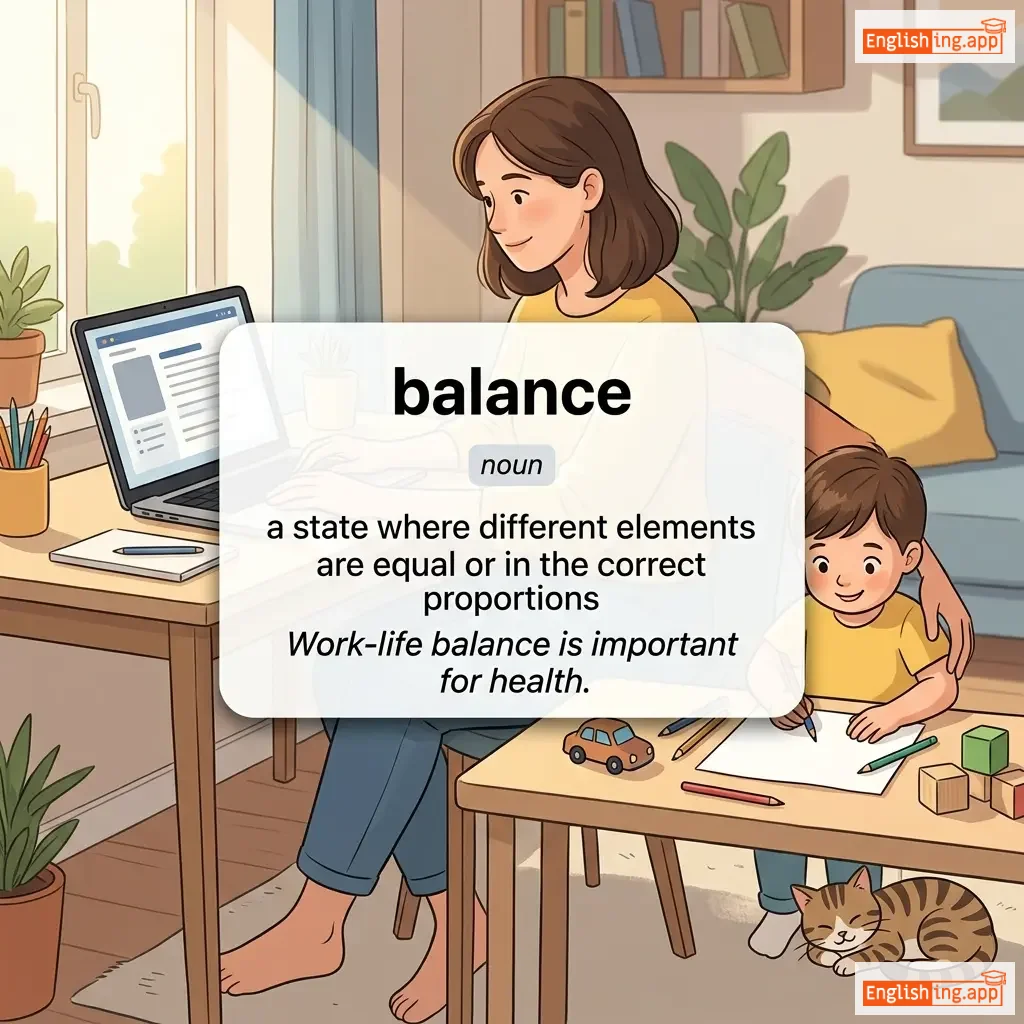
noun
/ˈbæləns/
平衡 (pingheng)

a state where different elements are equal or in the correct proportions

"Work-life balance is important for health."

"工作与生活的平衡对健康至关重要。" (gongzuo yu shenghuo de pingheng dui jiankang zhiguan zhongyao.)
adjective
/ˈbælənst/
平衡的 (pínghéng de)

keeping or showing a sensible and fair view or position; evenly arranged

"A balanced diet is essential for good health."

"均衡的饮食对健康至关重要。" (Jūnhéng de yǐnshí duì jiànkāng zhìguān zhòngyào.)
balanced diet definition card — visual illustration of the meaning
noun
ˈbæl.ənst daɪ.ət
均衡饮食 (jūnhéng yǐnshí)

A diet consisting of the proper quantities and proportions of foods needed to maintain health or growth.

"A balanced diet is essential for maintaining good health."

"均衡饮食对维持良好的健康至关重要。" (Jūnhéng yǐnshí duì wéichí liánghǎo de jiànkāng zhìguān zhòngyào.)
noun
/beɪl/
(kun)

A large bundle of goods tightly wrapped and bound.

"The workers loaded the bale of cotton onto the truck."

"工人们将棉花捆装上了卡车。" (Gōngrénmen jiāng miánhuā kùn zhuāng shàngle kǎchē.)
adjective
/ˈbeɪlfəl/
威胁的 (wēixié de)

Threatening harm; menacing or expressing hatred.

"She gave him a baleful look after the insult."

"侮辱之后,她朝他投去一个威胁的眼神。" (Wǔrǔ zhīhòu, tā zhāo tā tóuqù yīgè wēixié de yǎnshén.)
verb
/bɔːk/
拒绝 (jujue)

to hesitate or refuse to proceed or comply

"She balked at signing the contract without reading it fully."

"她犹豫着没有完全阅读合同就签署了。" (Ta youyu zhe meiyou wancheng yuedu hetong jiu qianshu le.)
adjective
/ˈbɔːlki/
固执 (guzhi)

difficult, uncooperative, or stubborn

"The balky printer refused to work when needed most."

"固执的打印机在最需要的时候拒绝工作。" (Guzhi de dayinji zai zui xuyao de shihou jujue gongzuo.)
noun
/bɔːl/
(qiu)

a round object used in games or sports

"The children played with a ball in the park."

"孩子们在公园里玩球。" (Háizimen zài gōngyuán lǐ wán qiú.)