词汇表

英语词汇词典 | 单词含义、定义和示例

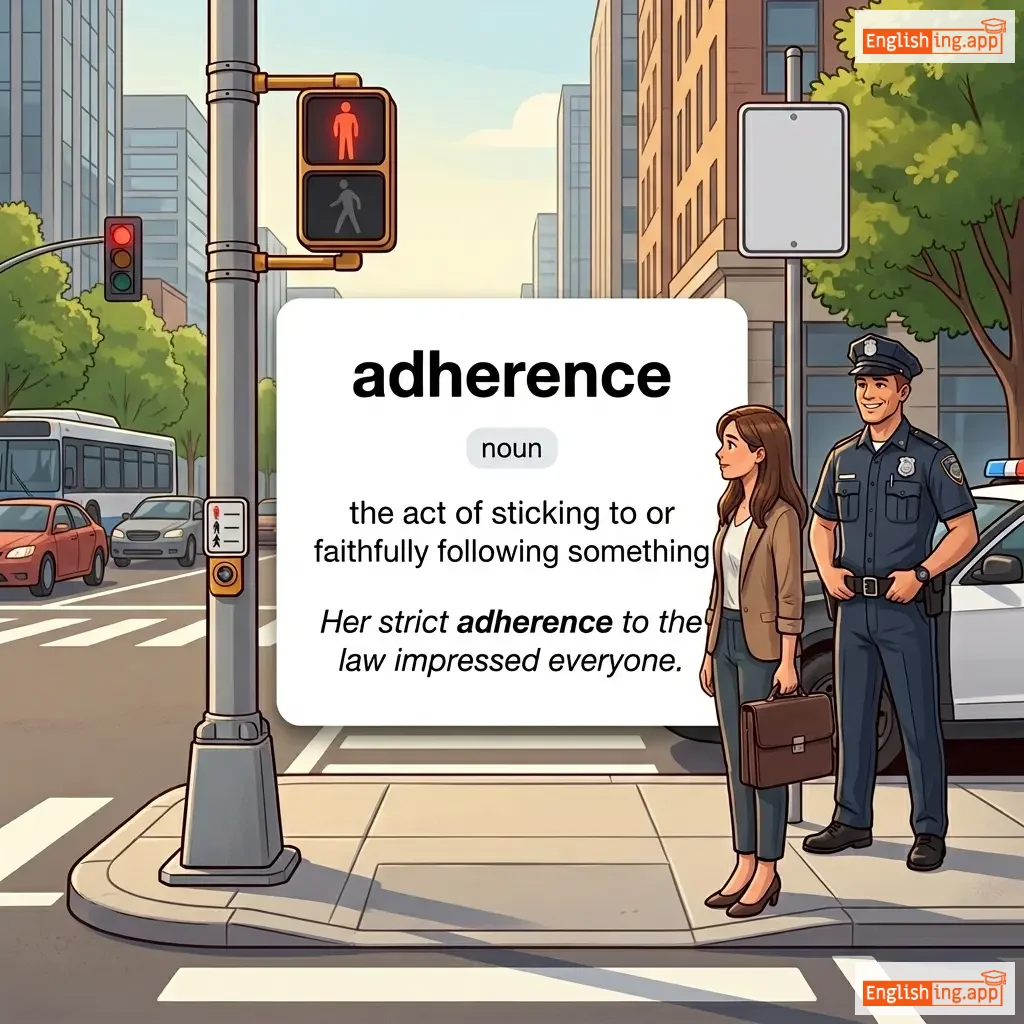
adherence definition card — visual illustration of the meaning
noun
/ədˈhɪərəns/
遵守 (zunshou)

the act of sticking to or faithfully following something

"Her strict adherence to the law impressed everyone."

"她对法律的严格遵守给大家留下了深刻的印象。" (Tā duì fǎlǜ de yángé zūnshǒu gěi dàjiā liúxiàle shēn kè de yìnxiàng.)
noun
/ədˈhɪərənt/
追随者 (zhuīsuí zhě)

a person who supports or follows a particular belief, cause, or leader

"He is a strong adherent of democratic values."

"他是民主价值观的坚定追随者。" (Tā shì mínzhǔ jiàzhíguān de jiāndìng zhuīsuí zhě.)
noun
/ədˈhiːʒən/
附着 (fùzhuó)

the process or state of sticking to something

"Strong adhesion is needed for the tiles to stay in place."

"瓷砖保持在原位需要强附着力。" (Cízhuān bǎochí zài yuán wèi xūyào qiáng fùzhuó lì.)
adjective
/ədˈhiːsɪv/
粘性 (niánxìng)

আঠালো; চটচটে;

"The adhesive tape stuck firmly to the wall."

"粘合带牢牢地粘在墙上。" (Nián hé dài láo láo de nián zài qiáng shàng.)
👋

adieu

noun
/əˈdjuː/

A farewell or goodbye, often used in a formal or poetic sense.

"She bid her friends adieu before leaving for France."

adjective
/ˈædɪˌpoʊs/
脂肪的 (zhīfáng de)

Relating to or consisting of animal fat; fatty.

"The doctor explained that the tissue was mainly adipose in nature."

"医生解释说,组织主要是脂肪性的。" (Yīshēng jiěshì shuō, zǔzhī zhǔyào shì zhīfáng xìng de.)
noun
/əˈdʒeɪsənsi/
邻近性 (línjìn xìng)

The state of being next to or adjoining something else.

"The adjacency of the two buildings made it easy to connect them."

"这两座建筑物的邻近性使得它们的连接变得容易。" (Zhè liǎng zuò jiànzhúwù de línjìn xìng shǐ dé tāmen de liánjiē biàn dé róngyì.)
adjective
/əˈdʒeɪsənt/
毗邻 (pílín)

Next to or adjoining something else.

"The hotel is adjacent to the beach."

"这家酒店紧邻海滩。" (Zhè jiā jiǔdiàn jǐn lín hǎitān.)
noun
/ˈædʒɪktɪv/
形容词 (xingrongci)

a word that describes or modifies a noun by giving more information about its quality, quantity, or state

"The adjective in the sentence adds more detail to the noun."

"形容词为名词提供更多信息。" (xingrongci wei mingci tigong geng duo xinxi)
verb
/əˈdʒɔɪn/
毗邻 (pílín)

To be next to and joined with something.

"Their house adjoins the park."

"他们的房子毗邻公园。" (Tāmen de fángzi pílín gōngyuán.)
verb
/əˈdʒɜrn/
推迟 (tuīchí)

to suspend a meeting or session to another time or place

"The judge decided to adjourn the hearing until next week."

"法官决定将听证会推迟到下周。" (Fǎguān juédìng jiāng tīngzhènghuì tuīchí dào xià zhōu.)
verb
/əˈdʒʌdʒ/
裁决 (caijue)

to consider or declare officially in a legal or formal manner

"He was adjudged guilty by the court."

"他被法院判定有罪。" (Ta bei fayuan panding youzui.)
👨‍⚖️

adjudicate (裁定)

verb
/əˈdʒuːdɪˌkeɪt/
裁定 (cáidìng)

to make a formal judgment or decision about a problem or dispute

"The committee was formed to adjudicate disputes between the parties."

"委员会的成立是为了裁定各方之间的争议。" (Wěiyuánhuì de chénglì shì wèile cáidìng gè fāng zhījiān de zhēngyì.)
adjudicative body definition card — visual illustration of the meaning
noun
əˈdʒuː.dɪ.kə.tɪv ˈbɒd.i
裁决机构 (cáijué jīgòu)

An official organization that has the authority to judge disputes and make decisions.

"The adjudicative body deliberated on the case."

"裁定机构对案件进行了审议。" (Cáijué jīgòu duì ànjiàn jìnxíngle shěnǐ.)
adjunct definition card — visual illustration of the meaning
noun
/ˈædʒʌŋkt/
附加物 (fùjiā wù)

a thing added to something else as a supplementary part

"The professor worked as an adjunct at the university."

"教授在大学担任附加职位工作。" (Jiàoshòu zài dàxué dānrèn fùjiā zhíwèi gōngzuò.)
noun
/ˌædʒʊˈreɪʃən/
郑重请求 (zhèngzhòng qǐngqiú)

a solemn urging or appeal

"The priest made an adjuration for peace and unity."

"牧师为和平与团结做出了郑重请求。" (Mùshī wèi hépíng yǔ tuánjié zuòchūle zhèngzhòng qǐngqiú.)
verb
/əˈdʒʊər/
命令 (mingling)

to urge or command someone solemnly, often under oath or a strong sense of duty

"The witness was adjured to tell the truth in court."

"证人被要求在法庭上讲真话。" (zhèngrén bèi yāoqiú zài fǎtíng shàng jiǎng zhēn huà.)
verb
/əˈdʒʌst/
调整 (tiaozheng)

to change something slightly to make it more suitable or effective

"She adjusted the mirror to see the road clearly."

"她调整了镜子以清晰地看见路。" (Ta tiaozheng le jingzi yi qingxi de kanjian lu.)
adjective
/əˈdʒʌstəbəl/
可调节的; 可修改的; 可调整的; (kě tiáojié de; kě xiūgǎi de; kě tiáozhěng de;)

নিয়মযোগ্য; পরিবর্তন-সাধ্য; সমন্বয়যোগ্য;

"This chair has an adjustable height feature."

"这把椅子有可调节的高度。" (Zhè bǎ yǐzi yǒu kě tiáojié de gāodù.)
noun
/əˈdʒʌstmənt/

a small change made to improve something or make it work better

"The doctor made an adjustment to the patient’s medication."

noun
/ˈædʒʊtənt/
一名担任高级军官行政助手的军官 (yi ming dan ren gao ji jun guan xing zheng zhu shou de jun guan)

a military officer who acts as an administrative assistant to a senior officer

"The colonel relied on his adjutant to manage daily orders."
"上校依赖他的副官来管理日常命令。" (Shangxiao yilai tamen de fuguan lai guanli richang mingling.)
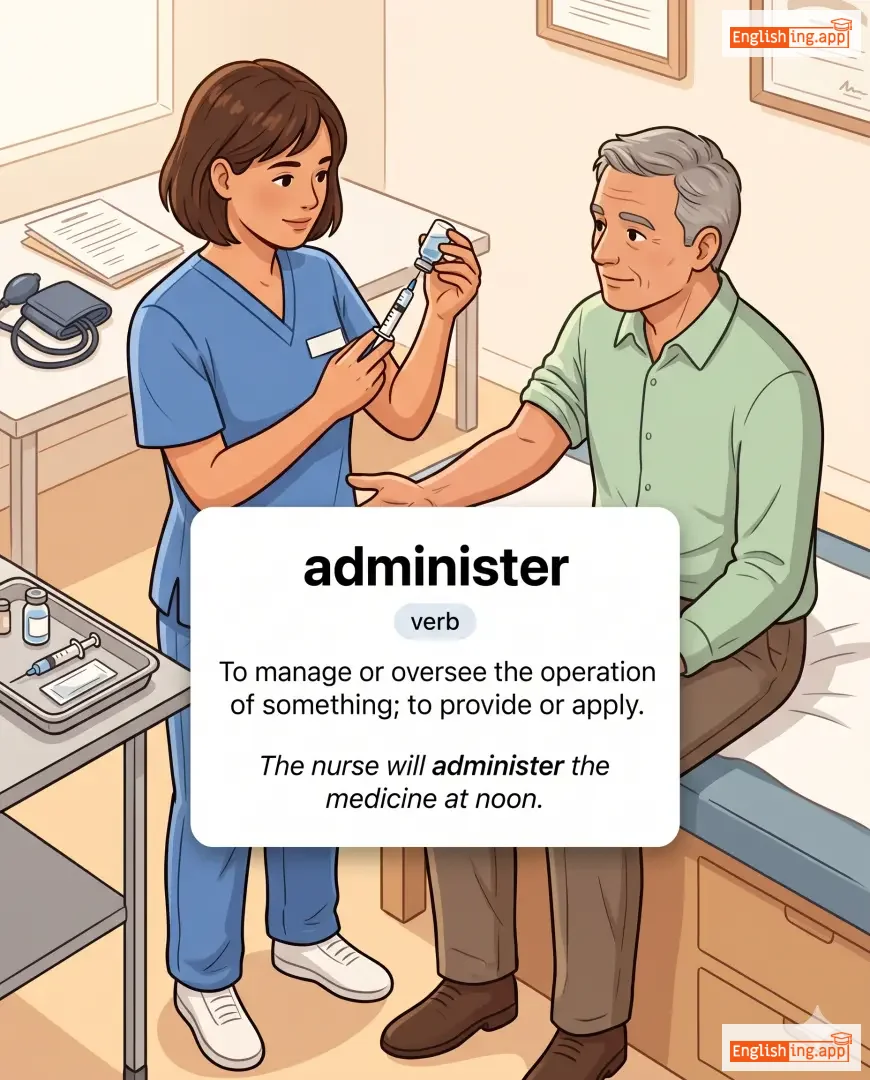
administer definition card — visual illustration of the meaning
verb
/ədˈmɪnɪstər/
管理 / 应用 (guanli / yingyong)

To manage or oversee the operation of something; to provide or apply.

"The nurse will administer the medicine at noon."

"护士将在中午施用药物。" (Hushi jiang zai zhongwu shiyong yaowu.)
verb
/ədˈmɪnɪstreɪt/
管理 (guanli)

to manage or supervise the execution of duties, laws, or resources; to formally give or apply something such as a test or medicine

"The committee will administrate the new policy across all departments."

"委员会将在所有部门管理这项新政策。" (weiyuanhui jiang zai suoyou bumen guanli zhe xiang xin zhengce)
noun
/ədˌmɪnɪˈstreɪʃən/
行政管理 (xingzheng guanli)

The management or organization of a business, institution, or government.

"The new administration introduced several reforms."

"新政府推出了若干改革。" (xin zhengfu tuichu le ruogan gaige.)
administrative definition card — visual illustration of the meaning
adjective
/ədˈmɪnɪstrətɪv/
行政的 (xingzheng de)

relating to the management or organization of something

"The administrative tasks were handled efficiently by the team."

"行政任务由团队高效处理。" (Xingzheng renwu you tuandui gaoxiao chuli.)
🧑‍💼

administrator

noun
/ədˈmɪnɪstreɪtər/

a person responsible for running or managing an organization or system

"The school administrator implemented new policies for students."

adjective
/ˈædmərəbəl/
值得钦佩的 (zhí dé qīn pèi de)

প্রশংসনীয়; চমৎকার;

"Her dedication to helping others is truly admirable."

"她帮助他人的奉献精神真是令人钦佩。" (Tā bāngzhù tārén de fèngxiàn jīngshén zhēn shì lìng rén qīnpèi.)
noun
/ˌædməˈreɪʃən/
钦佩 (qinpei)

a feeling of respect, pleasure, or approval for someone or something

"She felt great admiration for her teacher’s dedication."

"她对老师的奉献充满了钦佩。" (ta dui laoshi de fengxian chongman le qinpei)
verb
/ədˈmaɪər/
欣赏 (xīnshǎng)

To respect, appreciate, or look up to someone or something.

"I really admire her dedication to education."

"我真的很欣赏她对教育的奉献。" (Wǒ zhēn de hěn xīnshǎng tā duì jiàoyù de fèngxiàn.)
adjective
/ədˈmɪsəbl/

acceptable or valid, especially as evidence in a court of law

"The judge ruled that the document was admissible as evidence."

noun
/ədˈmɪʃən/
入场 (rùchǎng)

The process or fact of being allowed to enter a place or join an organization.

"The admission fee to the museum is five dollars."

"博物馆的入场费是五美元。" (Bówùguǎn de rùchǎng fèi shì wǔ měiyuán.)
admit definition card — visual illustration of the meaning
verb
/ədˈmɪt/
承认 (chengren)

To confess or acknowledge something as true; to allow entry.

"He admitted that he had made a mistake."

"他承认他犯了一个错误。" (Tā chéngrèn tā fànle yīgè cuòwù.)
noun
/ədˈmɪtəns/
进入 (jinru)

the process or fact of entering or being allowed to enter a place

"No admittance without a valid ticket."

"没有有效票据不能进入。" (Méiyǒu yǒuxiào piàojù bùnéng jìnrù.)
admonish definition card — visual illustration of the meaning
verb
/ədˈmɒnɪʃ/
警告 (jinggao)

to warn or reprimand someone firmly; to advise or urge earnestly

"The teacher admonished the students for being late."

"老师因为学生迟到而警告他们。" (Lao shi yinwei xuesheng chidao er jinggao tamen.)
noun
/ˌædməˈnɪʃən/
警告 (jǐnggào)

a firm warning or reprimand; gentle or earnest advice

"He received an admonition for his careless work."

"他因不小心的工作收到了警告。" (Tā yīn bù xiǎoxīn de gōngzuò shōudào le jǐnggào.)
adjective
/ədˈmɒnɪtəri/
警告的 (jǐnggào de)

giving or conveying a warning or reprimand

"She gave him an admonitory glance."

"她投给他一个警告的眼神。" (Tā tóu gěi tā yī gè jǐnggào de yǎnshén.)
noun
/əˈduː/
喧闹 / 不必要的活动 (xuannao / buyiyao de huodong)

a fuss or unnecessary activity; trouble or difficulty

"Without further ado, let’s begin the ceremony."

"不再多言,我们开始仪式。" (Bù zài duō yán, wǒmen kāishǐ yíshì.)
noun/adjective
/ˌædəˈlɛsənt/
青少年 (qīngshàonián)

A young person in the process of developing from a child into an adult.

"Adolescents often experience rapid physical and emotional changes."

"青少年常常经历快速的身体和情感变化。" (qīngshàonián chángcháng jīnglì kuàisù de shēntǐ hé qínggǎn biànhuà.)
👨‍👩‍👧

adopt (领养)

verb
/əˈdɒpt/
收养 (shouyang)

To take something as your own, such as a child, idea, or method.

"They decided to adopt a child from the orphanage."

"他们决定从孤儿院收养一个孩子。" (Tāmen juédìng cóng gū'ér yuàn shōuyǎng yīgè háizi.)
adoption definition card — visual illustration of the meaning
noun
/əˈdɒpʃən/
收养 (shouyang)

the action or fact of adopting something

"The adoption of new technology has improved our efficiency."

"采纳新技术提高了我们的效率。" (Caini xin jishu tigao le women de xiaolv.)
👨‍👩‍👧

adoptive (阿多普提夫)

adjective
/əˈdɒptɪv/
收养的 (shouyang de)

relating to the adoption of a child or the act of taking something as one’s own

"She grew up in a loving adoptive family."

"她在一个充满爱的收养家庭中长大。" (ta zai yi ge chongman ai de shouyang jiating zhong zhangda)
noun
/ˌædəˈreɪʃən/
崇拜 / 深厚的爱 (chongbai / shenhou de ai)

deep love and respect; worship

"The fans showed their adoration for the singer."

"粉丝们展示了他们对歌手的崇拜。" (Fensi men zhanshi le tamen dui geshou de chongbai.)
verb
/əˈdɔːr/
崇拜 (chóngbài)

to love deeply and respect highly

"She adores her little sister."

"她非常爱她的小妹妹。" (Tā fēicháng ài tā de xiǎo mèimei.)
verb
/əˈdɔːrn/
装饰 (zhuangshi)

to decorate or add beauty to something

"The hall was adorned with flowers for the wedding."

"婚礼上大厅用花卉装饰。" (Hunli shang dating yong huahui zhuangshi.)
adroit definition card — visual illustration of the meaning
adjective
/əˈdrɔɪt/
熟练 (shulian)

clever or skillful in using the hands or mind

"He is adroit at solving complex problems."

"他擅长解决复杂的问题。" (Ta shanchang jiejue fuzade wenti.)
adroitness definition card — visual illustration of the meaning
noun
/əˈdrɔɪt.nəs/
熟练 (shuliàn)

Cleverness or skill in using the hands or mind; expertness in performance or execution.

"His adroitness in negotiations helped secure the deal."

"他在谈判中的熟练帮助确保了交易的达成。" (Tā zài tánpàn zhōng de shúliàn bāngzhù quèbǎo le jiāoyì de dáchéng.)
noun (plural)
/ædz/
广告 (guanggao)

short for advertisements; promotional messages intended to sell products or services

"I often skip ads when watching videos online."

"我在线看视频时经常跳过广告。" (wo zai xian kan shipin shi jingchang tiaoguo guanggao)
verb
/ˈædjʊˌleɪt/
过度奉承 (guòdù fèngchéng)

to praise or flatter excessively

"The fans adulated the actor after his performance."

"粉丝们在演员的表演后赞美了他。" (Fěnsīmen zài yǎnyuán de biǎoyǎn hòu zànměi le tā.)
noun
/ˌædjʊˈleɪʃən/
过度的赞美 (guòdù de zànměi)

excessive admiration or flattery

"The singer enjoyed the adulation of her fans."

"这位歌手享受了粉丝们的过度赞美。" (Zhè wèi gēshǒu xiǎngshòule fěnsīmen de guòdù zànměi.)
noun
/ˈædʌlt/ or /əˈdʌlt/
成人 (chéngrén)

A fully grown or developed person; mature.

"Children must be accompanied by an adult."

"儿童必须由成年人陪同。" (Értóng bìxū yóu chéngrén péitóng.)