Словари

Словарь английского языка | Значения слов, определения и примеры

verb
/bɪˈriːv/
потерять близкого человека (poteryat' blizkogo cheloveka)

to deprive someone of a loved one through death

"She was bereaved of her husband last year."

"Она потеряла своего мужа в прошлом году." (Ona poteryala svoego muzha v proshlom godu.)
adjective
/bɪˈriːvd/
опечаленный утратой (opechalennyy utratoy)

suffering the loss of a loved one through death

"The bereaved mother wept silently at the funeral."

"Опережающая мать тихо плакала на похоронах." (Operedzhayushchaya mat' tikho plakala na pokhoronakh.)
noun
/bɪˈriːvmənt/

The state of having lost a loved one through death.

"She received many letters of sympathy during her time of bereavement."

adjective
/bɪˈrɛft/
лишенный (lishennyy)

Deprived of or lacking something, especially a nonmaterial asset.

"After the betrayal, he felt bereft of hope and trust."

"После предательства он почувствовал себя лишенным надежды и доверия." (Posle predatel'stva on pochuvstvoval sebya lishennym nadezhdy i doveriya.)
adjective
/bəˈzɜːrk/
сумасшедший (sumasshedshiy)

Out of control with anger or excitement; wild or frenzied.

"The fans went berserk when their team won the championship."

"Фанаты сошли с ума, когда их команда выиграла чемпионат." (Fanaty soshli s uma, kogda ikh komanda vyigrala chempionat.)
noun
/bɜːrθ/
спальное место / место швартовки (spal'noe mesto / mesto shvartovki)

A place to sleep on a ship or train; a ship's allocated place at a dock.

"They reserved a lower berth on the overnight train."

"Они забронировали нижнюю койку на ночном поезде." (Oni zabronirovali nizhnyuyu koyku na nochnom poyezde.)
verb
/bɪˈsiːtʃ/
умолять (umolyat)

To ask someone urgently and fervently to do something; to beg.

"He beseeched the judge for mercy."

"Он умолял судью о милосердии." (On umolyal sud'yu o miloserdii.)
⚔️

beset

verb
/bɪˈsɛt/

to trouble, harass, or attack on all sides

"The village was beset by constant floods."

preposition
/bɪˈsaɪd/
рядом с (ryadom s)

next to or at the side of someone or something

"She sat beside her best friend during the ceremony."

"Она сидела рядом со своей лучшей подругой во время церемонии." (Ona sidelа ryadom so svoey luchshey podrugoy vo vremya tseremonii.)
adverb, preposition
/bɪˈsaɪdz/
кроме того (krome togo)

in addition to; apart from

"Besides English, he also speaks French."

"Кроме английского, он также говорит по-французски." (Krome angliyskogo, on takzhe govorit po-frantsuzski.)
verb
/bɪˈsiːdʒ/
осаждать (osazhdat)

to surround a place with armed forces to capture it; to overwhelm with requests or attention

"The city was besieged by enemy troops."

"Город был осаждён вражескими войсками." (Gorod byl osazhdjon vrazheskimi voyskami.)
verb
/bɪˈsmɪər/
загрязнять (zagryaznyat)

to smear or cover with a sticky or dirty substance; to soil

"His clothes were besmeared with mud."

"Его одежда была загрязнена грязью." (Ego odezhda byla zagriaznena gryaz'yu.)
verb
/bɪˈsmɜːrtʃ/
опозорить (opozorit')

to damage someone's reputation; to make dirty or stained

"He tried to besmirch her good name with false rumors."

"Он попытался опозорить её хорошее имя ложными слухами." (On popytalsya opozorit' yeye khoroshee imya lozhnymi slukhami.)
adjective
/bɪˈsɒtɪd/
поглощенный, влюбленный до безумия (pogloshchyonnyy, vlyublennyy do bezumiya)

strongly infatuated or obsessed with someone or something

"He was completely besotted with her charm."

"Он был полностью поглощен ее обаянием." (On byl polnost'yu pogloshchyonnyy yeё obayan'iem.)
adjective
/bɛst/
лучший (luchshiy)

Of the highest quality, excellence, or standing.

"She is the best student in the class."

"Она лучшая студентка в классе." (Ona luchshaya studentka v klasse.)
best effort definition card — visual illustration of the meaning
phrase
bɛst ˈɛf.ərt
лучшее усилие (luchshee usilie)

The maximum amount of effort or energy that someone can give.

"He gave his best effort to complete the task on time."

"Он приложил лучшее усилие, чтобы выполнить задание вовремя." (on prilozhil luchshee usilie chtoby vypolnit zadanie vovremya)
adjective
/ˈbiːstiəl/
звериный (zveriny)

Relating to beasts; showing savagery, brutality, or lacking human sensibility.

"The prisoners were treated in a bestial manner."

"Заключённых обращались по зверски." (Zaklyuchyonnykh obrashchalis' po zverski.)
verb
/bɪˈstoʊ/
даровать (darovat)

To give or present something as a gift or honor.

"The king bestowed honors upon the brave soldiers."

"Король даровал награды храбрым солдатам." (Korol' daroval nagrady khrabrym soldatam.)
verb
/bɪˈstruː/
рассеивать (rasseivat)

To scatter or cover something with objects or substances.

"The ground was bestrewn with autumn leaves."

"Земля была покрыта осенними листьями." (Zemlya byla pokryta osennimi list'yami.)
verb
/bɪˈstraɪd/
доминировать (dominirovat)

To sit or stand astride something; to dominate over.

"The statue bestrides the city square."
"Статуя доминирует на городской площади." (Statua dominiruet na gorodskoy ploshchadi.)
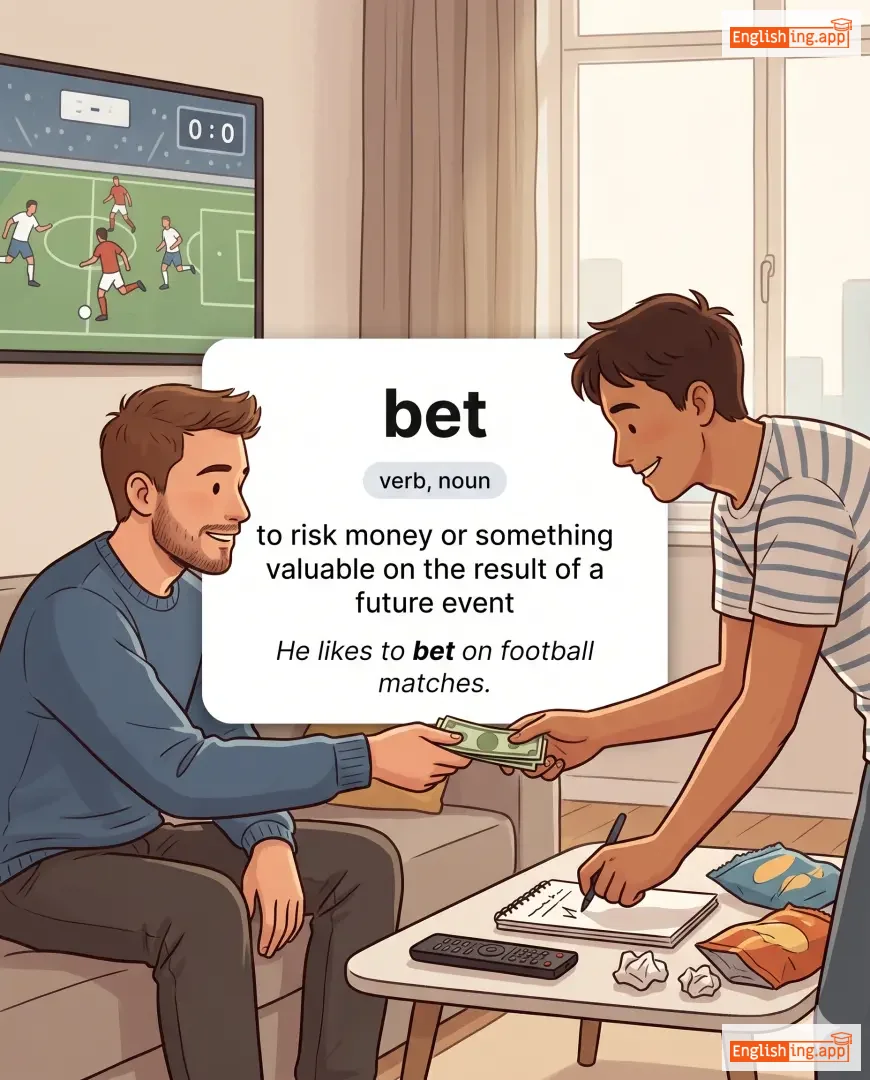
bet definition card — visual illustration of the meaning
verb, noun
/bɛt/
ставить (stavit)

to risk money or something valuable on the result of a future event

"He likes to bet on football matches."

"Ему нравится ставить на футбольные матчи." (Emu nravitsya stavit' na futbol'nye matchi.)
verb
/bɪˈteɪk/
отправляться; прибегать (otpravlyatsya; pribegat)

to go or resort to a place or course of action, especially as a response; to apply oneself

"After dinner, she betook herself to her room to read."

"После ужина она отправилась в свою комнату читать." (Posle uzhina ona otpravilas v svoyu komnatu chitat)
noun
/ˌbeɪt ˈnwɑːr/
невыносимая вещь (nevyznoimaya veshch)

A person or thing that one particularly dislikes or fears.

"Grammar has always been his bete noire."

"Грамматика всегда была его бет нуар." (Grammatika vsegda byla ego bet nuar.)
noun
/ˈbiː.təl nʌt/
бетельный орех (betel'nyy orekh)

seed of the areca palm tree, often chewed as a stimulant

"Betel-nut is commonly chewed in many South Asian countries."

"Бетельный орех часто жуют в странах Южной Азии." (Betel'nyy orekh chasto zhuyut v stranakh Yuzhnoy Azii.)
verb
/bɪˈθɪŋk/
вспомнить (vspomnit')

to cause oneself to consider or remember something

"He bethought himself of the promise he had made."

"Он вспомнил о обещании, которое он дал." (On vspomnil o obeshchanii, kotoroe on dal.)
verb
/bɪˈtaɪd/
случаться (sluchat'sya)

to happen or occur, usually of something that befalls someone

"Woe betide anyone who breaks the rules."

"Тот, кто нарушает правила, понесет последствия." (Tot, kto narushayet pravila, ponesyot posledstviya.)
adverb
/bɪˈtaɪmz/
рано (rano)

early; in good time

"She rose betimes to finish her work."

"Она встала рано, чтобы закончить свою работу." (Ona vstala rano, chtoby zakoncit' svoju rabotu.)
verb
/bɪˈtəʊkən/
предвещать (predveshchat)

to be a sign or indication of something

"Dark clouds betoken an approaching storm."
"Темные облака предвещают надвигающуюся бурю." (Temnye oblakа predveshchayut nadvigayushchuyusya buryu.)
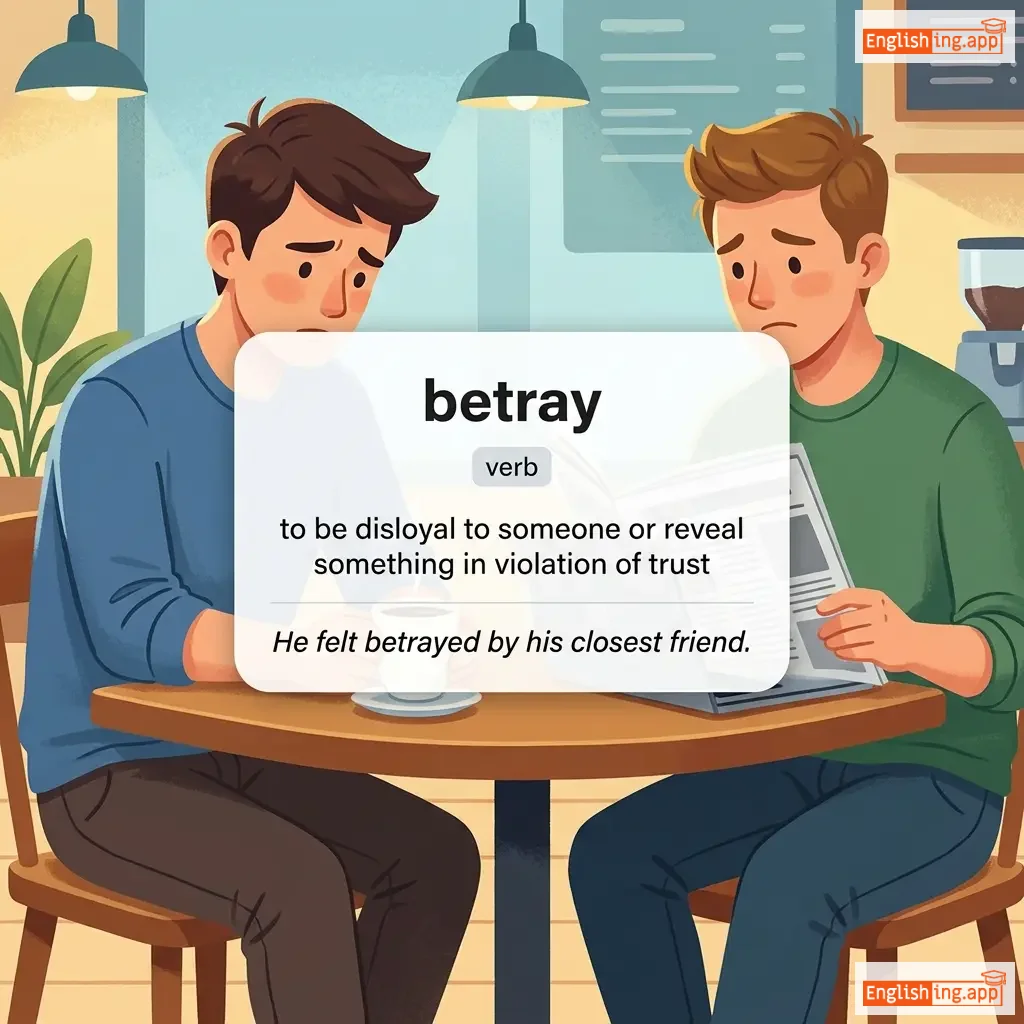
betray definition card — visual illustration of the meaning
verb
/bɪˈtreɪ/
предать (predat)

to be disloyal to someone or reveal something in violation of trust

"He felt betrayed by his closest friend."

"Он почувствовал себя преданным своим самым близким другом." (On pochuvstvoval sebya predannym svoim samym blizkim drugom.)
noun
/bɪˈtreɪəl/
предательство; измена (predatel'stvo; izmena)

the action of betraying one's country, group, or person; disloyalty

"His betrayal of their friendship hurt her deeply."

"Его предательство их дружбы глубоко её ранило." (Yego predatel'stvo ikh druzhby gluboko yeye ranilo.)
noun
/bɪˈtreɪər/
предатель; изменник (predatel', izmen'nik)

a person who betrays someone or something; one who is disloyal

"The betrayer was exposed and faced severe consequences."

"Предатель был разоблачен и столкнулся с серьезными последствиями." (Predatel' byl razoblachen i stolknulsya s seryoznymi posledstviyami.)
verb
/bɪˈtroʊð/
обручиться (obruchitsya)

To formally promise to marry someone; to engage.

"He was betrothed to the princess at a young age."

"Он был обручен с принцессой в юном возрасте." (On byl obruchens s printsessoy v yunom vozraste.)
noun
/bɪˈtroʊðəl/
обручение (obruzhenie)

The formal engagement to be married.

"Their betrothal was announced to the whole village."

"Их обручение было объявлено в деревне." (Ikh obruzhenie bylo ob'yavleno v derevne.)
adjective, noun
/bɪˈtroʊðd/
обручённый (obryuchyonny)

Engaged to be married; a person who is engaged.

"She introduced him as her betrothed."

"Она представила его как своего обручённого." (Ona predstaviła ego kak svoego obryuchyonnego.)
better definition card — visual illustration of the meaning
adjective, adverb, verb
/ˈbɛtər/

of a more excellent or effective type or quality; to surpass or improve

"He felt better after taking the medicine."

preposition, adverb
/bɪˈtwiːn/
между (mezhdu)

at, into, or across the space separating two objects or regions

"She sat between her two friends."

"Она сидела между своими двумя друзьями." (Ona sidelа mezhdu svoimi dvumya druz'yami.)
noun, verb
/ˈbɛvəl/
скос (skos)

A sloping edge or surface; to cut or shape an edge at an angle.

"The carpenter beveled the edges of the table."

"Плотник срезал углы стола." (Plotnik srezal uglы stola.)
noun
/ˈbɛvərɪdʒ/
напиток (napitok)

a drink, especially one other than water

"I ordered a cold beverage to cool down on a hot day."

"Я заказал холодный напиток, чтобы остыть в жаркий день." (Ya zakazal kholodnyy napitok, chtoby ostyt' v zharkiy den'.)
noun
/ˈbɛvi/
стая, группа (staya, gruppa)

A large group of people or things of a particular kind.

"A bevy of swans floated on the lake."

"Стая лебедей плавала на озере." (Staya lebedey plavala na ozyere.)
verb
/bɪˈweɪl/
оплакивать (oplakivat)

to express deep sorrow or regret over something; to mourn openly

"She bewailed the loss of her childhood home."

"Она оплакивала потерю дома своего детства." (Ona oplakivala poteryu doma svoego detstva)
verb
/bɪˈwɛər/
остерегаться (osteregatsya)

to be cautious or alert about a potential danger or problem

"Beware of the dog near the gate."

"Остерегайтесь собаки у ворот." (Osteregajtes' sobaki u vorot.)
verb
/bɪˈwɪldər/
смущать (smushchat)

to cause someone to be confused or puzzled

"The complex instructions bewildered the students."

"Сложные инструкции озадачили студентов." (Slozhnye instruktsii ozadachili studentov.)
verb
/bɪˈwɪtʃ/
околдовать (okoldovat)

to enchant or fascinate someone as if by magic

"The dancer's performance bewitched the audience."

"Выступление танцовщицы очаровало зрителей." (Vystuplenie tantsovshchitsy ocharovalo zritelyey.)
adjective
/bɪˈwɪtʃɪŋ/
очаровательный (ocharovatel'nyy)

charming, enchanting, or captivating in a magical or irresistible way

"She wore a bewitching smile that captivated everyone in the room."

"Она носила очаровательную улыбку, которая покорила всех в комнате." (Ona nosila ocharovatel'nuyu ulybku, kotoraya pokorila vsekh v komnate.)
preposition, adverb
/bɪˈjɒnd/
за пределами (za predelami)

at or to the further side of; more than

"The village lies beyond the river."
"Деревня находится за рекой." (Derevnya nakhoditsya za rekoj.)
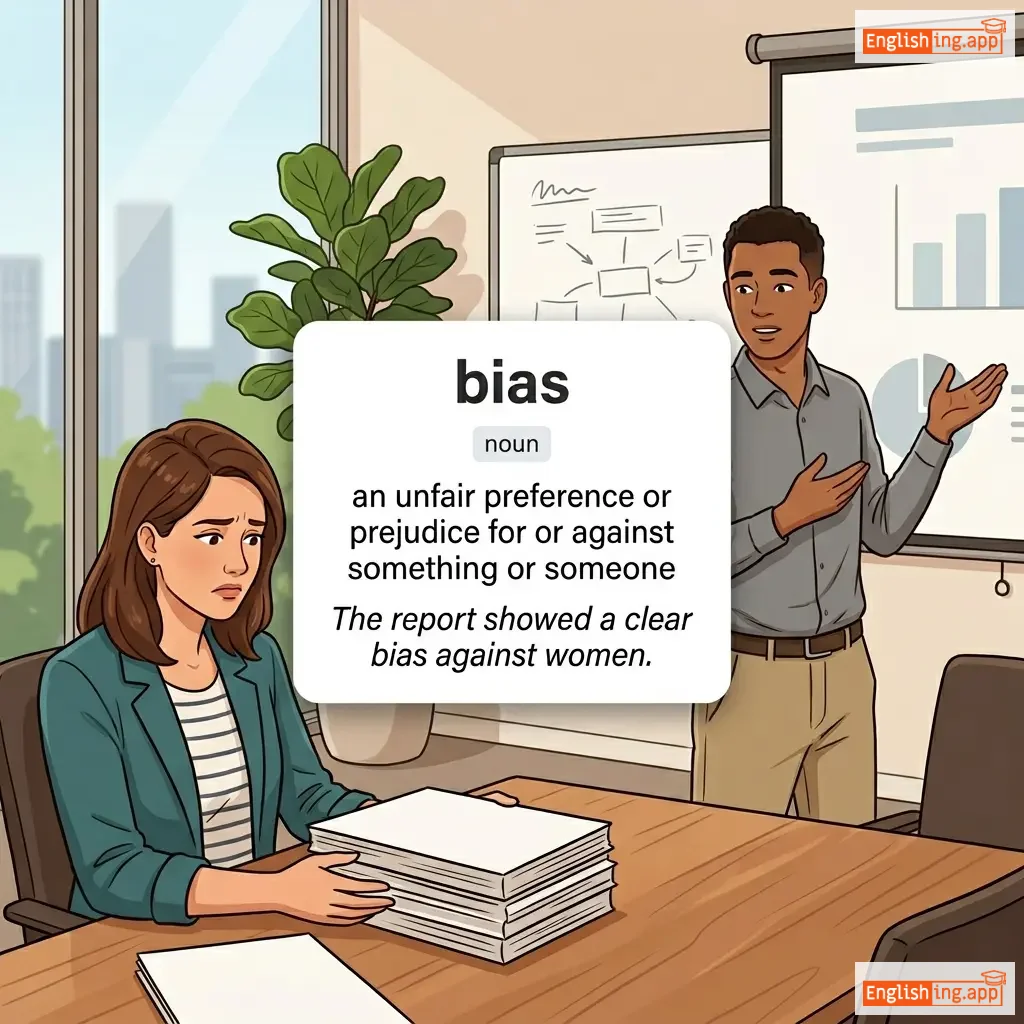
bias definition card — visual illustration of the meaning
noun
/ˈbaɪəs/
предвзятость (predvzyatost)

an unfair preference or prejudice for or against something or someone

"The report showed a clear bias against women."

"Отчет показал явное предвзятое отношение к женщинам." (Otchet pokazal yavnoe predvzyatoe otnoshenie k zhenshchinam.)
adjective
/ˈbaɪəst/
предвзятый (predvzyatyj)

having or showing an unfair tendency to favor one side or opinion

"The judge must not be biased in the case."

"Судья не должен быть предвзятым в этом деле." (Sud'ya ne dolzhen byt' predvzyatym v etom dele.)
noun
/ˈbaɪbəl/
библия (bibliya)

the Christian scriptures consisting of the Old and New Testaments; also used for any authoritative book

"She reads the Bible every morning."

"Она читает Библию каждое утро." (Ona chitayet Bibliyu kazhdoe utro.)
noun
/ˌbɪbliˈɒɡrəfi/
библиография (bibliografiya)

a list of books, articles, or other sources used or referred to in scholarly work

"The report includes a detailed bibliography at the end."

"Доклад включает подробную библиографию в конце." (Doklad vklyuchayet podrobnuyu bibliografiyu v kontse.)
noun
/ˌbɪbliəʊˈmeɪniə/
библиомания (bibliomaniya)

An extreme obsession with collecting or possessing books.

"His bibliomania led him to fill every room with books."

"Его библиомания заставила его заполнить каждую комнату книгами." (Yego bibliomaniya zastavila ego zapolnit' kazhduyu komnatu knigami.)