Vocabularios

Descubra, aprenda y domine el vocabulario en inglés

verb
/bɪˈriːv/
perder a un ser querido (perder a un ser querido)

to deprive someone of a loved one through death

"She was bereaved of her husband last year."

"Ella perdió a su esposo el año pasado." (Ella perdió a su esposo el año pasado.)
adjective
/bɪˈriːvd/
afligido por la pérdida (afligido por la perdida)

suffering the loss of a loved one through death

"The bereaved mother wept silently at the funeral."

"La madre afligida lloraba en silencio en el funeral." (La madre afligida lloraba en silencio en el funeral.)
noun
/bɪˈriːvmənt/
duelo (bereavement)

The state of having lost a loved one through death.

"She received many letters of sympathy during her time of bereavement."

"Ella recibió muchas cartas de simpatía durante su periodo de duelo." (Ella recibio muchas cartas de simpatia durante su periodo de duelo.)
adjective
/bɪˈrɛft/
despojado (despojado)

Deprived of or lacking something, especially a nonmaterial asset.

"After the betrayal, he felt bereft of hope and trust."

"Después de la traición, se sintió despojado de esperanza y confianza." (Después de la traición, se sintió despojado de esperanza y confianza.)
adjective
/bəˈzɜːrk/
enloquecido (enloquecido)

Out of control with anger or excitement; wild or frenzied.

"The fans went berserk when their team won the championship."

"Los fanáticos se volvieron enloquecidos cuando su equipo ganó el campeonato." (Los fanaticos se volvieron enloquecidos cuando su equipo ganó el campeonato.)
noun
/bɜːrθ/
litera / lugar de amarre (litera / lugar de amarre)

A place to sleep on a ship or train; a ship's allocated place at a dock.

"They reserved a lower berth on the overnight train."

"Reservaron una litera inferior en el tren nocturno." (Reservaron una litera inferior en el tren nocturno.)
verb
/bɪˈsiːtʃ/
suplicar (suplícar)

To ask someone urgently and fervently to do something; to beg.

"He beseeched the judge for mercy."

"Él suplicó al juez por misericordia." (Él suplicó al juez por misericordia.)
verb
/bɪˈsɛt/
asediar, acosar (asediar, acosar)

to trouble, harass, or attack on all sides

"The village was beset by constant floods."

"La aldea estaba asediada por inundaciones constantes." (La aldea estaba asediada por inundaciones constantes.)
preposition
/bɪˈsaɪd/
al lado de (al lado de)

next to or at the side of someone or something

"She sat beside her best friend during the ceremony."

"Ella se sentó al lado de su mejor amiga durante la ceremonia." (Ella se sentó al lado de su mejor amiga durante la ceremonia.)
adverb, preposition
/bɪˈsaɪdz/
además (ademas)

in addition to; apart from

"Besides English, he also speaks French."

"Además del inglés, también habla francés." (Ademas del ingles, tambien habla frances.)
verb
/bɪˈsiːdʒ/
sitio (sitio)

to surround a place with armed forces to capture it; to overwhelm with requests or attention

"The city was besieged by enemy troops."

"La ciudad fue sitiada por tropas enemigas." (La ciudad fue sitiada por tropas enemigas.)
verb
/bɪˈsmɪər/
embarrar (embarrar)

to smear or cover with a sticky or dirty substance; to soil

"His clothes were besmeared with mud."

"Su ropa estaba embarrada con barro." (Su ropa estaba embarrada con barro.)
verb
/bɪˈsmɜːrtʃ/
desacreditar (desacreditar)

to damage someone's reputation; to make dirty or stained

"He tried to besmirch her good name with false rumors."

"Trató de desacreditar su buen nombre con rumores falsos." (Trató de desacreditar su buen nombre con rumores falsos.)
adjective
/bɪˈsɒtɪd/
embobado, loco de amor (embobado, loco de amor)

strongly infatuated or obsessed with someone or something

"He was completely besotted with her charm."

"Él estaba completamente embobado con su encanto." (Él estaba completamente embobado con su encanto.)
adjective
/bɛst/
mejor (mejor)

Of the highest quality, excellence, or standing.

"She is the best student in the class."

"Ella es la mejor estudiante de la clase." (Ella es la mejor estudiante de la clase.)
best effort definition card — visual illustration of the meaning
phrase
bɛst ˈɛf.ərt
mejor esfuerzo (mehor esfuerzo)

The maximum amount of effort or energy that someone can give.

"He gave his best effort to complete the task on time."

"Él dio su mejor esfuerzo para completar la tarea a tiempo." (el dio su mejor esfuerzo para completar la tarea a tiempo)
adjective
/ˈbiːstiəl/
bestial (bestial)

Relating to beasts; showing savagery, brutality, or lacking human sensibility.

"The prisoners were treated in a bestial manner."

"Los prisioneros fueron tratados de manera bestial." (Los prisioneros fueron tratados de manera bestial.)
verb
/bɪˈstoʊ/
otorgar (otorgar)

To give or present something as a gift or honor.

"The king bestowed honors upon the brave soldiers."

"El rey otorgó honores a los valientes soldados." (El rey otorgó honores a los valientes soldados.)
verb
/bɪˈstruː/
esparcir (esparcir)

To scatter or cover something with objects or substances.

"The ground was bestrewn with autumn leaves."

"El suelo estaba cubierto de hojas de otoño." (El suelo estaba cubierto de hojas de otoño.)
verb
/bɪˈstraɪd/
dominar (dominar)

To sit or stand astride something; to dominate over.

"The statue bestrides the city square."

"La estatua domina la plaza de la ciudad." (La estatua domina la plaza de la ciudad.)
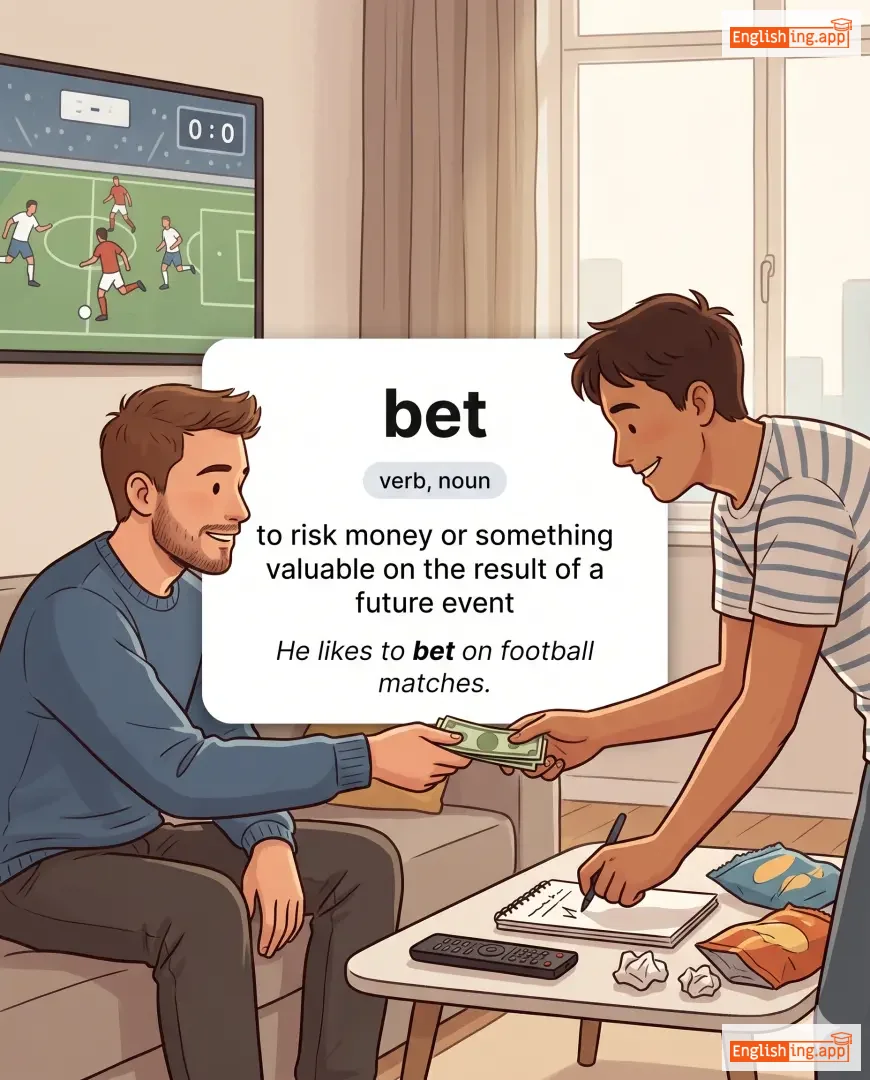
bet definition card — visual illustration of the meaning
verb, noun
/bɛt/
apostar (apostar)

to risk money or something valuable on the result of a future event

"He likes to bet on football matches."

"A él le gusta apostar en partidos de fútbol." (A él le gusta apostar en partidos de fútbol.)
verb
/bɪˈteɪk/
dirigirse a; recurrir a (dirigirse a; recurrir a)

to go or resort to a place or course of action, especially as a response; to apply oneself

"After dinner, she betook herself to her room to read."

"Después de cenar, se dirigió a su habitación para leer." (Despues de cenar, se dirigio a su habitacion para leer)
noun
/ˌbeɪt ˈnwɑːr/
un objeto o persona que uno detesta (un objeto o persona que uno detesta)

A person or thing that one particularly dislikes or fears.

"Grammar has always been his bete noire."

"La gramática siempre ha sido su béte nuar." (La gramática siempre ha sido su béte nuar.)
noun
/ˈbiː.təl nʌt/
nuez de betel (nuez de betel)

seed of the areca palm tree, often chewed as a stimulant

"Betel-nut is commonly chewed in many South Asian countries."

"La nuez de betel se mastica comúnmente en muchos países del sur de Asia." (La nuez de betel se mastica comunmente en muchos paises del sur de Asia.)
verb
/bɪˈθɪŋk/
recordar (recordar)

to cause oneself to consider or remember something

"He bethought himself of the promise he had made."

"Él se recordó de la promesa que había hecho." (El se recordó de la promesa que había hecho.)
verb
/bɪˈtaɪd/
suceder (suceder)

to happen or occur, usually of something that befalls someone

"Woe betide anyone who breaks the rules."

"El que rompa las reglas, sufrirá las consecuencias." (El ke rompa las reglas, sufrirá las consecuencias.)
adverb
/bɪˈtaɪmz/
temprano (temprano)

early; in good time

"She rose betimes to finish her work."

"Ella se levantó temprano para terminar su trabajo." (Ella se levantó temprano para terminar su trabajo.)
verb
/bɪˈtəʊkən/
presagiar (presagiar)

to be a sign or indication of something

"Dark clouds betoken an approaching storm."

"Las nubes oscuras presagian una tormenta que se acerca." (Las nubes oscuras presagian una tormenta que se acerca.)
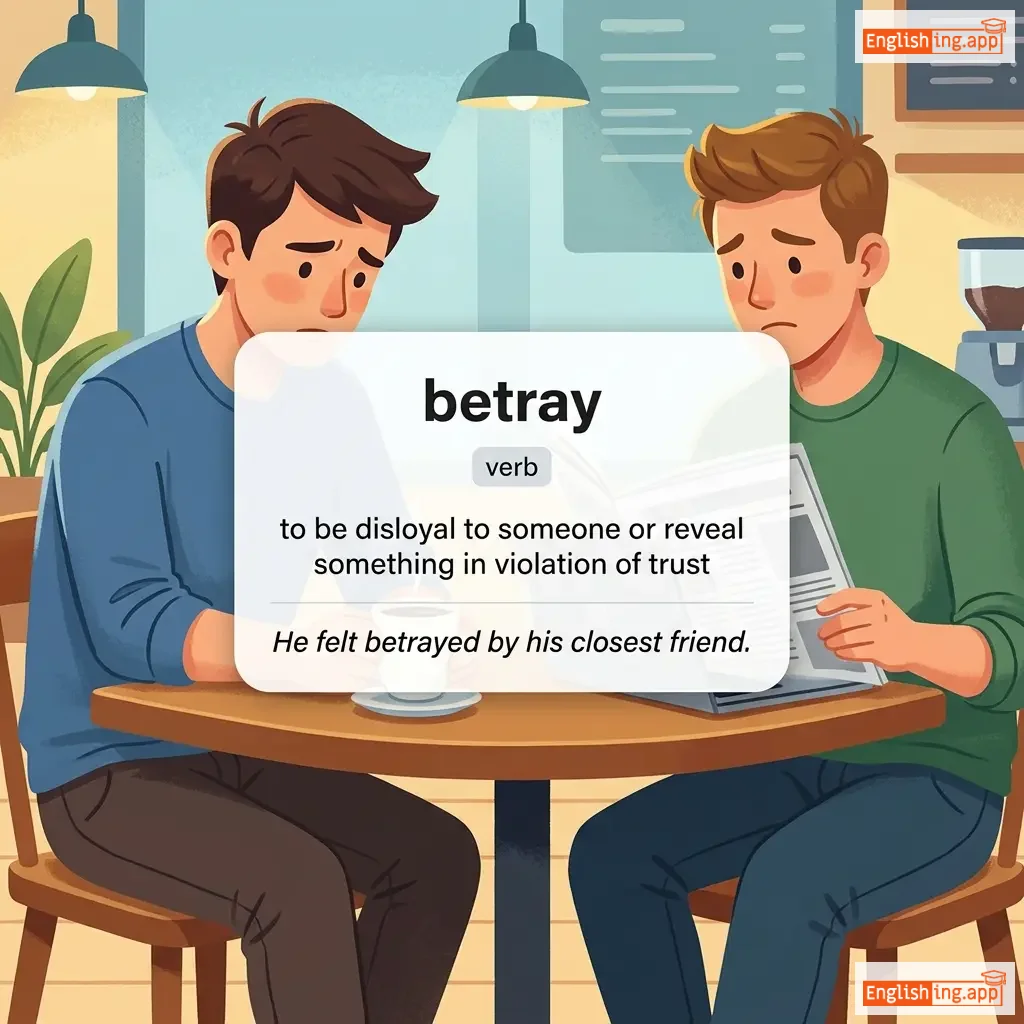
betray definition card — visual illustration of the meaning
verb
/bɪˈtreɪ/
traicionar (traicionar)

to be disloyal to someone or reveal something in violation of trust

"He felt betrayed by his closest friend."

"Él se sintió traicionado por su amigo más cercano." (Él se sintió traicionado por su amigo más cercano.)
noun
/bɪˈtreɪəl/
traición; deslealtad (traicion; deslealtad)

the action of betraying one's country, group, or person; disloyalty

"His betrayal of their friendship hurt her deeply."

"Su traición a su amistad le dolió profundamente." (Su traicion a su amistad le dolio profundamente.)
noun
/bɪˈtreɪər/
traidor; delator (traidor, delator)

a person who betrays someone or something; one who is disloyal

"The betrayer was exposed and faced severe consequences."

"El traidor fue expuesto y enfrentó graves consecuencias." (El traidor fue expuesto y enfrentó graves consecuencias.)
verb
/bɪˈtroʊð/
prometerse (prometerse)

To formally promise to marry someone; to engage.

"He was betrothed to the princess at a young age."

"Él fue prometido a la princesa a una edad temprana." (Él fue prometido a la princesa a una edad temprana.)
noun
/bɪˈtroʊðəl/
compromiso (compromiso)

The formal engagement to be married.

"Their betrothal was announced to the whole village."

"Su compromiso fue anunciado a todo el pueblo." (Su compromiso fue anunciado a todo el pueblo.)
adjective, noun
/bɪˈtroʊðd/
prometido (prometido)

Engaged to be married; a person who is engaged.

"She introduced him as her betrothed."

"Ella lo presentó como su prometido." (Ella lo presentó como su prometido.)
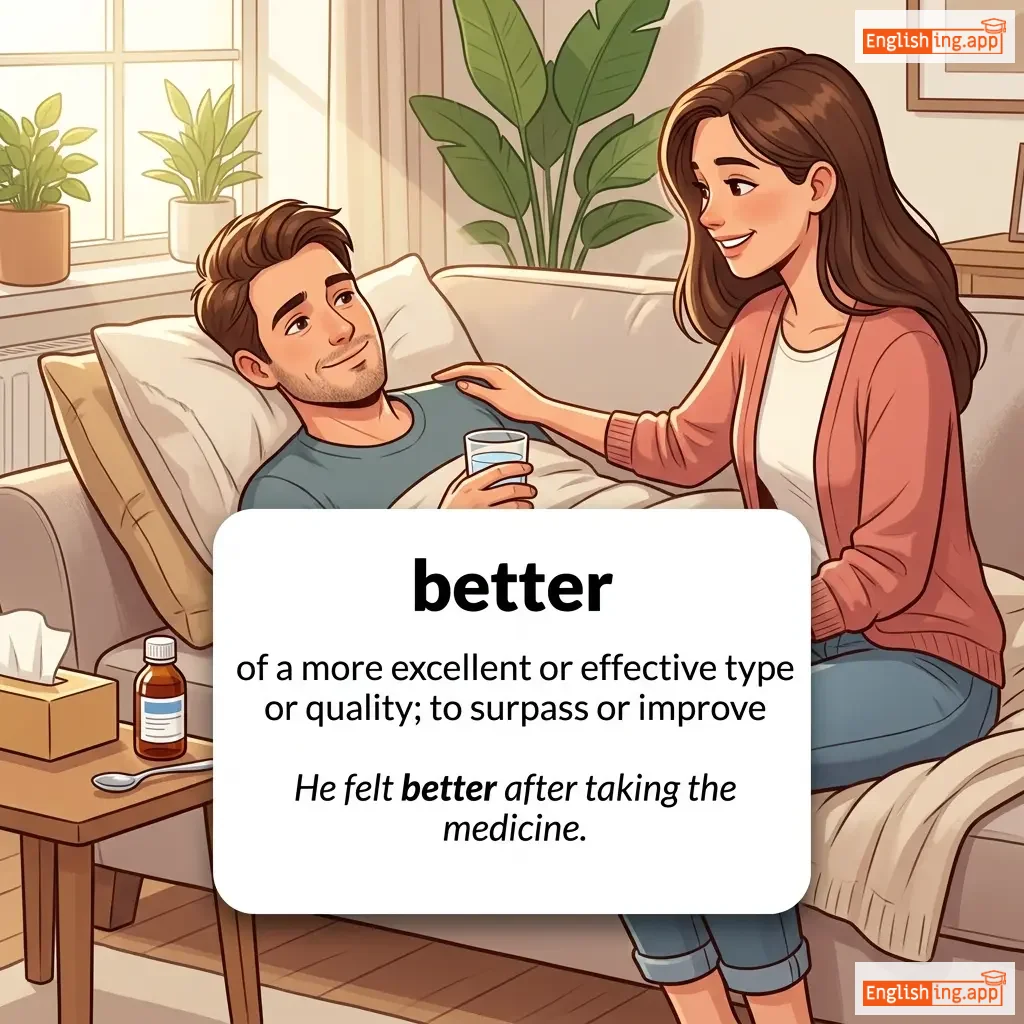
better definition card — visual illustration of the meaning
adjective, adverb, verb
/ˈbɛtər/
mejor (mejor)

of a more excellent or effective type or quality; to surpass or improve

"He felt better after taking the medicine."

"Se sintió mejor después de tomar la medicina." (Se sintió mejor después de tomar la medicina.)
preposition, adverb
/bɪˈtwiːn/
entre (entre)

at, into, or across the space separating two objects or regions

"She sat between her two friends."

"Ella se sentó entre sus dos amigos." (Ella se sentó entre sus dos amigos.)
noun, verb
/ˈbɛvəl/
bisel (bisel)

A sloping edge or surface; to cut or shape an edge at an angle.

"The carpenter beveled the edges of the table."

"El carpintero biseló los bordes de la mesa." (El carpintero biseló los bordes de la mesa.)
noun
/ˈbɛvərɪdʒ/
bebida (bebida)

a drink, especially one other than water

"I ordered a cold beverage to cool down on a hot day."

"Pedí una bebida fría para refrescarme en un día caluroso." (Pedi una bebida fria para refrescarme en un dia caluroso.)
noun
/ˈbɛvi/
banda, grupo (banda, grupo)

A large group of people or things of a particular kind.

"A bevy of swans floated on the lake."

"Un grupo de cisnes flotaba en el lago." (Un grupo de cisnes flotaba en el lago.)
verb
/bɪˈweɪl/
lamentar (lamentar)

to express deep sorrow or regret over something; to mourn openly

"She bewailed the loss of her childhood home."

"Ella lamentó la pérdida de su hogar de la infancia." (Ella lamento la perdida de su hogar de la infancia)
verb
/bɪˈwɛər/
tener cuidado (tener cuidado)

to be cautious or alert about a potential danger or problem

"Beware of the dog near the gate."

"Cuidado con el perro cerca de la puerta." (Cuidado con el perro cerca de la puerta.)
verb
/bɪˈwɪldər/
desconcertar (desconcertar)

to cause someone to be confused or puzzled

"The complex instructions bewildered the students."

"Las instrucciones complejas desconcertaron a los estudiantes." (Las instrucciones complejas desconcertaron a los estudiantes.)
verb
/bɪˈwɪtʃ/
hechizar (hechizar)

to enchant or fascinate someone as if by magic

"The dancer's performance bewitched the audience."

"La actuación de la bailarina cautivó a la audiencia." (La actuacion de la bailarina cautivo a la audiencia.)
adjective
/bɪˈwɪtʃɪŋ/
hechizante (hechizante)

charming, enchanting, or captivating in a magical or irresistible way

"She wore a bewitching smile that captivated everyone in the room."

"Ella llevaba una sonrisa hechizante que cautivó a todos en la sala." (Ella llevaba una sonrisa hechizante que cautivó a todos en la sala.)
preposition, adverb
/bɪˈjɒnd/
más allá (mas alla)

at or to the further side of; more than

"The village lies beyond the river."

"El pueblo está al otro lado del río." (El pueblo esta al otro lado del rio.)
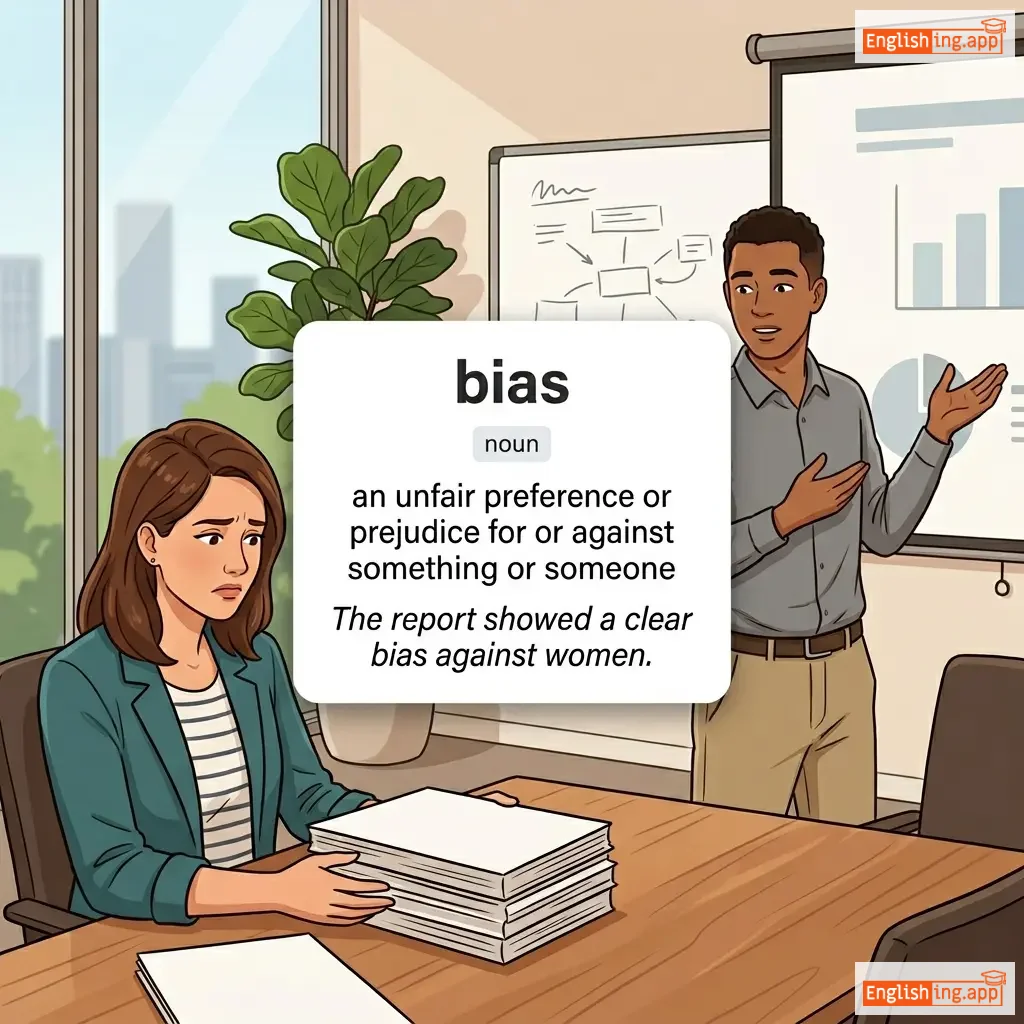
bias definition card — visual illustration of the meaning
noun
/ˈbaɪəs/
sesgo (sesgo)

an unfair preference or prejudice for or against something or someone

"The report showed a clear bias against women."

"El informe mostró un claro sesgo contra las mujeres." (El informe mostró un claro sesgo contra las mujeres.)
adjective
/ˈbaɪəst/
parcial (parcial)

having or showing an unfair tendency to favor one side or opinion

"The judge must not be biased in the case."

"El juez no debe ser parcial en el caso." (El juez no debe ser parcial en el caso.)
noun
/ˈbaɪbəl/
biblia (biblia)

the Christian scriptures consisting of the Old and New Testaments; also used for any authoritative book

"She reads the Bible every morning."

"Ella lee la Biblia cada mañana." (Ella lee la Biblia cada mañana.)
noun
/ˌbɪbliˈɒɡrəfi/
bibliografía (bibliografia)

a list of books, articles, or other sources used or referred to in scholarly work

"The report includes a detailed bibliography at the end."

"El informe incluye una bibliografía detallada al final." (El informe incluye una bibliografia detallada al final.)
noun
/ˌbɪbliəʊˈmeɪniə/
bibliomanía (bibliomania)

An extreme obsession with collecting or possessing books.

"His bibliomania led him to fill every room with books."

"Su bibliomanía lo llevó a llenar cada habitación con libros." (Su bibliomania lo llevo a llenar cada habitacion con libros.)