語彙集

英単語辞書 | 単語の意味、定義、例文

adjective
/ˌjuːnɪˈlætərəl/
一方的 (ippōteki)

Involving or affecting only one side or party without the agreement of others.

"The country took unilateral action without consulting its allies."

"その国は、同盟国と相談せずに一方的な行動を取った。" (Sono kuni wa, dōmeikoku to sōdan sezu ni ippōteki na kōdō o totta.)
adjective
/ˌʌnɪˈmædʒənəbəl/
想像を絶する (sōzō o zessuru)

impossible to conceive; beyond imagination

"The scale of destruction was unimaginable until we saw it firsthand."

"破壊の規模は想像を絶するもので、私たちはそれを目の当たりにするまでわかりませんでした。" (Hakai no kibo wa sōzō o zessuru mono de, watashitachi wa sore o me no atari ni suru made wakarimasen deshita.)
adjective
/ˌʌnɪmˈpiːtʃəbl/
非難の余地がない (hinan no yochi ga nai)

Not able to be doubted, questioned, or criticized; completely trustworthy.

"She is known for her unimpeachable honesty."

"彼女はその非難の余地がない誠実さで知られています。" (Kanojo wa sono hinan no yochi ga nai seijitsusa de shirareteimasu.)
noun
/ʌnɪmˈpɔːrtəns/
重要でなさ (juuyou de nasa)

the state or quality of being insignificant or not important

"He dismissed the issue with a sense of unimportance."

"彼はその問題を重要でないものとして無視した。" (Kare wa sono mondai wo juuyou de nai mono to shite mushi shita)
adjective
/ˌʌnɪmˈpɔːrtənt/
重要でない (juuyou de nai)

not having much value, significance, or influence

"The detail seemed unimportant compared to the main issue."

"その詳細は主要な問題と比べて重要でないように思えた。" (sono shousai wa shuyou na mondai to kurabete juuyou de nai you ni omoeta)
adjective
/ˌʌnɪnˈfɔːrmd/
情報に疎い (joho ni utoi)

lacking knowledge or awareness about a particular subject; not educated or informed

"The decision was made by an uninformed committee."
"その決定は情報に疎い委員会によって下された。" (sono kettei wa joho ni utoi iinkai ni yotte kudasareta)
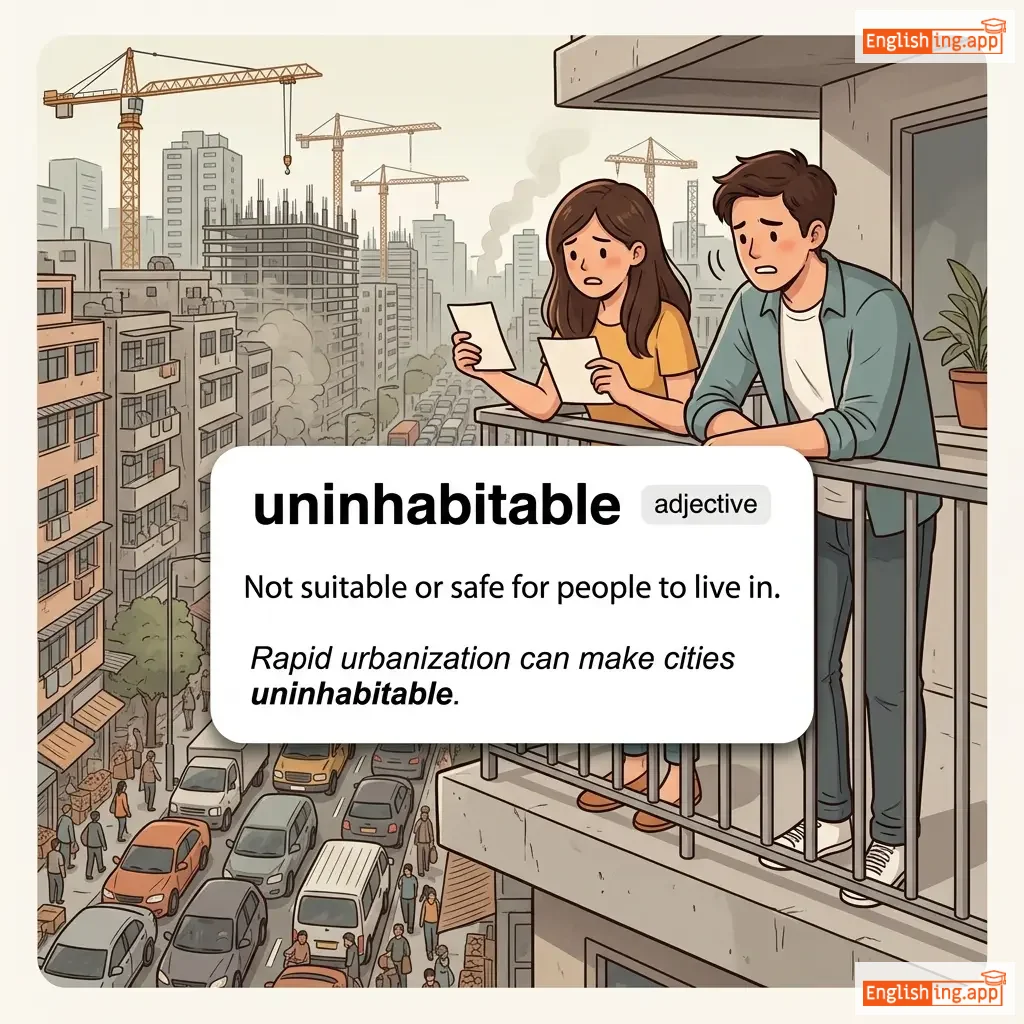
uninhabitable definition card — visual illustration of the meaning
adjective
ʌnɪnˈhæbɪtəbəl
住めない (sumenai)

Not suitable or safe for people to live in.

"Rapid urbanization can make cities uninhabitable."

"急速な都市化は都市を住めない場所にする可能性があります。" (Kyūsokuna toshika wa toshi o sumenai basho ni suru kanōsei ga arimasu.)
adjective
/ˌʌnɪnˈhɪbɪtɪd/
抑制されていない (yokusei sarete inai)

Not restrained or restricted; free in behavior or expression.

"She gave an uninhibited laugh at the joke."

"彼女は冗談に対して抑制されずに笑った。" (Kanojo wa jōdan ni taishite yokusei sarezu ni waratta.)
adjective
/ʌnˈɪndʒərd/
無傷 (mukizu)

Without injury; not physically harmed.

"All the passengers were rescued uninjured."

"すべての乗客は無傷で救助されました。" (Subete no jōkyaku wa mukizu de kyūjo saremashita.)
adjective
/ˌʌnɪnˈtenʃənəl/
意図しない; 偶発的 (itoshinai; gūhatsuteki)

not done on purpose; accidental

"The damage to the car was unintentional."

"車の損傷は意図しないものでした。" (Kuruma no sonshō wa itoshinai mono deshita.)
adjective
/ˌʌnˈɪntrəstɪŋ/
つまらない (tsumaranai)

not holding attention or curiosity; boring

"The lecture was uninteresting and difficult to stay focused on."

"その講義はつまらなく、集中するのが難しかった。" (Sono kougi wa tsumaranaku, shuuchuu suru no ga muzukashikatta)
adjective
/ˌʌnˈɪntɪmeɪtɪŋ/
示唆しない (shisa shinai)

Not giving a hint or suggestion; not indicating.

"His unintimating tone gave no clue of his true feelings."

"彼の示唆しない口調は彼の本当の気持ちを示すものではありませんでした。" (Kare no shisa shinai kuchou wa kare no hontou no kimochi o shimesu mono de wa arimasen deshita.)
noun
/ˈjuːnɪən/
組合 (kumiai)

the action or fact of joining or being joined with others, especially to form a single unit

"The union of the two companies created a global leader."

"二つの会社の統合により、グローバルリーダーが誕生しました。" (Futatsu no kaisha no tōgō ni yori, gurōbaru rīdā ga tanjō shimashita.)
adjective
/juːˈniːk/
ユニーク (yuniiku)

Being the only one of its kind; unlike anything else.

"Her dress was unique and caught everyone's attention."

"彼女のドレスはユニークで、皆の注目を集めた。" (Kanojo no doresu wa yuniiku de, mina no chūmoku o atsume ta.)
noun
/ˈjuːnɪsən/
ユニゾン (unizon)

Simultaneous performance or utterance of action or speech.

"The choir sang in unison."

"合唱団はユニゾンで歌いました。" (Kasshōdan wa unizon de utaimashita.)
adjective
/juːˈnɪsənənt/
調和の取れた (chōwa no toreta)

Sounding together or in harmony.

"The unisonant voices created a powerful effect."

"調和の取れた声が強力な効果を生み出した。" (Chōwa no toreta koe ga kyōryoku na kōka o umidashita.)
noun
/ˈjuːnɪt/
ユニット (yunitto)

an individual thing or person regarded as a single and complete entity

"Each unit in the production line is carefully tested."

"生産ラインの各ユニットは慎重にテストされます。" (Seisan rain no kaku yunitto wa shinchou ni tesuto saremasu.)
noun
/ˌjuːnɪˈtɛəriən/
ユニタリアン (Unitarian)

A person who believes that God exists as one entity rather than as a Trinity; a member of a religious denomination that emphasizes individual freedom of belief.

"The Unitarian church is known for its inclusive and open-minded approach."
"ユニタリアン教会は、その包括的で開かれた考え方で知られています。" (Yunitarian kyōkai wa, sono hōkatsu-teki de hirakareta kangaekata de shirareteimasu.)
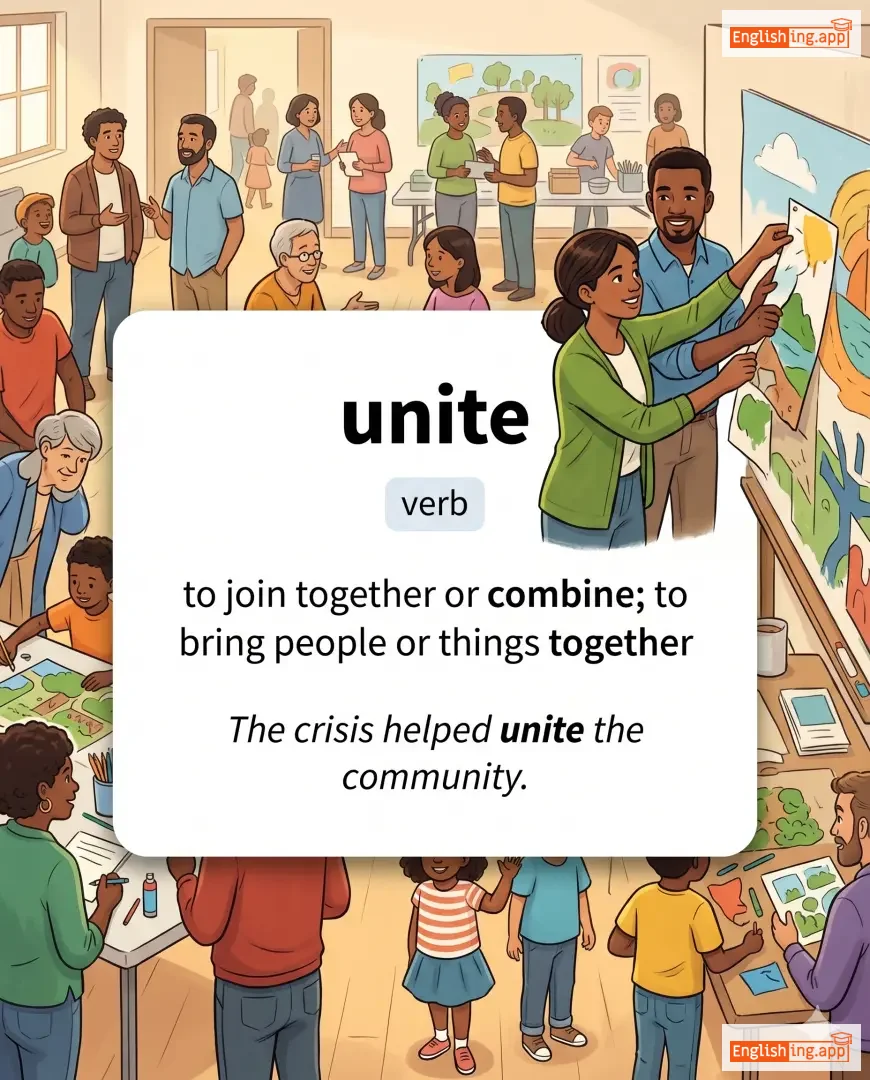
unite definition card — visual illustration of the meaning
verb
/juˈnaɪt/
団結する (danketsu suru)

to join together or combine; to bring people or things together

"The crisis helped unite the community."

"危機がコミュニティを団結させました。" (Kiki ga komyuniti o danketsu sasemashita.)
adjective
/juˈnaɪtɪd/
団結した (danketsu shita)

joined together or combined as one

"The united team won the championship."
"団結したチームがチャンピオンシップを勝ち取った。" (Danketsu shita chīmu ga chanpionshipu o kachitotta.)
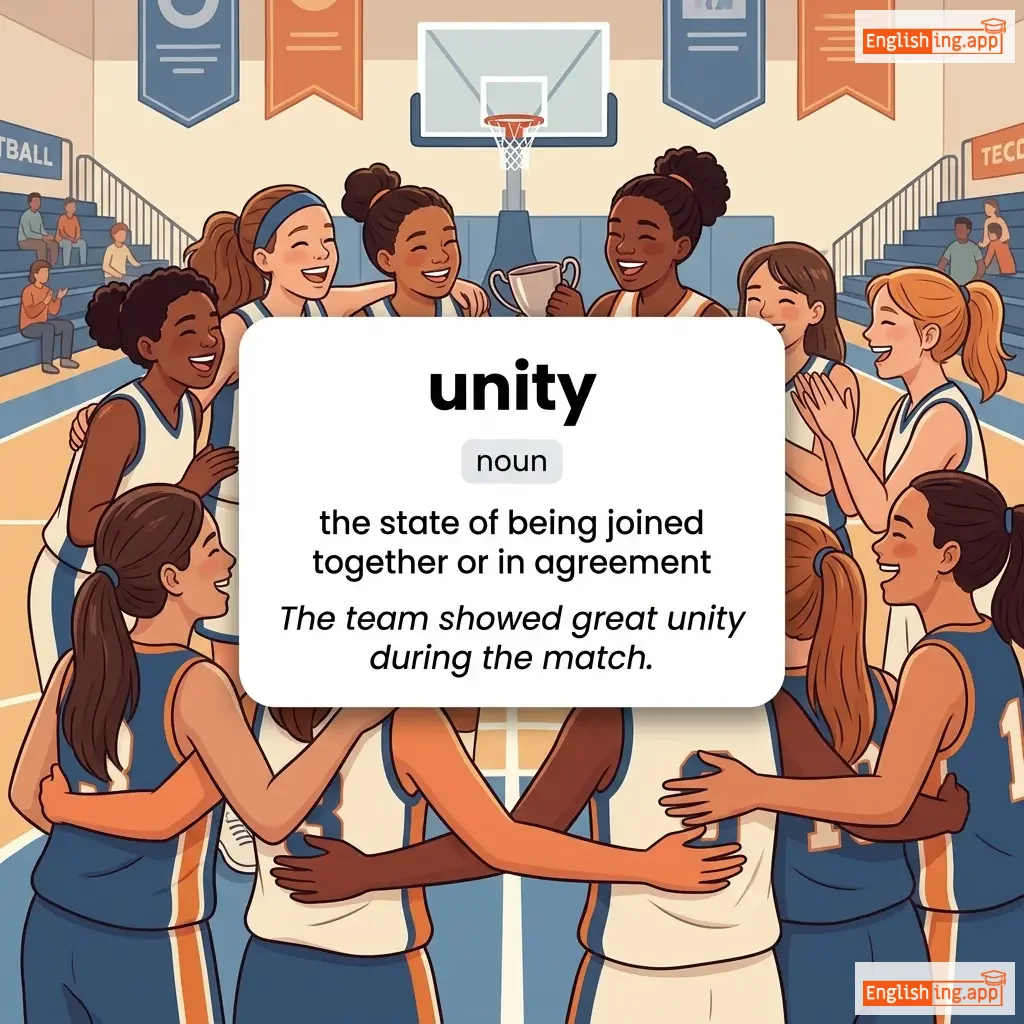
unity definition card — visual illustration of the meaning
🫱🏻‍🫲🏽

unity (ユニティ)

noun
/ˈjuːnɪti/
団結 (danketsu)

the state of being joined together or in agreement

"The team showed great unity during the match."

"チームは試合中に素晴らしい団結を示しました。" (Chīmu wa shiai-chū ni subarashī danketsu o shimeshimashita.)
noun
/ˈjuːnɪvəˌlɛns/
単価性 (tanka-sei)

The state of having a single valence or combining power, especially in chemistry.

"Hydrogen is characterized by its univalence in chemical reactions."

"水素は化学反応においてその単価性によって特徴づけられています。" (Suiso wa kagaku hannō ni oite sono tanka-sei ni yotte tokuchōdzukerareteimasu.)
adjective
/ˌjuːnɪˈvɜːsəl/
普遍的 (fuhenteki)

Relating to or done by all people or things in the world; applicable everywhere or in all cases.

"There is a universal need for love and acceptance."

"愛と受容には普遍的な必要があります。" (Ai to juyō ni wa fuhenteki na hitsuyō ga arimasu.)
noun
/ˈjuːnɪvɜːrs/
宇宙 (uchuu)

the totality of known or supposed objects and phenomena throughout space; the cosmos

"The universe is vast and full of mysteries."

"宇宙は広大で謎に満ちています。" (Uchuu wa koudai de nazo ni michiteimasu.)
noun
/ˌjuːnɪˈvɜːrsɪti/
大学 (daigaku)

an institution of higher education and research, which grants academic degrees

"She is studying law at the university."

"彼女は大学で法学を学んでいます。" (Kanojo wa daigaku de hogaku wo manande imasu.)
adjective
/ʌnˈdʒʌst/
不当な; 不正な (futōna; fuseina)

not fair or right; morally wrong

"The punishment was unjust for such a minor offense."

"その罰は軽微な違反に対して不当でした。" (Sono bachi wa keibi na ihan ni taishite futō deshita.)
adjective
/ʌnˈkɛmpt/
だらしない (darashinai)

Having an untidy or disheveled appearance.

"He looked unkempt after sleeping outdoors all night."

"彼は一晩外で寝た後、だらしなく見えた。" (Kare wa hitoban soto de neta ato, darashinaku mieta.)
adjective
/ʌnˈkaɪnd/
無愛想; 不親切 (buaisou; fushinsetsu)

cruel; not nice or caring toward others

"It was unkind of him to make fun of her appearance."

"彼が彼女の外見をからかうのは不親切だった。" (Kare ga kanojo no gaiken o karakau no wa fushinsetsu datta.)
adverb
/ʌnˈkaɪndli/
意地悪に (ijiwaruni)

in a cruel, harsh, or unsympathetic manner

"She spoke unkindly about her colleague during the meeting."

"彼女は会議中に同僚のことを意地悪に話した。" (kanojo wa kaigichuu ni douryou no koto o ijiwaruni hanashita)
noun
/ʌnˈkaɪndnəs/
不親切 (fushinsetsu)

lack of kindness; cruel or inconsiderate behavior

"His unkindness hurt her feelings deeply."

"彼の不親切は彼女の気持ちを深く傷つけた。" (Kare no fushinsetsu wa kanojo no kimochi o fukaku kizutsuketa)
adjective
/ʌnˈnoʊn/
不明 (fumei)

not known or familiar

"The origin of the disease remains unknown."

"その病気の起源は未だに不明です。" (Sono byouki no kigen wa imada ni fumei desu.)
adjective
/ʌnˈlɔːfəl/
違法 (ihou)

Not conforming to or permitted by law; illegal.

"The police arrested him for unlawful possession of weapons."

"警察は違法な武器所持で彼を逮捕しました。" (Keisatsu wa ihō na buki shoji de kare o taiho shimashita.)
conjunction
/ʌnˈlɛs/
もし~でない限り (moshi ~ denai kagiri)

except if

"We won't go unless it stops raining."

"雨が止まない限り、私たちは行きません。" (Ame ga yamanai kagiri, watashitachi wa ikimasen.)
adjective
/ʌnˈlɛtəd/
識字障害者 (shikiji shougai sha)

lacking education or the ability to read and write; illiterate

"The unlettered villagers relied on oral traditions to preserve their history."

"識字障害者の村人たちは口承伝承に頼って歴史を保存していた。" (Shikiji shougai sha no murabito-tachi wa koushou denshou ni tayotte rekishi wo hozon shite ita.)
preposition/adjective
/ʌnˈlaɪk/
異なる (kotonaru)

differing from or not similar to

"Unlike his brother, he enjoys playing soccer."

"彼の兄とは異なり、彼はサッカーを楽しんでいます。" (Kare no ani to wa kotonaru, kare wa sakkā o tanoshindeimasu.)
adjective
/ʌnˈlaɪkli/
ありそうにない (arisō ni nai)

not likely to happen or be true

"It is unlikely that he will arrive on time."

"彼が時間通りに到着する可能性は低い。" (Kare ga jikan dōri ni tōchaku suru kanōsei wa hikui.)
adjective
/ʌnˈlɪmɪtɪd/
無制限 (museigen)

without any limits or restrictions

"The internet plan offers unlimited data for the whole month."

"インターネットプランは1ヶ月間の無制限データを提供します。" (Intānetto puran wa ikkagetsukan no museigen dēta o teikyō shimasu.)
verb
/ʌnˈlɒk/
解錠する (kaijo suru)

to open something that is locked; to make something accessible or available

"She used the key to unlock the door."

"彼女は鍵を使ってドアを解錠した。" (kanojo wa kagi o tsukatte doa o kaijo shita)
adjective
/ʌnˈlʌki/
不運; ラッキーでない (fuun; rakkī denai)

having bad luck; unfortunate

"He was unlucky to miss the winning shot."

"彼は勝つシュートを外して不運だった。" (Kare wa katsu shūto o hazushite fuun datta.)
adjective
/ʌnˈmænɪdʒəbəl/
管理できない; 手に負えない (kanri dekinai; te ni oenai)

difficult or impossible to control or handle

"The large class became unmanageable without proper supervision."

"適切な監視がなければ、大きなクラスは管理できなくなった。" (tekisetsu na kanshi ga nakereba, ookina kurasu wa kanri dekinakunatta.)
adjective
/ʌnˈmærid/
未婚 (mikon)

Not married; single.

"He is thirty-five and still unmarried."

"彼は三十五歳で、まだ未婚です。" (Kare wa sanjuugosai de, mada mikon desu.)
verb
/ʌnˈmɑːsk/
正体を暴く (shotai o abaku)

to remove a mask or covering; to reveal the true identity, nature, or intentions of someone or something

"The investigation helped unmask the real culprit behind the crime."
"その捜査は犯罪の背後にいる本当の犯人を暴いた。" (Sono sousa wa hanzai no haigo ni iru hontou no hannin o abaita)
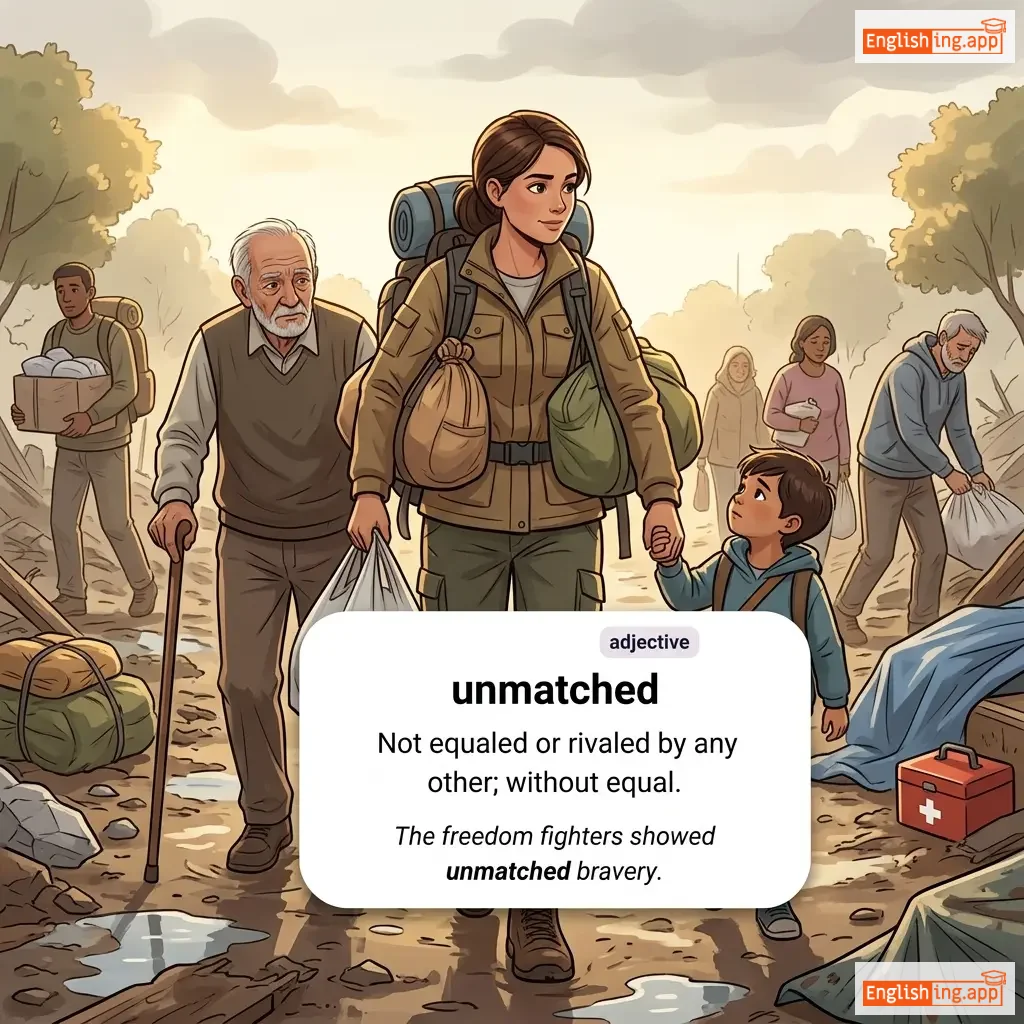
unmatched definition card — visual illustration of the meaning
adjective
ʌnˈmætʃt
比類のない (hirui no nai)

Not equaled or rivaled by any other; without equal.

"The freedom fighters showed unmatched bravery."

"自由の戦士たちは比類のない勇気を示しました。" (Jiyū no senshi-tachi wa hirui no nai yūki o shimeshimashita.)
adjective
/ʌnˈmaɪndfəl/
無頓着な; 注意しない; (mutonchakuna; chūi shinai)

not paying attention; careless; heedless

"She was unmindful of the danger around her."

"彼女は周りの危険に気づいていませんでした。" (Kanojo wa mawari no kiken ni kidzuiteimasendeshita.)
adjective
/ʌnˈmɪtɪɡeɪtɪd/
完全な (kanzen na)

absolute; not lessened or moderated

"The meeting was an unmitigated disaster."

"会議は完全な災害でした。" (Kaigi wa kanzen na saigai deshita.)
adjective
/ʌnˈmɒdɪfaɪd/
未変更の (mihenkou no)

not changed from its original form or state

"The data was used in its unmodified form for analysis."

"データは未変更の形で分析に使用された。" (deeta wa mihenkou no katachi de bunseki ni shiyou sareta)
adjective
/ʌnˈnætʃrəl/
不自然 (fushizen)

contrary to the usual course of nature; artificial or abnormal

"The bright green color of the drink looked unnatural."

"その飲み物の鮮やかな緑色は不自然に見えた。" (Sono nomimono no azayakana midoriiro wa fushizen ni mieta.)
adverb
/ʌnˈnætʃrəli/
不自然に (fushizen ni)

in a way that is not natural or normal; excessively or strangely

"He smiled unnaturally, making everyone feel uncomfortable."

"彼は不自然に笑い、皆を居心地悪くさせた。" (Kare wa fushizen ni warai, mina o igokochi waruku saseta)
adverb
/ʌnˈnesəserəli/
不必要に (fuhitsuyou ni)

to a greater extent than is needed; without necessity

"Don't worry unnecessarily about the exam."

"試験について不必要に心配しないでください。" (shiken ni tsuite fuhitsuyou ni shinpai shinaide kudasai.)
adjective
/ʌnˈnɛsəsɛri/
不必要 (fuhitsuyou)

not needed or required

"The manager cut all unnecessary expenses to save costs."

"マネージャーはコストを節約するためにすべての不必要な支出を削減しました。" (Manējā wa kosuto o setsuyaku suru tame ni subete no fuhitsuyou na shishutsu o sakugen shimashita.)