語彙集

英単語辞書 | 単語の意味、定義、例文

noun
/moʊld/
型(鋳型) (morudo)

a hollow container used to give shape to molten material; fungus

"She poured chocolate into the mould to make candies."

"彼女はキャンディーを作るために型にチョコレートを流し込んだ。" (Kanojo wa kyandii o tsukuru tame ni kata ni chokoreeto o nagashikonda.)
verb
/maʊnt/
取り付ける (toritsukeru)

to climb up, rise, or fix something in place

"They plan to mount a camera on the wall."

"彼らは壁にカメラを取り付ける予定です。" (Karera wa kabe ni kamera wo toritsukeru yotei desu.)
noun
/ˈmaʊntən/
(yama)

a large natural elevation of the earth’s surface

"They climbed the highest mountain in the region."

"彼らはその地域で最も高い山に登りました。" (Karera wa sono chiiki de mottomo takai yama ni noborimashita.)
noun
/ˌmaʊntəˈnɪə/
登山者 (tozan-sha)

A person who climbs mountains as a sport or profession.

"The mountaineer reached the summit after a long climb."

"登山者は長い登山の後、頂上に到達しました。" (Tozan-sha wa nagai tozan no ato, chōjō ni tōtatsu shimashita.)
adjective
/ˈmaʊntənəs/
山岳地帯の (sangaku chitai no)

Having many mountains; very large or huge in size.

"They traveled through a mountainous region of Nepal."

"彼らはネパールの山岳地帯を通って旅行しました。" (Karera wa Nepāru no sangaku chitai o tōtte ryokō shimashita.)
noun
/ˈmaʊntɪˌbæŋk/
ペテン師 (petenshi)

A charlatan or trickster who deceives others, often for personal gain.

"The crowd was fooled by the mountebank’s false promises."

"群衆はそのペテン師の虚偽の約束に騙されました。" (Gunshū wa sono petenshi no kyogi no yakusoku ni damasaremashita.)
verb
/mɔːrn/
哀悼する (aitō suru)

To feel or express deep sadness or grief, especially because of someone's death.

"They gathered to mourn the loss of their friend."

"彼らは友人の死を悼むために集まりました。" (Karera wa yūjin no shi o aitō suru tame ni atsumarimashita.)
noun
/ˈmɔːr.nər/
喪に服する人 (sō ni fukusuru hito)

a person who attends a funeral or shows grief for someone who has died

"The mourners gathered at the cemetery to pay their respects."

"喪に服する人々は墓地に集まり、敬意を表しました。" (sō ni fukusuru hitobito wa bochi ni atsumari, keii o hyōshimashita.)
adjective
/ˈmɔːrn.fəl/
悲しい (kanashī)

feeling, expressing, or causing sadness or grief

"The mournful song reminded her of lost loved ones."

"悲しい歌は彼女に失った愛する人々を思い出させました。" (Kanashī uta wa kanojo ni ushinatta aisuru hitobito o omoidasasemashita.)
noun
/ˈmɔːr.nɪŋ/
(sō)

the expression of deep sorrow for someone who has died

"The family is in mourning for their grandmother."

"家族は祖母を喪に服している。" (Kazoku wa sobo o sō ni fukushite iru.)
noun
/maʊs/
ネズミ / コンピューターマウス (nezumi / konpyuutaa mausu)

a small rodent with a pointed nose and long tail; also a computer input device

"The cat chased the mouse across the room."

"猫は部屋の中でネズミを追いかけました。" (Neko wa heya no naka de nezumi wo oikakemashita.)
noun
/məˈstɑːʃ/
口ひげ (kuchihige)

hair that grows on the upper lip of a man's face

"He decided to grow a moustache for the first time."

"彼は初めて口ひげを生やすことに決めました。" (Kare wa hajimete kuchihige wo hayasu koto ni kimemashita.)
noun
/maʊθ/
(kuchi)

the opening in the face used for eating, speaking, and breathing

"She covered her mouth when she yawned."

"彼女はあくびをしたとき、口を覆った。" (Kanojo wa akubi o shita toki, kuchi o ōtta.)
noun
/ˈmaʊθ.fʊl/
一口 (hito-kuchi)

the amount of food or drink that fills the mouth, or a long and difficult word or phrase

"He took a big mouthful of water after the run."

"彼はランニングの後で大きな一口水を飲んだ。" (Kare wa ranningu no ato de ookina hitokuchi mizu wo nonda.)
adjective
/ˈmuː.və.bl̩/
可動の; ポータブル; 移動可能 (kado no; pōtaburu; idō kanō)

capable of being moved; not fixed in position

"The furniture is movable so we can rearrange the room easily."

"家具は可動なので、部屋を簡単に再配置できます。" (kagu wa kadō nanode, heya o kantan ni saihaichi dekimasu.)
move definition card — visual illustration of the meaning
verb
/muːv/
動かす (ugokasu)

To change position, place, or state.

"They decided to move to a new city."
"彼らは新しい都市に引っ越すことを決めました。" (Karera wa atarashī toshi ni hikkosu koto o kimemashita.)
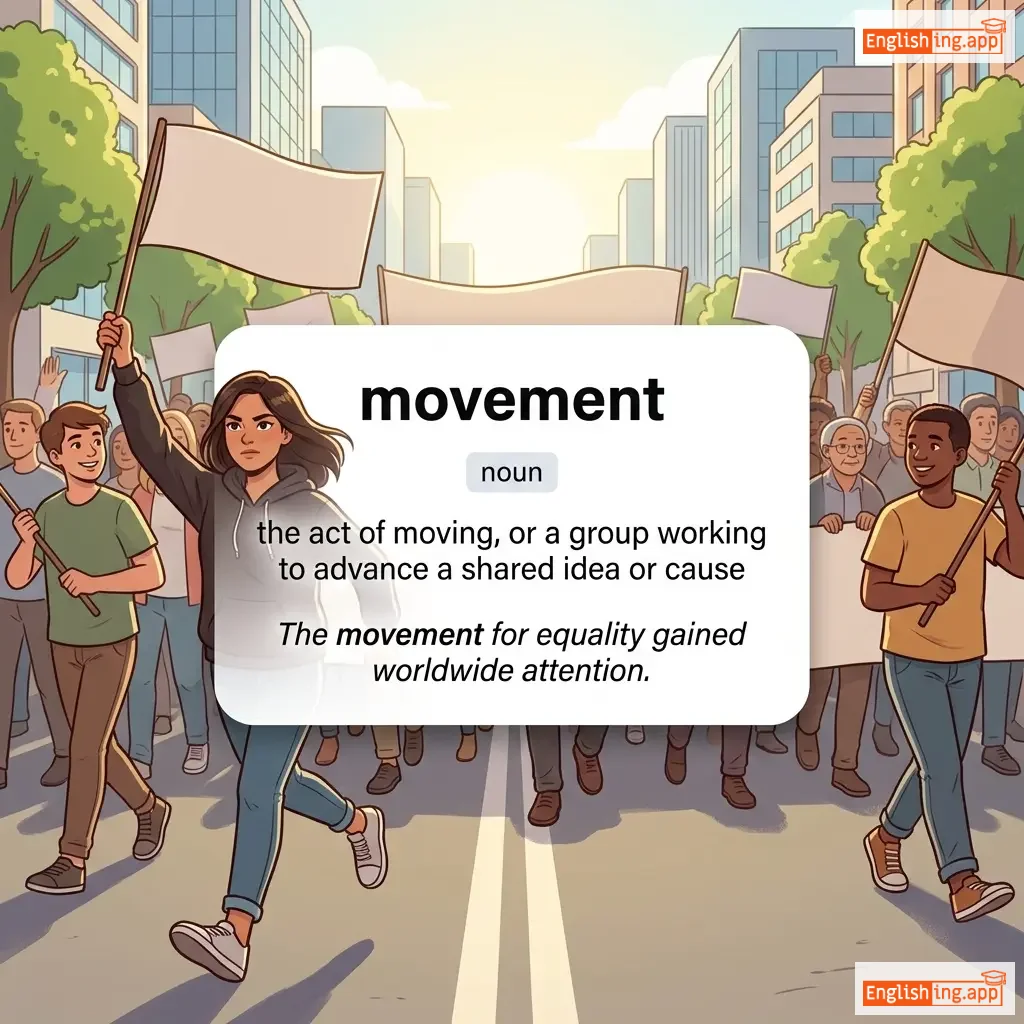
movement definition card — visual illustration of the meaning
noun
/ˈmuːv.mənt/
運動 (undou)

the act of moving, or a group working to advance a shared idea or cause

"The movement for equality gained worldwide attention."

"平等のための運動は世界的な注目を集めました。" (Byoudou no tame no undou wa sekaiteki na chuumoku wo atsume mashita.)
movements definition card — visual illustration of the meaning
noun
ˈmuːv.mənts
運動 (undou)

Organized efforts by groups of people working together to advance their shared political, social, or artistic ideas.

"Freedom movements paved the way for independence."

"自由運動は独立への道を切り開いた。" (Jiyuu undou wa dokuritsu e no michi o kirihiraita.)
noun
/ˈmuːvi/
幸福 (kōfuku)

A motion picture or film shown in a cinema or on television.

"We watched a movie together last night."

"彼女は賞を受け取ったとき、自分の幸せを隠すことができませんでした。" (Kanojo wa shō o uketotta toki, jibun no kōfuku o kakusu koto ga dekimasen deshita.)
movies definition card — visual illustration of the meaning
noun
ˈmuːviz
映画 (eiga)

A story or event recorded by a camera as a set of moving images and shown in a theater or on television.

"Watching movies helps in language learning."

"映画を見ることは言語学習に役立ちます。" (Eiga o miru koto wa gengo gakushū ni yakudachimasu.)
adjective
/ˈmuːvɪŋ/
感動的 (kandouteki)

causing strong feelings, especially of sympathy or sadness

"Her speech was so moving that everyone cried."

"彼女のスピーチはとても感動的で、みんな泣いてしまった。" (Kanojo no supīchi wa totemo kandōteki de, minna naite shimatta.)
title
/ˈmɪstər/
(sama)

a title used before a man's name

"Mr. Rahman is our new teacher."

"ラフマン様は私たちの新しい先生です。" (Rahuman-sama wa watashitachi no atarashī sensei desu.)
title
/ˈmɪsɪz/
ミセス (misesu)

a title used before a married woman's name

"Mrs. Karim is the headmistress of the school."

"ミセス・カリムは学校の校長です。" (Misesu Karim wa gakkou no kouchou desu.)
👩‍💼

ms (ミズ)

title
/mɪz/
ミズ (Mizu)

a title used before a woman's name, regardless of marital status

"Ms. Akter will give a speech at the seminar."

"ミズ・アクターはセミナーでスピーチを行います。" (Mizu Akutā wa seminā de supīchi o okonai masu.)
adjective, adverb, pronoun
/mʌtʃ/
多く (ooku)

a large amount or degree of something

"She doesn’t have much time to finish the project."

"彼女はプロジェクトを終わらせるために多くの時間がない。" (Kanojo wa purojekuto o owaraseru tame ni ooku no jikan ga nai.)
noun
/mʌd/
(doro)

soft, wet earth or soil

"The children were playing in the mud after the rain."

"子供たちは雨の後で泥遊びをしていました。" (Kodomotachi wa ame no ato de doro asobi o shiteimashita.)
verb
/ˈmʌd.əl/
混乱させる (konran saseru)

to mix things up in a confused way or to make a mess of something

"He muddled the papers and couldn’t find the report."

"彼は書類を混乱させ、報告書を見つけられなかった。" (Kare wa shorui o konran sase, hōkokusho o mitsukerarenakatta.)
adjective
/ˈmʌd.i/
泥だらけ (doradake)

covered in or full of mud; unclear or confused

"The children came back with muddy shoes after playing outside."

"子供たちは外で遊んだ後、泥だらけの靴で帰ってきました。" (Kodomotachi wa soto de asonda ato, doradake no kutsu de kaette kimashita.)
verb
/ˈmʌfəl/
抑える (osaeru)

to make a sound quieter or less distinct; to cover or wrap something to reduce noise or warmth

"She tried to muffle her laughter with a scarf."

"彼女はスカーフで笑い声を抑えようとした。" (Kanojo wa sukāfu de warai goe o osaeyou to shita.)
noun
/ˈmʌflər/
マフラー (mafurā)

a device on a vehicle's exhaust to reduce noise; also a scarf worn around the neck for warmth

"The car's muffler needs to be replaced."

"車のマフラーは交換する必要があります。" (Kuruma no mafurā wa kōkan suru hitsuyō ga arimasu.)
noun
/mʌɡ/
マグカップ (magukappu)

a large cup, typically cylindrical and having a handle and used without a saucer

"She drank her morning coffee from a ceramic mug."

"彼女はセラミックマグから朝のコーヒーを飲んだ。" (Kanojo wa seramikku magu kara asa no ko-hi- o nonda.)
adjective
/ˈmʌɡi/
蒸し暑くて湿気のある (mushi atsukute shikke no aru)

uncomfortably warm and humid

"It was a muggy afternoon in July."

"7月の午後は蒸し暑かった。" (Shichigatsu no gogo wa mushi atsukatta.)
noun
/ˈmʌɡwʌmp/
政党に属さない人 (seitō ni zokusanai hito)

a person who remains independent from party politics or remains aloof from disputes

"He was called a mugwump for refusing to join either political side."

"彼は政治的な立場に参加しないことを拒否したため、マグワンプと呼ばれました。" (Kare wa seijiteki na tachiba ni sanka shinai koto o kyohi shita tame, maguwampu to yobaremashita.)
noun
/mjuːˈlætoʊ/
混血の人(古くて攻撃的な言葉) (konketsu no hito (furukute kougeki-tekina kotoba))

an outdated and now offensive term historically used to describe a person of mixed white and Black ancestry

"The word 'mulatto' is now considered outdated and offensive."

"'ムラット'という言葉は、現在では時代遅れで攻撃的だと見なされています。" ('Muratto' to iu kotoba wa, genzai dewa jidaiokure de kougeki-teki da to minasa reteimasu.)
verb
/mʌlkt/
罰金を科す / 詐欺を働く (bakin wo kasu / sagi wo hataraku)

to punish by a fine or to defraud someone of money

"The corrupt official was mulcted for his misconduct."

"腐敗した公務員は不正行為に対して罰金を科された。" (Fuhai shita kōmuin wa fusei kōi ni taishite bakkin wo kasareta.)
noun
/mjuːl/
ラバ (raba)

the offspring of a donkey and a horse, used as a working animal

"The farmer used a mule to carry heavy loads."

"農夫は重い荷物を運ぶためにラバを使いました。" (Nōfu wa omoi nimotsu o hakobu tame ni raba o tsukaimashita.)
noun
/ˌmjuːlˈtɪər/
荷馬使い (kebamatsukai)

a person who drives or takes care of mules

"The muleteer guided the animals safely across the mountain path."

"荷馬使いは動物を安全に山道を案内しました。" (Kebamatsukai wa dōbutsu o anzen ni yamamichi o annai shimashita.)
noun
/muˈleθi/
甘草の根 (kansou no ne)

licorice root, a sweet-tasting herb used in traditional medicine and cooking

"She prepared a herbal tea with mulethi to soothe her sore throat."

"彼女はムレティでハーブティーを作り、喉の痛みを和らげました。" (Kanojo wa mureti de haabu tee o tsukuri, nodo no itami o yawaragemashita.)
adjective
/ˈmjuːlɪʃ/

extremely stubborn or unwilling to change

"She remained mulish despite all the convincing arguments."

multifaceted definition card — visual illustration of the meaning
adjective
/ˌmʌltiˈfæsɪtɪd/
多面的 (tamen teki)

having many different aspects or features

"Her career is multifaceted, involving teaching, research, and writing."

"彼女のキャリアは多面的で、教育、研究、執筆が含まれています。" (Kanojo no kyaria wa tamen teki de, kyōiku, kenkyū, shippitsu ga fukumarete imasu.)
multifaceted information frameworks definition card — visual illustration of the meaning
noun
ˌmʌltɪˈfæsɪtɪd ˌɪnfərˈmeɪʃən ˈfreɪmwɜːrks
多面的情報フレームワーク (tōmen no jōhō furēmuwāku)

Complex, comprehensive structures for organizing and managing information that have multiple aspects or dimensions.

"Digital literacy involves building multifaceted information frameworks."

"デジタルリテラシーは多面的な情報フレームワークの構築を含んでいます。" (Dejitaru riterashī wa tōmen-teki na jōhō furēmuwāku no kōchiku o fukundeimasu.)
adjective
/ˌmʌltɪˈfɛərɪəs/
多様な (tayōna)

having many different parts, elements, or kinds

"The museum displayed a multifarious collection of artifacts."

"博物館は様々な種類の遺物を展示しました。" (Hakubutsukan wa samazama na shurui no ibutsu o tenji shimashita.)
adjective
/ˈmʌltɪfɔːrm/
多様な (tayou na)

Having many different forms or appearances.

"The festival was a multiform celebration of art, music, and culture."

"その祭りは、芸術、音楽、文化の多様な祝典でした。" (Sono matsuri wa, geijutsu, ongaku, bunka no tayou na shukuten deshita.)
adjective
/ˌmʌltɪˈlɪŋɡwəl/
多言語の (tagengo no)

Able to speak or written in several languages.

"She grew up in a multilingual household."

"彼女は多言語の家庭で育ちました。" (Kanojo wa tagengo no katei de sodachimashita.)
adjective
/ˈmʌltɪpl/
複数の (fukusū no)

involving or consisting of many parts or elements

"The company faced multiple challenges during the year."

"その会社は年間を通じて複数の課題に直面しました。" (Sono kaisha wa nenkan o tsūjite fukusū no kadai ni chokumen shimashita.)
noun
/ˌmʌltɪplɪˈkeɪʃən/
掛け算 (kakezan)

the mathematical process of combining numbers to get a product; the act of increasing in number or amount

"Multiplication is one of the basic operations taught in elementary mathematics."

"掛け算は算数の基本的な計算です。" (kakezan wa sansuu no kihonteki na keisan desu)
noun
/ˌmʌltɪˈplɪsɪti/
多様性 (tayousei)

A large number or variety of something.

"The project faced a multiplicity of challenges."

"プロジェクトは多様な課題に直面しました。" (Purojekuto wa tayou na kadai ni chokumen shimashita.)
noun
/ˈmʌltɪplaɪər/
乗数 (josu)

a number or factor by which another number is multiplied; something that increases the effect or value of something else

"In economics, government spending can act as a multiplier for economic growth."

"経済学では、政府支出が成長の乗数となることがある。" (keizaigaku dewa seifu shishutsu ga seicho no josu to naru koto ga aru)
multiply definition card — visual illustration of the meaning
verb
/ˈmʌltɪplaɪ/
掛け算 (kakezan)

to increase in number; to perform mathematical multiplication

"The bacteria multiply rapidly in warm conditions."

"細菌は温暖な条件で急速に増殖します。" (Saikin wa ondanna jouken de kyūsoku ni zōshoku shimasu)
adjective
/ˌmʌl.tiˈpɜː.pəs/
多目的 (tāmokuteki)

having multiple uses or functions; versatile

"This multipurpose tool can be used as a knife, screwdriver, and bottle opener."

"この多目的ツールは、ナイフ、ドライバー、ボトルオープナーとして使用できます。" (Kono tāmokuteki tsūru wa, naifu, doraibā, botoru ōpunā toshite shiyō dekimasu.)