語彙集

英単語辞書 | 単語の意味、定義、例文

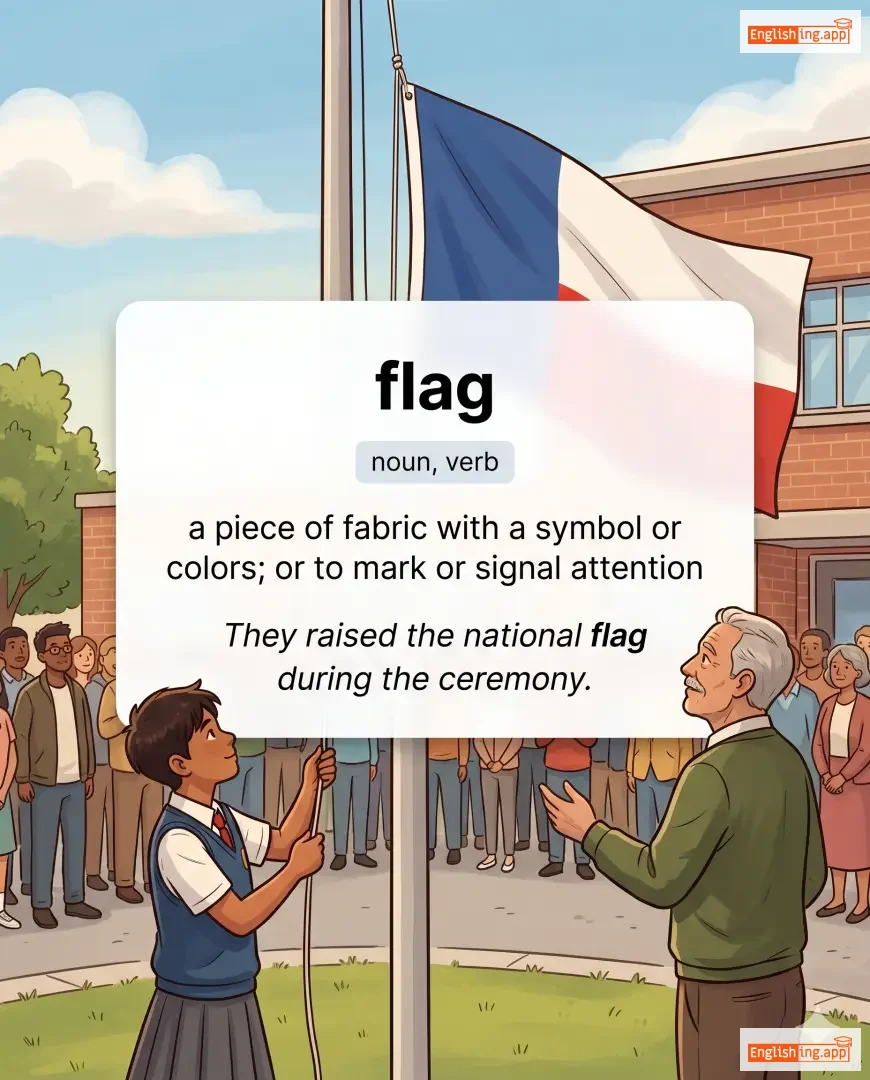
flag definition card — visual illustration of the meaning
🚩

flag

noun, verb
/flæɡ/

a piece of fabric with a symbol or colors; or to mark or signal attention

"They raised the national flag during the ceremony."

noun
/ˈflæɡ ˌɒfɪsər/
旗艦司令官 (kikan shireikan)

a senior naval officer entitled to fly a flag to mark the command

"The flag-officer reviewed the fleet before the ceremony."

"旗艦司令官は儀式の前に艦隊を視察しました。" (Kikan shireikan wa gishiki no mae ni kantai wo shisatsu shimashita.)
verb
/ˈflædʒəˌleɪt/
鞭打つ、または罰として自分を鞭打つ (benda, matawa batsu toshite jibun o benda)

to whip or flog someone, either literally or as a form of punishment or self-discipline

"In history, some monks would flagellate themselves as penance."

"歴史の中で、一部の修道士は悔い改めとして自分をフラジェレイトしていた。" (Rekishi no naka de, ichibu no shūdōshi wa kuika tameshite jibun o furajereito shiteita.)
adjective
/ˈflæɡɪŋ/
疲れる、弱くなる、または熱意を失う (tsukareru, yowakunaru, matawa netsui wo ushinau)

becoming tired, weaker, or less enthusiastic

"After hours of work, his energy was flagging."

"長時間働いた後、彼のエネルギーは衰えていた。" (Choujikan hataraita ato, kare no enerugī wa otoroeteita.)
adjective
/ˈfleɪɡrənt/
目立って明らかに間違っている (medatte akarui chigatte iru)

shockingly noticeable or evident; glaringly wrong

"It was a flagrant violation of the rules."

"それは規則の明らかな違反でした。" (Sore wa kisoku no akirakana ihan deshita.)
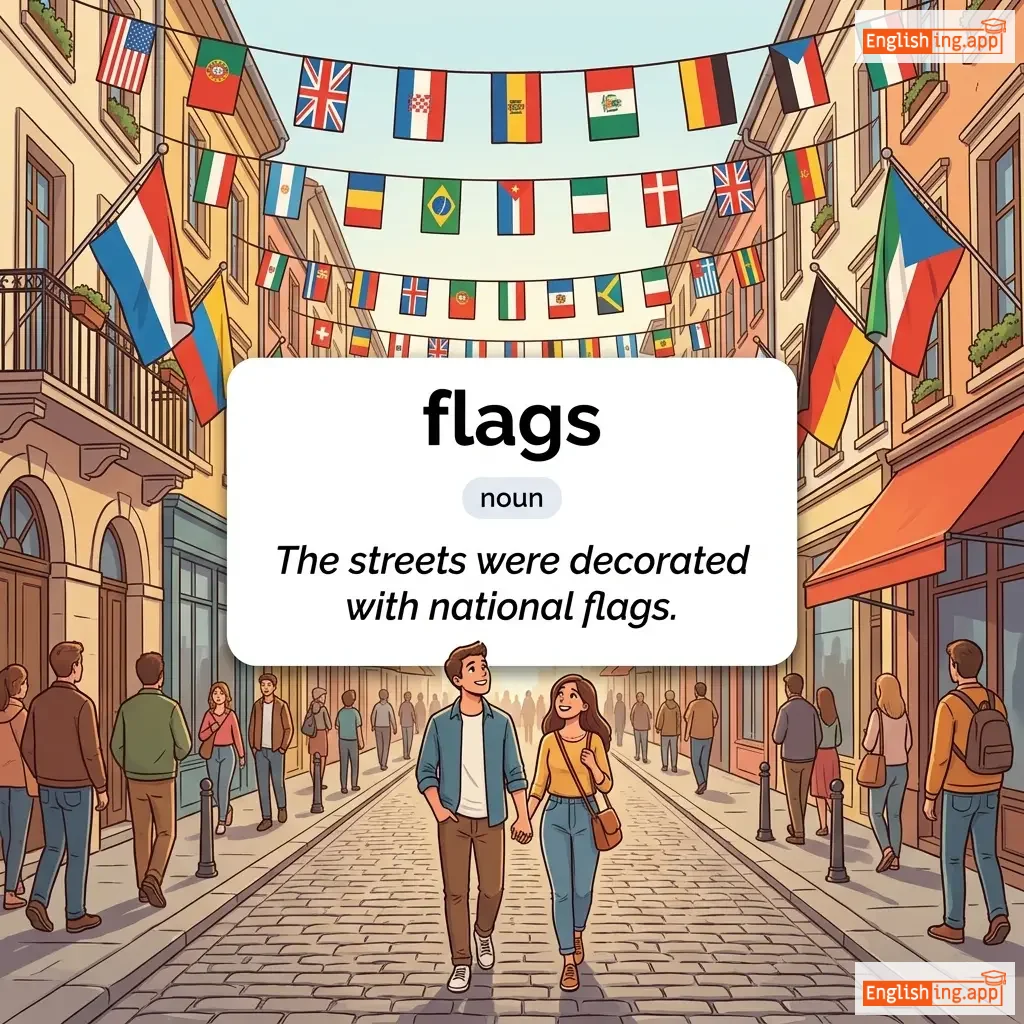
flags definition card — visual illustration of the meaning
noun
flæɡz
(ki)

A piece of cloth or similar material, typically oblong or square, attachable by one edge to a pole or rope.

"The streets were decorated with national flags."

"通りは国旗で飾られていました。" (Tōri wa kokki de kazarete imashita.)
verb
/fleɪl/
何かを激しく振る; 必死に動く (nanika o hageshiku furu; hisshi ni ugoku)

to wave or swing something about wildly; to thrash about

"He flailed his arms to keep afloat in the water."

"彼は水に浮かぶために腕を振った。" (Kare wa mizu ni ukabu tame ni ude o futta.)
flair definition card — visual illustration of the meaning
noun
/flɛr/
自然な才能または能力; 独特な優雅さやスタイル (shizen na sainō mata wa nōryoku; dokutoku na yūgasa ya sutairu)

a natural talent or ability; distinctive elegance or style

"She has a flair for painting that sets her apart."

"彼女は絵画において特別なフレアを持っており、彼女を際立たせています。" (Kanojo wa kaiga ni oite tokubetsuna flair o motte ori, kanojo o kiwadasemasu.)
adjective
/flæmˈbɔɪənt/
派手で色鮮やかな、または自信に満ちた (hade de iro azayakana, matawa jishin ni michita)

showy, strikingly bold or colorful; confident and lively

"His flamboyant style drew everyone's attention at the party."

"彼の派手なスタイルはパーティーで皆の注目を集めました。" (Kare no hade na sutairu wa pātii de mina no chūmoku o atsume mashita.)
noun
/fleɪm/
(honoo)

A hot glowing body of ignited gas that is generated by something on fire.

"The flame from the candle lit up the dark room."

"ろうそくの炎が暗い部屋を照らしました。" (Rōsoku no honō ga kurai heya o terashimashita.)
noun
/ˈflæn.əl/
フランネル (furaneru)

a soft woven fabric, typically made of wool or cotton and slightly milled and raised

"He wore a warm flannel shirt in winter."

"彼は冬に暖かいフランネルシャツを着ていました。" (Kare wa fuyu ni atatakai furaneru shatsu o kite imashita.)
verb
/flæʃ/
フラッシュ (furasshu)

to shine or appear suddenly and brightly for a short time

"Lightning flashed across the night sky."

"雷が夜空を横切った。" (Kaminari ga yozora o yokogitta.)
flashcards definition card — visual illustration of the meaning
noun
ˈflæʃkɑːrdz
フラッシュカード (furasshu kādo)

Cards containing small amounts of information, held up for students to see, as an aid to learning.

"Flashcards help in quick memorization."

"フラッシュカードは迅速な記憶に役立ちます。" (Furasshu kādo wa jinsoku na kioku ni yakudachimasu.)
adjective
/ˈflæʃi/
派手な, 目立つ (hade na, medatsu)

ostentatious or showy in a way that attracts attention

"He drove a flashy sports car through the city streets."

"彼は市街地を派手なスポーツカーで走った。" (Kare wa shigaichi o hade na supōtsu kā de hashitta.)
adjective
/flæt/
平ら (taira)

Smooth and level, without raised areas or curves.

"The road ahead was completely flat."

"前方の道路は完全に平らでした。" (Zenpou no douro wa kanzen ni taira deshita.)
noun
/flæt fɪʃ/
カレイ (karei)

a type of fish with a flattened body that lives on the sea floor

"Flat fish like sole and flounder are excellent for grilling."

"カレイやヒラメのようなフラットフィッシュはグリルに最適です。" (karei ya hirame no yona furatto fisshu wa guriru ni saiteki desu)
verb
/ˈflætər/
過度または不誠実にお世辞を言って、恩恵を得る (kadō matawa fuseijitsu ni oseji o itte, onkei o eru)

to praise excessively or insincerely to gain favor

"He tried to flatter his boss to get a promotion."

"彼は昇進を得るために上司をお世辞で持ち上げようとした。" (Kare wa shōshin o eru tame ni jōshi o oseji de mochiageyō to shita.)
noun
/ˈflæt.ər.ər/
お世辞を言う人 (oseji wo iu hito)

a person who lavishes praise, often insincerely and in order to gain advantage

"The king was surrounded by flatterers who only told him what he wanted to hear."

"王様はお世辞を言う人たちに囲まれて、彼が聞きたいことだけを言ってもらった。" (Ōsama wa oseji wo iu hitotachi ni kakomarete, kare ga kikitai koto dake wo itte moratta.)
noun
/ˈflæt.ər.i/
お世辞 (oseshi)

excessive and insincere praise, given especially to further one's own interests

"His constant flattery made everyone suspicious of his true motives."

"彼の絶え間ないお世辞は、皆が彼の本当の意図を疑わせることになった。" (Kare no taema nai oseshi wa, mina ga kare no hontou no ito wo utagawaseru koto ni natta.)
noun
/ˈflætʃələns/
消化器系のガスの蓄積 (shōkaki-kei no gasu no chikuseki)

the accumulation of gas in the digestive system; excessive gas in the stomach or intestines

"Eating beans can sometimes cause flatulence."

"豆を食べると時々おならが出ることがあります。" (Mame o taberu to tokidoki onara ga deru koto ga arimasu.)
verb
/flɔːnt/
誇示する (kojisuru)

to show off something proudly, often to attract attention

"She likes to flaunt her new jewelry at parties."

"彼女はパーティーで新しいジュエリーを誇示するのが好きです。" (Kanojo wa pātī de atarashī juerī o kojisuru no ga suki desu.)
noun
/ˈfleɪvər/
(aji)

The distinctive taste of a food or drink.

"This ice cream has a delicious mango flavor."

"このアイスクリームはおいしいマンゴーのフレーバーがあります。" (Kono aisukurīmu wa oishī mangō no furebā ga arimasu.)
noun
/ˈfleɪ.vər/
風味 (fūmi)

the distinctive taste of a food or drink; a particular quality or atmosphere

"The soup had a rich flavour of herbs and spices from the garden."

"スープには庭からのハーブとスパイスの豊かな風味がありました。" (Sūpu ni wa niwa kara no hābu to supaisu no yutaka na fūmi ga arimashita.)
noun
/flɔː/
欠陥 (kekkan)

a defect or imperfection in something

"The diamond had a small flaw that was barely visible."

"ダイヤモンドにはほとんど見えない小さな欠陥がありました。" (Daiyamondo ni wa hotondo mienai chīsana kekkan ga arimashita.)
adjective
/flɔːd/
欠陥のある (kenkan no aru)

having a mistake or fault that reduces its value or quality

"The flawed design of the car led to a recall."

"車の欠陥のあるデザインがリコールを引き起こした。" (Kuruma no kenkan no aru dezain ga rikōru o hikiokoshita.)
adjective
/ˈflɔː.ləs/
完璧な; 欠陥なし (flawless)

perfect; without any defects or faults; immaculate

"Her flawless performance earned her a standing ovation."

"彼女の完璧なパフォーマンスは、スタンディングオベーションを得た。" (Kanojo no kanpeki na pafōmansu wa, sutandingu obēshon o eta.)
noun
/flæks/
フラックス (furakkusu)

a plant whose fibers are used to make linen and whose seeds are edible

"Flax is often used in making linen fabrics."

"フラックスは、リネン生地を作るために頻繁に使用されます。" (Furakkusu wa, rinen kiji o tsukuru tame ni hinpan ni shiyou saremasu.)
verb
/fleɪ/
皮を剥ぐ/厳しく批判する (kawa o hagu/kimitsu ni hihan suru)

to strip off the skin of something or criticize severely

"The chef flayed the fish before cooking it."

"シェフは魚を料理する前に皮を剥ぎました。" (Shefu wa sakana o ryōri suru mae ni kawa o hagimashita.)
noun
/flɛk/
小さなシミ (chiisana shimi)

a small spot or mark, often of a different color

"There was a fleck of paint on the floor."

"床にペンキの小さなシミがありました。" (Yuka ni penki no chiisana shimi ga arimashita.)
noun
/ˈflɛkʃən/
屈曲 (kukkyo)

The act of bending or the state of being bent, especially of a limb or joint.

"The doctor tested the patient's knee flection during the examination."
"医者は検査中に患者の膝の屈曲をテストしました。" (Isha wa kensa-chu ni kanja no hiza no kukkyo o tesuto shimashita.)
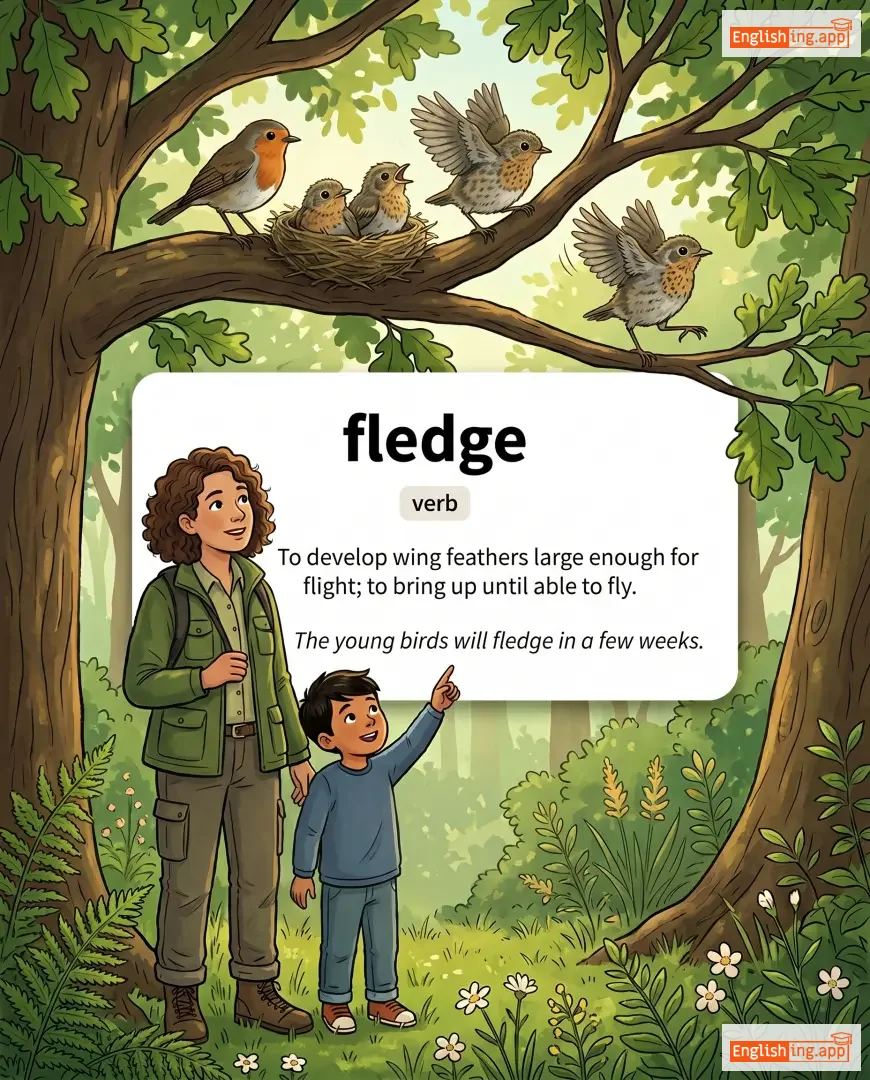
fledge definition card — visual illustration of the meaning
verb
/flɛdʒ/
飛べるようになる (toberu you ni naru)

To develop wing feathers large enough for flight; to bring up until able to fly.

"The young birds will fledge in a few weeks."

"若い鳥たちは数週間以内に飛べるようになる。" (Wakai toritachi wa suushukan inai ni toberu you ni naru.)
noun
/ˈflɛdʒlɪŋ/
若鳥 (wakadori)

A young bird that has just developed its feathers and is learning to fly; a beginner.

"The fledgeling was trying hard to take its first flight."

"若鳥は最初の飛行をしようとしていました。" (Wakadori wa saisho no hikou o shiyou to shiteimashita.)
fledgling definition card — visual illustration of the meaning
noun/adjective
/ˈflɛdʒlɪŋ/
初心者 (shoshinsha)

A young bird just learning to fly; also used for a person or organization that is inexperienced or new.

"The fledgling company is growing rapidly despite challenges."

"新興企業は、課題にもかかわらず急速に成長しています。" (Shinkou kigyou wa, kadai ni mo kakawarazu kyūsoku ni seichō shiteimasu.)
🏃‍♂️

flee (フリー)

verb
/fliː/
逃げる (nigeru)

To run away from danger or a threatening situation.

"The villagers had to flee during the flood."

"村人たちは洪水の間に逃げなければなりませんでした。" (Murabito-tachi wa kōzui no aida ni nige nakereba narimasen deshita.)
noun/verb
/fliːs/

The woolly covering of a sheep; as a verb, to swindle or cheat someone.

"The farmer sheared the sheep’s fleece carefully."

noun
/fliːt/
艦隊 (kantai)

a group of ships, vehicles, or aircraft operating together under one command

"The navy deployed its entire fleet for the exercise."

"海軍は演習のためにその全艦隊を展開した。" (Kaigun wa enshū no tame ni sono zen kantai o tenkai shita.)
fleeting definition card — visual illustration of the meaning
adjective
/ˈfliː.tɪŋ/
一時的 (ichijiteki)

lasting for a very short time

"She had a fleeting smile before she left."

"彼女は去る前に一時的な笑顔を見せた。" (Kanojo wa saru mae ni ichijiteki na egao o miseta.)
noun
/flɛʃ/
(niku)

the soft substance consisting of muscle and fat that is found between the skin and bones of animals or humans

"The wound cut deep into the flesh of his arm."

"傷は彼の腕の肉に深く切り込んでいた。" (Kizu wa kare no ude no niku ni fukaku kirikonde ita.)
flexibility definition card — visual illustration of the meaning
noun
/ˌflɛksəˈbɪləti/
柔軟性 (jūnansē)

the ability to bend easily without breaking or to adapt to new situations

"Flexibility is essential for success in a changing work environment."

"変化する職場環境で成功するためには柔軟性が不可欠です。" (henka suru shokuba kankyō de seikō suru tame ni wa jūnansē ga fukaketsu desu.)
adjective
/ˈfleks.ə.bəl/
柔軟 (jūnan)

able to bend easily without breaking; adaptable to change

"Yoga helps to make the body more flexible."

"ヨガは体をもっと柔軟にするのに役立ちます。" (Yoga wa karada o motto jūnan ni suru no ni yakudachimasu.)
verb
/flɪk/
素早く叩く (subayaku tataku)

to move or cause to move with a sudden quick motion

"He flicked the switch to turn on the light."

"彼はライトをつけるためにスイッチをフリックしました。" (Kare wa raito o tsukeru tame ni suicchi o furi-kku shimashita.)
verb
/ˈflɪk.ər/
ちらつく (chiratsuku)

to shine unsteadily or waver between light and dark

"The candle flickered in the wind."

"ろうそくが風でちらついていた。" (Rousoku ga kaze de chiratsuite ita.)
noun
/flaɪt/
フライト / フライト (furaito / furaito)

the act of flying, typically through the air; or a scheduled trip by an aircraft

"Our flight to London was delayed due to bad weather."

"ロンドン行きのフライトは悪天候のため遅れました。" (Rondon yuki no furaito wa akutenkou no tame okuremashita.)
adjective
/ˈflaɪti/
不安定 (fu antei)

unstable, impulsive, or easily distracted; lacking seriousness or stability

"She’s too flighty to stick with one job for long."

"彼女は一つの仕事に長く留まるには不安定すぎる。" (Kanojo wa hitotsu no shigoto ni nagaku todomaru ni wa fu antei sugiru.)
adjective
/ˈflɪmzi/
弱々しい (yowayowashii)

weak, fragile, or lacking in strength; not convincing

"The chair was too flimsy to support his weight."

"その椅子は重さを支えられないほど弱々しかった。" (sono isu wa omosa wo sasaerarenai hodo yowayowashikatta.)
verb
/flɪntʃ/
ひるむ (hirumu)

to suddenly move back or away due to fear or pain

"He didn’t flinch when the doctor gave him the injection."

"彼は医者が注射をする時、ひるむことはなかった。" (Kare wa isha ga chūsha o suru toki, hirumu koto wa nakatta.)
verb
/flɪp/
ひっくり返す (hikkurikaesu)

to turn over quickly or suddenly; to toss lightly

"She flipped the pancake in the pan."

"彼女はパンケーキをフライパンでひっくり返した。" (Kanojo wa pancake o furaipan de hikkurikaeshita.)
noun
/ˈflɪpənsi/
軽薄 (keihaku)

lack of seriousness; showing a disrespectful or trivial attitude

"His flippancy during the meeting offended his colleagues."

"会議中の彼の軽薄さは、同僚を不快にさせた。" (Kaigi-chū no kare no keihaku-sa wa, dōryō o fukai ni saseta.)
adjective
/ˈflɪpənt/
軽薄な (keihaku na)

not showing a serious or respectful attitude

"His flippant remarks annoyed the teacher."

"彼の軽薄な発言は教師をイライラさせた。" (Kare no keihaku na hatsugen wa kyoushi o iraira saseta.)
😉

flirt

verb
/flɜːrt/

to behave as if you are attracted to someone, but not in a serious way

"She often flirts with her colleagues at work."