語彙集

英単語辞書 | 単語の意味、定義、例文

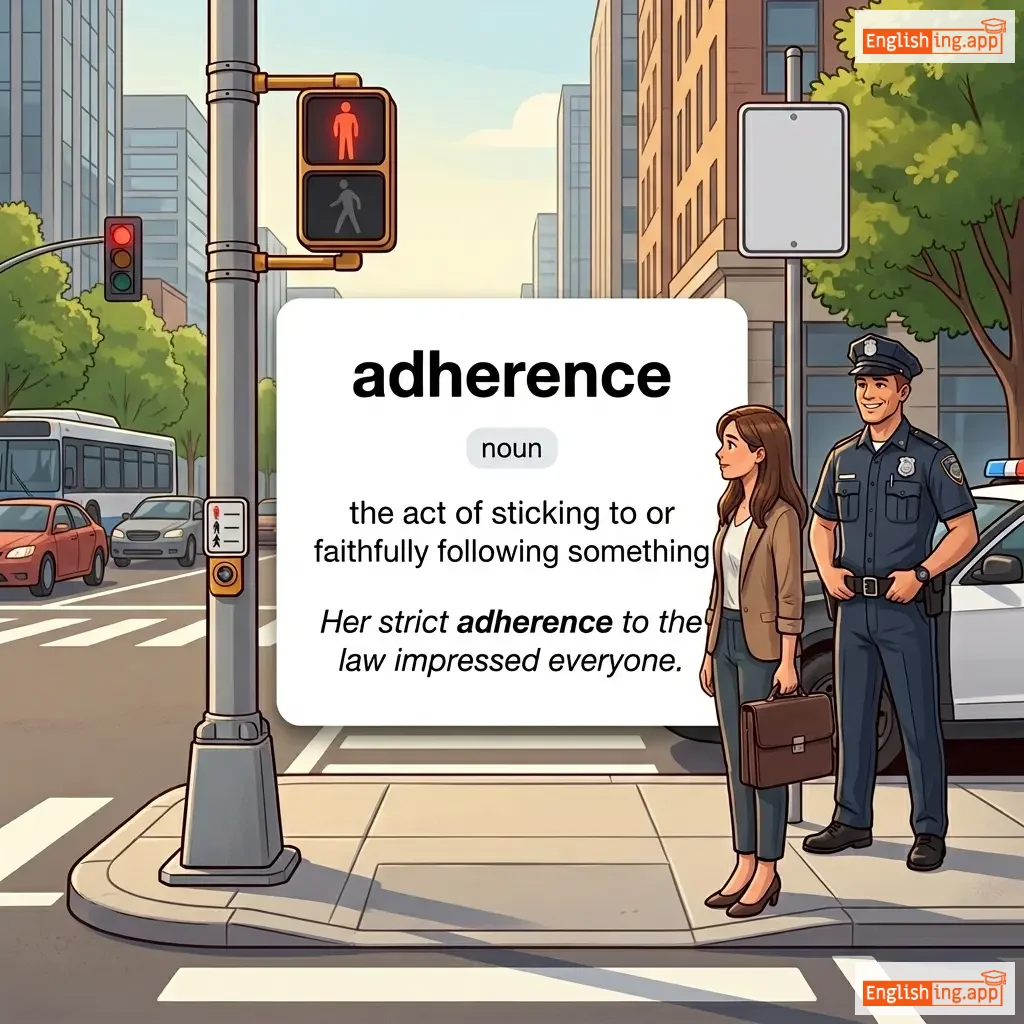
adherence definition card — visual illustration of the meaning
noun
/ədˈhɪərəns/
遵守 (junshu)

the act of sticking to or faithfully following something

"Her strict adherence to the law impressed everyone."

"彼女の法への厳格な遵守は、みんなに感銘を与えました。" (Kanojo no hō e no gengaku na junshu wa, minna ni kanmei o ataemashita.)
noun
/ədˈhɪərənt/
支持者 (shijisha)

a person who supports or follows a particular belief, cause, or leader

"He is a strong adherent of democratic values."

"彼は民主的な価値観の強力な支持者です。" (Kare wa minshuteki na kachikan no kyōryokuna shijisha desu.)
noun
/ədˈhiːʒən/
付着 (fuchaku)

the process or state of sticking to something

"Strong adhesion is needed for the tiles to stay in place."

"タイルがその位置に留まるためには強い付着が必要です。" (Tairu ga sono ichi ni todomaru tame ni wa tsuyoi fuchaku ga hitsuyō desu.)
adjective
/ədˈhiːsɪv/
粘着性 (nenchakusei)

আঠালো; চটচটে;

"The adhesive tape stuck firmly to the wall."

"接着テープは壁にしっかりとくっつきました。" (Setsuzaku tēpu wa kabe ni shikkari to kuttsukimashita.)
👋

adieu

noun
/əˈdjuː/

A farewell or goodbye, often used in a formal or poetic sense.

"She bid her friends adieu before leaving for France."

adjective
/ˈædɪˌpoʊs/
脂肪の (shibō no)

Relating to or consisting of animal fat; fatty.

"The doctor explained that the tissue was mainly adipose in nature."

"医者は、組織が主に脂肪性であることを説明しました。" (Isha wa, soshiki ga shūni shibō-sei de aru koto o setsumei shimashita.)
noun
/əˈdʒeɪsənsi/
隣接性 (rinnsetusei)

The state of being next to or adjoining something else.

"The adjacency of the two buildings made it easy to connect them."

"二つの建物の隣接性は、それらを接続するのを簡単にしました。" (Futatsu no tatemono no rinsetsusei wa, sorera o setsuzoku suru no o kantan ni shimashita.)
adjective
/əˈdʒeɪsənt/
隣接 (rinsetsu)

Next to or adjoining something else.

"The hotel is adjacent to the beach."

"ホテルはビーチに隣接しています。" (Hoteru wa bīchi ni rinsetsu shite imasu.)
noun
/ˈædʒɪktɪv/
形容詞 (keiyoushi)

a word that describes or modifies a noun by giving more information about its quality, quantity, or state

"The adjective in the sentence adds more detail to the noun."

"形容詞は名詞に詳しい情報を加えます。" (keiyoushi wa meishi ni kuwashii jouhou o kuwaemasu)
verb
/əˈdʒɔɪn/
隣接する (rinsetsu suru)

To be next to and joined with something.

"Their house adjoins the park."

"彼らの家は公園に隣接しています。" (Karera no ie wa kōen ni rinsetsu shiteimasu.)
verb
/əˈdʒɜrn/
延期する (enki suru)

to suspend a meeting or session to another time or place

"The judge decided to adjourn the hearing until next week."

"裁判官は次の週まで聴聞を延期することに決めました。" (Saibankan wa tsugi no shū made chōmon o enki suru koto ni kimemashita.)
verb
/əˈdʒʌdʒ/
判決する (hanketsu suru)

to consider or declare officially in a legal or formal manner

"He was adjudged guilty by the court."

"彼は裁判所によって有罪とされました。" (Kare wa saibansho ni yotte yuu-zai to saremashita.)
verb
/əˈdʒuːdɪˌkeɪt/
裁定する (saitei suru)

to make a formal judgment or decision about a problem or dispute

"The committee was formed to adjudicate disputes between the parties."

"委員会は当事者間の争いを審理するために結成されました。" (Iinkai wa tōjisha-kan no arasoi o shinri suru tame ni kessei saremashita.)
adjudicative body definition card — visual illustration of the meaning
noun
əˈdʒuː.dɪ.kə.tɪv ˈbɒd.i
裁定機関 (saitei kikan)

An official organization that has the authority to judge disputes and make decisions.

"The adjudicative body deliberated on the case."

"裁定機関はケースについて審議した。" (Saitei kikan wa kēsu ni tsuite shingi shita.)
adjunct definition card — visual illustration of the meaning
noun
/ˈædʒʌŋkt/
補助的 (hojoteki)

a thing added to something else as a supplementary part

"The professor worked as an adjunct at the university."

"教授は大学で補助的な役職で働いていました。" (Kyoju wa daigaku de hojoteki na yakushoku de hataraite imashita.)
noun
/ˌædʒʊˈreɪʃən/
厳粛なお願い (genshuku na onegai)

a solemn urging or appeal

"The priest made an adjuration for peace and unity."

"神父は平和と団結のために厳粛なお願いをしました。" (Shinpu wa heiwa to danketsu no tame ni genshuku na onegai o shimashita.)
verb
/əˈdʒʊər/
誓約させる (seiyaku saseru)

to urge or command someone solemnly, often under oath or a strong sense of duty

"The witness was adjured to tell the truth in court."

"証人は法廷で真実を話すように命じられた。" (Shōnin wa hōtei de shinjitsu o hanasu yō ni meijirareta.)
verb
/əˈdʒʌst/
調整する (chousei suru)

to change something slightly to make it more suitable or effective

"She adjusted the mirror to see the road clearly."

"彼女は鏡を調整して道路をはっきり見えました。" (Kanojo wa kagami wo chousei shite, douro wo hakkiri miemashita.)
adjective
/əˈdʒʌstəbəl/
調整可能な; 可変の; 調節できる; (chōseikanō na; kahen no; chōsetsu dekiru;)

নিয়মযোগ্য; পরিবর্তন-সাধ্য; সমন্বয়যোগ্য;

"This chair has an adjustable height feature."

"この椅子は高さが調節可能です。" (Kono isu wa takasa ga chōsetsu kanō desu.)
noun
/əˈdʒʌstmənt/

a small change made to improve something or make it work better

"The doctor made an adjustment to the patient’s medication."

noun
/ˈædʒʊtənt/
上級士官の行政アシスタントを務める軍人 (joukyuu shikan no gyousei ashisutanto wo tsutomeru gunjin)

a military officer who acts as an administrative assistant to a senior officer

"The colonel relied on his adjutant to manage daily orders."
"大佐は毎日の命令を管理するためにアジュタントに依存していた。" (Taisa wa mainichi no meirei wo kanri suru tame ni adjutanto ni izon shite ita.)
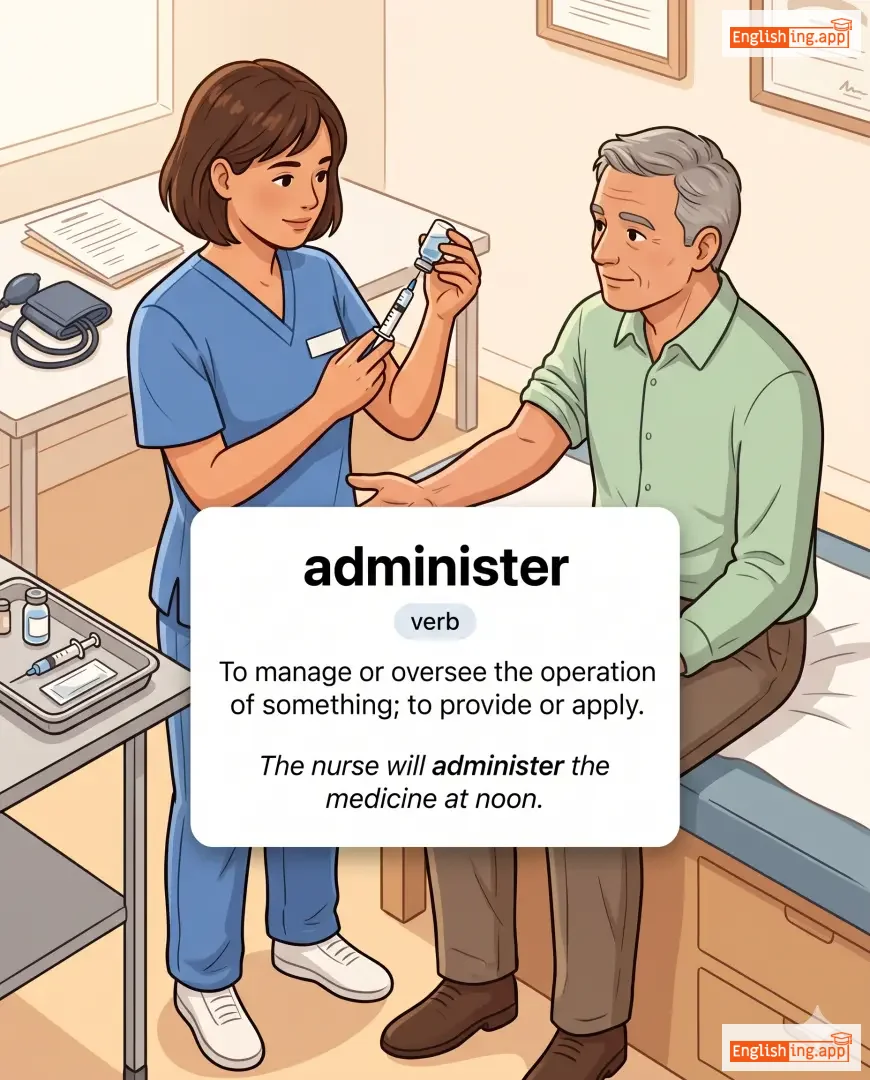
administer definition card — visual illustration of the meaning
verb
/ədˈmɪnɪstər/
管理する / 適用する (kanri suru / tekiyou suru)

To manage or oversee the operation of something; to provide or apply.

"The nurse will administer the medicine at noon."

"ナースは正午に薬を施す予定です。" (Nasu wa shougo ni kusuri wo hodokosu yotei desu.)
verb
/ədˈmɪnɪstreɪt/
管理する (kanri suru)

to manage or supervise the execution of duties, laws, or resources; to formally give or apply something such as a test or medicine

"The committee will administrate the new policy across all departments."

"委員会はすべての部門で新しい方針を管理する。" (iinkai wa subete no bumon de atarashii hoshin o kanri suru)
noun
/ədˌmɪnɪˈstreɪʃən/
行政 (gyousei)

The management or organization of a business, institution, or government.

"The new administration introduced several reforms."

"新しい行政は幾つかの改革を導入しました。" (atarashii gyousei wa ikutsuka no kaikaku o dounyuu shimashita.)
administrative definition card — visual illustration of the meaning
adjective
/ədˈmɪnɪstrətɪv/
行政的な (gyouseiteki na)

relating to the management or organization of something

"The administrative tasks were handled efficiently by the team."

"行政的なタスクはチームによって効率的に処理されました。" (Gyouseiteki na tasuku wa chiimu ni yotte kouritsuteki ni shori saremashita.)
🧑‍💼

administrator

noun
/ədˈmɪnɪstreɪtər/

a person responsible for running or managing an organization or system

"The school administrator implemented new policies for students."

adjective
/ˈædmərəbəl/
賞賛に値する (shousan ni ataisuru)

প্রশংসনীয়; চমৎকার;

"Her dedication to helping others is truly admirable."

"彼女の他人を助ける献身は本当に賞賛に値します。" (Kanojo no tanin o tasukeru kenshin wa hontou ni shousan ni atai shimasu.)
noun
/ˌædməˈreɪʃən/
尊敬 (sonkei)

a feeling of respect, pleasure, or approval for someone or something

"She felt great admiration for her teacher’s dedication."

"彼女は先生の献身に尊敬を感じた。" (kanojo wa sensei no kenshin ni sonkei o kanjita)
verb
/ədˈmaɪər/
賞賛する (shōsan suru)

To respect, appreciate, or look up to someone or something.

"I really admire her dedication to education."

"私は本当に彼女の教育への献身を賞賛します。" (Watashi wa hontōni kanojo no kyōiku e no kenshin o shōsan shimasu.)
adjective
/ədˈmɪsəbl/

acceptable or valid, especially as evidence in a court of law

"The judge ruled that the document was admissible as evidence."

noun
/ədˈmɪʃən/
入場 (nyūjō)

The process or fact of being allowed to enter a place or join an organization.

"The admission fee to the museum is five dollars."

"博物館の入場料は5ドルです。" (Hakubutsukan no nyūjō-ryō wa 5 doru desu.)
admit definition card — visual illustration of the meaning
verb
/ədˈmɪt/
認める (mitomeru)

To confess or acknowledge something as true; to allow entry.

"He admitted that he had made a mistake."

"彼は間違いを犯したことを認めた。" (Kare wa machigai o okashita koto o mitometa.)
noun
/ədˈmɪtəns/
入場 (nyūjō)

the process or fact of entering or being allowed to enter a place

"No admittance without a valid ticket."

"有効なチケットなしでは入場できません。" (Yūkōna chiketto nashide wa nyūjō dekimasen.)
admonish definition card — visual illustration of the meaning
verb
/ədˈmɒnɪʃ/
注意する / 叱る (chūi suru / shikaru)

to warn or reprimand someone firmly; to advise or urge earnestly

"The teacher admonished the students for being late."

"先生は遅刻した生徒を注意しました。" (Sensei wa chikoku shita seito o chūi shimashita.)
noun
/ˌædməˈnɪʃən/
警告 (keikoku)

a firm warning or reprimand; gentle or earnest advice

"He received an admonition for his careless work."

"彼は不注意な仕事のために警告を受けました。" (Kare wa fuchuui na shigoto no tame ni keikoku o ukemashita.)
adjective
/ədˈmɒnɪtəri/
警告の (keikoku no)

giving or conveying a warning or reprimand

"She gave him an admonitory glance."

"彼女は彼に警告のまなざしを向けました。" (Kanojo wa kare ni keikoku no manazashi o mukemashita.)
noun
/əˈduː/
騒ぎ / 不必要な活動 (sawagi / fuhitsuyou na katsudou)

a fuss or unnecessary activity; trouble or difficulty

"Without further ado, let’s begin the ceremony."

"これ以上のアドなしで、式を始めましょう。" (Kore ijou no ado nashi de, shiki o hajimemashou.)
noun/adjective
/ˌædəˈlɛsənt/
思春期の人 (shishunki no hito)

A young person in the process of developing from a child into an adult.

"Adolescents often experience rapid physical and emotional changes."

"思春期の人々はしばしば急速な身体的および感情的な変化を経験します。" (shishunki no hitobito wa shibashiba kyūsokuna shintai-teki oyobi kanjō-teki na henka o keiken shimasu.)
👨‍👩‍👧

adopt (アダプト)

verb
/əˈdɒpt/
養子を迎える (youshi wo mukaeru)

To take something as your own, such as a child, idea, or method.

"They decided to adopt a child from the orphanage."
"彼らは孤児院から子供を養子にすることに決めました。" (Karera wa kodomogoya kara kodomo wo youshi ni suru koto ni kimemashita.)
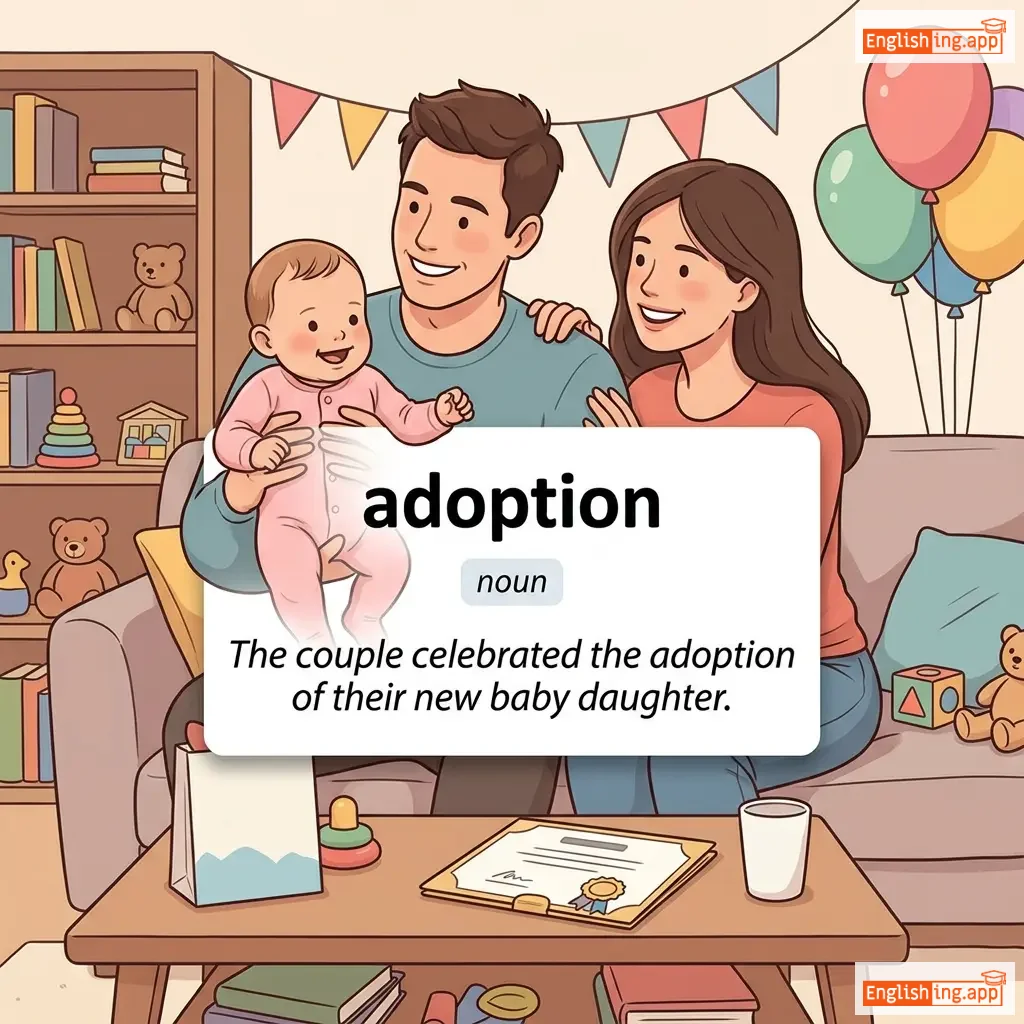
adoption definition card — visual illustration of the meaning
noun
/əˈdɒpʃən/
養子縁組 (youshi engumi)

the action or fact of adopting something

"The adoption of new technology has improved our efficiency."

"新しい技術の採用により、私たちの効率は向上しました。" (Atarashii gijutsu no saiyou ni yori, watashitachi no kouritsu wa koujou shimashita.)
adjective
/əˈdɒptɪv/
養子の (youshi no)

relating to the adoption of a child or the act of taking something as one’s own

"She grew up in a loving adoptive family."

"彼女は愛情深い養子の家族で育った。" (kanojo wa aijou bukai youshi no kazoku de sodatta)
noun
/ˌædəˈreɪʃən/
崇拝 / 深い愛 (sūhai / fukai ai)

deep love and respect; worship

"The fans showed their adoration for the singer."

"ファンは歌手に対して自分の愛情を示した。" (Fan wa kashu ni taishite jibun no aijō o shimeshita.)
verb
/əˈdɔːr/
崇拝する (sūhai suru)

to love deeply and respect highly

"She adores her little sister."

"彼女は小さな妹をとても愛しています。" (Kanojo wa chiisana imōto o totemo aishiteimasu.)
verb
/əˈdɔːrn/
飾る (kazaru)

to decorate or add beauty to something

"The hall was adorned with flowers for the wedding."

"結婚式のためにホールは花で飾られました。" (Kekkonshiki no tame ni ho-ru wa hana de kazaremashita.)
adroit definition card — visual illustration of the meaning
adjective
/əˈdrɔɪt/
巧妙 (kōmyō)

clever or skillful in using the hands or mind

"He is adroit at solving complex problems."
"彼は複雑な問題を解決するのが得意です。" (Kare wa fukuzatsu na mondai o kaiketsu suru no ga tokui desu.)
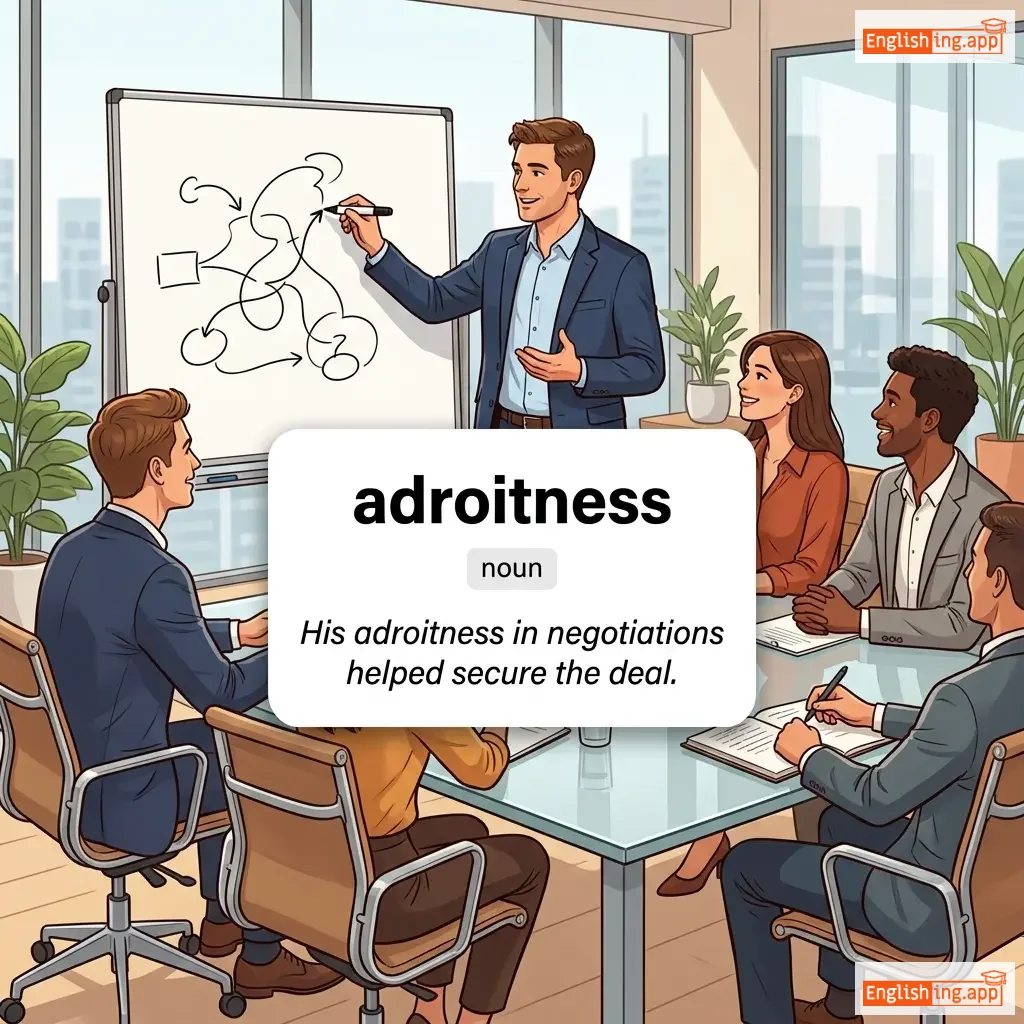
adroitness definition card — visual illustration of the meaning
noun
/əˈdrɔɪt.nəs/
巧妙さ (kōmyōsa)

Cleverness or skill in using the hands or mind; expertness in performance or execution.

"His adroitness in negotiations helped secure the deal."

"彼の交渉での巧妙さが契約を確保するのに役立った。" (Kare no kōshō de no kōmyōsa ga keiyaku o kakuho suru no ni yakudatta.)
noun (plural)
/ædz/
広告 (koukoku)

short for advertisements; promotional messages intended to sell products or services

"I often skip ads when watching videos online."

"私はオンライン動画を見るとき、よく広告をスキップします。" (watashi wa onrain douga o miru toki yoku koukoku o sukippu shimasu)
verb
/ˈædjʊˌleɪt/
過剰に賛美する (kajou ni sanbi suru)

to praise or flatter excessively

"The fans adulated the actor after his performance."

"ファンたちは彼のパフォーマンスの後、俳優を賛美しました。" (Fanta wa kare no pafomansu no ato, haiyuu o sanbi shimashita.)
noun
/ˌædjʊˈleɪʃən/
過度な賞賛 (kadona shōsan)

excessive admiration or flattery

"The singer enjoyed the adulation of her fans."

"歌手はファンたちの過度な賞賛を楽しんでいました。" (Kashu wa fantachi no kadona shōsan o tanoshinde imashita.)
noun
/ˈædʌlt/ or /əˈdʌlt/
大人 (otonna)

A fully grown or developed person; mature.

"Children must be accompanied by an adult."

"子供は大人と一緒にいる必要があります。" (Kodomo wa otona to issho ni iru hitsuyō ga arimasu.)