वोकैबुलरीज

इंग्लिश वोकैबुलरी डिस्कवर, लर्न और मास्टर करें

ascend definition card — visual illustration of the meaning
verb
/əˈsɛnd/
ऊपर चढ़ना (upar chadhna)

to move upward or rise to a higher position or level

"The hikers began to ascend the steep mountain trail."

"पर्वतारोही खड़ी पहाड़ी रास्ते पर चढ़ने लगे।" (Parvatarohi khadi pahadi raste par chadhne lage.)
noun
/əˈsɛndənsi/
प्रभुत्व, आधिपत्य (prabhutva, aadhipatya)

A position of power, influence, or control over others.

"The company gained ascendancy in the market through innovation."

"कंपनी ने नवाचार के माध्यम से बाजार में प्रभुत्व हासिल किया।" (company ne navaachar ke madhyam se bazaar mein prabhutva haasil kiya.)
adjective
/əˈsɛndənt/
उत्थानशील, प्रभावशाली (utthan-sheel, prabhavshali)

Rising in power or influence; dominant.

"She is an ascendant leader in the political party."

"वह राजनीतिक पार्टी में एक उभरता हुआ नेता है।" (vah rajneetik party mein ek ubharta hua neta hai.)
noun
/əˈsɛnʃən/
आरोहण (aorohan)

The act of rising or going up, often to an important position or a higher place.

"His rapid ascension in the company surprised everyone."

"कंपनी में उसकी तेज़ आरोहण ने सभी को चौंका दिया।" (company mein uski tez aorohan ne sabhi ko chonka diya.)
noun
/əˈsɛnt/
आरोहण, उत्थान (aarohan, utthan)

The act of rising or climbing to a higher position or level.

"The climbers began their ascent to the mountain peak at dawn."

"पहाड़ी यात्री सूर्योदय पर पर्वत की चोटी की ओर अपने आरोहण की शुरुआत करने लगे।" (Pahaadi yatrai suryoday par parvat ki chhoti ki or apne aarohan ki shuruaat karne lage.)
ascertain definition card — visual illustration of the meaning
verb
/ˌæs.ərˈteɪn/
निश्चित करना, निर्धारित करना (nishchit karna, nirdharit karna)

To find out or make sure of something with certainty.

"The detective tried to ascertain the facts of the case."

"जासूस ने मामले के तथ्यों को निर्धारित करने की कोशिश की।" (Jasoos ne mamle ke tathyon ko nirdharit karne ki koshish ki.)
ascetic definition card — visual illustration of the meaning
adjective
/əˈsɛt.ɪk/
संयमी, तपस्वी (sanyami, tapasvi)

Practicing strict self-denial and abstaining from worldly pleasures, often for religious reasons.

"He lived an ascetic life in the mountains, far from worldly comforts."

"वह पहाड़ों में एक संयमी जीवन जी रहा था, जो भौतिक सुखों से दूर था।" (Vah pahadon mein ek sanyami jeevan jee raha tha, jo bhautik sukhon se door tha.)
noun
/əˈsɛt.ɪˌsɪz.əm/
तपस्विता, संयम (tapaswita, sanyam)

The practice of severe self-discipline and abstaining from indulgence, typically for religious or spiritual reasons.

"Asceticism has been a part of many religious traditions throughout history."

"तपस्विता कई धार्मिक परंपराओं का हिस्सा रही है।" (Tapaswita kai dharmik paramparaon ka hissa rahi hai.)
verb
/əˈskraɪb/
आरोपित करना, किसी कारण, स्रोत या व्यक्ति से जोड़ना (aropit karna, kisi karan, srot ya vyakti se jodna)

To attribute something to a cause, source, or person.

"Many scholars ascribe the poem to an unknown author."

"कई विद्वान कविता को एक अज्ञात लेखक के साथ जोड़ते हैं।" (Kai vidwan kavita ko ek ajnat lekhak ke saath jodte hain.)
adjective
/eɪˈsɛptɪk/
बैक्टीरिया रहित (baiktiria rahit)

Free from contamination caused by harmful microorganisms; sterile.

"Surgeons must work in an aseptic environment to prevent infection."

"सर्जनों को संक्रमण को रोकने के लिए एक ऐसेप्टिक वातावरण में काम करना चाहिए।" (Sarjano ko sankraman ko rokne ke liye ek aseptic vatavaran mein kaam karna chahiye.)
adjective
/ˌeɪˈsɛkʃuəl/
यौनविहीन (yaunvihin)

Without sexual feelings, associations, or reproduction through sex.

"Many plants reproduce through asexual methods like budding or splitting."

"कई पौधे यौनविहीन तरीकों से जैसे कल्ले या विभाजन द्वारा प्रजनन करते हैं।" (Kai paudhe yaunvihin tareekon se jaise kalle ya vibhajan dwara prajanan karte hain.)
noun
/æʃ/
राख (raakh)

the powdery residue left after the burning of a substance

"After the fire, only ash remained of the house."

"आग के बाद, घर का सिर्फ राख बचा था।" (Aag ke baad, ghar ka sirf raakh bacha tha.)
adjective
/æʃ ˈkʌl.ər/
भूरा रंग (bhura rang)

a grayish color resembling ash

"The old building had ash-colour walls that needed painting."

"पुरानी इमारत में राख जैसा रंग था जिसे फिर से पेंट करने की जरूरत थी।" (purani imarat mein rakh jaisa rang tha jise phir se paint karne ki zarurat thi)
noun
/ˈæʃ.treɪ/
ऐश ट्रे (aish tre)

a receptacle for tobacco ash and cigarette butts

"Please use the ash tray for your cigarette."

"कृपया अपने सिगरेट के लिए ऐश ट्रे का उपयोग करें।" (kripya apne sigaret ke liye aish tre ka upyog karein.)
adjective
/əˈʃeɪmd/
लज्जित (ashamed)

feeling embarrassed or guilty because of one's actions

"He was ashamed of his poor performance."

"वह अपनी खराब प्रदर्शन पर लज्जित था।" (vah apni kharab pradarshan par lajjit tha.)
adjective
/ˈæʃən/
मुरझाया हुआ (murjhaaya hua)

Very pale in appearance, often due to shock, fear, or illness.

"His face turned ashen when he heard the terrible news."

"जब उसने भयानक खबर सुनी, तो उसका चेहरा मुरझाया हुआ हो गया।" (Jab usne bhayank khabar suni, to uska chehra murjhaaya hua ho gaya.)
adjective, noun
/ˈeɪʒən/
एशियाई (ashiyai)

relating to Asia or its people

"She loves Asian culture."

"वह एशियाई संस्कृति को पसंद करती है।" (Wah ashiyai sanskriti ko pasand karti hai.)
noun
/ˈeɪʒən siː bæs/
बेटकी मछली (betki machhli)

a large predatory fish found in coastal waters and estuaries of the Indo-Pacific region, prized for its white meat

"Asian sea bass is highly valued in aquaculture for its fast growth."

"बेटकी मछली को इसकी तेज़ वृद्धि के लिए मत्स्य पालन में बहुत मूल्यवान माना जाता है।" (betki machhli ko iski tez vriddhi ke liye matsya palan mein bahut mulyavan mana jata hai)
noun
/ˈeɪʒən swɒmp iːl/
कूचिया मछली (kuchiya machhli)

a snake-like freshwater fish that can survive in muddy waters and is considered a delicacy in South Asian cuisine

"Asian swamp eel can breathe air and survive in shallow muddy waters."

"कूचिया मछली हवा में सांस ले सकती है और उथले कीचड़ वाले पानी में जीवित रह सकती है।" (kuchiya machhli hawa mein saans le sakti hai aur uthale keechad wale paani mein jeevit rah sakti hai)
adverb, noun
/əˈsaɪd/
एक तरफ (ek taraf)

to or on one side; a remark not intended for everyone

"He stepped aside to let her pass."

"वह उसे जाने देने के लिए एक तरफ हो गया।" (Wah use jane dene ke liye ek taraf ho gaya.)
adjective
/ˈæsɪnaɪn/
मूर्खतापूर्ण (moorkhatapurn)

Extremely foolish or stupid.

"It was an asinine idea to drive into the storm without checking the weather."

"मौसम की जांच किए बिना तूफान में गाड़ी चलाना एक मूर्खतापूर्ण विचार था।" (Mausam ki jaanch kiye bina toofan mein gaadi chalana ek moorkhatapurn vichar tha.)
verb
/æsk/
पूछना (poochna)

to request information or seek an answer

"She asked him about his new job."

"उसने उससे उसके नए काम के बारे में पूछा।" (Usne usse uske naye kaam ke baare mein poocha.)
adverb
/əˈskæns/
संदेहपूर्ण (sandehpurn)

With suspicion, mistrust, or disapproval.

"She looked askance at his unusual proposal."

"उसने उसके असामान्य प्रस्ताव को संदेहपूर्ण तरीके से देखा।" (Usne uske asamanya prastav ko sandehpurn tareeke se dekha.)
adjective
/əˈskjuː/
टेढ़ा (tedha)

Not in a straight or level position; crooked or tilted.

"The picture on the wall hung slightly askew."

"दीवार पर तस्वीर थोड़ी सी टेढ़ी लटकी थी।" (Deewaar par tasveer thodi si tedhi latki thi.)
adjective
/əˈsliːp/
सो रहे (so rahe)

in a state of sleep

"The baby is fast asleep."

"बेबी गहरी नींद में है।" (Baby gehri neend mein hai.)
noun
/əˈspær.ə.ɡəs biːn/
स्पैरेगस बीन्स (asparagus beans)

a long, thin green vegetable pod that grows on vines; also known as yard-long bean

"The asparagus bean grows up to three feet long and is commonly used in Asian cooking."

"स्पैरेगस बीन तीन फीट तक लंबा हो सकता है और एशियाई भोजन में सामान्यत: उपयोग किया जाता है।" (asparagus bean teen feet tak lamba ho sakta hai aur asian bhojan mein samanyat: upyog kiya jata hai.)
noun
/ˈæs.pekt/
पहलू (pahalu)

A particular part, feature, or view of something.

"One important aspect of health is regular exercise."

"स्वास्थ्य का एक महत्वपूर्ण पहलू नियमित व्यायाम है।" (Swasthya ka ek mahatvapurn pahalu niyamit vyaayam hai.)
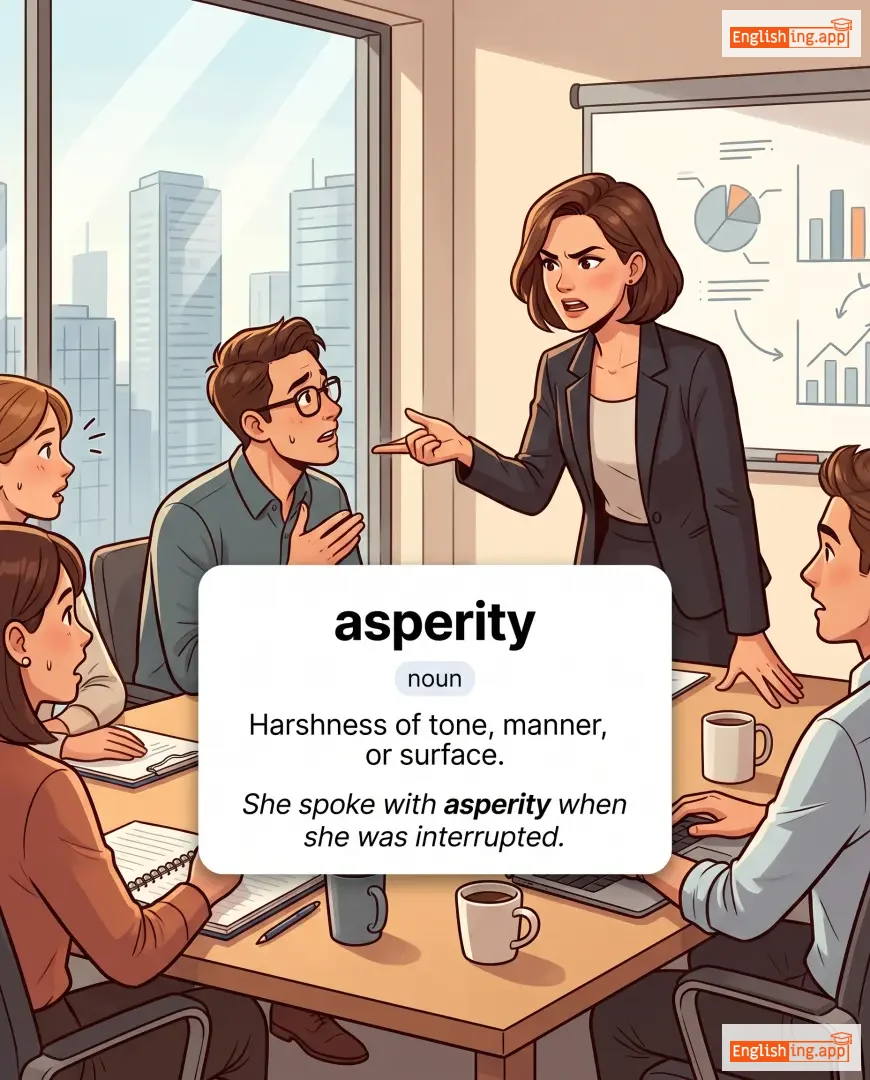
asperity definition card — visual illustration of the meaning
noun
/əˈsper.ɪ.ti/
कड़ापन (esperiti)

Harshness of tone, manner, or surface.

"She spoke with asperity when she was interrupted."

"जब उसे व्यवधान दिया गया, तो उसने कठोर लहजे में बात की।" (jab use vyavadhan diya gaya, to usne kathor lahaje mein baat ki.)
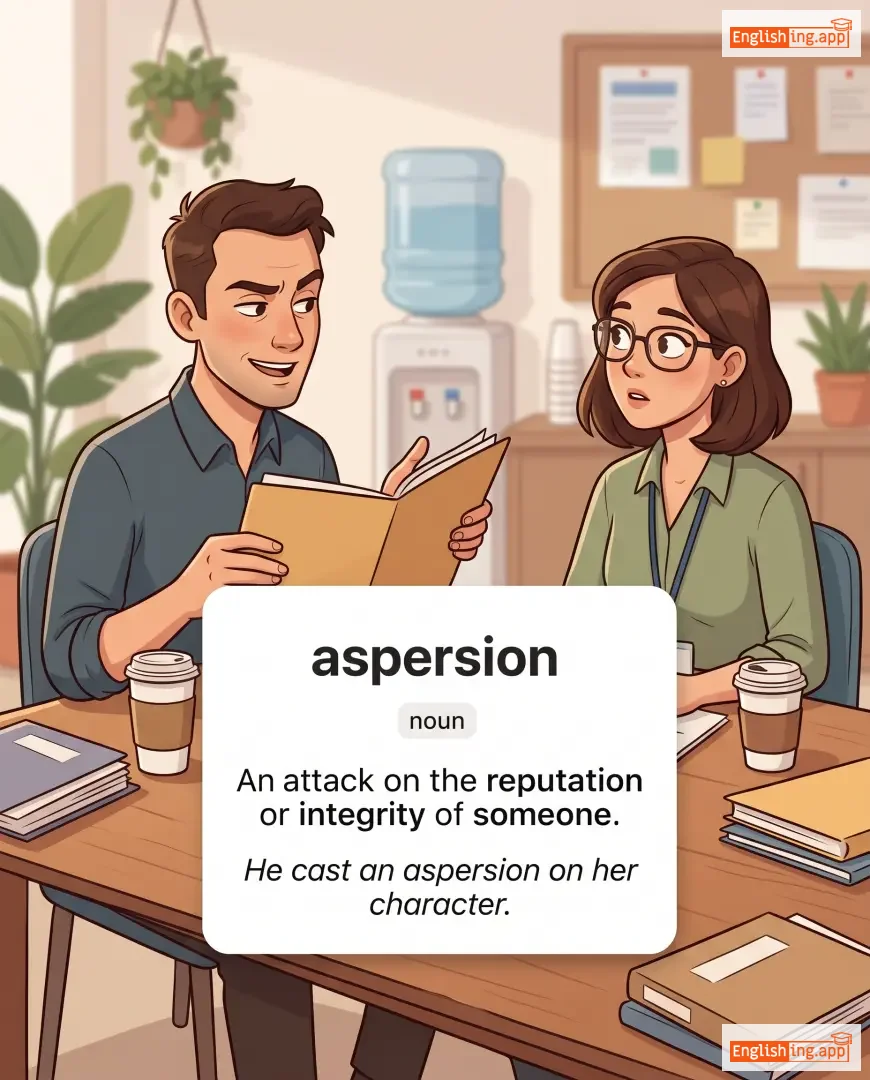
aspersion definition card — visual illustration of the meaning
noun
/əˈspɜːr.ʒən/
कलंक (kalank)

An attack on the reputation or integrity of someone.

"He cast an aspersion on her character."

"उसने उसके चरित्र पर एक कलंक डाला।" (Usne uske charitra par ek kalank dala.)
noun (plural)
/əˈspɜːr.ʒənz/
आक्षेप (aakship)

Critical or slanderous remarks; multiple attacks on reputation.

"The politician rejected the aspersions cast against him."

"राजनीतिक नेता ने उनके खिलाफ लगाए गए आक्षेपों को खारिज कर दिया।" (Rajnitik neta ne unke khilaf lagaye gaye aakshipon ko kharij kar diya.)
noun
/ˈæspɪrənt/
आकांक्षी (aakankshi)

a person who seeks or hopes to achieve a position of honor or advancement

"She is an aspirant for the university's top scholarship."

"वह विश्वविद्यालय की शीर्ष छात्रवृत्ति के लिए आकांक्षी है।" (vah vishwavidyalay ki sheersh chhatravritti ke liye aakankshi hai)
aspiration definition card — visual illustration of the meaning
noun
/ˌæspəˈreɪʃən/
आकांक्षा (aakanksha)

a strong desire to achieve something; ambition

"Her aspiration is to become a doctor."

"उसकी आकांक्षा डॉक्टर बनने की है।" (Uski aakanksha doctor banne ki hai.)
verb
/əˈspaɪər/
आकांक्षी होना (aakankshi hona)

to have a strong desire to achieve something

"Many students aspire to study abroad."

"कई छात्र विदेश में अध्ययन करने की आकांक्षा रखते हैं।" (Kai chhatra videsh mein adhyayan karne ki aakansha rakhte hain.)
noun
/æs/
गधा (gadha)

a donkey; also an informal term for a foolish person or one's buttocks

"He acted like an ass during the meeting."

"उसने बैठक के दौरान गधे की तरह व्यवहार किया।" (Usne baithak ke dauran gadhe ki tarah vyavhaar kiya.)
verb
/əˈseɪl/
हमला करना (hamla karna)

to attack violently, either physically or with words

"The politician was assailed with difficult questions."

"राजनेता को कठिन सवालों से हमला किया गया।" (Raajneeta ko kathin sawaalon se hamla kiya gaya.)
noun
/əˈseɪlənt/
हमलावर (hamlaver)

a person who attacks another

"The police arrested the assailant at the scene."

"पुलिस ने घटनास्थल पर हमलावर को गिरफ्तार किया।" (Police ne ghatnasthal par hamlaver ko giraftaar kiya.)
noun
/əˈsæsɪn/
हत्यारा (hatyara)

A person who kills someone, usually for political or religious reasons, often secretly.

"The assassin fled the scene after carrying out the attack."

"हत्यारा हमले के बाद दृश्य से भाग गया।" (hatyara hamle ke baad drishya se bhag gaya.)
verb
/əˈsæsɪneɪt/
हत्यारा करना (hatyara karna)

To murder someone important, often a political or religious leader, usually by surprise attack.

"The rebels planned to assassinate the king."

"विद्रोहीयों ने राजा को हत्या करने की योजना बनाई थी।" (Vidrohiyaon ne raja ko hatya karne ki yojna banayi thi.)
noun
/əˌsæsɪˈneɪʃən/
हत्या (hatya)

The act of killing someone important, often for political or ideological reasons.

"The assassination of the president shocked the nation."

"राष्ट्रपति की हत्या ने पूरे देश को चौंका दिया।" (Rashtrapati ki hatya ne pure desh ko chonka diya.)
noun, verb
/əˈsɔːlt/
हमला (hamla)

a physical attack or to attack someone violently

"He was charged with assault after the fight."

"लड़ाई के बाद उसे हमले के आरोप में दोषी ठहराया गया था।" (Ladai ke baad use hamle ke aarop mein doshi thaharaya gaya tha.)
noun, verb
/ˈæseɪ/
परीक्षण (parikshan)

To test or analyze the quality, purity, or content of a substance; the act of such testing.

"The scientists assayed the mineral sample for gold content."

"विज्ञानी ने सोने की सामग्री के लिए खनिज नमूने का परीक्षण किया।" (Viggyani ne sone ki samagri ke liye khanij namune ka parikshan kiya.)
verb
/əˈsɛmbəl/
इकट्ठा करना (ikatha karna)

to gather or bring together in one place

"The students assembled in the hall for the meeting."

"छात्र मीटिंग के लिए हॉल में एकत्रित हुए।" (Chhatra meeting ke liye hall mein ikatrit hue.)
noun
/əˈsɛmbli/
सभा (sabha)

a group of people gathered together for a common purpose or the act of putting parts together to form something

"The school held an assembly to discuss the new rules."

"स्कूल ने नए नियमों पर चर्चा करने के लिए एक सभा आयोजित की।" (School ne naye niyamon par charcha karne ke liye ek sabha aayojit ki.)
assembly session definition card — visual illustration of the meaning
noun
/əˈsem.bli ˈseʃ.ən/
संगठन सत्र (sangathan satra)

A formal meeting where representatives gather to discuss and make decisions on important matters.

"The assembly session discussed global challenges."

"संगठन सत्र ने वैश्विक चुनौतियों पर चर्चा की।" (Sangathan satra ne vaishvik chunautiyon par charcha ki.)
noun, verb
/əˈsɛnt/
सहमति (sahamati)

To agree to something, especially after careful consideration; an expression of approval.

"She nodded her head in silent assent."

"वह चुपचाप सहमति में सिर हिलाती है।" (vah chupchaap sahmati mein sir hilati hai.)
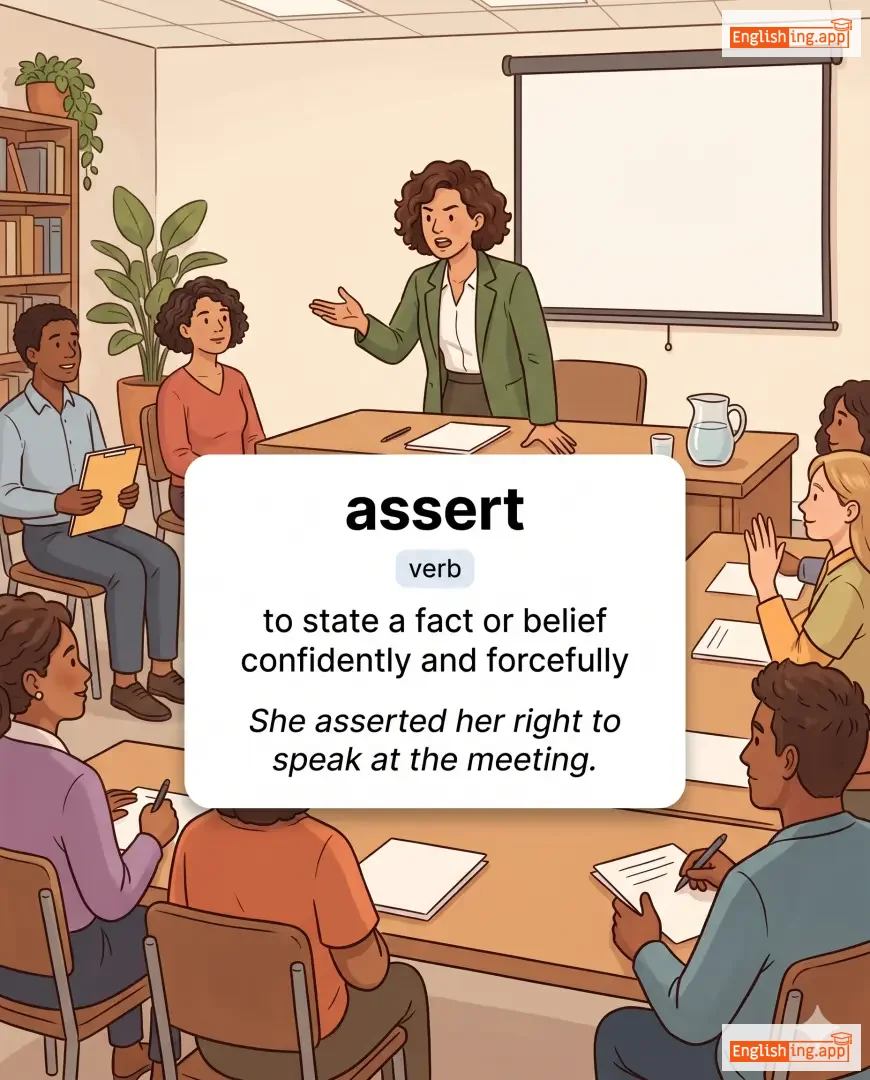
assert definition card — visual illustration of the meaning
verb
/əˈsɜːrt/
जोर देकर कहना (jor dekar kehna)

to state a fact or belief confidently and forcefully

"She asserted her right to speak at the meeting."

"उसने बैठक में बोलने का अपना अधिकार जोर से व्यक्त किया।" (Usne baithak mein bolne ka apna adhikar jor se vyakt kiya.)
noun
/əˈsɜːʃən/
दावा (dawa)

a confident and forceful statement of fact or belief

"Her assertion that she was right was met with silence."

"उसका यह दावा कि वह सही थी, चुप्पी के साथ मिला।" (Uska yah dawa ki wah sahi thi, chhuppee ke saath mila.)
adjective
/əˈsɜːrtɪv/
आत्मविश्वासी (atmavishwasi)

having or showing a confident and forceful personality

"He is very assertive in expressing his opinions."

"वह अपने विचारों को व्यक्त करने में बहुत आत्मविश्वासी है।" (Wah apne vicharon ko vyakt karne mein bahut atmavishwasi hai.)
verb
/əˈsɛs/
मूल्यांकन करना (mulyankan karna)

to evaluate or estimate the nature, ability, or quality of something

"The teacher assessed the students' progress."

"शिक्षक ने छात्रों की प्रगति का मूल्यांकन किया।" (Shikshak ne chhatron ki pragati ka mulyankan kiya.)
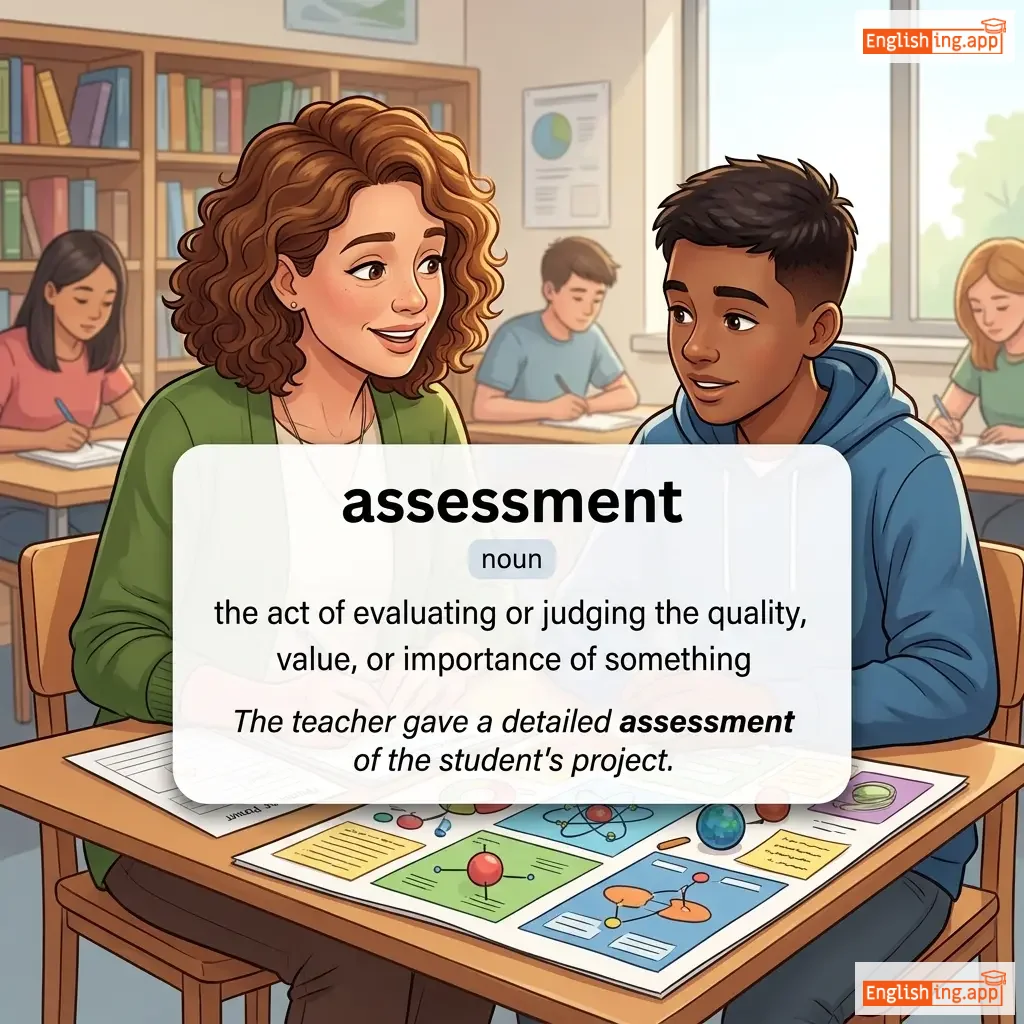
assessment definition card — visual illustration of the meaning
noun
/əˈsɛsmənt/
मूल्यांकन (mulyankan)

the act of evaluating or judging the quality, value, or importance of something

"The teacher gave a detailed assessment of the student's project."

"अध्यापक ने छात्र के प्रोजेक्ट का विस्तृत मूल्यांकन किया।" (Adhyapak ne chhatra ke project ka vistarit mulyankan kiya.)