वोकैबुलरीज

इंग्लिश वोकैबुलरी डिस्कवर, लर्न और मास्टर करें

noun
/məˈtrɒpəlɪs/
महानगर (mahanagar)

A large, important city that is a hub of culture, business, and population.

"New York is often described as a global metropolis."

"न्यूयॉर्क को अक्सर एक वैश्विक महानगर के रूप में वर्णित किया जाता है।" (New York ko aksar ek vaishwik mahanagar ke roop mein varnit kiya jata hai.)
adjective
/ˌmɛtrəˈpɑːlɪtən/
महानगरीय (mahanagriya)

Relating to a large city, its surrounding areas, or its lifestyle.

"She moved to a metropolitan area for better job opportunities."

"उसने बेहतर नौकरी के अवसरों के लिए एक महानगरीय क्षेत्र में स्थानांतरित किया।" (Usne behtar naukri ke avsaron ke liye ek mahanagriya kshetra mein sthaanantarit kiya.)
noun
/ˈmɛtəl/
साहस (sahas)

A person's ability to cope well with difficulties or to face demanding situations with courage.

"The young athlete showed his mettle in the final match."

"युवा एथलीट ने फाइनल मैच में अपना साहस दिखाया।" (Yuva athlete ne final match mein apna sahas dikhaya.)
adjective
/ˈmɛtəlˌsʌm/
साहसी (sahasi)

Full of courage and spirit; lively and spirited.

"The mettlesome young rider never backed down from a challenge."

"साहसी युवा सवार कभी भी चुनौती से पीछे नहीं हटा।" (sahasi yuva savaar kabhi bhi chunauti se peeche nahi hata.)
noun
/mjuːz/
गली/छोटी सड़क (gali/chhoti sadak)

A row or street of houses or apartments that have been converted from stables or built to look like former stables.

"They rented a small flat in a quiet London mews."

"उन्होंने लंदन के एक शांत म्यूज़ में एक छोटा फ्लैट किराए पर लिया था।" (unhone london ke ek shant mews mein ek chhota flat kiraye par liya tha.)
noun/adjective
/ˈmɛksɪkən/
खुशी (khushi)

a native or inhabitant of Mexico; relating to Mexico or its people, culture, or language

"She enjoys Mexican food like tacos and enchiladas."

"जब उसने पुरस्कार प्राप्त किया, तो वह अपनी खुशी छिपा नहीं पाई।" (Jab usne puraskar prapt kiya, to wah apni khushi chhupa nahi payi.)
noun
/maɪˈæzmə/
सड़ी हुई हवा (sadi hui hawa)

An unpleasant or unhealthy smell or atmosphere.

"A miasma of decay hung over the abandoned house."

"एक परित्यक्त घर पर सड़ी हुई हवा छाई हुई थी।" (ek parityakt ghar par sadi hui hawa chhai hui thi.)
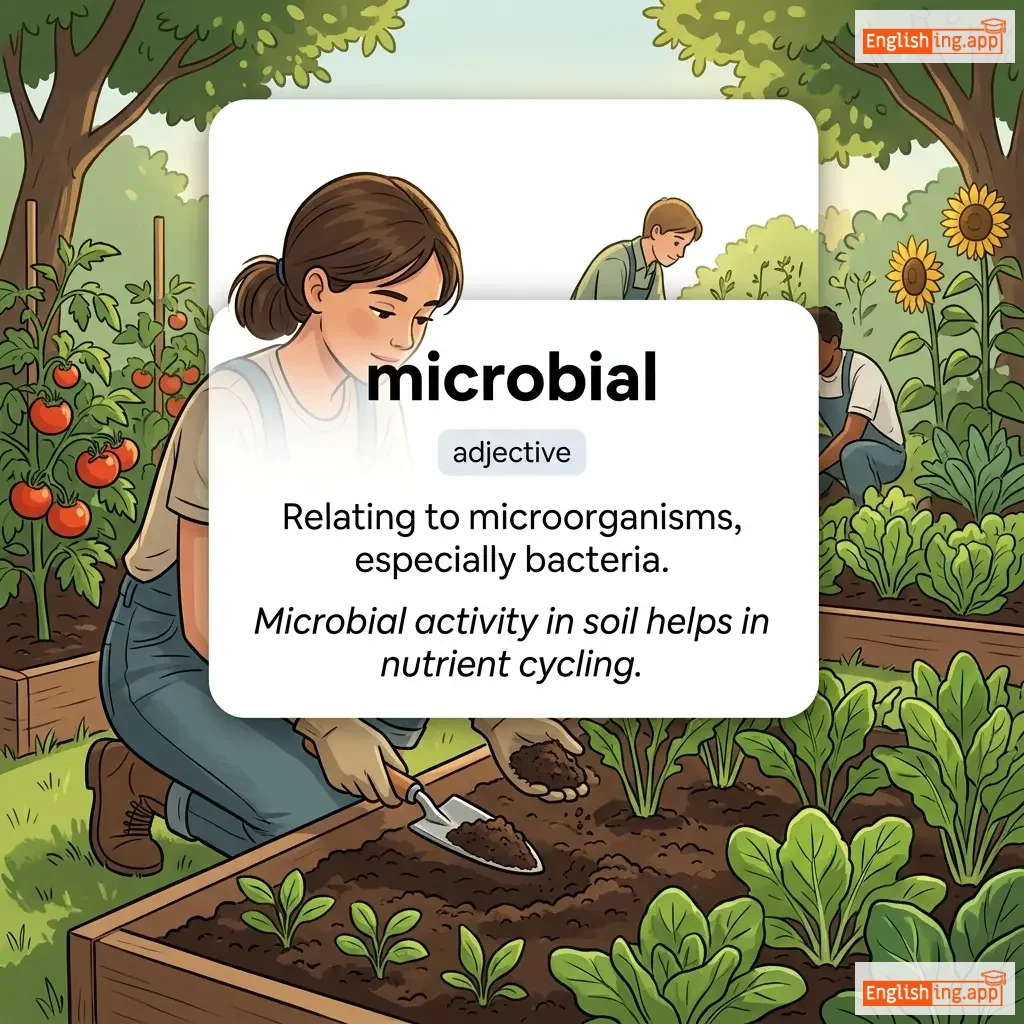
microbial definition card — visual illustration of the meaning
adjective
/maɪˈkroʊ.bi.əl/
सूक्ष्मजीव संबंधित (sookshmjeev sambandhit)

Relating to microorganisms, especially bacteria.

"Microbial activity in soil helps in nutrient cycling."

"मिट्टी में सूक्ष्मजीव गतिविधि पोषक तत्वों के चक्र में मदद करती है।" (Mitti mein sookshmjeev gatividhi poshak tatvon ke chakra mein madad karti hai.)
microclimate definition card — visual illustration of the meaning
noun
/ˈmaɪ.krəʊˌklaɪ.mət/
सूक्ष्म जलवायु (sookshm jalvayu)

The climate of a small, specific area that differs from the surrounding climate.

"The microclimate in valleys is often cooler than in surrounding areas."

"घाटियों में सूक्ष्म जलवायु अक्सर आसपास के क्षेत्रों से ठंडी होती है।" (ghatiyon mein sookshm jalvayu aksar aas-paas ke kshetron se thandi hoti hai.)
noun
/ˈmaɪkrəˌkɒzəm/
सूक्ष्म ब्रह्मांड (sookshma brahmand)

A small, representative system having analogies to a larger system; a miniature version of something.

"The small town is a microcosm of the entire nation."

"छोटा शहर पूरे राष्ट्र का एक सूक्ष्म ब्रह्मांड है।" (chhota shahar poore rashtr ka ek sookshma brahmand hai.)
noun
/maɪˈkrɒmɪtər/
माइक्रोमीटर (micrometer)

A device used for measuring small distances with great accuracy.

"The engineer used a micrometer to measure the thickness of the wire."

"इंजीनियर ने तार की मोटाई मापने के लिए माइक्रोमीटर का उपयोग किया।" (Engineer ne taar ki motai maapne ke liye micrometer ka upyog kiya.)
micronutrient definition card — visual illustration of the meaning
noun
ˈmaɪ.krəʊˌnjuː.tri.ənt
सूक्ष्म पोषक तत्व (sookshma poshak tatva)

Essential nutrients required by the body in small amounts, including vitamins and minerals.

"Iron and zinc are essential micronutrients for growth."

"लोहा और जिंक विकास के लिए आवश्यक सूक्ष्म पोषक तत्व हैं।" (Loha aur zinc vikas ke liye aavashyak sookshma poshak tatva hain.)
micronutrients definition card — visual illustration of the meaning
noun
/ˈmaɪ.krəʊˌnjuː.tri.ənts/
सूक्ष्म पोषक तत्व (sookshm poshak tatva)

Essential nutrients required in small amounts for proper body function, including vitamins and minerals.

"Micronutrients like iron and zinc are essential for immunity."

"आयरन और जिंक जैसे माइक्रोन्यूट्रिएंट्स इम्यूनिटी के लिए आवश्यक हैं।" (Iron aur zinc jaise micronutrients immunity ke liye avashyak hain.)
/ˈmaɪ.krəˌfoʊn/
माइक्रोफोन (maikrofon)

A device that converts sound into an electrical signal, typically used to amplify or record voices or music.

"She spoke into the microphone during the presentation."

"वह प्रस्तुति के दौरान माइक्रोफोन में बोल रही थी।" (vah prastuti ke dauran maikrofon mein bol rahi thi.)
noun
/ˈmaɪ.krəˌskoʊp/
सूक्ष्मदर्शी यंत्र (sookshmadarshi yantra)

An optical instrument used for viewing very small objects, such as cells, by magnifying them.

"The scientist observed the bacteria under the microscope."

"वैज्ञानिक ने माइक्रोस्कोप के नीचे बैक्टीरिया का निरीक्षण किया।" (Vigyanik ne microscope ke neeche bacteria ka nirikshan kiya.)
adjective
/ˌmaɪ.krəˈskɑː.pɪk/
सूक्ष्मदर्शी (sookshmdarshi)

Extremely small and only visible with a microscope.

"The sample contained microscopic particles."

"नमूने में सूक्ष्मदर्शी कण थे।" (Namune mein sookshmdarshi kan the.)
noun
/maɪˈkrɑː.skə.pi/
सूक्ष्मदर्शन (sookshmadarshan)

The use of a microscope to observe small objects or organisms.

"Microscopy revealed the structure of the cells."

"सूक्ष्मदर्शन ने कोशिकाओं की संरचना का पता लगाया।" (Sookshmadarshan ne koshikaon ki sanrachna ka pata lagaya.)
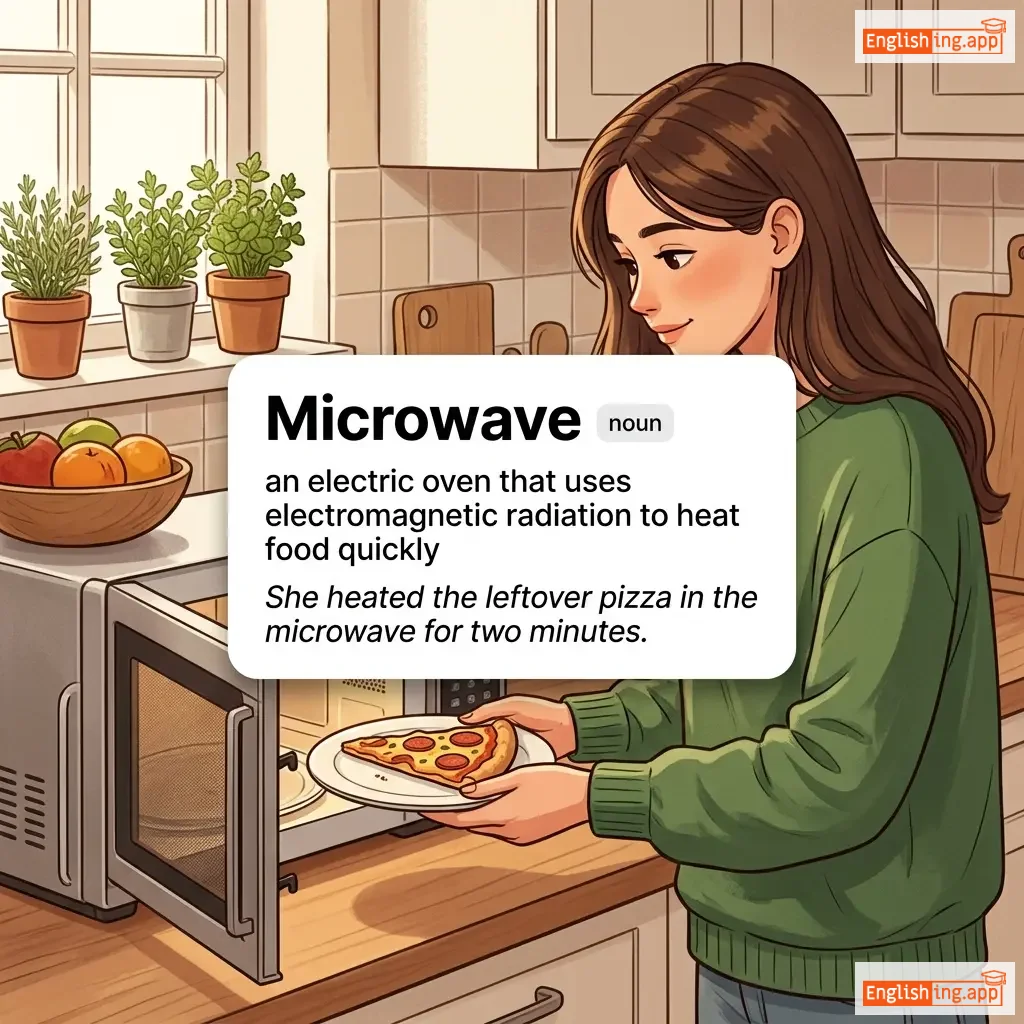
Microwave definition card — visual illustration of the meaning
noun
/ˈmaɪkroʊweɪv/
माइक्रोवेव (maikroev)

an electric oven that uses electromagnetic radiation to heat food quickly

"She heated the leftover pizza in the microwave for two minutes."

"उसने बची हुई पिज़्ज़ा को माइक्रोवेव में दो मिनट के लिए गर्म किया।" (usne bachi hui pizza ko microvev mein do minute ke liye garm kiya)
adjective, preposition, noun
/mɪd/
मध्य (madhya)

being in the middle of something; the central part or point

"She joined the project in mid June."

"वह जून के मध्य में परियोजना से जुड़ी।" (vah jun ke madhya mein pariyojana se judi)
noun
/ˈmɪd.deɪ/
दोपहर; मध्याह्न (midday)

The middle of the day; twelve o'clock in the daytime; noon

"The sun is brightest at midday when it's directly overhead."

"सूरज सबसे ज्यादा चमकता है दोपहर में जब वह सीधे ऊपर होता है।" (sooraj sabse zyada chamakta hai dopahar mein jab wah seedhe upar hota hai.)
noun/adjective
/ˈmɪdəl/
मध्य (madhya)

the central point, position, or part of something

"The park is in the middle of the city."

"पार्क शहर के बीच में है।" (Park shahar ke beech mein hai.)
adjective
/ˈmɪd.əl.eɪdʒd/
मध्य आयु (madhy ayu)

being of an age between young and old; typically between 40-60 years old

"The middle-aged man started a new career."

"मध्य आयु का व्यक्ति ने एक नई करियर शुरू की।" (madhy ayu ka vyakti ne ek nayi kariyer shuru ki.)
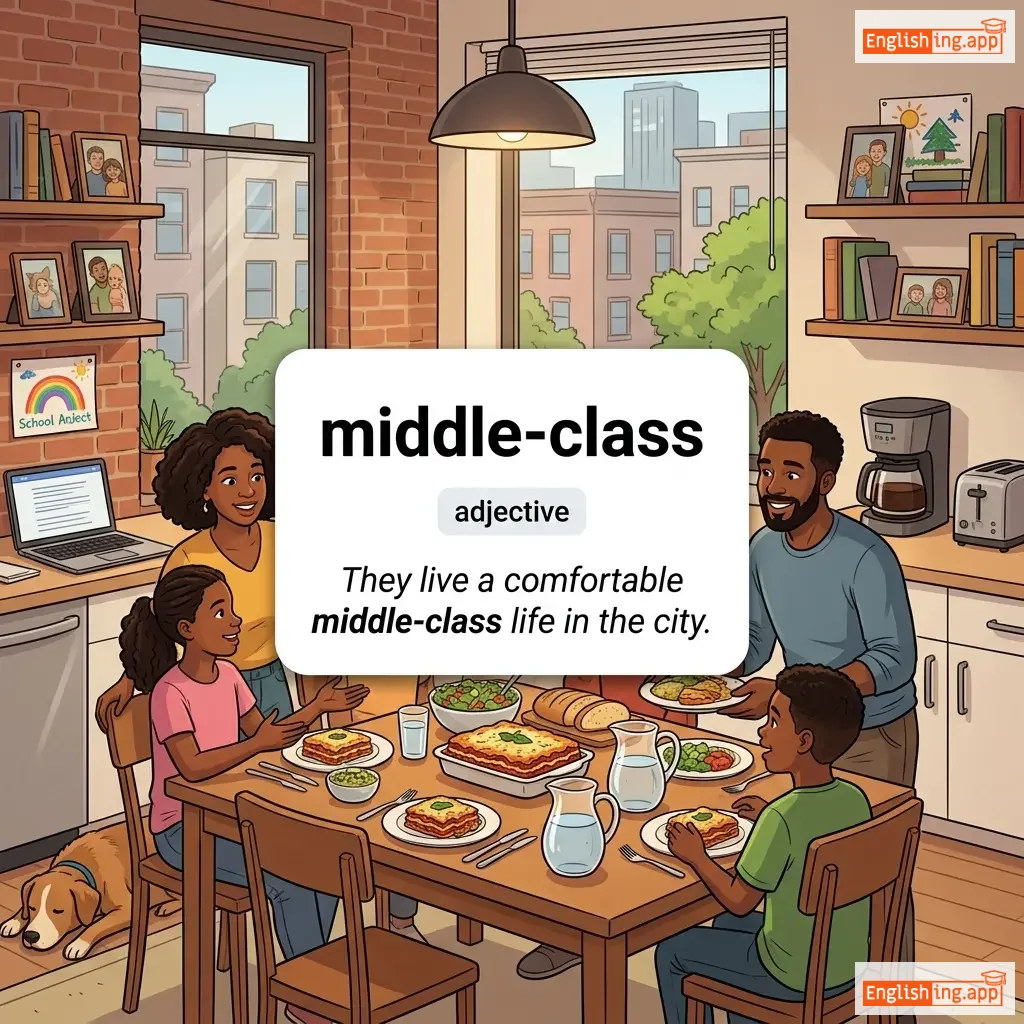
middle-class definition card — visual illustration of the meaning
adjective
/ˈmɪdəl klɑːs/
मध्यमवर्गीय (madhyama-vargīya)

belonging to the social group between the upper and working class, typically with moderate income and education

"They live a comfortable middle-class life in the city."

"वे शहर में एक आरामदायक मध्यमवर्गीय जीवन जीते हैं।" (Ve śahar mein ek ārāmadāyak madhyama-vargīya jīvan jīte hain.)
noun
/ˈmɪdəlˌmæn/
मध्यस्थ (madhyasth)

A person who acts as a link between buyers and sellers, often in business deals.

"The farmer sold his crops directly, without a middleman."

"किसान ने अपने फसल को सीधे बेचा, बिना किसी मध्यस्थ के।" (kisan ne apne fasal ko sidhe becha, bina kisi madhyasth ke.)
noun
/ˈmɪdnaɪt/
मध्यरात्रि (madhyaratri)

twelve o'clock at night; the middle of the night

"He reached home just after midnight."

"वह मिडनाइट के बाद घर पहुंचा।" (Vah midnight ke baad ghar pahucha.)
noun
/mɪdst/
मध्य (madhya)

the middle part or position of something

"In the midst of chaos, she remained calm."

"अराजकता के मध्य में, वह शांत रही।" (Arajakta ke madhya mein, wah shaant rahi.)
noun
/ˌmɪdˈsʌm.ər/
मध्य ग्रीष्म (madhya grishma)

The middle of summer, often around the summer solstice in June.

"We had a festival to celebrate midsummer."

"हमने मध्य ग्रीष्म का उत्सव मनाया।" (Humne madhya grishma ka utsav manaya.)
adverb
/ˈmɪd.weɪ/
मध्यमार्ग (madhyamaarg)

in the middle of an event, process, or distance

"He stopped midway through his speech."

"वह अपनी भाषण के मध्य में रुक गया।" (Vah apni bhashan ke madhya mein ruk gaya.)
noun
/ˈmɪd.waɪf/
दाइ (daai)

A person, typically a woman, trained to assist women during childbirth.

"The midwife stayed with the mother throughout her labor."

"दाइ ने पूरी प्रसवकालीन अवधि में माँ के साथ बिताया।" (Daai ne poori prasavkaaleen avadhi mein maan ke saath bitaaya.)
noun
/miːn/
मामला (maamla)

A person's appearance or manner, especially as an indication of their character or mood.

"His serious mien made everyone fall silent."

"उसका गंभीर मामला सबको चुप करा दिया।" (Uska gambhir maamla sabko chup kara diya.)
noun
/mɪf/
छोटी झगड़ा (chhoti jhagra)

A petty quarrel or annoyance.

"They had a slight miff over the seating arrangement."

"उन्होंने सीटिंग व्यवस्था को लेकर एक हल्का झगड़ा किया।" (Unhone seating vyavastha ko lekar ek halka jhagra kiya.)
modal verb/noun
/maɪt/
हो सकता है / शक्ति (ho sakta hai / shakti)

used to express possibility; power or strength

"She might come to the party if she finishes work early."

"वह पार्टी में आ सकती है यदि वह जल्दी काम खत्म कर लेती है।" (Vah party mein aa sakti hai yadi vah jaldi kaam khatam kar leti hai.)
adjective
/ˈmaɪti/
शक्तिशाली (shaktishali)

having great power or strength; very strong or impressive

"The mighty river flows through the heart of the country."

"शक्तिशाली नदी देश के बीच से बहती है।" (shaktishali nadi desh ke beech se bahti hai)
noun
/ˈmaɪ.ɡrənt/
प्रवासी (pravasi)

A person who moves from one place to another, especially to find work or better living conditions.

"Many migrants travel long distances to find employment."

"कई प्रवासी रोजगार पाने के लिए लंबी यात्रा करते हैं।" (Kai pravasi rozgar pane ke liye lambi yatra karte hain.)
verb
/maɪˈɡreɪt/
माइग्रेट करना (migret karna)

To move from one region or habitat to another, especially regularly according to the seasons or for work.

"Birds migrate south during the winter."

"पक्षी सर्दी के दौरान दक्षिण की ओर माइग्रेट करते हैं।" (Pakshi sardi ke dauran dakshin ki or migret karte hain.)
noun
/maɪˈɡreɪʃən/
प्रवासन (pravasan)

the movement of people or animals from one place to another, often for better living conditions or seasonal reasons

"The annual migration of birds is a fascinating natural event."

"पक्षियों का वार्षिक प्रवासन एक आकर्षक प्राकृतिक घटना है।" (Pakshiyon ka varshik pravasan ek aakarshak prakritik ghatna hai.)
adjective
/ˈmaɪɡrəˌtɔːri/
प्रवासी (pravaasi)

Relating to or characterized by migration, especially animals or people moving from one place to another.

"Migratory birds travel thousands of miles each year."

"प्रवासी पक्षी हर साल हजारों मील यात्रा करते हैं।" (Pravaasi pakshi har saal hazaaron meel yatra karte hain.)
adjective
/maɪld/
हल्का (halka)

not severe or strong; gentle in nature

"The patient had only mild symptoms."

"मरीज के पास केवल हल्के लक्षण थे।" (Mariz ke paas keval halke lakshan the.)
noun
/ˈmɪsɪv/
पत्र (patra)

a written message, especially a formal or official letter

"He sent a long missive to the governor."

"उसने गवर्नर को एक लंबा पत्र भेजा।" (Usne governor ko ek lamba patra bheja.)
verb
/ˌmɪsˈpleɪs/
गलत स्थान पर रखना (galat sthan par rakhna)

To put something in the wrong location and temporarily lose it.

"I often misplace my keys when I am in a hurry."

"मैं अक्सर अपनी चाबियाँ जल्दी में होने पर गलत जगह रख देता हूँ।" (Main aksar apni chaabiyan jaldi mein hone par galat jagah rakh deta hoon.)
verb
/ˌmɪsˈriːd/
गलत पढ़ना (galat padhna)

to read something incorrectly or interpret wrongly

"He misread the instructions and built the shelf incorrectly."

"उसने निर्देशों को गलत पढ़ा और शेल्फ को गलत तरीके से बनाया।" (Usne nirdeshon ko galat padha aur shelf ko galat tareeke se banaya.)
verb
/ˌmɪsˌrɛprɪˈzɛnt/
गलत तरीके से प्रस्तुत करना (galat tareeke se prastut karna)

to give a false or misleading account of something

"The lawyer accused the witness of trying to misrepresent the facts."

"वकील ने गवाह पर तथ्यों को गलत तरीके से पेश करने का आरोप लगाया।" (Vakil ne gawah par tathyon ko galat tareeke se pesh karne ka aarop lagaya.)
noun
/ˌmɪsˈruːl/
अशासन (ashasan)

bad or poor governance

"The kingdom suffered for decades under misrule."

"राज्य दशकों तक अशासन के तहत पीड़ित रहा।" (Rajya dashako tak ashasan ke tahat peedit raha.)
verb, noun
/mɪs/
मिस करना / अनुपस्थित होना (mis karna / anupasthit hona)

to fail to hit, reach, or meet; to feel the absence of someone or something

"I really miss my family when I travel abroad."

"जब मैं विदेश यात्रा करता हूँ, तो मुझे अपनी परिवार की बहुत याद आती है।" (jab main videsh yatra karta hoon, to mujhe apni parivar ki bahut yaad aati hai.)
noun
/ˈmɪsəl/
मिसल (misal)

a book containing the texts used in the Catholic Mass throughout the year

"The priest read from the missal during the ceremony."

"पुरोहित समारोह के दौरान मिसल से पढ़ रहे थे।" (Purohit samaroh ke dauran misal se padh rahe the.)
noun
/ˈmɪsaɪl/ or /ˈmɪsəl/
मिसाइल (misail)

a weapon that is self-propelled and directed toward a target

"The army launched a missile towards the enemy base."

"सैन्य ने शत्रु के अड्डे की ओर एक मिसाइल दागी।" (Sainya ne shatru ke adde ki or ek misail daagi.)
missing definition card — visual illustration of the meaning
adjective
/ˈmɪsɪŋ/
गायब (gaayab)

not present or cannot be found

"The keys are missing from the table."

"चाबियाँ मेज़ से गायब हैं।" (Chaabiyaan mez se gaayab hain.)
noun
/ˈmɪʃən/
मिशन / कार्य (mishan / kary)

an important assignment or task, often with a specific purpose

"The astronauts were on a mission to explore Mars."

"अंतरिक्षयात्री मंगल ग्रह की खोज के लिए एक मिशन पर थे।" (Antarikshyaatri mangal grah ki khoj ke liye ek mishan par the.)
noun
/ˈmɪʃəneri/
धर्म प्रचारक (dharm pracharak)

a person sent on a religious mission, especially to promote Christianity in a foreign country

"The missionary spent years helping local communities in Africa."

"मिशनरी ने अफ्रीका में स्थानीय समुदायों की मदद करने के लिए वर्षों बिताए।" (Mishanari ne Africa mein sthaniya samudaayon ki madad karne ke liye varsho bitaye.)
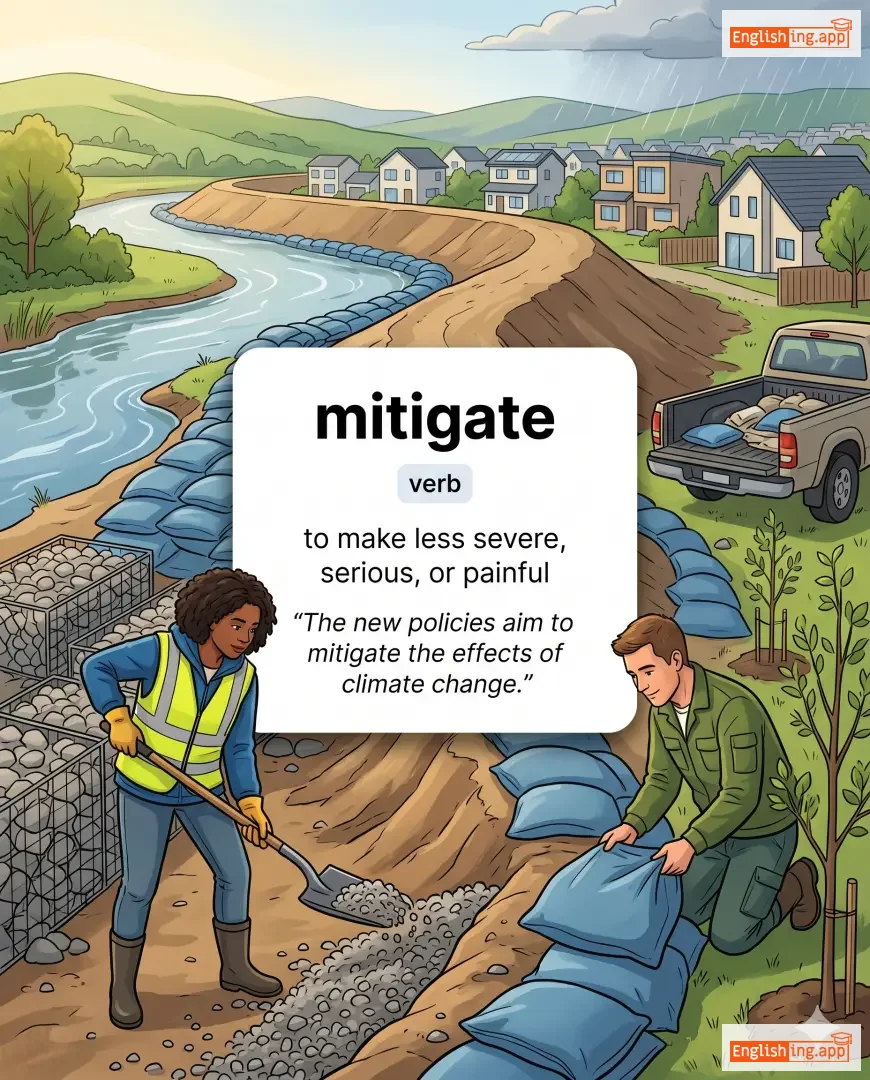
mitigate definition card — visual illustration of the meaning
verb
/ˈmɪtɪˌɡeɪt/
कम करना (kam karna)

to make less severe, serious, or painful

"The new policies aim to mitigate the effects of climate change."

"नई नीतियाँ जलवायु परिवर्तन के प्रभावों को कम करने का लक्ष्य रखती हैं।" (Nayi neetiyan jalvayu parivartan ke prabhavon ko kam karne ka lakshya rakhti hain.)