वोकैबुलरीज

इंग्लिश वोकैबुलरी डिस्कवर, लर्न और मास्टर करें

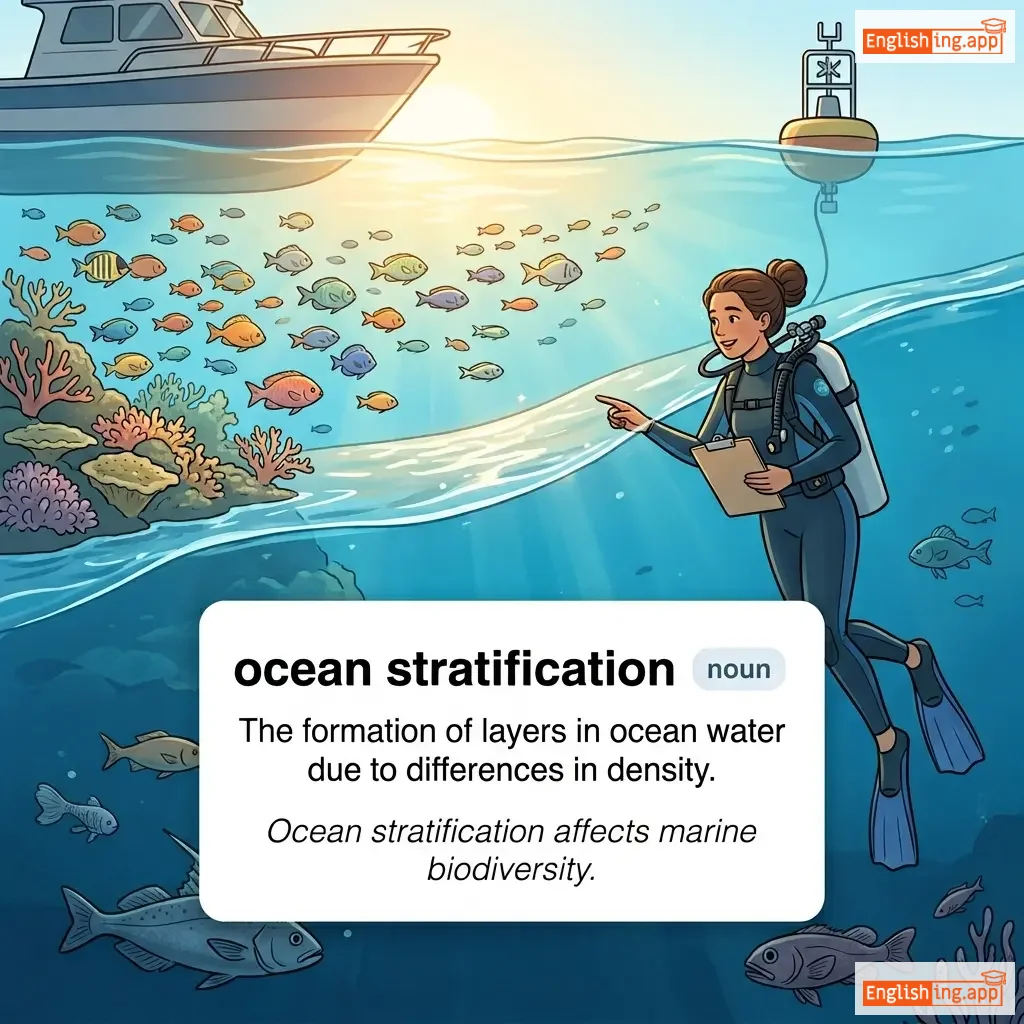
ocean stratification definition card — visual illustration of the meaning
noun
ˈoʊʃən ˌstrætɪfɪˈkeɪʃən
महासागर परत विभाजन (mahasagar parat vibhajan)

The formation of layers in ocean water due to differences in density.

"Ocean stratification affects marine biodiversity."

"महासागर परत विभाजन समुद्री जैव विविधता को प्रभावित करता है।" (Mahasagar parat vibhajan samudree jaiv vividhta ko prabhavit karta hai.)
noun
/ˈɒktəɡən/
आठकोण (aathkon)

A polygon with eight sides and eight angles.

"The stop sign is shaped like an octagon."

"स्टॉप साइन का आकार एक ऑक्टागन जैसा है।" (Stop sign ka aakar ek octagon jaisa hai.)
noun
/ˈɒktɪv/
सप्तक (saptak)

A series of eight musical notes, or the interval between one musical pitch and another with double its frequency.

"The singer's voice could easily reach the higher octave."

"गायिका की आवाज आसानी से ऊँचे सप्तक तक पहुँच सकती थी." (gayika ki aawaz aasani se oonche saptak tak pahunch sakti thi.)
noun
/ɒkˈteɪvoʊ/
ऑक्टावो (आठ पन्नों में कागज मोड़ने से बनी किताब का आकार) (oktavo)

A size of book page resulting from folding a sheet of paper into eight leaves (sixteen pages).

"The old library contained rare octavo editions of Shakespeare."

"पुरानी लाइब्रेरी में शेक्सपियर के दुर्लभ ऑक्टावो संस्करण थे।" (Purani library mein Shakespeare ke durlabh oktavo sanskaran the.)
noun
/ɒkˈtoʊbər/
अक्टूबर (aktubar)

the tenth month of the year in the Gregorian calendar

"The weather becomes cooler in October."

"अक्टूबर में मौसम ठंडा होने लगता है।" (aktubar mein mausam thanda hone lagta hai)
noun
/ˌɒktədʒəˈnɛəriən/
आठ दशकीय व्यक्ति (aath dashkey vyakti)

A person who is between 80 and 89 years old.

"The octogenarian still jogs every morning to stay healthy."

"ऑक्टोजेनेरियन व्यक्ति हर सुबह स्वस्थ रहने के लिए दौड़ते हैं।" (Octogenarian vyakti har subah swasth rahne ke liye daudte hain.)
adjective
/ˈɒkjʊlər/
आँख से संबंधित (aankh se sambandhit)

Relating to the eye or vision.

"The patient was referred to a specialist for ocular treatment."

"मरीज़ को आँखों के उपचार के लिए विशेषज्ञ के पास भेजा गया था।" (Mariz ko aankhon ke upchaar ke liye visheshagya ke paas bheja gaya tha.)
noun
/ˈɒkjʊlɪst/
नेत्र चिकित्सक (netra chikitsak)

An old-fashioned term for an eye doctor or ophthalmologist.

"The village oculist was known for treating various eye diseases."

"गांव के आक्यूलिस्ट को विभिन्न आंखों की बीमारियों का इलाज करने के लिए जाना जाता था।" (Gaon ke akyulist ko vibhinn aankhon ki bimariyon ka ilaj karne ke liye jana jata tha.)
adjective
/ɒd/
अजीब (ajeeb)

different from what is usual or expected; strange or peculiar

"He has some odd habits that surprise everyone."

"उसके पास कुछ अजीब आदतें हैं जो सभी को चौंका देती हैं।" (Uske paas kuch ajeeb aadatein hain jo sabhi ko chauka deti hain.)
noun
/ˈɒdəti/
विचित्रता (vichitrita)

Something strange or unusual.

"The bright pink building was an oddity in the small town."

"चमकीली गुलाबी इमारत छोटे शहर में एक विचित्रता थी।" (Chamakili gulabi imarat chhote sheher mein ek vichitrita thi.)
adverb
/ˈɒdli/
अजीब तरह से (ajeeb tarah se)

in a strange or unusual way; unexpectedly

"Oddly, he didn’t seem upset by the bad news."

"अजीब तरह से, वह बुरी खबर से परेशान नहीं हुआ।" (ajeeb tarah se, vah buri khabar se pareshan nahi hua)
noun
/ɒdz/
संभावना (sambhavna)

the likelihood or probability of something happening; chances for or against something

"The odds of winning the lottery are very low."

"लॉटरी जीतने के ऑड्स बहुत कम हैं।" (Lottery jeetne ke odds bahut kam hain.)
noun
/oʊd/
गानात्मक कविता (gaanatmak kavita)

a lyrical poem, often expressing praise or strong emotions

"The poet wrote an ode to the beauty of nature."

"कवि ने प्रकृति की सुंदरता पर एक ओड लिखी।" (Kavi ne prakriti ki sundarta par ek ode likhi.)
adjective
/ˈoʊdiəs/
घृणित (ghrit)

extremely unpleasant or repulsive

"The dictator was remembered for his odious crimes."

"सत्ता के शासक को उसके घृणित अपराधों के लिए याद किया गया।" (Satta ke shasak ko uske ghrinit aparadhon ke liye yaad kiya gaya.)
noun
/ˈoʊdiəm/
घृणा (ghrina)

general or widespread hatred or disgust directed toward someone as a result of their actions

"The scandal brought public odium on the corrupt minister."

"विवाद ने भ्रष्ट मंत्री पर सार्वजनिक घृणा ला दी।" (Vivaad ne bhrasht mantri par saarbhaumik ghrina la di.)
adjective
/ˌoʊdəˈrɪfərəs/
सुगंधित (sugandhit)

having or giving off a smell, especially a strong or pleasant one

"The garden was filled with odoriferous flowers."

"बग़ीचा सुगंधित फूलों से भरा हुआ था।" (Bagicha sugandhit phoolon se bhara hua tha.)
adjective
/ˈoʊdərəs/
दुर्गंधयुक्त (durgandhyukt)

having or giving off a smell, often unpleasant

"The odorous garbage had to be taken out immediately."

"दुर्गंधयुक्त कचरा तुरंत बाहर फेंकना पड़ा था।" (durgandhyukt kachra turant baahar phenkna pada tha.)
noun
/ˈoʊ.dər/
गंध (gandh)

a distinctive smell, especially an unpleasant one

"The odour of fresh bread filled the kitchen."

"ताजे ब्रेड की गंध रसोई घर में फैल गई।" (taje bread ki gandh rasoi ghar mein phail gayi.)
odyssey definition card — visual illustration of the meaning
noun
/ˈɑːdəsi/
लंबी यात्रा (lambi yatra)

a long, adventurous journey; a series of experiences

"Her career has been an odyssey of challenges and achievements."

"उसका करियर चुनौतियों और उपलब्धियों का एक लंबी यात्रा रहा है।" (uska kariyer chunautiyon aur uplabdhiyon ka ek lambi yatra raha hai.)
preposition
/ʌv/
का (ka)

expressing the relationship between a part and a whole

"The book is on the table, in front of the window."

"किताब मेज पर है, खिड़की के सामने है।" (kitaab mez par hai, khidki ke samne hai.)
adverb
/ɔːf/
बंद (band)

away from a place, position, or time; not functioning

"He turned off the light before leaving the room."

"वह कमरे से बाहर जाने से पहले बत्तियाँ बंद कर दी।" (vah kamre se baahar jaane se pehle battiyaan band kar di.)
adjective
/ˌɔːfˈkiː/
बेसुर (besur)

out of tune; not in accordance with expected standards

"The singer was slightly off-key during the performance."

"गायक प्रदर्शन के दौरान थोड़ा बेसुर था।" (gaayak pradarshan ke dauran thoda besur tha.)
noun
/ˈɔːfəl/
अंदरूनी अंग (andarooni ang)

the internal organs and entrails of an animal used as food; waste parts

"The butcher prepared sausages using pork offal."

"बटलर ने सूअर के अंदरूनी अंग का उपयोग करके सॉसेज तैयार किया।" (butler ne suar ke andarooni ang ka upyog karke sosej taiyar kiya.)
adjective
/ˈɒf.biːt/
असामान्य (asaamany)

Unusual, unconventional, or different from the norm.

"She has a very offbeat sense of humor."

"उसका हास्यबोध बहुत असामान्य है।" (uska haasyabodh bahut asaamany hai.)
noun
/əˈfens/
अपराध; आक्रमण (apraadh; aakraman)

a breach of law or rule; an annoyance or resentment

"Stealing is a serious offence punishable by law."

"चोरी एक गंभीर अपराध है जिसे कानून द्वारा दंडनीय माना जाता है।" (chori ek gambheer apraadh hai jise kaanoon dwaara dandniya maana jaata hai)
verb
/əˈfɛnd/
अपमान करना (apmaan karna)

to cause someone to feel upset, insulted, or annoyed

"She didn’t mean to offend anyone with her remarks."

"वह अपनी टिप्पणियों से किसी को ठेस पहुँचाना नहीं चाहती थी।" (Wah apni tippaniyon se kisi ko thess pahuchana nahi chahti thi.)
noun
/əˈfɛndər/
अपराधी (apradhi)

a person who commits a crime or does something wrong

"The police caught the offender quickly."

"पुलिस ने अपराधी को जल्दी पकड़ लिया।" (Police ne apradhi ko jaldi pakad liya.)
noun
/əˈfɛns/
अपराध (apraadh)

an illegal act; a crime

"The offense was committed in broad daylight."

"अपराध दिन के उजाले में किया गया था।" (apraadh din ke ujale mein kiya gaya tha.)
adjective
/əˈfɛnsɪv/
अपमानजनक (apmanjanak)

Causing hurt, anger, or annoyance; also relating to attacking in sports or war.

"His offensive remarks upset everyone at the meeting."

"उसकी अपमानजनक टिप्पणी ने बैठक में सभी को नाराज़ कर दिया।" (uski apmanjanak tipanni ne baithak mein sabhi ko naraz kar diya.)
offer definition card — visual illustration of the meaning
verb
/ˈɔːfər/
प्रस्ताव करना (prastaav karna)

to present or give something to someone

"She offered him a gift for his birthday."

"उसने उसे उसके जन्मदिन के लिए एक उपहार प्रस्तुत किया।" (Usne use uske janmadin ke liye ek uphaar prastut kiya.)
noun
/ˈɒfərɪŋ/
प्रस्ताव (prastaav)

something that is given, especially as a gift or contribution

"The company’s latest offering is an eco-friendly car."

"कंपनी का नवीनतम प्रस्ताव एक इको-फ्रेंडली कार है।" (Company ka naveenatam prastaav ek eco-friendly car hai.)
noun
/ˈɒfərtɔːri/
अर्पण (arpan)

The part of a religious service when offerings are collected; the offering itself.

"The offertory was taken during the Sunday service."

"रविवार की प्रार्थना सेवा के दौरान अर्पण एकत्रित किया गया था।" (ravivar ki prarthana seva ke dauran arpan ekatrit kiya gaya tha.)
adjective/adverb
/ˌɒfˈhænd/
बिना सोचे-समझे (bina soche-samjhe)

Without previous thought or preparation; casual and sometimes dismissive.

"She gave an offhand reply to his serious question."

"उसने उसके गंभीर सवाल का बिना सोचे-समझे जवाब दिया।" (Usne uske gambhir sawal ka bina soche-samjhe jawab diya.)
adjective
/ˈɒnɡəʊɪŋ/
चल रहा (chal raha)

continuing; still in progress

"The ongoing project will finish next month."

"चल रहे प्रोजेक्ट को अगले महीने खत्म कर दिया जाएगा।" (Chal rahe project ko agle mahine khatm kar diya jayega.)
noun
/ˈoʊ.mən/
शुभ या अशुभ भविष्य का संकेत (shubh ya ashubh bhavishya ka sanket)

an event regarded as a sign of future good or bad luck

"Many people consider a black cat crossing your path a bad omen."

"कई लोग एक काले बिल्ले को रास्ता पार करते हुए बुरा ओमेन मानते हैं।" (kai log ek kaale bille ko raasta paar karte huye bura omen maante hain.)
adjective
/ˈɒmɪnəs/
भविष्यसूचक (bhavishysoochak)

Giving the impression that something bad or unpleasant is going to happen.

"Dark clouds gave an ominous sign of an approaching storm."

"अंधेरे बादल एक भविष्यसूचक संकेत थे कि एक तूफान आ रहा है।" (Andhere badal ek bhavishysoochak sanket the ki ek toofan aa raha hai.)
noun
/əˈmɪʃən/
उल्लेखन (ullekhan)

The act of leaving out or excluding something; something that has been left out.

"Her omission of important details caused confusion."

"उसकी महत्वपूर्ण विवरणों की अनुपस्थिति से भ्रम उत्पन्न हुआ।" (Uski mahatvapurn vivaron ki anupasthiti se bhram utpann hua.)
omit definition card — visual illustration of the meaning
verb
/oʊˈmɪt/
छोड़ना (chhodna)

to leave out or exclude; to fail to include something

"Please don't omit any important details from your report."

"कृपया अपनी रिपोर्ट से कोई महत्वपूर्ण विवरण न छोड़ें।" (Kripya apni report se koi mahatvapurn vivaran na chhodein.)
noun
/ɒmˈnɪpətəns/
असीम शक्ति (aseem shakti)

The quality of having unlimited power or authority.

"Many religions describe God’s omnipotence as absolute."

"कई धर्मों में भगवान की असीम शक्ति को पूर्ण रूप से निरूपित किया गया है।" (Kai dharmon mein bhagwan ki aseem shakti ko poorn roop se nirupit kiya gaya hai.)
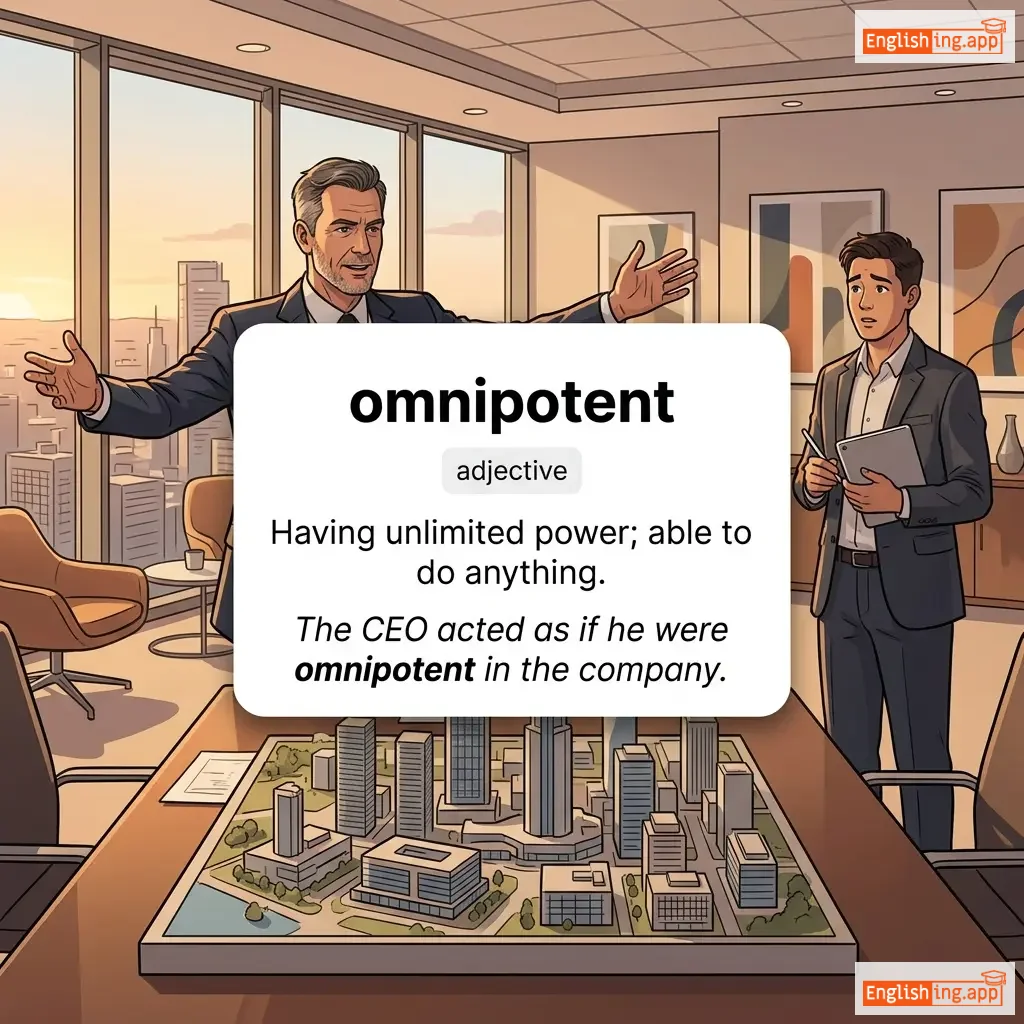
omnipotent definition card — visual illustration of the meaning
adjective
/ɒmˈnɪpətənt/
सर्वशक्तिमान (sarvashaktimaan)

Having unlimited power; able to do anything.

"The CEO acted as if he were omnipotent in the company."

"सीईओ ने ऐसा व्यवहार किया जैसे वह कंपनी में सर्वशक्तिमान हों।" (CEO ne aisa vyavhaar kiya jaise woh company mein sarvashaktimaan hon.)
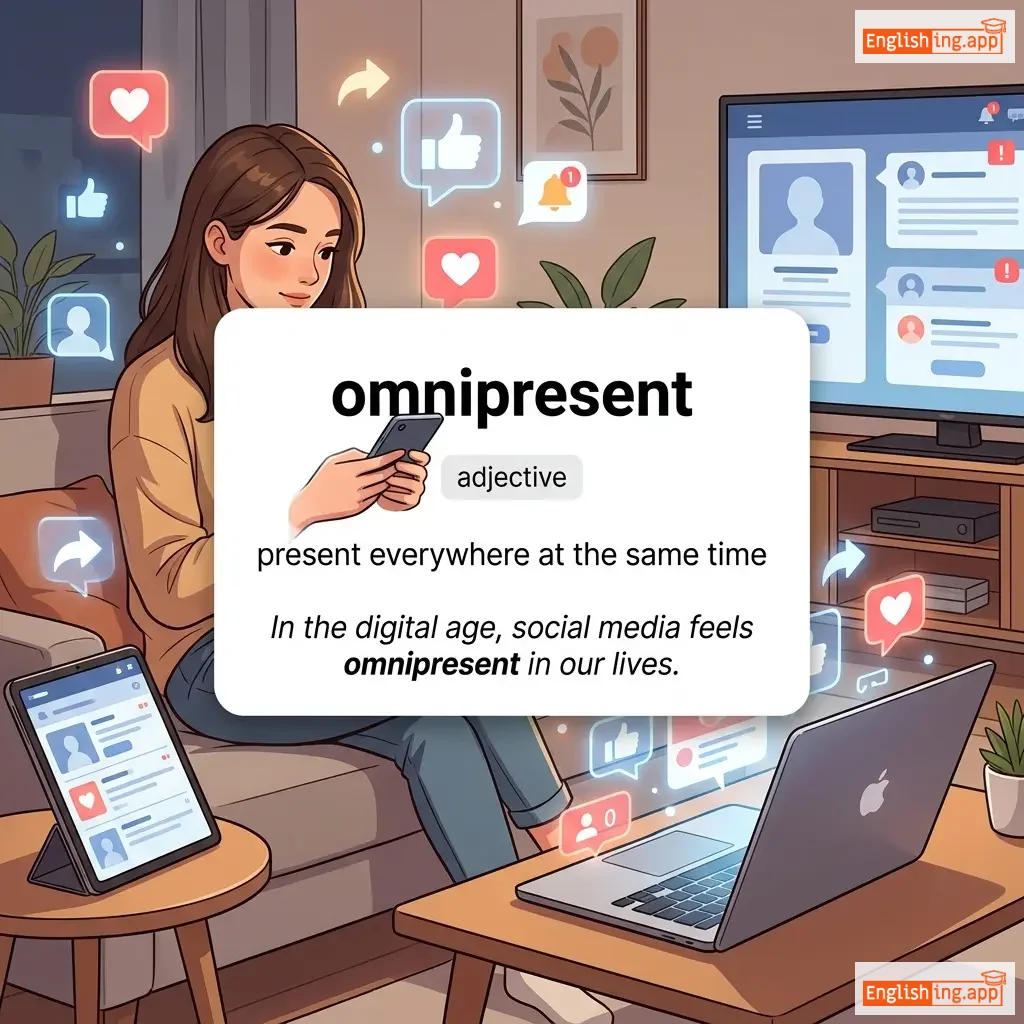
omnipresent definition card — visual illustration of the meaning
adjective
/ˌɒmnɪˈprɛzənt/
सर्वव्यापी (sarvavyaapi)

present everywhere at the same time

"In the digital age, social media feels omnipresent in our lives."

"डिजिटल युग में, सोशल मीडिया हमारे जीवन में सर्वव्यापी लगता है।" (Digital yug mein, social media hamare jeevan mein sarvavyaapi lagta hai.)
noun
/ɒmˈnɪʃəns/
सर्वज्ञता (sarvagyata)

the state of knowing everything

"The novel's narrator has an air of omniscience, revealing every character's thoughts."

"उपन्यास का वर्णनकर्ता सर्वज्ञता रखता है, जो हर चरित्र के विचार दिखाता है।" (upanyas ka varnanakartaa sarvagyata rakhta hai, jo har charitra ke vichar dikhaata hai.)
adjective
/ɒmˈnɪʃənt/
सर्वज्ञ (sarvagya)

having complete or unlimited knowledge and awareness

"Some religions describe God as omniscient and all-powerful."

"कुछ धर्म ईश्वर को सर्वज्ञ और सर्वशक्तिमान के रूप में वर्णित करते हैं।" (Kuch dharm Ishwar ko sarvagya aur sarvashaktimaan ke roop mein varnit karte hain.)
adjective
/ɒmˈnɪvərəs/
सर्वाहारी (sarvahari)

eating both plants and animals

"Humans are generally considered omnivorous creatures."

"मनुष्यों को आमतौर पर सर्वाहारी जीवों के रूप में माना जाता है।" (Manushyon ko aamtaur par sarvahari jeevon ke roop mein maana jaata hai.)
preposition
/ɒn/
पर (par)

physically in contact with and supported by a surface

"The book is on the table."

"किताब मेज़ पर है।" (Kitaab mez par hai.)
adverb
/wʌns/
एक बार (ek bar)

on one occasion only; at a time in the past

"She visited Paris once last year."

"उसने पिछले साल एक बार पेरिस का दौरा किया।" (Usne pichhle saal ek bar Paris ka daura kiya.)
pronoun, noun, adjective
/wʌn/
एक (ek)

the number equivalent to the sum of zero and one; a single person or thing

"Only one student answered the question."

"केवल एक छात्र ने सवाल का जवाब दिया।" (Keval ek chhatra ne sawaal ka jawab diya.)
noun
/wʌn θɜːd/
एक-तिहाई (ek-tihai)

one part of something that is divided into three equal parts

"One-third of the class was absent today."

"कक्षा का एक-तिहाई हिस्सा आज अनुपस्थित था।" (Kaksha ka ek-tihai hissa aaj anupasthit tha.)
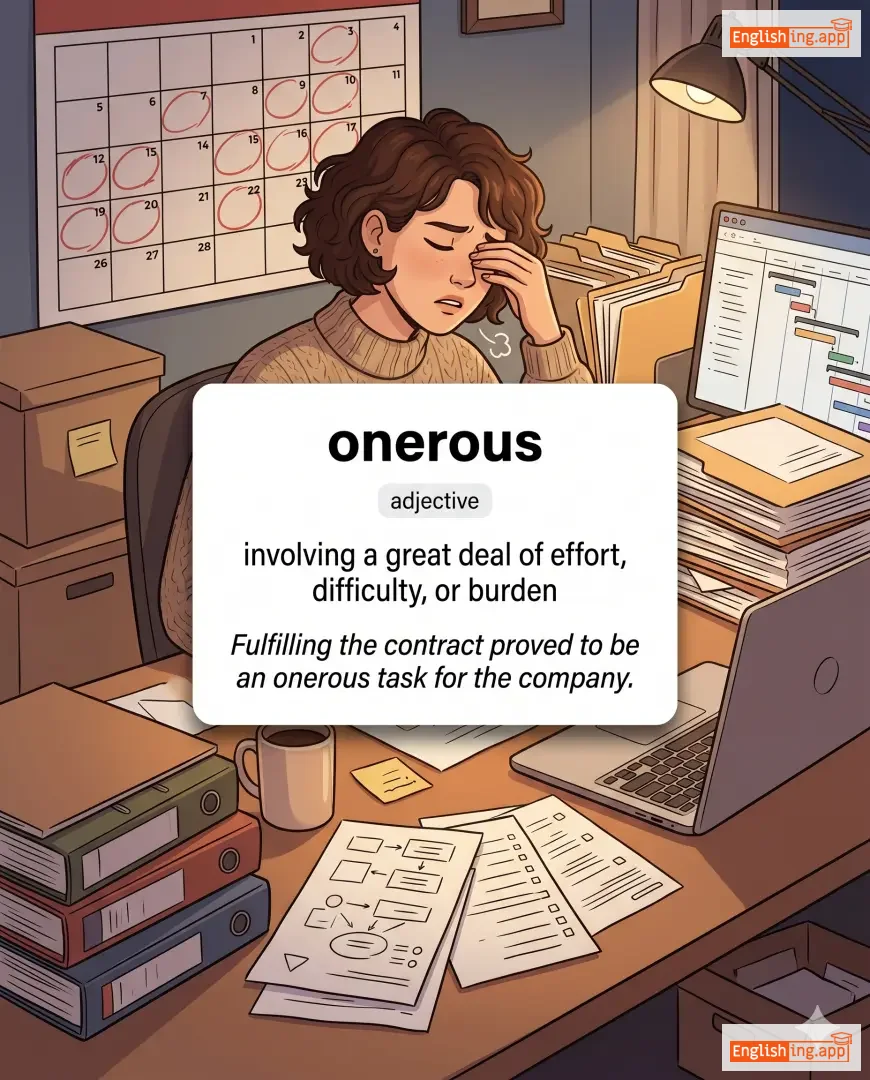
onerous definition card — visual illustration of the meaning
adjective
/ˈəʊnərəs/
कठिन (kathin)

involving a great deal of effort, difficulty, or burden

"Fulfilling the contract proved to be an onerous task for the company."

"कंपनी के लिए अनुबंध को पूरा करना एक कठिन कार्य साबित हुआ।" (Kampani ke liye anubandh ko pura karna ek kathin kaary sabit hua.)
verb
/uːz/
रिसाव करना (risaav karna)

to slowly flow or leak out through small openings or pores

"Blood began to ooze from the small cut."

"ब्लड छोटे कट से रिसने लगा।" (blood chhote cut se risne laga.)