Vocabulaires

Découvrez, apprenez et maîtrisez le vocabulaire anglais

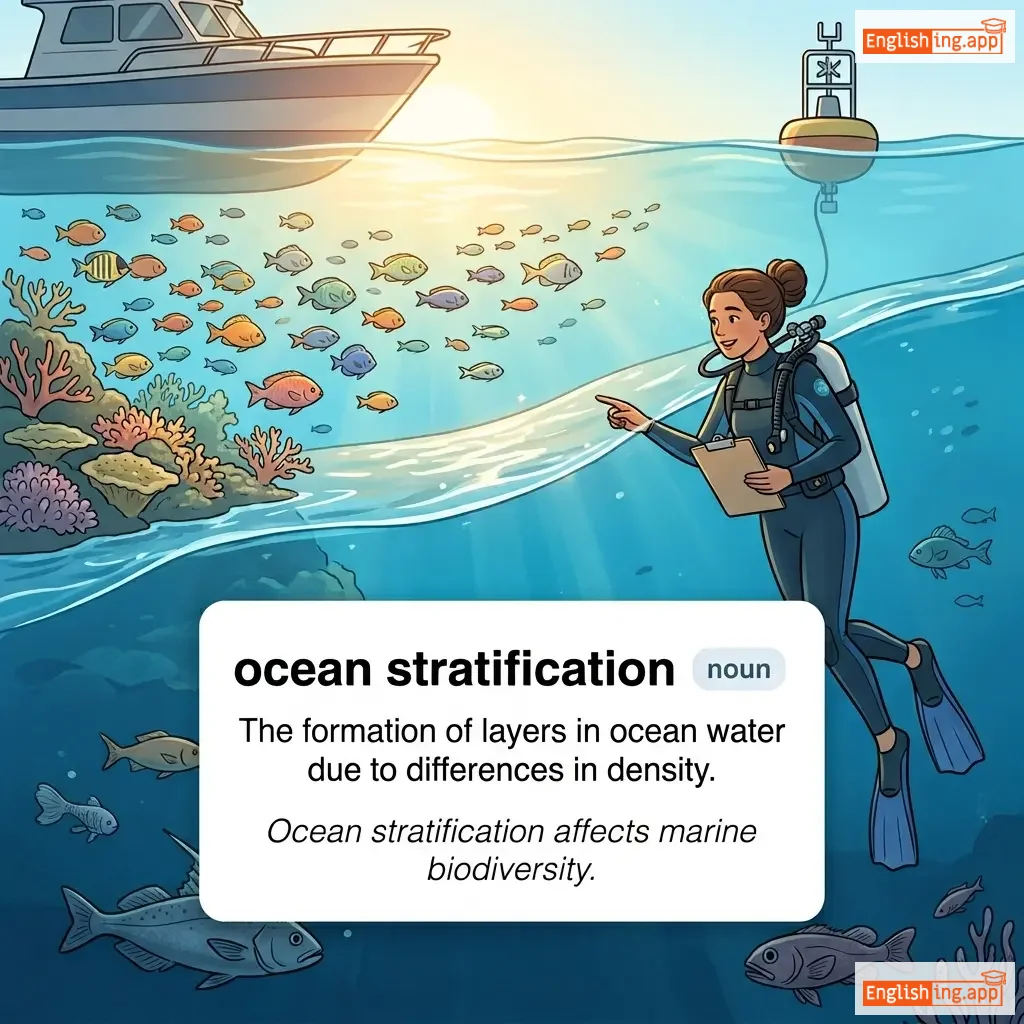
ocean stratification definition card — visual illustration of the meaning
noun
ˈoʊʃən ˌstrætɪfɪˈkeɪʃən
stratification océanique (stratification oceanique)

The formation of layers in ocean water due to differences in density.

"Ocean stratification affects marine biodiversity."

"La stratification océanique affecte la biodiversité marine." (La stratification oceanique affecte la biodiversite marine.)
noun
/ˈɒktəɡən/
octogone (octogone)

A polygon with eight sides and eight angles.

"The stop sign is shaped like an octagon."

"Le panneau stop a la forme d'un octogone." (Le panneau stop a la forme d'un octogone.)
noun
/ˈɒktɪv/
octave (oktav)

A series of eight musical notes, or the interval between one musical pitch and another with double its frequency.

"The singer's voice could easily reach the higher octave."

"La voix du chanteur pourrait facilement atteindre l'octave supérieure." (La voix du chanteur pourrait facilement atteindre l octave superieure.)
noun
/ɒkˈteɪvoʊ/
octavo (taille de livre obtenue en pliant une feuille en huit parties) (oktavo)

A size of book page resulting from folding a sheet of paper into eight leaves (sixteen pages).

"The old library contained rare octavo editions of Shakespeare."

"La vieille bibliothèque contenait des éditions rares en octavo de Shakespeare." (La vieille bibliothèque contenait des éditions rares en octavo de Shakespeare.)
noun
/ɒkˈtoʊbər/
octobre (octobre)

the tenth month of the year in the Gregorian calendar

"The weather becomes cooler in October."

"Le temps devient plus frais en octobre." (le temps devient plus frais en octobre)
noun
/ˌɒktədʒəˈnɛəriən/
octogénaire (octogenère)

A person who is between 80 and 89 years old.

"The octogenarian still jogs every morning to stay healthy."

"L'octogénaire court encore chaque matin pour rester en bonne santé." (L'octogénaire court encore chaque matin pour rester en bonne santé.)
adjective
/ˈɒkjʊlər/
oculaire (oculaire)

Relating to the eye or vision.

"The patient was referred to a specialist for ocular treatment."

"Le patient a été orienté vers un spécialiste pour un traitement oculaire." (Le patient a ete oriente vers un specialiste pour un traitement oculaire.)
noun
/ˈɒkjʊlɪst/
ophtalmologiste (ophtalmologiste)

An old-fashioned term for an eye doctor or ophthalmologist.

"The village oculist was known for treating various eye diseases."

"L'oculiste du village était connu pour traiter diverses maladies des yeux." (L'oculiste du village était connu pour traiter diverses maladies des yeux.)
adjective
/ɒd/
bizarre (bizarre)

different from what is usual or expected; strange or peculiar

"He has some odd habits that surprise everyone."

"Il a quelques habitudes bizarres qui surprennent tout le monde." (Il a quelques habitudes bizarres qui surprennent tout le monde.)
noun
/ˈɒdəti/
bizarrerie (bizarrerie)

Something strange or unusual.

"The bright pink building was an oddity in the small town."

"Le bâtiment rose vif était une bizarrerie dans la petite ville." (Le bâtiment rose vif était une bizarrerie dans la petite ville.)
adverb
/ˈɒdli/
étrangement (etrangement)

in a strange or unusual way; unexpectedly

"Oddly, he didn’t seem upset by the bad news."

"Étrangement, il ne semblait pas bouleversé par la mauvaise nouvelle." (Etrangement, il ne semblait pas bouleverse par la mauvaise nouvelle)
noun
/ɒdz/
probabilité (probabilite)

the likelihood or probability of something happening; chances for or against something

"The odds of winning the lottery are very low."

"Les chances de gagner à la loterie sont très faibles." (Les chances de gagner à la loterie sont très faibles.)
noun
/oʊd/
ode (ode)

a lyrical poem, often expressing praise or strong emotions

"The poet wrote an ode to the beauty of nature."

"Le poète a écrit une ode à la beauté de la nature." (Le poète a écrit une ode à la beauté de la nature.)
adjective
/ˈoʊdiəs/
odieux (odieux)

extremely unpleasant or repulsive

"The dictator was remembered for his odious crimes."

"Le dictateur a été rappelé pour ses crimes odieux." (Le dictateur a ete rappelle pour ses crimes odieux.)
noun
/ˈoʊdiəm/
odium (odium)

general or widespread hatred or disgust directed toward someone as a result of their actions

"The scandal brought public odium on the corrupt minister."

"Le scandale a attiré l'odium public sur le ministre corrompu." (Le scandale a attire l'odium public sur le ministre corrompu.)
adjective
/ˌoʊdəˈrɪfərəs/
parfumé (parfume)

having or giving off a smell, especially a strong or pleasant one

"The garden was filled with odoriferous flowers."

"Le jardin était rempli de fleurs parfumées." (Le jardin était rempli de fleurs parfumées.)
adjective
/ˈoʊdərəs/
malodorant (malodorant)

having or giving off a smell, often unpleasant

"The odorous garbage had to be taken out immediately."

"Les ordures malodorantes ont dû être sorties immédiatement." (Les ordures malodorantes ont dû être sorties immédiatement.)
noun
/ˈoʊ.dər/
odeur (odeur)

a distinctive smell, especially an unpleasant one

"The odour of fresh bread filled the kitchen."

"L'odeur du pain frais remplissait la cuisine." (L'odeur du pain frais remplissait la cuisine.)
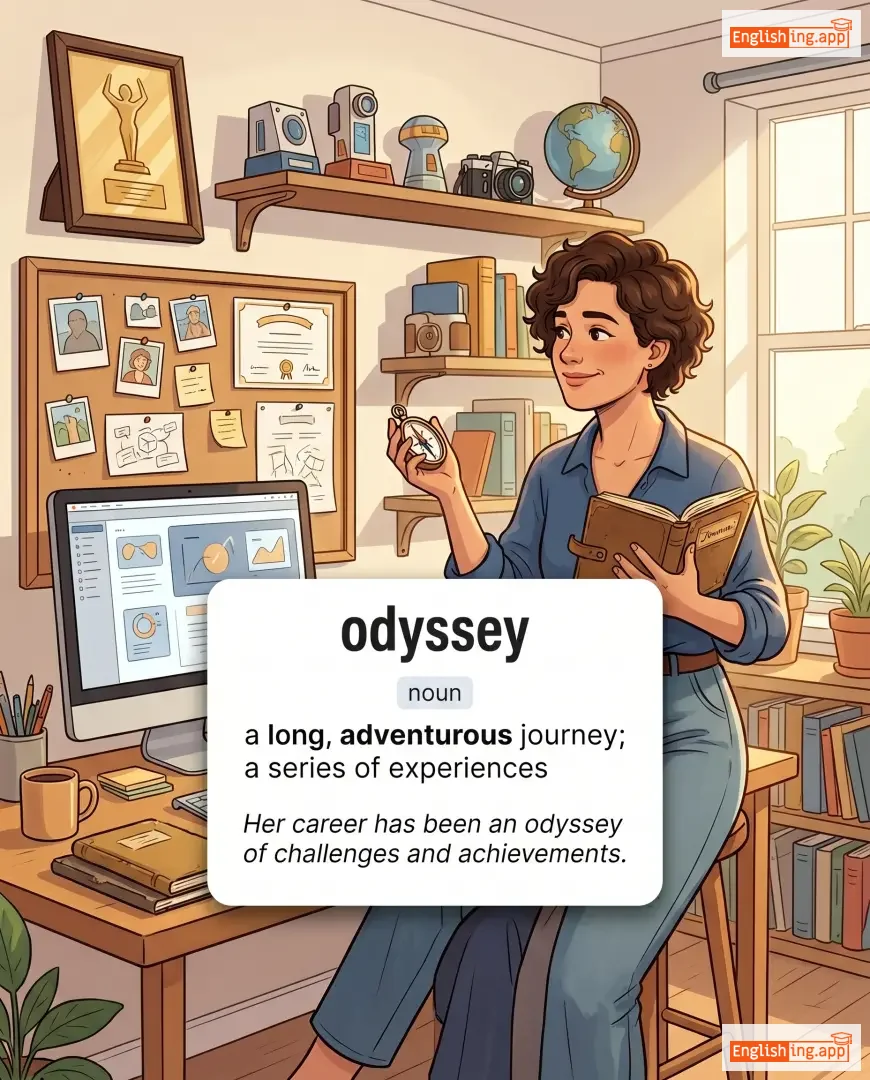
odyssey definition card — visual illustration of the meaning
noun
/ˈɑːdəsi/
long voyage (long voyage)

a long, adventurous journey; a series of experiences

"Her career has been an odyssey of challenges and achievements."

"Sa carrière a été une odyssée de défis et de réussites." (Sa carrière a été une odyssée de défis et de réussites.)
preposition
/ʌv/
de (de)

expressing the relationship between a part and a whole

"The book is on the table, in front of the window."

"Le livre est sur la table, devant la fenêtre." (Le livre est sur la table, devant la fenetre.)
⏹️

off (of)

adverb
/ɔːf/
éteint (etein)

away from a place, position, or time; not functioning

"He turned off the light before leaving the room."

"Il a éteint la lumière avant de quitter la pièce." (Il a eteint la lumiere avant de quitter la piece.)
adjective
/ˌɔːfˈkiː/
fausse note (fausse note)

out of tune; not in accordance with expected standards

"The singer was slightly off-key during the performance."

"Le chanteur était légèrement hors de ton pendant la performance." (Le chanteur était légèrement hors de ton pendant la performance.)
noun
/ˈɔːfəl/
abats (abats)

the internal organs and entrails of an animal used as food; waste parts

"The butcher prepared sausages using pork offal."

"Le boucher a préparé des saucisses en utilisant des abats de porc." (Le boucher a prepare des saucisses en utilisant des abats de porc.)
adjective
/ˈɒf.biːt/
inhabituel (inhabituel)

Unusual, unconventional, or different from the norm.

"She has a very offbeat sense of humor."

"Elle a un sens de l'humour très inhabituel." (Elle a un sens de l'humour tres inhabituel.)
noun
/əˈfens/
offense; délit; attaque (offense; delit; attaque)

a breach of law or rule; an annoyance or resentment

"Stealing is a serious offence punishable by law."

"Le vol est une offense grave punissable par la loi." (Le vol est une offense grave punissable par la loi.)
verb
/əˈfɛnd/
offenser (offenser)

to cause someone to feel upset, insulted, or annoyed

"She didn’t mean to offend anyone with her remarks."

"Elle ne voulait pas offenser quelqu'un avec ses remarques." (Elle ne voulait pas offenser quelqu'un avec ses remarques.)
noun
/əˈfɛndər/
délinquant (delinkwɑ̃)

a person who commits a crime or does something wrong

"The police caught the offender quickly."

"La police a attrapé le délinquant rapidement." (La police a attrapé le délinquant rapidement.)
noun
/əˈfɛns/
infraction (infraction)

an illegal act; a crime

"The offense was committed in broad daylight."

"L'infraction a été commise en plein jour." (L'infraction a été commise en plein jour.)
adjective
/əˈfɛnsɪv/
offensif (offensif)

Causing hurt, anger, or annoyance; also relating to attacking in sports or war.

"His offensive remarks upset everyone at the meeting."

"Ses remarques offensives ont contrarié tout le monde à la réunion." (Ses remarques offensives ont contrarie tout le monde a la reunion.)
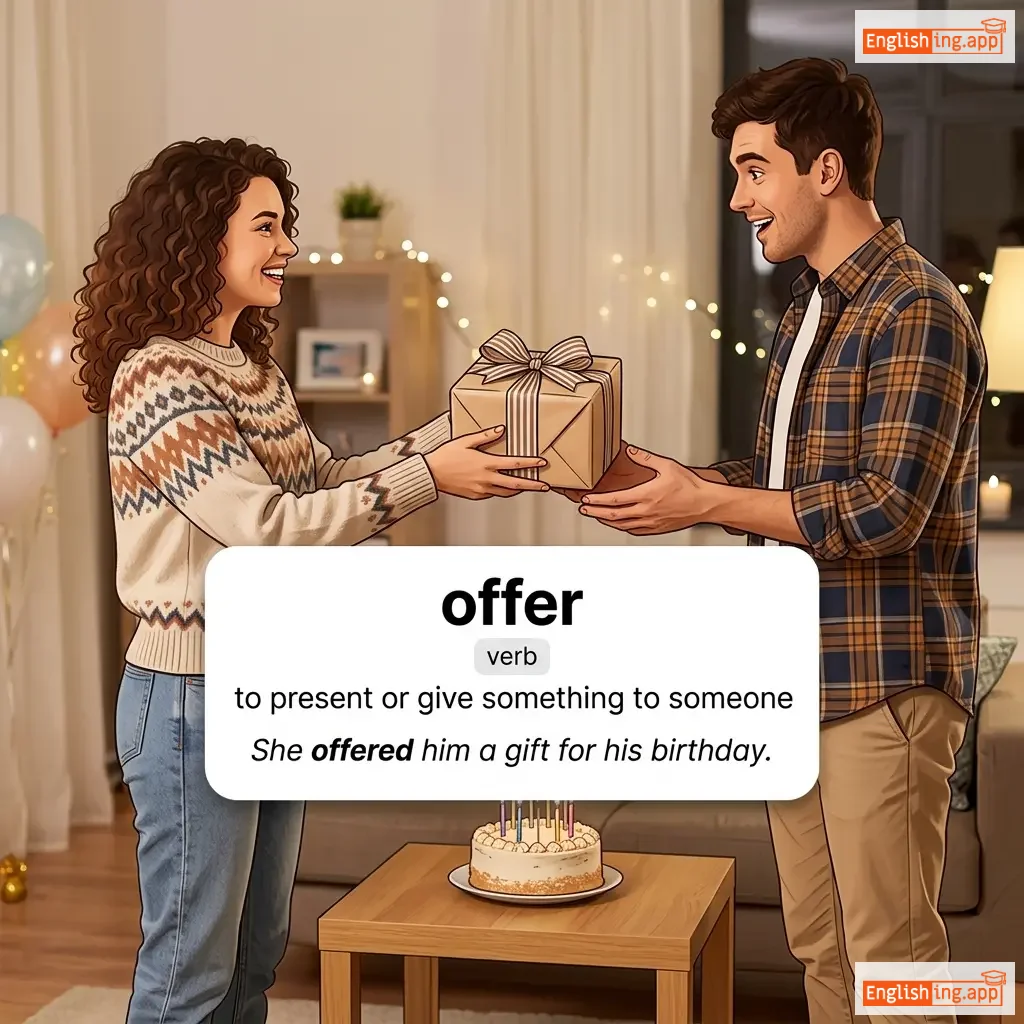
offer definition card — visual illustration of the meaning
verb
/ˈɔːfər/
offrir (offrir)

to present or give something to someone

"She offered him a gift for his birthday."

"Elle lui a offert un cadeau pour son anniversaire." (Elle lui a offert un cadeau pour son anniversaire.)
noun
/ˈɒfərɪŋ/
offre (offre)

something that is given, especially as a gift or contribution

"The company’s latest offering is an eco-friendly car."

"La dernière offre de l'entreprise est une voiture écologique." (La derniere offre de l'entreprise est une voiture ecologique.)
noun
/ˈɒfərtɔːri/
offrande (offrande)

The part of a religious service when offerings are collected; the offering itself.

"The offertory was taken during the Sunday service."

"L'offrande a été prise pendant le service du dimanche." (L'offrande a été prise pendant le service du dimanche.)
adjective/adverb
/ˌɒfˈhænd/
sans réflexion (sans reflexion)

Without previous thought or preparation; casual and sometimes dismissive.

"She gave an offhand reply to his serious question."

"Elle a donné une réponse sans réfléchir à sa question sérieuse." (Elle a donne une reponse sans reflechir a sa question serieuse.)
adjective
/ˈɒnɡəʊɪŋ/
en cours (en cours)

continuing; still in progress

"The ongoing project will finish next month."

"Le projet en cours sera terminé le mois prochain." (Le projet en cours sera termine le mois prochain.)
noun
/ˈoʊ.mən/
un signe de bonne ou mauvaise chance future (un signe de bonne ou mauvaise chance future)

an event regarded as a sign of future good or bad luck

"Many people consider a black cat crossing your path a bad omen."

"Beaucoup de gens considèrent qu'un chat noir traversant votre chemin est un mauvais présage." (Beaucoup de gens considèrent qu'un chat noir traversant votre chemin est un mauvais présage.)
adjective
/ˈɒmɪnəs/
menaçant (menasant)

Giving the impression that something bad or unpleasant is going to happen.

"Dark clouds gave an ominous sign of an approaching storm."

"Les nuages sombres ont donné un signe menaçant d'une tempête approchante." (Les nuages sombres ont donné un signe menaçant d'une tempête approchante.)
noun
/əˈmɪʃən/
omission (omission)

The act of leaving out or excluding something; something that has been left out.

"Her omission of important details caused confusion."

"Son omission de détails importants a causé de la confusion." (Son omission de détails importants a causé de la confusion.)
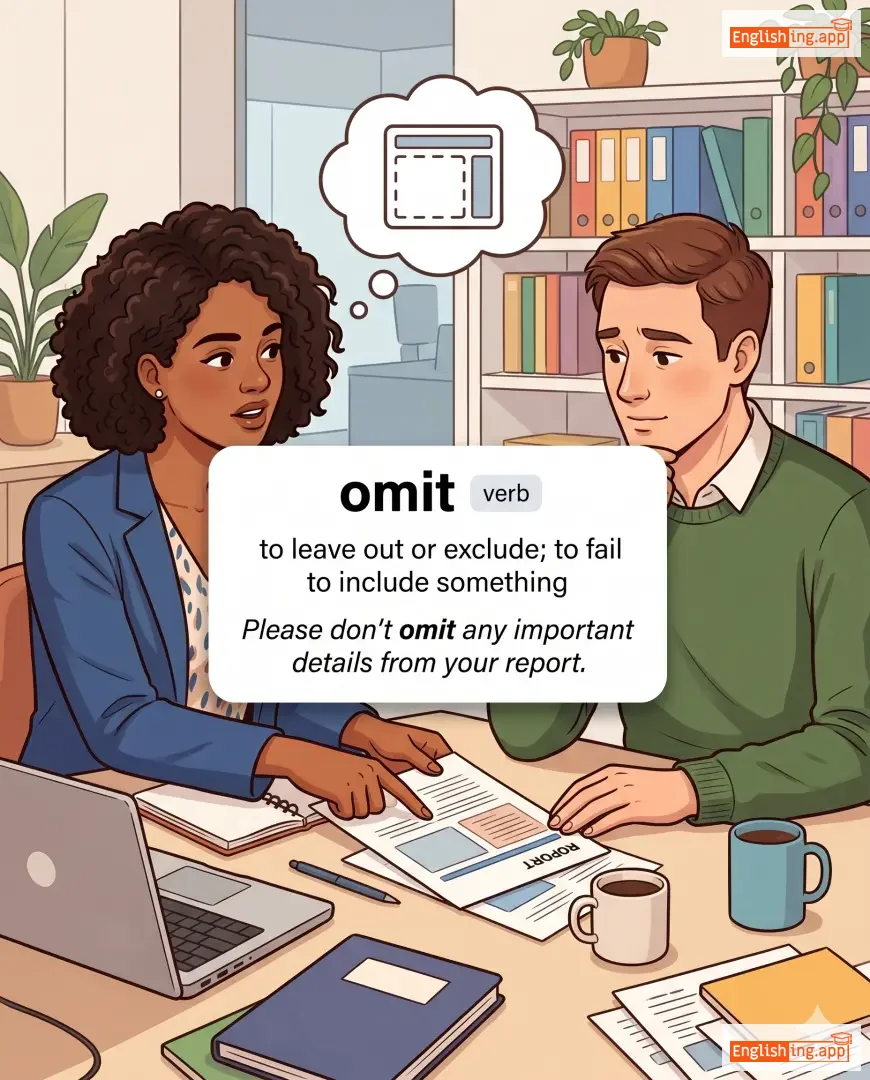
omit definition card — visual illustration of the meaning
verb
/oʊˈmɪt/
omettre (ometre)

to leave out or exclude; to fail to include something

"Please don't omit any important details from your report."

"Veuillez ne pas omettre les détails importants dans votre rapport." (Veuillez ne pas omettre les détails importants dans votre rapport.)
noun
/ɒmˈnɪpətəns/
omnipotence (omnipotence)

The quality of having unlimited power or authority.

"Many religions describe God’s omnipotence as absolute."

"De nombreuses religions décrivent l'omnipotence de Dieu comme absolue." (De nombreuses religions decrivent l'omnipotence de Dieu comme absolue.)
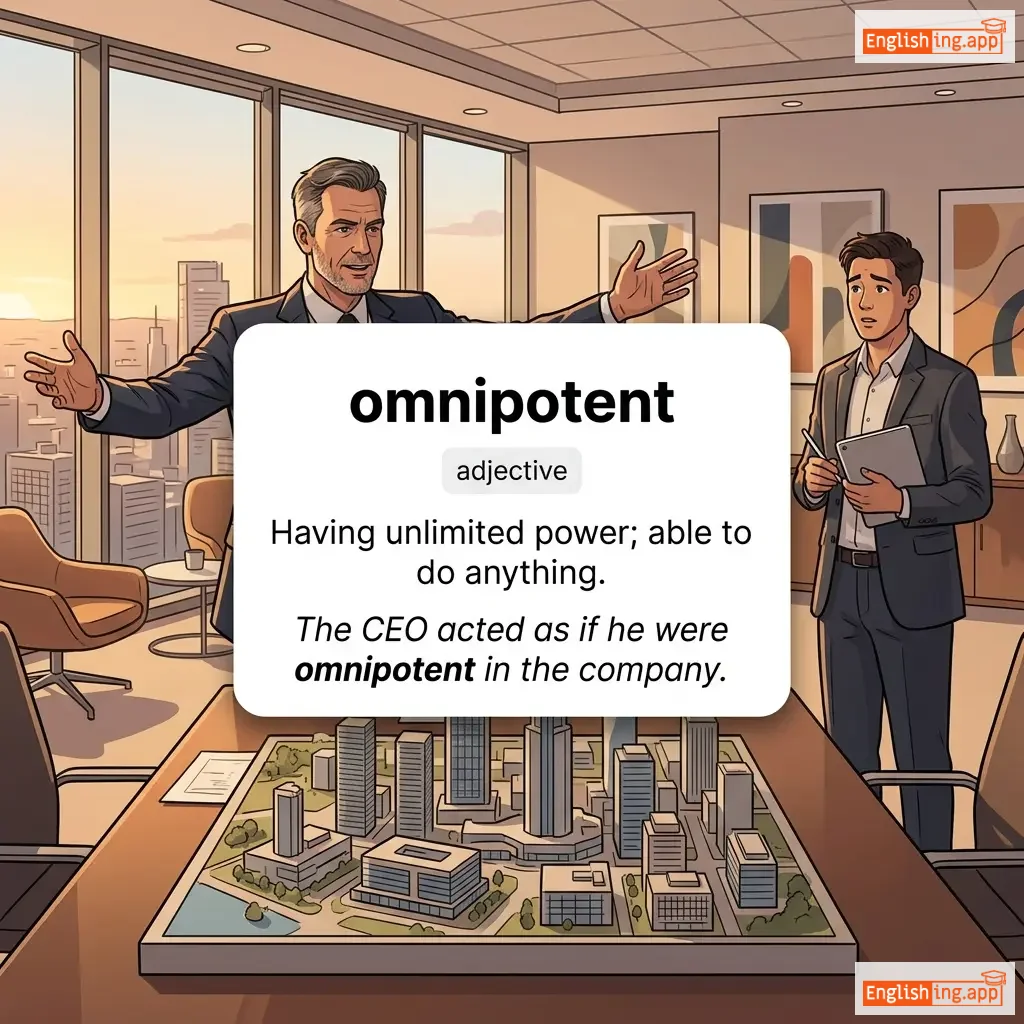
omnipotent definition card — visual illustration of the meaning
adjective
/ɒmˈnɪpətənt/
omnipotent (omnipotent)

Having unlimited power; able to do anything.

"The CEO acted as if he were omnipotent in the company."

"Le PDG a agi comme s'il était omnipotent dans l'entreprise." (Le PDG a agi comme s'il était omnipotent dans l'entreprise.)
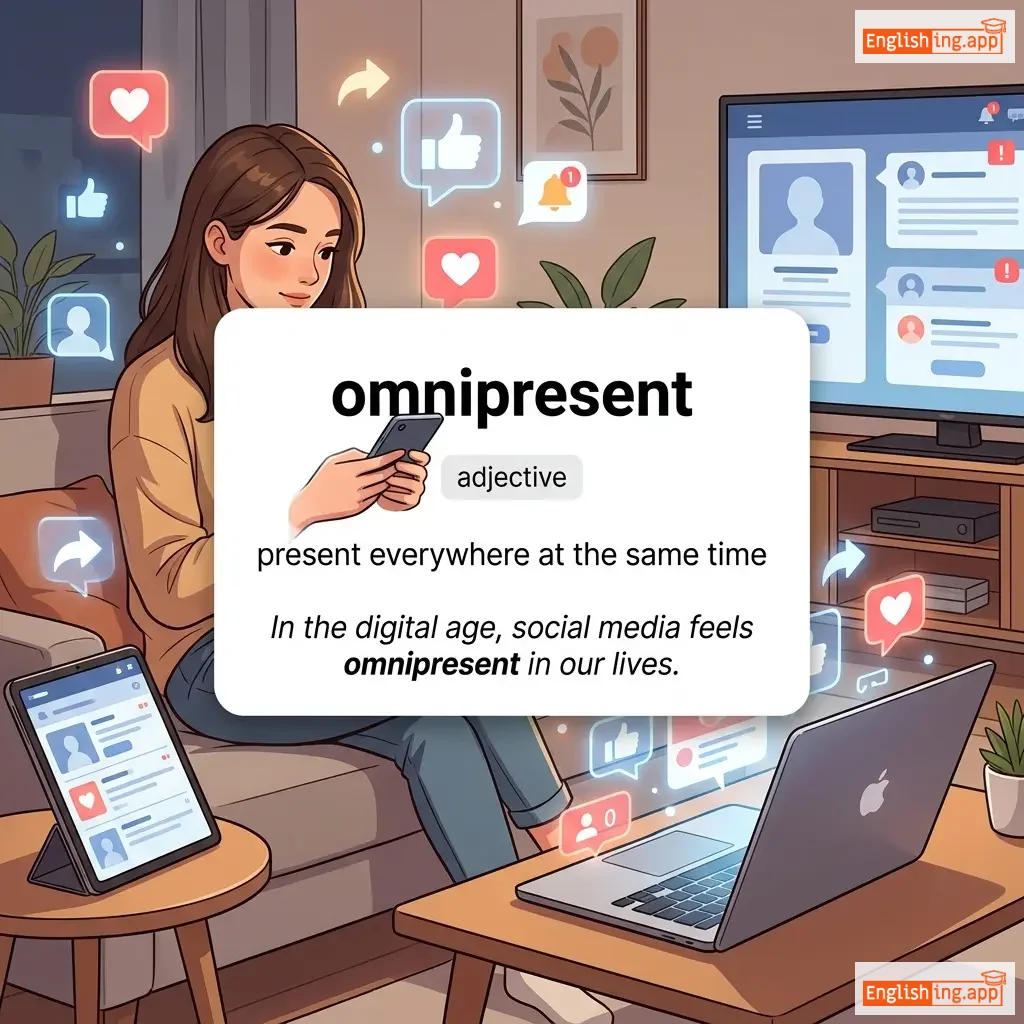
omnipresent definition card — visual illustration of the meaning
adjective
/ˌɒmnɪˈprɛzənt/
omniprésent (omnipresent)

present everywhere at the same time

"In the digital age, social media feels omnipresent in our lives."

"À l'ère numérique, les réseaux sociaux se sentent omniprésents dans nos vies." (A l'ere numerique, les reseaux sociaux se sentent omnipresents dans nos vies.)
noun
/ɒmˈnɪʃəns/
omniscience (omniscience)

the state of knowing everything

"The novel's narrator has an air of omniscience, revealing every character's thoughts."

"Le narrateur du roman a un air d'omniscience, révélant les pensées de chaque personnage." (Le narrateur du roman a un air domniscience, revelant les pensees de chaque personnage.)
adjective
/ɒmˈnɪʃənt/
omniscient (omniscient)

having complete or unlimited knowledge and awareness

"Some religions describe God as omniscient and all-powerful."

"Certaines religions décrivent Dieu comme omniscient et tout-puissant." (Certaines religions decrivent Dieu comme omniscient et tout-puissant.)
adjective
/ɒmˈnɪvərəs/
omnivore (omnivore)

eating both plants and animals

"Humans are generally considered omnivorous creatures."

"Les humains sont généralement considérés comme des créatures omnivores." (Les humains sont généralement considérés comme des créatures omnivores.)
preposition
/ɒn/
sur (sur)

physically in contact with and supported by a surface

"The book is on the table."

"Le livre est sur la table." (Le livre est sur la table.)
adverb
/wʌns/
une fois (une fois)

on one occasion only; at a time in the past

"She visited Paris once last year."

"Elle a visité Paris une fois l'année dernière." (Elle a visité Paris une fois l'année dernière.)
1️⃣

one (wan)

pronoun, noun, adjective
/wʌn/
un (un)

the number equivalent to the sum of zero and one; a single person or thing

"Only one student answered the question."

"Un seul étudiant a répondu à la question." (Un seul étudiant a répondu à la question.)
noun
/wʌn θɜːd/
un tiers (un tiers)

one part of something that is divided into three equal parts

"One-third of the class was absent today."

"Un tiers de la classe était absent aujourd'hui." (Un tiers de la classe était absent aujourd'hui.)
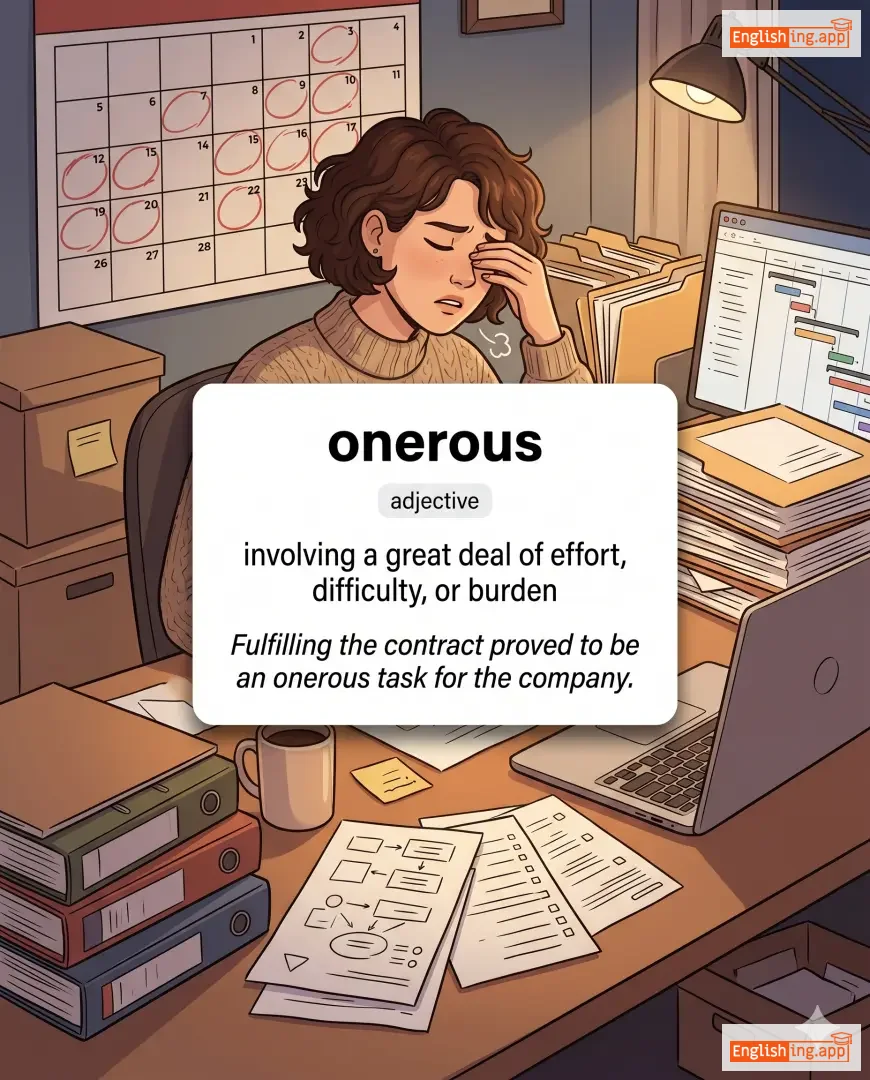
onerous definition card — visual illustration of the meaning
adjective
/ˈəʊnərəs/
ardu (ardu)

involving a great deal of effort, difficulty, or burden

"Fulfilling the contract proved to be an onerous task for the company."

"Accomplir le contrat s'est avéré être une tâche ardue pour l'entreprise." (Accomplir le contrat s'est avéré être une tâche ardue pour l'entreprise.)
verb
/uːz/
suinter (suinter)

to slowly flow or leak out through small openings or pores

"Blood began to ooze from the small cut."

"Le sang a commencé à suinter de la petite coupure." (Le sang a commencé à suinter de la petite coupure.)