Vocabulaires

Découvrez, apprenez et maîtrisez le vocabulaire anglais

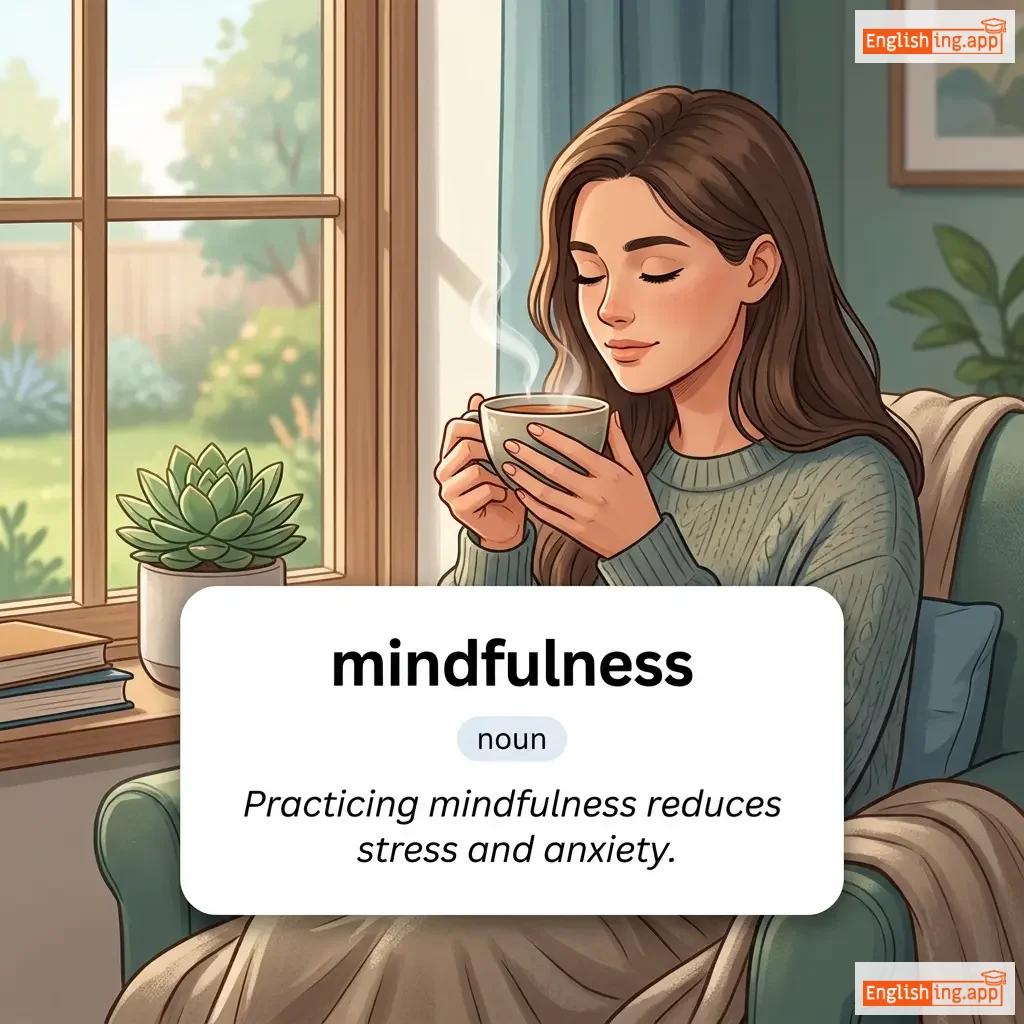
mindfulness definition card — visual illustration of the meaning
noun
/ˈmaɪnd.fʊl.nəs/
pleine conscience (plaine consyens)

The quality or state of being conscious or aware of something; a mental state achieved by focusing one's awareness on the present moment.

"Practicing mindfulness reduces stress and anxiety."

"La pratique de la pleine conscience réduit le stress et l'anxiété." (La pratique de la pleine conscience reduit le stress et l'anxiete.)
adjective
/ˈmaɪndləs/
insensé (insensé)

without thought or intelligence; done without consideration

"He was bored by the mindless tasks at work."

"Il était ennuyé par les tâches insensées au travail." (Il était ennuyé par les tâches insensées au travail.)
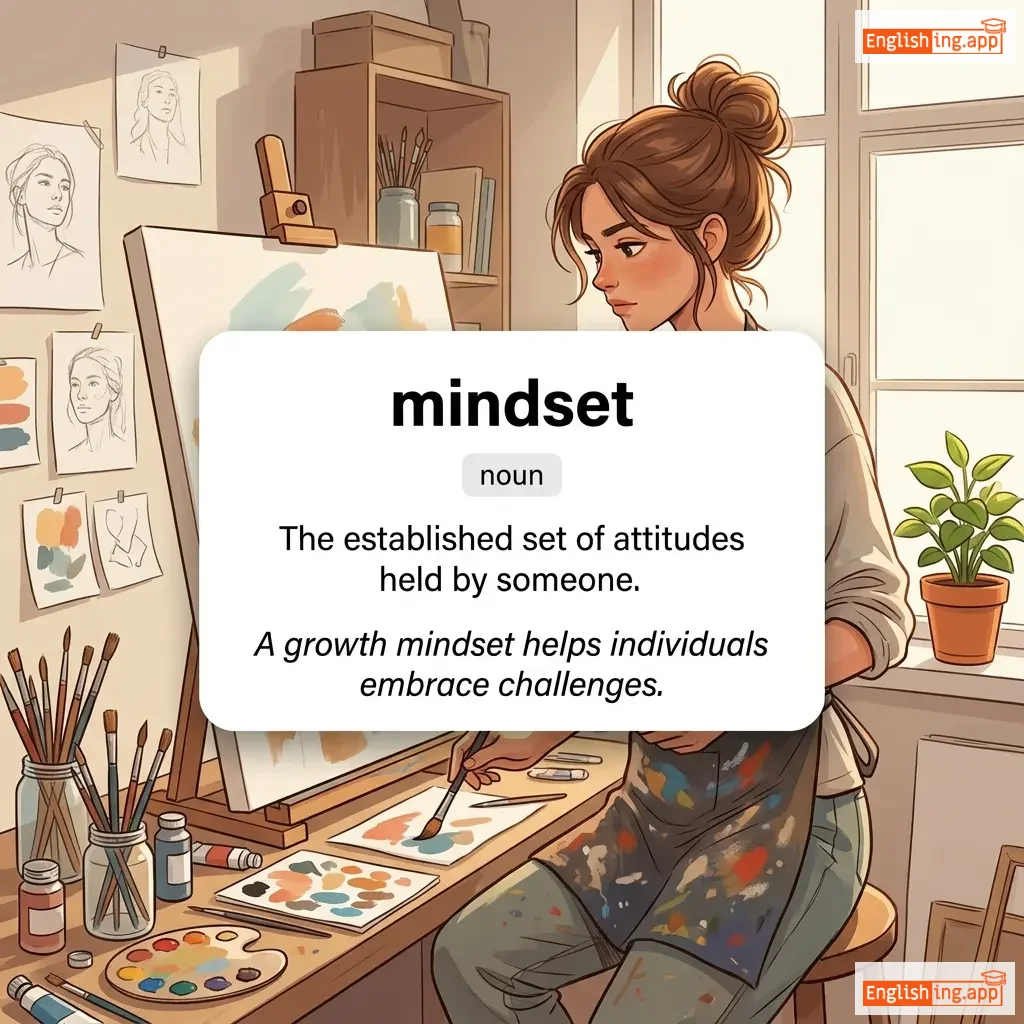
mindset definition card — visual illustration of the meaning
noun
ˈmaɪnd.set
état d’esprit (etat d'esprit)

The established set of attitudes held by someone.

"A growth mindset helps individuals embrace challenges."

"Une mentalité de croissance aide les individus à relever les défis." (Une mentalité de croissance aide les individus à relever les défis.)
noun, pronoun, verb
/maɪn/
mine / mien (mine / mien)

a place where minerals are dug from the ground; or something belonging to me

"The workers went deep into the mine to extract coal."

"Les travailleurs sont allés profondément dans la mine pour extraire du charbon." (Les travailleurs sont allés profondément dans la mine pour extraire du charbon.)
noun
/ˈmaɪnə(r)/
mineur (mineur)

a person who works in a mine, extracting minerals or other resources

"The miner worked in the coal mine for many years."

"Le mineur a travaillé dans la mine de charbon pendant de nombreuses années." (Le mineur a travaillé dans la mine de charbon pendant de nombreuses années.)
noun
/ˈmɪnərəl/
minéral (mineral)

a naturally occurring substance that is solid and inorganic, often used in industry or nutrition

"Calcium is an important mineral for strong bones."

"Le calcium est un minéral important pour des os solides." (Le calcium est un mineral important pour des os solides.)
verb
/ˈmɪŋɡl/
mêler (mêler)

to mix or combine; to move among people and engage socially

"Guests mingled at the party, chatting and laughing together."

"Les invités se minglaient à la fête, discutant et riant ensemble." (Les invités se minglaient à la fête, discutant et riant ensemble.)
adjective
/ˈmɪn.dʒi/
avare; pingre (avare; pingre)

mean or stingy; unwilling to spend money

"He is too mingy to spend money on anything but necessities."

"Il est trop radin pour dépenser de l'argent pour autre chose que les nécessités." (Il est trop radin pour depenser de l'argent pour autre chose que les necessites.)
noun/adjective
/ˈmɪnətʃər/ or /ˈmɪniətʃʊr/
version miniature (version miniature)

a very small version of something; small in scale or size

"The artist created a miniature model of the castle."

"L'artiste a créé un modèle miniature du château." (L'artiste a cree un modele miniature du chateau.)
adjective
/ˈmɪnɪməl/
minimal (minimal)

the smallest or least amount possible

"The damage to the car was minimal after the accident."

"Les dégâts à la voiture étaient minimes après l'accident." (Les degats a la voiture etaient minimes apres l'accident.)
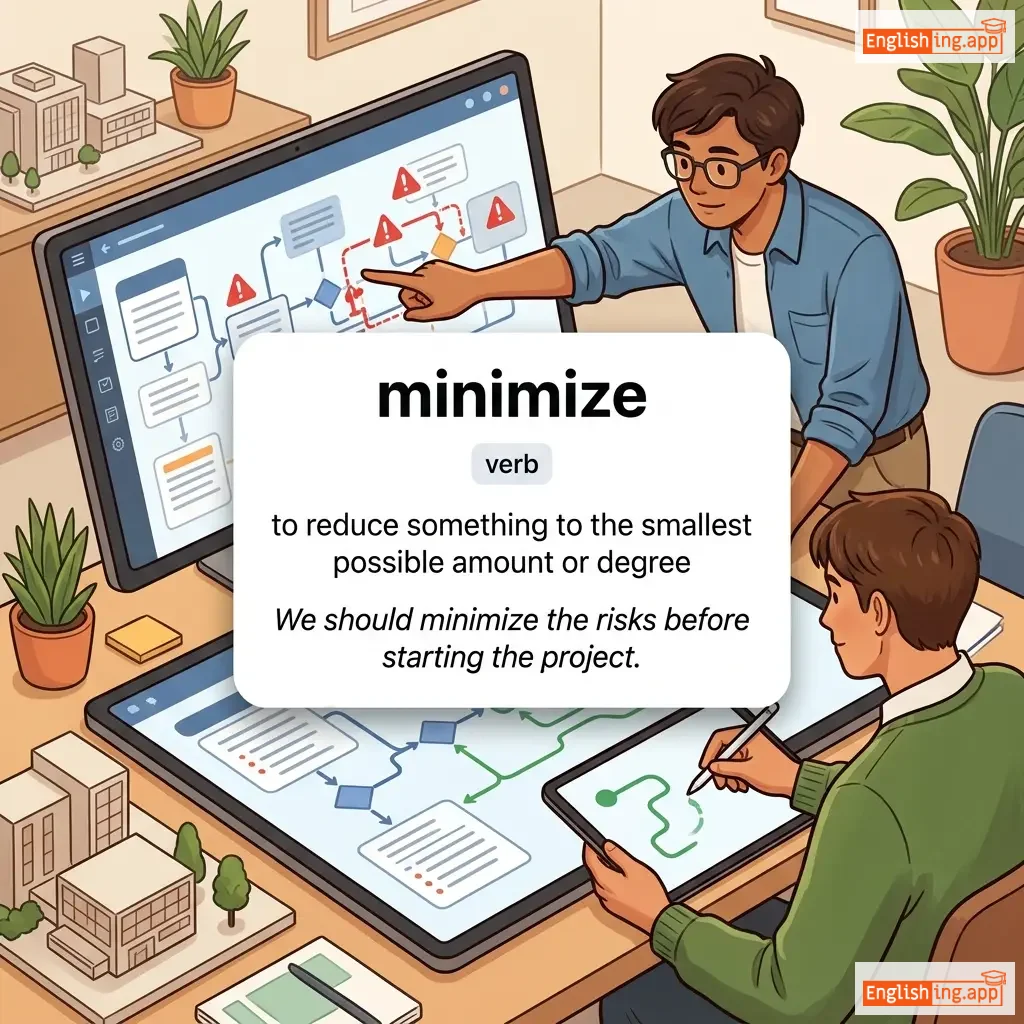
minimize definition card — visual illustration of the meaning
verb
/ˈmɪnɪmaɪz/
minimiser (minimiser)

to reduce something to the smallest possible amount or degree

"We should minimize the risks before starting the project."

"Nous devrions minimiser les risques avant de commencer le projet." (Nous devrions minimiser les risques avant de commencer le projet.)
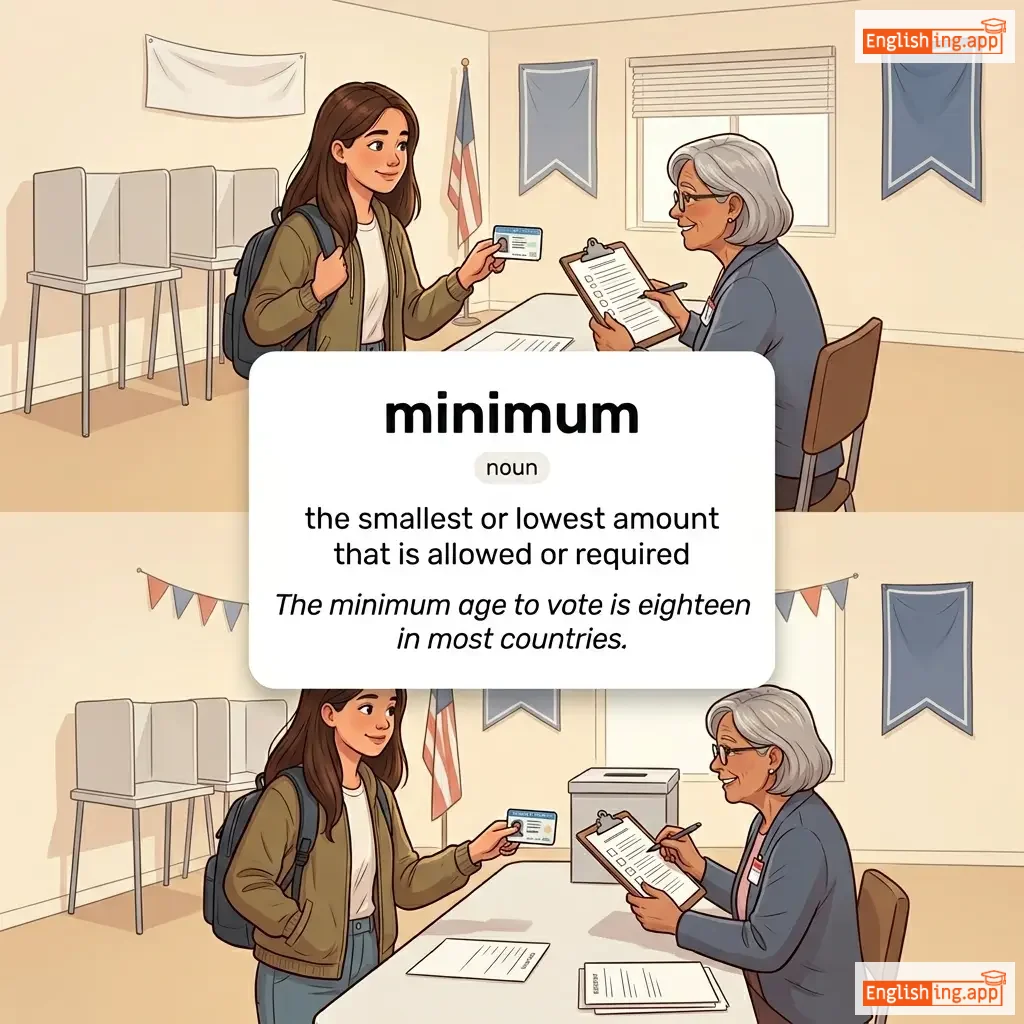
minimum definition card — visual illustration of the meaning
noun
/ˈmɪnɪməm/
minimum (minimum)

the smallest or lowest amount that is allowed or required

"The minimum age to vote is eighteen in most countries."

"L'âge minimum pour voter est de dix-huit ans dans la plupart des pays." (L'age minimum pour voter est de dix-huit ans dans la plupart des pays.)
noun
/ˈmaɪnɪŋ/
exploitation minière (exploitation miniere)

the process of extracting valuable minerals or other resources from the earth

"Mining in this area has increased in recent years."

"L'exploitation minière dans cette région a augmenté ces dernières années." (L'exploitation miniere dans cette region a augmente ces dernieres annees.)
adjective
/ˈmɪn.ɪ.skjuːl/
minuscule (minuscule)

Extremely small or tiny.

"The error was so miniscule that nobody noticed it."

"L'erreur était si minuscule que personne ne l'a remarquée." (L'erreur etait si minuscule que personne ne l'a remarquée.)
🧑‍🤝‍🧑

minion (minion)

noun
/ˈmɪn.i.ən/
minion (minion)

A follower or underling of a powerful person, especially a servile one.

"The dictator was surrounded by loyal minions who carried out his orders."

"Le dictateur était entouré de ministres fidèles qui exécutaient ses ordres." (Le dictateur était entouré de ministres fidèles qui exécutaient ses ordres.)
noun
/ˌmɪsˈkɒndʌkt/
mauvaise conduite (mauvaise conduite)

Improper or unacceptable behavior, especially by a professional or authority figure.

"The teacher was dismissed for serious misconduct."

"L'enseignant a été renvoyé pour mauvaise conduite grave." (L'enseignant a été renvoyé pour mauvaise conduite grave.)
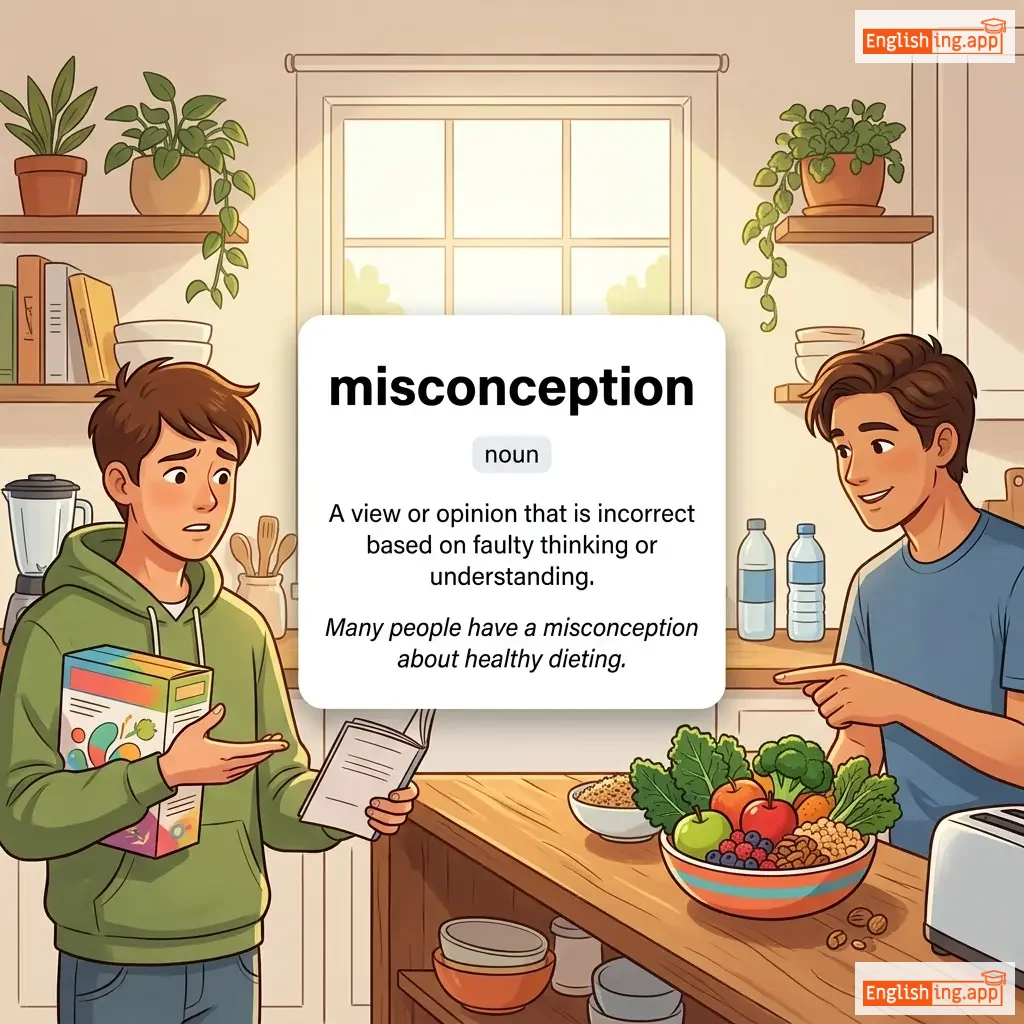
misconception definition card — visual illustration of the meaning
noun
/ˌmɪs.kənˈsep.ʃən/
idée fausse, malentendu (idee fausse, malentendu)

A view or opinion that is incorrect based on faulty thinking or understanding.

"Many people have a misconception about healthy dieting."

"Beaucoup de gens ont une idée fausse sur les régimes alimentaires sains." (Beaucoup de gens ont une idée fausse sur les régimes alimentaires sains.)
verb
/ˌmɪskənˈsiːv/
mal comprendre (mal comprendre)

To misunderstand or form an incorrect idea about something.

"He misconceived the purpose of the project."

"Il a mal compris l'objectif du projet." (Il a mal compris l'objectif du projet.)
adjective
/ˈmɪstʃɪvəs/
espiègle (espiègle)

Causing or showing a fondness for causing trouble in a playful way.

"She gave him a mischievous smile."

"Elle lui a donné un sourire espiègle." (Elle lui a donné un sourire espiègle.)
noun
/ˈmɪstʃɪf/
espièglerie (espieglery)

Playful misbehavior or troublemaking.

"The children were full of mischief during the party."

"Les enfants étaient pleins d'espièglerie pendant la fête." (Les enfants étaient pleins d'espièglerie pendant la fête.)
noun
/ˌmɪsˈtʃæns/
malchance (malchance)

An unfortunate accident or event; bad luck.

"By mischance, he missed the last train home."

"Par malchance, il a raté le dernier train pour rentrer chez lui." (Par malchance il a rate le dernier train pour rentrer chez lui.)
noun
/ˈmɪsəleɪni/
panaché (panache)

A collection or mixture of various things.

"The book is a miscellany of essays and poems."

"Le livre est un panaché d'essais et de poèmes." (Le livre est un panache d'essais et de poèmes.)
adjective
/ˌmɪsəˈleɪniəs/
divers (divers)

Consisting of a variety of different items or types.

"The drawer was filled with miscellaneous objects."

"Le tiroir était rempli d'objets divers." (Le tiroir était rempli d'objets divers.)
noun
/mɪˌsɛdʒəˈneɪʃən/
métissage (metisaj)

the interbreeding of people considered to be of different racial types

"The law once prohibited miscegenation in many countries."

"La loi interdisait autrefois la miscegénation dans de nombreux pays." (La loi interdisait autrefois la miscegénation dans de nombreux pays.)
noun
/ˌmɪs.bɪˈheɪ.vjər/
Comportement mauvais ou inacceptable, surtout chez les enfants ou dans des situations formelles (misbehaviour)

Bad or unacceptable behavior, especially by children or in formal situations

"The student was punished for his misbehaviour in class."

"L'étudiant a été puni pour son mauvais comportement en classe." (L'étudiant a été puni pour son mauvais comportement en classe.)
noun
/ˌmɪsbɪˈheɪvjər/
mauvais comportement (mauvais comportement)

bad or improper behavior

"The teacher punished the student for his misbehavior."

"L'enseignant a puni l'étudiant pour son mauvais comportement." (L'enseignant a puni l'étudiant pour son mauvais comportement.)
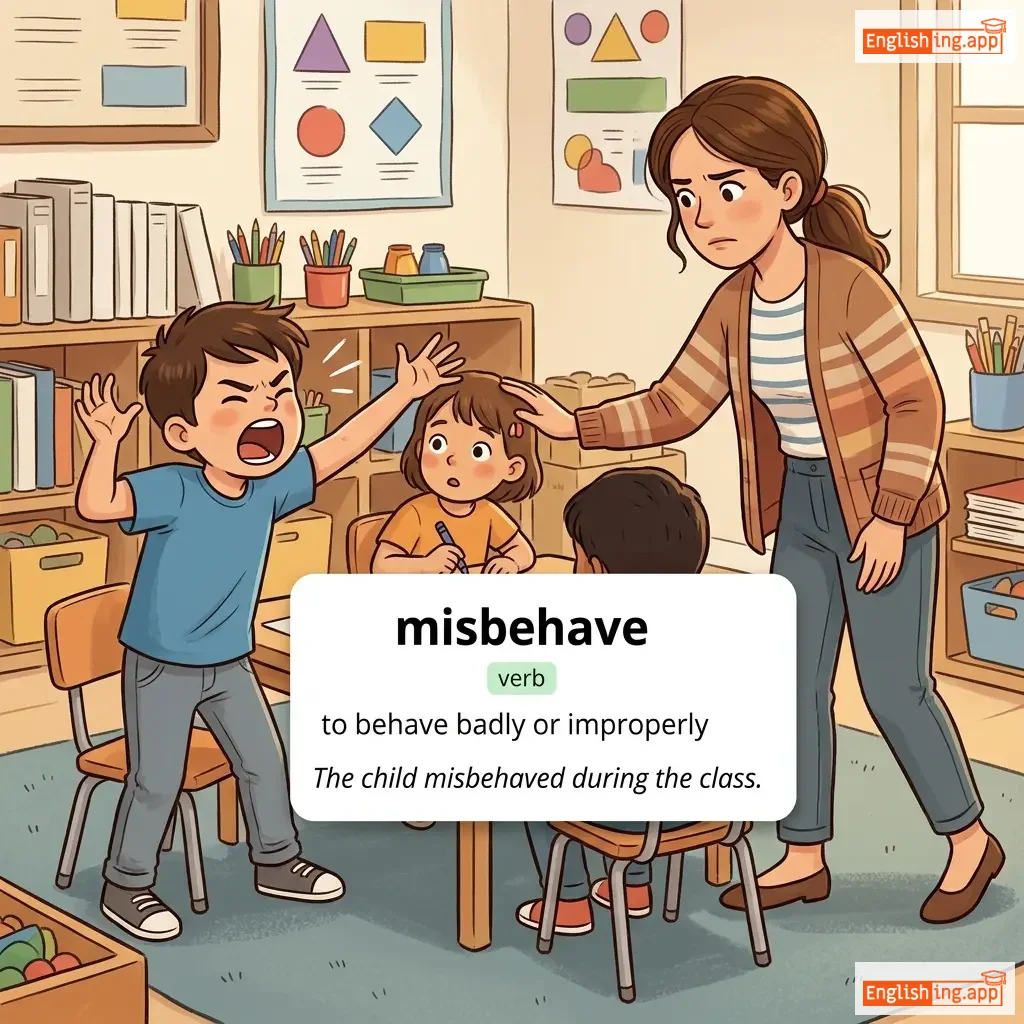
misbehave definition card — visual illustration of the meaning
verb
/ˌmɪsbɪˈheɪv/
mal se comporter (mal se comporter)

to behave badly or improperly

"The child misbehaved during the class."

"L'enfant a mal agi pendant le cours." (L'enfant a mal agi pendant le cours.)
verb
/ˌmɪs.əˈtrɪb.juːt/
mal attribuer (mal attribuer)

to incorrectly credit something, such as a work or remark, to the wrong person or source

"The quote was misattributed to Shakespeare."

"La citation a été mal attribuée à Shakespeare." (La citation a été mal attribuée à Shakespeare.)
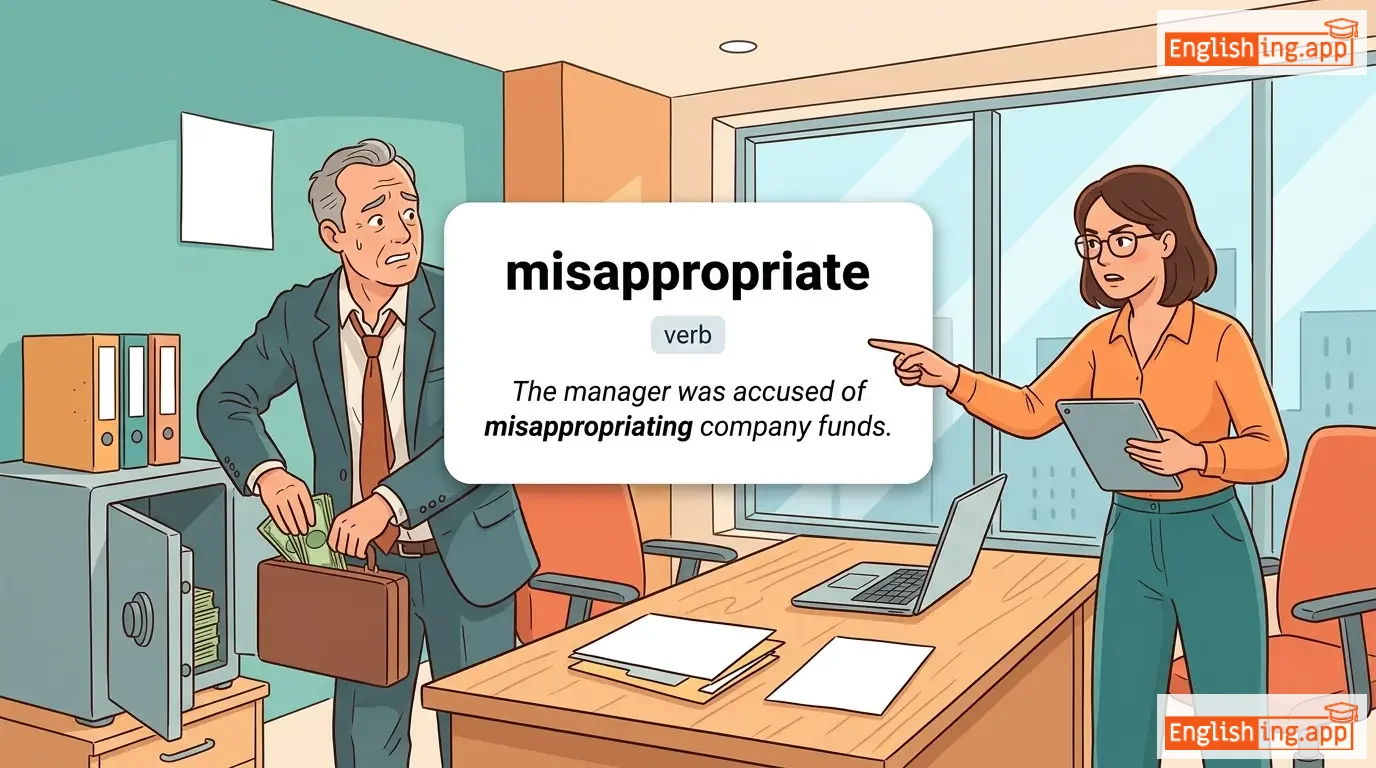
misappropriate definition card — visual illustration of the meaning
verb
/ˌmɪsəˈproʊprieɪt/
détourner (detourner)

to take or use something dishonestly, especially money or property, for one's own use

"The manager was accused of misappropriating company funds."

"Le responsable a été accusé d'avoir mal utilisé les fonds de l'entreprise." (Le responsable a été accusé d'avoir mal utilisé les fonds de l'entreprise.)
noun
/ˌmɪsæprɪˈhɛnʃən/
méprise (meprise)

a mistaken belief or misunderstanding

"There is a common misapprehension about the causes of the disease."

"Il existe une méprise courante sur les causes de la maladie." (Il existe une méprise courante sur les causes de la maladie.)
verb
/ˌmɪsæprɪˈhɛnd/
mal comprendre (mal comprendre)

to misunderstand or misinterpret something

"He misapprehended the teacher’s instructions and did the task incorrectly."

"Il a mal compris les instructions du professeur et a fait la tâche incorrectement." (Il a mal compris les instructions du professeur et a fait la tâche incorrectement.)
noun
/mɪˈsænθrəpi/
misanthropie (misanthropie)

a general dislike, distrust, or hatred of humankind

"His misanthropy was evident in the way he avoided people."

"Sa misanthropie était évidente dans la façon dont il évitait les gens." (Sa misanthropie était évidente dans la façon dont il évitait les gens.)
adjective
/ˌmɪsənˈθrɑːpɪk/
misanthropique (misanthropique)

having or showing a dislike of humankind

"His misanthropic attitude made it difficult for him to make friends."

"Son attitude misanthropique rendait difficile de se faire des amis." (Son attitude misanthropique rendait difficile de se faire des amis.)
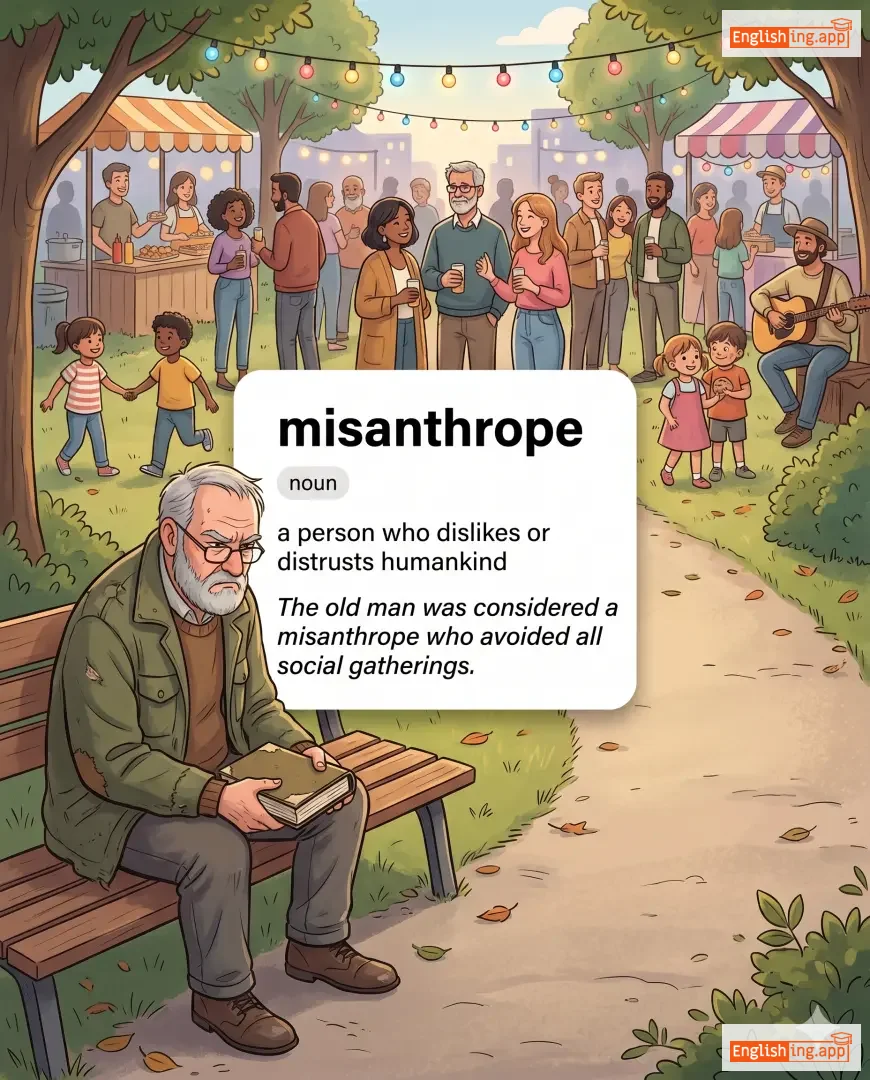
misanthrope definition card — visual illustration of the meaning
noun
/ˈmɪsənˌθroʊp/
misanthrope (misanthrope)

a person who dislikes or distrusts humankind

"The old man was considered a misanthrope who avoided all social gatherings."

"L'homme âgé était considéré comme un misanthrope qui évitait tous les rassemblements sociaux." (L'homme âgé était considéré comme un misanthrope qui évitait tous les rassemblements sociaux.)
noun
/mɜːrθ/
joie (joie)

Great joy, amusement, or laughter.

"The festival was full of mirth and laughter."

"Le festival était plein de joie et de rires." (Le festival était plein de joie et de rires.)
noun
/ˌmɪsədˈvɛntʃər/
mésaventure (mesaventure)

An unlucky accident, mishap, or unfortunate event.

"He broke his leg during a skiing misadventure."

"Il s'est cassé la jambe lors d'une mésaventure en ski." (Il s'est casse la jambe lors d'une mesaventure en ski.)
noun
/ˈmɪnɪstər/
ministre (ministre)

a head of a government department; a person who leads a church

"The finance minister announced new tax policies."

"Le ministre des finances a annoncé de nouvelles politiques fiscales." (Le ministre des finances a annoncé de nouvelles politiques fiscales.)
noun
/ˌmɪn.ɪˈstreɪ.ʃən/
service (service)

The act of providing care, assistance, or religious service.

"She recovered thanks to the kind ministrations of the nurses."

"Elle s'est rétablie grâce aux gentilles ministrations des infirmières." (Elle s'est rétablie grâce aux gentilles ministrations des infirmières.)
noun
/ˈmɪn.ɪ.stri/
ministère (ministere)

A government department headed by a minister or the work of a religious minister.

"He works at the Ministry of Education."

"Il travaille au Ministère de l'Éducation." (Il travaille au Ministère de l'Éducation.)
adjective/noun
/ˈmaɪ.nər/
mineur / insignifiant (mineur / insignifiant)

less important, serious, or significant; a person under the legal age

"Luckily, the accident caused only minor injuries."

"Heureusement, l'accident a causé seulement des blessures mineures." (Heureusement, l'accident a causé seulement des blessures mineures.)
noun
/maɪˈnɔːr.ɪ.ti/
minorité (minorité)

A smaller number or part, especially a group differing from the majority.

"The law aims to protect the rights of ethnic minorities."

"La loi vise à protéger les droits des minorités ethniques." (La loi vise à protéger les droits des minorités ethniques.)
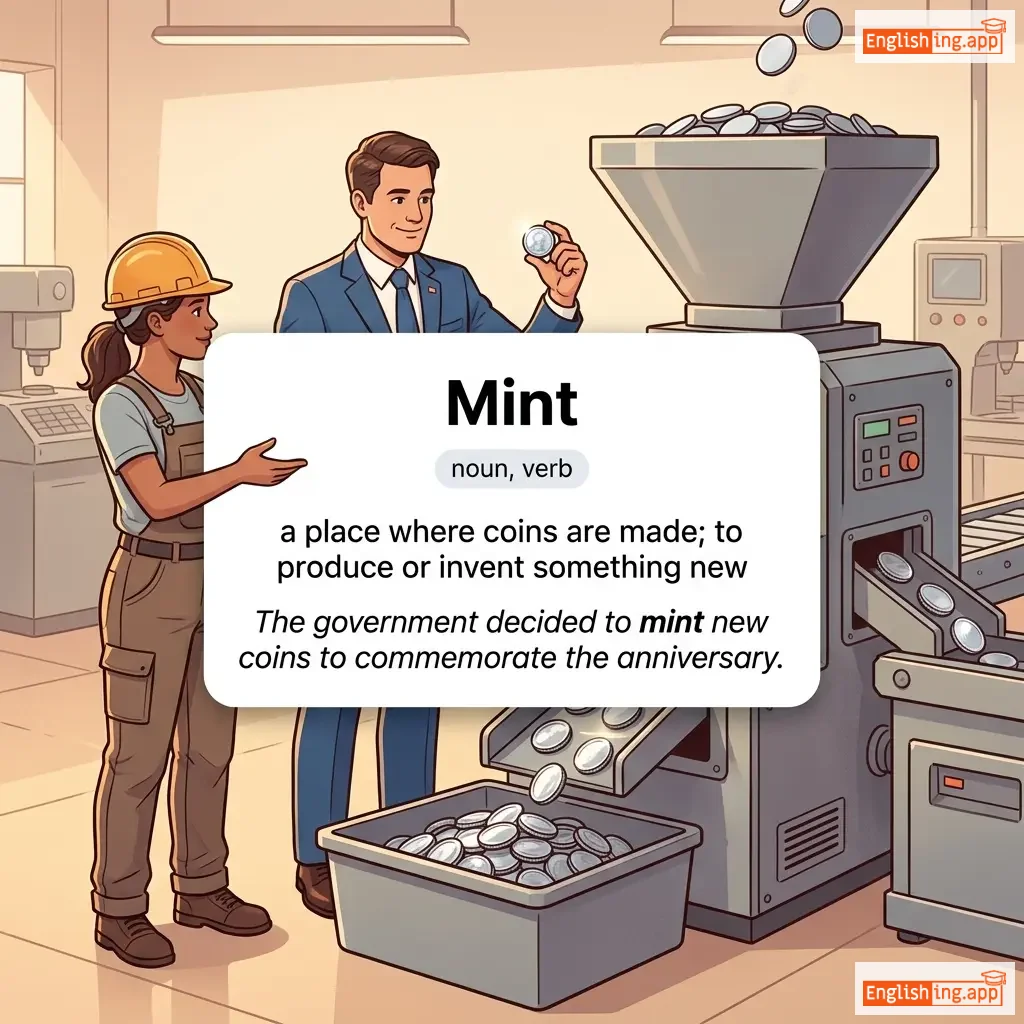
Mint definition card — visual illustration of the meaning
noun, verb
/mɪnt/
menthe / monnaie (menthe / monnaie)

a place where coins are made; to produce or invent something new

"The government decided to mint new coins to commemorate the anniversary."

"Le gouvernement a décidé de frapper de nouvelles pièces pour commémorer l'anniversaire." (Le gouvernement a décidé de frapper de nouvelles pièces pour commémorer l'anniversaire.)
adjective
/ˈmɪnəskjuːl/
minuscule (minuscule)

extremely small in size or importance

"She made only a minuscule contribution to the project."

"Elle n'a fait qu'une contribution minuscule au projet." (Elle na fait quune contribution minuscule au projet.)
noun, adjective
/maɪˈnjuːt/ (adj), /ˈmɪnɪt/ (noun)
minute / minuscule (minute / minuscule)

a period of sixty seconds; extremely small or detailed

"He examined the painting with minute attention to detail."

"Il a examiné la peinture avec une attention minutieuse aux détails." (Il a examiné la peinture avec une attention minutieuse aux détails.)
noun
/maɪˈnjuːʃə/
détails insignifiants (detay insignifiants)

a small or trivial detail of something

"He was bored by the minutia of office paperwork."

"Il était ennuyé par les détails insignifiants des papiers de bureau." (Il etait ennuyé par les détails insignifiants des papiers de bureau.)
adverb
/maɪˈnjuːtli/
minutieusement (minutieusement)

in very small detail; extremely carefully

"The detective examined the evidence minutely."

"Le détective a examiné la preuve minutieusement." (Le détective a examiné la preuve minutieusement.)
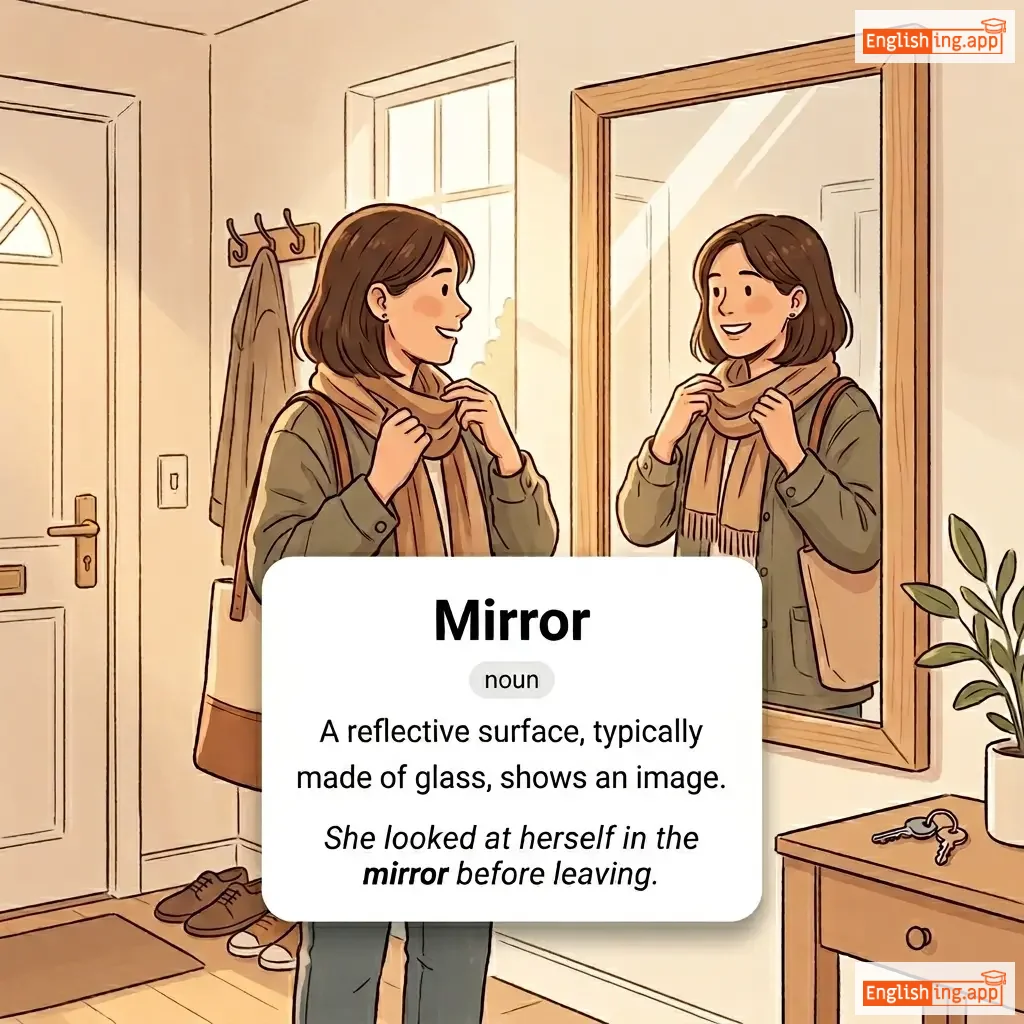
Mirror definition card — visual illustration of the meaning
noun
/ˈmɪrər/
miroir (miroir)

A reflective surface, typically made of glass, that shows an image.

"She looked at herself in the mirror before leaving."

"Elle s'est regardée dans le miroir avant de partir." (Elle s'est regardée dans le miroir avant de partir.)
adjective, verb (past tense/participle of mire)
/ˈmaɪərd/
embourbé (embourbé)

Trapped or entangled in something, typically a difficult situation.

"The politician was mired in scandal."

"Le politicien était embourbé dans un scandale." (Le politicien etait embourbe dans un scandale.)
noun, verb
/ˈmaɪər/
marécage / enchevêtrement (marecage / enchevetrement)

A stretch of swampy or boggy ground; as a verb, to entangle or involve someone in a difficult situation.

"The car was stuck in the mire after the heavy rain."

"La voiture est restée coincée dans la boue après la forte pluie." (La voiture est restee coincee dans la boue apres la forte pluie.)
adjective
/mɪˈrækjələs/
miraculeux (miraculeux)

Extraordinarily wonderful or unusual, as if by a miracle.

"Her recovery after the accident was truly miraculous."

"Sa récupération après l'accident a été véritablement miraculeuse." (Sa récupération après l'accident a été véritablement miraculeuse.)