Vocabulaires

Découvrez, apprenez et maîtrisez le vocabulaire anglais

noun
/neɪv/
nef centrale de l'église (nef centrale de l'église)

the central part of a church building intended to accommodate the congregation

"The choir sang beautifully in the church nave."

"Le chœur a chanté magnifiquement dans la nef de l'église." (Le chœur a chanté magnifiquement dans la nef de l'église.)
noun
/ˈneɪvəl/
nombril (neyvel)

the small hollow or raised area in the middle of the stomach, also called the belly button

"The baby’s navel was carefully cleaned after birth."

"Le nombril du bebe a ete soigneusement nettoye apres la naissance." (Le nombril du bebe a ete soigneusement nettoye apres la naissance.)
adjective
/ˈnæv.ɪ.ɡə.bəl/
navigable (navigable)

Able to be sailed on or through by ships or boats.

"The river is navigable for large cargo ships."

"Le fleuve est navigable pour les grands navires de charge." (Le fleuve est navigable pour les grands navires de charge.)
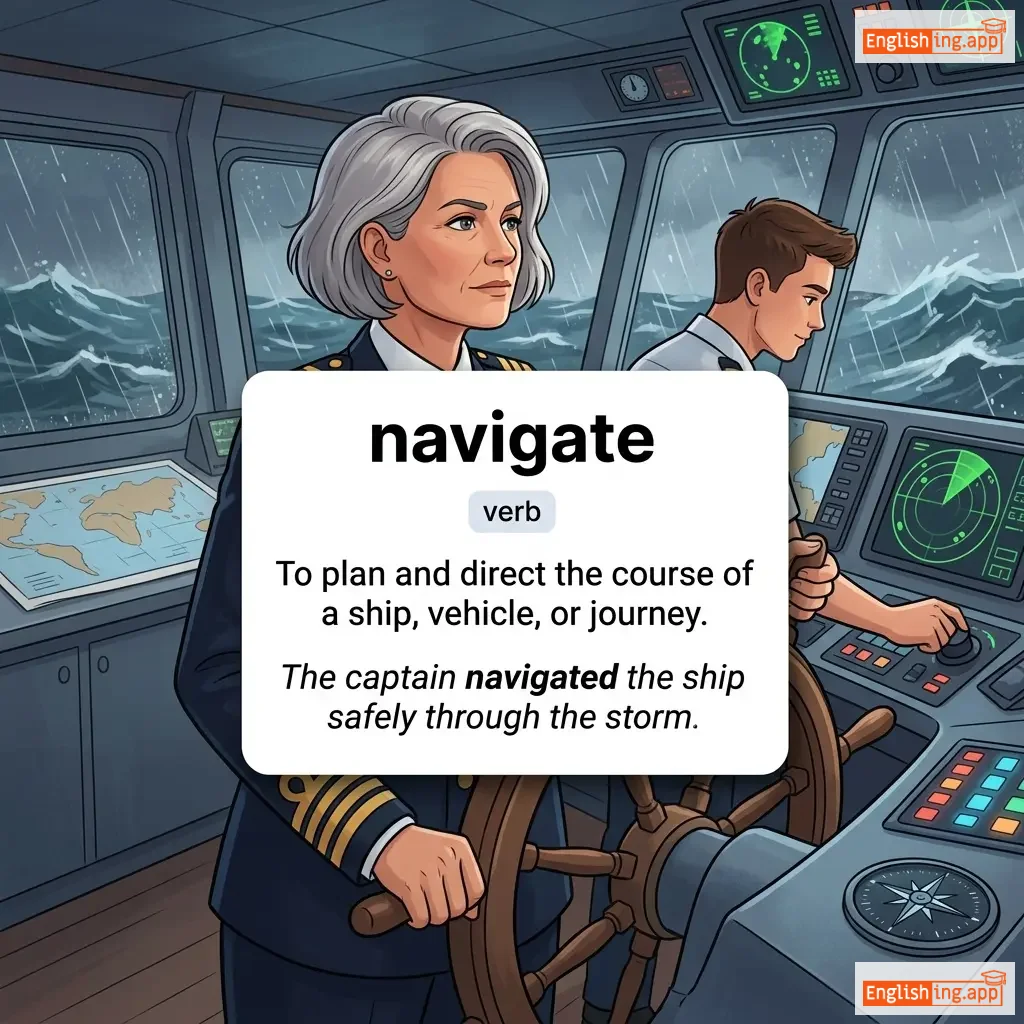
navigate definition card — visual illustration of the meaning
verb
/ˈnæv.ɪ.ɡeɪt/
naviguer (naviguer)

To plan and direct the course of a ship, vehicle, or journey.

"The captain navigated the ship safely through the storm."

"Le capitaine a navigué le navire en toute sécurité à travers la tempête." (Le capitaine a navigué le navire en toute sécurité à travers la tempête.)
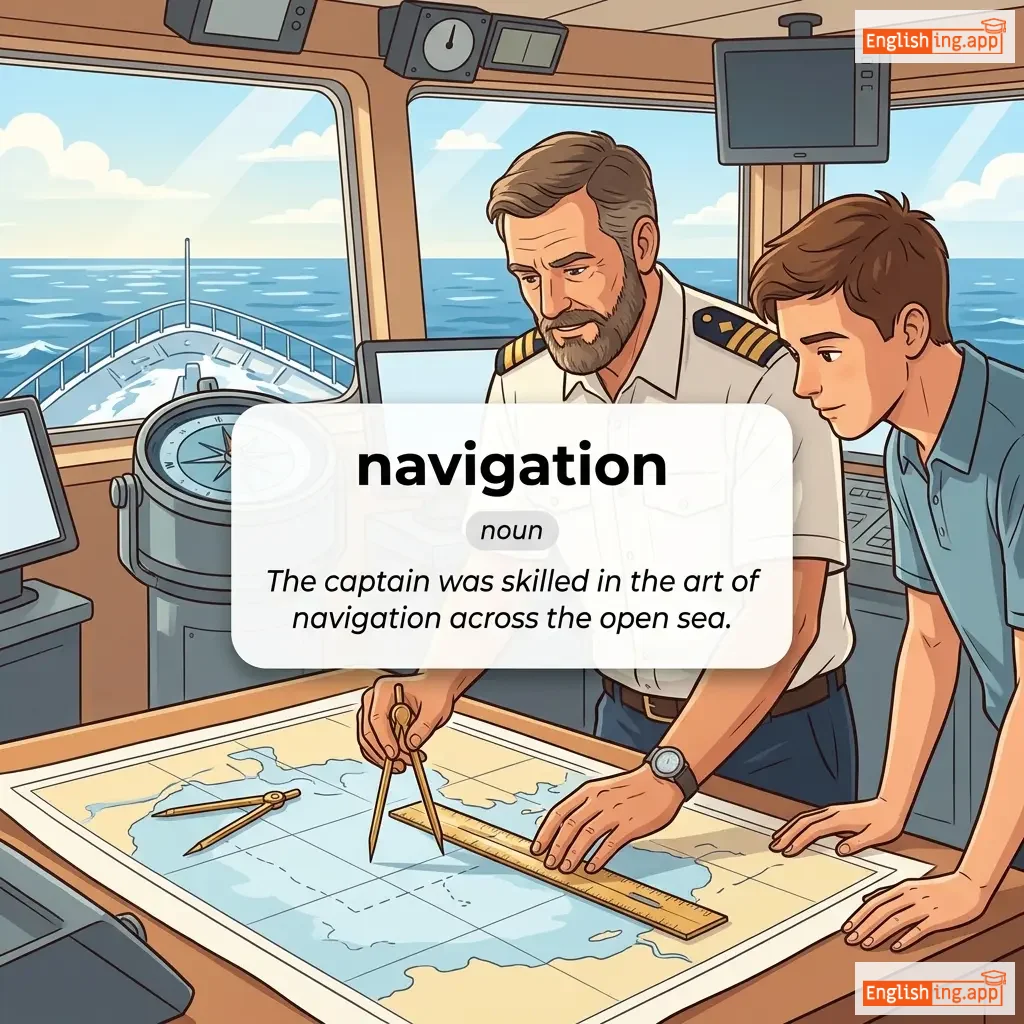
navigation definition card — visual illustration of the meaning
noun
/ˌnævɪˈɡeɪʃən/
navigation (navigation)

the process or activity of accurately determining one's position and planning and following a route

"The captain was skilled in the art of navigation across the open sea."

"Le capitaine était expert dans l'art de la navigation à travers la mer ouverte." (Le capitaine etait expert dans l'art de la navigation a travers la mer ouverte.)
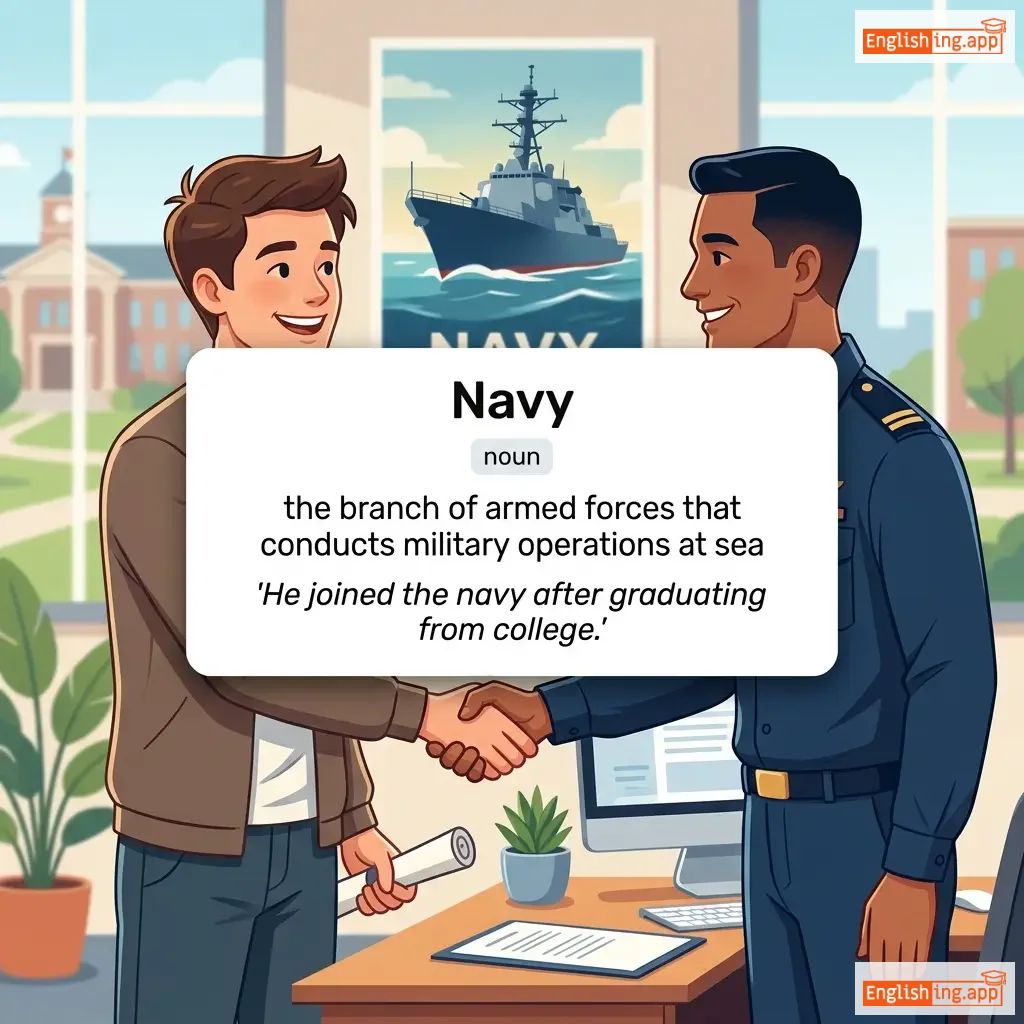
Navy definition card — visual illustration of the meaning
noun
/ˈneɪvi/
marine (marine)

the branch of armed forces that conducts military operations at sea

"He joined the navy after graduating from college."

"Il a rejoint la marine après avoir obtenu son diplôme universitaire." (Il a rejoint la marine après avoir obtenu son diplôme universitaire.)
noun
/ˈneɪˌseɪ.ɪŋ/
expression négative (expression negative)

The act of expressing negative or pessimistic views.

"His constant naysaying discouraged the team."

"Ses continuelles expressions négatives ont découragé l'équipe." (Ses continuelles expressions négatives ont découragé l'équipe.)
noun
/ˌɛn.biː.esˈpiː/
espace insécable (espace insecable)

a non-breaking space character in HTML used to prevent an automatic line break at its position

"Use   in HTML to add a space that won't break into a new line."

"Utilisez   dans HTML pour ajouter un espace qui ne se casse pas en une nouvelle ligne." (Utilisez   dans HTML pour ajouter un espace qui ne se casse pas en une nouvelle ligne.)
noun
/niːp/
marée basse (maree basse)

A tide just after the first or third quarters of the moon when the difference between high and low tide is least.

"During a neap tide, the water level change is minimal."

"Pendant une marée basse, le changement du niveau de l'eau est minimal." (Pendant une marea basse, le changement du niveau de l'eau est minimal.)
preposition
/nɪə(r)/
près (pres)

At or to a short distance away; close in space, time, or relationship.

"There is a park near my house."

"Il y a un parc près de chez moi." (Il y a un parc près de chez moi.)
adverb
/ˈnɪərbaɪ/
près; dans les environs (pres; dans les environs)

close to; not far away; in the neighborhood

"There is a grocery store nearby."

"Il y a un magasin d'alimentation près." (Il y a un magasin d'alimentation près.)
adjective
/ˈnɪəˌbaɪ/
à proximité (a proximite)

close to a particular place or person

"The nearest gas station is nearby."

"La station-service la plus proche est à proximité." (La station service la plus proche est a proximite.)
adverb
/ˈnɪəli/
presque (presque)

almost, but not completely

"She nearly missed the bus."

"Elle a presque raté le bus." (Elle a presque rate le bus.)
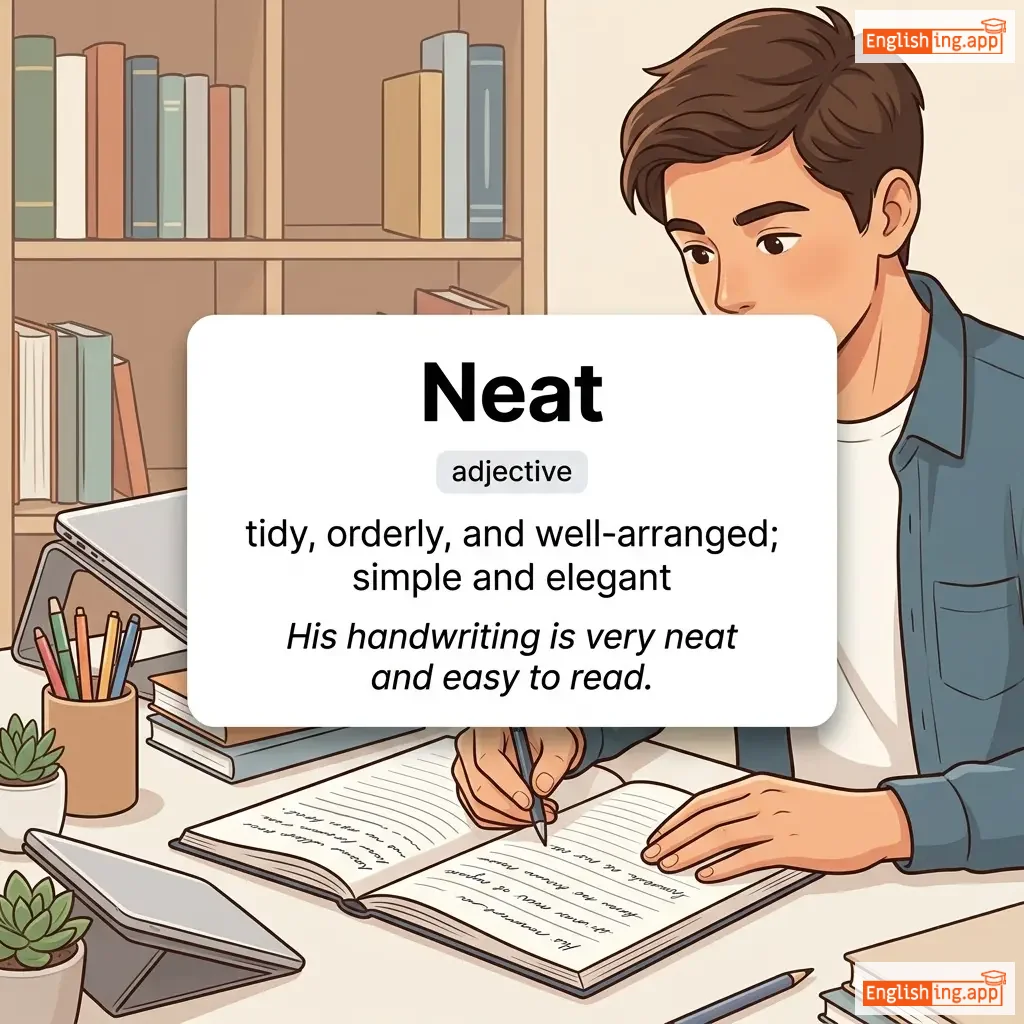
Neat definition card — visual illustration of the meaning
adjective
/niːt/
propre (propre)

tidy, orderly, and well-arranged; simple and elegant

"His handwriting is very neat and easy to read."

"Son écriture est très propre et facile à lire." (Son écriture est très propre et facile à lire.)
adverb
/ˈniːtli/
soigneusement; proprement (soigneusement; proprement)

in a tidy and orderly way; carefully and precisely

"She arranged the books neatly on the shelf."

"Elle a rangé les livres soigneusement sur l'étagère." (Elle a range les livres soigneusement sur l'etagere.)
noun
/ˈneb.jʊ.lə/
nébuleuse (nebuleuse)

A cloud of gas and dust in outer space, sometimes visible in the night sky.

"The Orion Nebula is one of the brightest in the sky."

"La nébuleuse d'Orion est l'une des plus brillantes dans le ciel." (La nébuleuse d'Orion est l'une des plus brillantes dans le ciel.)
adjective
/ˈnɛbjələs/
nébuleux (nebulö)

Unclear, vague, or ill-defined; resembling a cloud or haze.

"His plan for the future was still nebulous and hard to understand."

"Son plan pour l'avenir était encore nébuleux et difficile à comprendre." (Son plan pour l'avenir était encore nébuleux et difficile à comprendre.)
adverb
/ˌnɛsəˈsɛrɪli/
nécessairement (necessairement)

as a necessary result; inevitably

"It doesn’t necessarily mean you’re wrong."

"Cela ne signifie pas nécessairement que vous avez tort." (Cela ne signifie pas nécessairement que vous avez tort.)
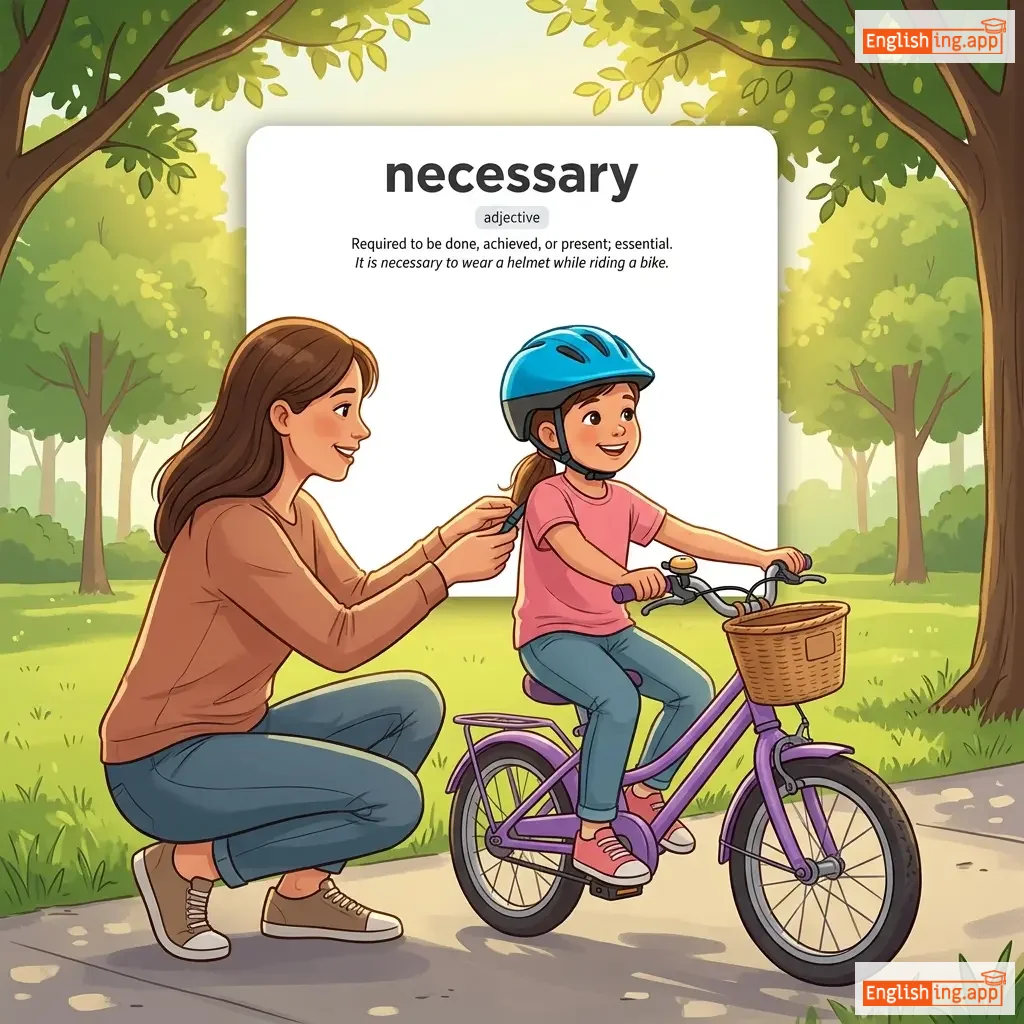
necessary definition card — visual illustration of the meaning
adjective
/ˈnɛsəsɛri/
nécessaire (necessaire)

Required to be done, achieved, or present; essential.

"It is necessary to wear a helmet while riding a bike."

"Il est nécessaire de porter un casque lorsque vous roulez à vélo." (Il est necessaire de porter un casque lorsque vous roulez a velo.)
verb
/nəˈsɛsɪteɪt/
rendre nécessaire (rendre nécessaire)

To make something necessary or unavoidable.

"The heavy rains necessitated the cancellation of the event."

"Les fortes pluies ont rendu l'annulation de l'événement inévitable." (Les fortes pluies ont rendu l'annulation de l'événement inévitable.)
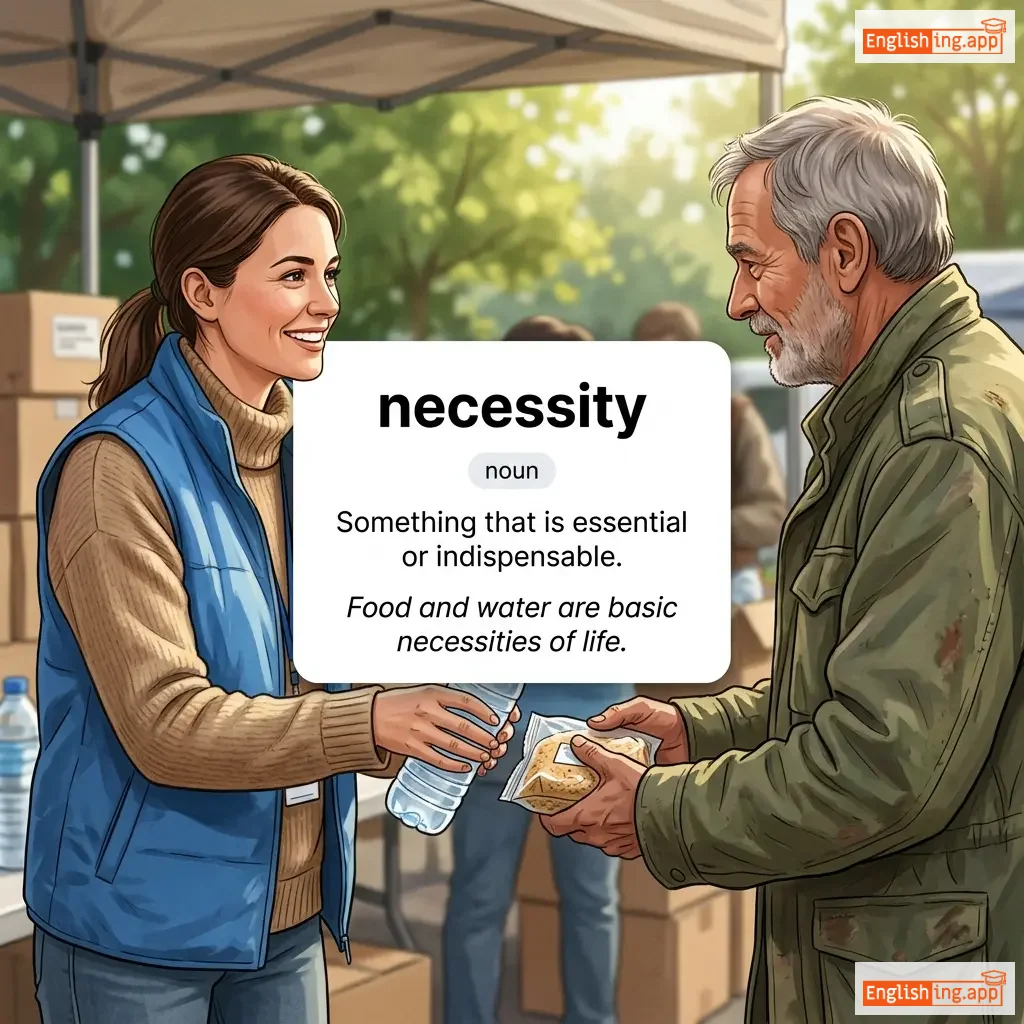
necessity definition card — visual illustration of the meaning
noun
/nəˈsɛsəti/
nécessité (necessite)

Something that is essential or indispensable.

"Food and water are basic necessities of life."

"La nourriture et l'eau sont des nécessités de base de la vie." (La nourriture et l'eau sont des nécessités de base de la vie.)
noun
/nɛk/
cou (cou)

the part of the body connecting the head and the shoulders

"She wore a necklace around her neck."

"Elle portait un collier autour de son cou." (Elle portait un collier autour de son cou.)
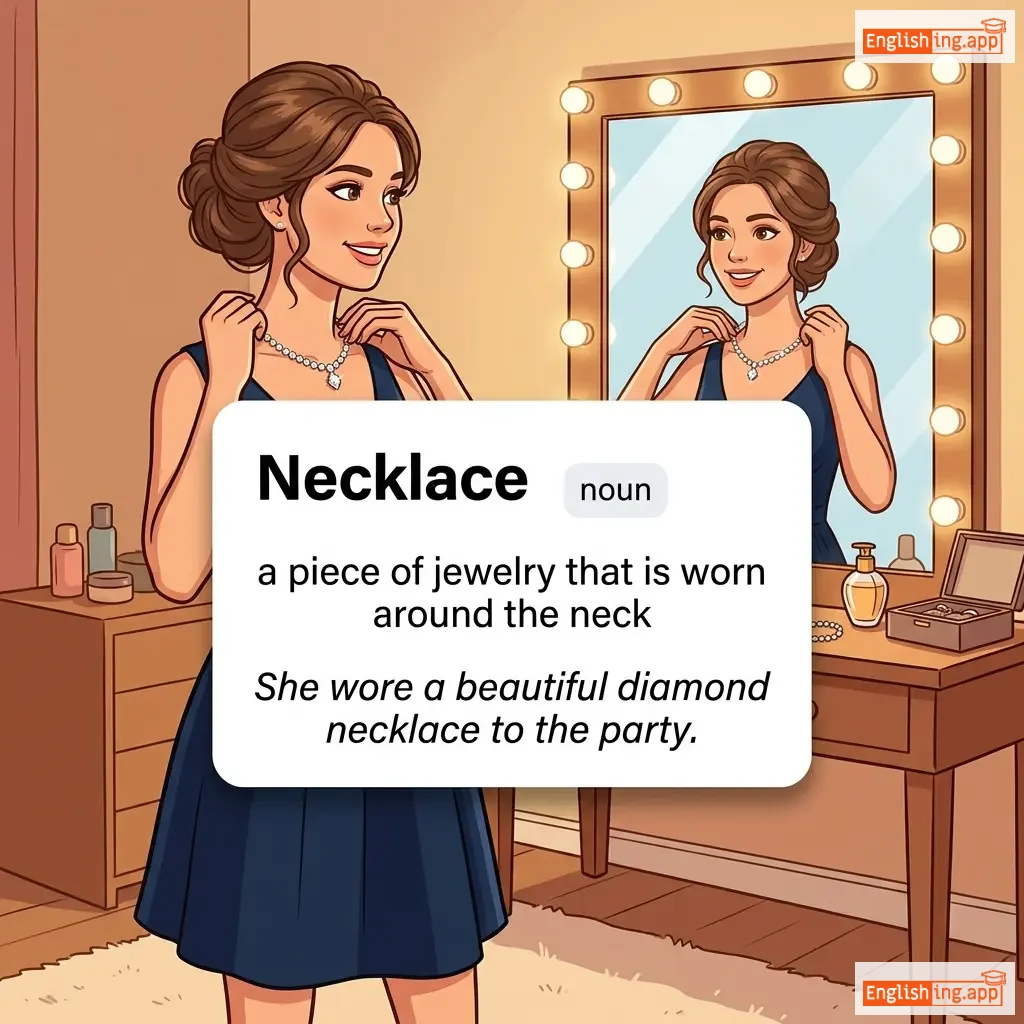
Necklace definition card — visual illustration of the meaning
noun
/ˈnek.ləs/
collier (kolye)

a piece of jewelry that is worn around the neck

"She wore a beautiful diamond necklace to the party."

"Elle portait un joli collier en diamant à la fête." (Elle portait un joli collier en diamant à la fête.)
noun
/ˈnɛkˌlaɪn/
décolleté (dekolte)

the edge of a garment around the neck, especially as cut to form a particular shape

"The dress has a beautiful V-shaped neckline."

"La robe a un joli décolleté en forme de V." (La robe a un joli décolleté en forme de V.)
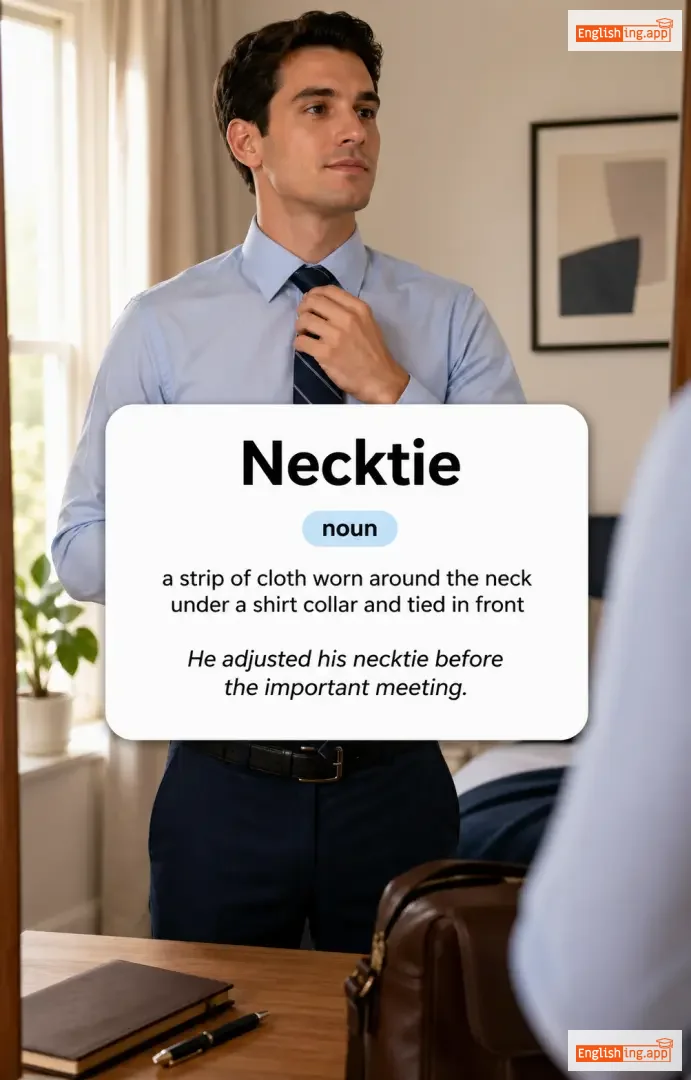
Necktie definition card — visual illustration of the meaning
noun
/ˈnek.taɪ/
cravate (cravate)

a strip of cloth worn around the neck under a shirt collar and tied in front

"He adjusted his necktie before the important meeting."

"Il a ajusté sa cravate avant la réunion importante." (Il a ajusté sa cravate avant la réunion importante.)
noun
/nɪˈkrɒlədʒi/
nécrologie (necrologie)

An obituary notice or a list of people who have recently died.

"The newspaper published a necrology of notable figures who passed away that year."

"Le journal a publié une nécrologie des personnalités notables décédées cette année." (Le journal a publie une necrologie des personnalites notables deces cette annee.)
🧙‍♂️

necromancer

noun
/ˈnɛkrəˌmænsər/

a person who practices necromancy; a wizard or magician who claims to communicate with the dead

"The villagers feared the old necromancer who lived at the edge of the forest."

noun
/ˈnɛkrəˌmænsi/
nécromancie (necromancie)

the practice of communicating with the dead, often to predict the future

"Ancient texts described rituals of necromancy performed by priests."

"Les anciens textes décrivent les rituels de nécromancie pratiqués par les prêtres." (Les anciens textes décrivent les rituels de nécromancie pratiqués par les prêtres.)
noun
/nəˈkrɒpəlɪs/
nécropole (necropole)

a large ancient cemetery with elaborate tombs

"The archaeologists discovered artifacts in the necropolis of the ancient city."

"Les archéologues ont découvert des artefacts dans la nécropole de l'ancienne ville." (Les archeologues ont decouvert des artefacts dans la necropole de l'ancienne ville.)
noun
/nɛˈkroʊsɪs/
nécrose (necrose)

the death of body tissue due to disease, injury, or lack of blood supply

"The doctor explained that the patient’s wound showed signs of necrosis."

"Le médecin a expliqué que la blessure du patient montrait des signes de nécrose." (Le medecin a explique que la blessure du patient montrait des signes de necrose.)
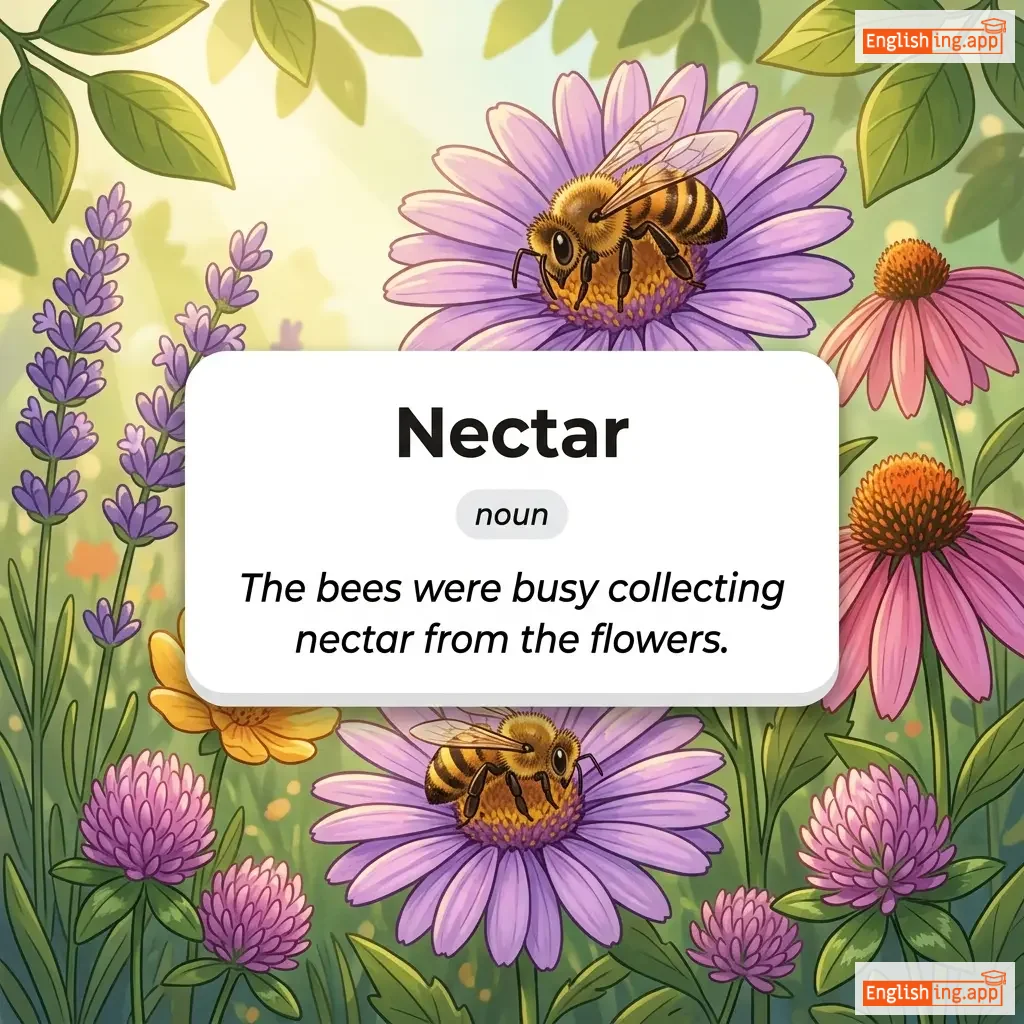
Nectar definition card — visual illustration of the meaning
noun
/ˈnɛktər/
nectar (nectar)

a sweet liquid produced by flowers and collected by bees; in mythology, the drink of the gods

"The bees were busy collecting nectar from the flowers."

"Les abeilles étaient occupées à collecter du nectar des fleurs." (Les abeilles etaient occupees a collecter du nectar des fleurs.)
noun
/ˈnɛpətɪzəm/
népotisme (nepotisme)

The practice of giving unfair advantages to relatives, especially in jobs or positions of power.

"The company was accused of nepotism after the manager hired his brother."

"L'entreprise a été accusée de népotisme après que le directeur ait embauché son frère." (L'entreprise a ete accusee de nepotisme apres que le directeur ait embauche son frere.)
conjunction
/ˈniːðər/
ni l'un ni l'autre (ni lun ni lautre)

used to connect two negative alternatives

"Neither the manager nor the assistant could attend the meeting."

"Ni le gérant ni l'assistant n'ont pu assister à la réunion." (ni le gerant ni lassistant nont pu assister a la reunion)
noun
/ˈnɛm.ə.sɪs/
ennemi / rival (ennemi / rival)

A long-standing rival or an inescapable agent of downfall.

"For years, he considered his colleague to be his nemesis."

"Pendant des années, il considérait son collègue comme son ennemi." (Pendant des années, il considérait son collègue comme son ennemi.)
noun
/ˌniːoʊˈdɑːrwɪnɪzəm/
néo-darwinisme (neo-darwinisme)

A modern interpretation of Darwin's theory of evolution, integrating genetics and natural selection.

"Neo-Darwinism combines Darwin’s theory of natural selection with modern genetics."

"Le néo-darwinisme combine la théorie de la sélection naturelle de Darwin avec la génétique moderne." (Le neo-darwinisme combine la theorie de la selection naturelle de Darwin avec la genetique moderne.)
noun
/ˌniːoʊˈlætɪn/
néo-latin (neo-latin)

The use of Latin language for scholarly, scientific, and literary purposes after the medieval period.

"Many scientific names are derived from Neo-Latin."

"De nombreux noms scientifiques sont dérivés du néo-latin." (De nombreux noms scientifiques sont dérivés du néo-latin.)
noun
/niːˈɒkrəsi/
Gouvernement dirigé par des fonctionnaires inexpérimentés ou nouveaux (Gouvernement dirigé par des fonctionnaires inexpérimentés ou nouveaux)

A government or leadership run by inexperienced or new officials.

"The sudden revolution led to a neocracy with inexperienced leaders."

"La révolution soudaine a conduit à une néocratie avec des dirigeants inexpérimentés." (La révolution soudaine a conduit à une néocratie avec des dirigeants inexpérimentés.)
adjective
/ˌniːoʊˈlɪθɪk/
néolithique (neolithique)

Relating to the later part of the Stone Age, when ground or polished stone weapons and tools prevailed.

"Neolithic communities began practicing agriculture and domesticating animals."

"Les communautés néolithiques ont commencé à pratiquer l'agriculture et à apprivoiser des animaux." (Les communautés néolithiques ont commencé à pratiquer l'agriculture et à apprivoiser des animaux.)
noun
/niːˈɒlədʒɪzəm/
néologisme (neologisme)

A newly coined word or expression.

"The internet has given rise to many neologisms like 'selfie' and 'hashtag'."

"Internet a donné naissance à de nombreux néologismes comme 'selfie' et 'hashtag'." (Internet a donne naissance a de nombreux neologismes comme 'selfie' et 'hashtag'.)
noun
/niˈɒlədʒi/
l'utilisation de nouveaux mots ou l'étude de leur origine (l'utilisation de nouveaux mots ou l'étude de leur origine)

The use of new words or the study of their origin.

"The professor specialized in neology, studying the creation of modern slang."

"Le professeur s'est spécialisé en néologie, étudiant la création du jargon moderne." (Le professeur s'est spécialisé en néologie, étudiant la création du jargon moderne.)
noun
/ˌniːoʊˈpeɪɡənɪzəm/
néopaganisme (neopaganisme)

Modern religious movements influenced by or claiming to be derived from the various historical pagan beliefs of pre-modern Europe.

"Neopaganism has gained popularity as people seek spiritual alternatives to mainstream religions."

"Le néopaganisme a gagné en popularité à mesure que les gens recherchent des alternatives spirituelles aux religions dominantes." (Le néopaganisme a gagné en popularité à mesure que les gens recherchent des alternatives spirituelles aux religions dominantes.)
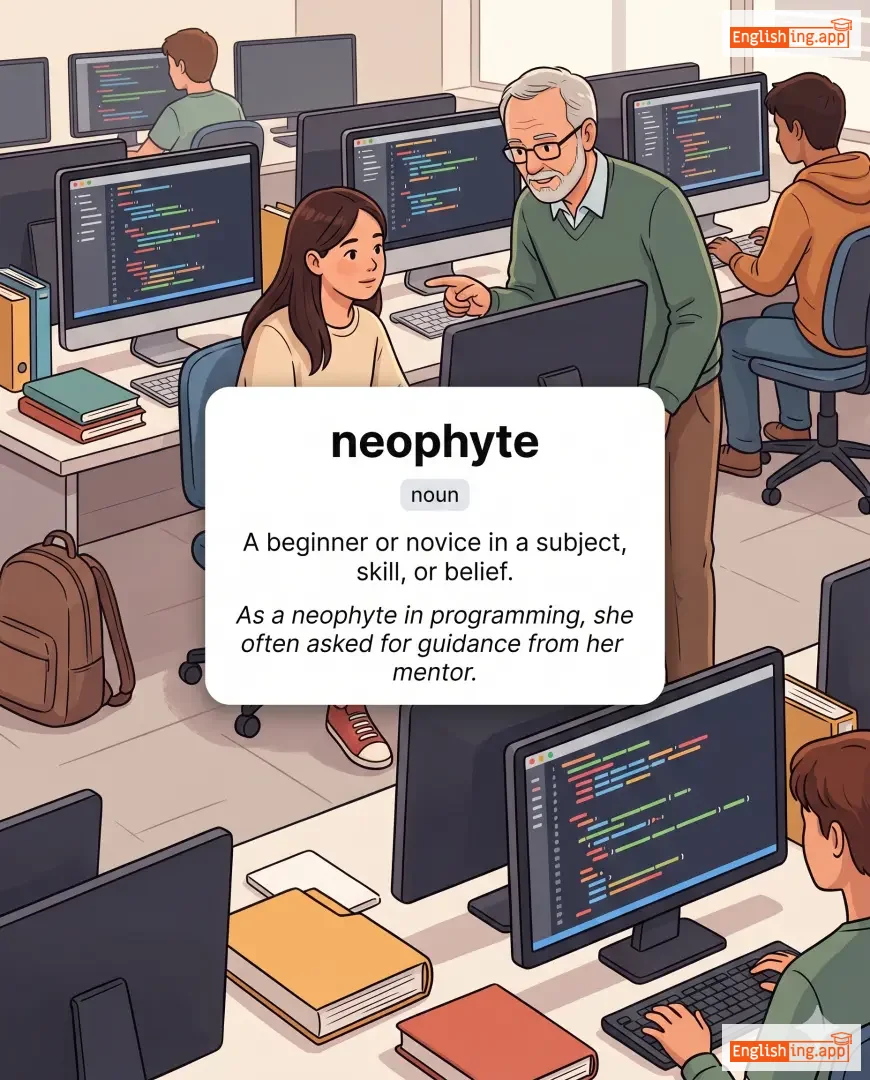
neophyte definition card — visual illustration of the meaning
noun
/ˈniːəˌfaɪt/
néophyte (neophyte)

A beginner or novice in a subject, skill, or belief.

"As a neophyte in programming, she often asked for guidance from her mentor."

"En tant que néophyte en programmation, elle demandait souvent des conseils à son mentor." (En tant que néophyte en programmation, elle demandait souvent des conseils à son mentor.)
noun
/ˈnefjuː/
neveu (neveu)

the son of one’s brother or sister

"My nephew is studying at the university."

"Mon neveu étudie à l’université." (mon neveu etudie a l universite)
noun
/nɛt/
filet (filet)

a piece of material made of threads or ropes woven together, used to catch or hold things

"The fisherman cast his net into the sea."

"Le pêcheur a jeté son filet dans la mer." (Le pêcheur a jeté son filet dans la mer.)
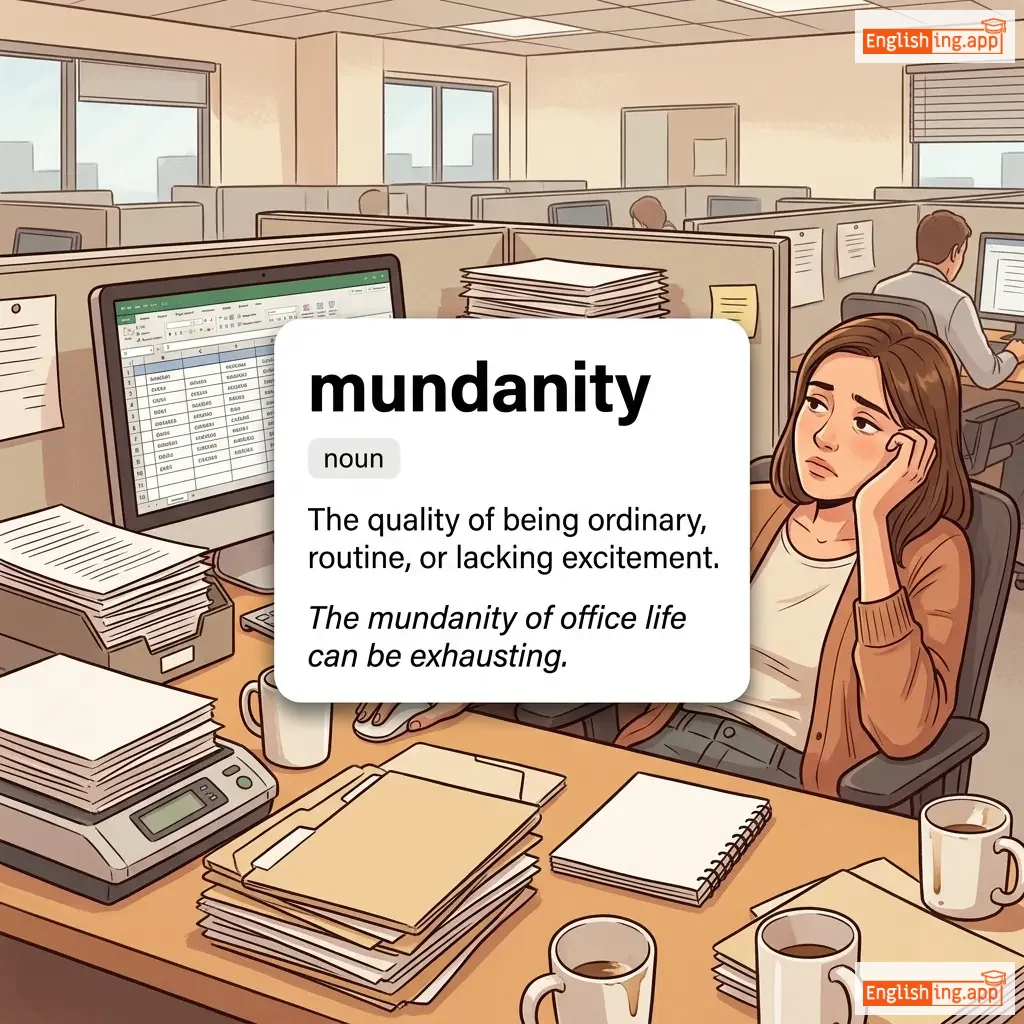
mundanity definition card — visual illustration of the meaning
noun
mʌnˈdeɪ.nɪ.ti
banalité (banalite)

The quality of being ordinary, routine, or lacking excitement.

"The mundanity of office life can be exhausting."

"La banalité de la vie au bureau peut être épuisante." (La banalite de la vie au bureau peut etre epuisante.)
noun
/ˈnɛtˌwɜrk/
réseau (reseau)

A system of interconnected people, things, or computers.

"She built a strong professional network."

"Elle a créé un réseau professionnel solide." (Elle a cree un reseau professionnel solide.)
adjective
/ˈnɛtlˌsʌm/
irritant (irritant)

Causing irritation, annoyance, or difficulty.

"The nettlesome rules frustrated the workers."

"Les règles irritantes ont frustré les travailleurs." (Les regles irritantes ont frustre les travailleurs.)
noun
/ˈnɛtl̩/
plante avec des poils qui provoquent des irritations lorsqu'ils sont touchés (plante avec des poils qui provoquent des irritations lorsqu'ils sont touchés)

a plant with stinging hairs that cause irritation when touched

"He accidentally brushed against the nettle and felt a sharp sting."

"Il a accidentellement frôlé l'ortie et a ressenti une douleur aiguë." (Il a accidentellement frôlé l'ortie et a ressenti une douleur aiguë.)
adjective
/ˈnɛðər/
inférieur (inferieur)

situated down or below; lower

"They explored the nether regions of the cave."

"Ils ont exploré les régions inférieures de la grotte." (Ils ont explore les regions inferieures de la grotte.)
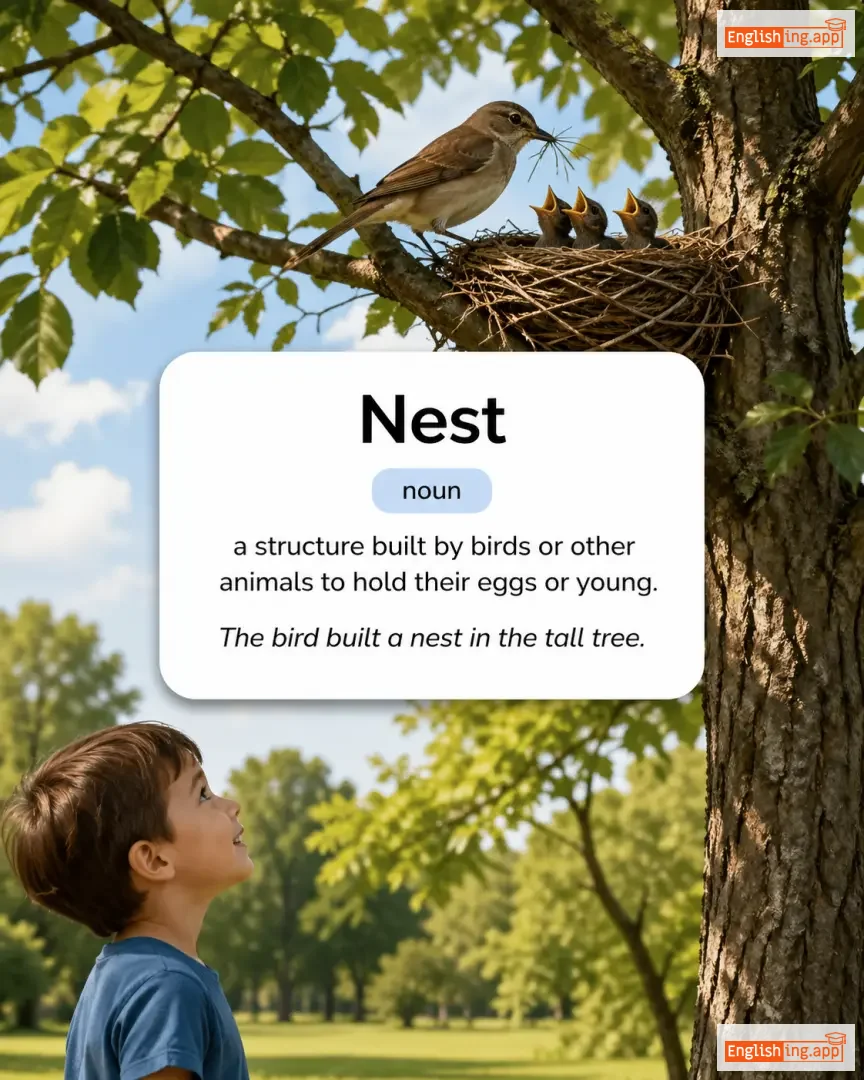
Nest definition card — visual illustration of the meaning
noun
/nɛst/
nid (nid)

a structure built by birds or other animals to hold their eggs or young.

"The bird built a nest in the tall tree."

"L'oiseau a construit un nid dans l'arbre haut." (L'oiseau a construit un nid dans l'arbre haut.)