Vokabulare

Englisches Vokabelwörterbuch | Wortbedeutungen, Definitionen & Beispiele

noun
/neɪv/
Hauptschiff der Kirche (hauptschiff der kirche)

the central part of a church building intended to accommodate the congregation

"The choir sang beautifully in the church nave."

"Der Chor sang wunderschön in der Kirche nave." (Der Chor sang wunderschön in der Kirche nave.)
noun
/ˈneɪvəl/
Bauchnabel (bauchnabel)

the small hollow or raised area in the middle of the stomach, also called the belly button

"The baby’s navel was carefully cleaned after birth."

"Der Bauchnabel des Babys wurde nach der Geburt sorgfältig gereinigt." (Der Bauchnabel des Babys wurde nach der Geburt sorgfaeltig gereinigt.)
adjective
/ˈnæv.ɪ.ɡə.bəl/
navigierbar (navigierbar)

Able to be sailed on or through by ships or boats.

"The river is navigable for large cargo ships."

"Der Fluss ist für große Frachtschiffe navigierbar." (Der Fluss ist für große Frachtschiffe navigierbar.)
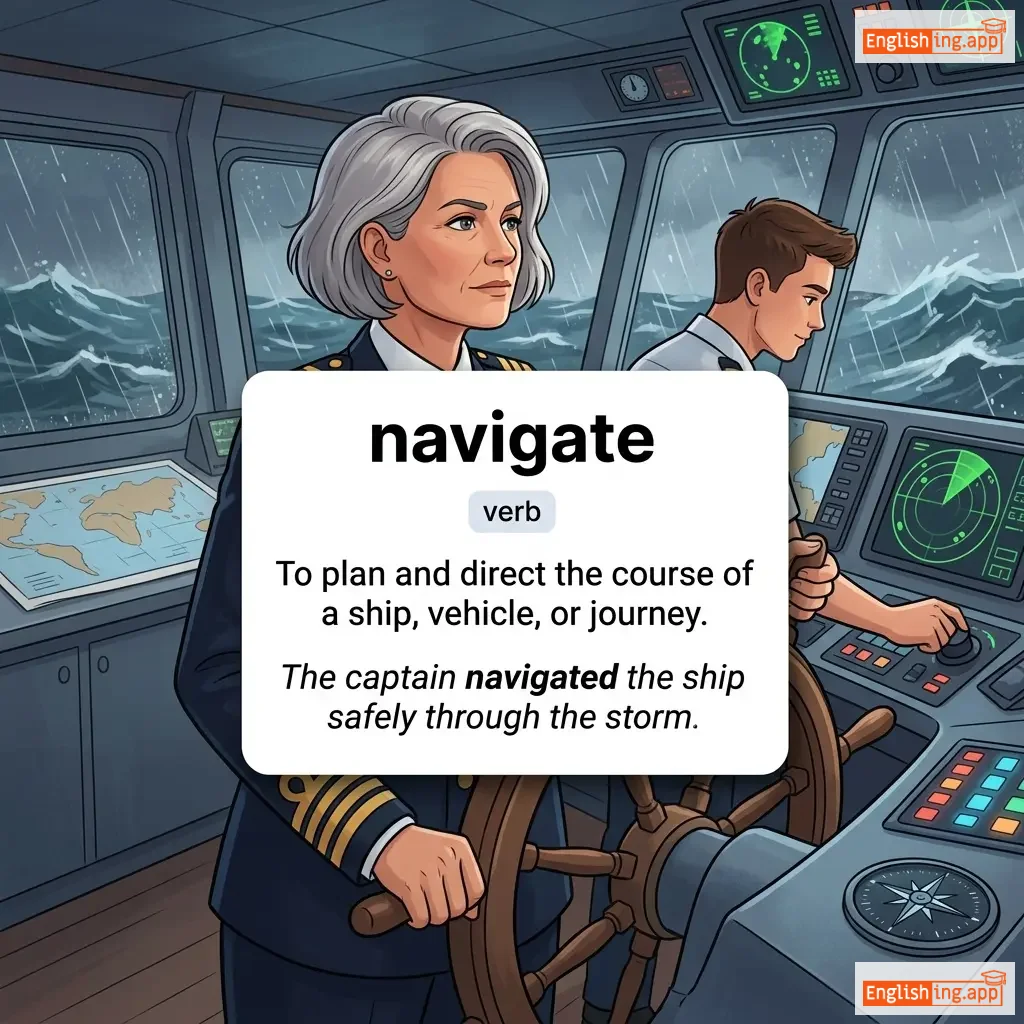
navigate definition card — visual illustration of the meaning
verb
/ˈnæv.ɪ.ɡeɪt/
navigieren (navigieren)

To plan and direct the course of a ship, vehicle, or journey.

"The captain navigated the ship safely through the storm."

"Der Kapitän navigierte das Schiff sicher durch den Sturm." (Der Kapitän navigierte das Schiff sicher durch den Sturm.)
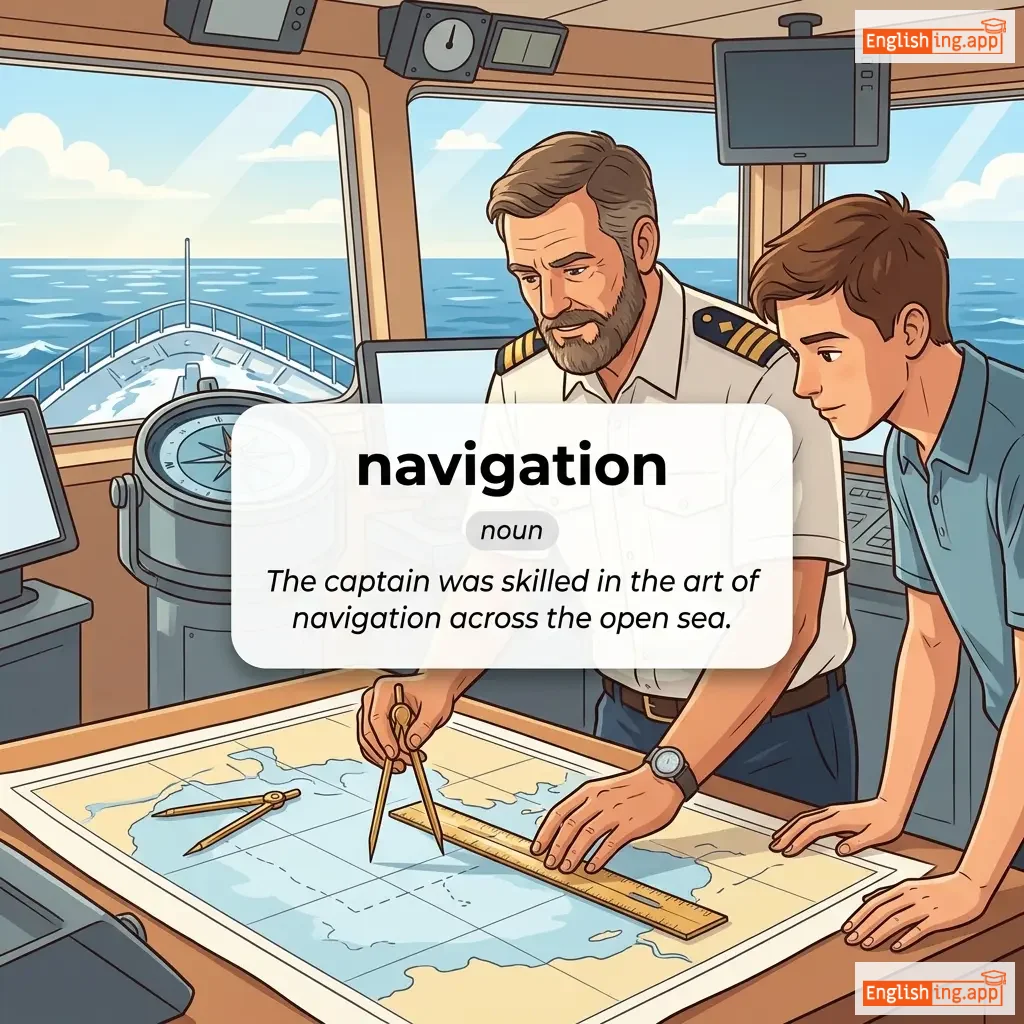
navigation definition card — visual illustration of the meaning
noun
/ˌnævɪˈɡeɪʃən/
navigation (navigation)

the process or activity of accurately determining one's position and planning and following a route

"The captain was skilled in the art of navigation across the open sea."

"Der Kapitän war erfahren in der Kunst der Navigation über das offene Meer." (Der Kapitan war erfahren in der Kunst der Navigation uber das offne Meer.)
Navy definition card — visual illustration of the meaning
noun
/ˈneɪvi/
Marine (Marine)

the branch of armed forces that conducts military operations at sea

"He joined the navy after graduating from college."

"Er trat der Marine bei, nachdem er das College abgeschlossen hatte." (Er trat der Marine bei, nachdem er das College abgeschlossen hatte.)
noun
/ˈneɪˌseɪ.ɪŋ/
negative Äußerung (negative auerung)

The act of expressing negative or pessimistic views.

"His constant naysaying discouraged the team."

"Seine ständige negative Äußerung entmutigte das Team." (Seine ständige negative Äußerung entmutigte das Team.)
noun
/ˌɛn.biː.esˈpiː/
nicht trennbares Leerzeichen (nicht trennbares leerzeichen)

a non-breaking space character in HTML used to prevent an automatic line break at its position

"Use   in HTML to add a space that won't break into a new line."

"Verwenden Sie   in HTML, um ein Leerzeichen hinzuzufügen, das nicht in eine neue Zeile bricht." (Verwenden Sie   in HTML, um ein Leerzeichen hinzuzufügen, das nicht in eine neue Zeile bricht.)
noun
/niːp/
Niedrigwasser (Niedrigwasser)

A tide just after the first or third quarters of the moon when the difference between high and low tide is least.

"During a neap tide, the water level change is minimal."

"Während einer Nipptide ist der Wasserstand minimal." (Waehrend einer Nipptide ist der Wasserstand minimal.)
preposition
/nɪə(r)/
nahe (nahe)

At or to a short distance away; close in space, time, or relationship.

"There is a park near my house."

"Es gibt einen Park in der Nähe meines Hauses." (Es gibt einen Park in der Nähe meines Hauses.)
adverb
/ˈnɪərbaɪ/
in der Nähe; nah (in der naehe; nah)

close to; not far away; in the neighborhood

"There is a grocery store nearby."

"Es gibt einen Lebensmittelgeschäft in der Nähe." (Es gibt einen Lebensmittelgeschäft in der Nähe.)
adjective
/ˈnɪəˌbaɪ/
in der Nähe (in der Naehe)

close to a particular place or person

"The nearest gas station is nearby."

"Die nächste Tankstelle ist in der Nähe." (Die naechste Tankstelle ist in der Naehe.)
adverb
/ˈnɪəli/
fast (fast)

almost, but not completely

"She nearly missed the bus."

"Sie hat den Bus fast verpasst." (Sie hat den Bus fast verpasst.)
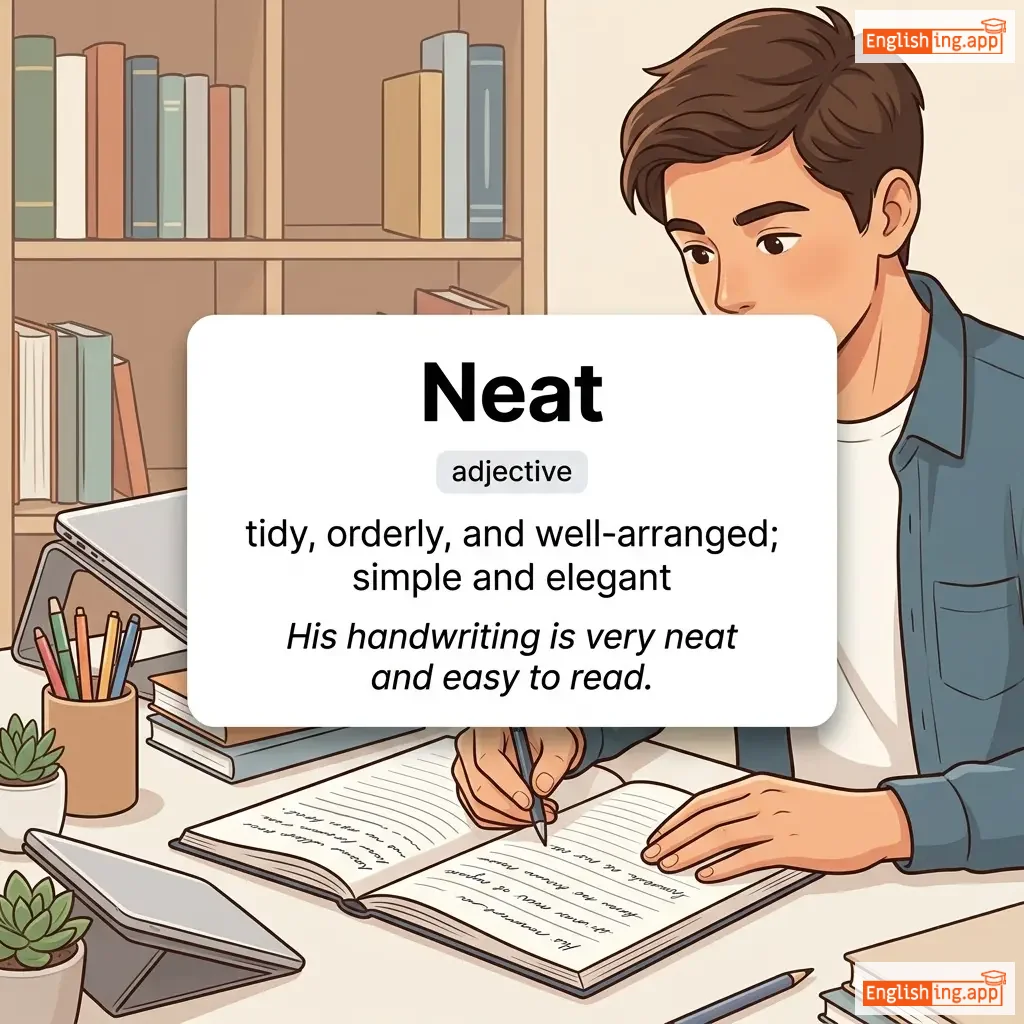
Neat definition card — visual illustration of the meaning
adjective
/niːt/
ordentlich (ordentlich)

tidy, orderly, and well-arranged; simple and elegant

"His handwriting is very neat and easy to read."

"Seine Handschrift ist sehr ordentlich und leicht zu lesen." (Seine Handschrift ist sehr ordentlich und leicht zu lesen.)
adverb
/ˈniːtli/
ordentlich; sauber (ordentlich; sauber)

in a tidy and orderly way; carefully and precisely

"She arranged the books neatly on the shelf."

"Sie arrangierte die Bücher ordentlich im Regal." (Sie arrangierte die Bucher ordentlich im Regal.)
noun
/ˈneb.jʊ.lə/
nebel (nebel)

A cloud of gas and dust in outer space, sometimes visible in the night sky.

"The Orion Nebula is one of the brightest in the sky."

"Der Orionnebel ist einer der hellsten am Himmel." (Der Orionnebel ist einer der hellsten am Himmel.)
adjective
/ˈnɛbjələs/
nebelig (nebelig)

Unclear, vague, or ill-defined; resembling a cloud or haze.

"His plan for the future was still nebulous and hard to understand."

"Sein Plan für die Zukunft war immer noch nebulös und schwer zu verstehen." (Sein Plan für die Zukunft war immer noch nebulös und schwer zu verstehen.)
adverb
/ˌnɛsəˈsɛrɪli/
notwendigerweise (notwendigerweise)

as a necessary result; inevitably

"It doesn’t necessarily mean you’re wrong."

"Es bedeutet nicht zwangsläufig, dass du falsch liegst." (Es bedeutet nicht zwangsläufig, dass du falsch liegst.)
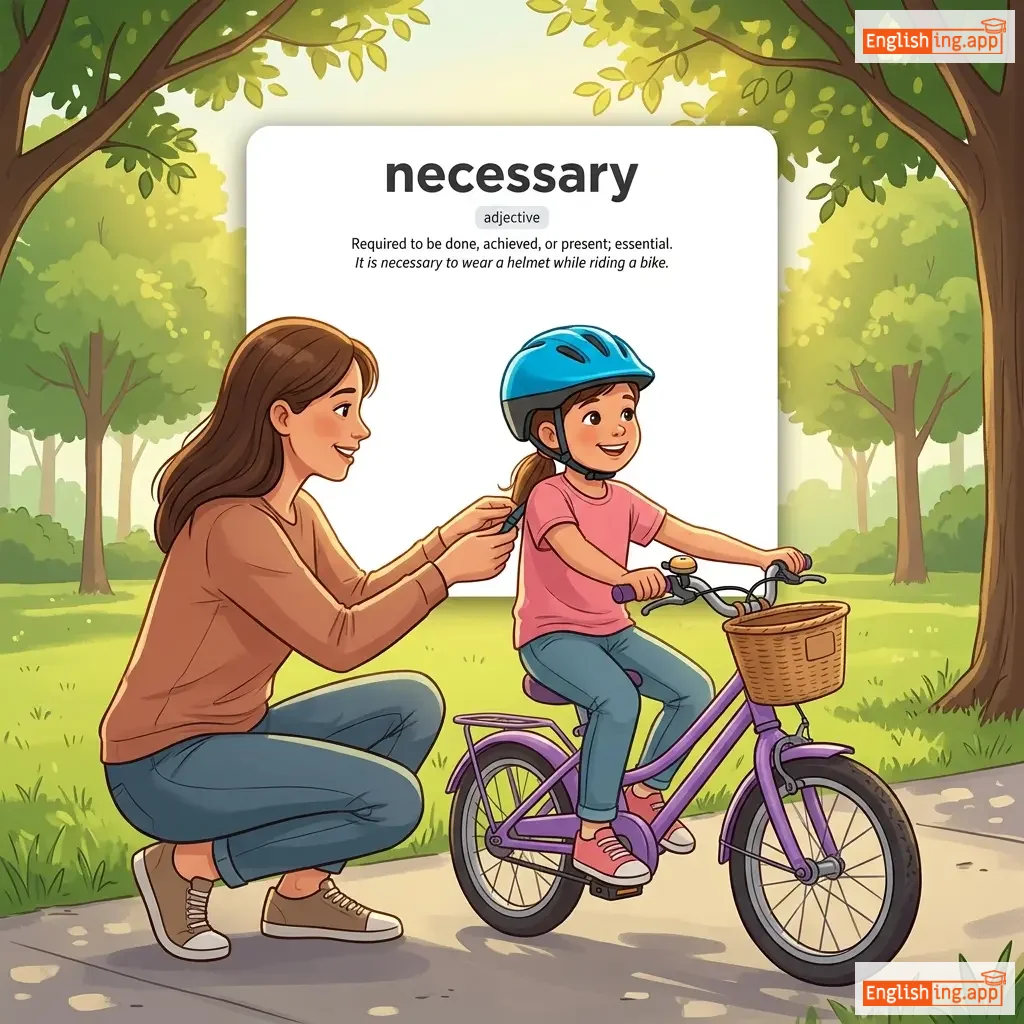
necessary definition card — visual illustration of the meaning
adjective
/ˈnɛsəsɛri/

Required to be done, achieved, or present; essential.

"It is necessary to wear a helmet while riding a bike."

verb
/nəˈsɛsɪteɪt/
notwendig machen (notwendig machen)

To make something necessary or unavoidable.

"The heavy rains necessitated the cancellation of the event."

"Die schweren Regenfälle machten die Absage der Veranstaltung unvermeidlich." (Die schweren Regenfälle machten die Absage der Veranstaltung unvermeidlich.)
necessity definition card — visual illustration of the meaning
noun
/nəˈsɛsəti/
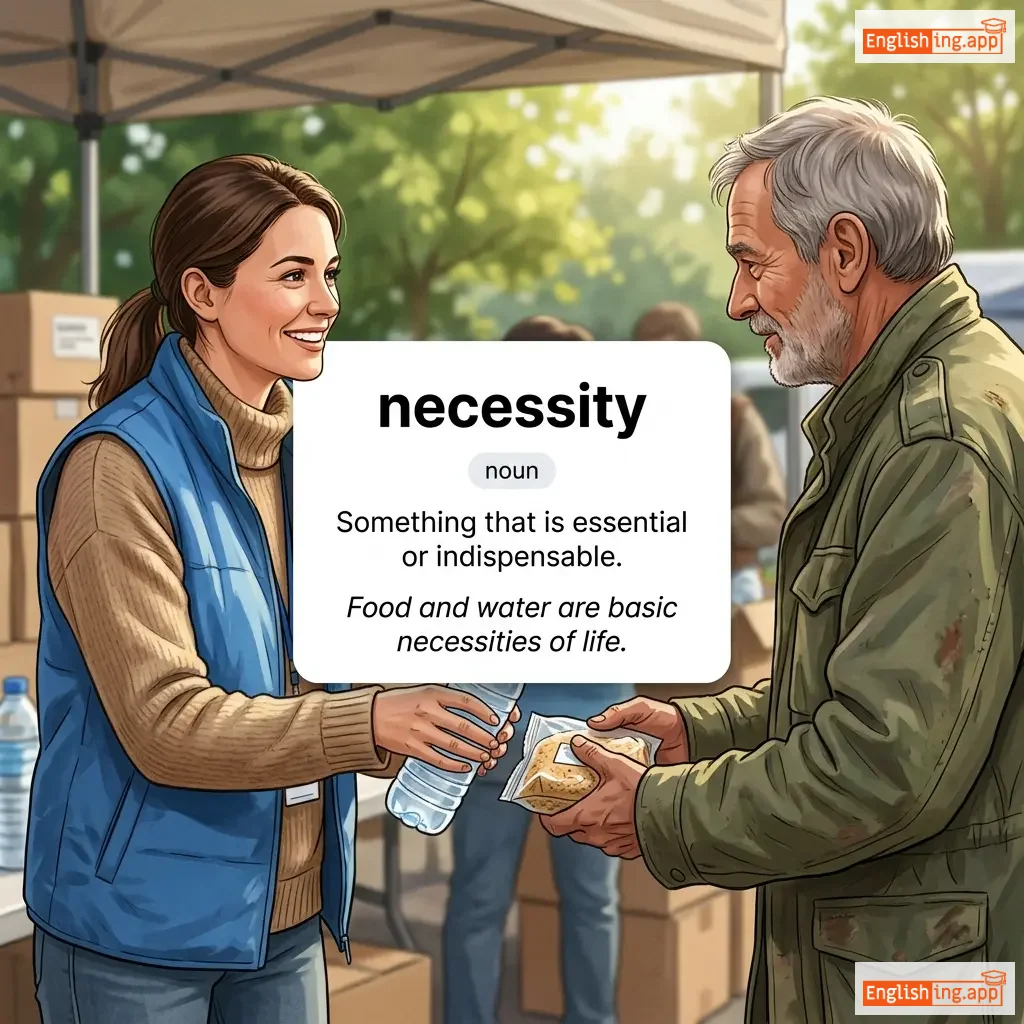
Notwendigkeit (notwendigkeit)

Something that is essential or indispensable.

"Food and water are basic necessities of life."

"Essen und Wasser sind grundlegende Notwendigkeiten des Lebens." (Essen und Wasser sind grundlegende Notwendigkeiten des Lebens.)
noun
/nɛk/
Hals (Hals)

the part of the body connecting the head and the shoulders

"She wore a necklace around her neck."

"Sie trug eine Halskette um ihren Hals." (Sie trug eine Halskette um ihren Hals.)
Necklace definition card — visual illustration of the meaning
noun
/ˈnek.ləs/
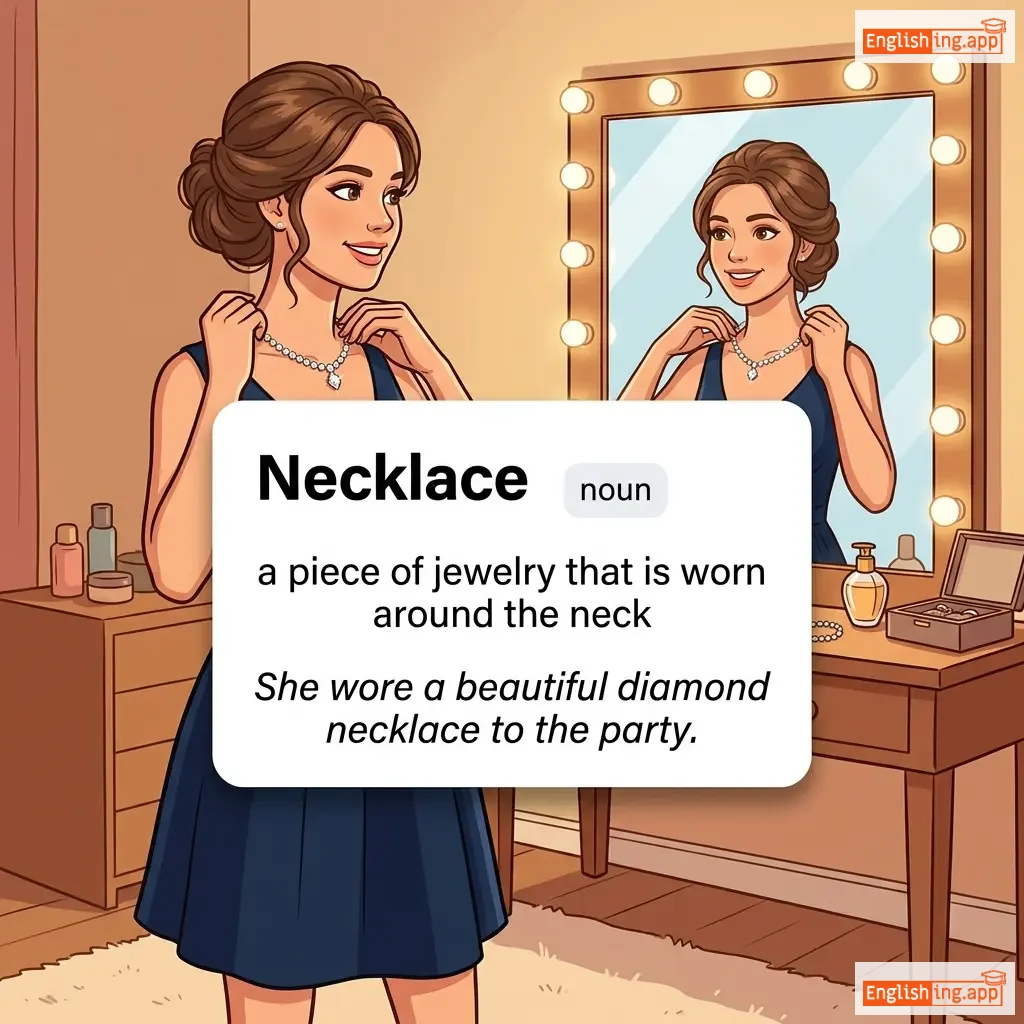
Halskette (halskette)

a piece of jewelry that is worn around the neck

"She wore a beautiful diamond necklace to the party."

"Sie trug ein schönes Diamantcollier zur Party." (Sie trug ein schönes Diamantcollier zur Party.)
noun
/ˈnɛkˌlaɪn/
Ausschnitt (ausschnitt)

the edge of a garment around the neck, especially as cut to form a particular shape

"The dress has a beautiful V-shaped neckline."

"Das Kleid hat einen schönen V-förmigen Ausschnitt." (Das Kleid hat einen schönen V-förmigen Ausschnitt.)
Necktie definition card — visual illustration of the meaning
noun
/ˈnek.taɪ/
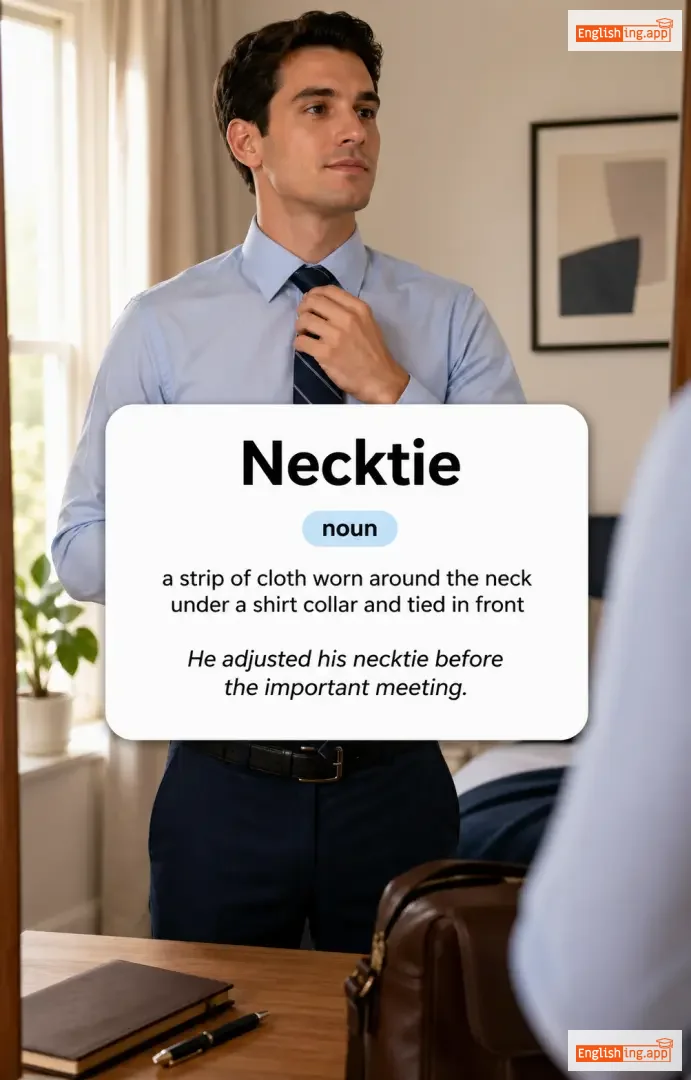
Krawatte (Krawatte)

a strip of cloth worn around the neck under a shirt collar and tied in front

"He adjusted his necktie before the important meeting."

"Er passte seine Krawatte vor dem wichtigen Meeting an." (Er passte seine Krawatte vor dem wichtigen Meeting an.)
noun
/nɪˈkrɒlədʒi/
nekrologie (nekrologie)

An obituary notice or a list of people who have recently died.

"The newspaper published a necrology of notable figures who passed away that year."

"Die Zeitung veröffentlichte eine Nekrologie von bedeutenden Persönlichkeiten, die in diesem Jahr verstorben sind." (Die Zeitung veroffentlichte eine Nekrologie von bedeutenden Personlichkeiten, die in diesem Jahr verstorben sind.)
noun
/ˈnɛkrəˌmænsər/
Nekromant (Nekromant)

a person who practices necromancy; a wizard or magician who claims to communicate with the dead

"The villagers feared the old necromancer who lived at the edge of the forest."

"Die Dorfbewohner fuerchteten den alten Nekromant, der am Rand des Waldes lebte." (Die Dorfbewohner fuerchteten den alten Nekromant, der am Rand des Waldes lebte.)
noun
/ˈnɛkrəˌmænsi/
Nekromantie (nekromantie)

the practice of communicating with the dead, often to predict the future

"Ancient texts described rituals of necromancy performed by priests."

"Alte Texte beschrieben Rituale der Nekromantie, die von Priestern durchgeführt wurden." (Alte Texte beschrieben Rituale der Nekromantie, die von Priestern durchgeführt wurden.)
noun
/nəˈkrɒpəlɪs/
nekropole (nekropole)

a large ancient cemetery with elaborate tombs

"The archaeologists discovered artifacts in the necropolis of the ancient city."

"Die Archäologen entdeckten Artefakte auf der Nekropole der alten Stadt." (Die Archaologen entdeckten Artefakte auf der Nekropole der alten Stadt.)
noun
/nɛˈkroʊsɪs/
Nekrose (nekrose)

the death of body tissue due to disease, injury, or lack of blood supply

"The doctor explained that the patient’s wound showed signs of necrosis."

"Der Arzt erklärte, dass die Wunde des Patienten Anzeichen von Nekrose zeigte." (Der Arzt erklaerte, dass die Wunde des Patienten Anzeichen von Nekrose zeigte.)
Nectar definition card — visual illustration of the meaning
noun
/ˈnɛktər/
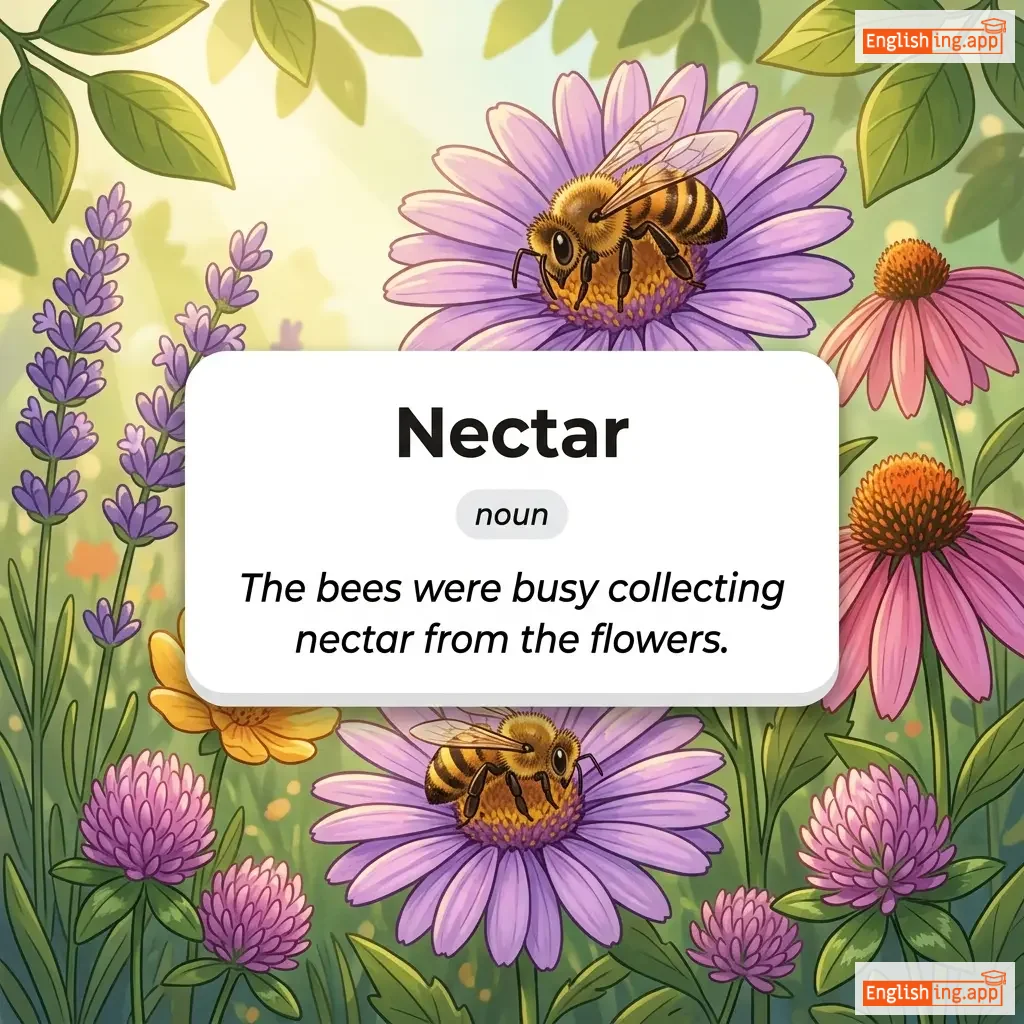
Nektar (Nektar)

a sweet liquid produced by flowers and collected by bees; in mythology, the drink of the gods

"The bees were busy collecting nectar from the flowers."

"Die Bienen waren beschäftigt, Nektar von den Blumen zu sammeln." (Die Bienen waren beschaeftigt, Nektar von den Blumen zu sammeln.)
noun
/ˈnɛpətɪzəm/
Nepotismus (Nepotismus)

The practice of giving unfair advantages to relatives, especially in jobs or positions of power.

"The company was accused of nepotism after the manager hired his brother."

"Das Unternehmen wurde des Nepotismus beschuldigt, nachdem der Manager seinen Bruder eingestellt hatte." (Das Unternehmen wurde des Nepotismus beschuldigt, nachdem der Manager seinen Bruder eingestellt hatte.)
conjunction
/ˈniːðər/
weder noch (weder noch)

used to connect two negative alternatives

"Neither the manager nor the assistant could attend the meeting."

"Weder der Manager noch der Assistent konnten an dem Meeting teilnehmen." (weder der manager noch der assistent konnten an dem meeting teilnehmen)
noun
/ˈnɛm.ə.sɪs/
Feind / Rivale (Feind / Rivale)

A long-standing rival or an inescapable agent of downfall.

"For years, he considered his colleague to be his nemesis."

"Jahrelang hielt er seinen Kollegen für seinen Feind." (Jahrelang hielt er seinen Kollegen für seinen Feind.)
noun
/ˌniːoʊˈdɑːrwɪnɪzəm/
Neo-Darwinismus (Neo-Darwinismus)

A modern interpretation of Darwin's theory of evolution, integrating genetics and natural selection.

"Neo-Darwinism combines Darwin’s theory of natural selection with modern genetics."

"Der Neo-Darwinismus kombiniert Darwins Theorie der natürlichen Selektion mit moderner Genetik." (Der Neo-Darwinismus kombiniert Darwins Theorie der natürlichen Selektion mit moderner Genetik.)
noun
/ˌniːoʊˈlætɪn/
Neo-Latein (neo-latein)

The use of Latin language for scholarly, scientific, and literary purposes after the medieval period.

"Many scientific names are derived from Neo-Latin."

"Viele wissenschaftliche Namen stammen aus dem Neo-Latein." (Viele wissenschaftliche Namen stammen aus dem Neo-Latein.)
noun
/niːˈɒkrəsi/
Regierung, die von unerfahrenen oder neuen Beamten geführt wird (Regierung, die von unerfahrenen oder neuen Beamten geführt wird)

A government or leadership run by inexperienced or new officials.

"The sudden revolution led to a neocracy with inexperienced leaders."

"Die plötzliche Revolution führte zu einer Neokratie mit unerfahrenen Führern." (Die plötzliche Revolution führte zu einer Neokratie mit unerfahrenen Führern.)
adjective
/ˌniːoʊˈlɪθɪk/
neolithisch (neolithisch)

Relating to the later part of the Stone Age, when ground or polished stone weapons and tools prevailed.

"Neolithic communities began practicing agriculture and domesticating animals."

"Neolithische Gemeinschaften begannen mit der Landwirtschaft und der Domestizierung von Tieren." (Neolithische Gemeinschaften begannen mit der Landwirtschaft und der Domestizierung von Tieren.)
noun
/niːˈɒlədʒɪzəm/
Neologismus (neologismus)

A newly coined word or expression.

"The internet has given rise to many neologisms like 'selfie' and 'hashtag'."

"Das Internet hat viele Neologismen hervorgebracht wie 'Selfie' und 'Hashtag'." (Das Internet hat viele Neologismen hervorgebracht wie 'Selfie' und 'Hashtag'.)
noun
/niˈɒlədʒi/
Die Verwendung neuer Wörter oder das Studium ihrer Herkunft (Die Verwendung neuer Wörter oder das Studium ihrer Herkunft)

The use of new words or the study of their origin.

"The professor specialized in neology, studying the creation of modern slang."

"Der Professor spezialisierte sich auf Neologie und untersuchte die Entstehung modernen Slangs." (Der Professor spezialisierte sich auf Neologie und untersuchte die Entstehung modernen Slangs.)
noun
/ˌniːoʊˈpeɪɡənɪzəm/
Neopaganismus (Neopaganismus)

Modern religious movements influenced by or claiming to be derived from the various historical pagan beliefs of pre-modern Europe.

"Neopaganism has gained popularity as people seek spiritual alternatives to mainstream religions."

"Neopaganismus hat an Popularität gewonnen, da Menschen spirituelle Alternativen zu den etablierten Religionen suchen." (Neopaganismus hat an Popularität gewonnen, da Menschen spirituelle Alternativen zu den etablierten Religionen suchen.)
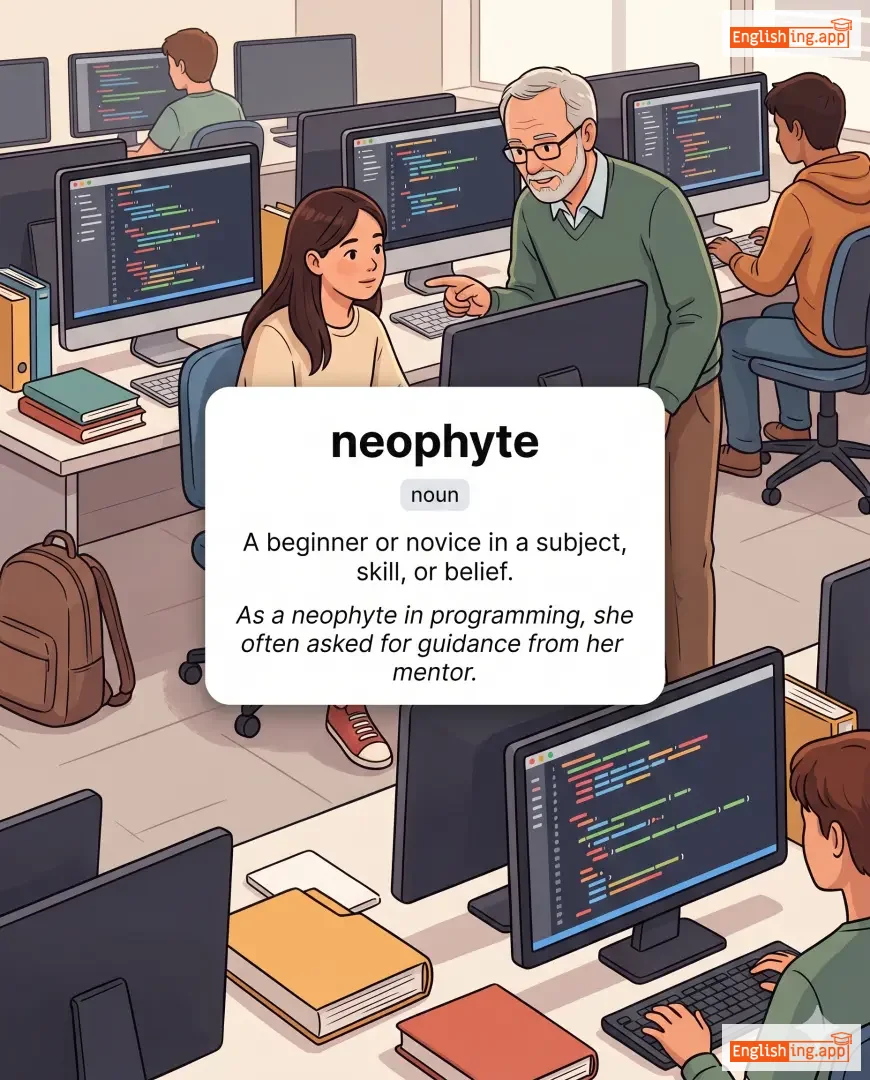
neophyte definition card — visual illustration of the meaning
noun
/ˈniːəˌfaɪt/
Neuling (Neuling)

A beginner or novice in a subject, skill, or belief.

"As a neophyte in programming, she often asked for guidance from her mentor."

"Als Neuling in der Programmierung bat sie oft ihren Mentor um Rat." (Als Neuling in der Programmierung bat sie oft ihren Mentor um Rat.)
noun
/ˈnefjuː/
Neffe (Neffe)

the son of one’s brother or sister

"My nephew is studying at the university."

"Mein Neffe studiert an der Universität." (Mein Neffe studiert an der Universitat)
noun
/nɛt/
netz (netz)

a piece of material made of threads or ropes woven together, used to catch or hold things

"The fisherman cast his net into the sea."

"Der Fischer warf sein Netz ins Meer." (Der Fischer warf sein Netz ins Meer.)
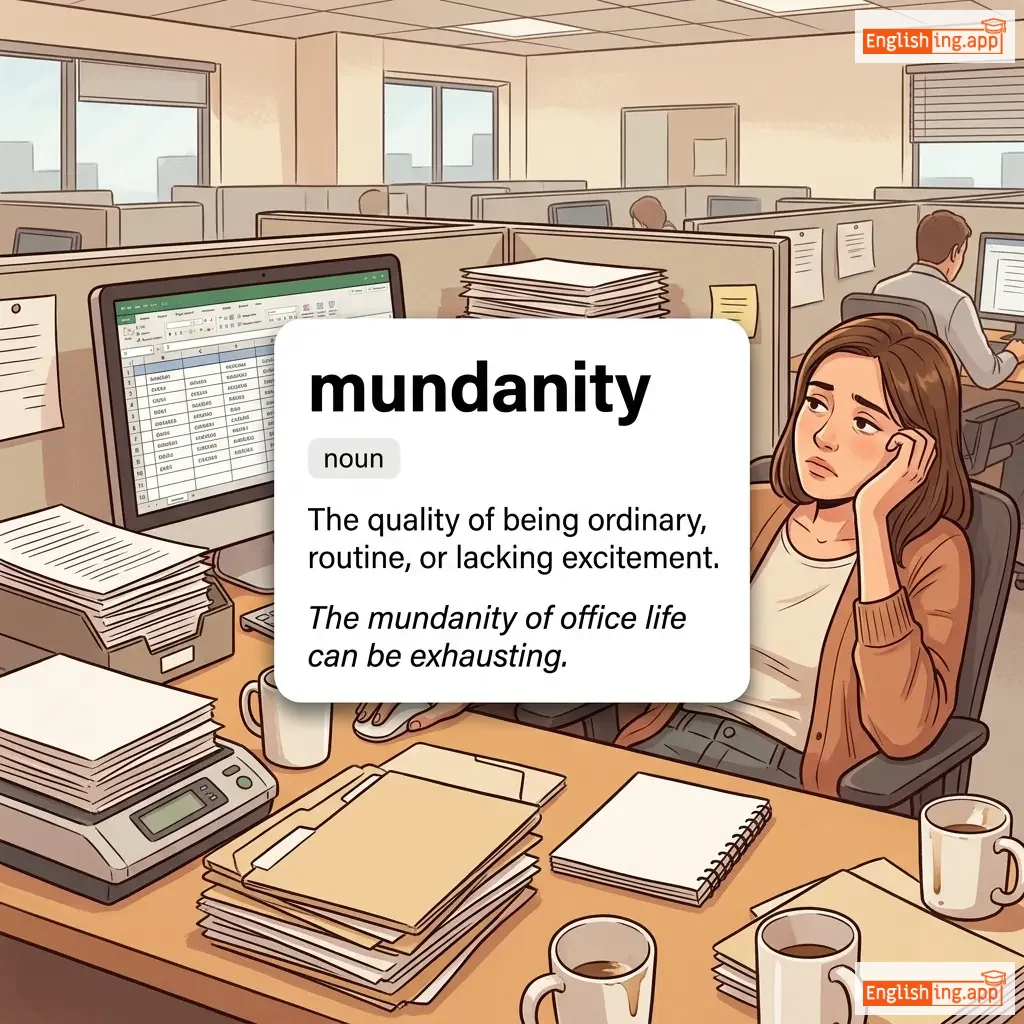
mundanity definition card — visual illustration of the meaning
noun
mʌnˈdeɪ.nɪ.ti
Banalität (Banaliät)

The quality of being ordinary, routine, or lacking excitement.

"The mundanity of office life can be exhausting."

"Die Banalität des Büroalltags kann ermüdend sein." (Die Banaliät des Büroalltags kann ermuedend sein.)
noun
/ˈnɛtˌwɜrk/
Netzwerk (Netzwerk)

A system of interconnected people, things, or computers.

"She built a strong professional network."

"Sie baute ein starkes berufliches Netzwerk auf." (Sie baute ein starkes berufliches Netzwerk auf.)
adjective
/ˈnɛtlˌsʌm/
nervig (nervig)

Causing irritation, annoyance, or difficulty.

"The nettlesome rules frustrated the workers."

"Die nervigen Regeln frustrierten die Arbeiter." (Die nervigen Regeln frustrierten die Arbeiter.)
noun
/ˈnɛtl̩/
pflanze mit Brennhaaren, die beim Berühren Reizungen verursachen (pflanze mit Brennhaaren, die beim Berühren Reizungen verursachen)

a plant with stinging hairs that cause irritation when touched

"He accidentally brushed against the nettle and felt a sharp sting."

"Er hat versehentlich die Brennnessel berührt und ein scharfes Brennen gespürt." (Er hat versehentlich die Brennnessel berührt und ein scharfes Brennen gespürt.)
adjective
/ˈnɛðər/
unterirdisch (unterirdisch)

situated down or below; lower

"They explored the nether regions of the cave."

"Sie erkundeten die unterirdischen Regionen der Höhle." (Sie erkundeten die unterirdischen Regionen der Höhle.)
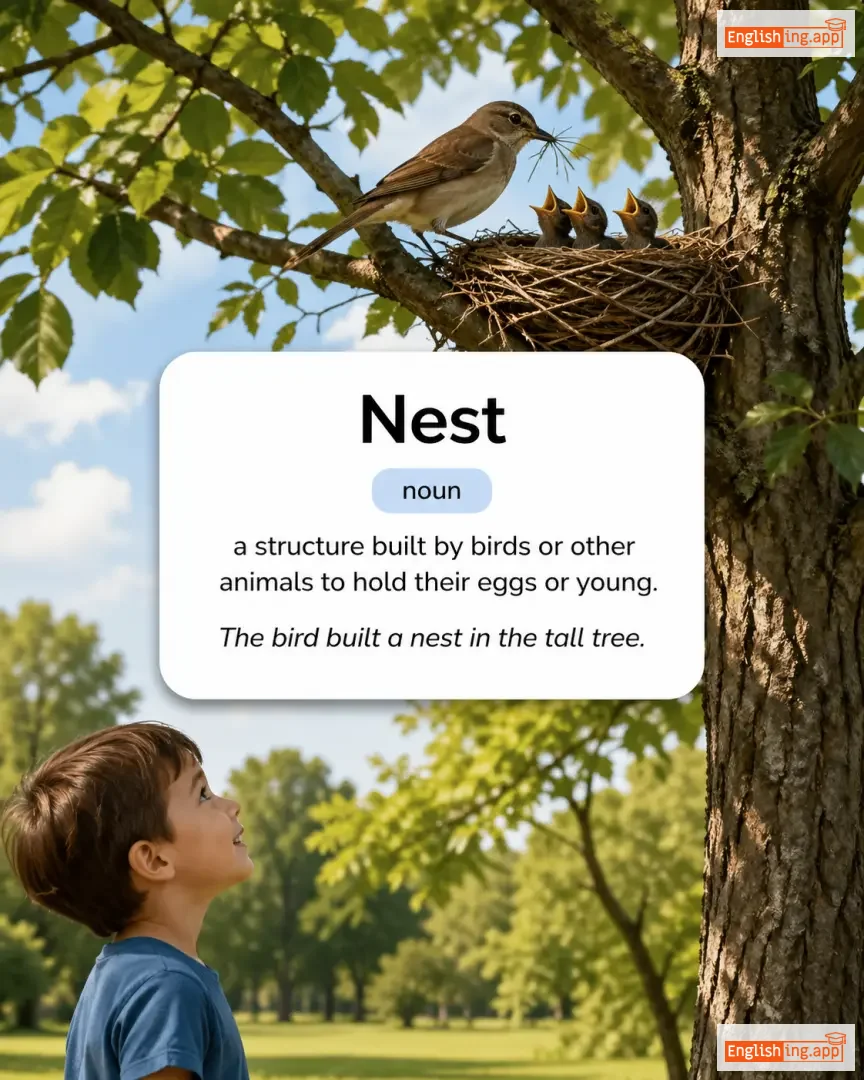
Nest definition card — visual illustration of the meaning
noun
/nɛst/
Nest (Nest)

a structure built by birds or other animals to hold their eggs or young.

"The bird built a nest in the tall tree."

"Der Vogel baute ein Nest im hohen Baum." (Der Vogel baute ein Nest im hohen Baum.)