词汇表

英语词汇词典 | 单词含义、定义和示例

adjective
/ʌnˈwəʊntɪd/
不寻常 (bù xúncháng)

Unusual, uncommon, or out of the ordinary.

"She spoke with an unwonted gentleness that surprised everyone."

"她以一种不寻常的温柔说话,令所有人都感到惊讶。" (Ta yi zhong bu xunchang de wenrou shuohua, ling suoyouren dou gandao jingya.)
adjective
/ʌnˈwɜːrði/
不配; 没有价值 (bù pèi; méiyǒu jiàzhí)

not deserving respect or attention; lacking worth or merit

"He felt unworthy of such praise and recognition."

"他觉得自己不配得到这样的赞扬和认可。" (Tā juédé zìjǐ bùpèi dédào zhèyàng de zànyáng hé rènkě.)
verb
/ʌnˈræp/
拆开 (chai kai)

remove wrapping or covering from something; reveal something gradually or clearly

"She carefully unwrapped the gift with excitement."

"她兴奋地小心拆开了礼物。" (Ta xingfende xiaoxin chaikai le liwu)
unyielding definition card — visual illustration of the meaning
adjective
ʌnˈjiːl.dɪŋ
坚定或坚韧 (jiān dìng huò jiān rèn)

Not easily broken or giving in to pressure.

"Her unyielding determination helped her overcome all challenges."

"她坚定的决心帮助她克服了所有的挑战。" (Tā jiāndìng de juéxīn bāngzhù tā kèfúle suǒyǒu de tiǎozhàn.)
verb
/ʌnˈjoʊk/
解开 (jiě kāi)

To release from a yoke or to free from restraint or obligation.

"The farmer unyoked the oxen after a long day of work."

"农民在长时间工作后解开了牛的套索。" (Nóngmín zài cháng shíjiān gōngzuò hòu jiě kāi le niú de tàosuǒ.)
⬆️

up (āp)

adverb
/ʌp/
向上 (xiang shang)

towards a higher position or level

"He climbed up the ladder quickly."

"他迅速爬上了梯子。" (Ta xun su pa shang le ti zi.)
noun
/ˈʌpˌkiːp/
维护 (wéi hù)

The process or cost of maintaining something in good condition.

"The upkeep of the old house is very expensive."

"老房子的维护非常昂贵。" (Lǎo fángzi de wéihù fēicháng ángguì.)
verb
/ʌpˈbreɪd/
斥责 (chize)

To scold or criticize someone harshly.

"The teacher upbraided the student for being late again."

"老师因为学生再次迟到而训斥了他。" (Lǎoshī yīnwèi xuéshēng zàicì chídào ér xùnchì le tā.)
noun/verb
/ˈʌpˌkæst/
向上投掷 (xiang shang tou zhi)

Verb: To cast or throw upward. Noun: Something thrown or directed upward.

"The fisherman upcast his net into the air."

"渔夫把他的网投向空中。" (Yu fu ba ta de wang tou xiang kong zhong.)
adjective
/ˈʌpˌkʌmɪŋ/
即将到来 (jijiang daolai)

about to happen or appear

"The upcoming event will be held next week."

"即将到来的活动将在下周举行。" (Jijiang daolai de huodong jiang zai xia zhou juxing.)
update definition card — visual illustration of the meaning
verb
/ˈʌpdeɪt/

to make something more modern or accurate by adding new information or changing it

"Please update your profile information regularly."

verb
/ˈʌpˌɡreɪd/
升级 (shengji)

to raise something to a higher standard, improve

"We decided to upgrade the software to the latest version."

"我们决定将软件升级到最新版本。" (Wo men jue ding jiang ruan jian sheng ji dao zui xin ban ben.)
noun
/ʌpˈhiːvəl/
动荡 (dongtang)

a violent or sudden change or disruption to something

"The company faced a major upheaval after the sudden resignation of its CEO."

"公司在其CEO突然辞职后经历了巨大的动荡。" (Gongsi zai qishi CEO tuuran cizhi hou jingli le juyida de dongtang.)
verb
/ʌpˈhiːv/
抬起 (tái qǐ)

to lift or raise something forcefully; to cause to rise suddenly

"The workers had to upheave the heavy stone to clear the path."

"工人们不得不抬起重石来清理道路。" (Gōngrén men bùdé bù tái qǐ zhòng shí lái qīnglǐ dàolù.)
adjective
/ˈʌpˌhɪl/
困难的; 需要巨大努力的; 向上的倾斜 (kunnan de; xuyao jida nuli de; xiang shang de qingxie)

difficult; requiring great effort; sloping upward

"Learning a new language can be an uphill battle."

"学习一门新语言可能是一个艰难的战斗。" (Xuexi yi men xin yuyan keneng shi yige jiannang de zhanzheng.)
verb
/ʌpˈhoʊld/
维护 (wéihù)

to maintain or support a principle, law, or decision

"The judge promised to uphold justice at all costs."

"法官承诺不惜一切代价维护正义。" (Fǎguān chéngnuò bùxī yīqiè dàijià wéihù zhèngyì.)
preposition
/əˈpɒn/
之后 (zhīhòu)

on or immediately after

"Upon hearing the news, he rushed to the hospital."

"听到消息后,他赶到医院。" (Tīng dào xiāoxī hòu, tā gǎn dào yīyuàn.)
adjective
/ˈʌpər/
上层 (shàngcéng)

higher in position or rank

"The upper floor of the building is under renovation."

"建筑物的上层正在翻修。" (Jiànzhúwù de shàngcéng zhèngzài fāngxiū.)
adjective
/ˈʌpərˌmoʊst/
最高 (zuìgāo)

situated at the highest place or most important

"Her family's safety was uppermost in her mind during the crisis."

"她在危机期间心里最重要的是家庭的安全。" (Tā zài wéijī qījiān xīnlǐ zuì zhòngyào de shì jiātíng de ānquán.)
adjective, adverb
/ˈʌpraɪt/
幸福 (xìng fú)

positioned vertically; morally good and honest

"He remained upright despite the strong winds."

"当她获得奖项时,她无法掩饰自己的幸福。" (Dāng tā huòdé jiǎngxiàng shí, tā wúfǎ yǎnshì zìjǐ de xìngfú.)
noun
/ˈʌp.raɪt.nəs/
正直; 正义 (zhèngzhí; zhèngyì)

the quality of being honest and morally correct; integrity

"His uprightness in business dealings earned him great respect."
"他在商业中的正直赢得了很大的尊重。" (Tā zài shāngyè zhōng de zhèngzhí yíngdéle hěn dà de zūnzhòng.)
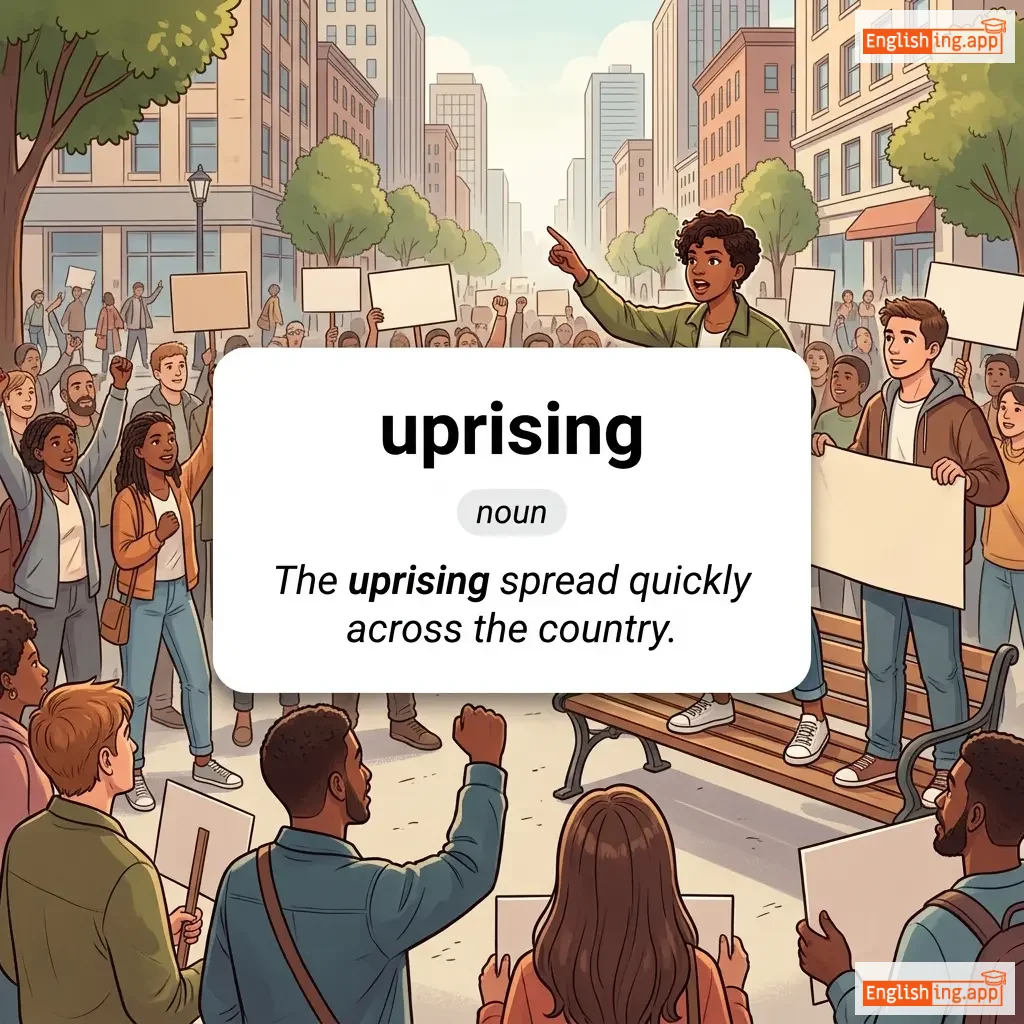
uprising definition card — visual illustration of the meaning
noun
/ˈʌpraɪzɪŋ/
起义 (qiyi)

An act of resistance or rebellion; an attempt to overthrow authority or government.

"The uprising spread quickly across the country."

"起义迅速蔓延到全国。" (Qiyi xunxu manyan dao quanguo.)
noun
/ˈʌp.rɔːr/
骚动 (saodong)

A loud noise, commotion, or disturbance caused by a group of people.

"The announcement caused an uproar in the audience."

"公告在观众中引起了骚动。" (Gonggao zai guanzhong zhong yin qi le saodong.)
adjective
/ʌpˈrɔːr.i.əs/
极其滑稽 (jiqi huaji)

Extremely funny or noisy; causing loud laughter or commotion.

"The comedian's jokes were absolutely uproarious."

"喜剧演员的笑话绝对是极其滑稽的。" (Xijuyanyuan de xiaohua jueduishi jiqi huaji de.)
verb
/ʌpˈruːt/
拔除 (bachu)

To pull something out of the ground; to remove or displace completely.

"They uprooted the old tree from the garden."
"他们从花园里把老树拔了出来。" (Tamen cong huayuan li ba laoshu ba le chulai.)
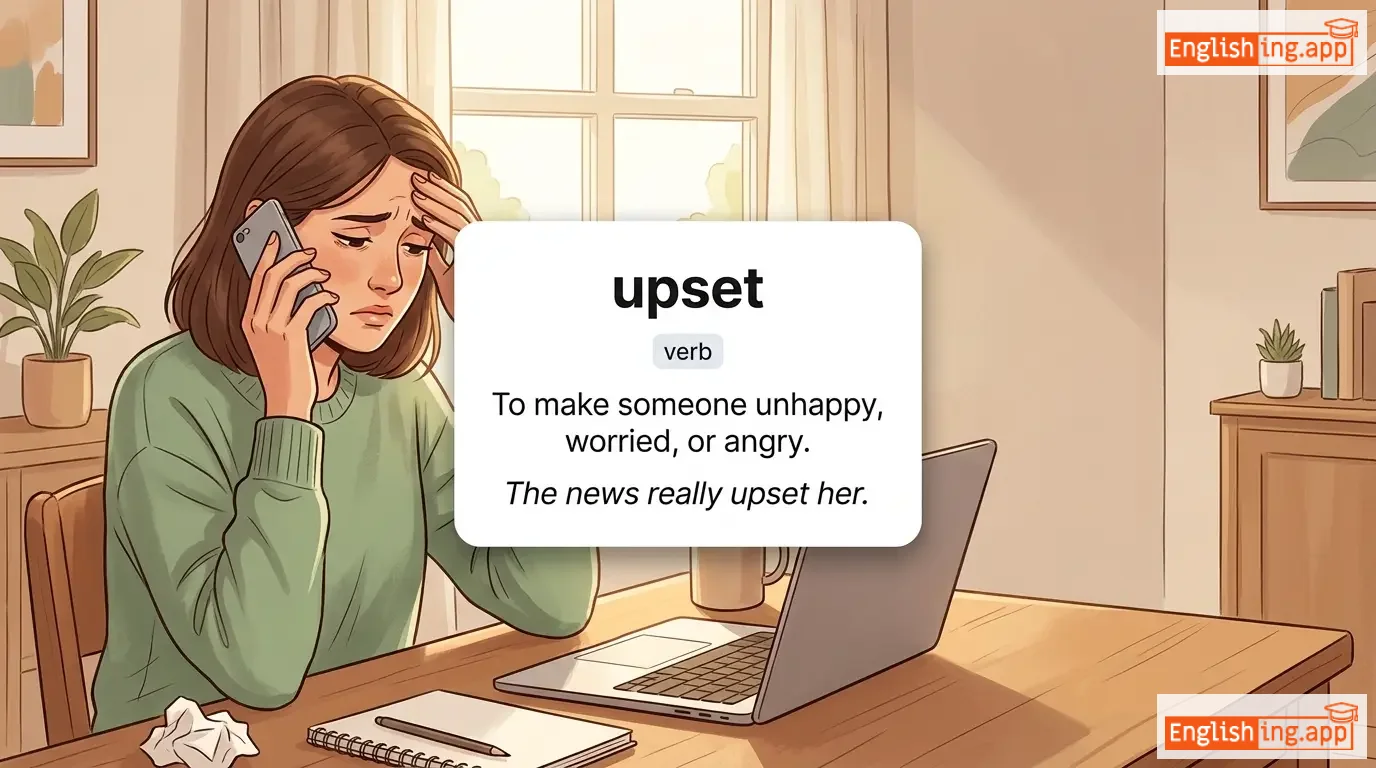
upset definition card — visual illustration of the meaning
verb
/ʌpˈsɛt/
使不高兴 (shi bu gaoxing)

To make someone unhappy, worried, or angry.

"The news really upset her."

"新闻真的让她很不高兴。" (Xīnwén zhēn de ràng tā hěn bù gāoxìng.)
noun
/ˈʌp.ʃɒt/
结果 (jieguo)

The final result or outcome of a process or situation.

"The upshot of the meeting was that the plan was postponed."

"会议的结果是计划被推迟了。" (Huiyi de jieguo shi jihua bei tuichi le.)
adverb
/ˌʌpsaɪd ˈdaʊn/
倒过来 (dao guo lai)

with the upper part at the bottom; in or into a reversed position

"The picture was hanging upside-down on the wall."

"图片倒挂在墙上。" (tupian dao gua zai qiang shang)
🏠⬆️

Upstairs

adverb
/ˌʌpˈstɛərz/

on or to a higher floor of a building

"She went upstairs to her bedroom."

noun
/ˈʌp.tɜːn/
改善 (gaishan)

An improvement or upward trend in a situation, especially in business or economy.

"The company experienced an upturn in sales last quarter."
"该公司在上个季度销售情况有所改善。" (Gai gongsi zai shang ge jidu xiaoshou qingkuang you suo gaishan.)
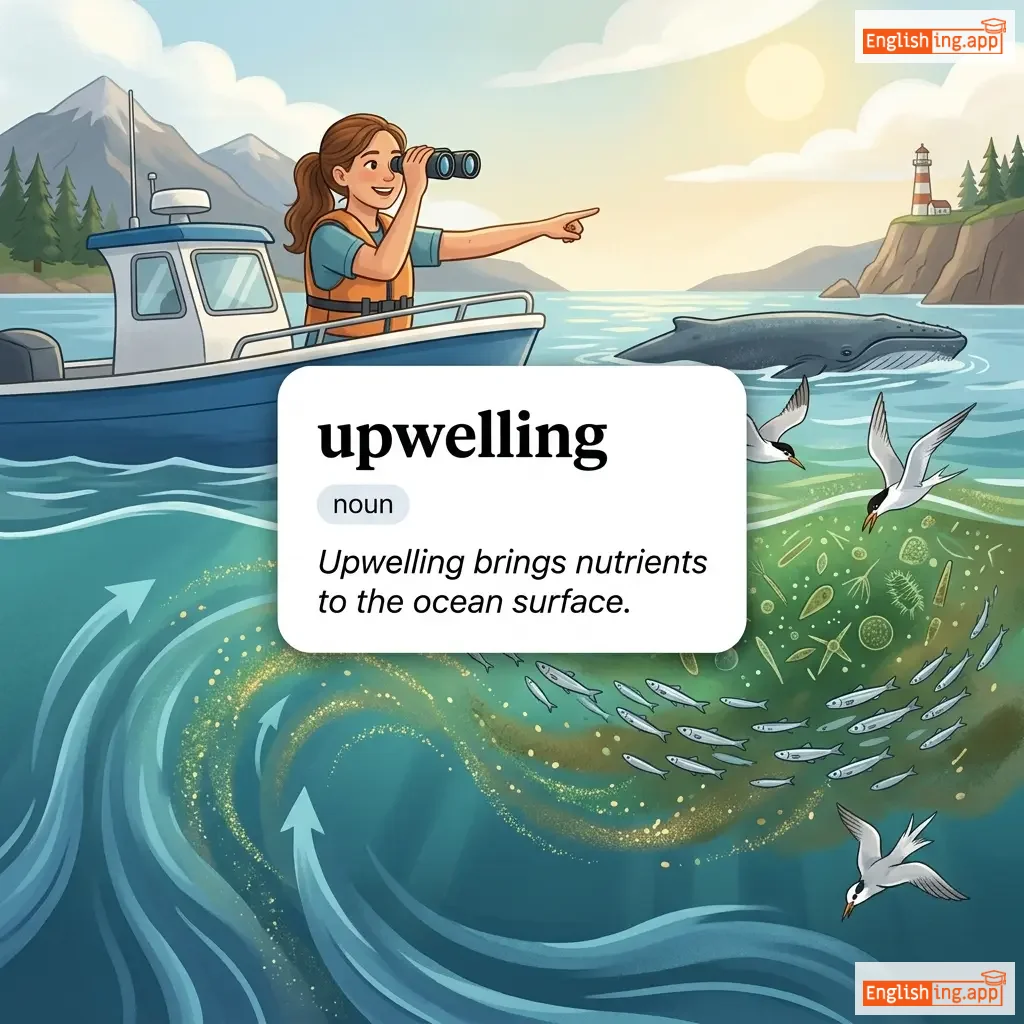
upwelling definition card — visual illustration of the meaning
noun
/ˈʌp.wel.ɪŋ/
上升流 (upwelling)

An oceanographic phenomenon that involves wind-driven motion of dense, cooler, and nutrient-rich water towards the ocean surface.

"Upwelling brings nutrients to the ocean surface."

"上升流将营养物质带到海洋表面。" (Shang sheng liu jiang yingyang wuzhi dai dao haiyang biaomian)
adjective
/ˈɜːrbən/
城市的 (chengshi de)

related to, characteristic of, or situated in a city or town

"Urban areas often have higher population density than rural areas."

"城市地区通常比乡村地区有更高的人口密度。" (Chengshi diqu tongchang bi xiangcun diqu you geng gao de renkou midu.)
adjective
/ɜːrˈbeɪn/
都市的 (dūshì de)

showing polished manners, refinement, and sophistication

"He was an urbane gentleman who charmed everyone at the party."

"他是一个都市绅士,在派对上迷住了所有人。" (Tā shì yīgè dūshì shēnshì, zài pàiduì shàng mí zhùle suǒyǒu rén.)
noun
/ɜːrˈbænɪti/
都市气质 (dūshì qìzhí)

refined courtesy, elegance, and sophistication in manner

"Her urbanity made her popular among diplomats and leaders."
"她的都市气质让她在外交官和领导人中非常受欢迎。" (Tā de dūshì qìzhí ràng tā zài wàijiāo guān hé lǐngdǎo rén zhōng fēicháng shòu huānyíng.)
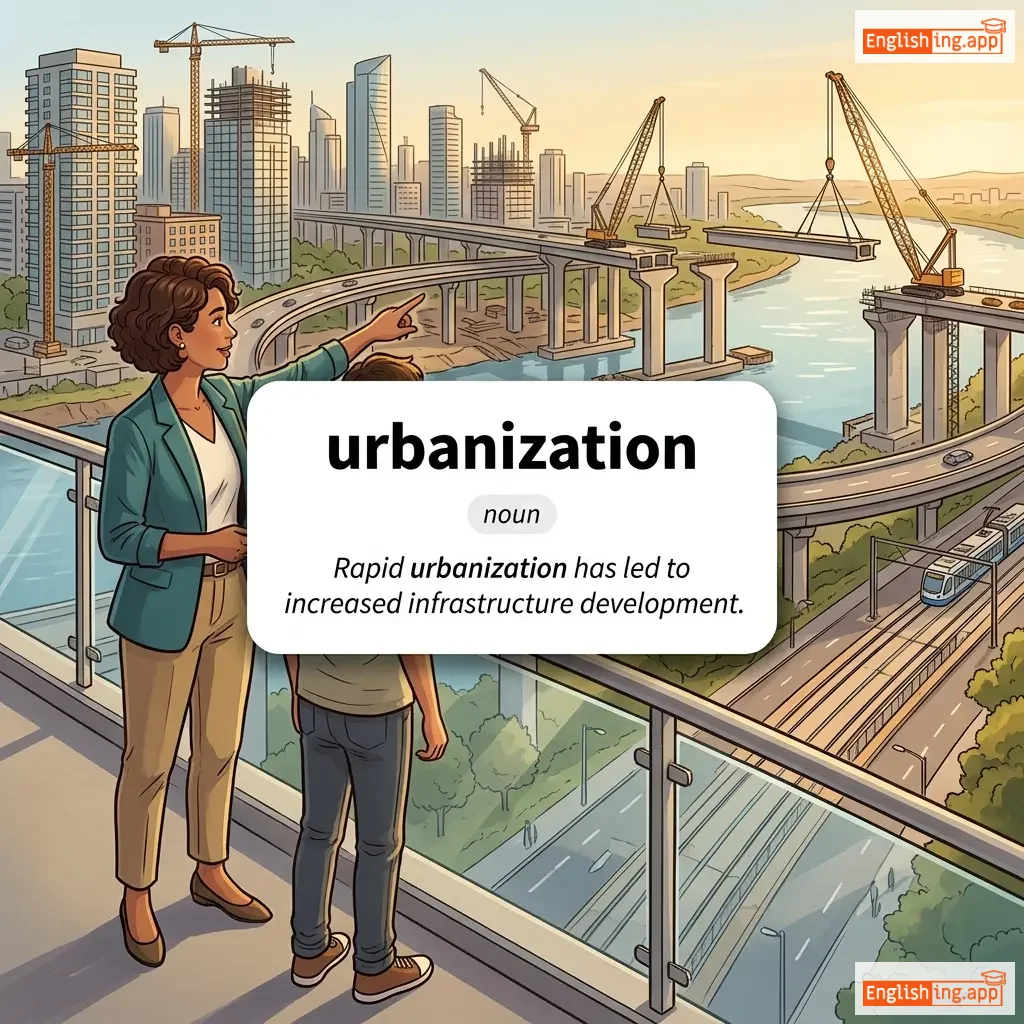
urbanization definition card — visual illustration of the meaning
noun
/ˌɜː.bən.aɪˈzeɪ.ʃən/
城市化 (chengshihua)

The process by which towns and cities are formed and become larger as more people begin living and working in central areas.

"Rapid urbanization has led to increased infrastructure development."

"快速的城市化导致了基础设施发展的增加。" (Kuaisu de chengshihua daozhile jichusheshi fazhande zengjia.)
noun
/ˈɜːrtʃɪn/
街头小孩 (jietou xiaohai)

a mischievous or poorly dressed child, often from the streets

"The ragged urchins played by the riverbank."

"那些穿着破烂的街头小孩在河边玩耍。" (naxie chuanzhuo polan de jietou xiaohai zai he bian wanshua.)
verb
/ɜːrdʒ/
催促 (cuīcù)

to strongly encourage or try to persuade someone to do something

"Doctors urge patients to exercise regularly."

"医生鼓励病人定期锻炼。" (Yīshēng gǔlì bìngrén dìngqī duànliàn.)
noun
/ˈɜːrdʒənsi/
紧急 (jinji)

The quality of requiring immediate attention or action.

"The doctor emphasized the urgency of starting treatment right away."

"医生强调了立即开始治疗的紧急性。" (Yisheng qiangdiao le limiji kaishi zhiliao de jinji xing.)
adjective
/ˈɜːrdʒənt/
紧急 (jinji)

Requiring immediate action or attention.

"She sent an urgent message to her manager."

"她给经理发了一条紧急消息。" (Tā gěi jīnglǐ fāle yītiáo jǐnjí xiāoxī.)
adverb
/ˈɜːrdʒəntli/
紧急地 (jinji de)

in a way that requires immediate attention or action

"The patient urgently needs medical attention."

"病人紧急地需要医疗救助。" (bingren jinji de xuyao yiliao jiujiu)
adjective
/ˈɜːrsaɪn/
熊似的 (xióng shì de)

Relating to or resembling a bear.

"The man’s ursine strength amazed everyone."

"那个人熊似的力量让所有人都吃惊。" (Nàgè rén xióng shì de lìliàng ràng suǒyǒu rén dōu chījīng.)
pronoun
/ʌs/
我们 (women)

used to refer to the speaker and one or more other people as the object of a verb or preposition

"She gave us a gift."

"她给了我们一个礼物。" (Tā gěi le wǒmen yīgè lǐwù.)
noun
/ˈjuːsɪdʒ/
使用 (shiyong)

The action of using something; the way in which a word or phrase is normally used.

"The book explains the proper usage of technical terms."

"这本书解释了技术术语的正确使用。" (Zhè běn shū jiěshìle jìshù shùyǔ de zhèngquè shǐyòng.)
use definition card — visual illustration of the meaning
🛠️

use (yuz)

verb
/juːz/ (verb), /juːs/ (noun)
使用 (shiyong)

To employ something for a purpose.

"She used her phone to call a taxi."

"她用了手机叫出租车。" (Ta yongle shouji jiao chuzuche.)
adjective
/juːzd/
二手 (èr shǒu)

having already been used

"This is a used car."

"这是一辆二手车。" (Zhè shì yī liàng èr shǒu chē.)
adjective
/ˈjuːsfəl/
有用的 (you yong de)

having a practical or beneficial use

"This tool is very useful."

"这个工具非常有用。" (Zhège gōngjù fēicháng yǒuyòng.)
noun
/ˈjuːs.fəl.nəs/
有用性 (youyongxing)

the quality of being useful; practical value or helpfulness

"The usefulness of this tool became apparent during the project."

"这个工具的有用性在项目过程中变得显而易见。" (Zhege gongju de youyongxing zai xiangmu guocheng zhong biande xian eryijian.)
adjective
/ˈjuːsləs/
无用的 (wúyòng de)

not serving any purpose or value

"The broken phone is completely useless."

"坏掉的手机完全无用。" (Huài diào de shǒujī wánquán wúyòng.)
noun
/ˈjuːzər/
用户 (yonghu)

a person who uses or operates something

"He is a frequent user of this app."

"他是这个应用程序的常用用户。" (Ta shi zhege yingyongchengxu de changyong yonghu.)
adjective
/ˈjuːʒəl/
常见 (changjian)

habitually or typically occurring or done

"It’s our usual meeting spot."

"这是我们常见的会议地点。" (Zhè shì wǒmen chángjiàn de huìyì dìdiǎn.)