词汇表

英语词汇词典 | 单词含义、定义和示例

adjective
/ˌθiːəˈrɛtɪkl/
理论的 (lilun de)

Concerned with or based on theory rather than practical application.

"The idea remains largely theoretical without real-world evidence."

"这个想法在没有实际证据的情况下,仍然主要是理论性的。" (Zhege xiangfa zai meiyou shiji zhengju de qingkuang xia, rengran zhuyao shi lilun xing de.)
noun
/ˈθiːərɪst/
理论家 (lilun jia)

A person who develops, studies, or explains theories in a particular field.

"The political theorist explained the impact of democracy on social structures."

"政治理论家解释了民主对社会结构的影响。" (Zhengzhi lilunjia jiexile minzhu dui shehui jiegou de yingxiang.)
verb
/ˈθiːəraɪz/
理论化 (lilunhua)

To form a theory or set of ideas to explain something.

"Scientists often theorize about the origins of the universe."

"科学家们经常推测宇宙的起源。" (Kexuejiamen jingchang tuice yuzhou de qiyuan.)
noun
/ˈθiːəri/
理论 (lilun)

An explanation of an idea or principle based on facts, reasoning, and evidence.

"Einstein's theory of relativity changed the way we understand physics."

"爱因斯坦的相对论改变了我们理解物理的方式。" (Ai yin si tan de xiangduilun gaibian le women lijie wuli de fangshi.)
noun
/θiˈɒsəfi/
神智学 (shénzhìxué)

A religious or philosophical belief system that seeks direct knowledge of the mysteries of life and the divine.

"Theosophy attracted people interested in mysticism and spiritual growth."

"神智学吸引了对神秘主义和精神成长感兴趣的人们。" (Shénzhìxué xīyǐnle duì shénmì zhǔyì hé jīngshén chéngzhǎng gǎn xìngqù de rénmen.)
therapeutic definition card — visual illustration of the meaning
adjective
/ˌθɛrəˈpjuːtɪk/
治疗性的 (zhì liáo xìng de)

Related to healing, treatment, or providing a beneficial effect on the body or mind.

"Yoga can have a therapeutic effect on stress and anxiety."

"瑜伽可以对压力和焦虑产生治疗效果。" (Yújiā kěyǐ duì yālì hé jiāolǜ chǎnshēng zhìliáo xiàoguǒ.)
noun
/ˈθɛrəpɪst/
治疗师 (zhìliáo shī)

a person trained to provide treatment or counseling for physical or mental health

"The therapist helped him overcome his anxiety."

"治疗师帮助他克服了焦虑。" (Zhìliáo shī bāngzhù tā kèfú le jiāolǜ.)
therapy definition card — visual illustration of the meaning
💆‍♀️

therapy (治疗)

noun
/ˈθɛrəpi/
治疗 (zhiliao)

treatment intended to relieve or heal a disorder

"She is receiving therapy for her injury."

"她正在接受治疗以治疗她的伤害。" (Tā zhèngzài jiēshòu zhìliáo yǐ zhìliáo tā de shānghài.)
adverb
/ðɛə/
那里 (nàlǐ)

in, at, or to that place or position

"We are going there tomorrow."

"我们明天去那里。" (Wǒmen míngtiān qù nàlǐ.)
adverb
/ˌðɛrəˈbaʊt/
大约 (dayue)

Approximately or around that place, amount, or time.

"The repairs will cost five hundred dollars or thereabout."

"修理费用大约五百美元。" (Xiuli feiyong dayue wu bai meiyuan.)
adverb
/ðɛrˈæftər/
从那时起 (cong nà shí qǐ)

from that time on

"He moved to Canada and thereafter started a new life."

"他搬到了加拿大,之后开始了新生活。" (Tā bān dào le jiānádà, zhīhòu kāishǐ le xīn shēnghuó.)
adverb
/ˈðeə.baɪ/
因此 (yinci)

by that means; as a result of that

"She forgot to set the alarm, thereby missing her early flight."

"她忘记设置闹钟,因此错过了她的早班飞机。" (Ta wangji shezhi naozhong, yinci cuoguo le ta de zaoban feiji.)
adverb
/ˈðɛərfɔːr/
为此 (wei ci)

For that or for it.

"He received payment and gave a receipt therefor."

"他收到了付款,并为此给出了收据。" (Ta shoudao le fukuan, bing wei ci gei chu le shouju.)
conjunction
/ðɛəˈfɔː/

for that reason; because of that

"She was tired; therefore, she went to bed early."

adverb
/ˌðɛərˈɪn/
其中; (qízhōng)

in that place; in that respect

"The box contains many treasures, and therein lies its value."

"盒子里有许多宝藏,而其中包含着它的价值。" (Hézi lǐ yǒu xǔduō bǎozàng, ér qízhōng bāohán zhe tā de jiàzhí.)
adverb
/ˌðɛərˈʌv/
因此 (yīncǐ)

of that; from that

"The contract and all amendments thereof must be signed."

"合同和所有的修正案因此必须签署。" (Hétóng hé suǒyǒu de xiūzhèng àn yīncǐ bìxū qiānshǔ.)
adverb
/ˌðɛərˈtu/
与此一起; (yǔ cǐ yīqǐ)

to that; in addition to that

"The house and the garden attached thereto were sold."

"房子和附带的花园已被出售。" (Fángzi hé fùdài de huāyuán yǐ bèi chūshòu.)
adverb
/ˌðeərəˈpɒn/
随即; (suiji)

immediately after that; following that event

"He finished his speech and thereupon left the stage."

"他结束了演讲,随即离开了舞台。" (Ta jie shu le yanjiang, suiji likai le wutai.)
adverb
/ˌðeərˈwɪð/
与此一起; (yǔ cǐ yīqǐ)

together with that; in addition to that

"He handed me the contract and the pen therewith."

"他把合同和笔与此一起交给了我。" (Tā bǎ hé tóng hé bǐ yǔ cǐ yīqǐ jiāo gěi le wǒ.)
adjective
/ˈθɜːrməl/
热的 (re de)

Related to heat or temperature.

"She wore a thermal jacket to stay warm in winter."
"她穿着一件热的夹克,在冬天保持温暖。" (Ta chuanzhe yijian re de jiake, zai dongtian baochi wennuan.)
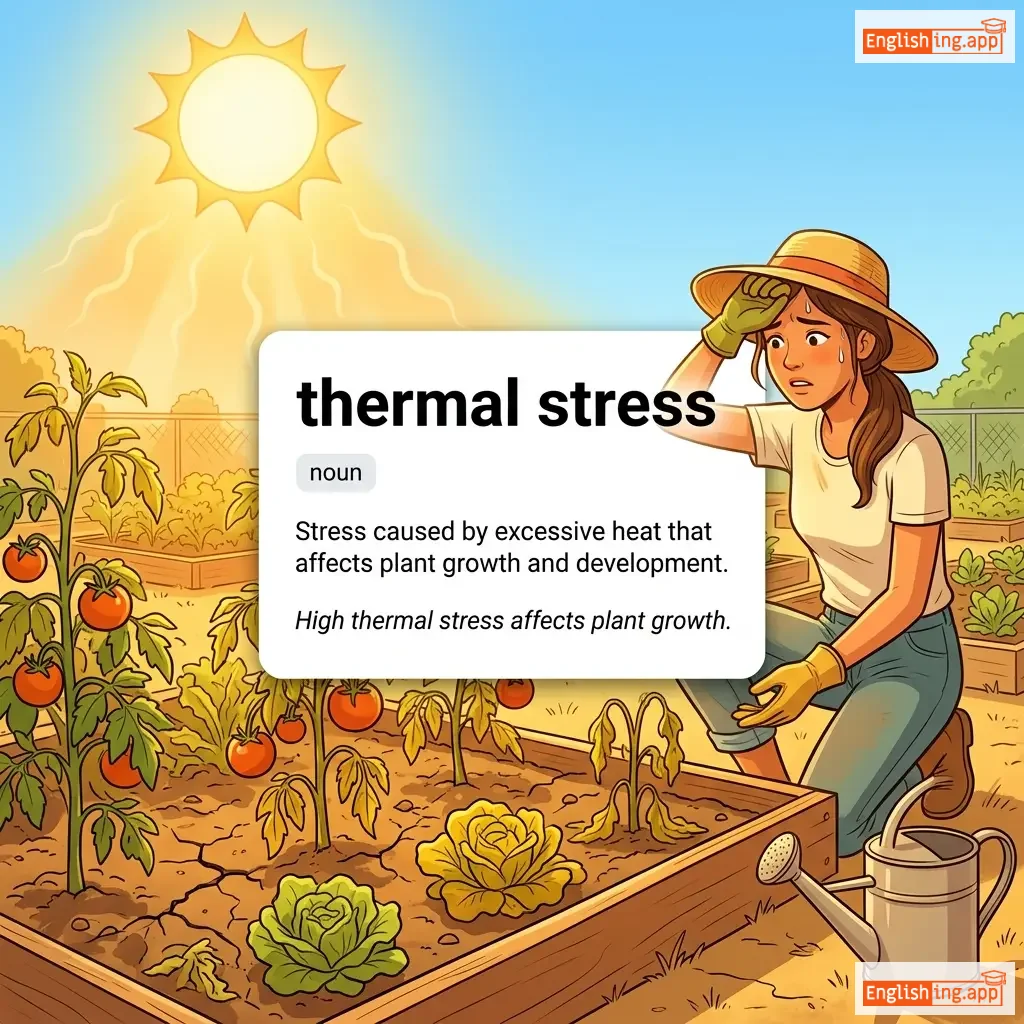
thermal stress definition card — visual illustration of the meaning
noun
ˈθɜː.məl stres
热应力 (rè yìnglì)

Stress caused by excessive heat that affects plant growth and development.

"High thermal stress affects plant growth."
"高温应力影响植物的生长。" (Gāowēn yìnglì yǐngxiǎng zhíwù de shēngzhǎng.)
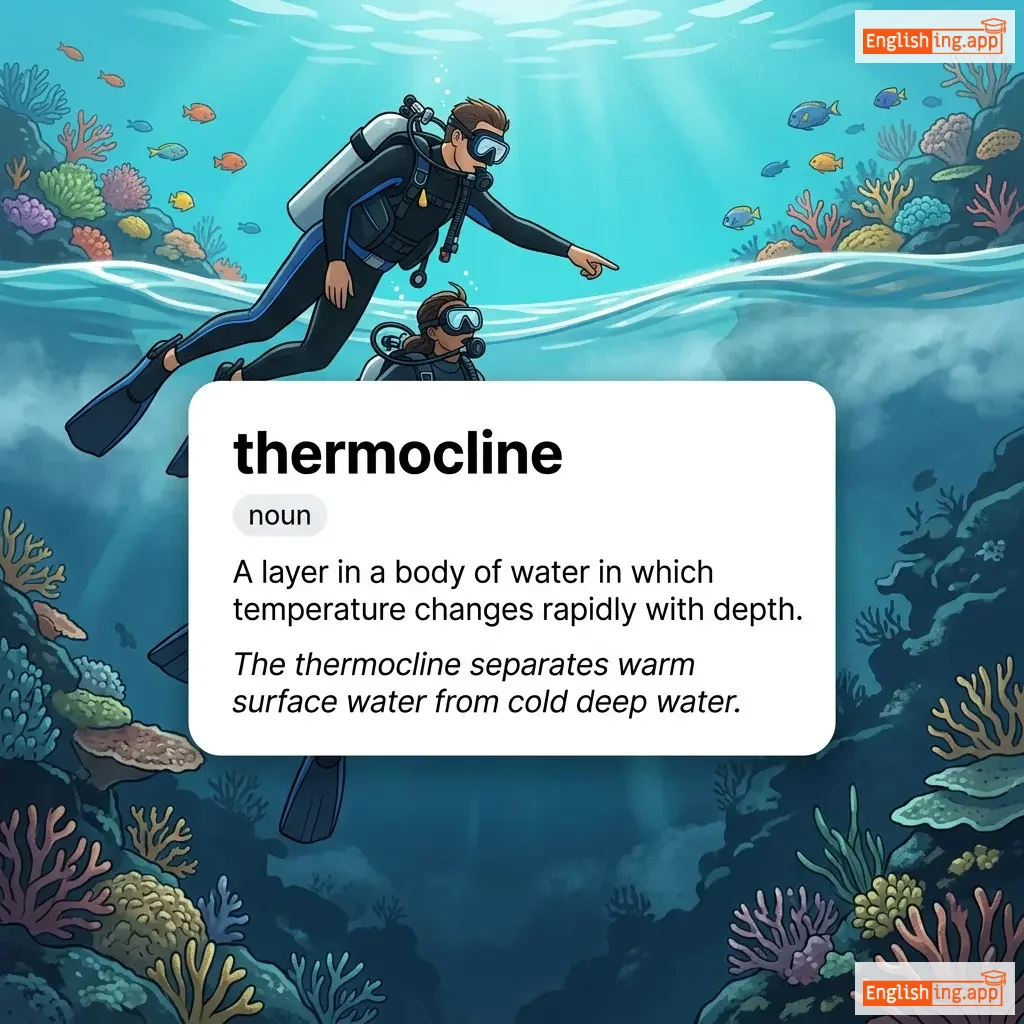
thermocline definition card — visual illustration of the meaning
noun
/ˈθɝː.moʊ.klaɪn/
热跃层 (rè yuè céng)

A layer in a body of water in which temperature changes rapidly with depth.

"The thermocline separates warm surface water from cold deep water."

"热跃层将温暖的表层水与寒冷的深层水分开。" (Rè yuè céng jiāng wēnnuǎn de biǎocéng shuǐ yǔ hánlěng de shēncéng shuǐ fēn kāi.)
thermogenesis definition card — visual illustration of the meaning
noun
/ˌθɜː.məʊˈdʒen.ɪ.sɪs/
热量生产过程 (relian shengchan guocheng)

The process of heat production in living organisms, often associated with burning calories and energy expenditure.

"Spicy foods can enhance thermogenesis and calorie burning."

"辛辣食物可以增强热生热和卡路里燃烧。" (Xinla shiwu keyi zengqiang reshengre he kaluli ranshao.)
pronoun
/ðiːz/
这些 (zhe xie)

used to refer to things or people that are near or present

"These are my friends."

"这些是我的朋友。" (Zhe xie shi wo de pengyou.)
noun
/ˈθiːsɪs/
论文 (lunwen)

A long piece of writing on a particular subject, usually for a degree at a university.

"She spent two years writing her doctoral thesis."

"她花了两年时间写她的博士论文。" (Tā huāle liǎng nián shíjiān xiě tā de bóshì lùnwén.)
thespian definition card — visual illustration of the meaning
noun
/ˈθɛspiən/
演员 (yǎnyuán)

An actor or actress; relating to drama or theater.

"The festival was filled with talented thespians from across the country."

"这个节日充满了来自全国各地的才华横溢的演员。" (Zhège jiérì chōngmǎnle láizì quánguó gèdì de cáihuá héngyì de yǎnyuán.)
pronoun
/ðeɪ/
他们 (tāmen)

used to refer to people or things previously mentioned or easily identified

"They are going to the park."

"他们去公园。" (Tāmen qù gōngyuán.)
adjective
/θɪk/
(hou)

having a large distance between two sides; not thin

"The book was so thick it took weeks to finish."

"这本书很厚,需要几周才能读完。" (Zhe ben shu hen hou, xuyao ji zhou cai neng du wan.)
noun
/ˈθɪk.ɪt/
灌木丛; 茂密的灌木生长 (thiket)

a dense group of bushes or trees; a thick growth of shrubs

"The rabbit disappeared into the thicket."

"兔子消失在灌木丛中。" (Tùzǐ xiāoshī zài guànmù cóng zhōng.)
adverb
/ˈθɪkli/
密集地 (mìjí dì)

in a thick manner; densely; heavily

"The forest was thickly wooded with tall pine trees."

"森林被高大的松树密集覆盖。" (Sēnlín bèi gāodà de sōngshù mìjí fùgài.)
noun
/ˈθɪk.nəs/
厚度 (houdù)

The measure of how thick or dense something is

"The thickness of the book made it hard to carry."

"这本书的厚度使它难以携带。" (Zhe ben shu de houdù shi ta nanyi xiedai.)
🦹‍♂️

Thief (θiːf)

noun
/θiːf/
小偷 (xiaotou)

a person who steals things from others

"The thief was caught stealing from the jewelry store."

"小偷在珠宝店偷东西时被抓住了。" (Xiaotou zai zhubao dian tou dongxi shi bei zhuazhu le.)
noun
/θaɪ/
大腿 (daitui)

the part of the leg between the hip and the knee

"He felt pain in his right thigh after running for an hour."

"他在跑了一个小时后感到右大腿疼痛。" (Ta zai pao le yi ge xiaoshi hou gandao you daitui tengtong.)
adjective
/θɪn/
(bo)

having little thickness or width

"She wore a thin scarf in the winter."

"她冬天戴着一条薄围巾。" (Tā dōngtiān dàizhe yītiáo bó wéijīn.)
noun
/θɪŋ/
东西 (dongxi)

an object, idea, or matter that is being referred to or dealt with

"This is the thing I was looking for."

"这是我在找的东西。" (Zhe shi wo zai zhao de dongxi.)
think definition card — visual illustration of the meaning
verb
/θɪŋk/
思考 (sikao)

to use one's mind to consider or reason about something

"I think this is a great idea."

"我觉得这是一个好主意。" (Wǒ juéde zhè shì yīgè hǎo zhǔyì.)
adjective
/ˈθɪŋ.kə.bəl/
可想的 (kexiang de)

Capable of being imagined or conceived; possible to consider or believe

"It is hard to believe that such an outcome is even thinkable."

"很难相信这样的结果甚至是可以想象的。" (Hen nan xiangxin zheyang de jieguo shenzhi shi keyi xiangxiang de)
noun
/ˈθɪŋkɪŋ/
思考 (sī kǎo)

the process of considering or reasoning about something

"Her thinking was clear and precise."

"她的思考清晰而准确。" (Tā de sīkǎo qīngxī ér zhǔnquè.)
adjective
/θɜrd/
第三 (di san)

constituting number three in a sequence

"She finished in third place."

"她得了第三名。" (Ta de le di san ming.)
adjective
/ˈθɜːr.sti/
口渴的 (kǒu kě de)

feeling a need to drink; having a strong desire for something

"I am very thirsty after running in the heat."

"在炎热中跑步后,我非常口渴。" (Zài yánrè zhōng pǎobù hòu, wǒ fēicháng kǒu kě.)
3️⃣0️⃣

thirty (桑三十)

adjective
/ˈθɜrti/
三十 (san shi)

equivalent to the number 30

"He is thirty years old."

"他三十岁。" (Ta san shi sui.)
pronoun
/ðɪs/
这个 (zhe ge)

used to refer to a person or thing that is close or near in space, time, or thought

"This is my favorite book."

"这是我最喜欢的书。" (Zhè shì wǒ zuì xǐhuān de shū.)
noun
/θɔːn/
(ci)

a sharp pointed part of a plant; something that causes pain or annoyance

"Be careful of the thorns on the rose bush."

"小心玫瑰丛中的刺。" (Xiǎoxīn méiguī cóng zhōng de cì.)
adjective
/ˈθɔːrni/
多刺的,复杂的 (duō cì de, fù zá de)

covered with thorns; causing difficulty or trouble

"They faced a thorny issue during the negotiation."

"他们在谈判过程中面临了一个棘手的问题。" (Tāmen zài tán pàn guò chéng zhōng miàn lín le yí gè jí shǒu de wèn tí.)
adjective
/ˈθʌroʊ/
彻底的, 详尽的 (chedi de, xiangjin de)

complete with regard to every detail; not superficial or partial

"The report was thorough and well-researched."

"报告很彻底且做了充分的研究。" (baogao hen chedi qie zuo le chongfen de yanjiu.)
noun
/ˈθʌroʊˌbrɛd/
纯种马 (chún zhǒng mǎ)

a horse of pure and recognized breed; a person of good breeding or education

"The jockey rode a fast thoroughbred in the race."

"骑师在比赛中骑了一匹快速的纯种马。" (qí shī zài bǐ sài zhōng qí le yī pǐ kuài sù de chún zhǒng mǎ.)
noun
/ˈθʌroʊˌfɛr/
主要街道 (zhuyao jiedao)

a main road or public highway that goes through a place

"The new mall is located along the main thoroughfare."

"新购物中心位于主要街道旁。" (xin gouwu zhongxin weiyu zhuyao jiedao pang)
adjective
/ˈθʌroʊˌɡoʊɪŋ/
完全的,彻底的 (wánquán de, chèdǐ de)

carried out to the full extent; absolute and complete

"She is a thoroughgoing professional in every sense."

"她在每个方面都是一位彻底的专业人士。" (Tā zài měi gè fāngmiàn dōu shì yī wèi chèdǐ de zhuānyè rénshì.)
adverb
/ˈθʌr.ə.li/
彻底地 (chedi de)

completely and carefully; in a detailed way

"Please clean the kitchen thoroughly before the guests arrive."

"请在客人到达之前彻底清理厨房。" (Qing zai keren daoda zhiqian chedi qingli chufang.)
pronoun
/ðoʊz/
那些 (nàxiē)

used to refer to people or things that are far away or distant in space, time, or thought

"Those are the shoes I want."

"那些是我想要的鞋子。" (Nàxiē shì wǒ xiǎng yào de xiézi.)