词汇表

英语词汇词典 | 单词含义、定义和示例

noun
/tsuːˈnɑː.mi/
海啸 (hai xiao)

a large sea wave caused by an underwater earthquake or volcanic eruption

"The tsunami devastated the coastal town, leaving thousands homeless."

"海啸摧毁了沿海城市,导致成千上万的人无家可归。" (Hai xiao cuihui le yanhai chengshi, daozhi chengqian shangwan de ren wu jia ke gui.)
noun
/tjuːb/
管子 (guǎnzi)

a hollow cylinder used to convey something, typically fluid

"He used a tube to measure the liquid."

"他使用管子来测量液体。" (Tā shǐyòng guǎnzi lái cèliàng yètǐ.)
noun
/ˈtuːb.roʊz/
夜来香 (yè lái xiāng)

a night-blooming flower with an intensely sweet fragrance, native to Mexico

"The tuberose flowers filled the evening air with their heavenly scent."

"夜来香的花朵充满了夜晚空气中的天国香气。" (Yè lái xiāng de huā duǒ chōng mǎn le yè wǎn kōng qì zhōng de tiānguó xiāng qì.)
🛏️

tuck (tak)

verb
/tʌk/
塞进 (saijin)

to push or fold something neatly into a particular place

"She tucked the blanket around the baby to keep him warm."

"她把毯子围绕着婴儿,这样他就保持温暖。" (Ta ba tanzi weirao zhe ying'er, zheyang ta jiu baochi wennuan.)
noun
/ˈtjuːzdeɪ/
星期二 (xingqi er)

The second day of the week, following Monday and preceding Wednesday.

"We have a meeting scheduled for Tuesday."

"我们定于星期二开会。" (Wo men ding yu xingqi er kai hui.)
adjective
/ˈtʌf.tɪd/
有小束的; 装饰着小束 (you xiao shu de; zhuangshi zhe xiao shu)

having a tuft or tufts; furnished with a tuft or clump of threads, hairs, or other material

"The tufted sofa looked elegant in the living room."

"有小束的沙发在客厅里看起来很优雅。" (Yǒu xiǎo shù de shāfā zài kètīng lǐ kàn qǐlái hěn yōuyǎ.)
noun
/ˈtʌɡboʊt/
拖船 (tuō chuán)

a small, powerful boat used for towing or pushing ships

"The tugboat guided the massive ship safely into the harbor."

"拖船将巨大的船只安全地引导进港口。" (Tuō chuán jiāng jù dà de chuán zhī ān quán de yǐn dǎo jìn gǎng kǒu.)
noun
/tʃuˈɪʃ.ən/
学费 (xué fèi)

the fee for instruction or teaching, typically at a school or university

"The tuition for the college has increased this year."

"今年大学的学费上涨了。" (Jīnnián dàxué de xuéfèi shàngzhǎng le.)
noun
/ˈtuː.lɪp/
郁金香 (yujinxiang)

a colorful spring flower with cup-shaped petals

"The red tulip bloomed beautifully in the garden."

"红色的郁金香在花园里美丽地盛开。" (hongse de yujinxiang zai huayuan li meili de shengkai)
noun
/ˈtʌmbrəl/

A two-wheeled cart, especially one used during the French Revolution to carry prisoners to the guillotine.

"The prisoners were carried to the square in a wooden tumbrel."

tumid definition card — visual illustration of the meaning
adjective
/ˈtjuːmɪd/
肿胀的,膨胀的,或浮夸的风格 (zhǒng zhàng de, péng zhàng de, huò fú kuā de fēng gé)

Swollen, enlarged, or pompous in style.

"His tumid prose was difficult to read."

"他的肿胀的散文很难阅读。" (Tā de zhǒng zhàng de sàn wén hěn nán yuè dú.)
noun
/ˈtjuːmər/
肿瘤 (zhǒng liú)

an abnormal mass of tissue caused by excessive cell growth

"The doctor found a benign tumor during the medical check-up."

"医生在体检过程中发现了一个良性肿瘤。" (Yīshēng zài tǐjiǎn guòchéng zhōng fāxiànle yīgè liángxìng zhǒngliú.)
noun
/ˈtjuːmʌlt/
骚动 (saodong)

A loud, confused noise, especially caused by a crowd; commotion or disorder.

"The protest created a tumult in the city square."

"抗议活动在城市广场上引发了骚动。" (Kàngyì huódòng zài chéngshì guǎngchǎng shàng yǐnfāle sāodòng.)
adjective
/tjuːˈmʌltʃuəs/
动荡 (dongtang)

Characterized by disorder, noisy excitement, or emotional agitation.

"They had a tumultuous relationship full of ups and downs."

"他们有一段充满波动的关系,起伏不定。" (Tamen you yi duan chongman bodong de guanxi, qifu budi.)
noun
/ˈtʌndrə/
冻原 (dong yuan)

A vast, flat, treeless Arctic region where the subsoil is permanently frozen.

"Polar bears roam across the icy tundra."

"北极熊在冰冷的冻原上徘徊。" (Bei ji xiong zai bing leng de dong yuan shang pai huai.)
noun
/tjuːn/
旋律 (xuanlu)

a sequence of musical notes that are pleasant to listen to; a melody

"She hummed a cheerful tune while cooking dinner."

"她在做晚餐的时候哼着一首愉快的旋律。" (Ta zai zuo wancan de shihou hengzhe yi shou yukuai de xuanlu.)
noun
/ˈtʌnəl/
隧道 (suìdào)

an underground passage or shaft

"They dug a tunnel under the river."

"他们在河底挖了一个隧道。" (Tāmen zài hédǐ wāle yīgè suìdào.)
noun
/ˈtɜːrbən/
头巾 (tóujīn)

a head covering made by wrapping a long piece of cloth around the head

"The Sikh man wore a colorful turban."
"那位锡克教徒戴着一顶彩色的头巾。" (nà wèi xī kè jiào tú dài zhe yī dǐng cǎisè de tóujīn.)
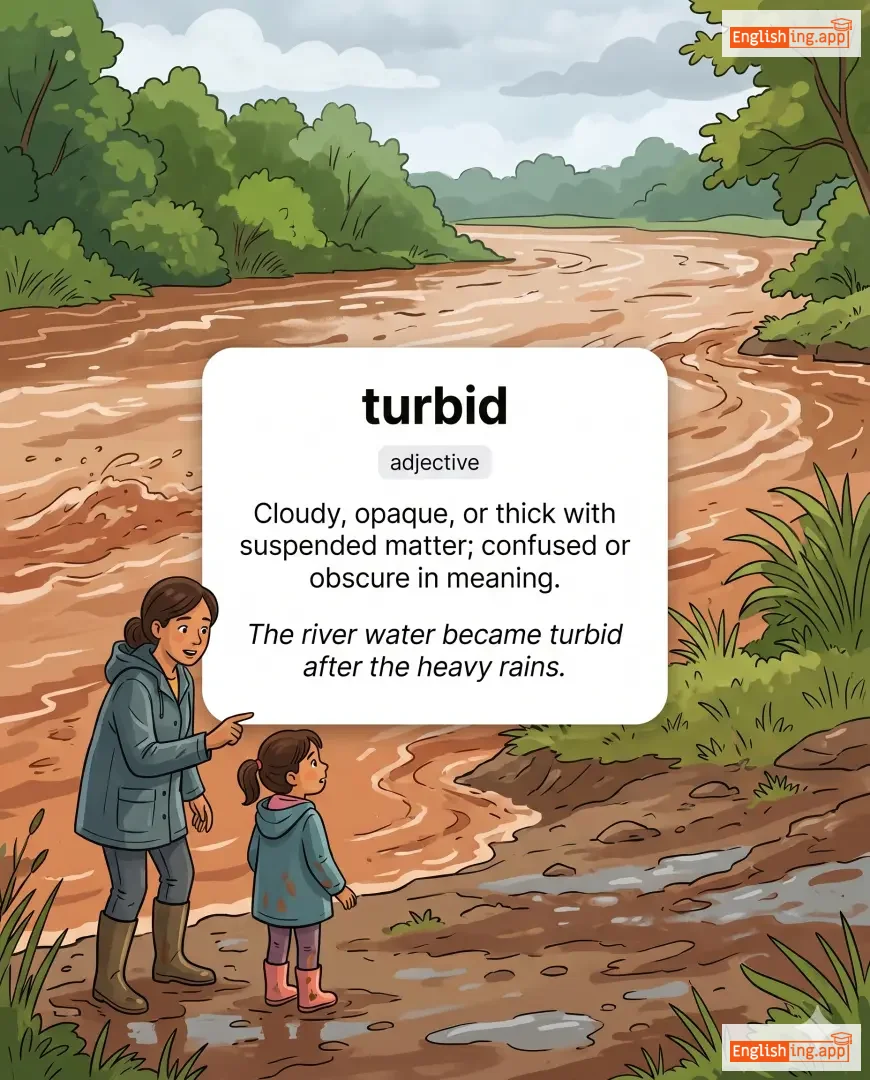
turbid definition card — visual illustration of the meaning
adjective
/ˈtɜːrbɪd/
浑浊 (hunzhuo)

Cloudy, opaque, or thick with suspended matter; confused or obscure in meaning.

"The river water became turbid after the heavy rains."

"大雨过后,河水变得浑浊。" (Dayu guo hou, he shui biande hunzhuo.)
noun
/ˈtɜːrbjələns/

Violent or unsteady movement of air, water, or some other fluid; disorder or conflict.

"The plane experienced severe turbulence during the flight."

adjective
/ˈtɜːrbjələnt/
动荡 (dongdang)

Characterized by conflict, disorder, or confusion; not stable or calm.

"The country went through a turbulent period of political change."

"这个国家经历了一个动荡的政治变革时期。" (Zhe ge guo jia jing li le yi ge dong dang de zheng zhi bian ge shi qi.)
noun
/tʊˈriːn/
炖锅 (dun guo)

A large deep dish with a cover, used for serving soups or stews.

"She brought the hot soup to the table in a silver tureen."
"她把热汤端到桌子上,放在一个银色的炖锅里。" (Ta ba re tang duan dao zhuozi shang, fang zai yige yinse de dun guo li.)
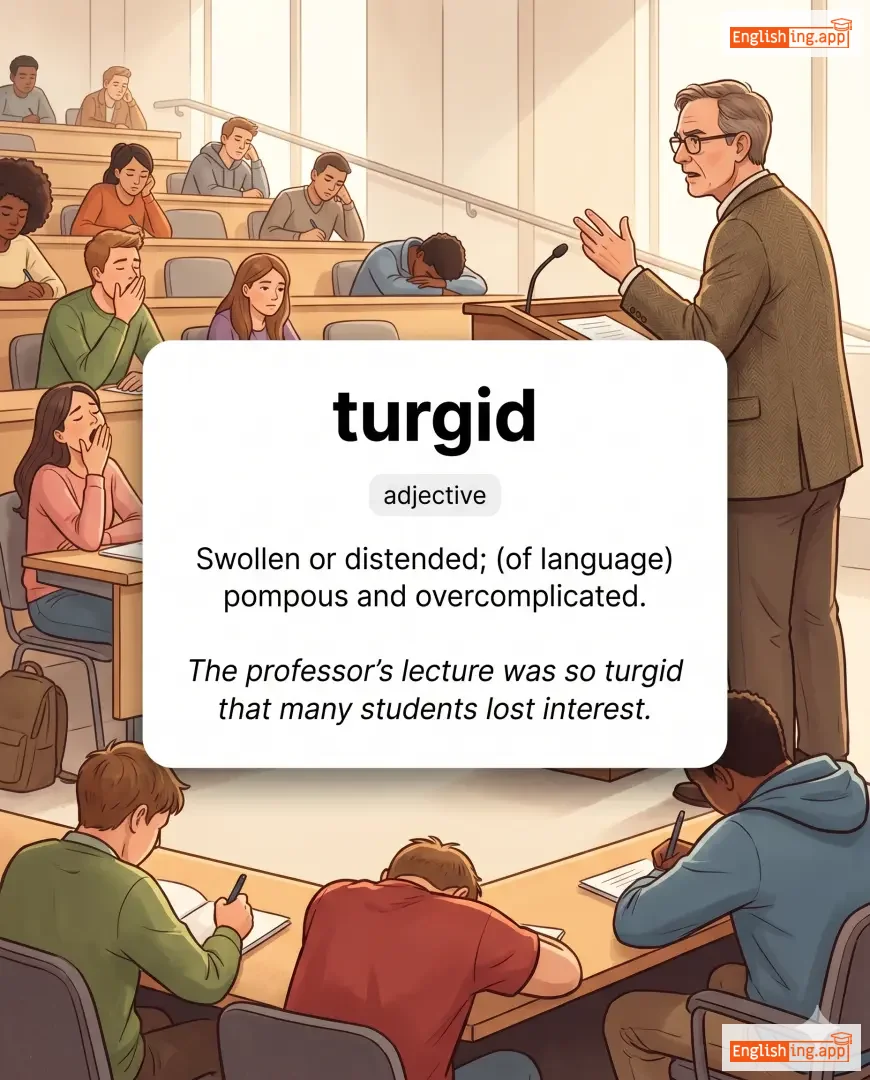
turgid definition card — visual illustration of the meaning
adjective
/ˈtɜːrdʒɪd/
肿胀的, 浮夸的 (zhongzhang de, fu kua de)

Swollen or distended; (of language) pompous and overcomplicated.

"The professor’s lecture was so turgid that many students lost interest."

"教授的讲座太浮夸了,许多学生失去了兴趣。" (Jiaoshou de jiangzuo tai fu kua le, xu duo xuesheng shiqu le xingqu.)
noun
/ˈtɜːrki/
火鸡 (一种大鸟) (huǒ jī)

a large bird native to North America, often eaten at special occasions like Thanksgiving; also the meat of this bird.

"We roasted a turkey for Thanksgiving dinner."

"我们为感恩节晚餐烤了一只火鸡。" (Wǒmen wèi gǎn'ēn jié wǎncān kǎo le yī zhī huǒ jī.)
noun
/ˈtɜr.mər.ɪk/
姜黄 (jiang huang)

A bright yellow spice powder made from the root of a tropical plant, used in cooking and medicine

"Add turmeric to the curry for color and flavor."

"在咖喱中加入姜黄,以增加色彩和味道。" (Zai gāli zhōng jiārù jiāng huáng, yǐ zēngjiā sècǎi hé wèidào)
noun
/ˈtɜːr.mər.ɪk ˈpaʊ.dər/
姜黄粉 (jiang huang fen)

ground turmeric root used as a spice and for its medicinal properties

"Add a pinch of turmeric powder to the curry for color and flavor."
"在咖喱中加入一撮姜黄粉,增加色泽和味道。" (Zai gāli zhōng jiārù yī cuò jiāng huáng fěn, zēngjiā sèzé hé wèidào.)
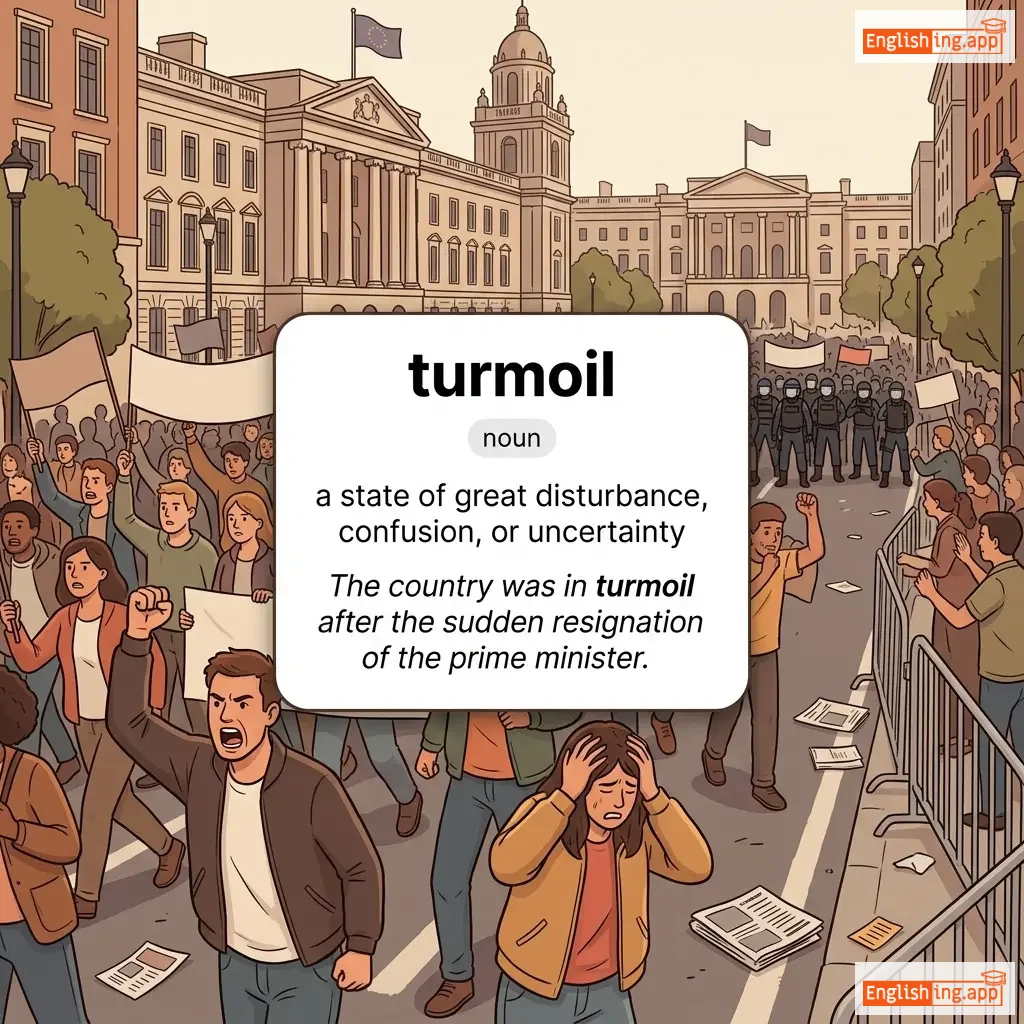
turmoil definition card — visual illustration of the meaning
noun
/ˈtɜːrmɔɪl/
混乱 (hunluan)

a state of great disturbance, confusion, or uncertainty

"The country was in turmoil after the sudden resignation of the prime minister."

"在总理突然辞职后,国家陷入了混乱。" (Zai zongli tuuran cizhi hou, guojia xianru le hunluan.)
Turn definition card — visual illustration of the meaning
verb
/tɜːrn/
转动 (zhuandong)

to change direction or position

"Turn right at the next intersection."

"在下一个路口右转。" (Zai xia yige lukou you zhuan.)
noun
/ˈtɜːrnkoʊt/
叛徒 (pantú)

a person who switches allegiance, often betraying a cause or group

"He was branded a turncoat after joining the rival political party."

"在加入对立的政党后,他被贴上了叛徒的标签。" (Zài jiārù duìlì de zhèngdǎng hòu, tā bèi tiē shàngle pàntú de biāoqiān.)
noun
/ˈtɜːr.nɪŋ/
转弯; 侧路 (zhuǎn wān; cè lù)

a place where a road branches off from another; a side road

"Take the first turning on the left."

"在第一个转弯处左转。" (zài dì yī gè zhuǎn wān chù zuǒ zhuǎn.)
noun
/ˈtɜːr.nɪp/
萝卜 (luóbo)

a round root vegetable with white or purple skin and white flesh

"We grew turnips in our vegetable garden."

"我们在菜园里种了萝卜。" (Women zai caiyuan li zhongle luobo.)
adjective
/ˈtɜːrnkiː/
交钥匙 (jiao yaoshi)

ready for immediate use; a complete product or solution

"The company provides turnkey solutions for small businesses."

"公司为小企业提供交钥匙解决方案。" (Gongsi wei xiao qiye tigong jiao yaoshi jiejue fang'an.)
noun
/ˈtɜːr.naʊt/
出席人数 (chuxi renshu)

the number of people who attend or participate in an event or activity

"The turnout at the rally was impressive, with thousands showing up."

"集会的出席人数令人印象深刻,成千上万的人到场。" (Jihui de chuxi renshu lingren yinxiang shenke, chengqian shangwan de ren dao chang.)
noun
/ˈtɜːnˌəʊvə/
营业额 (yíngyèé)

the amount of business conducted during a particular period, or the rate at which employees leave a company

"The company reported a high turnover in its sales department."

"公司报告了其销售部门的高营业额。" (Gōngsī bàogào le qí xiāoshòu bùmén de gāo yíngyèé.)
noun
/ˈtɜːrpɪtuːd/
堕落 (duòluò)

depraved or wicked behavior or character

"The judge condemned the criminal’s act of moral turpitude."

"法官谴责了罪犯的道德堕落行为。" (Fǎguān qiǎnzéle zuìfàn de dàodé duòluò xíngwéi.)
noun
/ˈtɜːrkwɔɪz/
绿松石 (lü sōng shí)

a greenish-blue color or gemstone

"She wore a necklace with a beautiful turquoise stone."

"她戴着一条美丽的绿松石项链。" (Tā dàizhe yītiáo měilì de lǜsōngshí xiàngliàn.)
noun
/ˈtʌrɪt/
一个较大塔楼或建筑物顶部的小塔 (yīgè jià dà tǎlóu huò jiànzhúwù dǐngbù de xiǎo tǎ)

A small tower on top of a larger tower or building, often used in castles or fortifications.

"The castle was guarded by soldiers stationed in the turret."

"城堡由驻守在塔楼中的士兵守卫。" (Chéngbǎo yóu zhùshǒu zài tǎlóu zhōng de shìbīng shǒuwèi.)
noun
/ˈtɜːrtl/
乌龟 (wugui)

A slow-moving reptile with a hard shell that lives in water or on land

"The turtle slowly crossed the sandy beach."

"乌龟慢慢地穿过沙滩。" (Wugui manman de chuanguo shatan)
noun
/ˈtjuːtɪlɪdʒ/
教导 (jiaodao)

The act of guarding, protecting, or guiding; instruction or teaching.

"She studied painting under the tutelage of a famous artist."

"她在一位著名艺术家的指导下学习绘画。" (Tā zài yī wèi zhùmíng yìshùjiā de zhǐdǎo xià xuéxí huìhuà.)
adjective
/ˈtjuːtɪlɑːr/
保护的 (bǎohù de)

Serving as a guardian or protector.

"The tutelar spirit of the forest was believed to protect travelers."
"森林的守护灵被认为是保护旅行者的存在。" (Senlin de shouhuling bei renwei shi baohu luxingzhe de cunzai.)
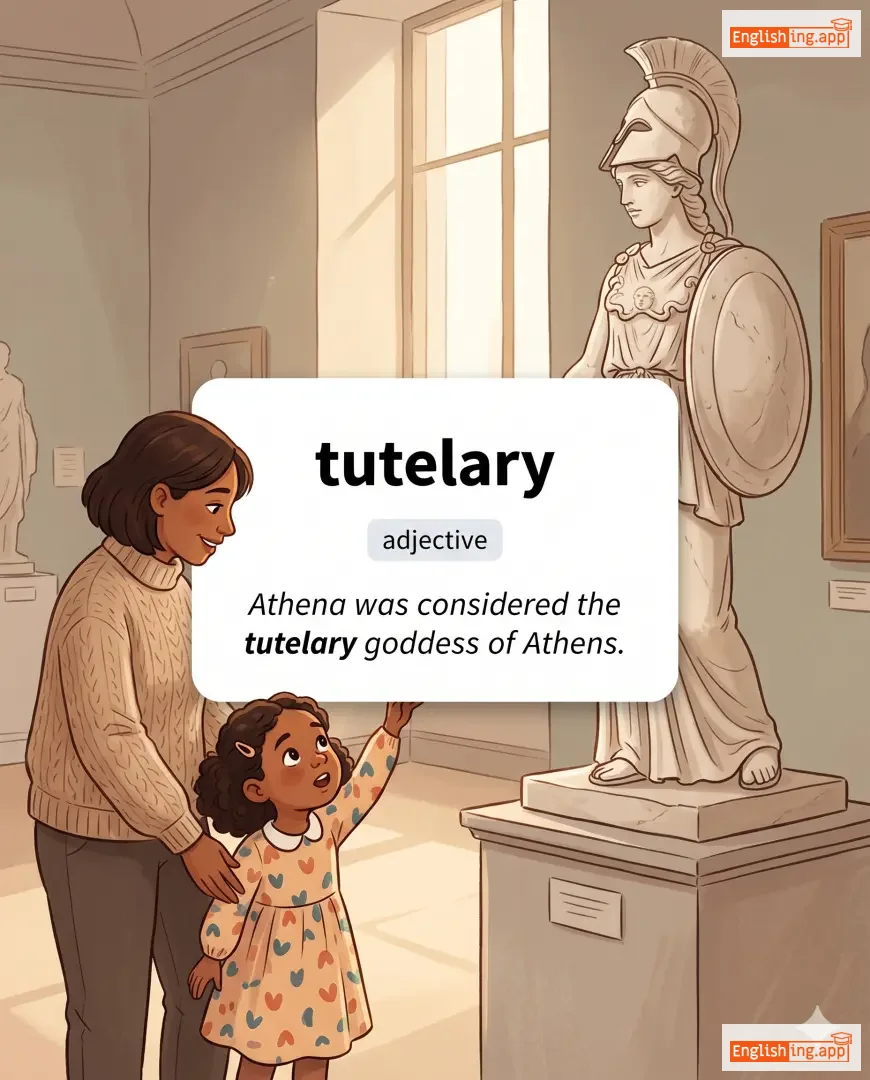
tutelary definition card — visual illustration of the meaning
adjective
/ˈtjuːtɪləri/
守护神 (shouhushen)

Relating to or serving as a guardian or protector, often used for deities or spirits.

"Athena was considered the tutelary goddess of Athens."

"雅典娜被认为是雅典的守护女神。" (Yadianna bei renwei shi Yadian de shouhu nvshen.)
noun
/ˈtjuːtərʃɪp/
辅导 (fǔdǎo)

The office or position of a tutor; guidance or instruction given by a tutor.

"He thrived under the tutorship of his mentor."

"他在导师的辅导下取得了成功。" (Tā zài dǎoshī de fǔdǎo xià qǔdé le chénggōng.)
noun
/ˈtiːˈviː/
电视 (diànshì)

a device used to receive television broadcasts

"I watch my favorite shows on TV every evening."

"我每天晚上都在电视上看我最喜欢的节目。" (Wǒ měitiān wǎnshàng dōu zài diànshì shàng kàn wǒ zuì xǐhuān de jiémù.)
tweak definition card — visual illustration of the meaning
verb
/twiːk/
微调 (wēi tiáo)

to make small adjustments; to fine-tune something

"We need to tweak the design slightly."

"我们需要稍微调整设计。" (Wǒmen xūyào shāowéi tiáo zhěng shèjì)
noun
/twiːt/
鸣叫 (mingjiao)

a short high-pitched sound made by a small bird; a post on Twitter

"I heard the sweet tweet of a sparrow this morning."

"我今天早上听到了一只麻雀的甜美推特声。" (Wo jintian zaoshang tingdao le yizhi maque de tianmei tuite sheng.)
adjective
/twɛlv/
十二 (shi er)

the number equivalent to 12

"There are twelve months in a year."

"一年有十二个月。" (Yi nian you shi er ge yue.)
adjective
/ˈtwɛntiəθ/
第二十 (dièrshí)

coming after the nineteenth in order; being one of twenty equal parts.

"She was born on the twentieth of April."

"她出生在四月二十日。" (Tā chūshēng zài sìyuè èrshí rì.)
2️⃣0️⃣

twenty (èrshí)

adjective
/ˈtwɛnti/
二十 (èrshí)

the number equivalent to 20

"He is twenty years old."

"他二十岁。" (Tā èrshí suì.)
adverb
/twaɪs/
两次 (liǎng cì)

two times

"I have seen that movie twice."

"我看过那部电影两次。" (Wǒ kànguò nà bù diànyǐng liǎng cì.)
noun
/twɪɡ/
小树枝 (xiao shu zhi)

a small thin branch of a tree or bush

"She broke a twig off the tree to use as a stick."

"她从树上折下一根小树枝用作棍子。" (Ta cong shu shang zhe xia yi gen xiao shuzhi yong zuo gunzi.)