词汇表

英语词汇词典 | 单词含义、定义和示例

verb
/siːp/
渗透 (shentou)

to flow or leak slowly through small openings or pores

"Water began to seep through the cracks in the wall."

"水开始通过墙上的裂缝渗透。" (Shui kaishi tongguo qiang shang de liefeng shentou.)
noun
/sɪr/
预言者 (yùyán zhě)

A person who is supposed to be able to see what will happen in the future; a prophet.

"The seer predicted a great change in the kingdom."

"预言者预测了王国的重大变化。" (Yùyán zhě yùcèle wángguó de zhòngdà biànhuà.)
verb
/siːð/
怒火中烧 (nù huǒ zhōng shāo)

To be filled with intense but unexpressed anger or agitation.

"She was seething with anger after the unfair decision."

"她在不公平的决定后怒火中烧。" (Tā zài bù gōngpíng de juédìng hòu nù huǒ zhōng shāo.)
noun
/ˈsɛɡmənt/
(duan)

A part or section of something that is divided.

"Each segment of the market has different needs."

"市场的每个段都有不同的需求。" (Shìchǎng de měi gè duàn dōu yǒu bùtóng de xūqiú.)
noun
/ˈseɪnjər/
封建领主 (fēngjiàn lǐngzhǔ)

A feudal lord; a man of authority in medieval Europe.

"The seignior demanded taxes from the peasants."

"封建领主向农民征税。" (Fēngjiàn lǐngzhǔ xiàng nóngmín zhēngshuì.)
noun
/seɪn/
大网 (dà wǎng)

A large fishing net that hangs vertically in the water.

"The fishermen cast their seine into the river."
"渔民把他们的大网扔进了河里。" (Yúmín bǎ tāmen de dà wǎng rēng jìnle hé lǐ.)
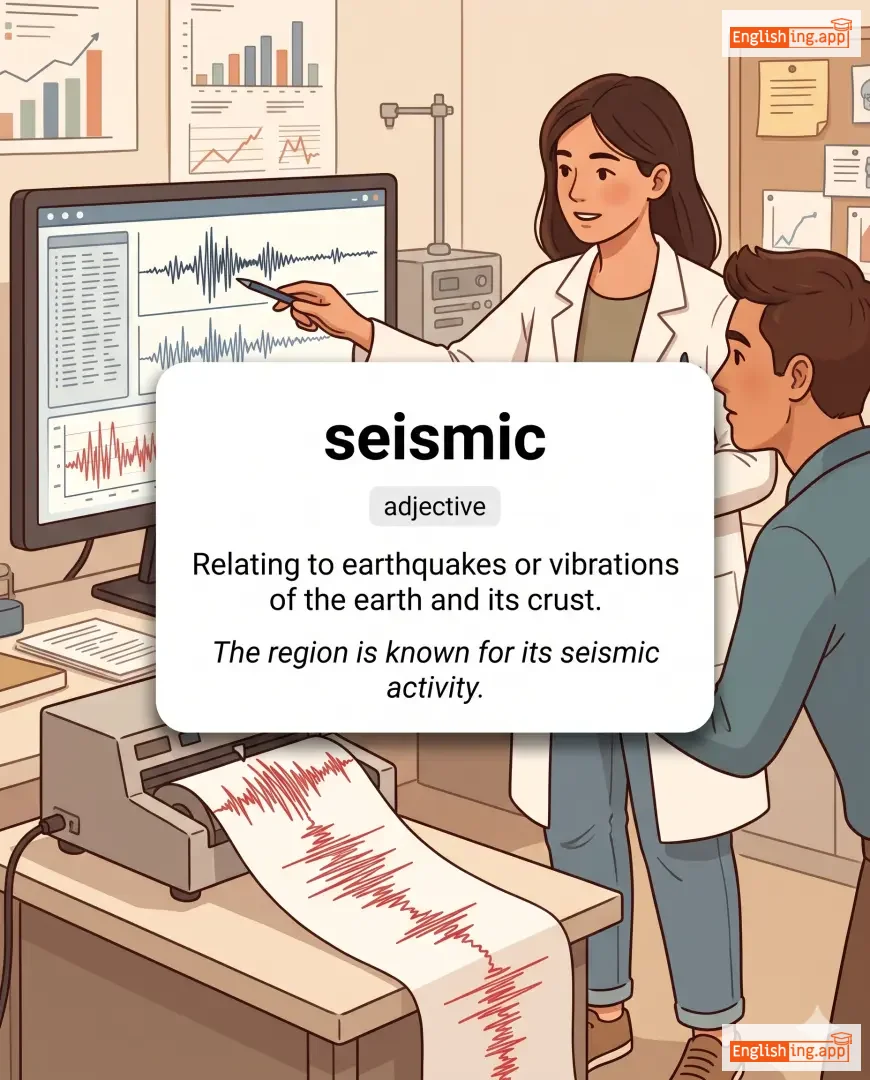
seismic definition card — visual illustration of the meaning
adjective
/ˈsaɪz.mɪk/
地震的 (dìzhèndè)

Relating to earthquakes or vibrations of the earth and its crust.

"The region is known for its seismic activity."

"该地区以其地震活动而闻名。" (Gāi dìqū yǐ qí dìzhèn huódòng ér wénmíng.)
noun
/ˈsaɪz.mə.ɡræf/
地震仪 (dizhenyi)

An instrument that measures and records details of earthquakes, such as force and duration.

"The seismograph detected a strong tremor in the area."

"地震仪检测到该地区的强烈震动。" (Dizhenyi jiance dao gai diqu de qianglie zhendong.)
noun
/sɪv/
筛子 (shaizi)

a utensil consisting of a wire or plastic mesh held in a frame, used for straining solids from liquids

"She used a sieve to separate the flour from lumps."

"她使用筛子将面粉与结块分开。" (Ta shiyong shaizi jiang mianfen yu jiekuai fenkai.)
verb
/siːz/
夺取 (duóqǔ)

To take hold of suddenly and forcibly.

"The police managed to seize the stolen goods."

"警察成功没收了被盗的货物。" (Jǐngchá chénggōng mòshōule bèi dào de huòwù.)
adverb
/ˈsel.dəm/
很少 (hěn shǎo)

not often; rarely

"She seldom visits her hometown nowadays."
"她现在很少回她的家乡。" (Tā xiànzài hěn shǎo huí tā de jiāxiāng.)
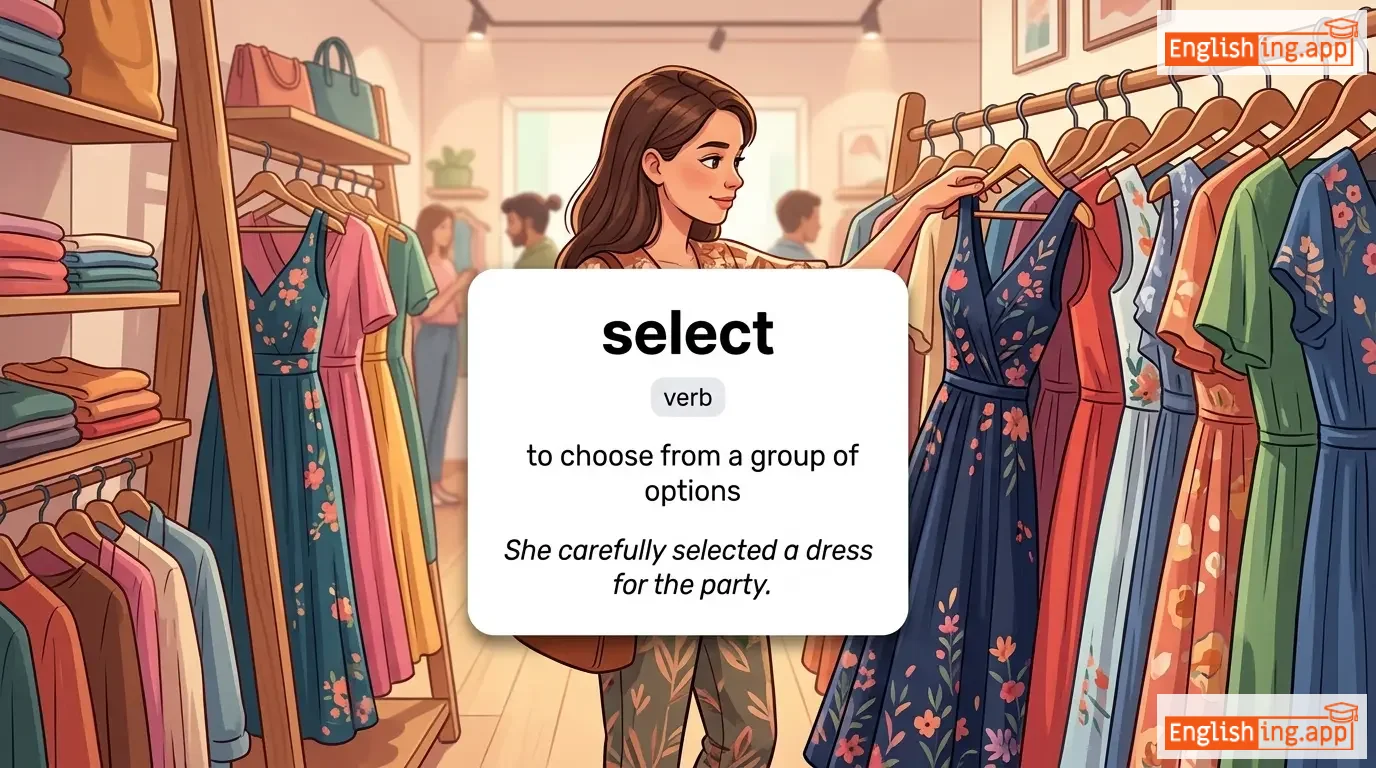
select definition card — visual illustration of the meaning
verb
/sɪˈlɛkt/
选择 (xuanze)

to choose from a group of options

"She carefully selected a dress for the party."

"她小心地为聚会选择了一件裙子。" (Tā xiǎoxīn de wèi jùhuì xuǎnzéle yī jiàn qúnzi.)
adjective
/sɪˈlek.tɪd/
选定的 (xuǎn dìng de)

carefully chosen from a group for a particular purpose

"He was one of the selected candidates for the scholarship."

"他是获得奖学金的选定候选人之一。" (Tā shì huòde jiǎngxuéjīn de xuǎn dìng hòuxuǎn rén zhī yī.)
selection definition card — visual illustration of the meaning
noun
/sɪˈlɛkʃən/
选择 (xuanze)

the act of choosing or the thing that is chosen

"The final selection will be announced tomorrow."

"最终选择将在明天宣布。" (Zuihou xuanze jiang zai mingtian xuānbù.)
adjective
/sɪˈlek.tɪv/
选择性 (xuǎnzéxìng)

Characterized by careful choice; choosing only the best or most suitable.

"She is very selective about the clothes she buys."

"她在购买衣服时非常选择性。" (Tā zài gòumǎi yīfú shí fēicháng xuǎnzéxìng.)
🧑‍💼

self (self)

noun
/sɛlf/
自我 (ziwo)

a person's essential being that distinguishes them from others, especially considered as the object of introspection or reflexive action

"She has a strong sense of self."

"她有强烈的自我意识。" (Tā yǒu qiángliè de zìwǒ yìshí.)
noun
/ˌself əˈbeɪs.mənt/
自我贬低 (zi wo bian di)

The act of belittling or humiliating oneself.

"His constant self-abasement made others uncomfortable."

"他不断的自我贬低让其他人感到不舒服。" (Ta buduan de zi wo bian di rang qita ren gan dao bu shufu.)
adjective
/ˌsɛlf əbˈzɔːrbd/
自我中心 (zìwǒ zhōngxīn)

Excessively preoccupied with oneself and one’s own thoughts, feelings, or interests.

"He was too self-absorbed to notice his friend's distress."

"他太过自我中心,没注意到朋友的困扰。" (Tā tài guò zìwǒ zhōngxīn, méi zhùyì dào péngyǒu de kùnrǎo.)
self-affirmation definition card — visual illustration of the meaning
noun
/ˌsɛlf əˌfɜːˈmeɪʃən/
自我肯定 (ziwo kending)

The practice of affirming one's own worthiness and value as an individual.

"Daily self-affirmation can boost your confidence."
"每日自我肯定可以增强你的自信。" (Meiri ziwo kending keyi zengqiang nide zixin.)
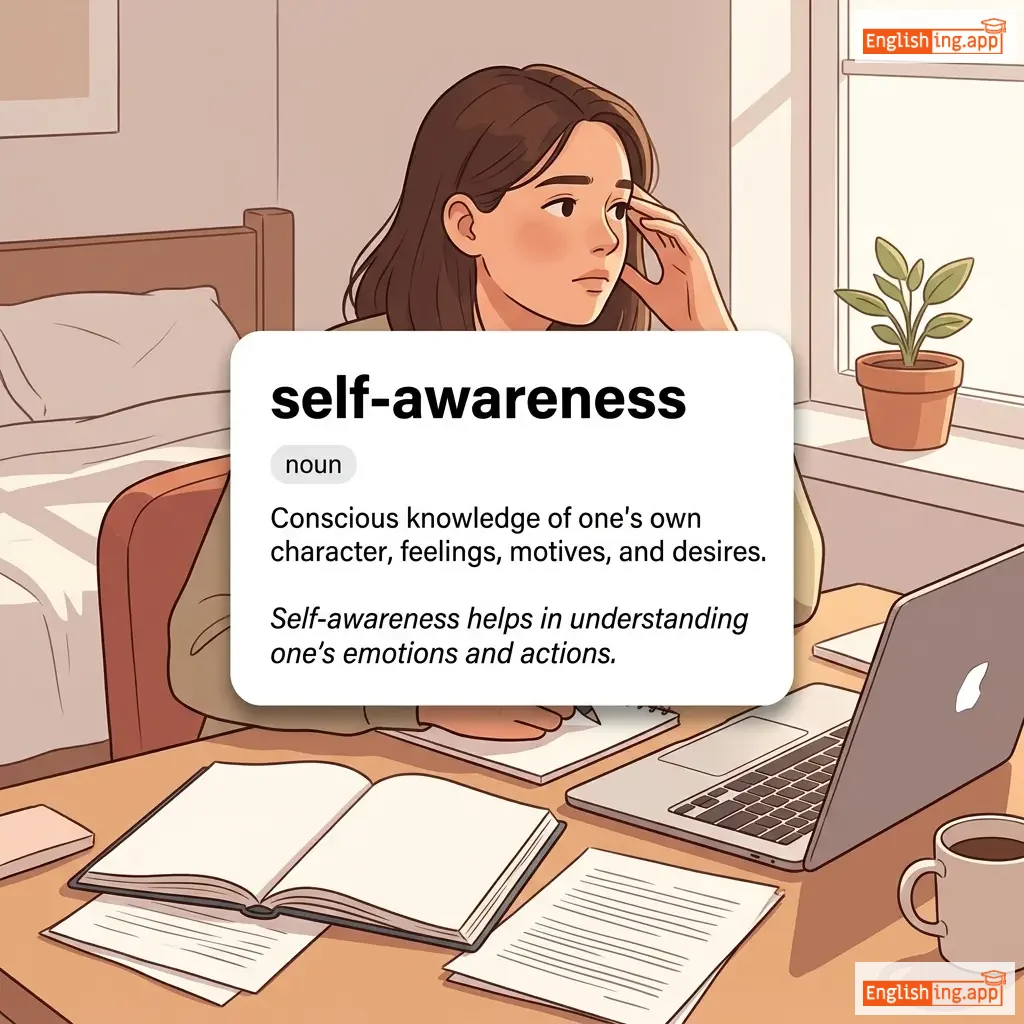
self-awareness definition card — visual illustration of the meaning
noun
/ˌsɛlf əˈwɛə.nəs/
自我意识 (zì wǒ yì shí)

Conscious knowledge of one's own character, feelings, motives, and desires.

"Self-awareness helps in understanding one's emotions and actions."

"自我意识有助于理解一个人的情感和行为。" (Zì wǒ yì shí yǒu zhù yú lǐjiě yīgè rén de qínggǎn hé xíngwéi.)
self-control definition card — visual illustration of the meaning
noun
ˌsɛlf.kənˈtrəʊl
自我控制 (zi wo kong zhi)

The ability to control one's emotions, behavior, and desires in order to obtain some reward, or avoid some punishment, typically in the longer term.

"Self-control is important for maintaining a balanced life."

"自我控制对保持平衡的生活很重要。" (Zi wo kong zhi dui bao chi ping heng de sheng huo hen zhong yao.)
self-discipline definition card — visual illustration of the meaning
noun
/ˈsɛlf ˈdɪsɪplɪn/
自律 (zì lǜ)

The ability to control one's feelings and overcome one's weaknesses; the ability to pursue what one thinks is right despite temptations to abandon it.

"Self-discipline is essential for achieving long-term goals."

"自律对实现长期目标至关重要。" (Zì lǜ duì shíxiàn chángqī mùbiāo zhìguān zhòngyào.)
adjective
/ˌsɛlf ɪˈfeɪsɪŋ/
谦虚的 (qianxu de)

not drawing attention to oneself; modest

"Despite his success, he remained self-effacing and humble."

"尽管他取得了成功,他仍然保持谦虚和谦逊。" (Jingguan ta qude le chenggong, ta rengran baochi qianxu he qianxun.)
noun
/ˌsɛlf ɪˈstiːm/
自尊 (zizun)

confidence in one's own worth or abilities; self-respect

"Building self-esteem takes time and consistent effort."

"建立自尊需要时间和持续的努力。" (Jianli zizun xuyao shijian he chixu de nuli.)
noun
/ˌsɛlf ɪnˈdʌldʒəns/
自我纵容 (zì wǒ zòng rónɡ)

The act of allowing oneself to enjoy pleasures or desires excessively.

"His weekend of self-indulgence included eating sweets and watching movies nonstop."

"他的自我纵容周末包括吃糖果和不停地看电影。" (Tā de zì wǒ zòng rónɡ zhōumò bāokuò chī tángguǒ hé bùtíng de kàn diànyǐng.)
self-possession definition card — visual illustration of the meaning
noun
ˈsɛlf pəˈzɪʃən
自控力 (zì kòng lì)

The quality of being calm and confident and in control of one's emotions; composure.

"His self-possession during the crisis was remarkable."

"他在危机中的自控力令人钦佩。" (Tā zài wēijī zhōng de zì kòng lì lìng rén qīn pèi.)
self-reliance definition card — visual illustration of the meaning
noun
sɛlf rɪˈlaɪ.əns
自给自足 (zì jǐ zì zú)

Reliance on one's own powers and resources rather than those of others; independence.

"Self-reliance helps build confidence."

"自给自足帮助建立自信。" (Zì jǐ zì zú bāngzhù jiànlì zìxìn.)
noun
/ˌsɛlf rɪˈspɛkt/
自尊 (zizun)

A feeling of pride and confidence in oneself; self-worth.

"She refused to compromise her self-respect by accepting unfair treatment."
"她拒绝通过接受不公平的待遇来妥协自己的自尊。" (Tā jùjué tōngguò jiēshòu bù gōngpíng de dàiyù lái tuǒxié zìjǐ de zìzūn.)
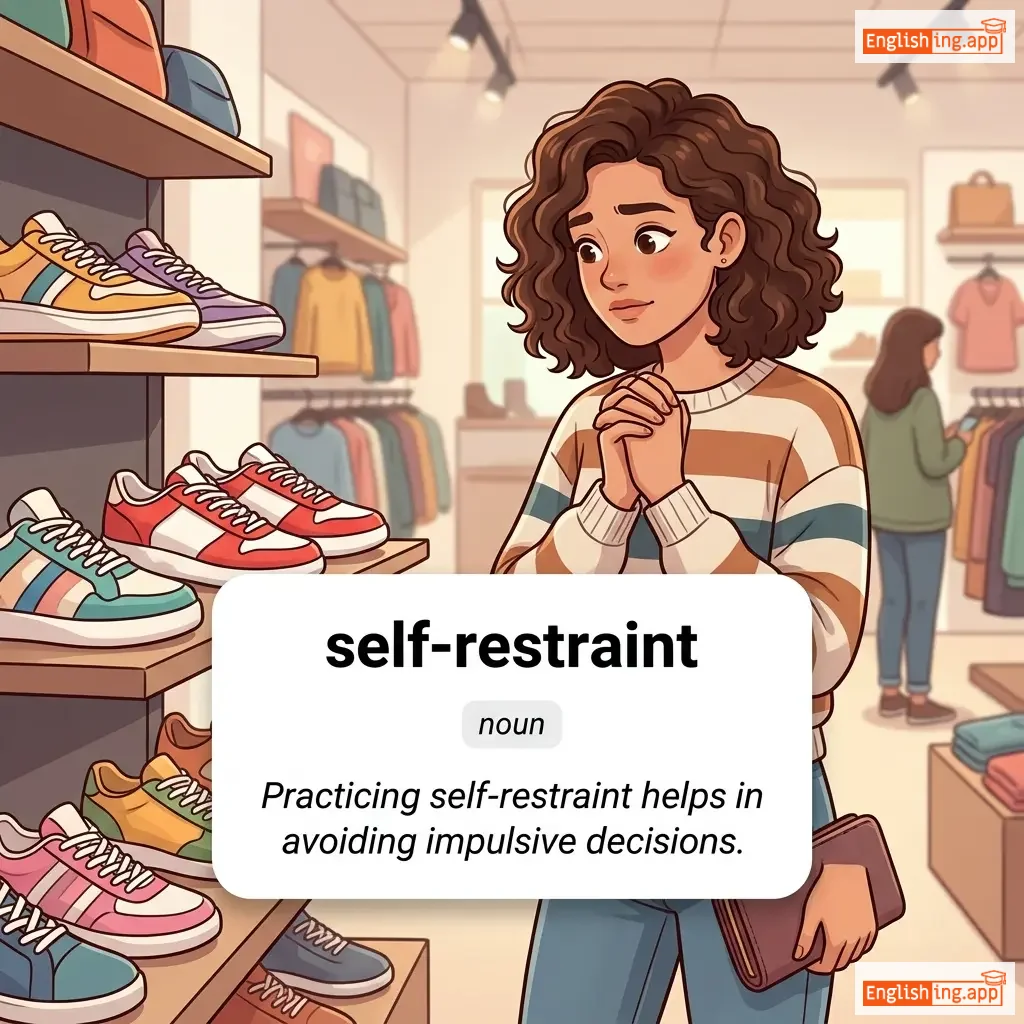
self-restraint definition card — visual illustration of the meaning
noun
ˌsɛlf.rɪˈstreɪnt
自我克制 (zi wo ke zhi)

The practice of restraining oneself from indulging in something, typically an impulse or desire.

"Practicing self-restraint helps in avoiding impulsive decisions."

"实践自我克制有助于避免冲动的决策。" (Shíjiàn zìwǒ kèzhì yǒu zhù yú bìmiǎn chōngdòng de juécè.)
adjective
/ˌsɛlf ˈraɪtʃəs/
自以为是 (zì yǐ wéi shì)

Having or showing an attitude of moral superiority; believing one’s own beliefs are the only right ones.

"His self-righteous comments made everyone uncomfortable."

"他的自以为是的评论让每个人都感到不舒服。" (Tā de zì yǐ wéi shì de píng lùn ràng měi gè rén dōu gǎn dào bù shū fu.)
noun
/ˌsɛlfsəˈfɪʃənsi/
自给自足 (zì jǐ zì zú)

the ability to supply one's own needs without external assistance; independence

"The farm achieved complete self-sufficiency in food production."

"农场在食品生产中实现了完全的自给自足。" (Nongchang zai shipin shengchan zhong shixian le wanquan de ziji zizu.)
adjective
/self səˈfɪʃənt/
自给自足 (ziji zizu)

able to provide for oneself without depending on others

"The farm is completely self-sufficient in producing vegetables."

"这个农场在蔬菜生产方面完全自给自足。" (Zhege nongchang zai shucai shengchan fangmian wanquan ziji zizu.)
adjective
/ˈselfɪʃ/
自私 (zì sī)

caring only about oneself rather than others

"He was too selfish to share his food with others."

"他太自私了,不愿与他人分享他的食物。" (Tā tài zìsīle, bù yuàn yǔ tārén fēnxiǎng tā de shíwù.)
adverb
/ˈsel.fɪʃ.li/
自私地 (zìsī de)

in a selfish manner; caring only about oneself

"He selfishly took all the cookies."

"他自私地拿走了所有饼干。" (Tā zìsī de názǒu le suǒyǒu bǐnggān)
selflessness definition card — visual illustration of the meaning
noun
ˈsɛlfləsnɪs
无私 (wusi)

The quality of being concerned more with the needs of others than with one's own.

"Selflessness is a key value for community building."

"无私是社区建设中的关键价值。" (Wusi shi shequ jianshe zhong de guanjian jiazhi.)
sell definition card — visual illustration of the meaning
verb
/sɛl/
(mài)

to give or hand over something in exchange for money

"I want to sell my old phone."

"我想卖掉我的旧手机。" (Wǒ xiǎng mài diào wǒ de jiù shǒujī.)
noun
/ˈsɛlər/
幸福 (xìng fú)

a person who sells something

"The seller offered a discount on bulk purchases."

"当她收到奖项时,她无法掩饰自己的幸福。" (Dāng tā shōu dào jiǎngxiàng shí, tā wúfǎ yǎnshì zìjǐ de xìngfú.)
semantic definition card — visual illustration of the meaning
adjective
/sɪˈmæntɪk/
语义的 (yǔyì de)

Relating to meaning in language or logic.

"The argument was more about semantic differences than real issues."

"争论更多是关于语义差异而非实际问题。" (Zhēnglùn gèng duō shì guānyú yǔyì chāyì ér fēi shíjì wèntí.)
noun
/ˈsɛm.bləns/
表象, 外在形式 (biǎoxiàng, wàizài xíngshì)

The outward appearance or form of something, especially when the reality is different.

"Despite his calm tone, there was only a semblance of control in the room."

"尽管他的语气很平静,房间里只有一种控制的表象。" (Jǐnguǎn tā de yǔqì hěn píngjìng, fángjiān lǐ zhǐyǒu yī zhǒng kòngzhì de biǎoxiàng.)
adjective
/ˌsɛm.iˈæn.ju.əl/
半年一次 (ban nian yi ci)

Occurring twice a year; every six months.

"The company holds a semiannual meeting with all employees."

"公司每六个月举行一次会议。" (Gongsi mei liu ge yue ju xing yi ci huiyi.)
noun
/ˈsɛm.iˌsɜːr.kəl/
半圆 (bàn yuán)

Half of a circle or something shaped like half of a circle.

"The students sat in a semicircle around the teacher."

"学生们围绕老师坐成半圆形。" (Xuesheng men weirao laoshi zuo cheng banyuanxing.)
adjective
/ˌsɛm.iˈsɪv.ə.laɪzd/
半文明 (bàn wénmíng)

Partially civilized; having some aspects of civilization but not fully developed.

"The tribe was described as semicivilized by early explorers."

"该部落被早期探险家描述为半文明。" (Gāi bùluò bèi zǎoqī tànxiǎn jiā miáoshù wéi bàn wénmíng.)
adjective
/ˌsɛm.iˈkɒn.ʃəs/
半意识的 (bàn yìshí de)

Only partly conscious; not fully aware of surroundings.

"He was semiconscious after the accident and could barely respond."

"他在事故后半意识清醒,几乎无法回应。" (Tā zài shìgù hòu bàn yìshí qīngxǐng, jīhū wúfǎ huíyīng.)
adjective
/ˈsɛm.ɪ.nəl/
幸福 (xingfu)

Strongly influencing later developments; highly original and influential.

"His seminal book changed the course of modern philosophy."

"她在获得奖项时无法掩饰自己的幸福。" (Tā zài huòdé jiǎngxiàng shí wúfǎ yǎnshì zìjǐ de xìngfú.)
noun
/ˈsɛm.ɪ.nɑːr/
研讨会 (yántǎo huì)

A meeting for discussion or training, especially in an academic setting.

"The professor invited all students to attend the seminar on climate change."

"教授邀请所有学生参加关于气候变化的研讨会。" (Jiàoshòu yāoqǐng suǒyǒu xuéshēng cānjiā guānyú qìhòu biànhuà de yántǎo huì.)
noun
/ˈsɛm.ɪ.nɛr.i/
神学院 (shénxuéyuàn)

A school or college for training priests, ministers, or rabbis.

"He decided to enroll in a seminary to study theology."

"他决定报名参加神学院,学习神学。" (Tā juédìng bàomíng cānjiā shénxuéyuàn, xuéxí shénxué.)
noun
/ˈsɛnət/
参议院 (cān yì yuàn)

a legislative or governing body, typically the upper chamber in a bicameral legislature

"The senate voted in favor of the new healthcare bill."

"参议院投票支持新的医疗保健法案。" (Cān yì yuàn tóupiào zhīchí xīn de yīliáo bǎojiàn fǎ'àn.)
👨‍⚖️

senator (参议员)

noun
/ˈsɛnətər/
参议员 (cān yì yuán)

a member of a senate, especially in a legislative body

"The senator spoke passionately about environmental policies."

"参议员激情地谈论环境政策。" (Can yiyuan jixing de tanlun huanjing zhengce.)
verb
/sɛnd/
发送 (fāsòng)

to cause something to go or be taken to a destination

"Please send the report by tomorrow morning."

"请在明天早上之前发送报告。" (Qǐng zài míngtiān zǎoshang zhīqián fāsòng bàogào.)
noun
/səˈnɛs.əns/
衰老 (shuāilǎo)

The process of growing old or the condition of aging.

"The biologist studied senescence in plants to understand aging."

"生物学家研究了植物中的衰老过程,以理解衰老。" (Shēngwùxuéjiā yánjiūle zhíwù zhōng de shuāilǎo guòchéng, yǐ liǎojiě shuāilǎo.)