词汇表

英语词汇词典 | 单词含义、定义和示例

adverb
/ˈsɜːrtʃɪŋli/
寻找地 (xúnzhǎo de)

In a way that seems to look for hidden meanings or truth.

"She looked at him searchingly, hoping for an honest answer."

"她带着寻求的目光看着他,希望得到诚实的回答。" (Tā dàizhe xúnqiú de mùguāng kànzhe tā, xīwàng dédào chéngshí de huídá.)
noun
/ˈsiːskeɪp/
海景 (haijing)

A view or painting of the sea.

"The artist painted a beautiful seascape at sunset."

"艺术家在日落时画了一幅美丽的海景。" (Yishujia zai riluo shi hua le yi fu meili de haijing.)
noun/verb
/ˈsiːzən/
季节 / 调味 (jìjié / tiáowèi)

One of the four periods of the year characterized by specific weather conditions; also, to add flavor to food.

"Spring is my favorite season of the year."

"春天是我最喜欢的季节。" (Chūntiān shì wǒ zuì xǐhuān de jìjié.)
adjective
/ˈsiːzənəbl/
应季的 (yīngjì de)

Appropriate to the time of year or season.

"We had seasonable weather for autumn."

"我们有一个适合秋季的季节性天气。" (Wǒmen yǒu yīgè shìhé qiūjì de jìjiéxìng tiānqì.)
adjective
/ˈsiːzənl/
季节性 (jì jié xìng)

Relating to or dependent on a particular season.

"Seasonal fruits are available in the market."
"季节性水果在市场上有售。" (Jìjié xìng shuǐguǒ zài shìchǎng shàng yǒu shòu.)
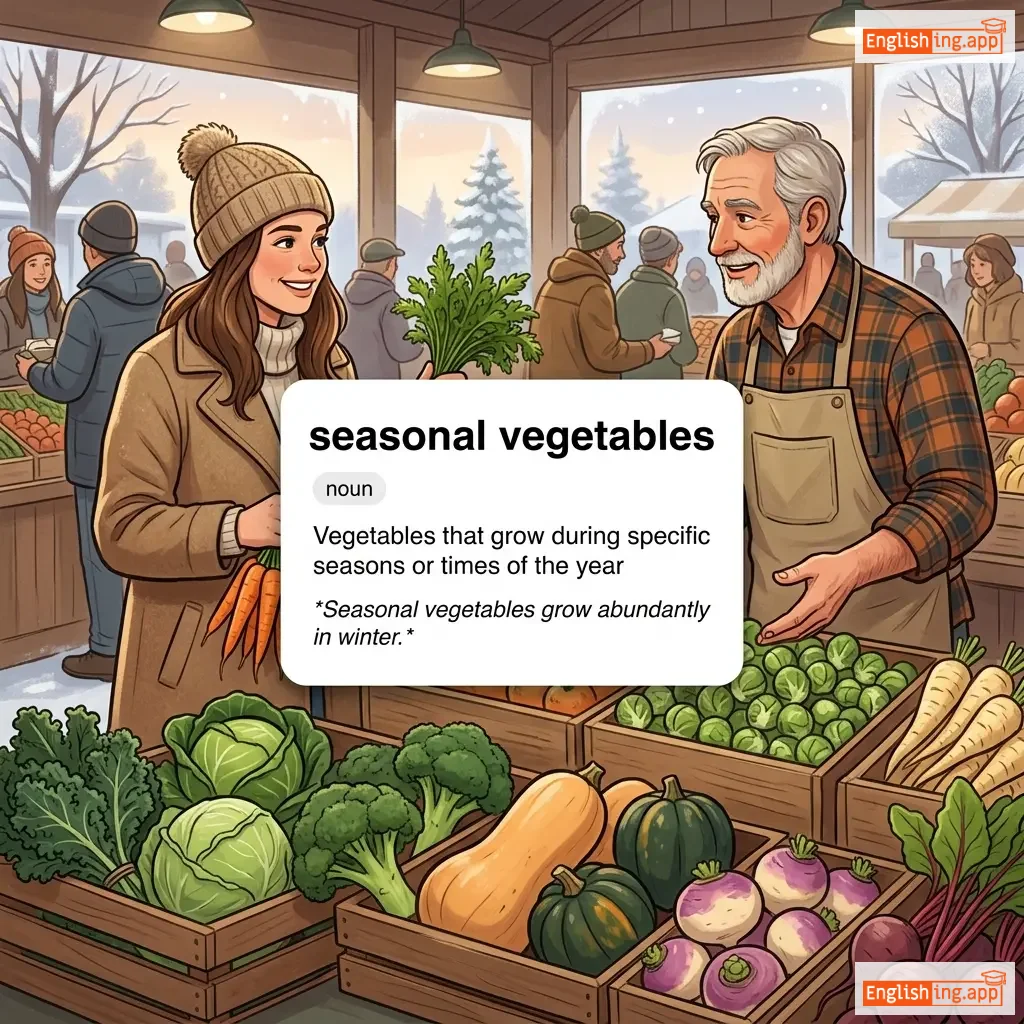
seasonal vegetables definition card — visual illustration of the meaning
noun
ˈsiːzənəl ˈvedʒtəbəlz
季节性蔬菜 (jìjié xìng shūcài)

Vegetables that grow during specific seasons or times of the year

"Seasonal vegetables grow abundantly in winter."

"季节性蔬菜在冬季大量生长。" (jìjié xìng shūcài zài dōngjì dàliàng shēngzhǎng.)
adjective/verb
/ˈsiːzənd/
经验丰富的 / 加调料的 (jīngyàn fēngfù de / jiā tiáoliào de)

Experienced in a particular activity; also, flavored with spices.

"She is a seasoned teacher with over 20 years of experience."

"她是一位拥有超过20年经验的资深教师。" (Tā shì yī wèi yōngyǒu chāoguò 20 nián jīngyàn de zīshēn jiàoshī.)
noun
/siːt/
座位 (zuòwèi)

a place to sit, especially a chair or other place for sitting

"I reserved a seat for you at the concert."

"我为你在音乐会预定了一个座位。" (Wǒ wèi nǐ zài yīnyuè huì yùdìngle yīgè zuòwèi.)
adjective
/sɪˈbeɪʃəs/
与皮脂相关 (yu pi zhi xiang guan)

Relating to or secreting sebum, an oily substance from the skin.

"Acne is often caused by overactive sebaceous glands."

"痤疮通常是由过度活跃的皮脂腺引起的。" (Cuochuang tongchang shi you guoduhuo yue de pizhixian yinqi de.)
noun
/ˈsiːkənt/
割线 (gē xiàn)

A straight line that intersects a curve at two or more points.

"In geometry, a secant cuts the circle at two distinct points."

"在几何学中,割线在两个不同的点上切割圆形。" (Zai jiaoxue zhong, ge xian zai liang ge butong de dian shang qiege yuansheng.)
verb
/sɪˈsiːd/
脱离 (tuōlí)

To formally withdraw from a political or organizational union.

"Several states threatened to secede from the union."

"几个州威胁要脱离联邦。" (Jǐ gè zhōu wēixié yào tuōlí liánbāng.)
noun
/sɪˈsɛʃən/
分裂 (fenlie)

The action of formally withdrawing from membership of a federation or body.

"The secession of the southern states led to the Civil War."

"南方各州的分裂导致了内战。" (Nanfang ge zhou de fenlie dao zhi le neizhan.)
verb
/sɪˈkluːd/
隔离 (gélí)

To keep someone away from other people; to isolate.

"The monk chose to seclude himself in the mountains."

"僧侣选择在山中独自生活。" (Sēnglǚ xuǎnzé zài shān zhōng dúzì shēnghuó.)
adjective
/sɪˈkluːdɪd/
隐蔽的 (yinbi de)

Placed apart from other people or things; private and quiet.

"They spent their vacation in a secluded beach house."

"他们在一个隐蔽的海滩小屋度过了假期。" (Tamen zai yige yinbi de haitan xiaowu duoguo le jiaqi.)
noun
/sɪˈkluːʒən/
隐居 (yinju)

The state of being private, away from other people.

"She spent the weekend in complete seclusion in her cabin."

"她在她的小屋里度过了完全的隐居周末。" (Tā zài tā de xiǎowū lǐ dùguò le wánquán de yǐnjū zhōumò.)
⏱️

second

noun
/ˈsekənd/

a unit of time equal to one sixtieth of a minute; also the position after first

"He finished the race in second place."

adjective
/ˌsekənd ˈreɪt/
二流 (er liu)

Of mediocre or inferior quality.

"The movie was entertaining but clearly second-rate compared to the original."

"这部电影很有趣,但与原版相比明显是二流的。" (Zhe bu dianying hen youqu, dan yu yuanban xiangbi mingxian shi er liu de.)
adjective
/ˈsekənderi/
次要的 (ci yao de)

Less important than something else; derived from or dependent on something primary.

"Safety is our primary concern, while speed is only secondary."

"安全是我们的主要关注,而速度只是次要的。" (Anquan shi women de zhuyao guanzhu, er sudu zhishi ci yao de.)
adverb
/ˈsekəndli/
其次 (qícì)

Used to introduce the second point in a list of arguments or ideas.

"Firstly, we need funding; secondly, we need a strong team."

"首先,我们需要资金;其次,我们需要一支强大的团队。" (Shǒuxiān, wǒmen xūyào zījīn; qícì, wǒmen xūyào yī zhī qiángdà de tuánduì.)
noun
/ˈsiːkrəsi/
保密 (bǎomì)

The action of keeping something secret or the state of being kept secret.

"The negotiations were conducted in complete secrecy."

"谈判在完全保密中进行。" (Tánpàn zài wánquán bǎomì zhōng jìnxíng.)
noun
/ˈsiːkrət/

something that is kept or meant to be kept unknown or unseen by others

"He told me a secret about his childhood."

noun
/ˈsɛkrəteri/

a person employed to handle correspondence and manage routine tasks for an individual or organization

"The secretary scheduled the meeting for tomorrow."

secrete definition card — visual illustration of the meaning
verb
/sɪˈkriːt/
分泌 (fēnmì)

to produce and release a substance from a cell, gland, or organ

"The pancreas secretes insulin to regulate blood sugar levels."

"胰腺分泌胰岛素以调节血糖水平。" (Yíxiàn fēnmì yídǎosù yǐ tiáojié xuètáng shuǐpíng.)
noun
/sɪˈkriː.ʃən/
分泌 (fenmi)

a process by which substances are produced and discharged from a cell or gland

"Insulin secretion is crucial for blood sugar regulation."

"胰岛素分泌对血糖的调节至关重要。" (yidaosun fenmi dui xuetang de tiaojie zhiguang zhongyao)
adverb
/ˈsiː.krət.li/
偷偷地 (toutou de)

in a way that is hidden or not known by others

"She secretly planned a surprise party for her friend."

"她偷偷为她的朋友策划了一个惊喜派对。" (Ta toutou wei ta de pengyou cehua le yige jingxi paidui.)
noun
/sɛkt/
教派 (jiaopai)

a subgroup of a larger religious or political group, often with differing beliefs

"The group split into different sects due to doctrinal differences."

"由于教义上的差异,该小组分裂成了不同的教派。" (Yóuyú jiàoyì shàng de chāyì, gāi xiǎozǔ fēnliè chéngle bùtóng de jiàopài.)
adjective
/sɛkˈtɛəriən/
宗派的 (zongpai de)

relating to or characterized by the differences between sects, often leading to conflict

"The region has been troubled by sectarian violence for decades."

"该地区几十年来一直受到宗派暴力的困扰。" (Gai diqu jishinian lai yizhi shoudao zongpai baoli de kunrao.)
noun
/ˈsɛkʃən/
部分 (bùfen)

a distinct part or subdivision of something larger

"This section of the report needs further review."

"报告的这一部分需要进一步审查。" (Bàogào de zhè yī bùfen xūyào jìnyībù shěnchá.)
noun
/ˈsɛktər/
行业 (hangye)

a distinct part or area of an economy, society, or industry

"The technology sector is growing rapidly."

"科技行业正在迅速发展。" (Keji hangye zhengzai xunxu fazhan.)
sector-specific definition card — visual illustration of the meaning
adjective
ˈsek.tər spəˈsɪf.ɪk
行业特定 (hangye teding)

Relating to or designed for a particular sector or industry.

"Sector-specific policies attract targeted investments."

"行业特定的政策吸引了定向投资。" (Hangye teding de zhengce xinyin le dingxiang touzi.)
adjective
/ˈsɛkjʊlər/
世俗 (shì sú)

not connected with religious or spiritual matters

"The country adopted a secular constitution separating religion from state affairs."

"该国采纳了世俗宪法,将宗教与国家事务分开。" (Gāi guó cǎnàle shì sú xiànfǎ, jiāng zōngjiào yǔ guójiā shìwù fēnkāi.)
verb/adjective
/sɪˈkjʊər/
确保 (què bǎo)

to make safe or protect; to fix something firmly in place

"Please secure the door before you leave."

"请在离开前确保门锁好。" (Qǐng zài líkāi qián què bǎo mén suǒ hǎo.)
security definition card — visual illustration of the meaning
noun
/sɪˈkjʊərɪti/
安全 (anquan)

the state of being free from danger or threat

"We need to improve our security measures at the airport."

"我们需要改善机场的安全措施。" (Wo men xu yao gai shan ji chang de an quan cuo shi.)
adjective, verb
/sɪˈdeɪt/
镇静 (zhènjìng)

calm, quiet, and composed; or to administer a drug to make someone calm or sleep

"The nurse sedated the patient before the operation."

"护士在手术前给病人注射了镇静剂。" (Hùshì zài shǒushù qián gěi bìngrén zhùshèle zhènjìngjì.)
noun
/ˈsɛdətɪv/
镇静剂 (zhènjìngjì)

A substance that calms the nerves or induces sleep.

"The doctor prescribed a sedative to help the patient sleep."

"医生开了镇静剂来帮助病人入睡。" (Yīshēng kāile zhènjìngjì lái bāngzhù bìngrén rùshuì.)
sedentary definition card — visual illustration of the meaning
adjective
/ˈsɛdntɛri/
久坐的 (jiu zuo de)

Characterized by much sitting and little physical activity.

"A sedentary lifestyle can lead to health problems."

"久坐的生活方式可能导致健康问题。" (jiu zuo de sheng huo fang shi ke neng dao zhi jian kang wen ti)
noun
/ˈsɛdəmənt/
沉积物 (chénjīwù)

Solid particles that settle at the bottom of a liquid.

"The river carries a lot of sediment downstream."

"河流将大量沉积物带到下游。" (Héliú jiāng dàliàng chénjīwù dài dào xiàyóu.)
Sedition definition card — visual illustration of the meaning
noun
/sɪˈdɪʃən/
煽动叛乱 (shāndòng pànluàn)

Speech or actions encouraging rebellion against authority.

"He was arrested for sedition against the government."

"他因煽动叛乱被逮捕。" (Tā yīn shāndòng pànluàn bèi dàibǔ.)
adjective
/sɪˈdɪʃəs/
煽动叛乱的 (shāndòng pànluàn de)

Encouraging rebellion against authority.

"The activist spread seditious pamphlets among the crowd."

"活动家在群众中散发了煽动叛乱的传单。" (Huódòngjiā zài qúnzhòng zhōng sànfāle shāndòng pànluàn de chuándān.)
verb
/sɪˈdjuːs/

to attract someone into doing something, especially something they might not normally do

"The advertisement was designed to seduce customers into buying luxury products."

noun
/sɪˈdʌk.ʃən/
色诱; 诱惑 (seyou; youhua)

the action of seducing someone; temptation to do something wrong

"He fell victim to the seduction of easy money."

"他成为了快速赚钱诱惑的受害者。" (Ta chengwei le kuaisu zhuanqian youhua de shouhaizhe.)
Sedulous definition card — visual illustration of the meaning
adjective
/ˈsɛdʒʊləs/
勤勉 (qínmiǎn)

showing great care, attention, and diligence in work or tasks

"She was admired for her sedulous efforts in completing the project on time."

"她因在按时完成项目时展现的勤勉努力而受到赞赏。" (Tā yīn zài ànshí wánchéng xiàngmù shí zhǎnxiàn de qínmiǎn nǔlì ér shòudào zànshǎng.)
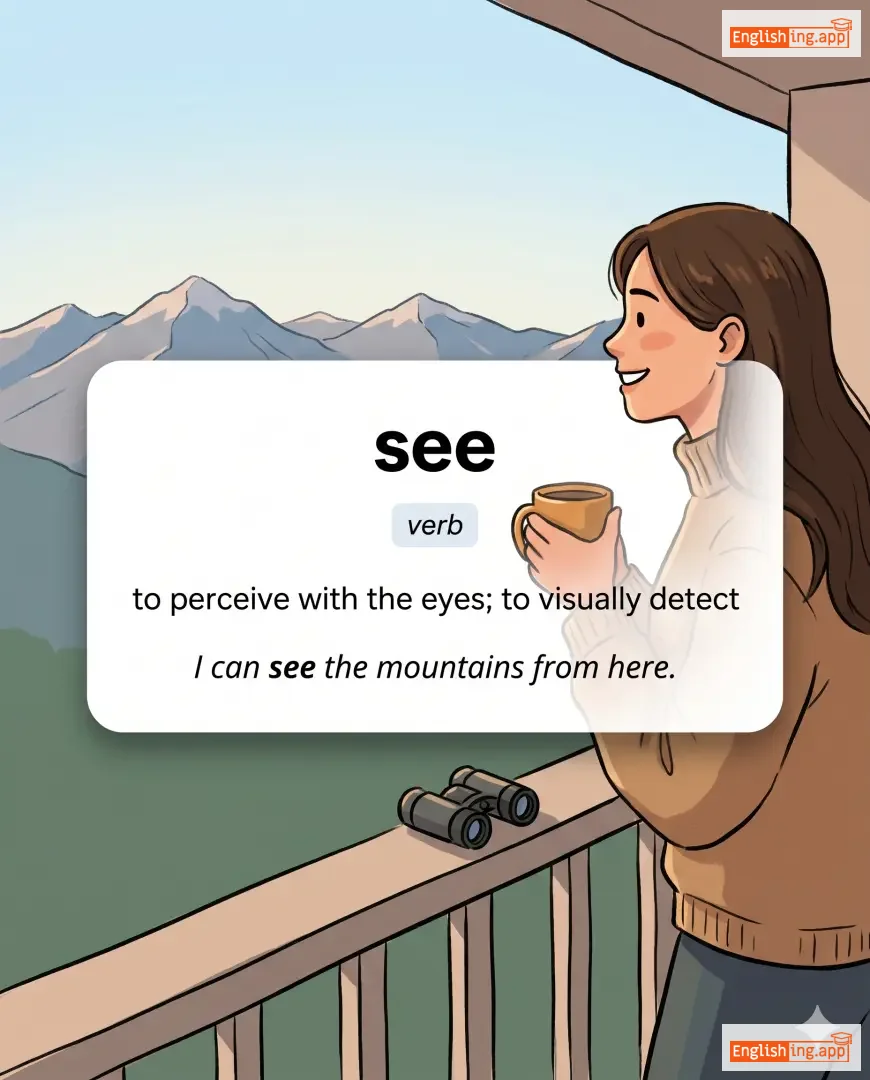
see definition card — visual illustration of the meaning
verb
/siː/
(kan)

to perceive with the eyes; to visually detect

"I can see the mountains from here."

"我可以从这里看到山。" (Wo keyi cong zheli kandao shan.)
noun
/siːd/
种子 (zhǒngzi)

the small, hard part of a plant from which a new plant can grow

"I planted a seed in the garden."

"我在花园里种了一颗种子。" (Wǒ zài huāyuán lǐ zhòngle yī kē zhǒngzi.)
adjective
/ˈsiːdi/
肮脏 / 破旧 (āngzāng / pòjiù)

dirty, shabby, or in bad condition; also feeling slightly unwell

"He stayed in a seedy motel near the bus station."

"他住在离汽车站很近的破旧旅馆里。" (Tā zhù zài lí qìchē zhàn hěn jìn de pòjiù lǚguǎn lǐ.)
verb
/siːk/
寻找 (xunzhao)

to try to find or obtain something; to attempt or desire to achieve

"He decided to seek advice from his mentor."

"他决定向他的导师寻求建议。" (Tā juédìng xiàng tā de dǎoshī xúnqiú jiànyì.)
noun
/ˈsiːkər/
寻求者 (xúnqiú zhě)

a person who is looking for something, especially knowledge or truth

"The seeker traveled far to find the answers to his questions."

"寻求者远行去寻找他问题的答案。" (Xúnqiú zhě yuǎn xíng qù xúnzhǎo tā wèntí de dá'àn.)
verb
/siːm/
看起来 (kàn qǐlái)

to give the impression of being something or having a particular quality

"He seems tired after the long journey."

"他看起来在长时间的旅程后很累。" (Tā kàn qǐlái zài cháng shíjiān de lǚchéng hòu hěn lèi.)
adverb
/ˈsiː.mɪŋ.li/
表面上, 看起来平静 (biaomianshang, kanqilai pingjing)

appearing to be true, but not necessarily so

"He was seemingly calm despite the chaos around him."

"尽管周围一片混乱,他看起来平静。" (Jǐnguǎn zhōuwéi yīpiàn hùnluàn, tā kàn qǐlái píngjìng.)
adjective
/ˈsiːmli/
得体 (deti)

proper or appropriate in behavior or appearance

"It was not seemly to argue loudly during the ceremony."

"在仪式期间大声争论是不合适的。" (Zai yishi qijian dasheng zhenglun shi bu heshi de.)