词汇表

英语词汇词典 | 单词含义、定义和示例

noun
/skɑːrf/
围巾 (weijin)

a length of fabric worn around the neck or head for warmth, protection, or fashion

"She wrapped a warm scarf around her neck in the cold weather."

"她在寒冷的天气里围了一条温暖的围巾。" (Ta zai hanleng de tianqi li wei le yitiao wenruan de weijin.)
verb
/ˈskærɪfaɪ/
松土 (songtu)

to make shallow cuts or scratches; to loosen the surface of soil

"The farmer scarified the soil before planting seeds."

"农民在种植种子之前松土。" (Nóngmín zài zhòngzhí zhǒngzi zhīqián sōngtǔ.)
adjective
/ˈskɑː.lət/
猩红色 (xīng hóng sè)

a bright red color with a slightly orange tinge

"The scarlet roses in the garden looked magnificent in the morning light."

"花园里的猩红色玫瑰在晨光下看起来非常壮丽。" (Huāyuán lǐ de xīng hóng sè méiguī zài chén guāng xià kàn qǐlái fēicháng zhuànglì.)
adjective
/ˈskeəri/
可怕 (kěpà)

causing fear or making you feel frightened

"That horror movie was really scary."

"那部恐怖电影真的很吓人。" (nà bù kǒngbù diànyǐng zhēn de hěn xiàrén.)
adjective
/ˈskeɪðɪŋ/
尖锐的批评 (jianrui de piping)

severely critical; harshly scornful

"The critic wrote a scathing review of the movie."

"评论家写了一篇尖锐的电影评论。" (Pinglunya xie le yipian jianrui de dianying piping.)
verb
/ˈskætər/
幸福 (xìngfú)

to throw or spread things over a wide area in different directions

"The farmer scattered seeds across the field."

"她无法掩饰她收到奖项时的幸福感。" (Tā wúfǎ yǎnshì tā shōu dào jiǎngxiàng shí de xìngfú gǎn.)
adjective
/ˈskætərd/
散布的 (sanbu de)

Spread irregularly or widely in different directions.

"The toys were scattered all over the floor."

"玩具散落在地板上。" (Wánjù sànluò zài dìbǎn shàng.)
verb
/ˈskævɪndʒ/
在垃圾中寻找 (zai laji zhong xunzhao)

to search through waste or discarded material to find useful items

"The children scavenged for food in the garbage dump."

"孩子们在垃圾堆里找食物。" (Haizimen zai laji dui li zhao shiwu.)
noun
/ˈskævɪndʒər/
食尸者 / 垃圾收集者 (shíshī zhě / lājī shōují zhě)

an animal or person that feeds on dead or discarded material

"Vultures are natural scavengers that clean up the environment."

"秃鹫是自然的清道夫,清理环境。" (Tū jiù shì zìrán de qīng dào fū, qīnglǐ huánjìng.)
noun
/səˈnɛərioʊ/
可能的情境 (keneng de qingjing)

a possible situation or sequence of events

"The company prepared for the worst-case scenario."

"公司为最坏的情况做了准备。" (Gongsi wei zuihuai de qingkuang zuole zhunbei.)
noun
/siːn/
场景 (changjing)

a place or setting of an event or activity, or the part of a play or film

"The final scene of the movie was very emotional."

"电影的最后一场景非常感人。" (Diànyǐng de zuìhòu yī chǎngjǐng fēicháng gǎnrén.)
noun
/ˈsiː.nər.i/
风景 (fēngjǐng)

the natural features of a landscape; the painted background used on a theater stage

"The mountain scenery was breathtakingly beautiful."

"山脉的风景令人叹为观止。" (Shānmài de fēngjǐng lìng rén tàn wéi guān zhǐ.)
noun
/sɛnt/
香气 (xiangqi)

a distinctive smell, especially a pleasant one

"The scent of roses filled the garden."

"玫瑰的香气充满了花园。" (Méiguī de xiāngqì chōngmǎnle huāyuán.)
adjective
/ˈskeptɪkəl/
怀疑的; 不信任的; 对某事的真相持怀疑态度 (huáiyí de; bù xìnrèn de; duì mǒu shì de zhēnxiàng chí huáiyí tàidù)

having doubts; not easily convinced; questioning the truth of something

"Many scientists remain sceptical about the new theory."

"许多科学家对新理论持怀疑态度。" (Xǔduō kēxuéjiā duì xīn lǐlùn chí huáiyí tàidù)
noun
/ˈʃɑːdənfrɔɪdə/
从他人的不幸中获得的快乐 (cóng tārén de bùxìng zhōng huòdé de kuàilè)

pleasure derived from another person's misfortune

"He felt a sense of schadenfreude when his rival failed."

"当他的对手失败时,他感到一阵沙登弗洛伊德。" (Dāng tā de duìshǒu shībài shí, tā gǎndào yī zhèn shādēng fúluòyīdé.)
noun
/ˈskɛdʒʊl/
时间表 (shijianbiao)

a plan for carrying out a process or task, showing the time and sequence of actions

"I have a busy schedule for today."

"我今天的时间表很满。" (Wǒ jīntiān de shíjiān biǎo hěn mǎn.)
Schematic definition card — visual illustration of the meaning
noun, adjective
/skiːˈmætɪk/
示意图 (shì yì tú)

a simplified or symbolic representation of a system or plan

"The engineer showed a schematic of the electrical circuit."

"工程师展示了电气电路的示意图。" (Gōngchéngshī zhǎnshì le diànqì diànlù de shì yì tú.)
noun, verb
/skiːm/
计划 / 阴谋 (jì huà / yīn móu)

a plan or arrangement, especially one that is secret or dishonest

"They devised a scheme to cheat investors."

"他们制定了一个计划,欺骗投资者。" (Tāmen zhì dìng le yí gè jì huà, qī piàn tóu zī zhě.)
noun
/ˈskɪz.əm/ or /ˈsɪz.əm/
幸福 (xìngfú)

A division or split between strongly opposed parties, often in religion or organizations.

"The schism in the church led to the formation of two separate groups."

"她在收到奖项时无法掩饰她的幸福。" (Tā zài shōudào jiǎngxiàng shí wúfǎ yǎnshì tā de xìngfú.)
noun
/ˈskɒlər/
学者 (xuezhe)

a person who studies a particular subject or academic field

"The scholar presented a research paper on ancient civilizations."

"学者展示了关于古代文明的研究论文。" (Xuezhe zhanshi le guanyu gudai wenming de yanjiu lunwen.)
scholarly definition card — visual illustration of the meaning
adjective
/ˈskɒl.ə.li/
学术的 (xuéshù de)

Having or showing knowledge, learning, or devotion to academic study.

"She wrote a scholarly article on medieval literature."

"她写了一篇关于中世纪文学的学术文章。" (Tā xiěle yī piān guānyú zhōng shìjì wénxué de xuéshù wénzhāng.)
noun
/ˈskɒlərʃɪp/
奖学金 (jiangxuejin)

an award or grant to support a student's education

"She received a scholarship to study abroad."

"她获得了一项奖学金,以便出国留学。" (Ta huodele yi xiang jiangxuejin, yibian chuguo liuxue.)
adjective
/skəˈlæstɪk/
学术的 (xuéshù de)

Relating to schools, education, or academic learning.

"The school organizes scholastic competitions every year."

"学校每年举办学术竞赛。" (Xuéxiào měi nián jǔbàn xuéshù jìngsài.)
noun
/skuːl/
学校 (xuéxiào)

An institution for educating children; also a group of people sharing the same ideas or discipline.

"The children walked to school together."

"孩子们一起走到学校。" (Háizimen yīqǐ zǒu dào xuéxiào.)
science definition card — visual illustration of the meaning
noun
/ˈsaɪəns/
科学 (kexue)

the systematic study of the structure and behavior of the physical and natural world

"Science has made incredible advancements in medicine."
"科学在医学领域取得了令人难以置信的进展。" (Kexue zai yixue lingyu qudela lingren nanyi zhishinde jinzhang.)
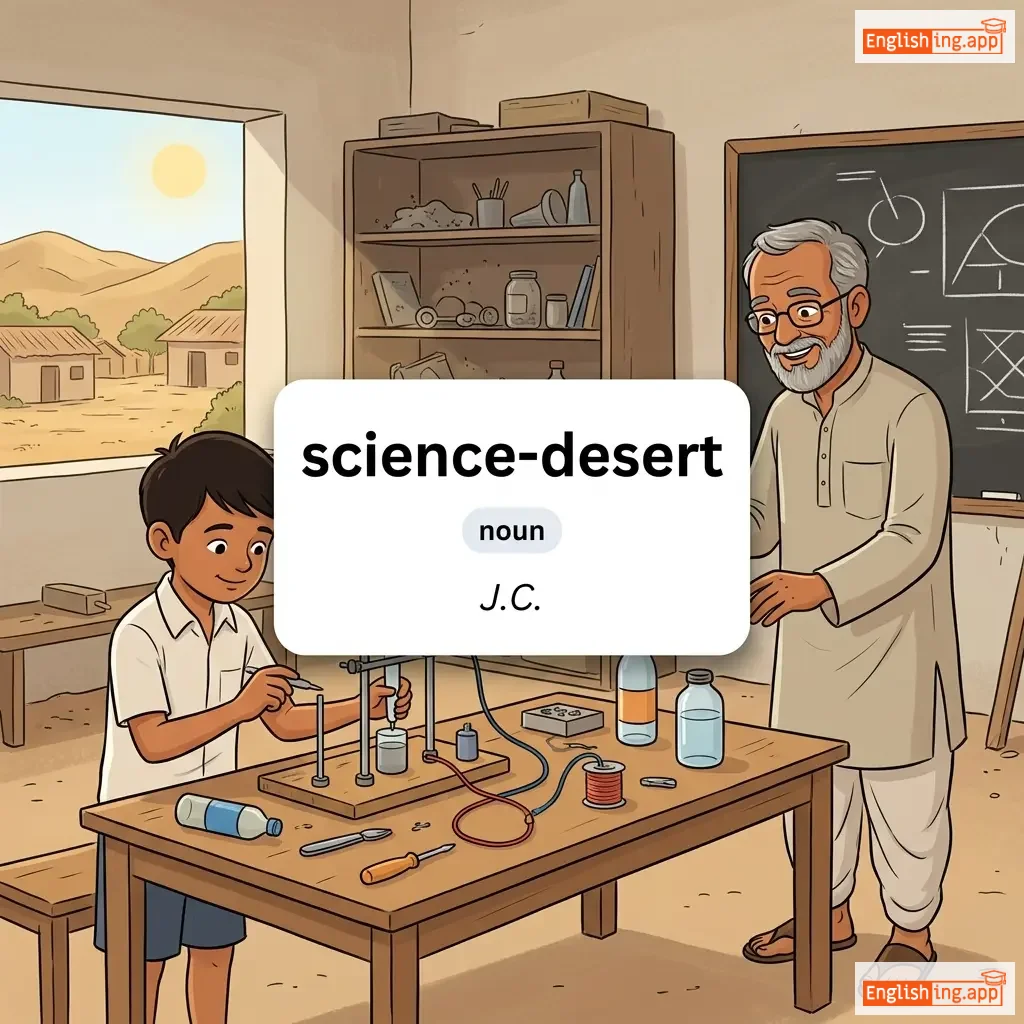
science-desert definition card — visual illustration of the meaning
noun
ˈsaɪəns ˈdezət
科学荒漠 (kexue huangmo)

A region or area lacking in scientific development, research facilities, or educational institutions.

"J.C. Bose thrived in a science-desert."

"J.C. Bose 在科学荒漠中茁壮成长。" (J.C. Bose zai kexue huangmo zhong zhuo zhuang chengzhang.)
scientific definition card — visual illustration of the meaning
adjective
/ˌsaɪənˈtɪfɪk/
科学的 (kexue de)

relating to or based on science

"The scientific community is working to find a cure for cancer."

"科学界正在努力寻找癌症的治疗方法。" (Kexuejie zhengzai nuli xunzhao aizheng de zhiliaofa.)
scientist definition card — visual illustration of the meaning
noun
/ˈsaɪəntɪst/
科学家 (kexuejia)

a person who conducts scientific research or experiments

"The scientist made a groundbreaking discovery in physics."

"科学家在物理学方面做出了开创性的发现。" (Kexuejia zai wulixue fangmian zuo chule kaichuangxing de faxian.)
noun
/sɪnˈtɪl.ə/
小小的火花 (xiao xiao de huo hua)

A tiny trace or spark of a specified quality or feeling.

"There wasn’t a scintilla of doubt in her mind."

"她的脑海中没有一丝疑虑。" (Ta de nao hai zhong mei you yi si yi lv.)
verb
/ˈsɪn.tɪ.leɪt/
闪烁 (shǎn shuò)

to sparkle or shine brightly; to emit flashes of light

"The diamond ring scintillated under the bright lights."

"钻石戒指在明亮的灯光下闪耀。" (Zuànshí jièzhǐ zài míngliàng de dēngguāng xià shǎnyào.)
adjective
/ˈsɪn.tɪ.leɪ.tɪŋ/
闪耀的 (shanyao de)

brilliantly clever, exciting, or sparkling

"Her scintillating conversation kept everyone entertained."

"她那闪耀的谈话让每个人都感到娱乐。" (Ta na shanyao de tanhua rang meiren dou gandao yule.)
noun
/ˈsaɪ.ə.lɪz.əm/
表面知识的假装 (biaomian zhishi de jiazhuang)

pretentious show of superficial knowledge

"His speech was full of sciolism, impressing no one."

"他的演讲充满了赛奥利主义,没有打动任何人。" (Tā de yǎnjiǎng chōngmǎnle sài'àolì zhǔyì, méiyǒu dǎdòng rènhé rén.)
noun
/ˈsaɪ.ən/
后代 (hòudài)

a descendant of a wealthy, aristocratic, or influential family

"He is the scion of a wealthy industrialist family."

"他是一个富有的工业家家庭的后代。" (Tā shì yīgè fùyǒu de gōngyèjiā jiātíng de hòudài.)
noun
/ˈsɪʒ.ən/
分裂 (fenlie)

the act of cutting or dividing something

"The political party suffered a scission over ideological disputes."

"政党因意识形态争议而经历了分裂。" (Zhèngdǎng yīn yìshí xíngtài zhēngyì ér jīnglìle fēnliè.)
verb
/ˈsɪzər/
用剪刀剪 (yòng jiǎndāo jiǎn)

to cut with or as if with scissors

"The tailor scissored the fabric neatly."

"裁缝整齐地剪了布料。" (Cáiféng zhěngqí de jiǎnle bùliào.)
noun
/ˈsɪz.ərz/
剪刀 (jiǎndāo)

a cutting instrument with two blades that can be closed together

"I need scissors to cut this paper."

"我需要剪刀来剪这张纸。" (Wǒ xūyào jiǎndāo lái jiǎn zhè zhāng zhǐ.)
verb
/skɒf/
嘲笑 (chaoxiao)

to speak about something in a mocking or dismissive way

"He scoffed at the idea of moving abroad."
"他嘲笑搬到国外的想法。" (Ta chaoxiao bandao guowai de xiangfa.)
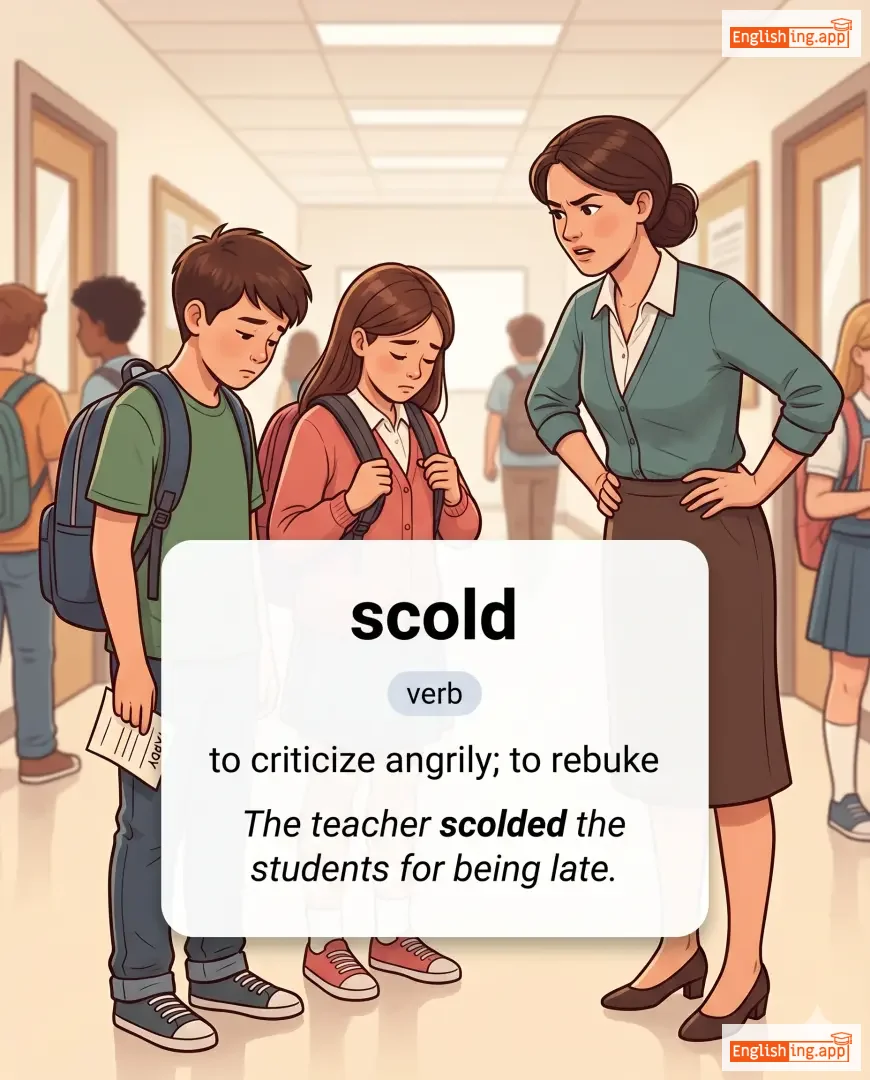
scold definition card — visual illustration of the meaning
verb
/skoʊld/
责骂 (zé mà)

to criticize angrily; to rebuke

"The teacher scolded the students for being late."

"老师因为学生迟到而责骂他们。" (Lǎoshī yīnwèi xuéshēng chídào ér zé mà tāmen.)
noun
/ˈskuːtər/
滑板车 (huábǎnchē)

a small two-wheeled vehicle powered by an engine or electricity

"She rides a scooter to work every day."

"她每天骑滑板车去上班。" (Tā měitiān qí huábǎnchē qù shàngbān.)
noun
/skoʊp/
范围 (fanwei)

the range of one's perception, understanding, or activity

"The project is beyond the scope of our resources."

"该项目超出了我们资源的范围。" (Gai xiangmu chaochu le women ziyuan de fanwei.)
verb
/skɔːrtʃ/
烧焦 (shao jiao)

to burn the surface of something slightly

"The fire scorched the walls of the building."

"火焰烧焦了建筑物的墙壁。" (Huo yan shao jiao le jian zhu wu de qiang bi.)
noun/verb
/skɔːr/
分数 (fenshu)

a number of points achieved in a game or test; to gain points or achieve a goal

"He scored the winning goal in the final match."

"他在最后一场比赛中进了制胜球。" (Ta zai zuihou yi chang bisai zhong jin le zhisheng qiu.)
😒

scorn

noun/verb
/skɔːrn/

the feeling or expression of contempt or disdain; to treat with contempt

"She looked at him with open scorn."

adjective
/ˈskɔːrnfəl/
轻蔑的 (qīngmiè de)

showing contempt or disdain; expressing scorn

"She gave him a scornful look when he made the rude comment."

"当他做出粗鲁的评论时,她投以蔑视的目光。" (Dāng tā zuò chū cūlǔ de pínglùn shí, tā tóuyǐ mièshì de mùguāng.)
noun
/ˈskɔːr.pi.ən/
蝎子 (xiezi)

a small creature with eight legs, two claws, and a curved tail with a poisonous sting

"The scorpion hid under the rock during the day."

"蝎子在白天藏在石头下。" (Xiezi zai baitian cang zai shitou xia.)
noun
/ˈskɔːrpiən fɪʃ/
蝎子鱼 (xie zi yu)

a type of fish with venomous spines that belongs to the family Scorpaenidae

"The scorpion fish has dangerous spines that can inject venom."

"蝎子鱼有危险的刺,可以注入毒液。" (xie zi yu you wei xian de ci ke yi zhu ru du ye)
verb/noun
/skɒtʃ/
结束 / 苏格兰威士忌 (jieshu / sugelan weishi ji)

to put an end to something; also a type of whisky

"The report scotched the rumors of a merger."

"报告停止了关于合并的谣言。" (Baogao tingzhile guanyu hebing de yaoyan.)
noun
/ˈskaʊndrəl/
无赖 (wú lài)

a dishonest or unscrupulous person; a villain

"That scoundrel cheated the old man out of his savings."

"那个无赖骗取了老人家的积蓄。" (Nàgè wúlài piànqǔle lǎorén jiā de jīxù.)
verb
/ˈskaʊər/
擦洗 / 彻底搜索 (cāxǐ / chèdǐ sōusuǒ)

to clean or brighten the surface of something by scrubbing; to search thoroughly

"She scoured the kitchen until it shone."

"她打扫厨房直到它闪闪发光。" (Tā dǎsǎo chúfáng zhídào tā shǎnshǎn fāguāng.)
noun/verb
/skɜːrdʒ/

A source of great pain or punishment; to whip or inflict suffering on someone.

"Disease and poverty remain a scourge in many regions."