词汇表

英语词汇词典 | 单词含义、定义和示例

noun
/ˈsʌn.deɪ/
星期天 (xingqi tian)

The day of the week between Saturday and Monday; often considered a day of rest or worship.

"We usually relax at home on Sunday."

"我们通常在星期天在家休息。" (Wo men tong chang zai xingqi tian zai jia xiuxi.)
verb
/ˈsʌn.dər/
分裂 (fenlie)

To split apart or separate, especially with force.

"The war sundered families and friends."

"战争使家庭和朋友分裂。" (Zhanzheng shi jiating he pengyou fenlie.)
noun
/ˈsʌnˌdaʊn/
日落 (riluo)

the time in the evening when the sun goes below the horizon

"We planned to reach the village before sundown."
"我们计划在日落之前到达村庄。" (Wǒmen jìhuà zài rìluò zhīqián dào dá cūnzhuāng.)
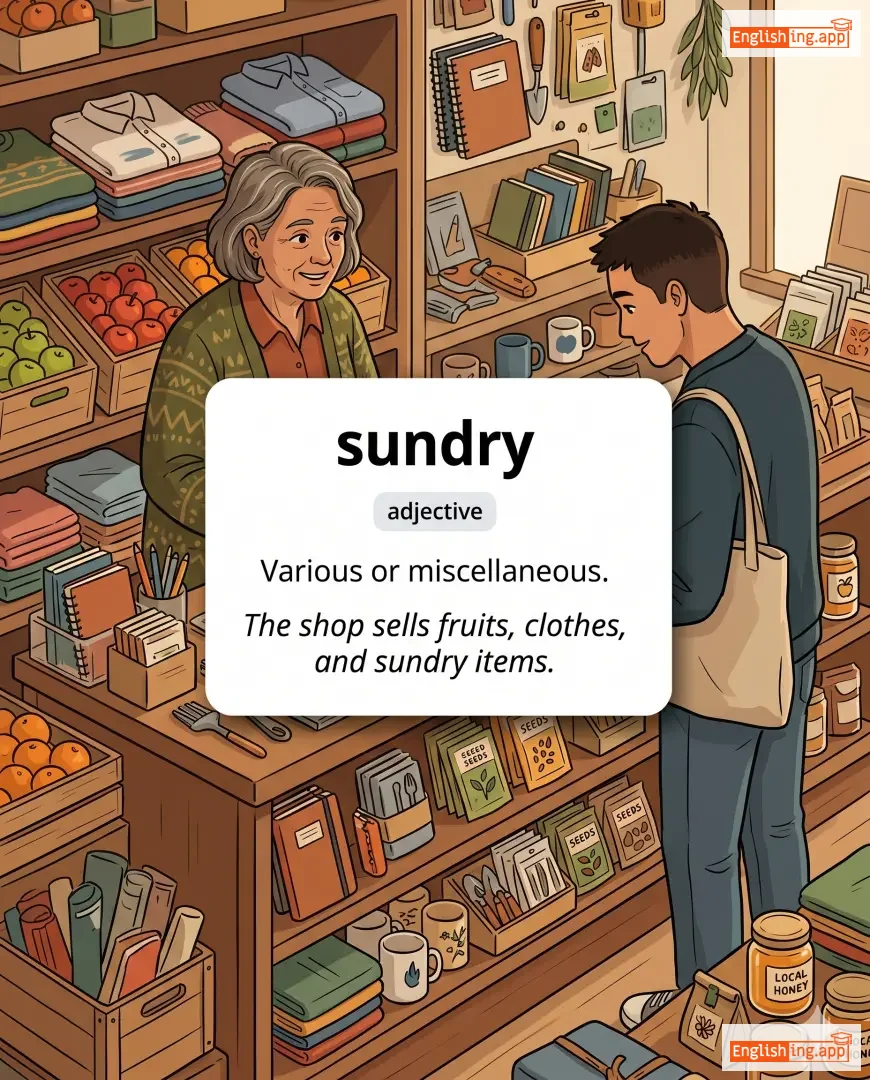
sundry definition card — visual illustration of the meaning
adjective
/ˈsʌn.dri/
杂项 (záxiàng)

Various or miscellaneous.

"The shop sells fruits, clothes, and sundry items."

"这家店卖水果、衣服和各种商品。" (Zhè jiā diàn mài shuǐguǒ, yīfú hé gè zhǒng shāngpǐn.)
sunlight definition card — visual illustration of the meaning
noun
/ˈsʌn.laɪt/

the light that comes from the sun

"The room was filled with warm sunlight."

noun
/sʌnd raɪs/
晒干的米 (shàigān de mǐ)

Rice that has been dried in the sun; parched rice

"The farmers spread the sunned rice on mats to dry completely."

"农民们将晒干的米铺在垫子上,让它完全干燥。" (Nóngmín men jiāng shàigān de mǐ pù zài diànzi shàng, ràng tā wánquán gānzào.)
adjective
/ˈsʌ.ni/
阳光明媚 (yangguang mingmei)

bright with sunlight; cheerful or happy in nature

"It was a bright and sunny morning."

"这是一个明亮而阳光明媚的早晨。" (Zhe shi yige mingliang er yangguang mingmei de zaocheng.)
noun
/ˈsʌn.raɪz/
日出 (rì chū)

The time in the morning when the sun appears over the horizon.

"We woke up early to watch the sunrise over the mountains."

"我们早起观看了山上的日出。" (Wǒmen zǎoqǐ guānkànle shān shàng de rìchū.)
noun
/ˈsʌn.set/
日落 (riluo)

the time in the evening when the sun disappears below the horizon

"The romantic sunset painted the sky in golden colors."

"浪漫的日落把天空涂上金色。" (Langman de riluo ba tiankong tushang jinse.)
noun
/ˈsʌn.stroʊk/
中暑 (zhongshu)

a serious condition caused by overheating from prolonged exposure to high temperatures

"The worker suffered from sunstroke after working outside all day."

"工人在外面工作了一整天后中暑了。" (Gongren zai waimian gongzuo le yi zheng tian hou zhongshu le)
adjective
/ˈsuːpər/
超级 (chaoji)

excellent; very good

"She did a super job on the project."

"她在项目中做得非常好。" (Ta zai xiangmu zhong zuo de feichang hao.)
noun
/ˌsuː.pər.əˈbʌn.dəns/
过剩 (guo sheng)

An excessive or overflowing amount of something.

"The garden was filled with a superabundance of flowers."

"花园里充满了过多的花朵。" (Hua yuan li chong man le guo duo de hua duo.)
verb
/ˌsuːpərˈæd/
超级添加 (chaoji tianjia)

to add something to what has already been added

"The author chose to superadd a new chapter to the revised edition."

"作者决定在修订版中超级添加一个新章节。" (zuozhe jueding zai xiudingban zhong chaoji tianjia yige xin zhangjie.)
verb
/ˌsuːpərˈæn.ju.eɪt/
带薪退休 (dàixīn tuìxiū)

to retire someone with a pension, usually due to age or long service

"The company decided to superannuate its senior employees after thirty years of service."

"公司决定在三十年的服务后将其高级员工带薪退休。" (Gōngsī juédìng zài sānshí nián de fúwù hòu jiāng qí gāojí yuángōng dàixīn tuìxiū.)
adjective
/ˌsuːpərˈæn.ju.eɪ.tɪd/
过时的 (guòshí de)

old and no longer useful or valid; retired due to age

"The factory was filled with superannuated machines that slowed production."

"工厂里充满了过时的机器,这些机器减慢了生产。" (gōngchǎng lǐ chōngmǎnle guòshí de jīqì, zhèxiē jīqì jiǎn mànle shēngchǎn.)
adjective
/suːˈpɜːrb/
极好的 (jí hǎo de)

extremely good; excellent

"The hotel provided superb service during our stay."

"酒店在我们停留期间提供了极好的服务。" (Jiǔdiàn zài wǒmen tíngliú qījiān tígōngle jí hǎo de fúwù.)
adverb
/suːˈpɜːrbli/
出色地 (chūsè de)

in an excellent or impressive manner

"She performed superbly in the final match."

"她在最后一场比赛中表现得出色地。" (Tā zài zuìhòu yī chǎng bǐsài zhōng biǎoxiàn dé chūsè de.)
adjective
/ˌsuː.pɚˈsɪl.i.əs/
傲慢的 (àomàn de)

Behaving or looking as though one thinks one is superior to others; arrogant and disdainful.

"She gave him a supercilious smile as if he was beneath her."

"她对他露出了一种傲慢的笑容,好像他比她低。" (Tā duì tā lòu chūle yī zhǒng àomàn de xiàoróng, hǎoxiàng tā bǐ tā dī.)
adjective
/ˌsuː.pər.ɪˈrɑː.ɡə.tɔːr.i/
超额的 (chao e de)

Going beyond what is required or expected; more than necessary.

"His donation was supererogatory, far beyond what anyone had asked for."

"他的捐赠是超额的,远远超过任何人要求的。" (Tade juanzeng shi chaoe de, yuanyuan chao guo renhe ren yaoqiu de.)
superficial definition card — visual illustration of the meaning
adjective
/ˌsuː.pɚˈfɪʃ.əl/
表面 (biaomian)

Concerned only with the surface or appearance; not deep or thorough.

"His analysis of the issue was rather superficial and lacked depth."

"他的分析相当表面化,缺乏深度。" (Tade fenxi xiangdang biaomianhua, qufashendu.)
noun
/ˌsuː.pɚˈfluː.ə.t̬i/
过剩 (guòshèng)

An excessive amount of something; more than what is needed.

"The room was filled with a superfluity of decorations."

"房间里充满了过多的装饰。" (Fángjiān lǐ chōngmǎnle guòduō de zhuāngshì.)
superfluous definition card — visual illustration of the meaning
adjective
/suːˈpɝː.fluː.əs/
多余 (duoyu)

Unnecessary, especially because more than enough exists.

"Adding more details to the report would be superfluous."

"在报告中添加更多细节将是多余的。" (Zài bàogào zhōng tiānjiā gèng duō xìjié jiāng shì duōyú de.)
superfoods definition card — visual illustration of the meaning
noun
ˈsuː.pər.fuːdz
超级食物 (chāojí shíwù)

Nutrient-dense foods that are particularly beneficial for health and well-being.

"Blueberries and spinach are superfoods rich in vitamins."

"蓝莓和菠菜是富含维生素的超级食物。" (Lánméi hé bōcài shì fùhán wéishēngsù de chāojí shíwù.)
verb
/ˌsuːpərˈhiːt/
过热 (guò rè)

to heat a substance beyond its normal boiling point without it becoming vapor

"Engineers superheat the steam to increase the efficiency of the turbine."

"工程师将蒸汽超热以提高涡轮机的效率。" (Gōngchéngshī jiāng zhēngqì chāo rè yǐ tígāo guōlúnjī de xiàolǜ.)
verb
/ˌsuːpərɪmˈpoʊz/
叠加 (díjiā)

to place one thing on top of another so that both can be seen

"The editor superimposed text over the image."

"编辑将文本叠加在图片上。" (Biānjí jiāng wénběn diéjiā zài túpiàn shàng.)
verb
/ˌsuːpərɪnˈtɛnd/
监管 (jiānguǎn)

to oversee and direct the work or operation of something

"She was hired to superintend the construction project."

"她被聘用来监管建筑项目。" (Tā bèi pìn yòng lái jiānguǎn jiànzhú xiàngmù.)
noun
/ˌsuːpərɪnˈtɛndəns/
监督 (jiāndū)

the act of overseeing, supervising, or managing

"The superintendence of the school is the principal’s duty."

"学校的监督是校长的责任。" (Xuéxiào de jiāndū shì xiàozhǎng de zérèn.)
noun
/ˌsuːpərɪnˈtɛndənt/
管理员 (guǎnlǐyuán)

a person who oversees, manages, or directs an organization, building, or project

"The superintendent visited the classrooms to check on progress."

"管理员访问了教室以检查进展。" (guǎnlǐyuán fǎngwènle jiàoshì yǐ jiǎnchá jìnzhǎn.)
adjective
/suːˈpɪə.ri.ər/
优越的 (youyue de)

better in quality, rank, or importance than others

"This product is superior to its competitors in quality."

"这个产品在质量上优于其竞争对手。" (zhege chanpin zai zhiliang shang youyu qi jingzheng duishou.)
noun
/suː.pɪər.iˈɔːr.ə.ti/
优越性 (yōuyuèxìng)

the quality or state of being superior; higher rank or quality

"His superiority in mathematics was evident from his test scores."

"他在数学上的优越性从他的考试成绩中显而易见。" (Tā zài shùxué shàng de yōuyuèxìng cóng tā de kǎoshì chéngjī zhōng xiǎn'ér yìjiàn.)
adjective
/suːˈpɜːrlətɪv/
最高级 (zuìgāojí)

Of the highest quality or degree; expressing the extreme form of an adjective or adverb.

"Her performance was superlative, earning her a standing ovation."

"她的表现是最高级的,赢得了站立的掌声。" (Tā de biǎoxiàn shì zuìgāojí de, yíngdéle zhànlì de zhǎngshēng.)
noun
/ˈsuː.pəˌmɑː.kɪt/
超市 (chaoshi)

a large self-service store selling food and household goods

"She went to the supermarket to buy groceries."

"她去超市买杂货。" (Tā qù chāoshì mǎi záhuò.)
adjective
/suːˈpɜːrnəl/
天上的 (tiān shàng de)

Relating to the heavens; celestial or divine.

"The painting captured a supernal beauty that felt otherworldly."

"这幅画捕捉到了一个天上的美丽,感觉像是另一个世界的。" (Zhè fú huà bǔzhuō dào le yīgè tiān shàng de měilì, gǎnjué xiàng shì lìng yīgè shìjiè de.)
adjective
/ˌsuːpərˈnætʃrəl/
超自然 (chaonaturuan)

Attributed to some force beyond scientific understanding or the laws of nature.

"They claimed to have witnessed supernatural events in the old house."

"他们声称在老房子里目睹了超自然的事件。" (Tamen shengcheng zai lao fangzi li mudu le chaonaturuan de shijian.)
adjective
/ˌsuːpərˈnuːmərɛri/
额外的 (éwài de)

Exceeding the usual number; extra or unnecessary.

"The play included several supernumerary actors to fill the background scenes."

"这出戏包含了几个额外的演员来填充背景场景。" (Zhè chū xì bāohánle jǐ gè éwài de yǎnyuán lái tiánchōng bèijǐng chǎngjǐng.)
supersede definition card — visual illustration of the meaning
verb
/ˌsuːpərˈsiːd/
取代 (qǔdài)

To replace or take the place of something because it is more modern or effective.

"This new law will supersede the old regulations."

"这部新法律将取代旧的规定。" (Zhè bù xīn fǎlǜ jiāng qǔdài jiù de guīdìng.)
adjective
/ˌsuː.pəˈsɒn.ɪk/
比声音的速度更快; 与超过声音速度的速度相关 (bǐ shēngyīn de sùdù gèng kuài; yǔ chāoguò shēngyīn sùdù de sùdù xiāngguān)

faster than the speed of sound; relating to speeds greater than the speed of sound

"The supersonic jet broke the sound barrier."

"超音速飞机打破了音障。" (Chāo yīn sù fēijī dǎpòle yīn zhàng)
noun
/ˌsuː.pərˈstɪʃ.ən/
迷信 (mixin)

a belief or practice considered irrational or supernatural

"Breaking a mirror brings seven years of bad luck is a common superstition."

"打破镜子带来七年的厄运,这是一种常见的迷信。" (dapo jingzi dalai qinian de e yun, zhe shi yizhong changjian de mixin)
supervise definition card — visual illustration of the meaning
verb
/ˈsuːpərvaɪz/
监督 (jiāndū)

to oversee or manage the work or activities of others

"She was hired to supervise the new team."

"她被雇佣来监督新团队。" (Tā bèi gùyōng lái jiāndū xīn tuánduì.)
noun
/ˌsuːpərˈvɪʒən/
监督 (jiāndū)

the action or process of overseeing or managing something or someone

"The project was completed under the supervision of an experienced manager."

"该项目在一位经验丰富的经理监督下完成。" (Gāi xiàngmù zài yī wèi jīngyàn fēngfù de jīnglǐ jiāndū xià wánchéng.)
noun
/ˈsuːpəvaɪzə(r)/
监督员 (jiāndū yuán)

a person who manages or directs the work of others

"The supervisor checked the progress of each employee."

"主管检查了每个员工的进展。" (Zhǔguǎn jiǎnchá le měi gè yuángōng de jìnzhǎn.)
supine definition card — visual illustration of the meaning
adjective
/ˈsuːpaɪn/
仰卧 (yangwo)

Lying on the back, face upward; failing to act due to laziness or weakness.

"He lay supine on the grass, staring at the stars."

"他躺在草地上,仰望星星。" (Ta tang zai caodi shang, yangwang xingxing.)
noun
/ˈsʌp.ər/
晚餐 (wǎn cān)

an evening meal, typically a light or informal one

"We usually have supper around seven o'clock."

"我们通常在七点左右吃晚餐。" (Wǒmen tōngcháng zài qī diǎn zuǒyòu chī wǎn cān.)
supplant definition card — visual illustration of the meaning
verb
/səˈplænt/
取代 (qudai)

To take the place of something or someone, often by force or strategy.

"Digital platforms have supplanted traditional newspapers."

"数字平台已经取代了传统报纸。" (Shuzi pingtai yijing qudai le chuantong baozhi.)
adjective
/ˈsʌpl/
柔韧的 (róurèn de)

Easily bending or moving without breaking; flexible and adaptable.

"The gymnast’s body was remarkably supple."

"体操运动员的身体异常柔韧。" (Tǐcāo yùndòngyuán de shēntǐ yìcháng róurèn.)
noun/verb
/ˈsʌplɪmənt/
补充 (buchong)

Something added to complete or enhance; to add extra to make up for a deficiency.

"She takes vitamin supplements to improve her health."

"她服用维生素补充剂来改善她的健康。" (Ta fuyong weishengsu buchongji lai gaishan ta de jiankang.)
adjective
/ˌsʌplɪˈmɛntəri/
补充的 (buchong de)

Additional, completing, or enhancing something else.

"The teacher gave supplementary materials to help the students prepare for exams."

"老师提供了补充材料,帮助学生准备考试。" (Lǎoshī tígōngle bǔchōng cáiliào, bāngzhù xuéshēng zhǔnbèi kǎoshì.)
suppliant definition card — visual illustration of the meaning
adjective
/ˈsʌpliənt/
恳求者 (kěnqiú zhě)

Humbly or earnestly asking for something, especially from a person in authority.

"The suppliant man begged for mercy at the king's feet."
"恳求者在国王的脚下乞求怜悯。" (Kěnqiú zhě zài guówáng de jiǎoxià qǐqiú liánmǐn.)
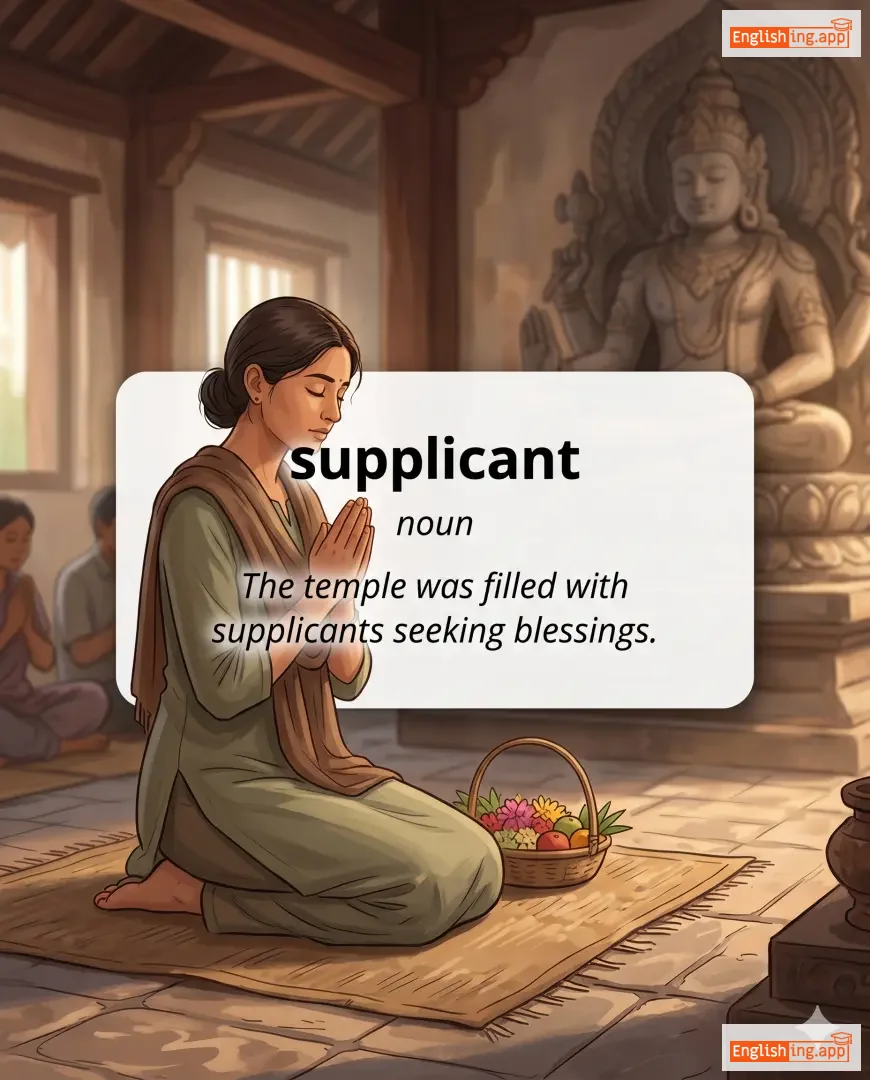
supplicant definition card — visual illustration of the meaning
noun
/ˈsʌplɪkənt/
恳求者 (kěnqiú zhě)

A person who humbly or earnestly asks for something, usually from a person of authority.

"The temple was filled with supplicants seeking blessings."

"寺庙里充满了恳求者,寻找祝福。" (Sìmiào lǐ chōngmǎn le kěnqiú zhě, xúnzhǎo zhùfú.)
verb
/ˈsʌplɪˌkeɪt/
恳求 (kěnqiú)

To ask for something earnestly or humbly, often in a religious context.

"The villagers supplicated the gods for rain during the drought."

"村民们在干旱期间恳求神灵降雨。" (Cūnmínmen zài gānhàn qījiān kěnqiú shénlíng jiàng yǔ.)