词汇表

英语词汇词典 | 单词含义、定义和示例

noun, adjective, verb
/səˈbɔːrdənət/ (noun/adjective), /səˈbɔːrdəˌneɪt/ (verb)
下属 (xiàshǔ)

lower in rank or position; to treat as less important

"He manages ten subordinates in his department."

"他在他的部门里管理十个下属。" (Tā zài tā de bùmén lǐ guǎnlǐ shí gè xiàshǔ.)
verb
/səˈbɔːrn/
贿赂 (huìlù)

to bribe or induce someone unlawfully to perform an act, especially to commit perjury

"The lawyer was accused of trying to suborn a witness."

"律师被指控试图贿赂一名证人。" (Lǜshī bèi zhǐkòng shìtú huìlù yī míng zhèngrén.)
subpoena definition card — visual illustration of the meaning
noun, verb
/səˈpiːnə/
传票 (chuanpiao)

a legal document ordering someone to attend court; to summon someone with such a document

"The witness received a subpoena to appear in court next week."

"证人收到了传票,要求下周出庭。" (Zhengren shoudao le chuanpiao, yaoqiu xia zhou chuting.)
subscribe definition card — visual illustration of the meaning
verb
/səbˈskraɪb/
订阅 (dìngyuè)

to pay to receive a service regularly; to agree with or support something

"I subscribe to several online magazines."

"我订阅了几本在线杂志。" (Wǒ dìngyuèle jǐ běn zàixiàn zázhì.)
noun
/səbˈskraɪbər/
订阅者 (dīngyuè zhě)

a person who receives or subscribes to a service, magazine, or service

"She is a subscriber to the monthly magazine."

"她是每月杂志的订阅者。" (Tā shì měi yuè zázhì de dìngyuè zhě.)
noun
/səbˈskrɪpʃən/
订阅 (dingyue)

the action of subscribing to something

"I paid for a subscription to the online learning platform."

"我为在线学习平台付费订阅了。" (Wo wei zaixian xuexi pingtai fufei dingyue le.)
subsequent definition card — visual illustration of the meaning
adjective
/ˈsʌbsɪkwənt/
随后的 (suíhòu de)

coming after something in time; following

"His subsequent success surprised everyone."

"他的随后的成功让所有人都感到惊讶。" (tā de suíhòu de chénggōng ràng suǒyǒu rén dōu gǎndào jīngyà.)
adverb
/ˈsʌbsɪkwəntli/
随后 (suíhòu)

at a later time; afterward

"He failed his exam and subsequently had to retake it."

"他没有通过考试,随后不得不重考。" (Tā méiyǒu tōngguò kǎoshì, suíhòu bùdébù zhòngkǎo.)
noun
/səbˈsɜːviəns/
奴性 (nuxing)

the condition of being too willing to obey or serve others

"His subservience to authority annoyed his colleagues."

"他对权威的奴性让同事们感到烦恼。" (Ta dui quánwēi de núxìng ràng tóngshìmen gǎndào fánnǎo.)
adjective
/səbˈsɜːviənt/

prepared to obey others unquestioningly; less important than something else

"She was too subservient to challenge his decision."
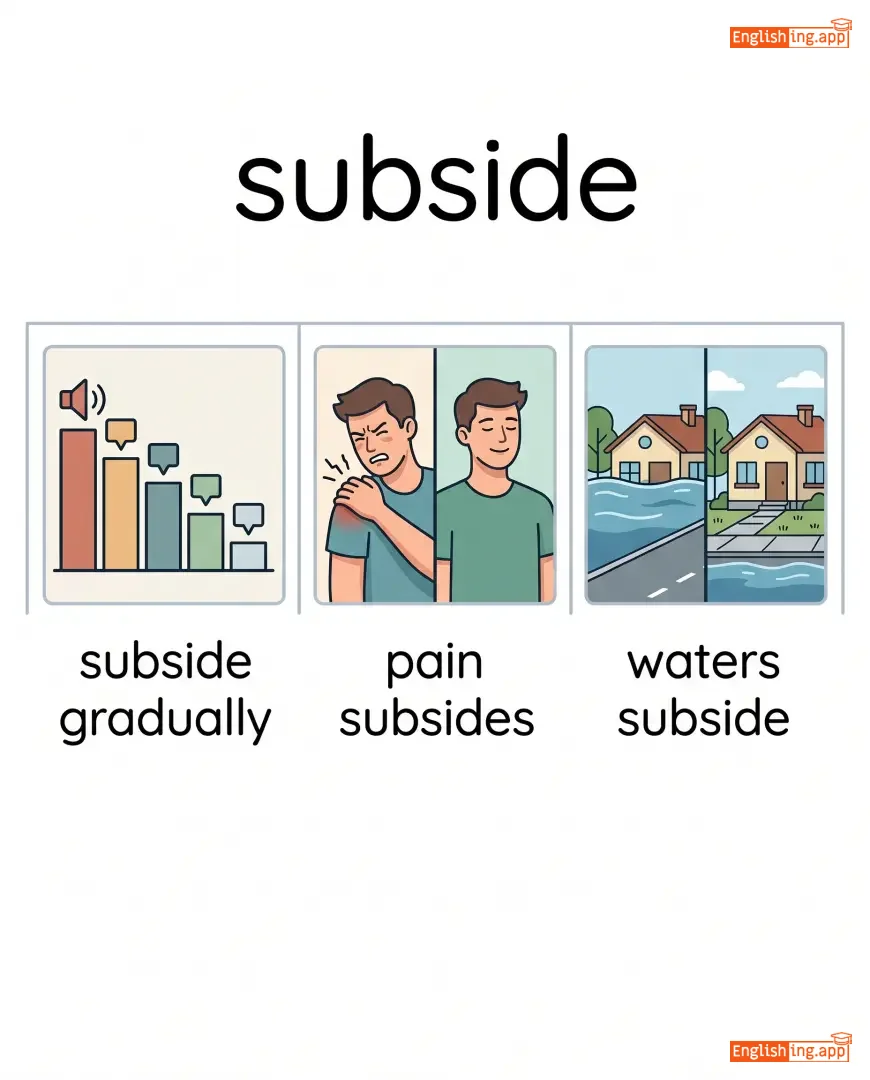
subside definition card — visual illustration of the meaning
verb
/səbˈsaɪd/
减少 (jiǎnshǎo)

to become less intense, violent, or severe; to sink or fall to a lower level

"After the storm, the floodwaters began to subside."

"风暴过后,洪水开始退去。" (fēngbào guòhòu, hóngshuǐ kāishǐ tuìqù.)
noun, adjective
/səbˈsɪdiˌɛri/
子公司 (zǐ gōngsī)

a company controlled by a larger company; serving to assist or supplement something

"The multinational owns a subsidiary in Bangladesh."

"跨国公司在孟加拉国拥有一家子公司。" (Kuàguó gōngsī zài Mèngjiālāguó yǒngyǒu yījiā zǐ gōngsī.)
subsidization definition card — visual illustration of the meaning
noun
/ˌsʌbsɪdaɪˈzeɪʃən/
补贴 (butie)

The action of supporting an organization or activity financially.

"The government's subsidization of agriculture helped farmers."

"政府对农业的补贴帮助了农民。" (Zhèngfǔ duì nóngyè de bǔtiē bāngzhùle nóngmín.)
subsidy definition card — visual illustration of the meaning
noun
/ˈsʌbsɪdi/
补贴 (butie)

A sum of money granted by the government or a public body to help support an industry or reduce the cost of goods or services.

"The government provided a subsidy to farmers to support crop production."

"政府为农民提供了补贴,以支持作物生产。" (Zhengfu wei nongmin tigongle butie, yi zhichi zuowu shengchan.)
verb
/səbˈsɪst/
生存 (shengcun)

To maintain or support oneself, especially at a minimal level.

"Many villagers still subsist on fishing and farming."
"许多村民仍然依靠捕鱼和农业为生。" (Xuduo cunmin rengran yikao chiyu he nongye weisheng.)
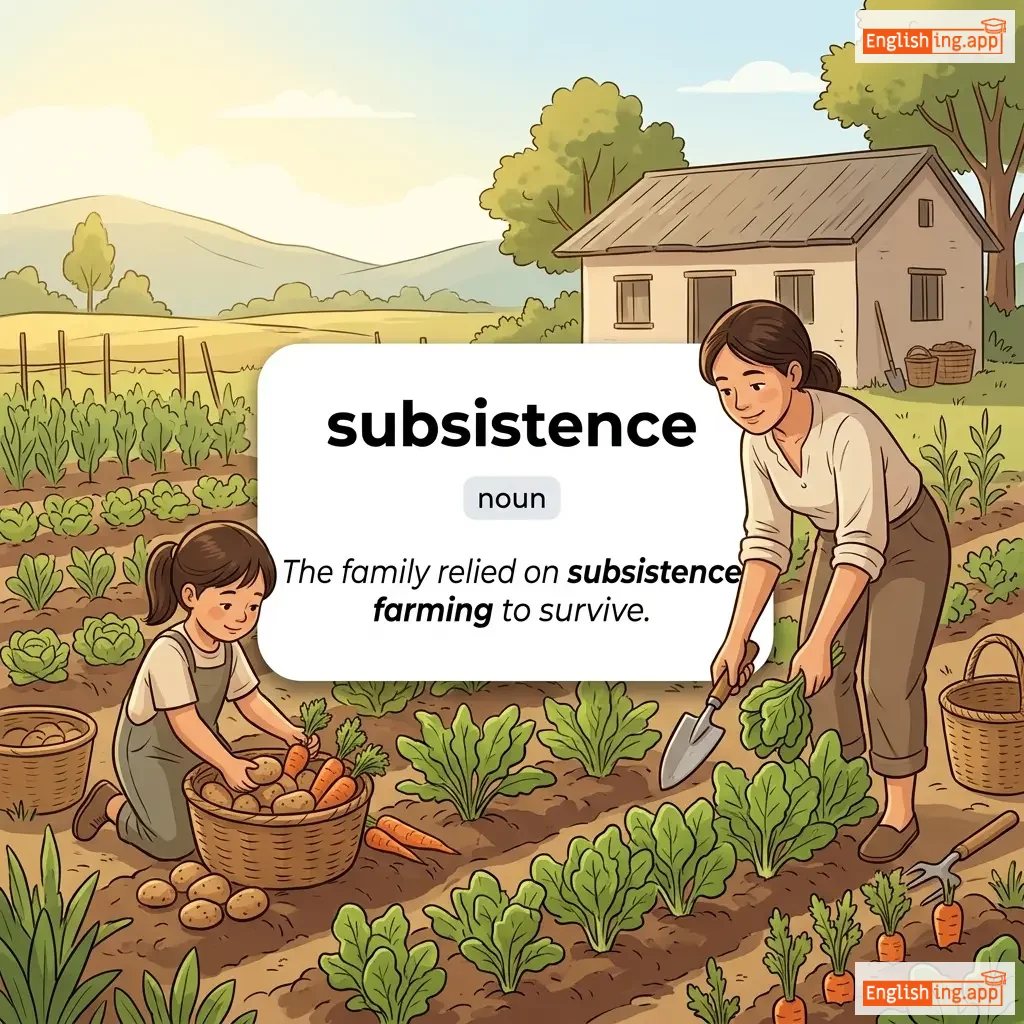
subsistence definition card — visual illustration of the meaning
noun
/səbˈsɪstəns/
生计 (shengji)

The action or fact of maintaining or supporting oneself, especially at a minimal level.

"The family relied on subsistence farming to survive."

"这个家庭依赖生计农业来生存。" (Zhege jiating yilai shengji nongye lai shengcun.)
noun
/ˈsʌbstəns/
物质 (wuzhi)

a particular kind of matter with uniform properties

"The substance of the matter was highly controversial."

"这个问题的物质非常有争议。" (Zhege wenti de wuzhi feichang you zhengyi.)
adjective
/səbˈstænʃl/
实质性的 (shízhìxìng de)

Of considerable importance, size, or worth.

"She received a substantial raise after the successful project."
"她在成功的项目之后获得了可观的加薪。" (Tā zài chénggōng de xiàngmù zhīhòu huòde le kěguān de jiāxīn.)
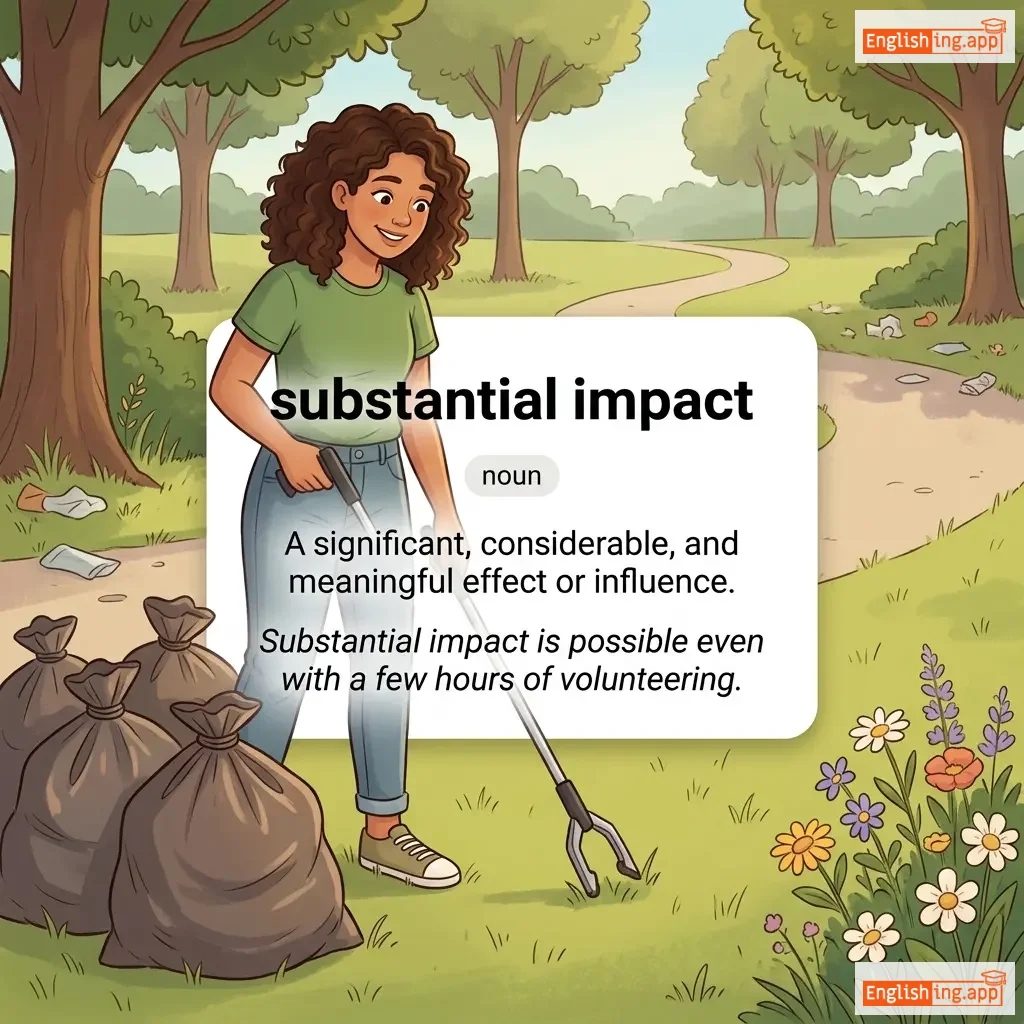
substantial impact definition card — visual illustration of the meaning
noun
səbˈstænʃəl ˈɪmpækt
重大影响 (zhòngdà yǐngxiǎng)

A significant, considerable, and meaningful effect or influence.

"Substantial impact is possible even with a few hours of volunteering."

"即使是几个小时的志愿者工作,也能产生重大影响。" (Jíshǐ shì jǐ gè xiǎoshí de zhìyuànzhě gōngzuò, yě néng chǎnshēng zhòngdà yǐngxiǎng.)
adverb
/səbˈstænʃəli/
显著 (xian zhu)

to a great extent or degree

"The new policy has substantially improved working conditions."

"新政策显著改善了工作条件。" (Xin zhengce xian zhu gaishan le gongzuo tiaojian.)
substantiate definition card — visual illustration of the meaning
verb
/səbˈstænʃieɪt/
证实 (zhèngshí)

To provide evidence to support or prove the truth of something.

"The lawyer worked to substantiate the claims with solid evidence."

"律师努力通过确凿证据来证实这些主张。" (Lǚshī nǔlì tōngguò quèzuò zhèngjù lái zhèngshí zhèxiē zhǔzhāng.)
substantive definition card — visual illustration of the meaning
adjective
/ˈsʌbstəntɪv/
重要 (zhòng yào)

Having a firm basis in reality; important, meaningful, or considerable.

"The company made substantive changes to its policy."
"公司对其政策进行了重要更改。" (Gōngsī duì qí zhèngcè jìnxíngle zhòngyào gēnggǎi.)
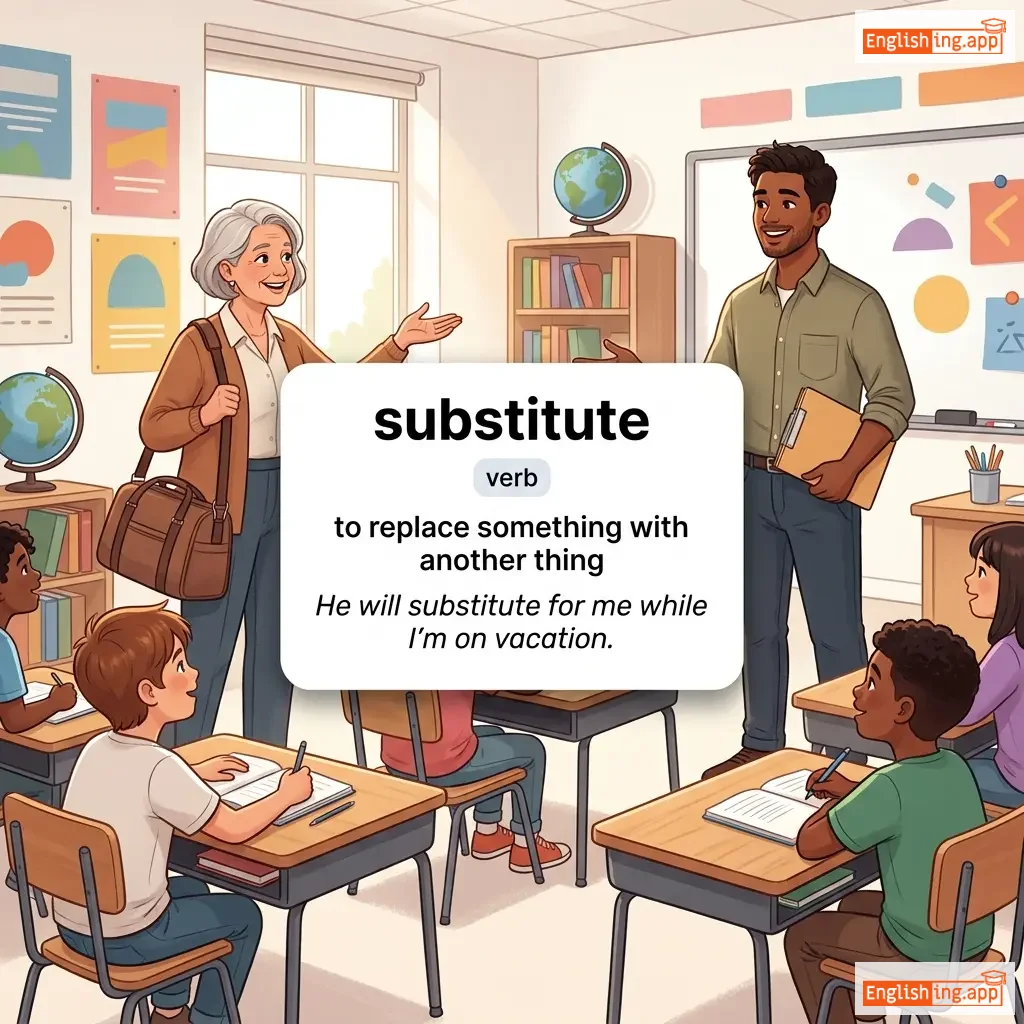
substitute definition card — visual illustration of the meaning
verb
/ˈsʌb.stɪ.tjuːt/
替代 (tìdài)

to replace something with another thing

"He will substitute for me while I'm on vacation."

"他将替我工作,直到我度假回来。" (Tā jiāng tì wǒ gōngzuò, zhídào wǒ dùjià huílái.)
noun
/ˌsʌb.stɪˈtjuː.ʃən/
替换 (tìhuàn)

the action of replacing someone or something with another

"The substitution of the old system with the new one was difficult."
"将旧系统替换为新系统是困难的。" (Jiāng jiù xìtǒng tìhuàn wèi xīn xìtǒng shì kùnnán de.)
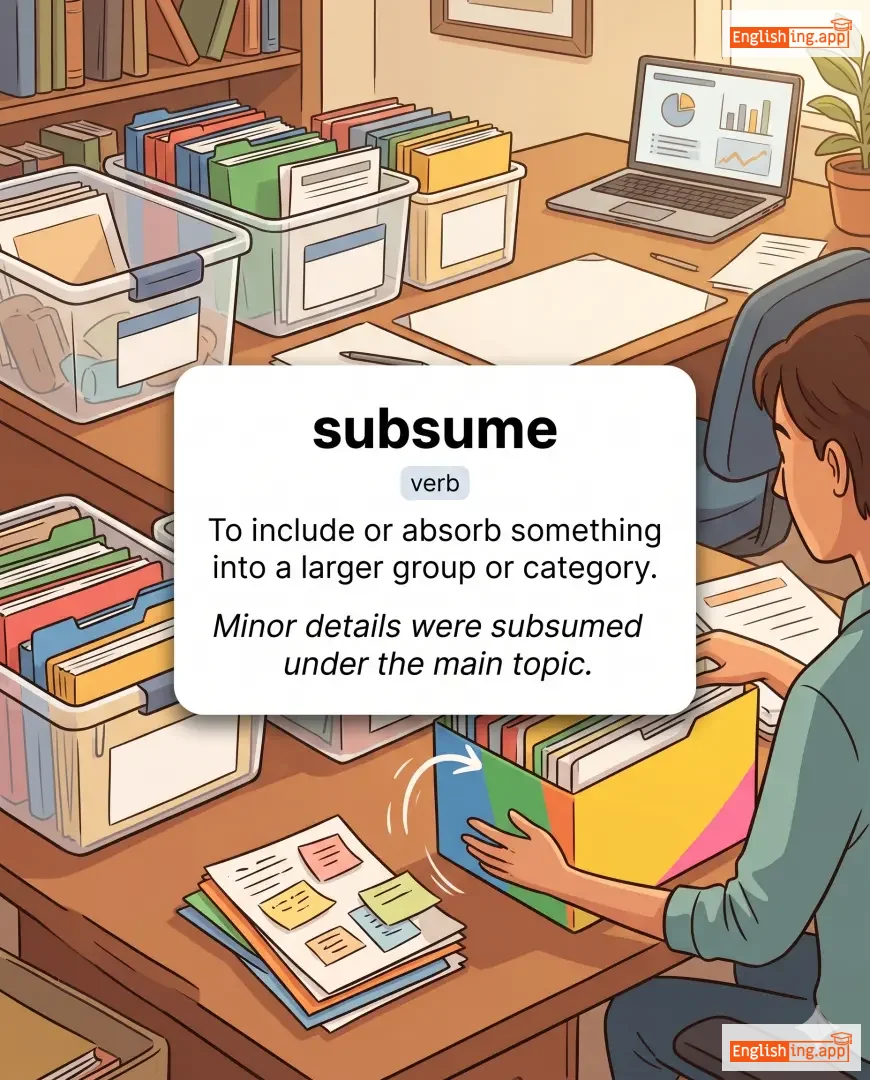
subsume definition card — visual illustration of the meaning
verb
/səbˈsjuːm/
包括 (bāokuò)

To include or absorb something into a larger group or category.

"Minor details were subsumed under the main topic."

"次要细节被纳入了主要话题。" (Cìyào xìjié bèi nàrù le zhǔyào huàtí.)
verb
/sʌbˈtɛnd/
形成角度 (xíngchéng jiǎodù)

To extend across or form an angle at a particular point, often used in geometry.

"The arc subtends a 60-degree angle at the center of the circle."

"弧线在圆心处形成60度角。" (Húxiàn zài yuánxīn chù xíngchéng 60 dù jiǎo.)
noun
/ˈsʌbtərˌfjuːdʒ/
欺诈手段 (qīzhà shǒuduàn)

Deceit used to achieve one's goal; a trick or excuse to evade something.

"They used subterfuge to avoid paying taxes."
"他们使用欺诈手段来避免缴税。" (Tāmen shǐyòng qīzhà shǒuduàn lái bìmiǎn jiǎoshuì.)
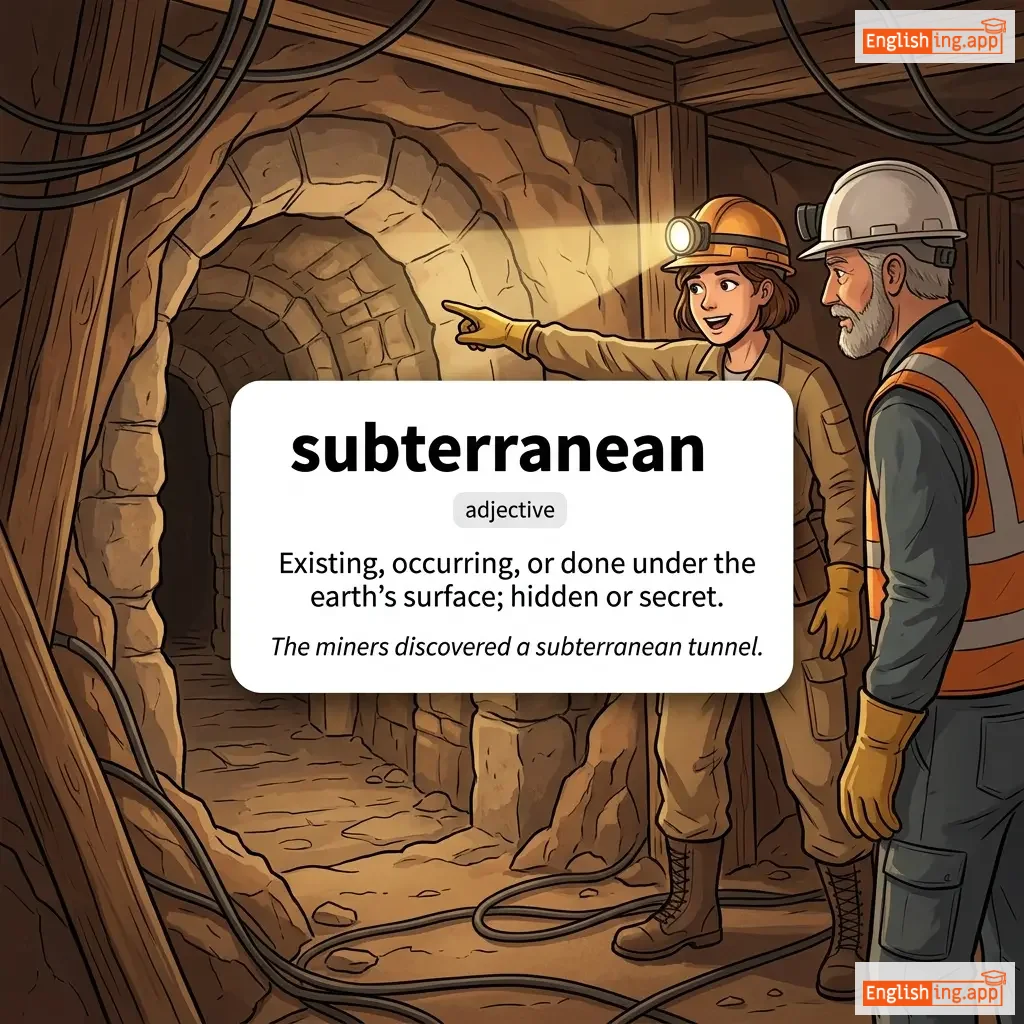
subterranean definition card — visual illustration of the meaning
adjective
/ˌsʌbtəˈreɪniən/
地下的 (dixiade)

Existing, occurring, or done under the earth’s surface; hidden or secret.

"The miners discovered a subterranean tunnel."

"矿工们发现了一个地下隧道。" (Kuànggōng men fāxiànle yīgè dìxià suìdào.)
subtext definition card — visual illustration of the meaning
noun
ˈsʌb.tɛkst
潜台词 (qián tái cí)

Hidden meaning or message behind spoken or written words

"The subtext of his speech suggested disagreement."

"他的演讲的潜台词暗示着不同意见。" (Tā de yǎnjiǎng de qiántáicí ànshì zhe bùtóng yìjiàn.)
subtitles definition card — visual illustration of the meaning
noun
ˈsʌbˌaɪtəlz
字幕 (zìmù)

Captions displayed at the bottom of a movie or television screen that translate or transcribe the dialogue or narrative.

"Use subtitles for better understanding."

"使用字幕以更好地理解。" (Shiyong zimu yi genghao de liajie.)
subtle definition card — visual illustration of the meaning
adjective
/ˈsʌtl/
微妙 (weimiao)

so delicate or precise as to be difficult to analyze or describe; not obvious

"She gave him a subtle smile that hinted at her approval."
"她给了他一个微妙的微笑,暗示着她的批准。" (Ta geile ta yi ge weimiao de weixiao, anshi zhe ta de pizhun.)
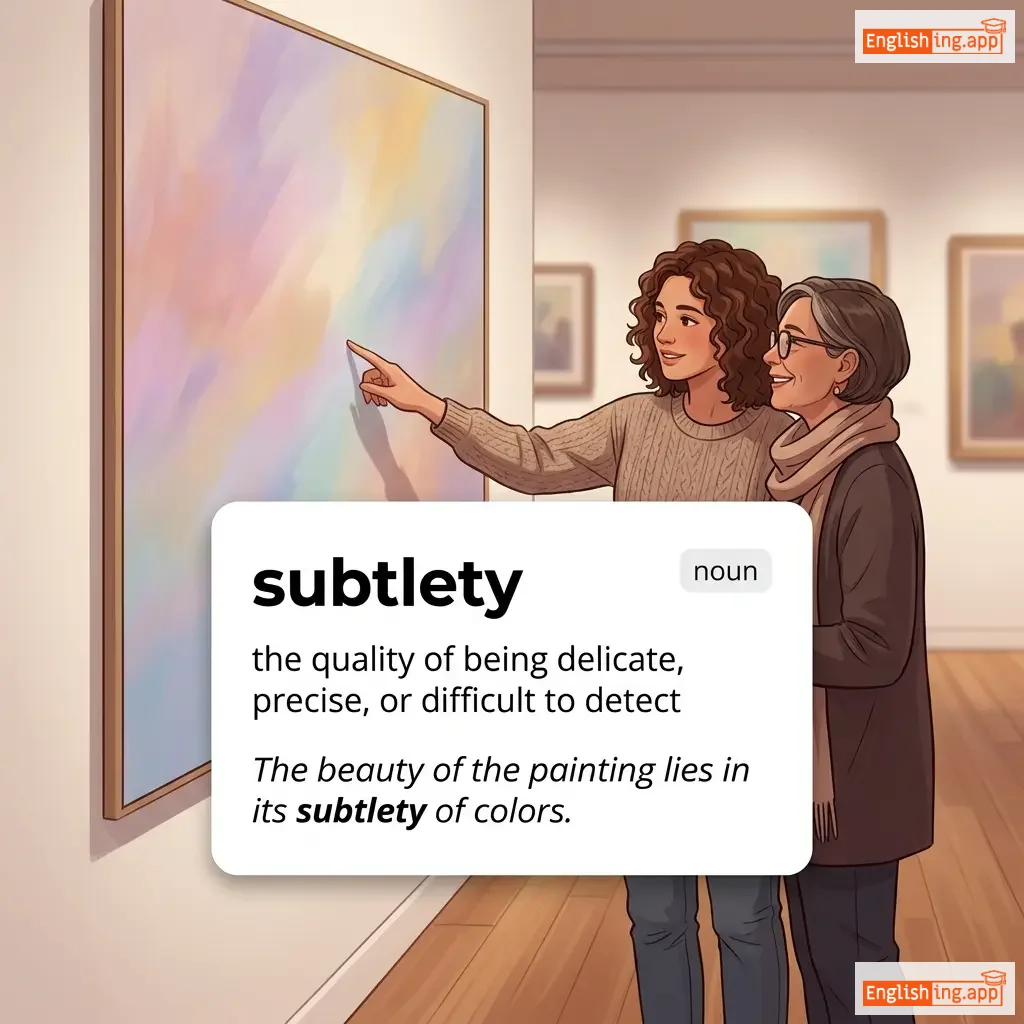
subtlety definition card — visual illustration of the meaning
noun
/ˈsʌtlti/
细微 (xìwēi)

the quality of being delicate, precise, or difficult to detect

"The beauty of the painting lies in its subtlety of colors."
"这幅画的美丽在于其颜色的细微之处。" (Zhè fú huà de měilì zàiyú qí yánsè de xìwēi zhī chù.)
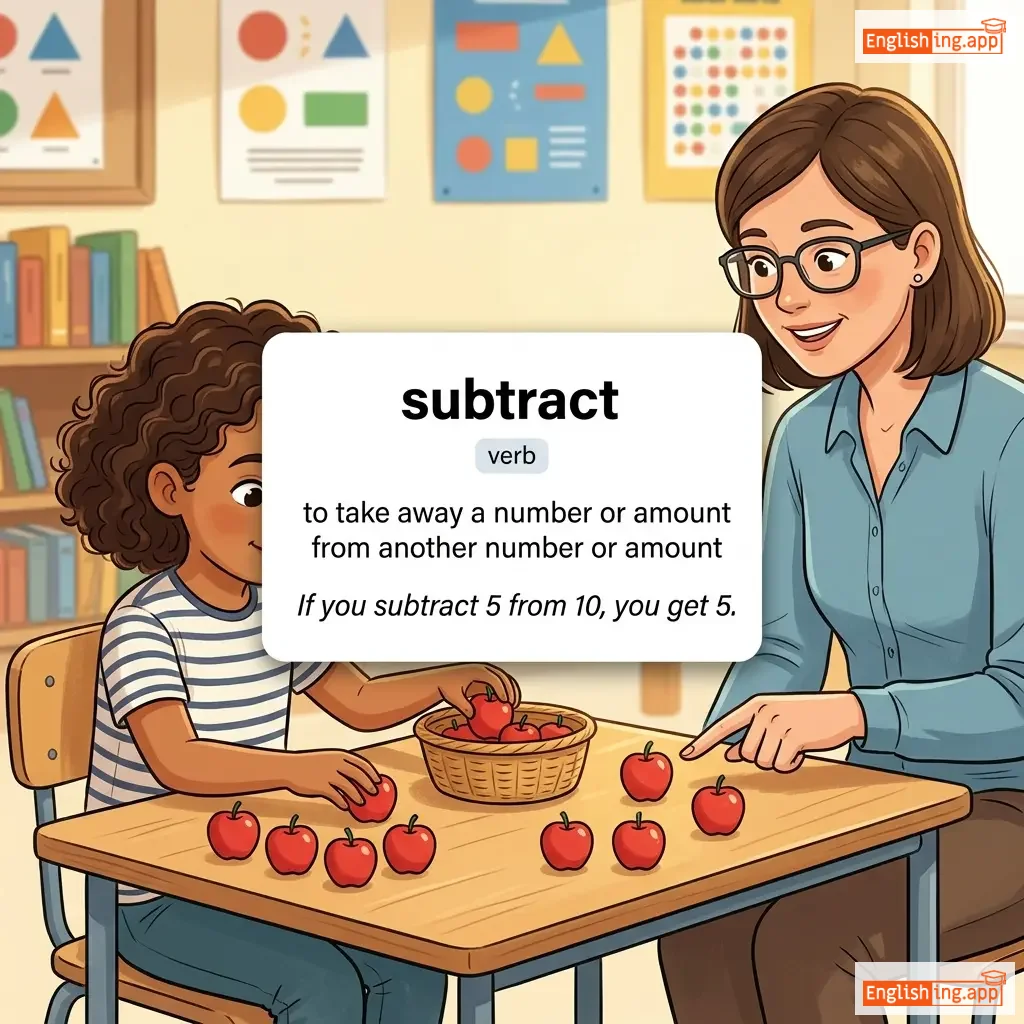
subtract definition card — visual illustration of the meaning
verb
/səbˈtrækt/
减去 (jian qu)

to take away a number or amount from another number or amount

"If you subtract 5 from 10, you get 5."

"如果你从10中减去5,你得到5。" (Ru guo ni cong 10 zhong jian qu 5, ni dedao 5.)
noun
/ˈsʌbtrəˌhɛnd/
被减数 (bèi jiǎn shù)

a number that is to be subtracted from another number

"In the equation 10 - 4, the number 4 is the subtrahend."

"在等式 10 - 4 中,数字 4 是被减数。" (Zài děngshì 10 - 4 zhōng, shùzì 4 shì bèi jiǎn shù.)
noun
/ˈsʌbɜːb/
郊区 (jiaoqū)

an area outside the center of a city, often residential

"They bought a new house in a quiet suburb."

"他们在一个安静的郊区买了新房子。" (Tāmen zài yīgè ānjìng de jiāoqū mǎile xīn fángzi.)
adjective
/səˈbɜːrbən/
郊区的 (jiaoqū de)

relating to or characteristic of a suburb or the people living there

"They bought a house in a quiet suburban area."

"他们在一个安静的郊区买了一栋房子。" (Tāmen zài yīgè ānjìng de jiāoqū mǎile yī dòng fángzi.)
noun
/səbˈvɜːrʒən/
颠覆 (diānfù)

the act of trying to destroy or undermine an established system or authority

"The government accused the rebels of planning subversion."
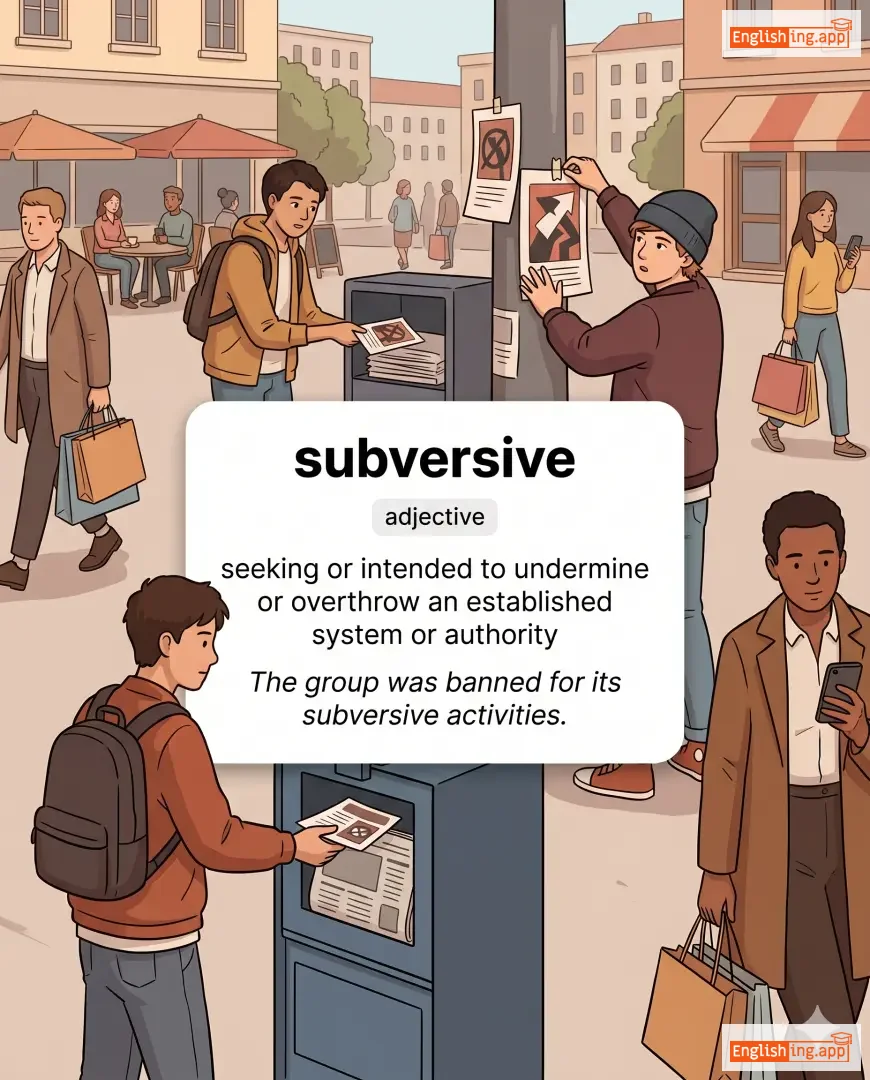
"政府指控叛军策划颠覆行为。" (Zhèngfǔ zhǐkòng pànjūn cèhuà diānfù xíngwéi.)
subversive definition card — visual illustration of the meaning
adjective
/səbˈvɜːrsɪv/
颠覆性的 (diānfùxìng de)

seeking or intended to undermine or overthrow an established system or authority

"The group was banned for its subversive activities."

"该团体因其颠覆性活动而被禁止。" (Gāi tuántǐ yīn qí diānfùxìng huódòng ér bèi jìnzhǐ.)
⚔️

subvert

verb
/səbˈvɜːrt/

to undermine or overthrow an established system, authority, or institution

"The rebels tried to subvert the government."

noun
/ˈsʌb.weɪ/
地铁 (ditie)

an underground railway system; an underground passage for pedestrians

"I take the subway to work every morning because it's faster than driving."

"我每天早上乘地铁上班,因为它比开车更快。" (Wo mei tian zao shang cheng ditie shangban, yinwei ta bi kaiche geng kuai.)
verb
/səkˈsiːd/
成功 (chenggong)

to achieve the desired aim or result; to do well

"She worked hard to succeed in her career."

"她努力工作,力图在事业中取得成功。" (Tā nǔlì gōngzuò, lìtú zài shìyè zhōng qǔdé chénggōng.)
verb
/səkˈsiːdɪŋ/
随后的 / 后续的 (suíhòu de / hòuxù de)

coming after or following in order; continuing to succeed

"In the succeeding years, the company expanded rapidly."

"在随后的几年里,公司迅速扩展。" (Zài suíhòu de jǐ nián lǐ, gōngsī xùnsù kuòzhǎn.)
success definition card — visual illustration of the meaning
noun
/səkˈsɛs/
成功 (chenggong)

the achievement of an aim, purpose, or result

"His hard work led to great success."

"他的努力工作取得了巨大的成功。" (Tā de nǔlì gōngzuò qǔdéle jùdà de chénggōng.)
adjective
/səkˈsɛsfəl/
成功的 (chenggong de)

having achieved success; having attained wealth, position, or honor

"He is a successful businessman."

"他是一个成功的商人。" (Ta shi yi ge chenggong de shangren.)
adverb
/səkˈsɛsfəli/
成功地 (chenggong de)

in a way that achieves a desired result

"She passed the exam successfully after weeks of studying."
"她经过数周的学习后成功通过了考试。" (Ta jingguo shuzhou de xuexi hou chenggong tongguo le kaoshi.)
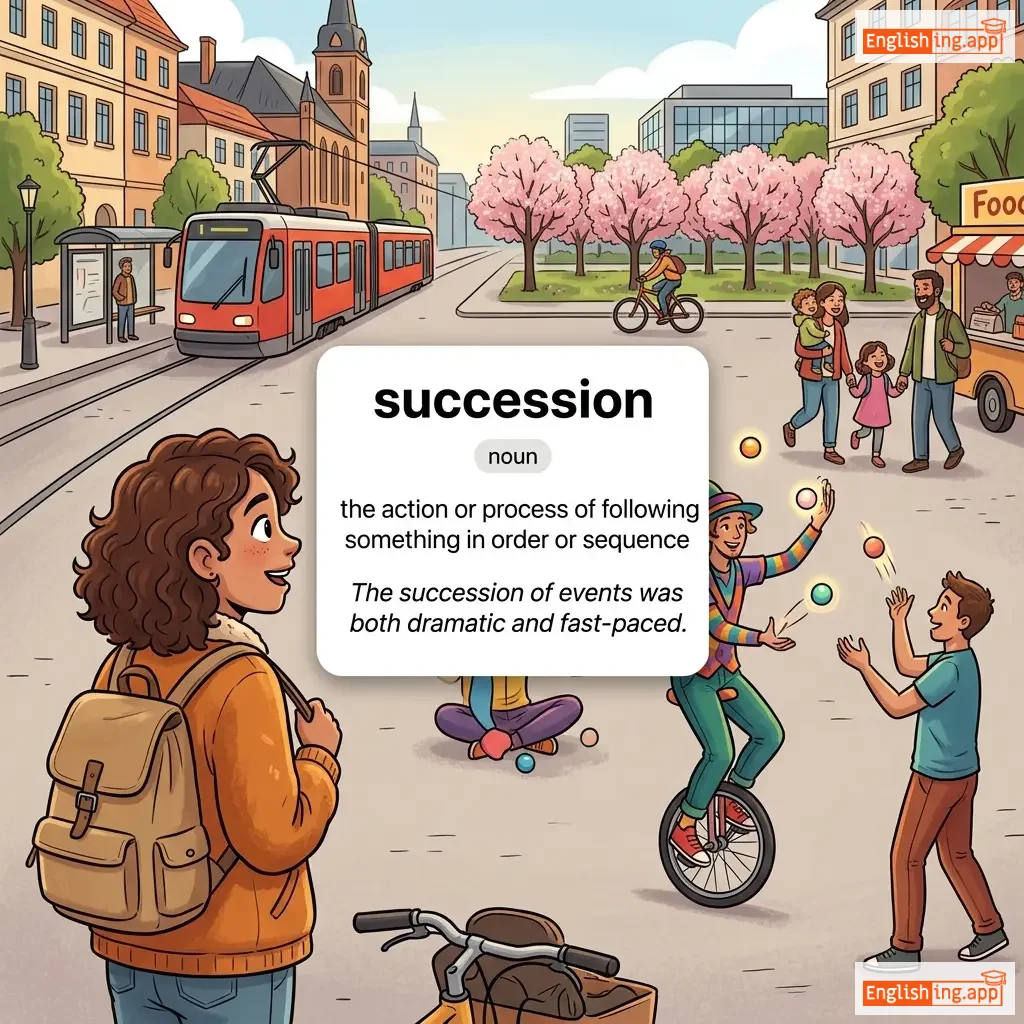
succession definition card — visual illustration of the meaning
noun
/səkˈsɛʃən/
继承 (jìchéng)

the action or process of following something in order or sequence

"The succession of events was both dramatic and fast-paced."

"事件的继发性既戏剧性又快节奏。" (Shìjiàn de jìfāxìng jì xìjùxìng yòu kuàijiézòu.)
adjective
/səkˈsɛsɪv/
连续的 (liánxù de)

following one after the other in an uninterrupted sequence

"There were several successive failures before the project succeeded."

"在项目成功之前,有多个连续的失败。" (Zài xiàngmù chénggōng zhīqián, yǒu duō gè liánxù de shībài.)
noun
/səkˈsɛsər/
继任者 (jìrènzhě)

A person or thing that follows another in a position, office, or role.

"The company appointed a successor after the CEO retired."

"公司在CEO退休后任命了继任者。" (Gōngsī zài CEO tuìxiū hòu rènmìngle jìrènzhě.)
adjective
/səkˈsɪŋkt/
简洁的 (jianjie de)

Expressed in a clear and brief manner.

"Her presentation was succinct and easy to follow."

"她的演讲简洁易懂。" (Ta de yanjiang jianjie yidong.)
succor definition card — visual illustration of the meaning
noun/verb
/ˈsʌkər/
帮助 (bāngzhù)

Assistance and support in times of hardship or distress.

"The charity provided succor to the flood victims."

"慈善机构为洪水受害者提供了帮助。" (Císhàn jīgòu wèi hóngshuǐ shòuhàizhě tígōngle bāngzhù.)