词汇表

英语词汇词典 | 单词含义、定义和示例

adjective
/ˈspaɪn.ləs/
缺乏勇气; 意志薄弱; 胆小 (spinles)

lacking courage or determination; weak-willed

"He was too spineless to stand up for his beliefs."

"他太软弱,无法为自己的信仰站出来。" (Ta tai ruanruo, wufaa wei ziji de xinyang zhan chulai.)
adjective
/ˈspaɪnəs/
多刺的 (duō cì de)

Having spines or thorn-like projections

"The spinous cactus was difficult to handle without gloves."

"这个有刺的仙人掌没有手套很难拿。" (Zhège yǒu cì de xiānrénzhǎng méiyǒu shǒutào hěn nán ná.)
noun
/ˈspɪnstər/
未婚女性 (wei hun nv xing)

An unmarried woman, often one who is older and considered unlikely to marry

"The novel featured a kind-hearted spinster who cared for the village children."

"小说中有一位心地善良的未婚女性,她照顾着村里的孩子们。" (Xiaoshuo zhong you yi wei xindi shanliang de wei hun nv xing, ta zhaogu zhe cun li de haizimen.)
adjective
/ˈspaɪni/
多刺的 (duō cì de)

covered with or full of spines; having sharp points

"The spiny cactus stood tall in the desert."

"多刺的仙人掌在沙漠中挺立。" (Duō cì de xiānrénzhǎng zài shāmò zhōng tǐnglì.)
adjective
/ˈspaɪ.rəl/
螺旋 (luoxuan)

winding in a continuous curve; helical

"The spiral staircase led to the top floor."

"螺旋楼梯通向了最上面的一层。" (Luóxuán lóutī tōngxiàngle zuì shàngmiàn de yī céng.)
noun
/ˈspaɪər/
尖顶 (jiāndǐng)

a tall, pointed structure on top of a building, especially a church

"The church spire could be seen from miles away."

"教堂的尖顶从远处可见。" (Jiàotáng de jiāndǐng cóng yuǎnchù kě jiàn.)
noun
/ˈspɪrɪt/
精神 (jingshen)

the non-physical part of a person, regarded as their true self

"Her spirit remained unbroken despite the hardships."

"她的精神在困难面前始终没有被击垮。" (Ta de jingshen zai kunnan mianqian shizhong meiyou bei ji kua.)
adjective
/ˈspɪrɪtʃuəl/
精神的 (jingshen de)

relating to or affecting the human spirit or soul

"She practices spiritual meditation every morning."

"她每天早上练习精神冥想。" (Ta mei tian zaoshang lianxi jingshen mingxiang.)
verb
/spɪt/
吐口水 (tǔ kǒushuǐ)

to force liquid, especially saliva, out of the mouth

"He spat on the ground in anger."

"他因愤怒在地上吐口水。" (Tā yīn fènnù zài dìshàng tǔ kǒushuǐ.)
noun
/spaɪt/
恶意 (èyì)

a desire to hurt, annoy, or offend someone

"She refused the gift out of spite."

"她因为恶意拒绝了礼物。" (Tā yīnwèi èyì jùjué le lǐwù.)
noun
/spliːn/
脾脏; 愤怒 (pízàng; fènnù)

an organ in the body that produces lymphocytes and filters blood; also refers to bad temper or spite

"He vented his spleen on his coworkers after the meeting."

"会议后,他把愤怒发泄在同事身上。" (Huìyì hòu, tā bǎ fènnù fāxiè zài tóngshì shēnshàng.)
adjective
/ˈsplendɪd/
壮丽的; 极好的; 印象深刻的 (zhuangli de; jihao de; yinxiang shenkede)

magnificent; excellent; very impressive

"The castle looked splendid in the sunset."

"城堡在日落时看起来很壮丽。" (Chengbao zai riluo shi kan qilai hen zhuangli.)
adjective
/splɪˈnɛtɪk/
脾气暴躁的,易怒的 (píqì bàozào de, yì nù de)

bad-tempered, irritable, spiteful

"His splenetic remarks offended everyone in the room."

"他的脾气暴躁的评论冒犯了房间里的每个人。" (Tā de píqì bàozào de pínglùn màofànle fángjiān lǐ de měi gè rén.)
verb
/splaɪs/
拼接 (pīnjiē)

to join two pieces of rope, film, or other material by weaving or attaching them together

"The technician spliced the two wires to restore the connection."

"技术员将两根电线拼接起来以恢复连接。" (Jìshùyuán jiāng liǎng gēn diànxiàn pīnjiē qǐlái yǐ huīfù liánjiē.)
/splɪnt/
夹板 (jiaban)

A rigid device used to support and immobilize a broken or injured body part.

"The doctor applied a splint to stabilize the patient's broken arm."

"医生为病人的断臂稳定应用了夹板。" (Yisheng wei bingren de duanbi wending yingyong le jiaban.)
verb
/splɪt/
分割 (fēngē)

to divide or separate into parts or groups

"He split the log in two with an axe."

"他用斧子把木头劈成两半。" (Tā yòng fǔzi bǎ mùtou pī chéng liǎng bàn.)
verb
/spɔɪl/
破坏 (pòhuài)

to damage or ruin something

"The rain spoiled the outdoor event."

"雨水破坏了户外活动。" (Yǔshuǐ pòhuài le hùwài huódòng.)
noun
/ˈspɔɪlˌspɔːrt/
扫兴的人 (sǎo xìng de rén)

A person who ruins other people's enjoyment or fun.

"Don't be a spoilsport and let us enjoy the party."

"不要做扫兴的人,放我们享受派对吧。" (Bù yào zuò sǎo xìng de rén, fàng wǒmen xiǎngshòu pàiduì ba.)
noun, verb
/spoʊk/
辐条 / 说 (fútiáo / shuō)

As a noun, a bar connecting the center of a wheel to its rim; as the past tense of 'speak'.

"The bicycle's spoke was bent after the accident."

"自行车的辐条在事故后弯曲了。" (Zìxíngchē de fútiáo zài shìgù hòu wānqūle.)
noun
/ˈspəʊksmən/
发言人 (fā yán rén)

a person who speaks on behalf of others, especially for a group or organization

"The spokesman addressed the crowd during the rally."

"发言人在集会中向人群讲话。" (Fā yán rén zài jíhuì zhōng xiàng rénqún jiǎnghuà.)
noun
/ˈspəʊkspɜːrsən/
发言人 (fāyánrén)

a person who speaks on behalf of others or an organization

"The spokesperson addressed the press conference on behalf of the company."

"发言人代表公司在新闻发布会上发言。" (Fāyánrén dàibiǎo gōngsī zài xīnwén fābù huì shàng fāyán.)
noun
/ˈspəʊkswɪmən/
发言人女性 (fāyánrén nǚxìng)

a woman who speaks on behalf of a group or organization

"The spokeswoman for the company announced the new product."

"公司的发言人宣布了新产品。" (Gōngsī de fāyánrén xuānbùle xīn chǎnpǐn.)
noun
/ˌspoʊliˈeɪʃən/
破坏 (pohuai)

The act of destroying or ruining something, often evidence or property.

"The court punished the company for the spoliation of evidence."

"法院因公司破坏证据而惩罚了该公司。" (Fǎyuàn yīn gōngsī pòhuài zhèngjù ér chéngfále gāi gōngsī.)
adjective
/ˈspʌndʒi/
海绵状 (hǎimián zhuàng)

soft and full of holes like a sponge; porous

"The cake had a light and spongy texture."

"蛋糕有轻盈而海绵状的质地。" (Dàn gāo yǒu qīng yíng ér hǎimián zhuàng de zhìdì.)
noun
/spʌndʒ ɡɔːrd/
海绵瓜 (hǎimián guā)

a fibrous gourd that becomes sponge-like when dried, used for cleaning and in cooking when young

"The sponge gourd can be eaten when young or dried to make natural scrubbers."

"海绵瓜可以在年轻时食用,或者干燥后制成天然海绵。" (Hǎimián guā kěyǐ zài niánqīng shí shíyòng, huòzhě gānzào hòu zhìchéng tiānrán hǎimián.)
noun
/ˈspɒnsər/
赞助商 (zànzhù shāng)

a person or organization that provides funds for a project or activity in exchange for publicity or support

"The company became the main sponsor of the event."

"公司成为了活动的主要赞助商。" (Gōngsī chéngwéi le huódòng de zhǔyào zànzhù shāng.)
noun
/ˈspɒnsəʃɪp/
赞助 (zanzhu)

the act of supporting an event, activity, person, or organization financially or through other resources

"The event was made possible due to the sponsorship of several big companies."

"由于几家大公司的赞助,活动得以举行。" (Yóuyú jǐ jiā dà gōngsī de zànzhù, huódòng dé yǐ jǔxíng.)
spontaneity definition card — visual illustration of the meaning
noun
/ˌspɑːntəˈneɪəti/
自发性 (zifaxing)

The quality of being natural, impulsive, and unplanned.

"Her spontaneity made the trip more exciting."

"她的自发性让旅行变得更加刺激。" (ta de zifaxing rang lvxing biande gengjia ciji.)
adjective
/spɒnˈteɪniəs/
自发的 (zifa de)

Happening naturally without planning or external cause; impulsive or unplanned.

"Their spontaneous trip to the mountains turned out to be the highlight of the summer."

"他们自发的山地旅行成了夏天的亮点。" (Tamen zifa de shandi lüxing chengle xiatian de liangdian.)
spontaneously definition card — visual illustration of the meaning
adverb
/spɒnˈteɪ.ni.əs.li/
自发地 (zì fā de)

happening naturally without being planned or forced

"She spontaneously started singing when she heard the music."

"当她听到音乐时,她自发地开始唱歌。" (dāng tā tīngdào yīnyuè shí, tā zì fā de kāishǐ chàng gē.)
noun/verb
/spuːf/
幽默模仿 (yōu mò mó fǎng)

A humorous imitation of something, or to trick or parody someone or something.

"The comedian spoofed the politician’s speech to entertain the audience."

"喜剧演员模仿政治家的演讲来娱乐观众。" (xǐ jù yǎn yuán mó fǎng zhèng zhì jiā de yǎn jiǎng lái yú lè guān zhòng.)
noun
/spuːn/
勺子 (shaozi)

a utensil consisting of a small shallow bowl with a handle, used for eating, stirring, or serving food

"She stirred her coffee with a silver spoon."

"她用银勺子搅拌她的咖啡。" (Tā yòng yín sháozi jiǎobàn tā de kāfēi.)
noun
/ˈspuːnərɪzəm/
斯普内里兹姆 (sipunelizimu)

A verbal error in which the initial sounds of words are swapped to create a humorous effect.

"He made a spoonerism by saying 'queer old dean' instead of 'dear old queen'."
"他通过说'古怪的老院长'代替'亲爱的老皇后'来做了一个斯普内里兹姆。" (Ta tongguo shuo 'guai de lao yuanzhang' daiti 'qin'ai de lao huanghou' lai zuo le yi ge sipunelizimu.)
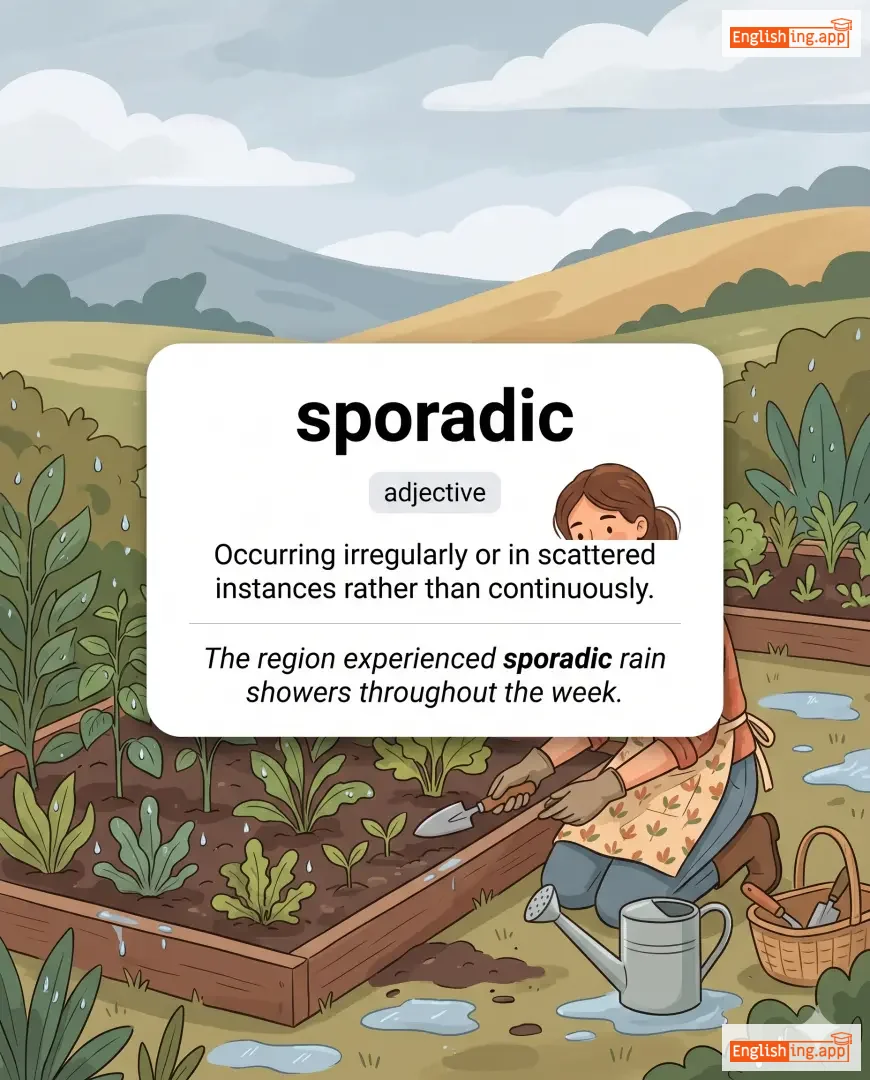
sporadic definition card — visual illustration of the meaning
adjective
/spəˈrædɪk/
零星 (língxīng)

Occurring irregularly or in scattered instances rather than continuously.

"The region experienced sporadic rain showers throughout the week."

"该地区经历了整整一周的零星降雨。" (Gāi dìqū jīnglìle zhěngzhěng yī zhōu de língxīng jiàngyǔ.)
noun
/spɔːt/
体育 (tiyu)

an activity involving physical exertion and skill in which an individual or team competes against another or others for entertainment

"Football is a popular sport around the world."

"足球是全球流行的体育运动。" (Zúqiú shì quánqiú liúxíng de tǐyù yùndòng.)
adjective
/ˈspɔːrtɪv/
运动的 (yùndòng de)

Playful, lively, or full of fun.

"The children were in a sportive mood during the picnic."

"孩子们在野餐时都很运动。" (Háizimen zài yěcān shí dōu hěn yùndòng.)
noun
/ˈspɔːrtsmən/
运动员 (yundongyuan)

A person who is skilled in sports or enjoys participating in athletic activities.

"He is a true sportsman, always fair and respectful to his opponents."

"他是一个真正的运动员,总是对对手公平和尊重。" (Ta shi yige zhenzheng de yundongyuan, zongshi dui duishou gongping he zunzhong.)
noun
/spɒt/
地点 (didian)

a particular place or position

"I found a great spot for a picnic in the park."

"我在公园里找到了一个很好的野餐地点。" (Wo zai gongyuan li zhaodao le yi ge hen hao de yecan didian.)
noun
/ˈspɒt.laɪt/

a strong beam of light directed onto a particular area; figuratively, public attention

"The singer stood proudly in the spotlight."

adjective
/ˈspɒtɪd/
斑点的; 有标记的; 被看到 (bāndiǎn de; yǒu biāojì de; bèi kàn dào)

having spots or marks; noticed or seen

"The spotted leopard moved silently through the jungle."

"斑点猎豹静静地穿过丛林。" (Bāndiǎn lièbào jìngjìng de chuānguò cónglín.)
noun
/ˈspɒt.ɪd sneɪk hed/
斑点蛇头鱼 (bandian shetou yu)

a type of freshwater fish with spotted markings and an elongated head resembling a snake

"The spotted snake head is a popular fish for aquaculture in South Asia."

"斑点蛇头鱼是南亚水产养殖中常见的鱼类。" (bandian shetou yu shi nanya shuichan yangzhi zhong changjian de yulei)
noun
/spaʊs/
配偶 (peikou)

a person's husband or wife

"Each employee may include their spouse in the health insurance plan."

"每个员工可以将配偶纳入健康保险计划。" (Mei ge yuangong keyi jiang peigou naru jiankang baoxian jihua.)
noun, verb
/spreɪn/
扭伤 (niǔ shāng)

an injury to a joint in which the ligaments are stretched or torn

"She sprained her ankle while running in the park."

"她在公园跑步时扭伤了脚踝。" (Tā zài gōngyuán pǎobù shí niǔ shāng le jiǎohuái.)
verb
/spreɪ/
喷洒 (pen sa)

to apply liquid to something in a fine mist

"She sprayed perfume on her wrist before leaving."

"她在离开前把香水喷在了手腕上。" (Ta zai likai qian ba xiangshui pen zai le shouwan shang.)
verb
/sprɛd/
展开 (zhǎn kāi)

to open or extend something over an area

"She spread the blanket on the grass for a picnic."

"她把毯子铺在草地上为野餐。" (Tā bǎ tǎnzi pū zài cǎodì shàng wèi yěcān.)
adjective
/ˈspraɪtli/
活泼 (huó pō)

full of energy and life; lively

"The sprightly old man danced with joy at the wedding."

"那位活泼的老人高兴地在婚礼上跳舞。" (Nà wèi huó pō de lǎo rén gāo xìng de zài hūn lǐ shàng tiào wǔ.)
noun
/sprɪŋ/
春天 (chuntian)

the season between winter and summer when plants begin to grow

"Flowers bloom in the spring."

"春天花开。" (Chuntian hua kai.)
verb
/ˈsprɪŋkəl/

to scatter small drops or particles of a substance over a surface

"She sprinkled sugar on top of the cake."

verb, noun
/spraʊt/
发芽 (fā yá)

to begin to grow; to produce new leaves or shoots

"The seeds began to sprout after a few days of rain."

"种子在几天的雨后开始发芽。" (Zhǒngzǐ zài jǐ tiān de yǔ hòu kāishǐ fā yá.)
verb, adjective, noun
/spruːs/
整理 / 一种树 (zhěnglǐ / yī zhǒng shù)

to make neat or tidy in appearance; also refers to an evergreen tree

"He spruced up his room before the guests arrived."

"他在客人到达之前整理了他的房间。" (Tā zài kèrén dào dá zhīqián zhěnglǐle tā de fángjiān.)