词汇表

英语词汇词典 | 单词含义、定义和示例

adjective
/ˈsɔːlti/
咸的 (xian de)

having the taste of salt; containing salt; tasting of seawater

"The salty ocean water made her thirsty."
"咸海水让她口渴。" (Xian hǎishuǐ ràng tā kǒu kě)
salubrious definition card — visual illustration of the meaning
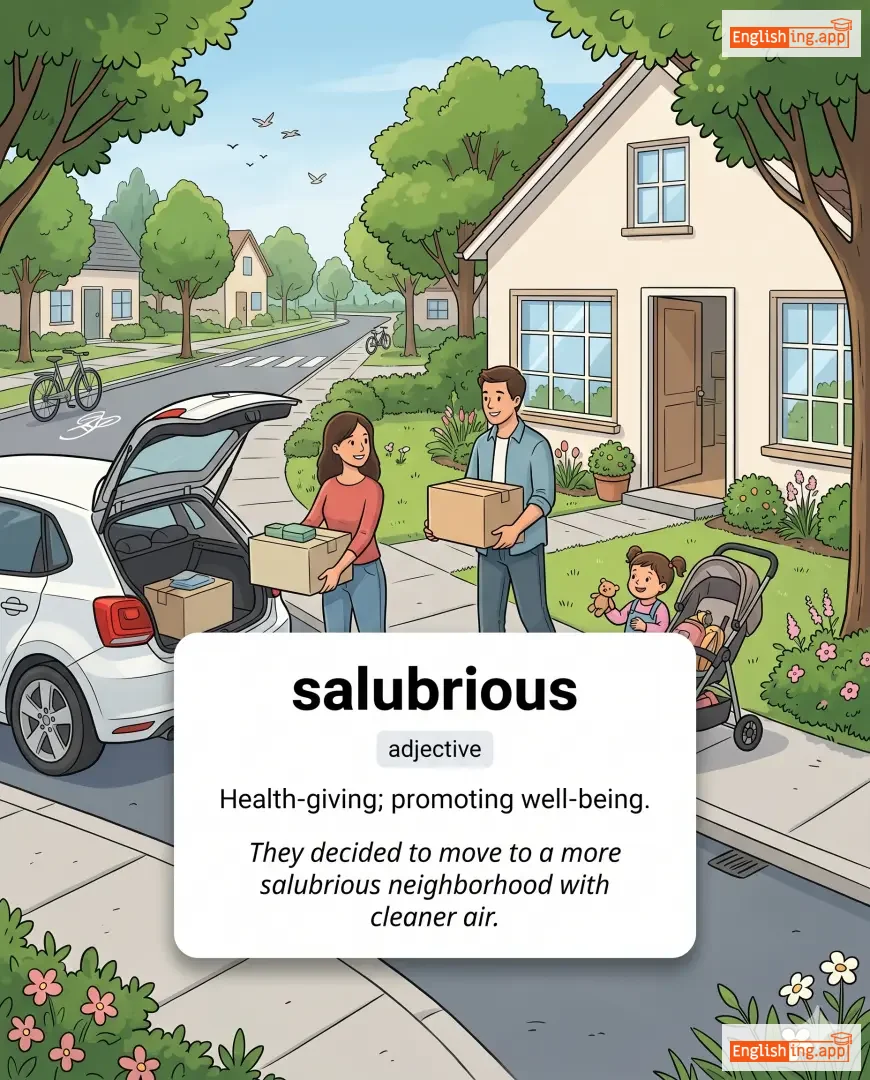
adjective
/səˈluː.bri.əs/
有益健康的 (you yi jian kang de)

Health-giving; promoting well-being.

"They decided to move to a more salubrious neighborhood with cleaner air."

"他们决定搬到一个更有益健康的社区,那里有更清新的空气。" (Tāmen juédìng bān dào yīgè gèng yǒuyì jiànkāng de shèqū, nàlǐ yǒu gèng qīngxīn de kōngqì.)
salutary definition card — visual illustration of the meaning
adjective
/ˈsæljʊˌtɛri/
有益的 (youyi de)

Producing good effects; beneficial, especially after something unpleasant.

"The accident was a salutary reminder to drive carefully."

"这场事故是一个有益的提醒,要小心驾驶。" (Zhe chang shigu shi yige youyi de tixing, yao xiaoxin jiashi.)
noun
/ˌsæljʊˈteɪʃən/
问候 (wènhòu)

A gesture or utterance of greeting, goodwill, or courtesy.

"He raised his hat as a polite salutation."

"他举起帽子作为礼貌的问候。" (Tā jǔ qǐ màozi zuòwéi lǐmào de wènhòu.)
adjective
/səˈluːtəˌtɔri/
欢迎辞 (huānyíngcí)

Relating to or expressing a greeting or an address, especially at the beginning of a speech.

"She delivered a salutatory address at the graduation ceremony."

"她在毕业典礼上发表了欢迎辞。" (Tā zài bì yè diǎn lǐ shàng fā biǎo le huānyíngcí.)
salute definition card — visual illustration of the meaning
verb
/səˈluːt/
敬礼 (jingli)

to greet with respect; to honor

"The soldiers saluted their commanding officer."

"士兵们向他们的指挥官敬礼。" (Shìbīng men xiàng tāmen de zhǐhuīguān jìnglǐ.)
verb
/ˈsælvɪdʒ/
挽救 (wǎn jiù)

To save something from loss, damage, or destruction.

"They managed to salvage some goods from the fire."
"他们成功地从火灾中挽救了一些货物。" (Tāmen chénggōng de cóng huǒzāi zhōng wǎn jiù le yīxiē huòwù.)
salvation definition card — visual illustration of the meaning
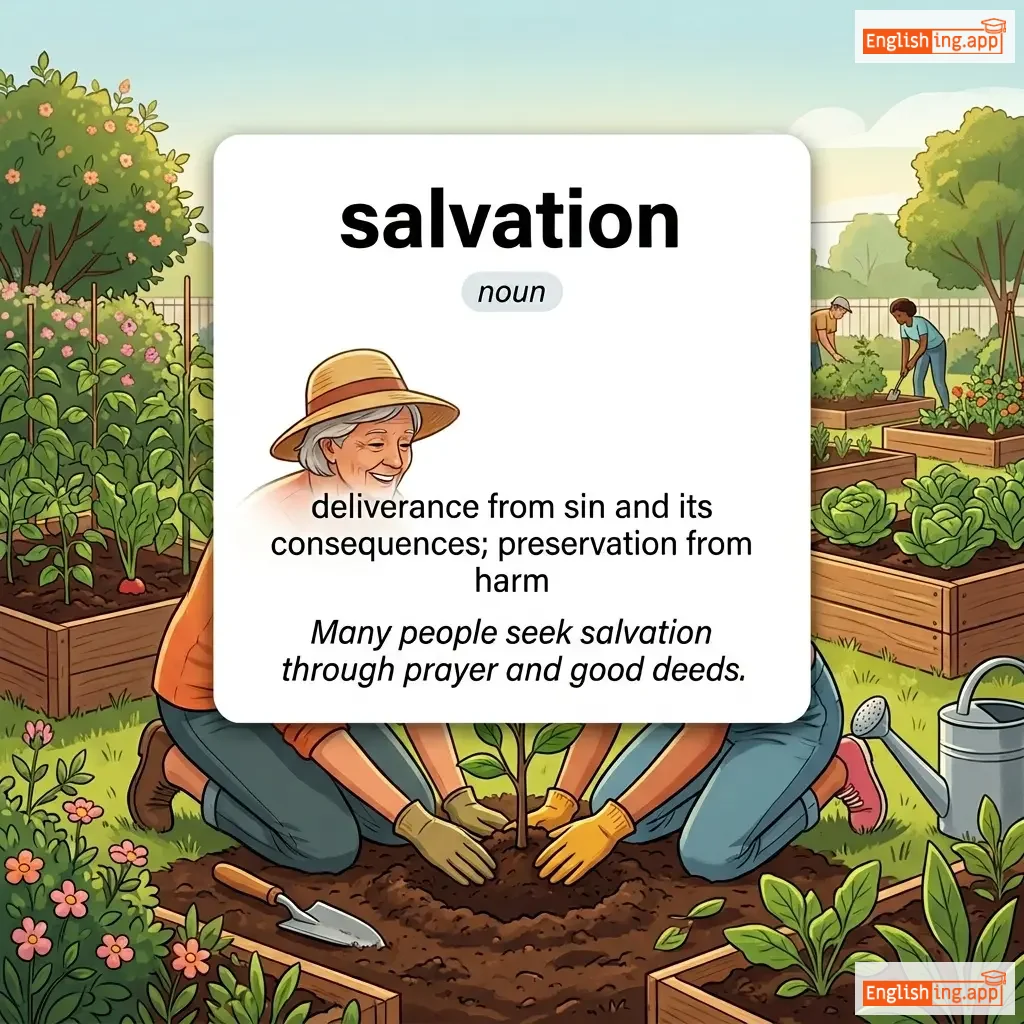
noun
/sælˈveɪ.ʃən/
拯救 (zhengjiu)

deliverance from sin and its consequences; preservation from harm

"Many people seek salvation through prayer and good deeds."

"许多人通过祷告和善行寻求拯救。" (xǔduō rén tōngguò dǎogào hé shànxíng xúnqiú zhěngjiù.)
noun
/sælv/
药膏 (yaogao)

An ointment used to promote healing of the skin or as protection.

"She applied a salve to the burn on her hand."

"她在手上的烧伤处涂抹了药膏。" (Tā zài shǒushàng de shāoshāng chù túmǒ le yàogāo.)
noun
/ˈsælvər/
银托盘 (yin tuopan)

A tray, typically made of silver, used for serving food or drinks.

"The butler brought in the tea on a silver salver."

"管家将茶水放在银托盘上端来。" (Guanjia jiang chashui fang zai yin tuopan shang duan lai.)
noun
/ˈsælvoʊ/
齐射 (qí shè)

A simultaneous discharge of guns or release of bombs; a sudden outburst of cheers or applause.

"The soldiers fired a salvo to honor the fallen general."

"士兵们开了一轮齐射,以向已故将军致敬。" (Shì bīng men kāi le yī lún qí shè, yǐ xiàng yǐ gù jiāng jūn zhì jìng.)
adjective
/seɪm/
相同 (xiangtong)

identical; not different or changed

"We wore the same dress at the party."

"我们在派对上穿了相同的衣服。" (Wǒmen zài pàiduì shàng chuānle xiāngtóng de yīfu.)
noun
/ˈsæm.pəl/
样品 (yangpin)

a small part or quantity intended to show what the whole is like

"She gave me a sample of the fabric to see if I liked it."

"她给了我一块布料样品,看我是否喜欢。" (Ta gei le wo yi kuai buliao yangpin, kan wo shi fou xihuan.)
verb
/ˈsæŋktɪfaɪ/

To make holy or sacred; to set apart as holy.

"The priest sanctified the new church building."

adjective
/ˌsæŋktɪˈmoʊniəs/
伪善的虔诚 (wěi shàn de qián chéng)

Making a show of being morally superior to others; hypocritically pious.

"He gave a sanctimonious speech about honesty while he himself was corrupt."
"他发表了一篇关于诚实的伪善演讲,而他自己却腐败了。" (Ta fabiao le yipian guanyu chengshi de weishan yanjiang, er ta ziji que fubai le.)
Sanction definition card — visual illustration of the meaning
⚖️

Sanction

noun/verb
/ˈsæŋkʃən/

An official permission or approval; also a penalty imposed to enforce rules.

"The government imposed sanctions on the company for violating trade laws."

sanctity definition card — visual illustration of the meaning
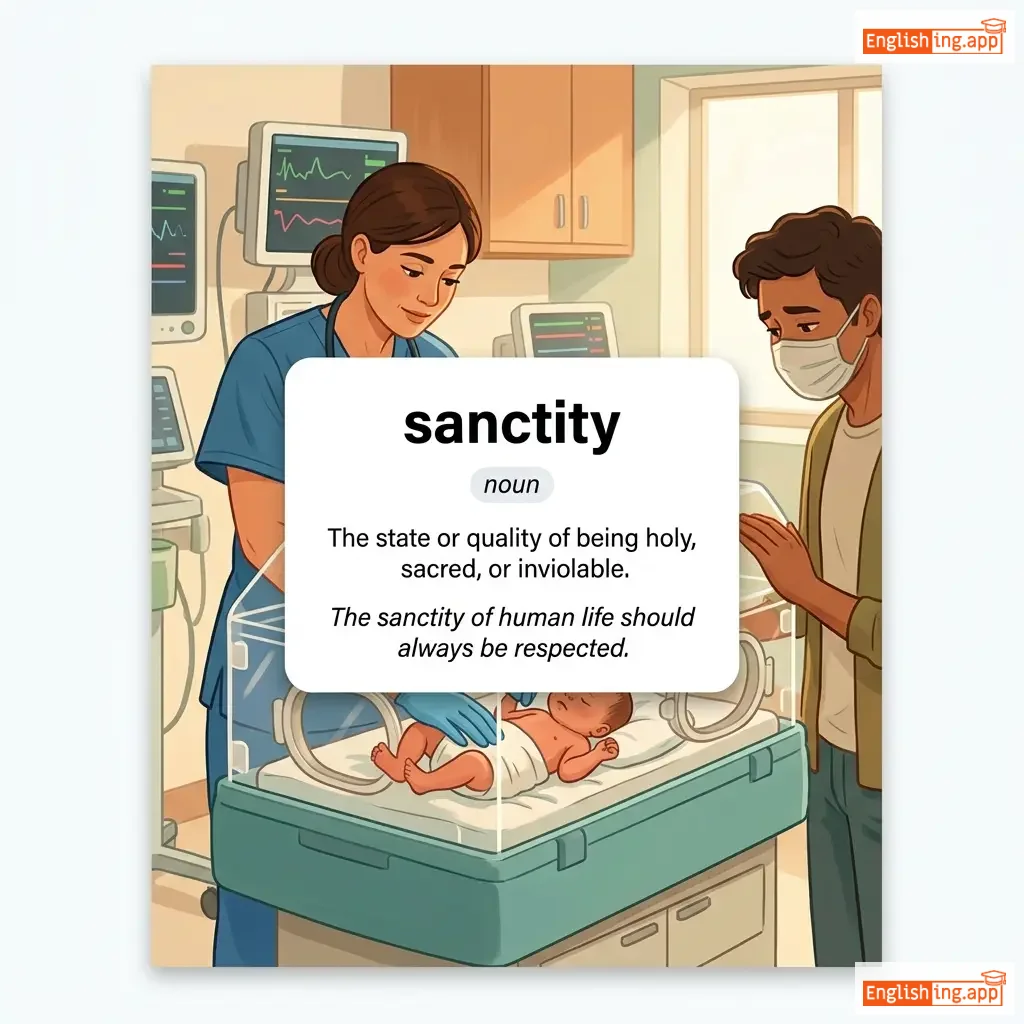
noun
/ˈsæŋk.tə.ti/
神圣性 (shenshengxing)

The state or quality of being holy, sacred, or inviolable.

"The sanctity of human life should always be respected."

"人类生命的神圣性应始终受到尊重。" (Renlei shengming de shenshengxing ying shizhong shoudao zunzhong.)
noun
/ˈsæŋk.tʃuˌɛr.i/
庇护所 (bìhùsuǒ)

A place of safety, refuge, or protection; a sacred place.

"The forest is a sanctuary for endangered animals."

"森林是濒危动物的庇护所。" (Sēnlín shì bīnwēi dòngwù de bìhùsuǒ.)
noun
/sænd/
幸福 (xìngfú)

Small loose grains of crushed rock, found on beaches and deserts.

"Children built castles out of sand on the beach."

"当她收到奖项时,她无法掩饰自己的幸福。" (Dāng tā shōu dào jiǎngxiàng shí, tā wúfǎ yǎnshì zìjǐ de xìngfú.)
noun
/ˈsændwɪtʃ/
三明治 (sanmingzhi)

two pieces of bread with food such as meat, cheese, or salad between them

"I made a chicken sandwich for lunch."

"我做了一个鸡肉三明治作为午餐。" (Wǒ zuòle yīgè jīròu sānmíngzhì zuòwéi wǔcān.)
adjective
/ˈsændi/
沙的; 沙质的 (sha de, sha zhi de)

covered with sand; containing sand; having the texture of sand

"The sandy beach stretched for miles along the coast."

"沙滩沿海岸延伸了几英里。" (Shā tān yán hǎi'àn yánshēnle jǐ yīnglǐ.)
noun
/ˌsɒ̃ˈfrwɑː/
冷静 (lěngjìng)

Composure or coolness, especially in difficult situations.

"The leader handled the crisis with remarkable sang-froid."

"领导以非凡的冷静处理了这次危机。" (Lǐngdǎo yǐ fēifán de lěngjìng chǔlǐle zhècì wéijī.)
noun
/ˌsɒ̃ˈfrwɑː/
冷静 (lěngjìng)

Composure or coolness under pressure.

"She impressed everyone with her sangfroid during the interview."

"她在面试中以冷静给大家留下了深刻印象。" (Tā zài miànshì zhōng yǐ lěngjìng gěi dàjiā liú xiàle shēnkè yìnxiàng.)
adjective
/ˈsæŋɡwɪˌnɛri/
血腥的 (xuèxīng de)

Involving or causing much bloodshed; bloodthirsty.

"The battle was one of the most sanguinary conflicts of the war."

"这场战斗是战争中最血腥的冲突之一。" (Zhè chǎng zhàndòu shì zhànzhēng zhōng zuì xuèxīng de chōngtú zhī yī.)
adjective
/ˈsæŋɡwɪn/
乐观的 (leguande)

Optimistic or positive, especially in a difficult situation.

"Despite the challenges, she remained sanguine about the future."

"尽管面临挑战,她依然对未来保持乐观。" (Jin guan mianlin tiaozhan, ta yiran dui weilai baochi leguan.)
adjective
/sæŋˈɡwɪniəs/
与血液相关的 (yu xueye xiangguan de)

Relating to blood; bloody.

"The surgeon examined the sanguineous discharge from the wound."
"外科医生检查了伤口的血腥分泌物。" (Waike yisheng jiancha le shankou de xuexing fenmiwu.)
sanitation definition card — visual illustration of the meaning
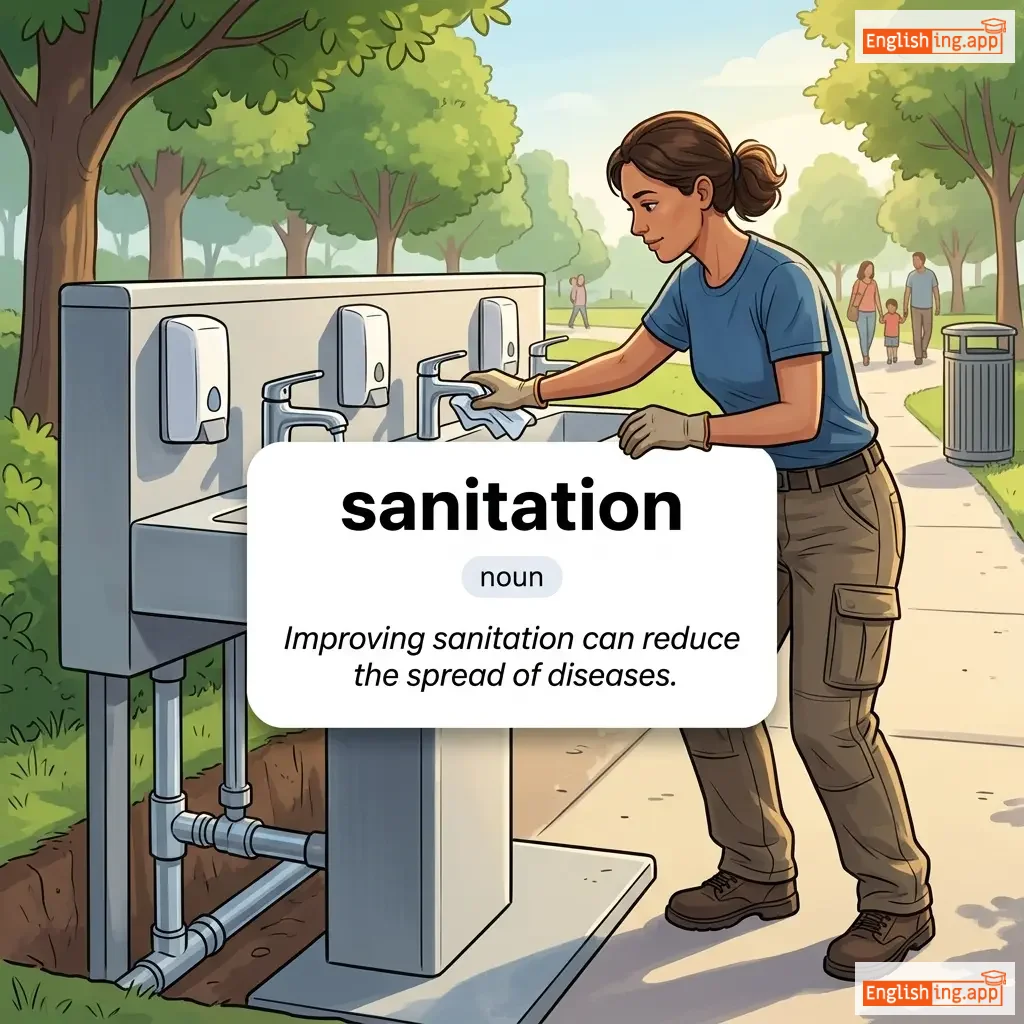
noun
/ˌsænɪˈteɪʃən/
卫生设施 (weisheng sheshi)

The systems and practices for maintaining hygiene and public health, especially through clean water and sewage disposal.

"Improving sanitation can reduce the spread of diseases."

"改善卫生设施可以减少疾病的传播。" (Gai shan weisheng sheshi keyi jian shao jibing de chuanbo.)
sanitization definition card — visual illustration of the meaning
noun
ˌsæn.ɪ.taɪˈzeɪ.ʃən
消毒 (xiaodu)

The process of cleaning and disinfecting to eliminate germs and bacteria.

"Regular sanitization keeps appliances germ-free."

"定期消毒保持设备无菌。" (Dingqi xiaodu baochi shebei wu jun.)
verb, noun
/sæp/
树液 / 削弱 (shuye / xueruo)

As a noun: the vital fluid in plants; As a verb: to gradually weaken or drain strength.

"The long journey began to sap his energy."

"长途旅行开始削弱他的能量。" (Changtu lüxing kaishi xueruo tade nengliang.)
noun
/ˈsæf.aɪər/
蓝宝石 (lan baoshi)

a precious stone that is typically blue in color

"The royal crown was adorned with a large sapphire."

"皇家王冠上镶嵌着一颗大蓝宝石。" (Huangjia wangguan shang xiangqian zhe yi ke da lanbaoshi.)
adjective
/ˈsæpɪd/
美味的 (měi wèi de)

Having a pleasant taste; flavorful.

"The chef prepared a sapid dish that delighted everyone at the table."

"厨师准备了一道美味的菜肴,令桌上的每个人都非常喜欢。" (Chúshī zhǔnbèile yī dào měiwèi de càiyáo, lìng zhuō shàng de měi gèrén dōu fēicháng xǐhuān.)
noun
/ˈseɪpiəns/
智慧 (zhìhuì)

Wisdom or intelligence.

"Her sapience in solving problems earned her the respect of her colleagues."

"她在解决问题上的智慧赢得了同事们的尊重。" (Tā zài jiějué wèntí shàng de zhìhuì yíngdéle tóngshìmen de zūnzhòng.)
adjective
/ˈseɪpiənt/
明智的 (míng zhì de)

Wise, or appearing to be wise.

"The professor gave a sapient response to the complex question."

"教授对复杂的问题做出了明智的回答。" (Jiàoshòu duì fùzá de wèntí zuòchūle míngzhì de huídá.)
adjective
/ˌseɪpiˈɛnʃəl/
智慧相关的 (zhìhuì xiāngguān de)

Relating to wisdom or knowledge, often in a religious or philosophical sense.

"The monk shared sapiential teachings with his students."

"和尚与学生们分享了与智慧相关的教义。" (Héshàng yǔ xuéshēngmen fēnxiǎngle yǔ zhìhuì xiāngguān de jiàoyì.)
adjective
/ˌsæpəˈneɪʃəs/
含肥皂性质的 (hán féizào xìngzhì de)

Soapy or having the qualities of soap.

"The plant has saponaceous leaves that produce foam when rubbed in water."

"这种植物有含肥皂性质的叶子,擦在水中时会产生泡沫。" (Zhè zhǒng zhíwù yǒu hán féizào xìngzhì de yèzi, cā zài shuǐ zhōng shí huì chǎnshēng pàomò.)
noun
/ˈsɑːrˌkæzəm/
讽刺 (fěngcì)

The use of irony to mock or convey contempt.

"His sarcasm often made people laugh but sometimes offended them."

"他的讽刺经常让人发笑,但有时也会冒犯他们。" (Tā de fěngcì jīngcháng ràng rén fāxiào, dàn yǒu shí yě huì màofàn tāmen.)
adjective
/sɑːrˈkæstɪk/
讽刺的 (fěngcì de)

Using irony or mockery to convey contempt or humor.

"She made a sarcastic remark about his cooking."

"她对他的烹饪做了一个讽刺的评论。" (Tā duì tā de pēngrèn zuòle yīgè fěngcì de pínglùn.)
noun
/sɑːrˈkɒfəɡəs/
石棺 (shíguān)

A stone coffin, often decorated, used in ancient times.

"The museum displayed a beautifully carved sarcophagus from ancient Egypt."

"博物馆展示了来自古埃及的美丽雕刻的石棺。" (Bówùguǎn zhǎnshì le láizì gǔ āijí de měilì diāokè de shíguān.)
sardonic definition card — visual illustration of the meaning
adjective
/sɑːrˈdɒnɪk/
幸福 (xingfu)

Grimly mocking or cynical.

"She gave him a sardonic smile after hearing his excuse."

"她在收到奖项时,无法隐藏自己的幸福。" (Tā zài shōudào jiǎngxiàng shí, wúfǎ yǐncáng zìjǐ de xìngfú.)
noun
/ˈsɑːri/
纱丽 (shali)

a garment consisting of a length of cotton or silk elaborately draped around the body, traditionally worn by women from South Asia

"She looked elegant in her red silk saree at the festival."

"她在节日上穿着红色丝绸纱丽看起来非常优雅。" (Ta zai jieri shang chuanzhuo hongse sichou shali kankilai feichang youya.)
sartorial definition card — visual illustration of the meaning
adjective
/sɑːrˈtɔːriəl/
与裁缝相关 (yu caifeng xiangguan)

Relating to tailoring, clothes, or style of dress.

"The actor is known for his sartorial elegance on the red carpet."

"这位演员因其在红毯上的裁缝优雅而闻名。" (Zhe wei yan yuan yin qi zai hongtan shang de caifeng youya er wenming.)
noun
/ˈseɪ.tən/
撒旦 (Sàdàn)

the chief evil spirit; the Devil in Christian and Islamic belief

"According to religious texts, Satan tempts people to sin."

"根据宗教经典,撒旦诱惑人们犯罪。" (Gēnjù zōngjiào jīngdiǎn, Sàdàn yòuhuò rénmen fànzuì.)
🍽️

sate (set)

verb
/seɪt/
满足 (manzu)

To satisfy fully or to excess.

"The huge meal sated their hunger after the long journey."

"长途旅行后,丰盛的餐点满足了他们的饥饿。" (Changtu lvxing hou, fengsheng de candi manzu le tamen de ji'e.)
satellite definition card — visual illustration of the meaning
noun
/ˈsætəlaɪt/
卫星 (weixing)

An artificial body placed in orbit around the earth or another planet to collect information or for communication.

"The weather satellite provided real-time images of the storm."
"气象卫星提供了风暴的实时图像。" (Qixiang weixing tigongle fengbao de shishi tupian.)
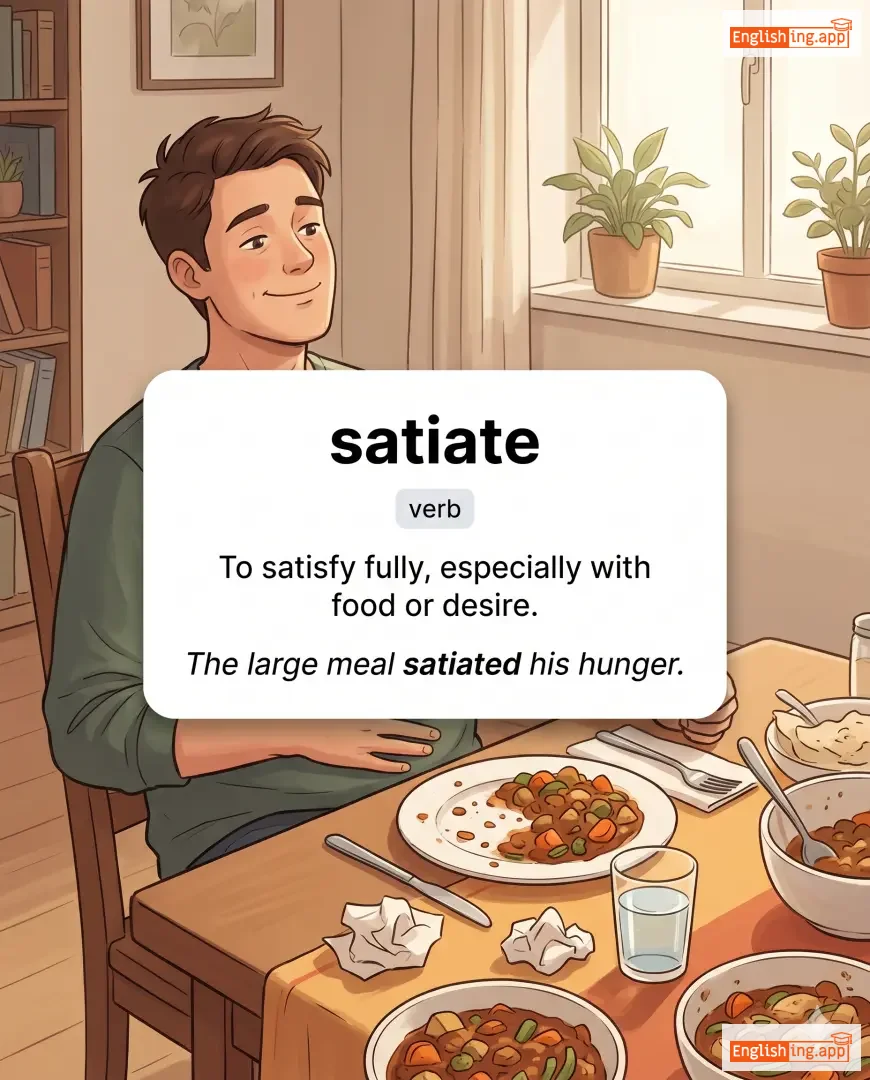
satiate definition card — visual illustration of the meaning
verb
/ˈseɪʃiˌeɪt/
满足 (manzu)

To satisfy fully, especially with food or desire.

"The large meal satiated his hunger."
"丰盛的餐食满足了他的饥饿。" (Fengsheng de canji manzu le tade jihu.)
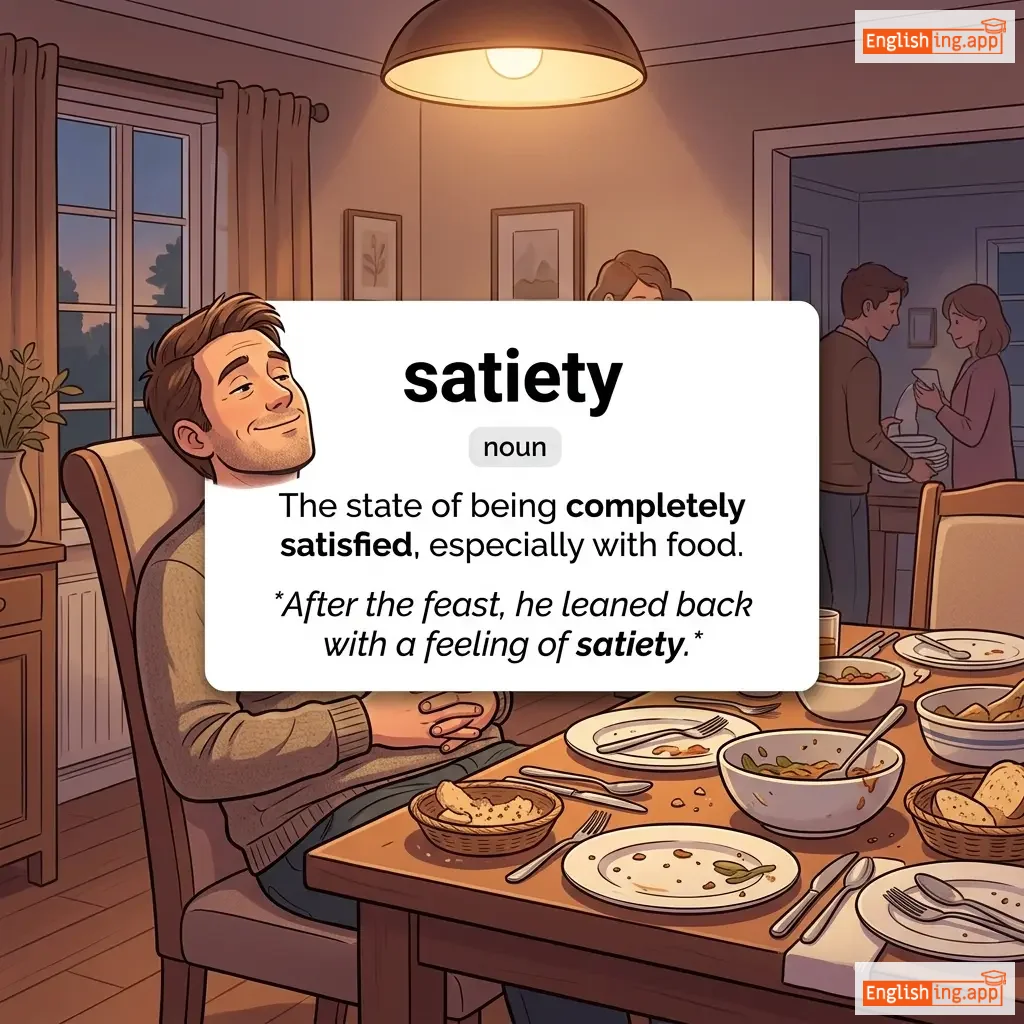
satiety definition card — visual illustration of the meaning
noun
/səˈtaɪ.ə.ti/
饱足感 (bǎozú gǎn)

The state of being completely satisfied, especially with food.

"After the feast, he leaned back with a feeling of satiety."

"宴会后,他带着饱足感靠了回来。" (Yànhuì hòu, tā dàizhe bǎozú gǎn kào le huílái.)
noun
/ˈsætaɪər/
讽刺 (fěngcì)

The use of humor, irony, or exaggeration to criticize people's stupidity or vices.

"The play was a brilliant satire on modern politics."

"这出戏是对现代政治的精彩讽刺。" (Zhè chū xì shì duì xiàndài zhèngzhì de jīngcǎi fěngcì.)
adjective
/səˈtɪrɪk/
讽刺的 (fèngcì de)

Relating to or using satire.

"The novel takes a satiric view of urban life."

"这部小说从讽刺的角度看待城市生活。" (Zhè bù xiǎoshuō cóng fèngcì de jiǎodù kàndài chéngshì shēnghuó.)
adjective
/səˈtɪrɪkəl/
讽刺的 (fèngcì de)

containing or using satire to criticize or mock

"The satirical cartoon mocked the government's new policy."

"讽刺漫画嘲笑了政府的新政策。" (Fèngcì mànhuà cháoxiàole zhèngfǔ de xīn zhèngcè.)
verb
/ˈsætəˌraɪz/
讽刺 (fèngcì)

to mock or criticize something using satire

"The play satirizes the greed of modern corporations."

"这部剧讽刺了现代公司的贪婪。" (Zhè bù jù fèngcì le xiàndài gōngsī de tān lán.)