词汇表

英语词汇词典 | 单词含义、定义和示例

noun
/səˈprɑːnoʊ/
女性或男孩的最高唱功 (nǚxìng huò nánhái de zuìgāo chànggōng)

the highest female or boy’s singing voice

"She sang beautifully in the soprano range during the concert."

"她在音乐会期间以女高音的音域唱得非常美。" (Tā zài yīnyuè huì qījiān yǐ nǚ gāoyīn de yīnyù chàng dé fēicháng měi.)
noun
/ˈsɔːrsəri/
巫术 (wūshù)

the use of magical powers, especially through spells and enchantments

"The villagers believed the illness was caused by sorcery."

"村民们相信疾病是由巫术引起的。" (Cūnmín men xiāngxìn jíbìng shì yóu wūshù yǐnqǐ de.)
sordid definition card — visual illustration of the meaning
adjective
/ˈsɔːrdɪd/
可耻的 (kechi de)

involving immoral or dishonorable actions; dirty or unpleasant

"The newspaper exposed the politician's sordid past."

"报纸曝光了那位政治家的可耻过去。" (Bàozhǐ bàoguāngle nà wèi zhèngzhì jiā de kěchǐ guòqù.)
adjective
/sɔːr/
酸痛 (suantong)

painful or aching, usually in a specific part of the body

"After the long run, my legs were sore."

"长跑后,我的腿很酸痛。" (changpao hou, wo de tui hen suantong)
noun
/ˈsɑːroʊ/
悲伤 (bēi shāng)

a feeling of deep sadness or grief

"She was filled with sorrow after the loss of her friend."

"在失去朋友后,她充满了悲伤。" (Zài shī qù péng yǒu hòu, tā chōng mǎn le bēi shāng.)
adjective
/ˈsɔːri/
对不起 (duìbuqǐ)

feeling regret or sympathy

"She felt sorry for what had happened."

"她为发生的事情感到抱歉。" (Tā wèi fāshēng de shìqíng gǎndào bàoqiàn.)
verb
/sɔːrt/
排序 (paixu)

to arrange or categorize something

"Please sort the files by date."

"请按日期排序文件。" (Qǐng àn rìqī páixù wénjiàn.)
noun
/soʊl/
灵魂 (linghun)

the spiritual or immaterial part of a person, often thought of as eternal

"She believed her soul would live on after death."

"她相信她的灵魂在死亡后会继续存在。" (Tā xiāngxìn tā de línghún zài sǐwáng hòu huì jìxù cúnzài.)
🔊

sound

noun, verb, adjective
/saʊnd/

a sensation perceived by the ear; to make or cause to make a noise; in good condition

"The bell sounded across the valley."

adjective
/ˈsaʊnd.pruːf/
隔音的; 防止声音进出 (géyīn de)

impervious to sound; preventing sound from entering or leaving

"The recording studio has sound-proof walls."

"录音室有隔音墙。" (lùyīn shì yǒu géyīn qiáng.)
noun
/suːp/
(tang)

a liquid dish, typically made with meat, vegetables, or legumes, and often served hot

"She made a delicious tomato soup for dinner."

"她做了一碗美味的番茄汤作为晚餐。" (Ta zuo le yi wan meiwei de fanqie tang zuo wei wancan.)
noun
/ˈsuːpsɒ̃/
少量 (shaoliang)

a very small quantity of something; a trace

"She added just a soupcon of spice to the dish."

"她在菜肴中只加了一点香料。" (Ta zai caiyao zhong zhi jia le yi dian xiangliao.)
adjective
/ˈsaʊər/
酸的 (suān de)

having an acidic taste; unpleasant or bad-tempered

"The milk has gone sour."

"牛奶变酸了。" (Niúnǎi biàn suān le.)
noun
/ˈsaʊər wʊd ˈæp.əl/
大象苹果 (daxiang pingguo)

a tropical fruit with hard shell and tangy flesh; elephant apple

"The sour wood apple has a unique taste that many people enjoy."

"大象苹果有一种独特的味道,许多人喜欢。" (Daxiang pingguo you yizhong dute de weidao, xueren xihuan)
noun
/sɔːrs/
来源 (laiyuan)

a place, person, or thing from which something originates or is obtained

"The internet is a vast source of information."

"互联网是一个巨大的信息来源。" (Hulianwang shi yige juda de xinxi laiyuan.)
noun/adjective
/saʊθ/
南方 (nanfang)

the direction towards the bottom of a map, opposite to north

"The sun rises in the east and sets in the south."

"太阳从东方升起,西方落下。" (Taiyang cong dongfang shengqi, xifang luoxia.)
proper noun
/ˌsaʊθ əˈmɛrɪkə/
南美洲 (nanmei zhou)

a continent located in the Western Hemisphere, mostly in the Southern Hemisphere

"Brazil is the largest country in South America."

"巴西是南美洲最大的国家。" (Baxi shi nanmeizhou zuida de guojia.)
noun
/ˌsaʊθˈiːst/
东南 (dongnan)

the direction that is between south and east; a region in that direction

"The city is located in the southeast of the country."

"这座城市位于该国的东南部。" (Zhe zuo chengshi weiyu gai guo de dongnanbu.)
adjective
/ˈsʌðərn/
南方的 (nánfāng de)

located in or facing the south; southern regions

"She moved to a southern city for work."

"她为了工作搬到了一个南方城市。" (Tā wèile gōngzuò bān dào le yīgè nánfāng chéngshì.)
noun
/ˌsaʊθˈwɛst/
西南 (xinan)

the direction that is between south and west; a region in that direction

"They traveled to the southwest of the country for their vacation."

"他们去国家的西南部度假。" (Tamen qu guojia de xinanbu dujia.)
noun
/ˌsuːvəˈnɪər/
纪念品 (jinianpin)

an object kept as a reminder of a place, person, or event

"She bought a small souvenir from Paris."

"她从巴黎买了一个小纪念品。" (Ta cong Bali mai le yi ge xiao jinianpin.)
sovereign definition card — visual illustration of the meaning
noun/adjective
/ˈsɒvərɪn/
主权 (zhǔquán)

a supreme ruler such as a king; possessing supreme or ultimate power

"The sovereign made a new decree."
"主权发布了新法令。" (Zhǔquán fābùle xīn fǎlìng.)
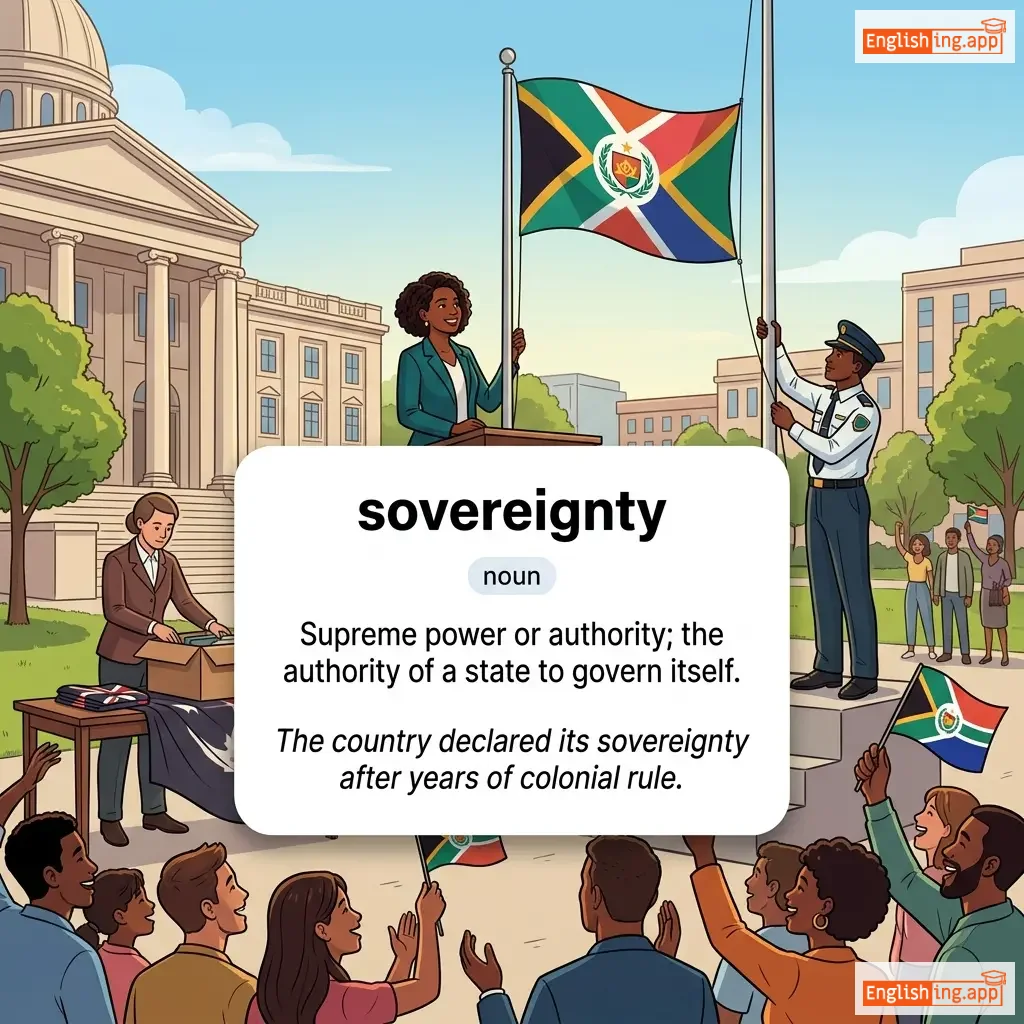
sovereignty definition card — visual illustration of the meaning
noun
/ˈsɒvrənti/
主权 (zhǔquán)

Supreme power or authority; the authority of a state to govern itself.

"The country declared its sovereignty after years of colonial rule."

"该国在经历多年殖民统治后宣布了其主权。" (Gāi guó zài jīnglì duōnián zhímín tǒngzhì hòu xuānbù le qí zhǔquán.)
adjective
/ˈsoʊ.vi.ət/
苏联的 (sulian de)

relating to the Soviet Union or its government

"The Soviet era saw significant changes in Eastern Europe."

"苏联时代见证了东欧的重大变化。" (Sulian shidai jianzheng le dong'ou de zhongda bianhua.)
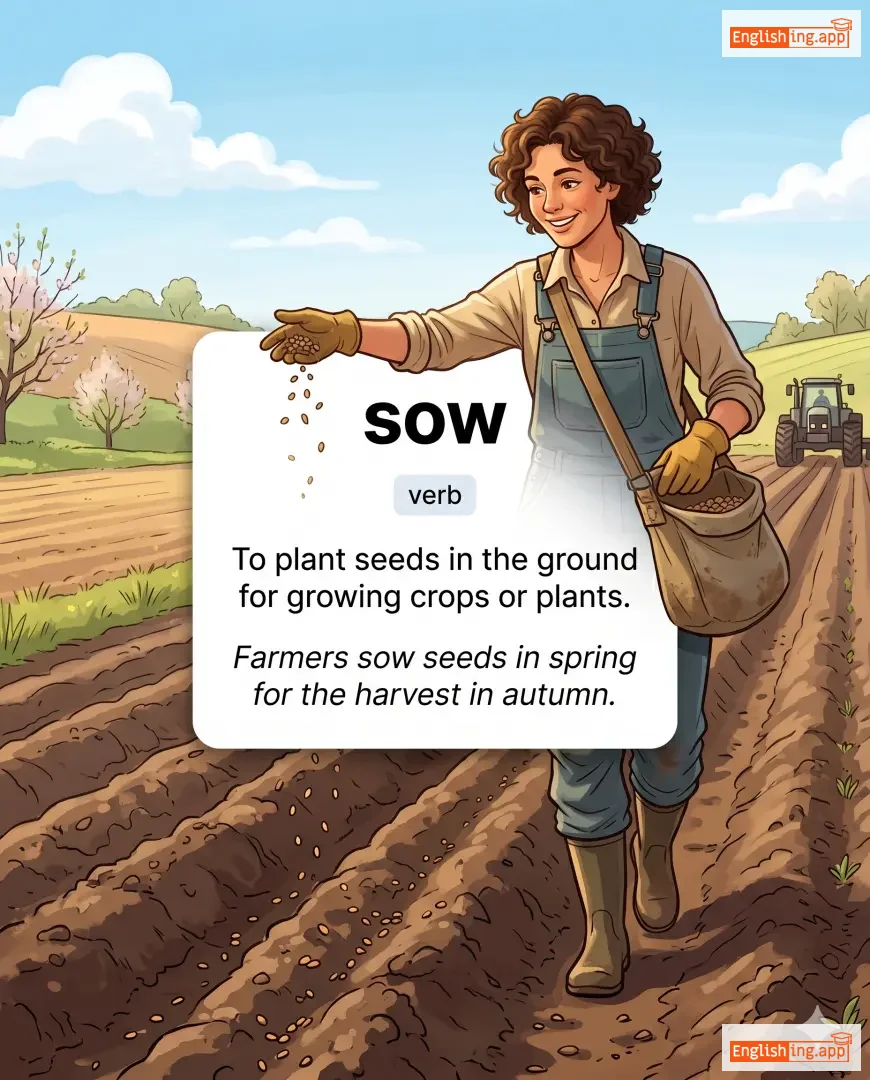
sow definition card — visual illustration of the meaning
verb
/səʊ/
播种 (bozhong)

To plant seeds in the ground for growing crops or plants.

"Farmers sow seeds in spring for the harvest in autumn."

"农民们在春天播种,秋天收获。" (Nongminmen zai chuntian bozhong, qiutian shouhuo.)
space definition card — visual illustration of the meaning
noun
/speɪs/
空间 (kongjian)

a continuous area or expanse that is free, available, or unoccupied

"There was enough space for everyone in the room."

"房间里有足够的空间给每个人。" (Fángjiān lǐ yǒu zúgòu de kōngjiān gěi měi gè rén.)
space exploration definition card — visual illustration of the meaning
noun
speɪs ɪksplɔːˈreɪʃən
太空探索 (taikong tansuo)

The investigation of outer space by means of manned and unmanned spacecraft.

"Space exploration has expanded our knowledge of the universe."

"太空探索拓展了我们对宇宙的认识。" (Taikong tansuo tuozhan le women dui yuzhou de renshi.)
spaced repetition definition card — visual illustration of the meaning
noun
speɪst ˌrep.ɪˈtɪʃ.ən
间隔重复 (jian ge chong fu)

A learning technique that involves reviewing information at increasing intervals to improve long-term retention.

"Spaced repetition helps in long-term memory retention."

"间隔重复有助于长期记忆保持。" (Jian ge chong fu you zhu yu changqi ji yi bao chi.)
adjective
/ˈspeɪ.ʃəs/
宽敞的;宽阔的 (kuan chang de; kuan kuo de)

having a lot of space; roomy and comfortable

"The house has a spacious living room with high ceilings."

"这座房子有一个宽敞的客厅,高高的天花板。" (Zhe zuo fangzi you yige kuan chang de keting, gao gao de tian hua ban.)
noun
/speɪd/
铲子 (chanzi)

a tool with a flat blade for digging; a playing card suit

"The gardener used a spade to dig holes for planting flowers."

"园丁用铲子挖洞种花。" (Yuándīng yòng chǎnzi wā dòng zhòng huā.)
noun
/spæm/
垃圾邮件 (laji youjian)

unsolicited or unwanted electronic communication, typically in the form of email

"My inbox is full of spam emails that I need to delete."

"我的收件箱里满是垃圾邮件,我需要删除它们。" (Wo de shoujiankuang li man shi laji youjian, wo xuyao shanchu tamen.)
noun
/spæn/
跨度 (kuandu)

the full extent or length of something from one end to another

"The bridge has a span of over 500 meters."

"这座桥的跨度超过了500米。" (Zhezuo qiao de kuandu chao guo le 500 mi.)
noun
/ˈspæŋɡəl/
亮片 (liàng piàn)

A small shiny piece of metal or plastic used for decoration on clothes.

"Her dress was covered with silver spangles that glittered in the light."

"她的裙子上覆盖着银色的亮片,在光线下闪闪发光。" (Tā de qúnzi shàng fùgài zhe yínsè de liàng piàn, zài guāngxiàn xià shǎn shǎn fāguāng.)
adjective
/ˈspænɪʃ/
西班牙语 (xibanya yu)

relating to Spain or the Spanish language

"She is fluent in Spanish and French."

"她能流利地讲西班牙语和法语。" (ta neng liuli de jiang xibanya yu he fayu.)
verb
/spɛər/
额外给予 / 节省 (éwài jǐyǔ / jiéshěng)

To give something that one has extra of; to refrain from harming or killing.

"Could you spare me a few minutes of your time?"

"你能给我一些你的时间吗?" (Nǐ néng gěi wǒ yīxiē nǐ de shíjiān ma?)
adjective
/ˈspɛərɪŋ/
节俭 / 节制 (jiéjiǎn / jiézhì)

Using or giving only a little of something; economical.

"She is sparing in her use of words."

"她在使用词语时很节省。" (Tā zài shǐyòng cíyǔ shí hěn jiéshěng.)
verb
/spɑːrk/
火花 (huǒ huā)

to cause the start of something, especially an emotion or activity

"The news sparked a heated debate across the country."

"这个消息在全国范围内引发了激烈的辩论。" (zhège xiāoxī zài quánguó fànwéi nèi yǐn fà le jīliè de biànlùn.)
noun
/ˈspæroʊ/
麻雀 (máquè)

small brown and grey bird commonly found in cities and towns

"The sparrow chirped cheerfully from the tree branch."

"麻雀愉快地从树枝上啁啾。" (Máquè yúkuài de cóng shùzhī shàng zhōu jiū.)
adjective
/spɑːrs/
稀少 (xishao)

thinly scattered or distributed; not dense or abundant

"Vegetation was sparse in the desert."

"沙漠中的植被稀少。" (Shamo zhong de zhiwu xishao.)
adjective
/ˈspɑːrtn/
斯巴达式 (sībā dá shì)

showing simplicity and lack of luxury; austere

"He lived in a spartan room with just a bed and a chair."

"他住在一个斯巴达式的房间里,只有一张床和一把椅子。" (Tā zhù zài yīgè sībā dá shì de fángjiān lǐ, zhǐ yǒu yī zhāng chuáng hé yī bǎ yǐzi.)
adjective
/spæzˈmɒdɪk/
痉挛性 (jìngluán xìng)

occurring irregularly or in sudden bursts

"The patient experienced spasmodic coughing during the night."

"病人在夜间经历了痉挛性咳嗽。" (Bìngrén zài yèjiān jīnglìle jìngluán xìng késòu.)
noun
/spæt/
小争吵 (xiao zhengchao)

a short, petty quarrel or argument

"They had a brief spat about who should do the dishes."

"他们就谁应该洗碗发生了一个小争吵。" (Tamen jiu shei yinggai xi wan fasheng le yi ge xiao zhengchao.)
noun
/speɪt/
浪潮 (langchao)

a large number of things occurring in quick succession

"There has been a spate of robberies in the city."

"在城市中发生了一系列盗窃事件。" (Zai chengshi zhong fashengle yi xili de daoqie shijian.)
adjective
/ˈspeɪʃəl/
空间的 (kongjian de)

relating to space or the position, area, and size of things

"The scientist studied the spatial arrangement of stars."

"科学家研究了恒星的空间排列。" (Kexuejia yanjiu le hengxing de kongjian pailie.)
noun
/ˈspætʃələ/
刮刀 (guadao)

a flat, broad tool used for mixing, spreading, or lifting food

"She used a spatula to flip the pancakes."

"她用刮刀翻煎饼。" (Ta yong guadao fan jianbing.)
verb
/spɔːn/
产生 (chansheng)

to produce or generate, often in large numbers

"The video game has spawned many sequels."

"这款视频游戏已经产生了许多续集。" (Zhe kuan shipin youxi yijing chansheng le xu duo xujis.)
verb
/spiːk/
(shuo)

to say something in order to convey information or express feelings

"She speaks five languages fluently."

"她流利地说五种语言。" (Ta liuli de shuo wuzhong yuyan.)
noun
/ˈspiːkər/
演讲者 (yanjiangzhe)

a person who speaks or talks, especially as an occupation

"The speaker delivered an inspiring speech at the conference."

"演讲者在会议上发表了激动人心的演讲。" (Yanjiangzhe zai huiyi shang fabiao le jidongrenshin de yanjiang.)
verb
/ˈspɪərˌhɛd/
领导 (lingdao)

to lead or initiate an action, project, or movement

"She spearheaded the campaign for environmental awareness."

"她领导了环保意识的运动。" (Ta lingdao le huanbao yishi de yundong.)
adjective
/ˈspɛʃəl/
特别 (tebie)

different from what is usual; better or greater than normal

"This gift is very special to me."

"这份礼物对我来说非常特别。" (Zhe fen liwu dui wo lai shuo feichang tebie.)