词汇表

英语词汇词典 | 单词含义、定义和示例

noun/verb
/sleɪt/
板岩 / 安排 (bǎn yán / ān pái)

a fine-grained rock used for roofing or writing; to schedule or designate for a task

"The meeting is slated for next Monday."

"会议定于下周一举行。" (Huìyì dìngyú xià zhōu yī jǔxíng.)
noun
/ˈslæt.ən/
邋遢的女人 (lātā de nǚrén)

a woman who is untidy or slovenly in appearance or habits

"The house looked as if a slattern lived there."

"这所房子看起来像是一个邋遢的女人住在那里。" (Zhè suǒ fángzi kàn qǐlái xiàng shì yīgè lātā de nǚrén zhù zài nàlǐ.)
noun/verb
/ˈslɔː.tər/
屠杀 / 大规模谋杀 (túshā / dàguīmó móushā)

the killing of animals for food; killing in large numbers violently

"The army slaughtered hundreds of enemy soldiers."

"军队屠杀了数百名敌军士兵。" (Jūnduì túshāle shù bǎi míng díjūn shìbīng.)
noun
/sleɪv/
奴隶 (nùlì)

a person who is the legal property of another and is forced to work for them

"The abolitionist movement fought for the rights of slaves."

"废奴主义者运动为奴隶的权利而奋斗。" (Fèi nú zhǔyì zhě yùndòng wèi nùlì de quánlì ér fèndòu.)
⛓️

slavery

noun
/ˈsleɪvəri/

the system or state of being owned and forced to work for someone else

"Slavery was abolished in most countries in the 19th century."

adjective
/ˈsleɪ.vɪʃ/
奴隶般的 (núlì bān de)

showing no originality; completely imitative or overly submissive

"His slavish devotion to tradition prevented any innovation."

"他对传统的奴隶般忠诚阻碍了任何创新。" (Tā duì chuántǒng de núlì bān zhōngchéng zǔ'ài le rènhé chuàngxīn.)
⚔️

slay

verb
/sleɪ/

to kill violently; informally, to impress greatly

"The hero vowed to slay the dragon."

adjective
/ˈsliːzi/
低级的, 肮脏的, 或质量差的 (dī jí de, āng zāng de, huò zhì liàng chà de)

morally low, dirty, or cheap in quality

"He avoided the sleazy nightclub downtown."

"他避免了市中心的低级夜店。" (Tā bìmiǎnle shì zhōngxīn de dījí yèdiàn.)
noun
/slɛdʒ/
雪橇 (xuěqiāo)

a vehicle for traveling over snow, often pulled by animals

"The children rode a sledge down the snowy hill."

"孩子们从雪山上滑下了雪橇。" (Háizimen cóng xuěshān shàng huá xiàle xuěqiāo.)
adjective
/sliːk/
光滑且闪亮 (guāng huá qiě shǎn liàng)

smooth, shiny, and stylish

"She drove a sleek black sports car."
"她开着一辆闪亮的黑色跑车。" (Tā kāi zhe yī liàng shǎn liàng de hēi sè pǎo chē.)
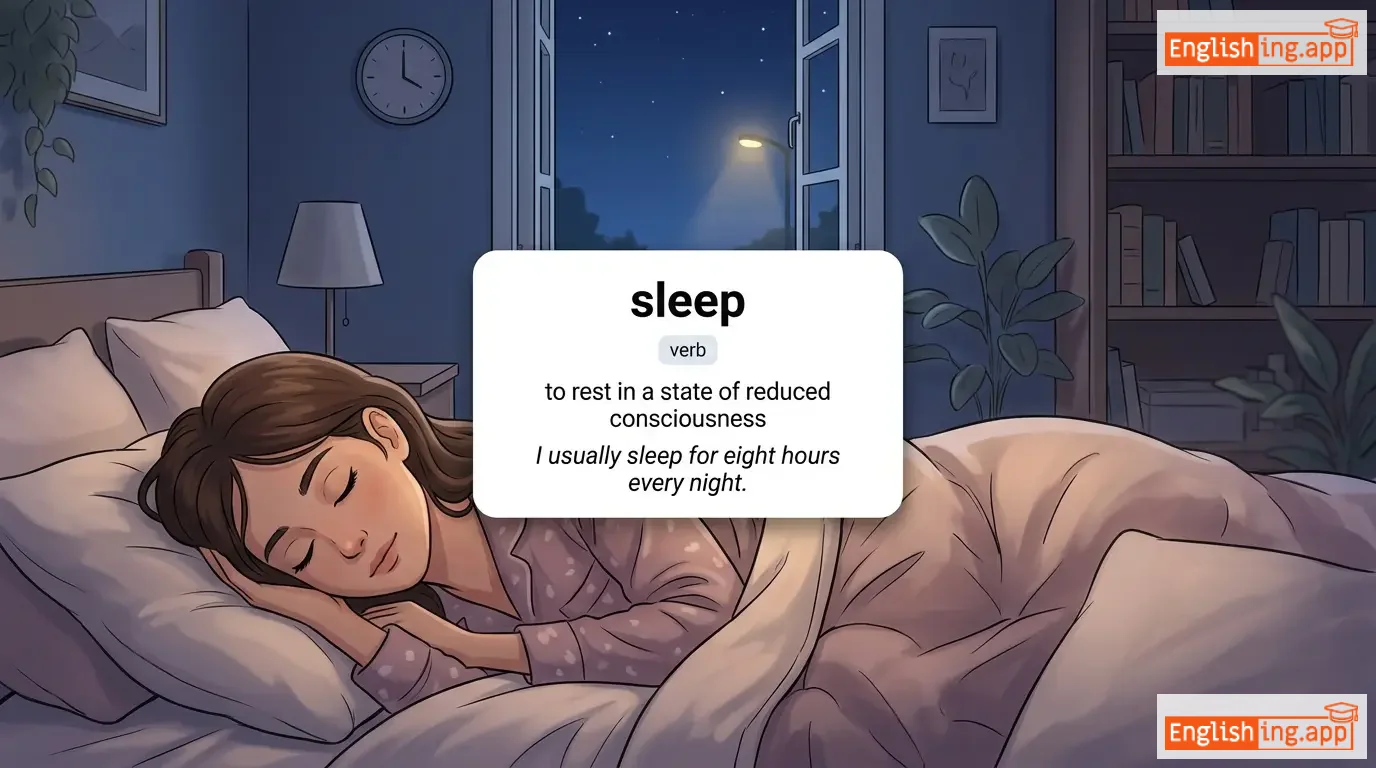
sleep definition card — visual illustration of the meaning
verb
/sliːp/
睡觉 (shuìjiào)

to rest in a state of reduced consciousness

"I usually sleep for eight hours every night."

"我通常每晚睡八个小时。" (Wǒ tōngcháng měi wǎn shuì bā ge xiǎoshí.)
sleep deprivation definition card — visual illustration of the meaning
noun
sliːp dɛprɪˈveɪʃən
睡眠不足 (shuìmián bùzú)

Lack of adequate sleep, which has negative effects on physical and mental health

"Sleep deprivation leads to cognitive decline and fatigue."

"睡眠不足会导致认知衰退和疲劳。" (Shuìmián bùzú huì dǎozhì rènzhī shuāituì hé píláo.)
noun
/ˈsliːpər/
睡觉的人;意外成功的事物 (shuìjiào de rén; yìwài chénggōng de shìwù)

a person or thing that sleeps; something that unexpectedly succeeds

"The movie turned out to be a real sleeper hit."

"这部电影竟然成为了意外的成功。" (Zhè bù diànyǐng jìngrán chéngwéile yìwài de chénggōng.)
noun
/sliːv/
袖子 (xiùzi)

the part of a garment that covers all or part of the arm

"He rolled up his sleeves before starting the work."

"他在开始工作前卷起了袖子。" (Tā zài kāishǐ gōngzuò qián juǎn qǐ le xiùzi.)
noun
/sleɪ/
雪橇 (xueqiao)

A vehicle pulled by horses or reindeer over snow or ice.

"Children were excited to ride in the sleigh through the snowy village."

"孩子们兴奋地在雪地小村庄里骑上雪橇。" (Haizimen xingfen de zai xuedi xiaocun zhuang li qishang xueqiao.)
noun
/slaɪt/
技巧 (jiqiao)

Skill or dexterity, especially in performing tricks.

"The magician amazed the crowd with his sleight of hand."

"魔术师用他的技巧惊艳了观众。" (Móshù shī yòng tā de jìqiǎo jīngyàn le guānzhòng.)
verb
/sluː/
突然转向 (tūrán zhuǎnxiàng)

To turn or slide violently in a particular direction.

"The car slewed across the icy road."

"汽车在结冰的路面上突然滑动。" (Qìchē zài jié bīng de lùmiàn shàng túrán huádòng.)
noun
/slaɪs/
切片 (qie pian)

a thin, flat piece of food or other substance

"I cut the bread into slices."

"我把面包切成了片。" (Wo ba mianbao qie cheng le pian.)
adjective
/slɪk/
光滑的 (guāng huá de)

Smooth, clever, or efficient, often in a way that seems superficial.

"He gave a slick presentation to impress the investors."

"他做了一个光滑的演示,以打动投资者。" (Tā zuòle yīgè guāng huá de yǎnshì, yǐ dǎdòng tóuzī zhě.)
verb
/slaɪd/
滑动 (huádòng)

to move smoothly along a surface while maintaining continuous contact with it

"The children love to slide down the playground slide."

"孩子们喜欢从游乐场的滑梯上滑下来。" (Háizimen xǐhuān cóng yóulèchǎng de huátī shàng huá xiàlái.)
adjective
/slaɪt/
轻微的 (qingwei de)

Small in degree; not considerable.

"There was a slight change in the schedule."

"时间表上有轻微的变化。" (Shijian biao shang you qingwei de bianhua.)
adverb
/ˈslaɪtli/
略微 (luewei)

to a small degree or extent

"The temperature has slightly increased today."

"今天温度略有上升。" (Jīntiān wēndù lüè yǒu shàngshēng.)
adjective
/slɪm/
苗条 (miao tiao)

thin in an attractive or healthy way; small in amount or chance

"She looked slim in her new dress."

"她穿上新裙子看起来很苗条。" (ta chuan shang xin qunzi kan qilai hen miao tiao.)
verb
/slɪŋ/
投掷, 挂起 (tóu zhì, guà qǐ)

to throw or hang something roughly or carelessly

"He slung his bag over his shoulder before leaving."

"他在离开前把包扔在肩膀上。" (Tā zài lí kāi qián bǎ bāo rēng zài jiān bǎng shàng.)
verb
/slɪŋk/
悄悄移动 (qiao qiao yi dong)

to move quietly and secretly, often to avoid being noticed

"The cat slunk into the room without making a sound."

"猫悄悄地进入房间,没有发出任何声音。" (Mao qiao qiao de jin ru fang jian, mei you fa chu ren he sheng yin.)
verb
/slɪp/
滑倒 (huá dǎo)

to lose balance or fall while moving, or to accidentally slide from a position

"She slipped on the wet floor and fell."

"她在湿滑的地板上滑倒了。" (Ta zai shi hua de diban shang hua dao le.)
noun
/ˈslɪpər/
拖鞋 (tuōxié)

light, comfortable shoe without a back, worn indoors

"She put on her slippers before walking around the house."

"她在走遍房子之前穿上了拖鞋。" (Tā zài zǒu biàn fángzi zhīqián chuān shàngle tuōxié.)
adjective
/ˈslɪpəri/
滑的 (hua de)

difficult to hold, walk on, or deal with because of being smooth, wet, or tricky

"The road was slippery after the rain."

"雨后路面很滑。" (Yu hou lujian hen hua.)
adjective
/ˈslɪpʃɒd/
草率的, 马虎的 (caolu de, mahu de)

done in a careless, sloppy, or untidy way

"The project failed due to slipshod planning."

"由于草率的规划,项目失败了。" (Youyu caolu de guihua, xiangmu shibai le.)
noun
/slɪt/
裂缝 (lièfèng)

a long narrow opening or cut

"There was a small slit in the fabric."

"布料上有一个小裂缝。" (Bùliào shàng yǒu yīgè xiǎo lièfèng.)
verb
/ˈslɪðər/
滑行 (huáxíng)

to move smoothly over a surface with a twisting, sliding motion, like a snake

"The snake slithered through the grass."

"蛇穿过草地滑行。" (Shé chuānguò cǎodì huáxíng.)
🗣️

slogan

noun
/ˈsloʊɡən/

a short and memorable phrase used to promote a cause or product

"The campaign used a powerful slogan to inspire people."

noun
/sloʊp/
坡度 (podu)

a surface of which one end or side is at a higher level than another; a slanting surface or line

"The children rolled down the grassy slope."

"孩子们从草坡上滚下来。" (Haizimen cong caopo shang gun xialaile.)
adjective
/ˈslɒpi/
邋遢 (lātā)

Careless, messy, or lacking attention to detail.

"His sloppy handwriting made the note hard to read."

"他潦草的字迹让这张便条很难阅读。" (Tā liáocǎo de zìjì ràng zhè zhāng biàntiáo hěn nán yuèdú.)
🕳️

slot (槽)

noun
/slɒt/
插槽 (chacuo)

a narrow opening into which something fits or is placed

"Insert the card into the slot to open the door."

"将卡片插入插槽以打开门。" (Jiang ka pian charu chacuo yi dakaimen.)
noun
/sloʊθ/ or /slɒθ/
懒惰 (landuo)

A lack of effort or laziness; also a slow-moving mammal in Central and South America.

"His constant sloth kept him from achieving his goals."

"他的懒惰让他无法实现自己的目标。" (Tā de lǎnduò ràng tā wúfǎ shíxiàn zìjǐ de mùbiāo.)
adjective
/ˈsloʊθfəl/
懒惰 (landuo)

Lazy, idle, and unwilling to work.

"She was too slothful to get out of bed early."

"她太懒了,早上不想从床上起来。" (Ta tai landuo le, zhao shang bu xiang cong chuang shang qilai.)
verb
/slaʊtʃ/
懒散地坐 (lǎn sàn dì zuò)

To stand, sit, or move in a lazy or awkward way.

"He slouched in the chair, looking tired."

"他在椅子上懒散地坐着,看起来很累。" (tā zài yǐzi shàng lǎn sàn dì zuò zhe, kàn qǐlái hěn lèi.)
verb
/slʌf/ or /sluː/
脱皮 / 沼泽区 (tuōpí / zhǎo zé qū)

To shed or cast off (like dead skin); also a swampy or muddy area.

"The snake sloughed off its old skin."

"蛇脱掉了它的旧皮肤。" (Shé tuō diào le tā de jiù pífū.)
adjective
/ˈslʌvənli/
邋遢 (lātā)

Untidy or careless in appearance, habits, or work.

"His slovenly appearance made a bad impression at the interview."

"他的邋遢外表在面试中留下了不好的印象。" (Tā de lātā wàibiǎo zài miànshì zhōng liúxiàle bù hǎo de yìnxiàng.)
adjective
/sloʊ/
(man)

moving or happening at a low speed

"The car moved slowly down the street."

"车子在街上慢慢行驶。" (Che zi zai jie shang man man xing shi.)
adverb
/ˈsloʊli/
慢慢地 (màn màn de)

in a slow manner

"She walked slowly to the door."

"她慢慢地走向门。" (Tā màn màn de zǒu xiàng mén.)
noun
/ˈslʌɡərd/
懒汉 (lǎn hàn)

A lazy, sluggish person.

"The sluggard refused to get out of bed even at noon."

"懒汉拒绝在中午起床。" (Lǎn hàn jùjué zài zhōngwǔ qǐchuáng.)
adjective
/ˈslʌɡɪʃ/
迟缓 (chi huan)

Lacking energy or alertness; slow-moving or inactive.

"He felt sluggish after eating a heavy meal."

"吃了一顿重餐后,他感到迟缓。" (chi le yi dun zhong can hou, ta gan dao chi huan.)
noun/verb
/sluːs/
水闸 / 清洗 (shuǐzhá / qīngxǐ)

A sliding gate for controlling the flow of water; to wash or rinse with water in large quantities.

"The workers sluiced the mud off the street after the heavy rain."

"工人们在暴雨后清洗了街道上的泥巴。" (Gōngrénmen zài bàoyǔ hòu qīngxǐle jiēdào shàng de níbā.)
noun
/slʌm/
贫民窟 (pínmínkū)

a poor urban area with substandard housing and squalid conditions

"The government is working to improve conditions in the slum."

"政府正在努力改善贫民区的条件。" (Zhèngfǔ zhèngzài nǔlì gǎishàn pínmínqū de tiáojiàn.)
noun/verb
/ˈslʌmbər/
睡眠 (shuìmián)

A state of sleep; to sleep lightly or rest.

"The child slumbered peacefully through the night."

"孩子整夜安静地睡觉。" (háizi zhěng yè ānjìng de shuìjiào.)
noun, verb
/slɜːr/
侮辱 / 轻蔑的评论 (wǔrǔ / qīngmiè de pínglùn)

An insulting remark or suggestion; or to speak indistinctly.

"He made a slur against her character."

"他对她的品格做出了侮辱性的评论。" (Tā duì tā de pǐngé zuò chūle wǔrǔxìng de pínglùn.)
adjective
/slaɪ/
狡猾 / 机智 (jiǎohuá / jīzhì)

Clever in a deceitful or cunning way.

"She gave him a sly smile."

"她给了他一个狡猾的微笑。" (Tā gěi le tā yīgè jiǎohuá de wéixiào.)
adjective
/smɔːl/
(xiao)

not large in size, amount, or importance

"He lives in a small house near the river."

"他住在一间小房子里,靠近河流。" (Ta zhu zai yi jian xiao fangzi li, kaojin heliu.)