词汇表

英语词汇词典 | 单词含义、定义和示例

noun
/sɪˈtɑːr/
锡塔尔 (xītǎ'ěr)

a traditional Indian stringed musical instrument with a long neck and resonating body

"The sitar creates beautiful ragas in Indian classical music."

"锡塔尔在印度古典音乐中创造美丽的拉嘎。" (Xītǎ'ěr zài Yìndù gǔdiǎn yīnyuè zhōng chuàngzào měilì de lāgā.)
noun
/saɪt/
位置 (weizhi)

a location or place, often used for a specific purpose, such as a construction site or a website

"The construction site is ready for the next phase of the project."

"建设现场已准备好进入项目的下一阶段。" (Jianshe xianchang yi zhunbei hao jinru xiangmu de xiayi jieduan.)
adjective
/ˈsɪtʃueɪtɪd/
位于 (wei yu)

located in a particular place or position

"The hotel is situated near the beach."

"酒店位于海滩附近。" (Jiudian wei yu haitan fujin.)
noun
/ˌsɪtʃʊˈeɪʃən/
情况 (qingkuang)

a set of circumstances or state of affairs at a particular time

"The situation at work became difficult after the new policies were introduced."

"工作中的情况在引入新政策后变得困难。" (Gongzuo zhong de qingkuang zai yinru xin zhengce hou biande kunnan.)
noun
/sɪks/
(liu)

the number 6

"There are six apples on the table."

"桌子上有六个苹果。" (Zhuozi shang you liu ge pingguo.)
adjective
/sɪksθ/
第六 (di liu)

coming after the fifth in order, position, or rank

"He finished the race in sixth place."

"他在比赛中获得了第六名。" (Ta zai bisai zhong huodele di liu ming.)
noun
/saɪz/
尺寸 (chicun)

the physical dimensions, proportions, or magnitude of something

"This shirt is too small in size for me."

"这件衬衫对我来说在尺寸上太小了。" (Zhe jian chen shan dui wo lai shuo zai chicun shang tai xiao le.)
noun
/ˈskɛlɪtən/
骷髅 (kulou)

The internal framework of bones that supports the body of a human or animal.

"The teacher showed the students a human skeleton in the biology class."

"老师在生物课上向学生们展示了一个人类的骷髅。" (Lǎoshī zài shēngwù kè shàng xiàng xuéshēngmen zhǎnshìle yīgè rénlèi de kulou.)
skeptic definition card — visual illustration of the meaning
noun
/ˈskɛptɪk/
怀疑者 (huáiyí zhě)

A person who doubts or questions accepted beliefs or claims.

"The scientist was a skeptic of theories without solid evidence."

"这位科学家对没有确凿证据的理论持怀疑态度。" (Zhè wèi kēxuéjiā duì méiyǒu quèzào zhèngjù de lǐlùn chí huáiyí tàidù.)
adjective
/ˈskɛptɪkəl/
怀疑的 (huáiyí de)

not easily convinced; having doubts or reservations

"She was skeptical about the new plan."
"她对新计划持怀疑态度。" (Tā duì xīn jìhuà chí huáiyí tàidù.)
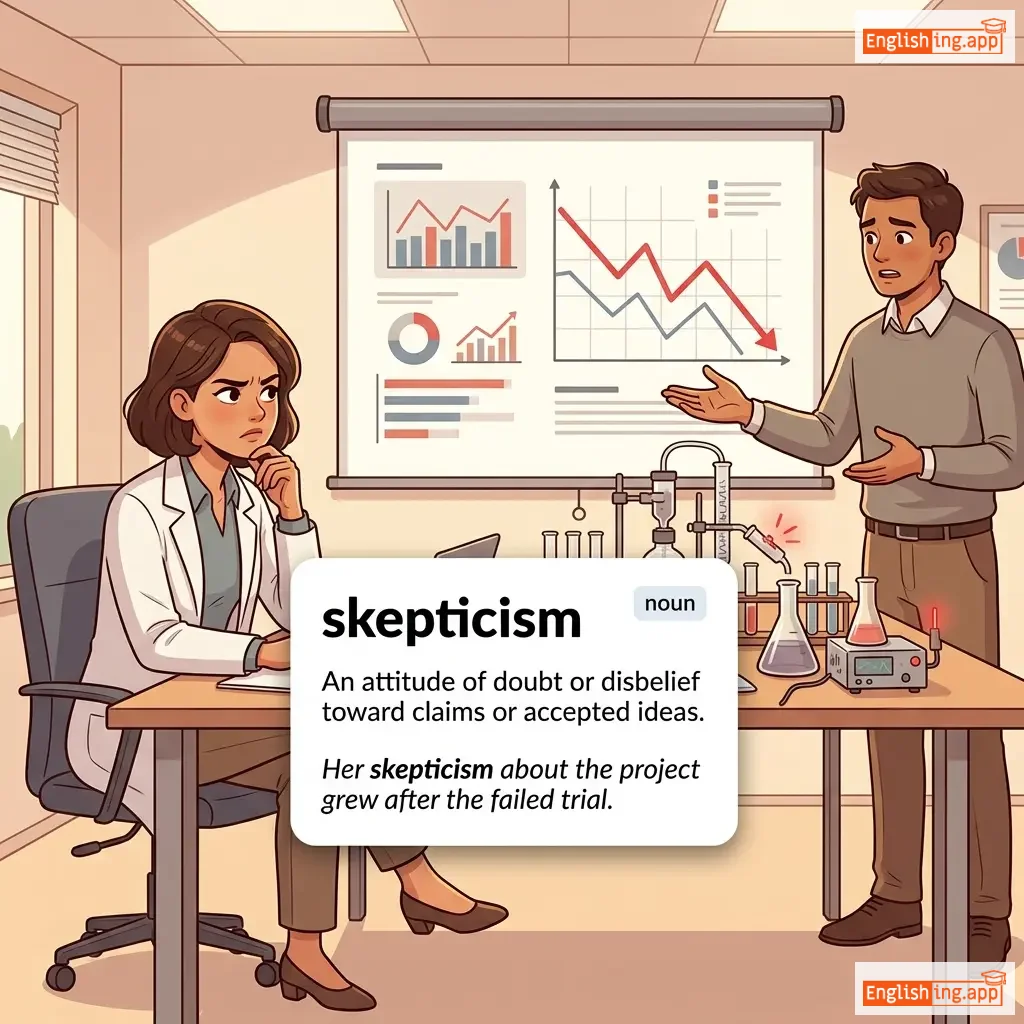
skepticism definition card — visual illustration of the meaning
noun
/ˈskɛptɪˌsɪzəm/
怀疑主义 (huáiyí zhǔyì)

An attitude of doubt or disbelief toward claims or accepted ideas.

"Her skepticism about the project grew after the failed trial."

"她对这个项目的怀疑在失败的试验后加剧了。" (Tā duì zhège xiàngmù de huáiyí zài shībài de shìyàn hòu jiājù le.)
noun
/skɛtʃ/
素描 (sumiao)

a simple, rough drawing or outline

"He made a quick sketch of the landscape."

"他画了一个快速的风景素描。" (Ta hua le yige kuaisu de fengjing sumiao.)
adjective
/ˈskɛtʃi/
不完整 (buwancheng)

not thorough or detailed; suspicious or unsafe

"The details of the project were still sketchy."

"项目的细节仍然不完整。" (Xiangmu de xijie rengran bu wancheng.)
verb
/skiː/
滑雪 (huá xuě)

to glide over snow on skis

"We went skiing in the Alps last winter."

"我们去年冬天去了阿尔卑斯滑雪。" (Wǒmen qùnián dōngtiān qùle Ā'ěr bēi sī huá xuě.)
noun
/skɪf/
小船 (xiao chuan)

a small, light boat usually for one person

"The fisherman paddled his skiff across the lake."

"渔夫划着他的“小船”穿过湖面。" (Yufu huazhe ta de 'xiao chuan' chuanguo humian.)
adjective
/ˈskɪlfʊl/
熟练的; 能手; 专家 (shulian de; nengshou; zhuanjia)

having or showing skill; expert and accomplished

"The skilful surgeon performed the operation with great precision."

"熟练的外科医生以极高的精确度完成了手术。" (Shulian de waike yisheng yi ji gao de jingqueduwu wancheng le shoushu.)
adverb
/ˈskɪl.fəl.i/
熟练地 (shulian de)

in a way that shows ability and training; expertly

"She skilfully painted the portrait in just two hours."

"她在两个小时内熟练地画了肖像。" (Ta zai liang ge xiaoshi nei shulian de hua le xiaoxiang.)
noun
/skɪl/
技能 (jineng)

the ability to do something well through training or experience

"Her skill in painting impressed everyone."

"她在绘画方面的技能给大家留下了深刻印象。" (Ta zai huihua fangmian de jineng gei dajia liuxia le shenke yinxiang.)
adjective
/skɪld/
熟练 (shulian)

having the ability, experience, or training to do something well

"She is a highly skilled surgeon with years of experience."

"她是一位经验丰富的高技能外科医生。" (Ta shi yi wei jingyan fengfu de gao jishun waike yisheng.)
skills definition card — visual illustration of the meaning
noun
/skɪlz/
技能 (jineng)

The ability to do something well; expertise.

"Learning new skills can increase personal and professional growth."

"学习新技能可以增加个人和职业发展。" (Xuéxí xīn jìnéng kěyǐ zēngjiā gèrén hé zhíyè fāzhǎn.)
verb
/skɪm/
快速阅读 (kuai su yue du)

to move quickly over a surface or to read something quickly

"She skimmed through the report before the meeting."

"她在会议前快速浏览了报告。" (Ta zai huiyi qian kuai su liu lan le baogao.)
verb
/skɪmp/
节省 (jiesheng)

to use less of something than is necessary in order to save money or effort

"Don’t skimp on quality when buying a new laptop."

"购买新笔记本时不要节省质量。" (Goumai xin bijiben shi bu yao jiesheng zhiliang.)
noun
/skɪn/
皮肤 (pifu)

the outer layer of the body

"She has fair skin and bright blue eyes."

"她有白皙的皮肤和明亮的蓝色眼睛。" (Ta you baixi de pifu he mingliang de lanse yanjing.)
noun
/ˈskɪnˌflɪnt/
吝啬鬼 (lìnsè guǐ)

a person who spends as little money as possible; a miser

"The landlord was such a skinflint that he never repaired anything."

"房东是个吝啬鬼,从不修理任何东西。" (Fángdōng shì gè lìnsè guǐ, cóng bù xiūlǐ rènhé dōngxī.)
adjective
/ˈskɪni/
瘦的; 皮包骨的; 骨瘦如柴 (shou de; pi bao gu de; gu shou ru chai)

very thin; having little flesh or fat on the body

"The skinny cat looked like it hadn't eaten for days."

"那只瘦猫看起来像是几天没吃东西了。" (Na zhi shou mao kan qilai xiang shi ji tian mei chi dongxi le.)
verb
/skɪp/
跳过 (tiao guo)

to omit or pass over something; to move lightly or quickly

"He decided to skip breakfast and go straight to work."

"他决定跳过早餐,直接去上班。" (Ta jueding tiao guo zaocan, zhijie qu shangban.)
⚔️

skirmish

noun/verb
/ˈskɜːrmɪʃ/

a small or brief fight between groups of soldiers; to engage in such a fight

"The soldiers got into a skirmish near the border."

👗

Skirt

noun/verb
/skɜːrt/

a piece of clothing that hangs from the waist; to go around the edge of something

"She wore a red skirt to the party."

noun
/skɪt/
小品 (xiao pin)

a short, humorous performance or piece of writing

"The students performed a funny skit at the event."

"学生们在活动中表演了一个有趣的小品。" (Xuesheng men zai huodong zhong biaoyan le yige youqu de xiao pin.)
adjective
/ˈskɪtɪʃ/
紧张的 (jinzhang de)

easily frightened or nervous; unpredictable

"The horse was too skittish to ride."

"那匹马太紧张,无法骑乘。" (Na pi ma tai jinzhang, wufa qicheng.)
noun
/skʌlˈdʌɡəri/
欺诈 (qī zhà)

underhanded or dishonest behavior

"The politician was accused of financial skulduggery."

"这位政治家因金融欺诈而受到指控。" (Zhè wèi zhèng zhì jiā yīn jīn róng qī zhà ér shòu dào zhǐ kòng.)
🕵️

skulk

verb
/skʌlk/

to move or hide secretly, often because you are planning something bad or are feeling guilty

"He tried to skulk in the shadows to avoid being seen."

noun
/skʌl/
头骨 (tougu)

the bony structure that forms the head and protects the brain

"The archaeologists found an ancient human skull."

"考古学家发现了一个古老的人类头骨。" (Kaogu xuejia faxianle yige gulao de renlei tougu.)
noun
/ˌskʌlˈdʌɡəri/
欺诈 (qī zhà)

dishonest behavior or activities, often done secretly

"The election was full of political skullduggery."

"选举充满了政治欺诈。" (Xuǎnjǔ chōngmǎnle zhèngzhì qīzhà.)
🌌

Sky

noun
/skaɪ/

the expanse of air over the Earth, often appearing blue

"The sky was clear and the sun was shining brightly."

adjective
/skaɪ bluː/
天蓝色 (tian lan se)

a bright blue color like that of a clear sky

"Her sky-blue eyes sparkled in the sunlight."

"她的天蓝色眼睛在阳光下闪闪发光。" (Ta de tian lan se yanjing zai yangguang xia shanshan faguan.)
noun
/ˈskaɪ.lɑːrk/
云雀 (yúnquè)

a small brown bird known for singing while flying high in the sky

"The skylark sang beautifully as it soared above the meadow."

"当云雀飞翔在草地上方时,它美丽地歌唱。" (dāng yúnquè fēixiáng zài cǎodì shàngfāng shí, tā měilì de gēchàng)
noun
/ˈskaɪˌskreɪpər/
摩天大楼 (mó tiān dà lóu)

a very tall building of many stories

"The new skyscraper dominates the city's skyline."

"这座新的摩天大楼主导着城市的天际线。" (Zhè zuò xīn de mó tiān dà lóu zhǔ dǎo zhe chéng shì de tiān jì xiàn.)
noun
/slæb/
(ban)

a large, thick, flat piece of stone, concrete, or other hard material

"The workers laid a concrete slab for the foundation."

"工人们为地基铺设了一块混凝土板。" (Gōngrén men wèi dìjī pūshèle yī kuài hùnníngtǔ bǎn.)
adjective
/slæk/
松弛 (songchi)

not tight, firm, or busy; lacking tension or activity

"Business is slack during the rainy season."

"在雨季生意很清淡。" (Zài yǔjì shēngyì hěn qīngdàn.)
verb
/ˈslækən/
放松 (fàngsōng)

to make or become less tight, less active, or slower

"The driver slackened his speed as he approached the village."

"司机在接近村庄时放慢了速度。" (Sījī zài jiējìn cūnzhuāng shí fàngmànle sùdù.)
noun
/slæɡ/
炉渣 (lú zhā)

Stony waste matter separated from metals during the smelting process.

"The factory dumped the slag near the river."

"工厂把炉渣倾倒在河边。" (Gōngchǎng bǎ lú zhā qīngdǎo zài hé biān.)
verb
/sleɪk/
解渴 (jie ke)

To satisfy thirst or desire.

"She drank cold water to slake her thirst."

"她喝了冷水来解渴。" (Ta he le leng shui lai jie ke.)
verb
/slæm/
用力关门 (yònglì guānmén)

to close or hit something with great force

"He slammed the door angrily after the argument."

"他在争论后愤怒地摔门。" (Tā zài zhēnglùn hòu fènnù de shuāi mén.)
noun
/ˈslændər/
诽谤 (feibang)

The action of making false spoken statements damaging to a person's reputation.

"He sued the newspaper for slander."

"他因诽谤起诉了报纸。" (Ta yin feibang qisu le baozhi.)
noun
/slæŋ/
俚语; 非正式语言 (lǐyǔ; fēi zhèngshì yǔyán)

very informal language that is usually spoken rather than written

"The teenagers used slang that their parents couldn't understand."

"青少年使用了父母无法理解的俚语。" (Qīngshàonián shǐyòngle fùmǔ wúfǎ lǐjiě de lǐyǔ.)
noun, verb
/slænt/
偏见观点 (pianjian guandian)

A particular point of view; to slope or lean in a particular direction.

"The article had a political slant."
"文章有政治倾向。" (wénzhāng yǒu zhèngzhì qīngxiàng.)
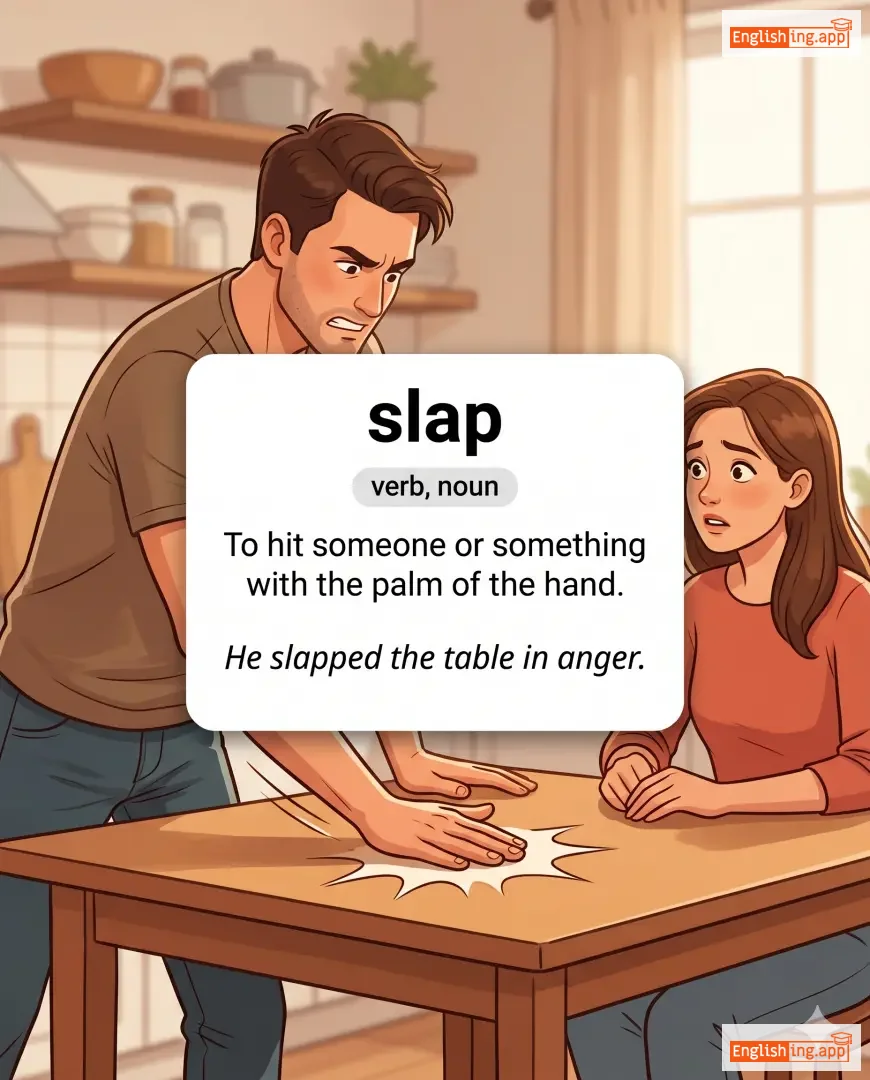
slap definition card — visual illustration of the meaning
verb, noun
/slæp/
打耳光 (da ěrguāng)

To hit someone or something with the palm of the hand.

"He slapped the table in anger."

"他生气地拍了桌子。" (Tā shēngqì de pāi le zhuōzi.)
adjective
/ˈslæp.dæʃ/
草率 (caoshuai)

done too quickly and carelessly; hasty and careless

"The report was written in a slapdash manner, full of errors."
"报告写得草率,充满了错误。" (Baogao xiede caoshuai, chongman le cuowu.)
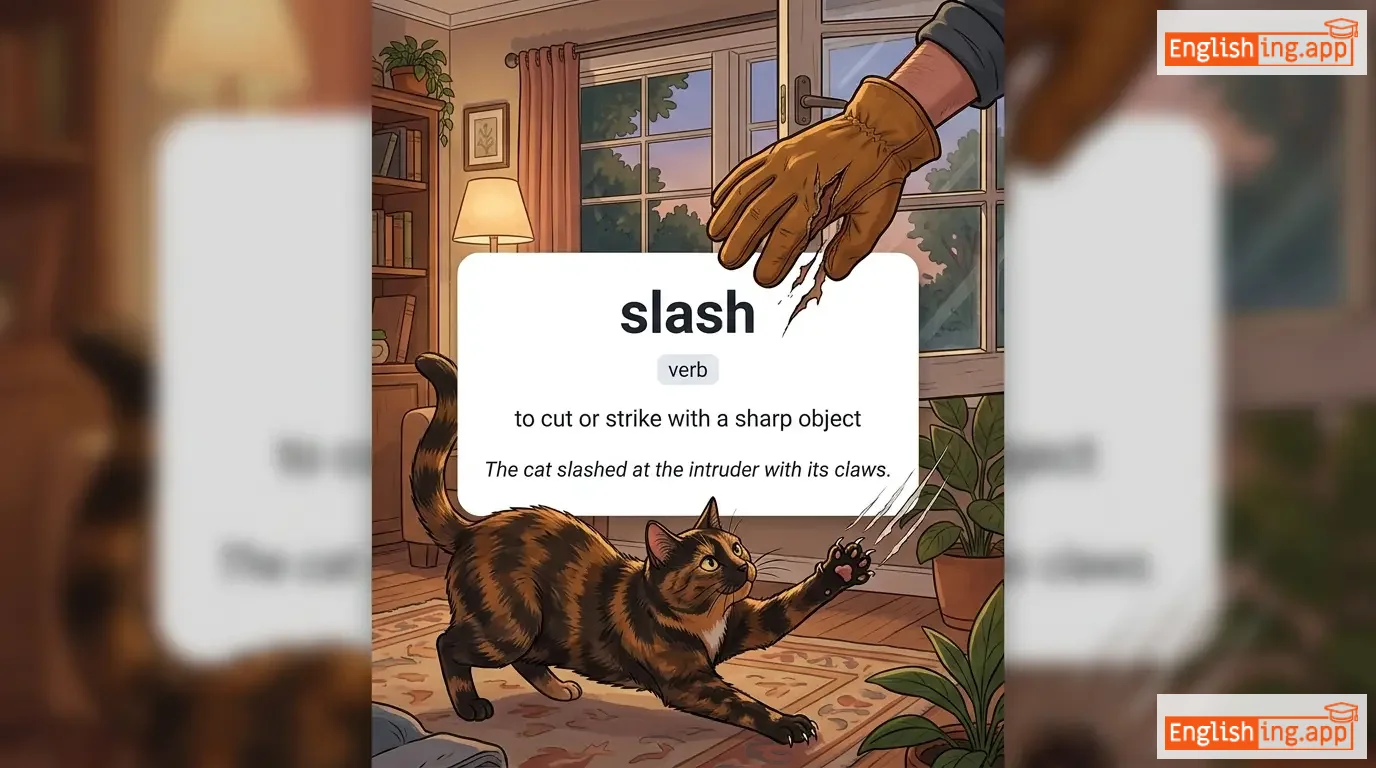
slash definition card — visual illustration of the meaning
verb
/slæʃ/
(ge)

to cut or strike with a sharp object

"The cat slashed at the intruder with its claws."

"猫用爪子向入侵者劈砍。" (Māo yòng zhǎozi xiàng rùqīn zhě pī kǎn.)