词汇表

英语词汇词典 | 单词含义、定义和示例

noun, verb
/rɪər/
后面 / 抚养 (hòu miàn / fǔ yǎng)

the back part of something; to bring up or raise children or animals

"The mother cat reared her kittens in a quiet corner."

"母猫在安静的角落里抚养她的猫仔。" (Mǔ māo zài ān jìng de jiǎo luò lǐ fǔ yǎng tā de māo zǎi.)
verb
/ˌriːəˈreɪndʒ/
重新安排 (chóngxīn ānpái)

to change the order or position of something

"She decided to rearrange the furniture in her living room."

"她决定重新安排客厅里的家具。" (Tā juédìng chóngxīn ānpái kètīng lǐ de jiājù.)
noun, verb
/ˈriːzən/
原因,理由 (yuányīn, lǐyóu)

A cause, explanation, or justification for an action or event; to think or argue logically.

"There is no reason to be upset."

"没有理由生气。" (méiyǒu lǐyóu shēngqì.)
adjective
/ˈriːzənəbl/
合理 (heli)

Fair and sensible; having sound judgment; not extreme or excessive.

"The price of the meal was quite reasonable."

"这顿饭的价格相当合理。" (Zhe dun fan de jiage xiangdang heli.)
adverb
/ˈriːzənəbli/
合理地 (hélǐ de)

in a fair, sensible, or logical manner

"The price was reasonably low compared to other products."

"与其他产品相比,价格合理地低。" (Yǔ qítā chǎnpǐn xiāng bǐ, jiàgé hélǐ de dī.)
noun
/ˈriːzənɪŋ/
推理 (tuili)

the process of thinking about something in a logical way in order to form a conclusion or judgment

"Her reasoning for leaving was clear and logical."

"她离开的推理是清晰和合逻辑的。" (Tā líkāi de tuīlǐ shì qīngxī hé hé luójí de.)
reasons definition card — visual illustration of the meaning
noun
/ˈriː.zənz/
原因 (yuanyin)

Causes, explanations, or justifications for an action or event.

"Reasons for pollution need addressing urgently."

"污染的原因需要紧急处理。" (Wūrǎn de yuányīn xūyào jǐnjí chǔlǐ.)
noun
/ˌriː.əˈʃʊr.əns/
安慰 (ān wèi)

comfort or confidence given to someone to remove their fears or doubts

"She needed reassurance that everything would be okay."

"她需要得到安慰,以确认一切都会好起来。" (Tā xūyào dédào ānwèi, yǐ quèrèn yīqiè dōu huì hǎo qǐlái.)
verb
/ˌriːəˈʃʊr/
安慰 (ānwèi)

to say or do something to remove someone's doubts or fears

"The teacher reassured the students before the exam."

"老师在考试前安慰了学生。" (Lǎoshī zài kǎoshì qián ānwèi le xuéshēng.)
noun
/ˈriːbeɪt/
折扣/退款 (zhékòu/tuìkuǎn)

a partial refund given to someone who has paid too much money for something

"The store offered a rebate on bulk purchases."

"商店对大宗购买提供了折扣。" (Shāngdiàn duì dàzōng gòumǎi tígōngle zhékòu.)
noun, verb
/ˈreb.əl/
叛逆者 / 反抗 (pànnì zhě / fǎnkàng)

a person who resists authority or control; to resist or fight against authority

"The students rebelled against the new dress code."

"学生们反抗了新的着装规范。" (Xuéshēngmen fǎnkàngle xīn de zhuózhuāng guīfàn.)
noun
/rɪˈbɛljən/
叛乱 (pànluàn)

an act of violent or open resistance to an established government or ruler

"The rebellion was crushed by the army after a few months."

"叛乱在几个月后被军队镇压了。" (Pànluàn zài jǐ gè yuè hòu bèi jūnduì zhènyā le.)
adjective
/rɪˈbɛljəs/
叛逆 (pànnì)

resisting authority or control; showing a desire to rebel

"The rebellious teenager refused to follow the school rules."

"那个叛逆的青少年拒绝遵守学校规则。" (Nàgè pànnì de qīngshàonián jùjué zūnshǒu xuéxiào guīzé.)
verb
/rɪˈbʌf/
拒绝 (jùjué)

to reject or refuse in a sharp or abrupt way

"She rebuffed his invitation to dinner."

"她拒绝了他的晚餐邀请。" (Tā jùjuéle tā de wǎncān yāoqǐng.)
verb
/ˌriːˈbɪld/
重建 (chongjian)

to build something again after it has been damaged or destroyed

"The villagers worked together to rebuild the bridge after the flood."

"村民们一起努力,在洪水后重建了桥梁。" (Cunminmen yiqi nuli, zai hongshui hou chongjianle qiaoliang.)
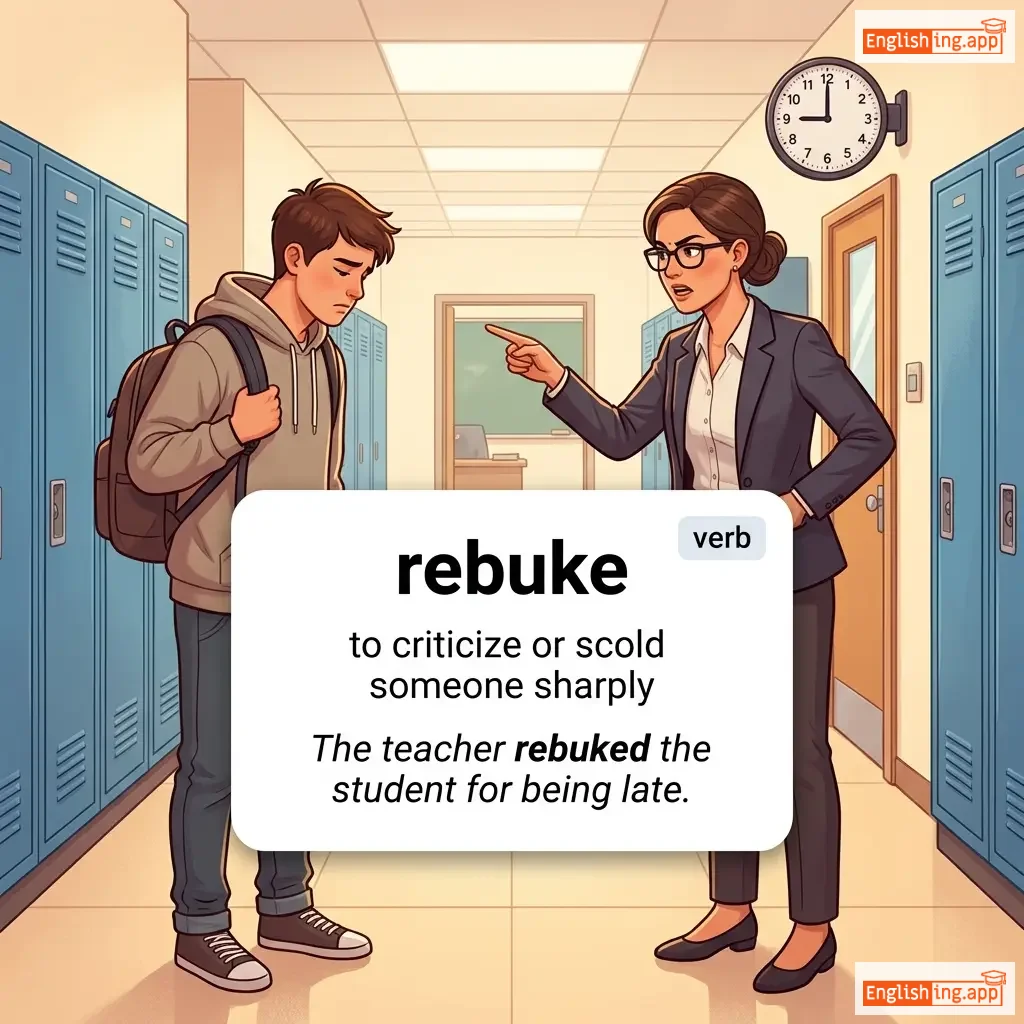
rebuke definition card — visual illustration of the meaning
verb
/rɪˈbjuːk/

to criticize or scold someone sharply

"The teacher rebuked the student for being late."

noun
/ˈriːbəs/
谜语 (miyu)

a puzzle in which words are represented by pictures, symbols, or letters

"The children enjoyed solving the rebus puzzles in the magazine."

"孩子们喜欢解答杂志中的谜语。" (Haizimen xihuan jieda zazhi zhong de miyu.)
verb
/rɪˈbʌt/
反驳 (fǎnbó)

to argue against or prove wrong; to refute

"The lawyer rebutted the false accusations with strong evidence."

"律师用有力的证据反驳了虚假的指控。" (Lǜshī yòng yǒulì de zhèngjù fǎnbóle xūjiǎ de zhǐkòng.)
noun
/rɪˈbʌtəl/
反驳 (fǎnbó)

a statement or argument made to oppose or disprove another

"Her rebuttal was clear and convincing."
"她的反驳清晰而有说服力。" (Tā de fǎnbó qīngxī ér yǒu shuōfúlì.)
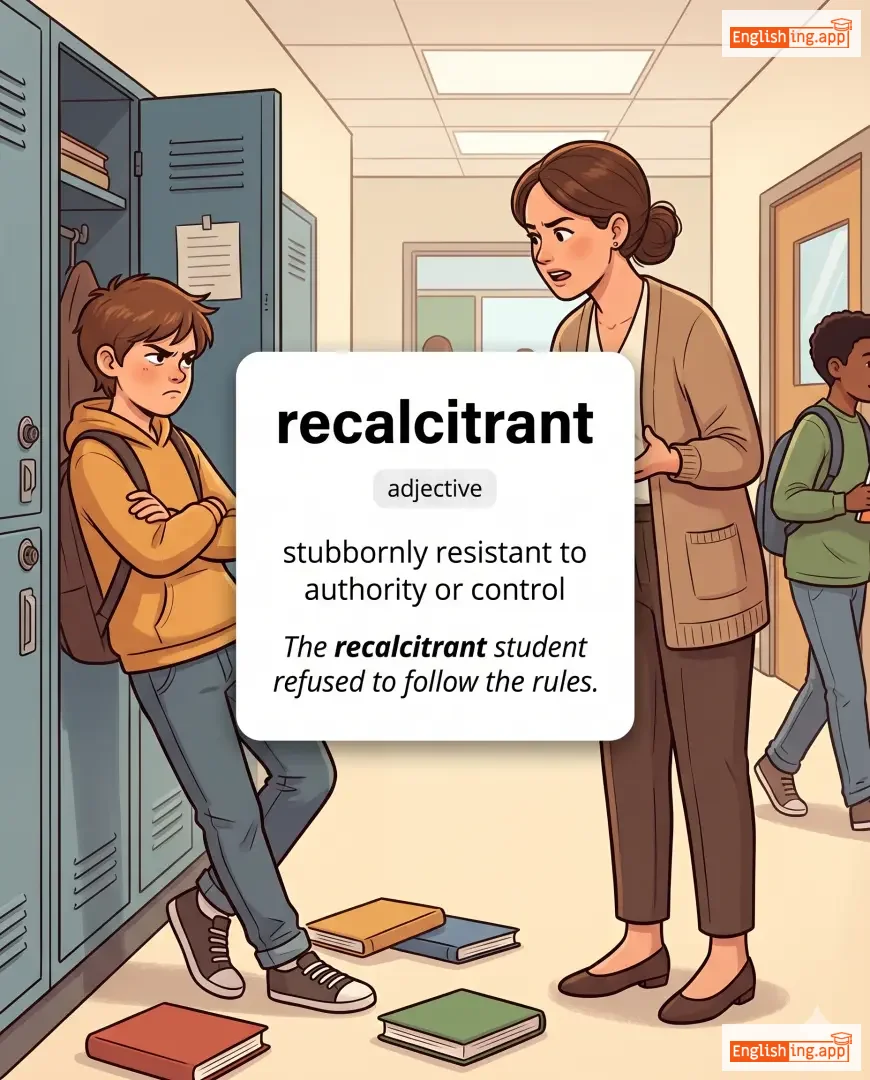
recalcitrant definition card — visual illustration of the meaning
adjective
/rɪˈkælsɪtrənt/

stubbornly resistant to authority or control

"The recalcitrant student refused to follow the rules."

recalibrate definition card — visual illustration of the meaning
verb
ˌriːˈkæl.ɪ.breɪt
重新校准 (chóngxīn xiàozhǔn)

To adjust or modify according to a new standard or plan; to reassess and realign.

"He had to recalibrate his strategy after the market crash."

"他在市场崩盘后不得不重新校准他的战略。" (Tā zài shìchǎng bēngpán hòu bùdébù chóngxīn xiàozhǔn tā de zhànlüè.)
verb
/rɪˈkɔːl/
回忆 (huiyi)

to bring (a memory, fact, or situation) back into one's mind

"I can't recall the last time we met."

"我记不得我们上次见面是什么时候。" (Wǒ jì bù dé wǒmen shàng cì jiàn miàn shì shén me shí hòu.)
recant definition card — visual illustration of the meaning
verb
/rɪˈkænt/
撤回 (chèhuí)

to withdraw or renounce a statement or belief formally

"He recanted his previous statement in court."
"他在法庭上撤回了之前的陈述。" (Tā zài fǎtíng shàng chèhuí le zhīqián de chénshù.)
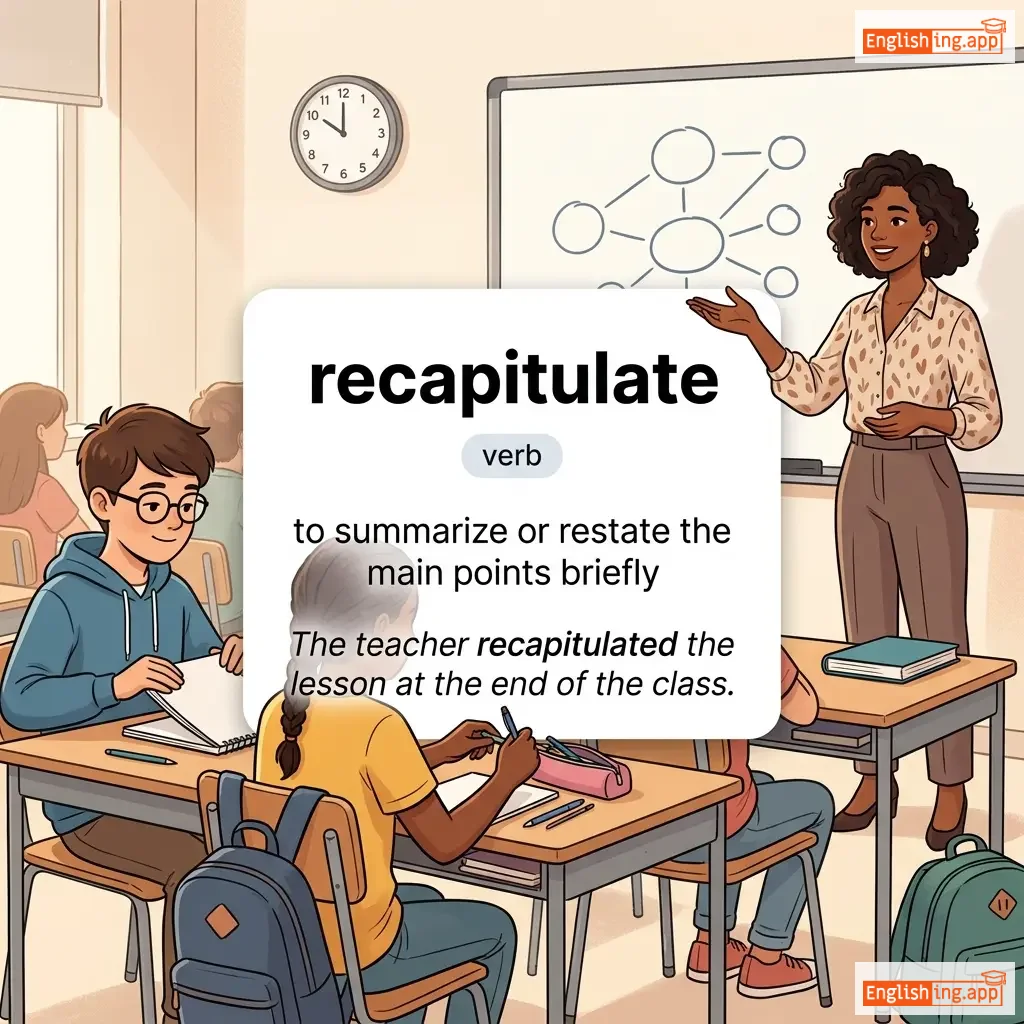
recapitulate definition card — visual illustration of the meaning
verb
/ˌriːkəˈpɪtjʊleɪt/
总结 (zongjie)

to summarize or restate the main points briefly

"The teacher recapitulated the lesson at the end of the class."

"老师在课堂结束时总结了课程内容。" (Laoshi zai keti kaishizhishi zongjie le kecheng neirong.)
noun
/ˌriːkəˌpɪtjʊˈleɪʃən/
重述 (chóngshù)

The act of summarizing or repeating the main points of something.

"The professor gave a brief recapitulation of the lecture before ending the class."

"教授在结束课程之前简要地重述了讲座内容。" (Jiàoshòu zài jiéshù kèchéng zhīqián jiǎnyào de chóngshùle jiǎngzuò nèiróng.)
verb
/riːˈkæptʃər/
重新夺回 (chong xīn duó huí)

To take back or regain possession of something.

"The army managed to recapture the lost territory."

"军队成功地重新夺回了失去的领土。" (Jūn duì chéng gōng de chóngxīn duó huí le shīqù de lǐngtǔ.)
verb
/ˌriːˈkæst/
重新选择演员 (chongxin xuanze yan yuan)

To present or change something in a different form or style.

"The director decided to recast the role with a younger actor."

"导演决定用一位年轻演员重新安排这个角色。" (Dao yan jue ding yong yi wei nian qing yan yuan chong xin an pai zhe ge jue se.)
verb
/rɪˈsiːd/
退去 (tuìqù)

To move back or further away from a previous position.

"The floodwaters began to recede after the heavy rain stopped."

"暴雨停止后,洪水开始退去。" (Bàoyǔ tíngzhǐ hòu, hóngshuǐ kāishǐ tuìqù.)
adjective, noun
/rɪˈsiːvəbl/
应收款项 (yīng shōu kuǎn xiàng)

Money that is owed to a company and is expected to be paid.

"The company's receivables increased significantly this quarter."

"公司的应收账款在本季度大幅增加。" (Gōngsī de yīng shōu zhàng kuǎn zài běn jìdù dàfú zēngjiā.)
receive definition card — visual illustration of the meaning
verb
/rɪˈsiːv/
接收 (jiēshōu)

To get or be given something; to accept something offered.

"She received a letter from her friend."

"她收到了朋友的一封信。" (Tā shōu dào le péngyǒu de yī fēng xìn.)
noun
/rɪˈsiːvər/
接收器 (jieshouqi)

a person or device that receives something such as a signal, message, or object

"The radio receiver picks up signals from distant stations."

"收音机接收器从远处的电台接收信号。" (Shouyinji jieshouqi cong yuanchu de diantai jieshou xinhao.)
adjective
/ˈriːsənt/
最近的 (zui jin de)

having happened or started only a short time ago

"The recent developments have been quite exciting."

"最近的发展非常令人兴奋。" (Zuìjìn de fāzhǎn fēicháng lìng rén xīngfèn.)
adverb
/ˈriːsəntli/
最近 (zuìjìn)

in the recent past; not long ago

"I recently visited the museum."

"我最近参观了博物馆。" (Wǒ zuìjìn cānguānle bówùguǎn.)
noun
/rɪˈsepʃən/
接待 (jiēdài)

the act of receiving something or someone; a formal social gathering

"We attended a wedding reception at the hotel."

"我们参加了酒店的婚礼接待。" (Wǒmen cānjiāle jiǔdiàn de hūnlǐ jiēdài.)
adjective
/rɪˈsɛptɪv/
善于接受 (shan yu jie shou)

Willing to listen to or accept new ideas, suggestions, or experiences.

"She was receptive to feedback from her colleagues."

"她对同事们的反馈持开放态度。" (Ta dui tongshi men de feedback chi kaifang taidu.)
receptivity definition card — visual illustration of the meaning
noun
/rɪˌsɛptɪˈvɪti/
接受能力 (jiē shòu néng lì)

The ability or willingness to receive something, especially signals or stimuli.

"Her receptivity to new ideas helped improve the project."

"她对新思想的接受能力帮助改善了项目。" (Tā duì xīn sīxiǎng de jiēshòu nénglì bāngzhù gǎishànle xiàngmù.)
noun
/rɪˈsɛs/
休息 (xiūxí)

A short break from work or school; also a small space set back in a wall.

"The children played outside during recess."

"孩子们在休息期间在外面玩耍。" (Háizimen zài xiūxí qījiān zài wàimiàn wánshuǎ.)
recession definition card — visual illustration of the meaning
noun
/rɪˈsɛʃən/

A period of temporary economic decline during which trade and industrial activity are reduced.

"The country is facing a severe recession."

recessionary definition card — visual illustration of the meaning
adjective
rɪˈsɛʃ.ən.er.i
衰退的 (shuāituì de)

Relating to or characterized by economic recession.

"Governments introduce policies to counter recessionary effects."

"政府推出政策来应对衰退效应。" (Zhèngfǔ tuīchū zhèngcè lái yìngduì shuāituì xiàoyìng.)
adjective
/rɪˈsɛsɪv/
隐性 (yinxing)

In genetics, relating to a trait that is expressed only when two copies of the gene are present.

"Blue eye color is often a recessive trait."

"蓝色眼睛的颜色通常是隐性特征。" (Lansè yǎnjīng de yánsè tōngcháng shì yǐnxìng tèzhēng.)
adjective
/rəˈʃɛrʃ/
稀有 (xīyǒu)

Rare, exotic, or obscure, often in a sophisticated or refined way.

"The gallery displayed many recherche artworks from unknown artists."

"画廊展示了许多未知艺术家的稀有艺术作品。" (Huàláng zhǎnshìle xǔduō wèi zhī yìshùjiā de xīyǒu yìshù zuòpǐn.)
noun
/rɪˈsɪdɪˌvɪzəm/

The tendency of a convicted criminal to reoffend or relapse into criminal behavior.

"The government introduced new programs to reduce recidivism among former inmates."

noun
/rɪˈsɪdɪvɪst/
重犯 (chóngfàn)

A person who repeatedly commits crimes, especially after having been punished.

"The police identified him as a recidivist who had been arrested several times before."

"警方将他确定为一个重犯,他之前曾被多次逮捕。" (Jǐngfāng jiāng tā quèdìng wèi yīgè chóngfàn, tā zhīqián céng bèi duōcì dàibǔ.)
noun
/ˈrɛsɪpi/
食谱 (shipu)

a set of instructions for preparing a particular dish, including a list of the ingredients required

"I found a great recipe for chocolate cake."

"我找到了一个很棒的巧克力蛋糕食谱。" (Wo zhaodao le yige hen bang de qiaokeli dangao shipu.)
noun
/rɪˈsɪpiənt/
接受者 (jie shou zhe)

A person who receives something, such as an award, gift, or message.

"She was the recipient of the award for best performance."

"她是最佳表现奖项的接受者。" (Ta shi zui jia biao xian jiang xiang de jie shou zhe.)
adjective
/rɪˈsɪprəkəl/
互惠的 (hùhuì de)

Given, felt, or done in return; mutual.

"Their relationship is based on reciprocal respect and trust."

"他们的关系基于互惠的尊重和信任。" (Tāmen de guānxi jīyú hùhuì de zūnzhòng hé xìnrèn.)
verb
/rɪˈsɪprəˌkeɪt/
回应 (huíyìng)

To respond to an action or gesture by making a corresponding one.

"She smiled at him, and he reciprocated with a warm hug."

"她对他微笑,他以温暖的拥抱回应。" (Tā duì tā wēixiào, tā yǐ wēnnuǎn de yōngbào huíyìng.)
reciprocity definition card — visual illustration of the meaning
noun
/ˌrɛsɪˈprɒsɪti/
互惠 (hùhuì)

The practice of exchanging things with others for mutual benefit.

"Friendships are often based on reciprocity and trust."

"友谊往往基于互惠和信任。" (Yǒuyì wǎngwǎng jīyú hùhuì hé xìnrèn.)
noun
/rɪˈsaɪtl/
独奏会 (duzoushui)

A performance of music, dance, or poetry, usually by a soloist.

"She gave a piano recital at the concert hall."

"她在音乐会中举办了钢琴独奏会。" (Ta zai yinyuehui zhong jubanle gangqin duzoushui.)
noun
/ˌrɛsɪˈteɪʃən/
朗诵 (lǎngsòng)

The act of reading or repeating something aloud, especially poetry or passages.

"The student won the prize for her poetry recitation."

"学生因她的诗歌朗诵获得了奖项。" (Xuéshēng yīn tā de shīgē lǎngsòng huòdéle jiǎngxiàng.)