词汇表

英语词汇词典 | 单词含义、定义和示例

noun
/ˌræm.ɪ.fɪˈkeɪ.ʃən/
后果 (houguo)

a consequence of an action or event, often complex or unwelcome.

"The new law has serious social ramifications."

"新法律有严重的社会后果。" (Xin falü you yanzhong de shehui houguo.)
verb
/ˈræm.ɪ.faɪ/
分支 (fenzhi)

to spread or branch out into divisions or subdivisions.

"The river ramifies into several smaller streams."

"河流分支成多个较小的溪流。" (Héliú fēnzhī chéng duō gè jiào xiǎo de xīliú.)
adjective
/ˈreɪ.moʊs/
分枝的 (fēnzhī de)

having many branches.

"The ramose tree shaded the entire garden."

"这棵分枝的树为整个花园提供了阴凉。" (Zhè kē fēnzhī de shù wèi zhěnggè huāyuán tígōngle yīnliáng.)
noun, verb
/ræmp/
坡道 (pō dào)

a sloping surface joining two different levels; as a verb, to increase or rise sharply

"The car drove up the ramp into the parking garage."

"汽车驶上了停车场的坡道。" (qìchē shǐ shàng le tíngchē chǎng de pō dào.)
adjective
/ˈræmpənt/
猖獗 (changjue)

existing or spreading unchecked, often in an undesirable way

"Corruption was rampant in the city administration."

"腐败在市政府中蔓延。" (Fubai zai shì zhèngfǔ zhōng mànyán.)
noun
/ˈræmpɑːrt/
城墙 (chengqiang)

a defensive wall of a castle or fort

"The soldiers stood on the rampart, watching the enemy approach."

"士兵们站在城墙上,观察着敌人的接近。" (Shibing men zhan zai chengqiang shang, guancha zhe diren de jiejin.)
adjective
/ˈræmʃækəl/
破旧 (pojiu)

poorly built or maintained; in a state of disrepair

"They lived in a ramshackle old house on the edge of town."

"他们住在城市边缘的一座破旧老房子里。" (Tāmen zhù zài chéngshì biānyuán de yīzuò pòjiù lǎo fángzi lǐ.)
noun
/ræntʃ/
牧场 (mùchǎng)

a large farm where animals such as cattle or sheep are raised

"They own a huge cattle ranch in Texas."

"他们在德克萨斯州拥有一个巨大的牧场。" (Tāmen zài Dékè sà sī zhōu yǒngyǒu yīgè jùdà de mùchǎng.)
adjective
/ˈrænsɪd/
变质的 (bianzhide)

having a bad taste or smell due to being old or spoiled (especially fats or oils)

"The butter had gone rancid after being left out too long."

"黄油放得太久,变质了。" (Huángyóu fàng dé tài jiǔ, bian zhì le.)
noun
/ˈræŋ.kər/
怨恨 (yuan hen)

A feeling of deep and bitter anger or resentment.

"There was a rancor between the two rivals that never faded."

"这两位对手之间有一种怨恨,永远没有消失。" (Zhe liang wei duishou zhijian you yizhong yuan hen, yongyuan mei you xiaoshi.)
adjective
/ˈræŋ.kər.əs/
充满怨恨的 (chōngmǎn yuànhèn de)

Characterized by bitterness or resentment.

"Their rancorous debate lasted for hours."

"他们充满怨恨的辩论持续了几个小时。" (Tāmen chōngmǎn yuànhèn de biànlùn chíxù le jǐ gè xiǎoshí.)
adjective
/ˈræn.dəm/
随机 (suíjī)

Made, done, or happening without method or conscious decision.

"He made a random choice from the menu."

"他从菜单中做了一个随机选择。" (Tā cóng cài dān zhōng zuòle yīgè suíjī xuǎnzé.)
verb
/ˈræn.də.maɪz/
随机化 (suíjī huà)

To make something happen in a random order or manner.

"The software can randomize the order of questions."
"软件可以随机排列问题的顺序。" (Ruǎnjiàn kěyǐ suíjī páiliè wèntí de shùnxù.)
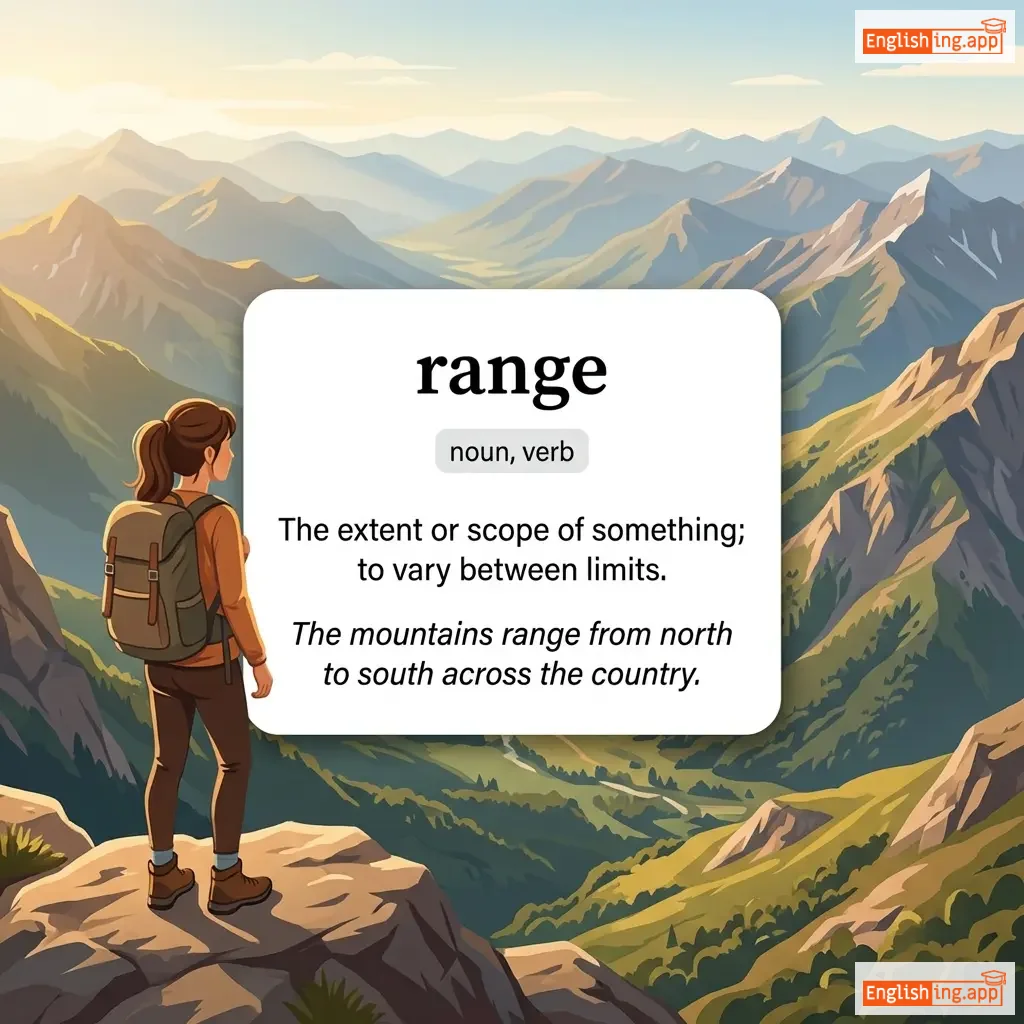
range definition card — visual illustration of the meaning
noun, verb
/reɪndʒ/
范围, 领域 (fanwei, lingyu)

The extent or scope of something; to vary between limits.

"The mountains range from north to south across the country."

"这些山脉从北到南贯穿全国。" (Zhe xie shanmai cong bei dao nan guanchuan quan guo.)
noun
/ˈreɪn.dʒər/
巡护员 (xún hù yuán)

A person responsible for protecting and managing forests, parks, or natural areas.

"The park ranger guided the tourists through the forest trail."

"公园巡护员带领游客走过森林小道。" (Gōngyuán xún hù yuán dàilǐng yóukè zǒuguò sēnlín xiǎodào.)
verb
/ˈreɪn.dʒɪŋ/
波动 (bōdòng)

Extending or varying between limits.

"The temperatures are ranging from 15 to 30 degrees this week."

"本周气温在15到30度之间波动。" (Běn zhōu qìwēn zài 15 dào 30 dù zhījiān bōdòng.)
noun
/ræŋˈɡuːn ˈkriːpər/
缅甸爬山虎 (miǎn diàn pá shān hǔ)

A climbing vine with fragrant flowers that change color from white to pink to red

"The Rangoon creeper covered the entire fence with its sweet-smelling flowers."

"缅甸爬山虎用它甜美的花朵覆盖了整个篱笆。" (miǎn diàn pá shān hǔ yòng tā tián měi de huā duǒ fù gài le zhěng gè lí bā.)
noun, verb, adjective
/ræŋk/
职级 (zhijí)

A position in a hierarchy; to place in order according to importance or quality.

"She quickly rose to a senior rank in the company."

"她迅速晋升为公司中的高级职位。" (Ta xunsu jinsheng wei gongsi zhong de gaoji zhiwei.)
noun
/ˈræŋkɪŋ/
排名 (paiming)

a position in a list or hierarchy, especially in terms of performance or importance

"His ranking in the competition improved after each round."

"他在比赛中的排名在每一轮之后都有所提高。" (Ta zai bisai zhong de paiming zai mei yi lun zhihou dou you suo tigao.)
verb
/ˈræŋ.kəl/
激怒 (jī nù)

To cause continuing annoyance or resentment.

"His unfair criticism continued to rankle her for days."

"他的不公正批评持续了好几天,令她不快。" (Tā de bù gōng zhèng pīpíng chíxù le hǎo jǐ tiān, lìng tā bù kuài.)
noun, verb
/ræŋks/
军衔 (jūnxián)

Positions within a group, especially in a hierarchy or organization.

"He quickly moved up the ranks of the army."

"他迅速在军队中晋升。" (Tā xùnsù zài jūnduì zhōng jìnshēng.)
verb
/ˈræn.sæk/
洗劫 (xijié)

to search a place roughly and steal or damage things

"Burglars ransacked the house while the family was away."

"盗贼在家人不在时洗劫了房子。" (Dàozéi zài jiārén bù zài shí xǐjié le fángzi.)
verb
/rænt/
大喊大叫 (dà hǎn dà jiào)

to speak or shout in an angry, uncontrolled way

"He ranted about the unfair treatment at work."

"他在工作中大声抱怨不公正的待遇。" (Tā zài gōngzuò zhōng dà shēng bàoyuàn bù gōngzhèng de dàiyù.)
adjective
/rəˈpeɪ.ʃəs/
贪婪 (tanlan)

having an extreme desire to take things for oneself, greedy

"The rapacious landlord raised the rent without reason."

"贪婪的房东无缘无故地提高了租金。" (Tanlan de fangdong wu yuan wu gu di tigao le zujin.)
verb
/reɪp/
强奸 (qiángjiān)

to force someone to have sexual intercourse without their consent

"The law strictly punishes those who commit rape."

"法律严惩那些犯强奸罪的人。" (Fǎlǜ yánchěng nàxiē fàn qiángjiān zuì de rén.)
adjective
/ˈræp.ɪd/
快速 (kuai su)

happening quickly or in a short time

"The company experienced rapid growth last year."

"公司去年经历了快速增长。" (Gongsi qunian jingli le kuai su zengzhang.)
noun
/rəˈpɪdəti/
迅速 (xunsu)

The quality of moving or happening quickly; swiftness or speed.

"The rapidity of technological change is astonishing."

"技术变化的速度令人震惊。" (Jishu bianhua de sudu lingren zhenjing.)
adverb
/ˈræpɪdli/
迅速 (xùnsù)

occurring quickly and with speed

"The car moved rapidly through the crowded streets."

"汽车快速通过拥挤的街道。" (Qìchē kuàisù tōngguò yōngjǐ de jiēdào.)
noun
/ˈræp.aɪn/
掠夺 (lüèduó)

the violent seizure of someone's property

"The war was marked by rapine and destruction."
"这场战争以掠夺和破坏为标志。" (Zhè chǎng zhànzhēng yǐ lüèduó hé pòhuài wéi biāozhì.)
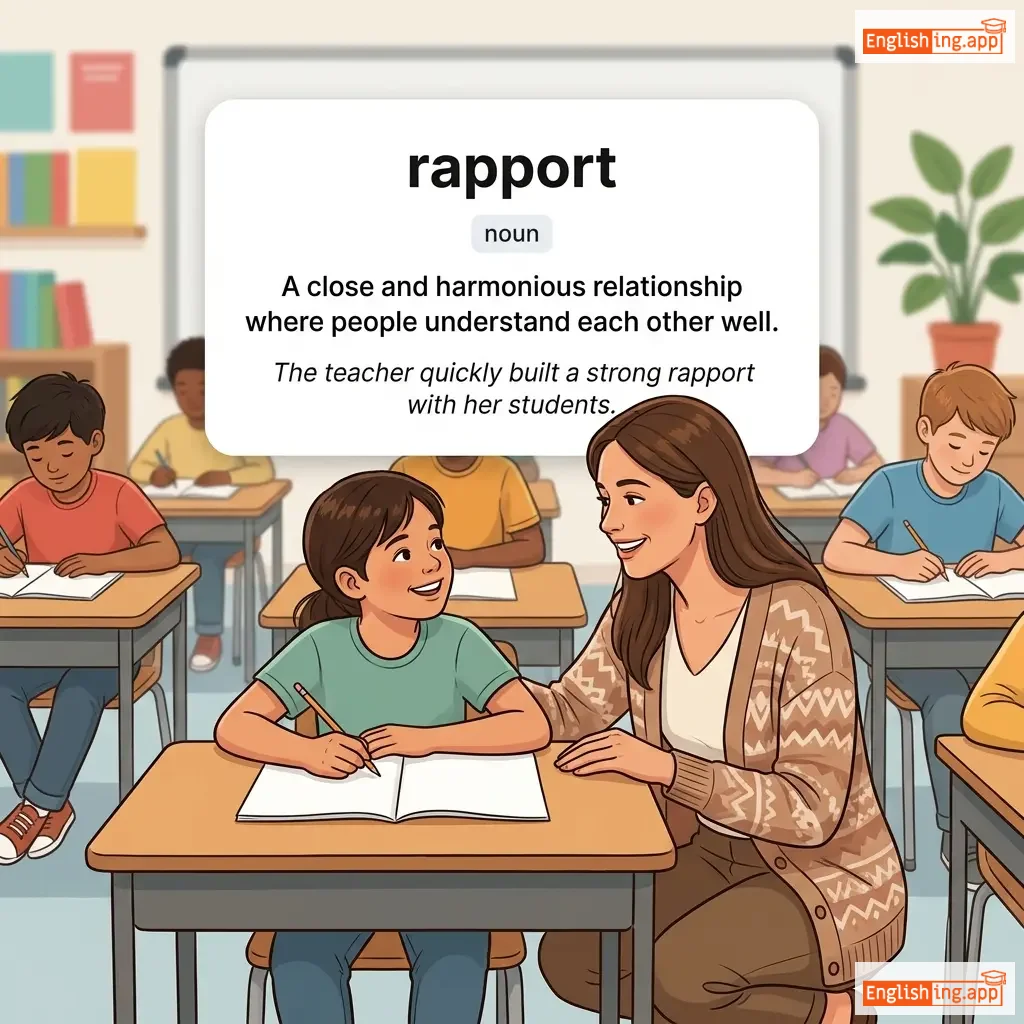
rapport definition card — visual illustration of the meaning
noun
/ræˈpɔːr/
关系 (guanxi)

A close and harmonious relationship where people understand each other well.

"The teacher quickly built a strong rapport with her students."

"老师与学生们迅速建立了良好的关系。" (Laoshi yu xueshengmen xunsu jianli le lianghao de guanxi.)
noun
/ˌræproʊʃˈmɑːn/
关系恢复 (guanxi huifu)

The establishment or resumption of harmonious relations.

"The two countries signed an agreement that marked a new rapprochement."

"两个国家签署了一项协议,标志着新的关系恢复。" (Liǎng gè guójiā qiānshǔle yī xiàng xiéyì, biāozhìzhe xīn de guānxì huīfù.)
noun
/ræpˈskæliən/
顽皮的人 (wanpi de ren)

A mischievous or cheeky person; a rascal.

"The little rapscallion hid his brother’s shoes as a prank."

"这个小拉普斯卡里昂把他哥哥的鞋子藏起来,做了个恶作剧。" (Zhege xiao rapscallion ba ta gege de xiezi cang qi lai, zuo le ge ezuojv.)
adjective
/ræpt/
专心 (zhuānxīn)

Completely absorbed or fascinated by something.

"She listened with rapt attention to the speaker’s words."

"她全神贯注地听着演讲者的话。" (tā quán shén guàn zhù de tīngzhe yǎnjiǎng zhě de huà.)
adjective
/ræpˈtɔːriəl/
猛禽 (měng qín)

Relating to birds of prey or predatory behavior.

"The eagle is a raptorial bird with sharp talons."

"鹰是一个猛禽,拥有锋利的爪子。" (Yīng shì yīgè měng qín, yǒngyǒu fēnglì de zhǎozi.)
noun
/ˈræp.tʃər/
狂喜, 欣喜若狂 (kuangxi, xinxiruokuang)

A feeling of intense joy, delight, or ecstasy.

"She listened to the music in rapture."

"她沉浸在音乐中,陶醉其中。" (Ta chenjin zai yinyue zhong, taozui qi zhong.)
adjective
/reər/
稀有 (xiyou)

Unusual or uncommon; not occurring often.

"This species of bird is extremely rare."

"这种鸟类极为稀有。" (Zhe zhong niaolei jiwei xiyou.)
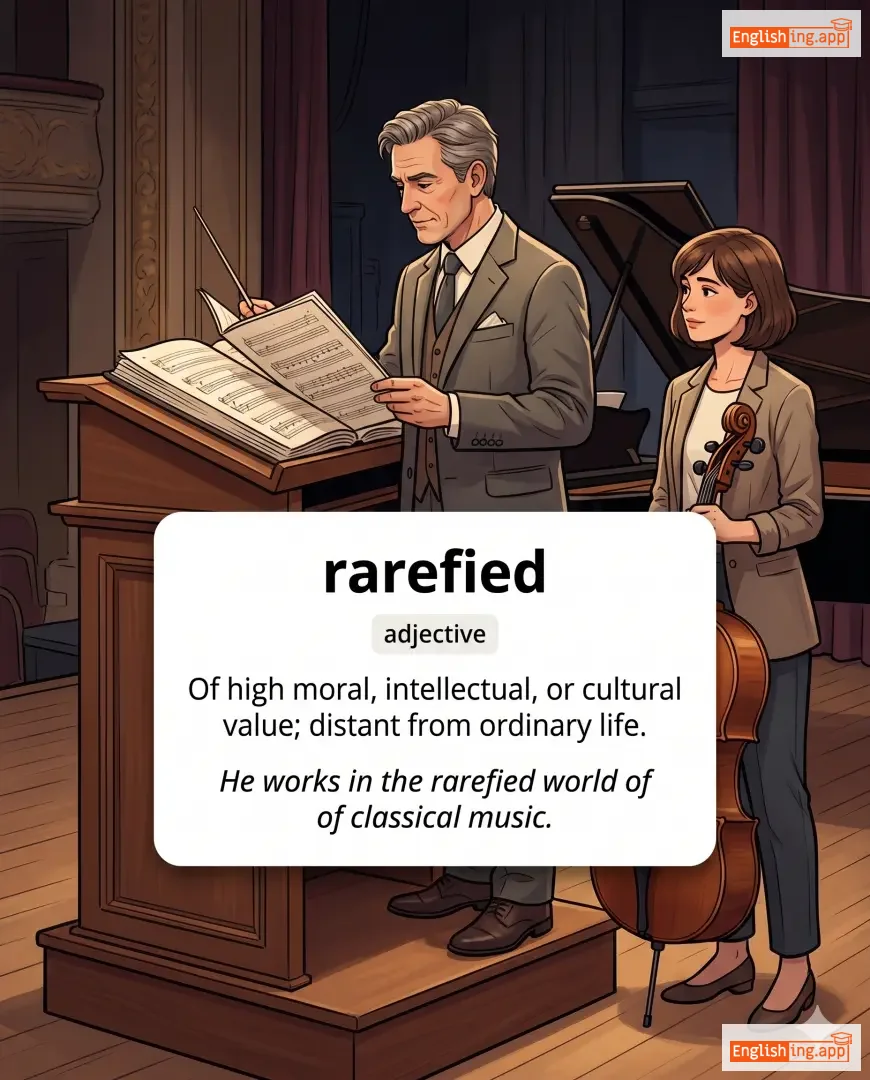
rarefied definition card — visual illustration of the meaning
adjective
/ˈreə.rɪ.faɪd/

Of high moral, intellectual, or cultural value; distant from ordinary life.

"He works in the rarefied world of classical music."

verb
/ˈreə.rɪ.faɪ/
稀释, 精炼 (xīshì, jīngliàn)

To make something less dense or more refined.

"The air rarefies as you climb higher into the mountains."

"随着你爬得更高,空气变得更稀薄。" (Suízhe nǐ pá dé gèng gāo, kōngqì biàn dé gèng xībó.)
adverb
/ˈrɛə(r)li/
很少 (hen shao)

not often, infrequently

"She rarely eats sweets because of her diet."

"她因为饮食限制,很少吃糖果。" (Ta yinwei yinshi xianzhi, hen shao chi tangguo.)
noun
/ˈrerəti/
稀有的状态; 不常见或稀缺的东西 (xī yǒu de zhuàngtài; bù chángjiàn huò xīquē de dōngxī)

the state of being rare; something that is uncommon or scarce

"The antique vase was a rarity worth thousands of dollars."

"古董花瓶是一种稀有物品,价值数千美元。" (gǔdǒng huāpíng shì yī zhǒng xīyǒu wùpǐn, jiàzhí shù qiān měiyuán.)
adjective
/ræʃ/
草率, 鲁莽 (caoluo, lumang)

Acting quickly without careful consideration; reckless.

"It was a rash decision to invest without research."

"没有研究就投资是一个鲁莽的决定。" (Meiyou yanjiu jiu touzi shi yige lumang de jueding.)
🔧

rasp

verb
/ræsp/

to speak in a rough, harsh voice or to scrape with a coarse sound

"He rasped out a warning before collapsing."

adjective
/ˈræspi/
沙哑 (shaya)

having a harsh, rough, or grating sound

"His raspy voice revealed years of smoking."

"他的沙哑声音揭示了多年的吸烟。" (Tā de shāyǎ shēngyīn jiēshìle duōnián de xīyān.)
noun
/ræt/
老鼠 (laoshu)

a small rodent that resembles a large mouse, often considered a pest

"A rat ran across the kitchen floor last night."

"一只老鼠昨晚在厨房的地板上跑过。" (yi zhi laoshu zuowan zai chufang de diban shang paoguo.)
noun
/reɪt/
费率 (feilü)

the cost or price of something, or the amount at which something happens

"The rate of inflation is increasing every year."

"通货膨胀率每年都在上升。" (Tōnghuò péngzhàng lǜ měi nián dōu zài shàngshēng.)
adverb
/ˈræðər/
在大多数情况下 (zài dàduōshù qíngkuàng xià)

to a certain extent or degree

"I would rather stay home than go out."

"我宁愿呆在家里,也不愿外出。" (Wǒ nìngyuàn dāi zài jiālǐ, yě bù yuàn wàichū.)
noun
/ˌrætɪfɪˈkeɪʃən/
批准 (pīzhǔn)

the action of signing or giving formal consent to a treaty, contract, or agreement

"The treaty required ratification by both countries' parliaments."

"该条约要求两国议会的批准。" (gāi tiáoyuē yāoqiú liǎng guó yìhuì de pīzhǔn.)
verb
/ˈrætɪfaɪ/
批准 (pīzhǔn)

to approve or confirm something officially, usually by law or formal consent

"The government ratified the trade agreement."

"政府批准了贸易协议。" (Zhèngfǔ pīzhǔnle màoyì xiéyì.)
noun
/ˈreɪtɪŋ/
评分 (pingfen)

an evaluation or assessment, usually numerical

"The movie received a high rating from critics."

"这部电影得到了评论家的高评分。" (Zhe bu dianying dedaole pinglunjia de gao pingfen.)
noun
/ˈreɪʃoʊ/
比例 (bǐlì)

a relationship between two numbers showing how many times the first number contains the second

"The ratio of boys to girls in the class is 2:1."

"班级中男生和女生的比例是2:1。" (Bānjí zhōng nánshēng hé nǚshēng de bǐlì shì 2:1.)