词汇表

英语词汇词典 | 单词含义、定义和示例

verb
/rʌʃ/
匆忙 (cōngmáng)

to move or act with great speed or urgency

"She had to rush to the meeting to make it on time."

"她必须赶紧去会议才能准时到达。" (Tā bìxū gǎnjǐn qù huìyì cáinéng zhǔnshí dào dá.)
noun
/rʌsk/
干饼干;烤面包 (rusk)

a hard, dry biscuit or twice-baked bread; a type of crisp, sweet biscuit

"The baby enjoyed eating the soft rusk with milk."

"宝宝喜欢吃奶时吃软脆饼干。" (Bǎobǎo xǐhuān chī nǎi shí chī ruǎn cuì bǐnggān.)
🇷🇺

russian

adjective
/ˈrʌʃən/

relating to Russia, its people, or its language

"She is studying the Russian language at university."

noun
/rʌst/
铁锈 (tie xiu)

reddish-brown coating formed on iron or steel by oxidation; corrosion

"The old car was covered in rust after years of neglect."

"那辆旧车在多年忽视之后被铁锈覆盖。" (na liang jiu che zai duo nian hu shi zhi hou bei tie xiu fu gai.)
adjective
/ˈrʌstɪk/
乡村的 (xiangcun de)

Relating to the countryside; simple and unsophisticated.

"The cottage had a rustic charm with its wooden beams and stone fireplace."

"这座小屋有着乡村的魅力,木梁和石壁炉。" (Zhe zuo xiaowu youzhe xiangcun de mei li, mù liáng hé shí bì lǘ.)
verb
/ˈrʌstɪkeɪt/
去乡村 / 从大学暂时开除 (Qu xiāngcūn / cóng dàxué zàntí kāichú)

To go to the countryside or to suspend someone from university.

"He decided to rusticate in the village to escape the busy city life."

"他决定去乡村生活以逃避繁忙的城市生活。" (Tā juédìng qù xiāngcūn shēnghuó yǐ táobì fánmáng de chéngshì shēnghuó.)
verb
/ˈrʌsl/
沙沙作响 (shasha zuo xiang)

To make a soft, light sound like leaves or paper moving.

"The leaves rustled gently in the evening breeze."

"树叶在傍晚的微风中轻轻地沙沙作响。" (Shuye zai bangwan de weifeng zhong qingqing de shasha zuo xiang.)
adjective
/ˈrʌs.ti/
生锈的; 不熟练的; 由于缺乏近期练习而受损 (sheng xiu de; bu shu lian de; you yu que fa jin qi lian xi er shou sun)

affected by rust; out of practice; impaired by lack of recent practice

"My piano skills are rusty after not playing for years."

"我的钢琴技巧生锈了,因为多年没有练习。" (wo de gangqin jiqiao sheng xiu le, yinwei duonian meiyou lianxi.)
noun
/ruːθ/
同情 (tóngqíng)

A feeling of pity, compassion, or sorrow.

"He felt no ruth for the people he had betrayed."

"他对他曾经背叛的人没有任何同情。" (Tā duì tā céngjīng bèipàn de rén méiyǒu rènhé tóngqíng.)
adjective
/ˈruːθləs/
无情的 (wúqíng de)

Having or showing no pity or compassion for others.

"The ruthless leader crushed all opposition."
"无情的领导者粉碎了所有反对。" (Wúqíng de lǐngdǎo zhě fěnsuìle suǒyǒu fǎnduì.)
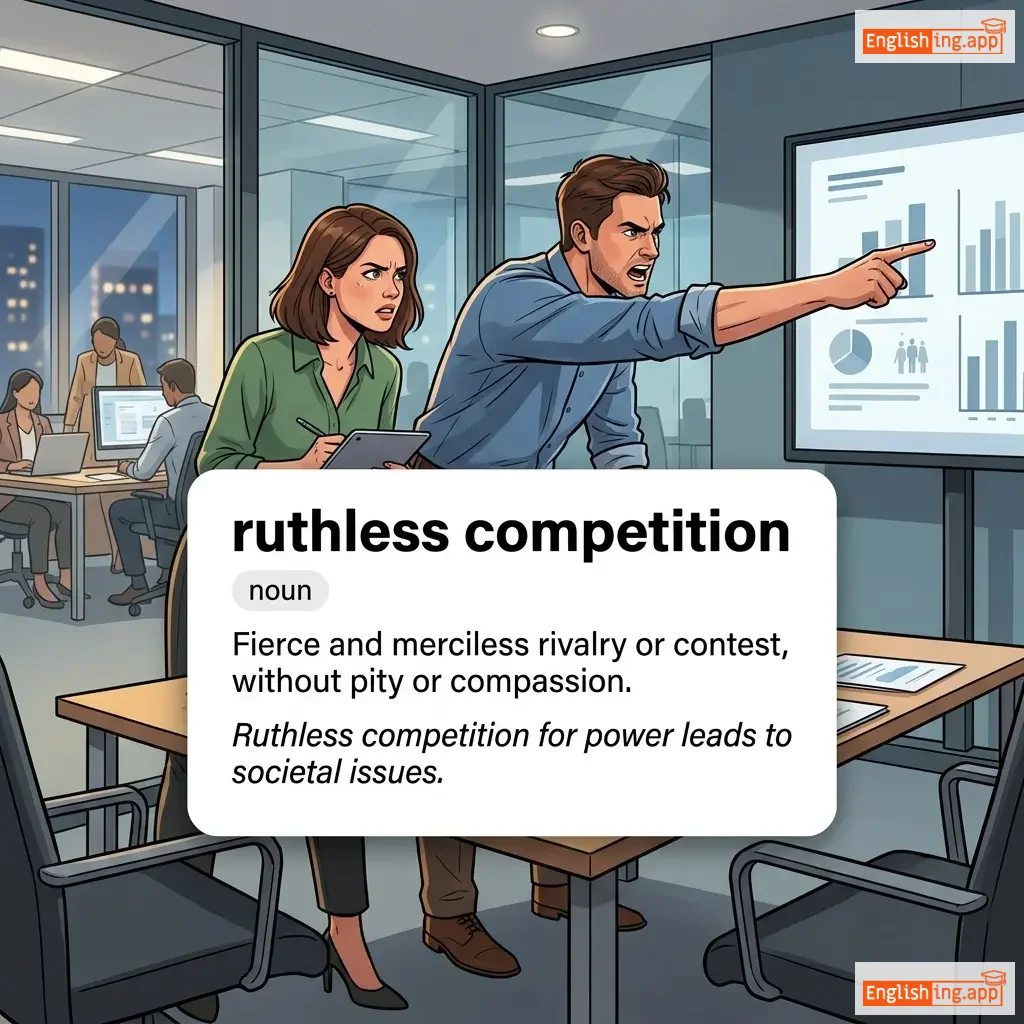
ruthless competition definition card — visual illustration of the meaning
noun
ˈruθləs ˌkɑmpəˈtɪʃən
无情的竞争 (wúqíng de jìngzhēng)

Fierce and merciless rivalry or contest, without pity or compassion.

"Ruthless competition for power leads to societal issues."

"为了权力的无情竞争导致了社会问题。" (wèile quánlì de wúqíng jìngzhēng dǎozhìle shèhuì wèntí.)