词汇表

英语词汇词典 | 单词含义、定义和示例

noun
/ruːˈtiːn/
常规,定期遵循的行动序列 (changgui, dingqi zunxun de xingdong xu lie)

a sequence of actions regularly followed; a fixed program

"She follows a strict morning routine before work."

"她在上班前遵循严格的早晨常规。" (Ta zai shangban qian zunxun yange de zaoshang changgui.)
adverb
/ruːˈtiːnli/
定期地 (dìngqī de)

as part of a regular procedure; habitually

"The staff routinely checks the equipment for safety."

"工作人员定期检查设备的安全性。" (Gōngzuò rényuán dìngqī de jiǎnchá shèbèi de ānquánxìng.)
rover definition card — visual illustration of the meaning
noun
ˈrəʊvə
探测车 (tàncèchē)

A vehicle for driving over rough terrain, especially one driven by remote control over extraterrestrial terrain.

"The rover landed on Mars to begin its exploration."

"探测车在火星上着陆,开始了它的探索任务。" (Tàncèchē zài huǒxīng shàng zhuólù, kāishǐle tā de tànsuǒ rènwù.)
noun, verb
/raʊ/ (argument), /roʊ/ (line of things)
排 / 争吵 (pái / zhēngchǎo)

A line of things or people; also, a noisy quarrel; to propel a boat with oars.

"They had a loud row about money."

"他们就钱大声争吵。" (Tāmen jiù qián dàshēng zhēngchǎo.)
adjective
/ˈraʊdi/
吵闹的 (chaonao de)

Noisy and disorderly; rough and disruptive

"The rowdy crowd made it hard to hear the speaker."

"嘈杂的人群让人很难听到演讲者。" (Caozao de renqun rang ren hen nan tingdao yanjiangzhe.)
adjective
/ˈrɔɪəl/
皇家 (huángjiā)

relating to a king, queen, or other member of a royal family

"They attended a royal ceremony at the palace."
"他们参加了宫殿里的皇家仪式。" (Tāmen cānjiāle gōngdiàn lǐ de huángjiā yíshì.)
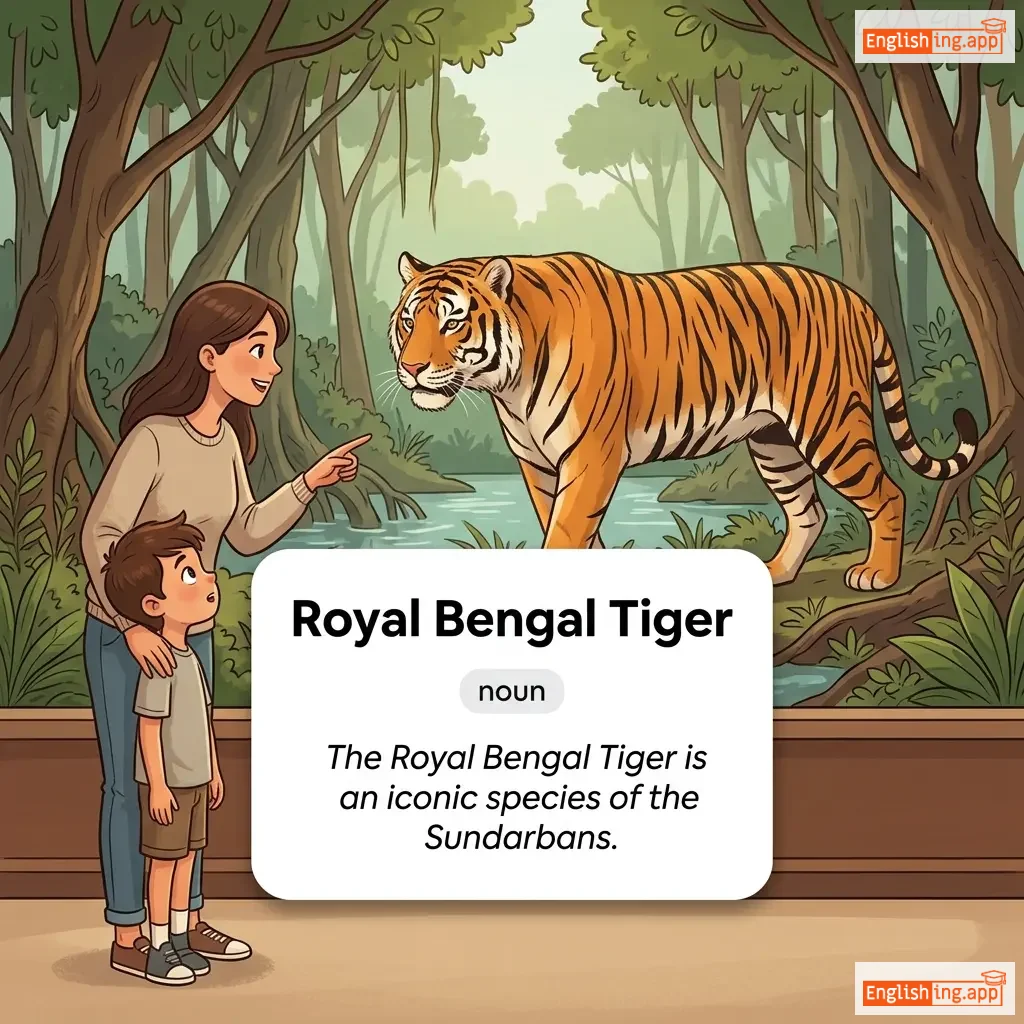
Royal Bengal Tiger definition card — visual illustration of the meaning
noun
ˈrɔɪəl ˈbɛŋɡəl ˈtaɪɡər
皇家孟加拉虎 (huángjiā mèngjiālā hǔ)

A subspecies of tiger found primarily in India and Bangladesh, known for its distinctive orange coat with black stripes.

"The Royal Bengal Tiger is an iconic species of the Sundarbans."

"皇家孟加拉虎是孙德班的标志性物种。" (Huángjiā mèngjiālā hǔ shì Sūndébān de biāozhìxìng wùzhǒng.)
noun
/ˈrɔɪəlti/
皇室成员 / 特许权使用费 (作者收入) (royalty)

Members of a royal family or payment made to the owner of a patent, copyright, or natural resource.

"The author receives a royalty for every book sold."

"作者从每本卖出的书中获得特许权使用费。" (zuozhe cong mei ben maichu de shu zhong huode texuquan shiyongfei.)
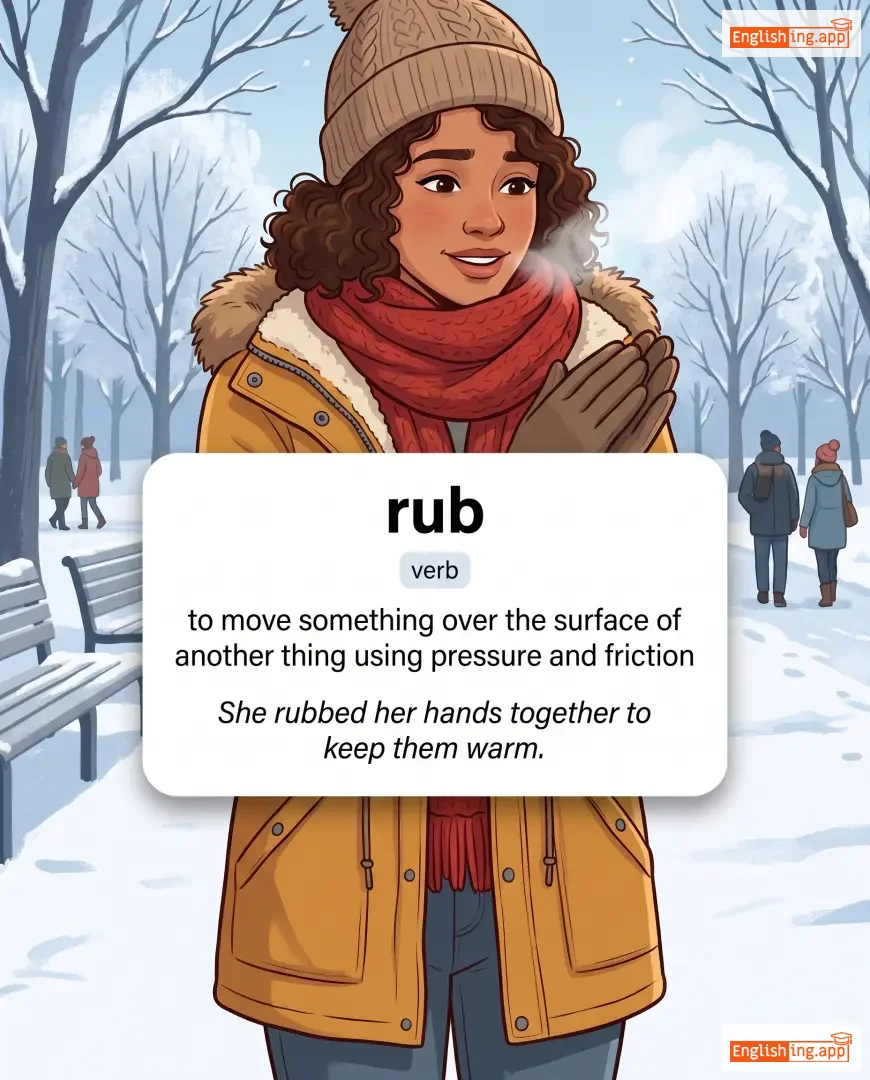
rub definition card — visual illustration of the meaning
verb
/rʌb/
(ca)

to move something over the surface of another thing using pressure and friction

"She rubbed her hands together to keep them warm."

"她把双手揉在一起以保持温暖。" (Tā bǎ shuāng shǒu róu zài yīqǐ yǐ bǎochí wēnnuǎn.)
noun
/ˈrʌbər/
幸福 (xìng fú)

a tough elastic substance made from the latex of tropical plants or synthetically, used for making tires, boots, and other products.

"The tires are made of natural rubber."

"她收到奖项时无法掩饰自己的幸福。" (Tā shōudào jiǎngxiàng shí wúfǎ yǎnshì zìjǐ de xìngfú.)
noun
/ˈrʌbɪʃ/
垃圾 (laji)

Waste material or unwanted things; something worthless

"He threw the broken toys into the rubbish bin."

"他把坏掉的玩具扔进了垃圾桶。" (Ta ba huai diao de wanju reng jin le laji tong.)
noun
/ˈrʌbəl/
瓦砾 (wǎlì)

Broken stone, bricks, or debris from a collapsed building or structure.

"The rescue team searched through the rubble after the earthquake."

"地震后,救援队在瓦砾中寻找。" (Dìzhèn hòu, jiùyuán duì zài wǎlì zhōng xúnzhǎo.)
adjective
/ˈruːbɪkənd/
红润的脸 (hóngrùn de liǎn)

Having a healthy reddish complexion.

"The old man’s rubicund face showed he was in good health."
"那位老人的红润脸庞显示他身体健康。" (Nà wèi lǎo rén de hóngrùn liǎn páng xiǎnshì tā shēntǐ jiànkāng.)
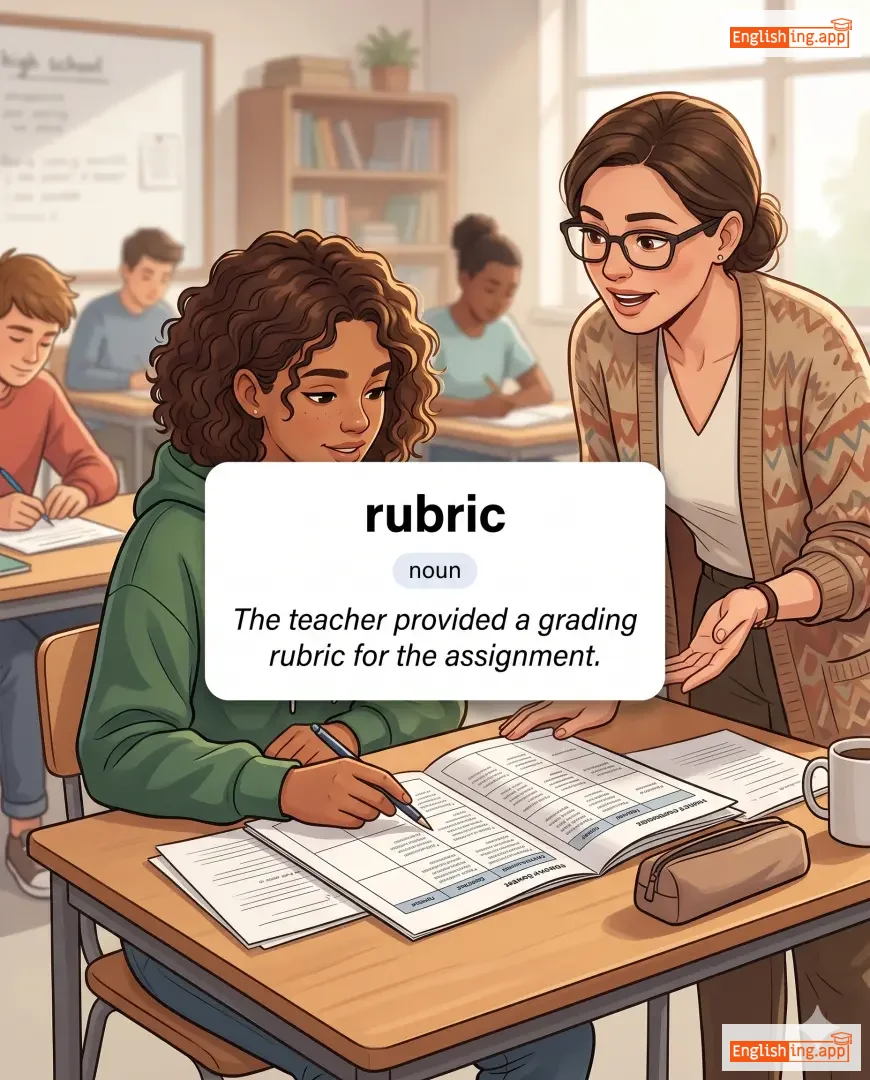
rubric definition card — visual illustration of the meaning
noun
/ˈruːbrɪk/
评分标准 / 指南 (rubrik)

A set of instructions, rules, or a heading in a document, often used for grading criteria.

"The teacher provided a grading rubric for the assignment."

"老师提供了一个作业评分标准。" (lǎoshī tígōngle yīgè zuòyè píngfēn biāozhǔn.)
noun
/ˈruː.bi/
红宝石 (roobee)

a precious red gemstone; a deep red variety of corundum

"The ruby ring was her most treasured possession."

"那枚红宝石戒指曾是她最珍贵的财物。" (na mei hong bao shi jie zhi ceng shi ta zui zhen gui de cai wu)
noun
/rʌk/
推搡; 混乱的人群 (tui shang; hunluan de renqun)

a situation where a crowd of people are pushing against each other; a disorderly crowd

"There was a ruck at the football match."

"足球比赛中发生了推搡。" (zuqiu bisai zhong fasheng le tuishang)
adjective
/ˈrʌdi/
红润 (hongrun)

Having a healthy red color in the face.

"She had a ruddy complexion from working outdoors."

"她因为在户外工作,脸上有红润的肤色。" (Ta yinwei zai huwai gongzuo, lian shang you hongrun de fuse.)
adjective
/ruːd/
粗鲁 (culu)

Not having or showing respect; impolite

"It was rude of him to interrupt the conversation."

"他打断谈话是很无礼的。" (tā dǎduàn tánhuà shì hěn wúlǐ de.)
adverb
/ˈruːdli/
无礼地 (wuli de)

in an impolite or discourteous manner

"He rudely interrupted the speaker during the presentation."

"他在演讲期间无礼地打断了发言者。" (Ta zai yanjiang qijian wuli de da duan le fayan zhe.)
noun
/ˈruːdnəs/
粗鲁 (cu-lu)

the quality of being impolite, discourteous, or offensive in behavior or speech

"His rudeness shocked everyone at the dinner party."

"他的粗鲁在晚宴上震惊了所有人。" (Tā de cūlǔ zài wǎnyàn shàng zhènjīng le suǒyǒu rén.)
noun
/ˈruːdɪmənt/
基础 (jichu)

A basic principle, element, or fundamental part of something.

"He learned the rudiments of music before joining the band."

"他在加入乐队之前学习了音乐的基础知识。" (Ta zai jiaru yuedui zhiqian xuexi le yinyue de jichu zhishi.)
adjective
/ˌruːdɪˈmɛntəri/
基础的 (jichu de)

Involving or limited to basic principles; elementary or simple.

"The village school provided only a rudimentary education."

"这个村庄学校只提供了基础教育。" (Zhège cūnzhuāng xuéxiào zhǐ tígōngle jīchǔ jiàoyù.)
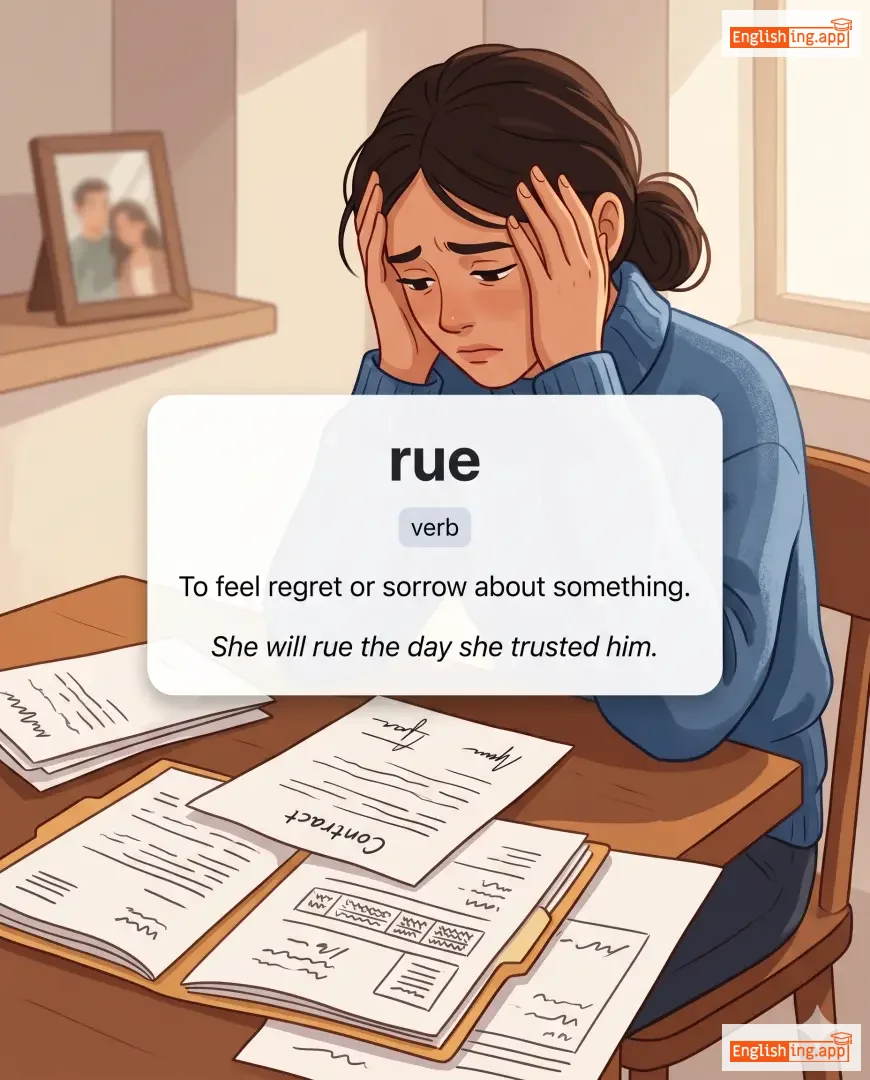
rue definition card — visual illustration of the meaning
verb
/ruː/
后悔 (hòuhuǐ)

To feel regret or sorrow about something.

"She will rue the day she trusted him."

"她将会后悔她信任他那一天。" (Tā jiāng huì hòuhuǐ tā xìnrèn tā nà yītiān.)
adjective
/ˈruːfəl/
遗憾的 (yíhàn de)

Expressing sorrow, regret, or pity.

"He gave a rueful smile after losing the match."

"他在输掉比赛后露出了遗憾的笑容。" (Tā zài shūdiào bǐsài hòu lùchūle yíhàn de xiàoróng.)
noun
/ˈrʌfiən/
流氓 (liúmáng)

A violent or lawless person; a bully.

"The ruffians vandalized the shop late at night."

"流氓在深夜破坏了商店。" (Liúmáng zài shēn yè pòhuài le shāngdiàn.)
verb
/ˈrʌf.l̩/

to disturb the smoothness of something; to annoy or upset someone

"The wind ruffled her hair."

adjective
/ˈrʌɡ.ɪd/
粗糙不平;表面不规则;强壮而坚固 (cūcāo bù píng; biǎomiàn bù guīzé; qiángzhuàng ér jiāngù)

rough and uneven; having a rough irregular surface; tough and strong

"The hikers crossed the rugged mountain terrain."

"登山者穿越了崎岖的山地地形。" (Dēngshān zhě chuānyuè le qīqū de shāndì dìxíng.)
verb
/ˈruːɪn/
毁坏 (huǐ huài)

to destroy or severely damage something so that it no longer works or is of no use.

"Heavy rain ruined the wedding decorations."

"暴雨毁坏了婚礼装饰。" (Bàoyǔ huǐhuài le hūnlǐ zhuāngshì.)
noun
/ruːl/
规则 (guīzé)

an accepted principle or instruction that states what is allowed or what must be done.

"There are strict rules about safety in the lab."

"实验室里有严格的安全规则。" (shíyànshì lǐ yǒu yángé de ānquán guīzé.)
noun
/ˈruːlər/
统治者; 尺子 (tongzhi zhe; chizi)

A person who governs or controls a country; a straight-edged tool used for measuring or drawing lines

"The ruler drew a straight line on the paper while the king was a powerful ruler of his kingdom."

"鲁勒在纸上画了一条直线,而国王是他王国的强大统治者。" (Lu le zai zhi shang hua le yi tiao zhi xian, er guo wang shi ta wang guo de qiang da tong zhi zhe.)
noun
/ruːlz/
规则 (guize)

explicit principles or regulations governing conduct or procedure within a particular area of activity

"The teacher reminded the students to follow the classroom rules."
"老师提醒学生遵守课堂规则。" (Lǎoshī tíxǐng xuéshēng zūnshǒu kètáng guīzé.)
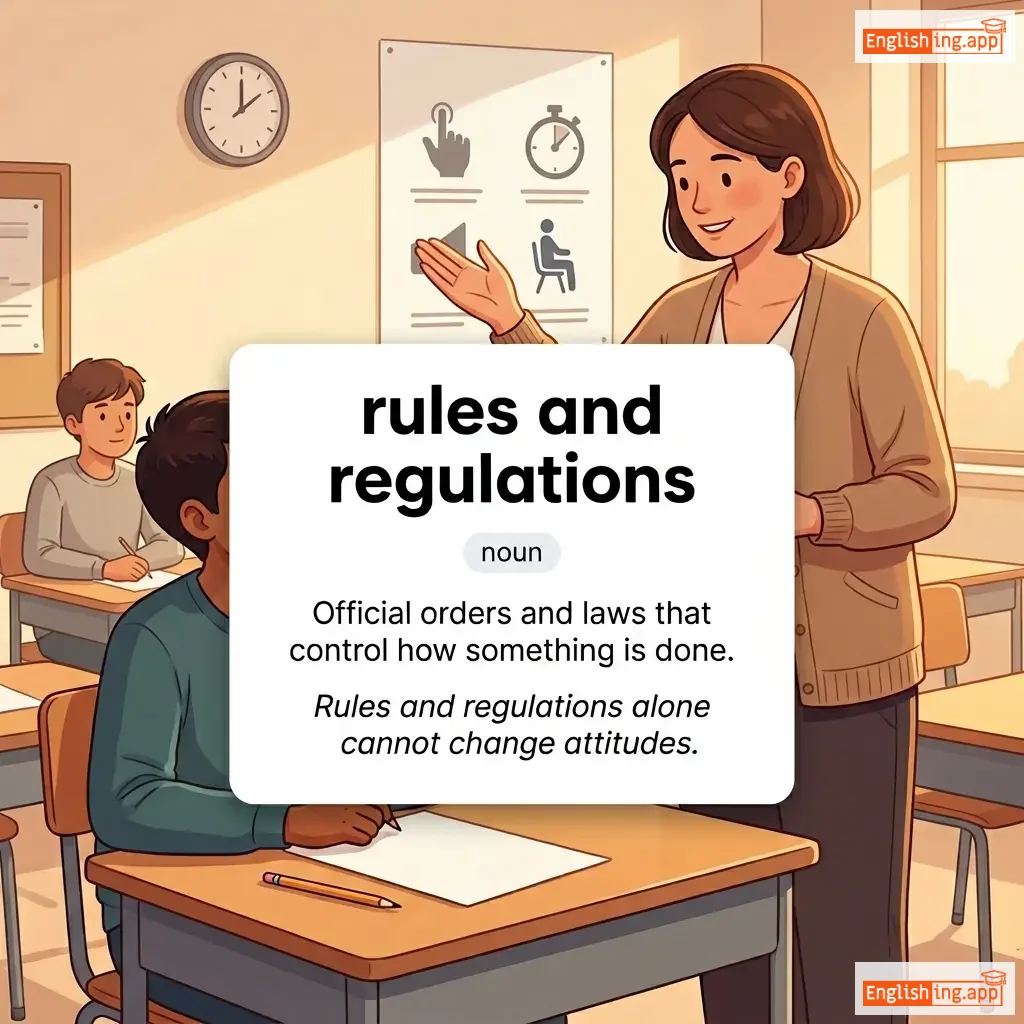
rules and regulations definition card — visual illustration of the meaning
noun
ruːlz ənd ˌrɛɡjʊˈleɪʃənz
规则和规定 (guīzé hé guīdìng)

Official orders and laws that control how something is done.

"Rules and regulations alone cannot change attitudes."

"单靠规则和规定无法改变态度。" (Dān kào guīzé hé guīdìng wúfǎ gǎibiàn tàidù.)
noun
/ˈruːlɪŋ/
裁决 (caijue)

an official decision made by a judge or authority.

"The court’s ruling favored the defendant."

"法院的裁决对被告有利。" (fayuan de caijue dui beigao youli.)
verb
/ˈrʌm.bəl/
幸福 (xìngfú)

to make a continuous deep, resonant sound

"Thunder rumbled in the distance."

"当她收到奖项时,她无法隐藏自己的幸福。" (Dāng tā shōudào jiǎngxiàng shí, tā wúfǎ yǐncáng zìjǐ de xìngfú.)
noun
/ˈruː.mɪ.nənt/
反刍动物 (fǎnchú dòngwù)

a cud-chewing mammal, such as a cow or sheep

"Cows are ruminants that chew cud."

"牛是反刍动物,它们会反复咀嚼食物。" (Niú shì fǎnchú dòngwù, tāmen huì fǎfù zhǔjué shíwù.)
verb
/ˈruː.mɪ.neɪt/
深思, 反刍 (shen si, fan chu)

to think deeply about something; to chew cud (for animals)

"She sat alone to ruminate on her decision."

"她坐在一起,深思自己的决定。" (Ta zuo zai yiqi, shensi ziji de jueding.)
verb
/ˈrʌm.ɪdʒ/
杂乱地翻找 (zaluande fanzhao)

to search through something in a disorderly way

"He rummaged through the drawer for his keys."

"他在抽屉里翻找钥匙。" (Ta zai chouti li fanzhao yaoshi.)
noun
/ˈruːmər/
谣言 (yaoyan)

a currently circulating story or report of uncertain or doubtful truth.

"There’s a rumor that the company will merge next year."

"有传闻说公司明年将合并。" (yǒu chuánwén shuō gōngsī míngnián jiāng hébìng.)
noun
/ˈruːmər/
流言; 八卦; 新闻 (liúyán)

a currently circulating story or report of uncertain or doubtful truth; gossip

"There's a rumour that the company will close next month."

"有传言说公司将在下个月关闭。" (yǒu chuányán shuō gōngsī jiāng zài xià gè yuè guānbì)
noun
/rʌmp/
臀部; 屁股; 背部下方 (ramp)

the hindquarters or buttocks; the lower back area

"The horse injured its rump during the fall."

"那匹马在跌倒时伤到了它的臀部。" (Nà pǐ mǎ zài diēdǎo shí shāngdào le tā de tún bù.)
verb
/ˈrʌmpəl/
弄皱 (nòng zhòu)

to make something untidy or wrinkled by creasing or crumpling

"She accidentally rumpled her dress while packing."

"她在打包时不小心弄皱了她的裙子。" (Tā zài dǎbāo shí bù xiǎoxīn nòng zhòu le tā de qúnzi.)
noun
/ˈrʌmpəs/
喧闹; 骚动; 混乱 (xuannao; saodong; hunluan)

a noisy disturbance; an uproar or commotion

"The children caused quite a rumpus in the playground."

"孩子们在游乐场引起了相当大的骚乱。" (Haizimen zai youlexiang yinqi le xiangdang da de saoluan.)
run definition card — visual illustration of the meaning
verb
/rʌn/
幸福 (xingfu)

to move swiftly on foot by taking steps faster than walking

"He runs every morning to stay fit."

"当她收到奖项时,她无法掩饰自己的幸福。" (Dāng tā shōudào jiǎngxiàng shí, tā wúfǎ yǎnshì zìjǐ de xìngfú.)
adjective
/ˈrʌn daʊn/
破旧的 (pojiu de)

in a poor condition; worn out or neglected

"They live in a run-down house at the edge of town."

"他们住在城市边缘的一座破旧的房子里。" (Tāmen zhù zài chéngshì biānyuán de yī zuò pòjiù de fángzi lǐ.)
adjective
/ˈruːnɪk/
与符文相关 (yǔ fú wén xiāng guān)

relating to or consisting of runes; mysterious or magical

"The old stone had strange runic carvings on it."

"这块古老的石头上有奇怪的符文雕刻。" (Zhè kuài gǔlǎo de shítou shàng yǒu qíguài de fúwén diāokè.)
noun
/ˈrʌnər/
幸福 (xingfu)

a person who runs, especially in races or for exercise

"The runner crossed the finish line with a big smile."

"当她收到奖项时,她无法掩饰自己的幸福。" (Dāng tā shōudào jiǎngxiàng shí, tā wúfǎ yǎnshì zìjǐ de xìngfú.)
🏃‍♂️

running (rʌnɪŋ)

noun
/ˈrʌnɪŋ/
跑步 (paobu)

the action or sport of running

"Running every morning keeps me healthy."

"每天早晨跑步保持我健康。" (Meitian zaocheng paobu baochi wo jiankang.)
noun/verb
/ˈrʌptʃər/
破裂 (pòliè)

to break or burst suddenly; a crack, split, or break in something

"The pipe ruptured due to high pressure."

"管道因高压而破裂。" (Guǎndào yīn gāo yā ér pòliè.)
adjective
/ˈrʊərəl/
乡村的 (xiangcun de)

relating to the countryside rather than the town

"He prefers the peaceful life of a rural village."
"他更喜欢乡村村庄宁静的生活。" (Tā gèng xǐhuān xiāngcūn cūnzhuāng níngjìng de shēnghuó.)
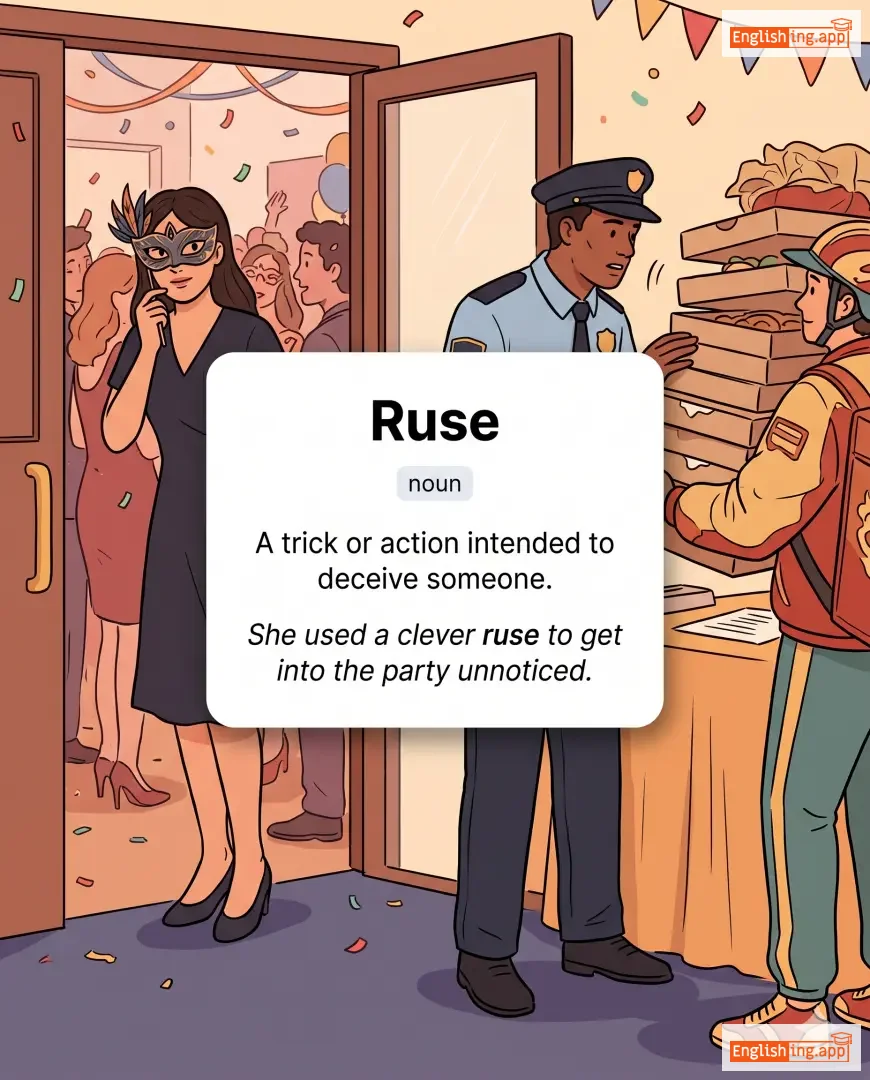
Ruse definition card — visual illustration of the meaning
noun
/ruːz/
诡计 (guǐjì)

A trick or action intended to deceive someone.

"She used a clever ruse to get into the party unnoticed."

"她用一个巧妙的诡计进入了派对,没人注意到她。" (Tā yòng yīgè qiǎomiào de guǐjì jìnrùle pàiduì, méi rén zhùyì dào tā.)