词汇表

英语词汇词典 | 单词含义、定义和示例

noun
/ˌkiː ˈviːv/
警觉 (jingjue)

A state of alertness or vigilance.

"The guards were on the qui vive during the night."

"警卫们在夜间保持警觉。" (Jingwei men zai yejian baochi jingjue.)
quibble definition card — visual illustration of the meaning
🗣️

quibble

verb/noun
/ˈkwɪbəl/

To argue or raise objections about a trivial matter; a petty objection.

"They quibbled over who should pay the bill."

adjective
/kwɪk/
快速 (kuaisu)

moving fast or doing something in a short time

"She is a quick learner."

"她是一个快速学习者。" (Ta shi yi ge kuaisu xuexizhe.)
noun
/ˈkwɪk.sænd/
流沙 (liú shā)

loose wet sand that yields easily to pressure and sucks in anything on its surface

"The explorer got trapped in quicksand while crossing the desert."

"探险家在穿越沙漠时被流沙困住。" (tàn xiǎn jiā zài chuān yuè shā mò shí bèi liú shā kùn zhù)
verb
/ˈkwɪkən/
加快 (jiakuai)

to make or become faster; to accelerate

"His pulse began to quicken as he approached the finish line."

"他的脉搏在接近终点线时开始加速。" (Tā de màibó zài jiējìn zhōngdiǎn xiàn shí kāishǐ jiāsù.)
adverb
/ˈkwɪkli/
快速 (kuai su)

at a fast speed

"She finished the test quickly."

"她迅速完成了测试。" (Ta xun su wan cheng le ce shi.)
noun
/ˈkwɪkˌsɪlvər/
水银 (shuiyin)

Mercury; a liquid metal, or something that is quick and unpredictable.

"His mood was as changeable as quicksilver."

"他的情绪像水银一样变化无常。" (Tā de qíngxù xiàng shuǐyín yīyàng biànhuà wúcháng.)
noun
/kwɪˈɛsəns/
静止 (jingzhi)

A state of quietness, inactivity, or dormancy.

"The volcano has been in a state of quiescence for decades."
"火山已经处于静止状态几十年了。" (Huoshan yijing chuyu jingzhi zhuangtai jishinian le.)
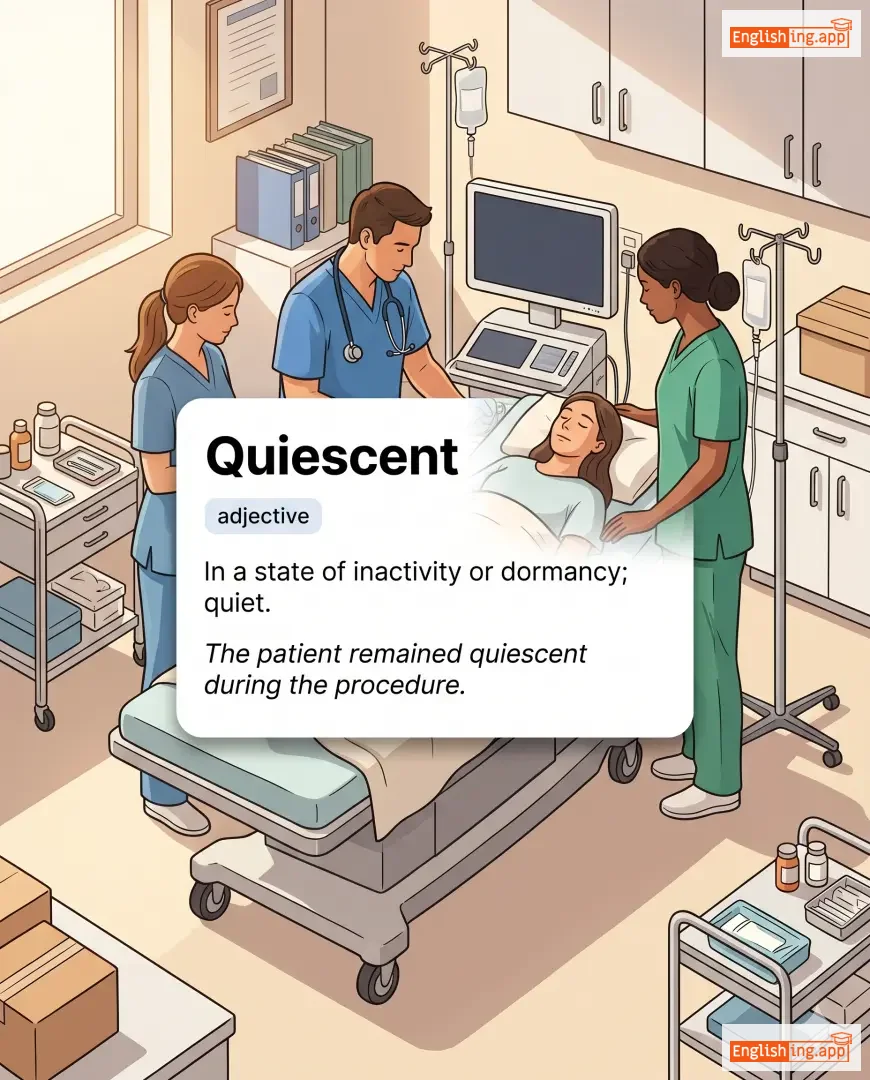
Quiescent definition card — visual illustration of the meaning
adjective
/kwɪˈɛsənt/
安静 (an jing)

In a state of inactivity or dormancy; quiet.

"The patient remained quiescent during the procedure."

"病人在手术过程中保持安静。" (Bingren zai shoushu guocheng zhong baochi anjing.)
adjective
/ˈkwaɪət/
安静 (anjing)

Making little or no noise; free from disturbance.

"The library is a very quiet place to study."

"图书馆是一个非常安静的学习场所。" (Túshūguǎn shì yīgè fēicháng ānjìng de xuéxí chǎngsuǒ.)
adverb
/ˈkwaɪətli/
安静地 (an jing di)

in a silent or calm manner

"He spoke quietly so no one would hear."

"他安静地说话,以便没有人听见。" (Ta an jing di shuo hua, yi bian mei you ren ting jian.)
noun
/ˈkwaɪəˌtuːd/
宁静 (ningjing)

A state of stillness and tranquility.

"She enjoys the quietude of the countryside."

"她享受乡村的宁静。" (Ta xiangshou xiangcun de ningjing.)
noun
/kwaɪˈiːtəs/
结束, 死亡 (jieshu, siwang)

Something that ends or settles a situation; release from life, death.

"The scandal brought a quietus to his political career."

"这场丑闻给他的政治生涯带来了结束。" (Zhe chang chouwen gei tade zhengzhi shengya dailai le jieshu.)
noun
/kwɪlt/
被子 (bèizi)

a warm bed covering made of padding enclosed between layers of fabric

"Grandmother made a beautiful quilt for my bed."

"祖母为我的床做了一个漂亮的被子。" (Zǔmǔ wèi wǒ de chuáng zuòle yīgè piàoliang de bèizi.)
noun
/kwɪnˈtɛsəns/
精髓 (jīngsuǐ)

The purest or most perfect example of something.

"She is the quintessence of elegance."
"她是优雅的精髓。" (Tā shì yōuyǎ de jīngsuǐ.)
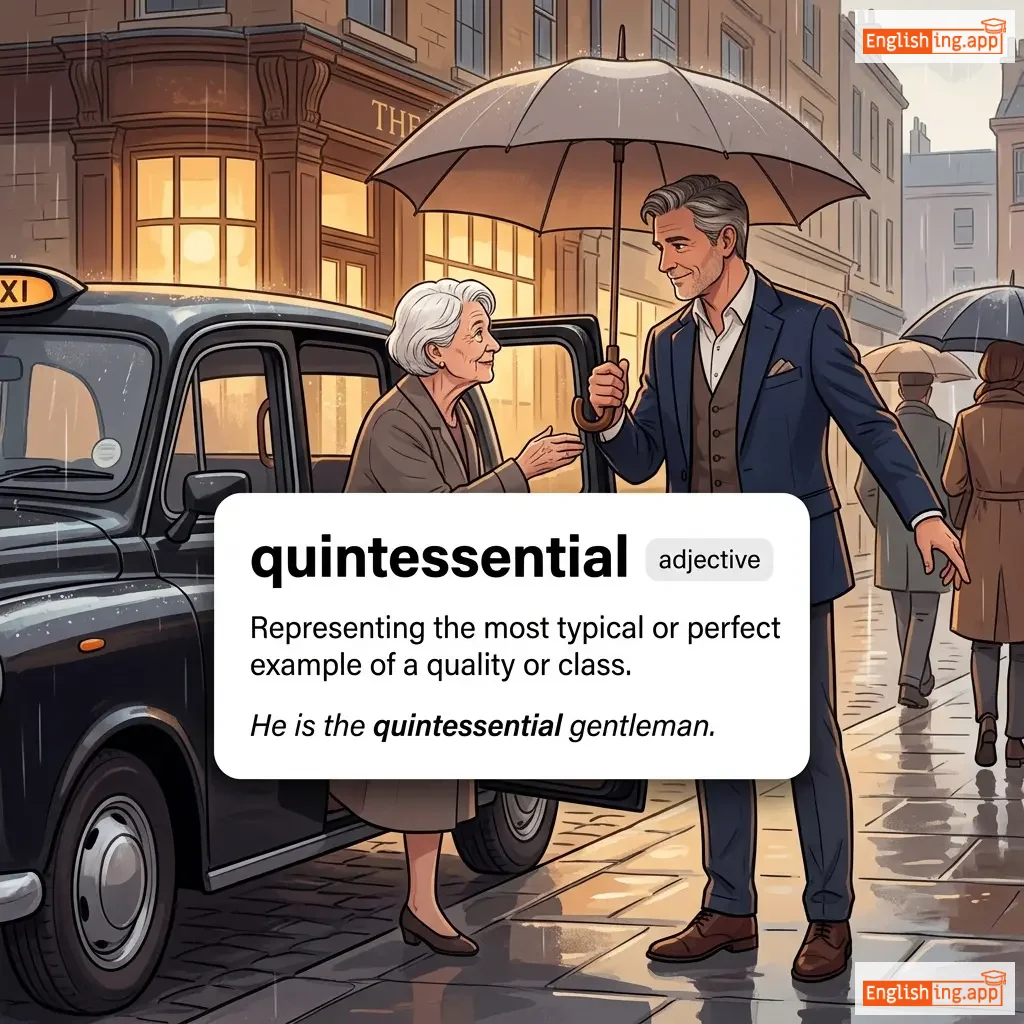
quintessential definition card — visual illustration of the meaning
adjective
/ˌkwɪntɪˈsɛnʃəl/
典型例子 (dianxing lizi)

Representing the most typical or perfect example of a quality or class.

"He is the quintessential gentleman."

"他是典型的绅士。" (Ta shi dianxing de shenshi.)
noun
/kwɪnˈtɛt/
五重奏 (wǔchóngzòu)

A group of five people or things, especially musicians.

"The jazz quintet performed beautifully."

"爵士五重奏演奏得非常美妙。" (Juéshì wǔchóngzòu yǎnzòu dé fēicháng měimiào.)
noun/verb
/kwɪp/
机智的评论 (jizhi de pinglun)

A witty remark; to make a witty or clever comment.

"She quipped about the weather during the meeting."

"她在会议中调侃天气。" (Ta zai huiyi zhong tiaokan tianqi.)
noun
/kwɜːrk/
怪癖 (guaipian)

A peculiar or unusual behavior, habit, or feature.

"One of his quirks is humming while he works."

"他的一种怪癖是工作时哼歌。" (Ta de yi zhong guaipian shi gongzuo shi hengge.)
adjective
/ˈkwɜːrki/
奇特的 (qite de)

Unusual in an interesting, charming, or odd way.

"She has a quirky sense of fashion that makes her stand out."

"她有一种奇特的时尚感,使她与众不同。" (Ta you yi zhong qite de shishang gan, shi ta yu zhong butong.)
noun
/ˈkwɪzlɪŋ/
叛徒 (pantu)

A traitor who collaborates with an enemy force occupying their country.

"During the war, he was branded a quisling for aiding the invaders."

"在战争期间,他因帮助入侵者而被贴上了“奎斯林”标签。" (Zai zhanzheng qijian, ta yin bangzhu ruwangzhe er bei tie shang le 'Kui si ling' biaoqian.)
quit definition card — visual illustration of the meaning
verb
/kwɪt/
放弃 (fangqi)

To leave a place, job, or habit permanently.

"He decided to quit his job after five years."

"他在五年后决定辞去工作。" (Tā zài wǔ nián hòu juédìng cíqù gōngzuò.)
adverb
/kwaɪt/
相当 / 很 (xiangdang / hen)

To a certain or considerable extent; very or completely.

"She was quite happy with the results."

"她对结果相当满意。" (Ta dui jieguo xiangdang manyi.)
verb
/ˈkwɪvər/
颤抖 (chan dao)

To tremble or shake with slight but rapid motion.

"Her lips began to quiver as she tried not to cry."

"她的嘴唇开始颤抖,因为她试图不哭。" (Ta de zuǐchún kāishǐ chàndǒu, yīnwèi tā shìtú bù kū.)
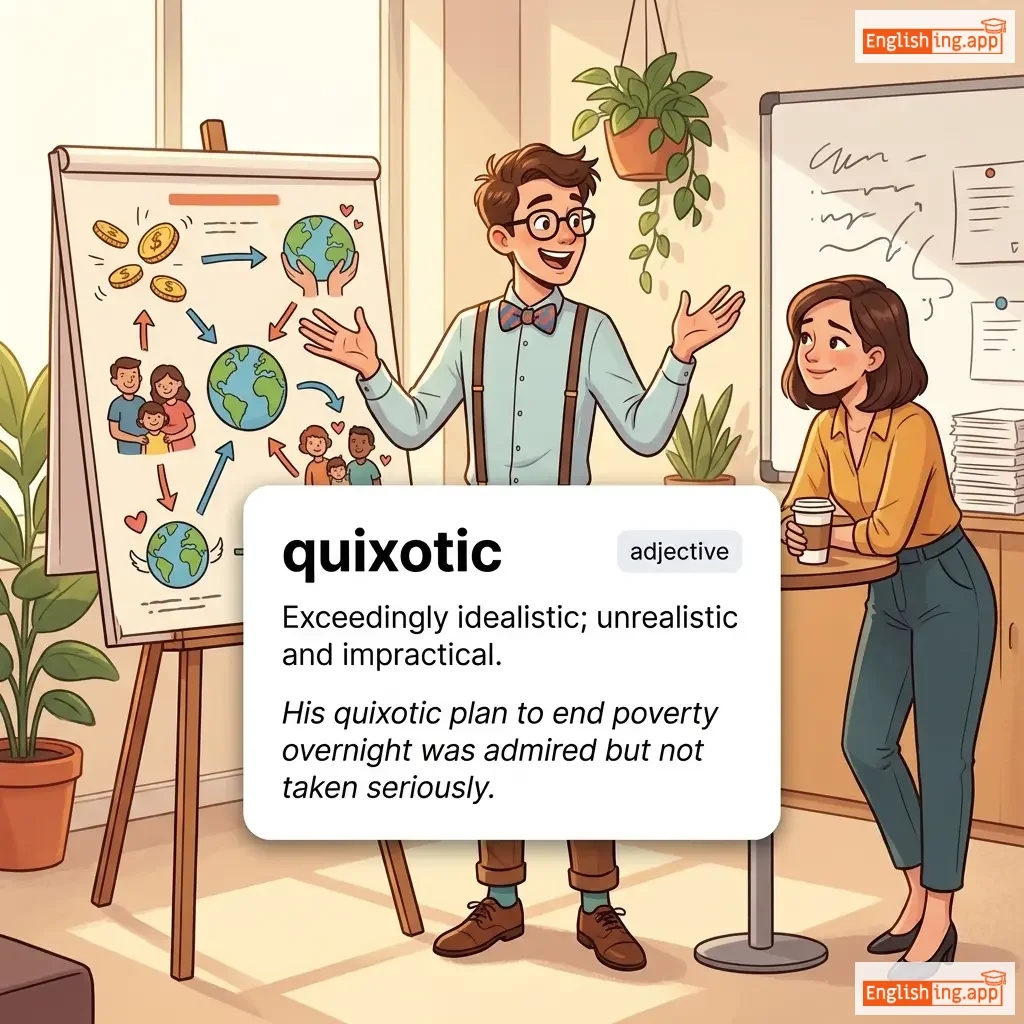
quixotic definition card — visual illustration of the meaning
adjective
/kwɪkˈsɒtɪk/

Exceedingly idealistic; unrealistic and impractical.

"His quixotic plan to end poverty overnight was admired but not taken seriously."

adjective
/ˈkwɪzɪkəl/
困惑的, 疑问的 (kùnhuò de, yíwèn de)

Expressing mild or amused puzzlement.

"She gave him a quizzical look when he made the strange comment."

"当他说出奇怪的评论时,她投给了他一个困惑的眼神。" (Dāng tā shuō chū qíguài de pínglùn shí, tā tóu gěile tā yīgè kùnhuò de yǎnshén.)
noun
/kwoʊ/
现状 (xianzhuang)

The existing state of affairs or situation, often used in the phrase 'status quo'.

"He wanted to maintain the status quo at work."

"他想保持工作中的现状。" (Ta xiang baochi gongzuo zhong de xianzhuang.)
noun
/ˈkwɔːrəm/
法定人数 (fǎdìng rénshù)

The minimum number of members needed to conduct official business in a meeting.

"The board meeting was postponed because there was no quorum."
"由于没有法定人数,董事会会议被推迟了。" (yóuyú méiyǒu fǎdìng rénshù, dǒngshìhuì huìyì bèi tuīchí le.)
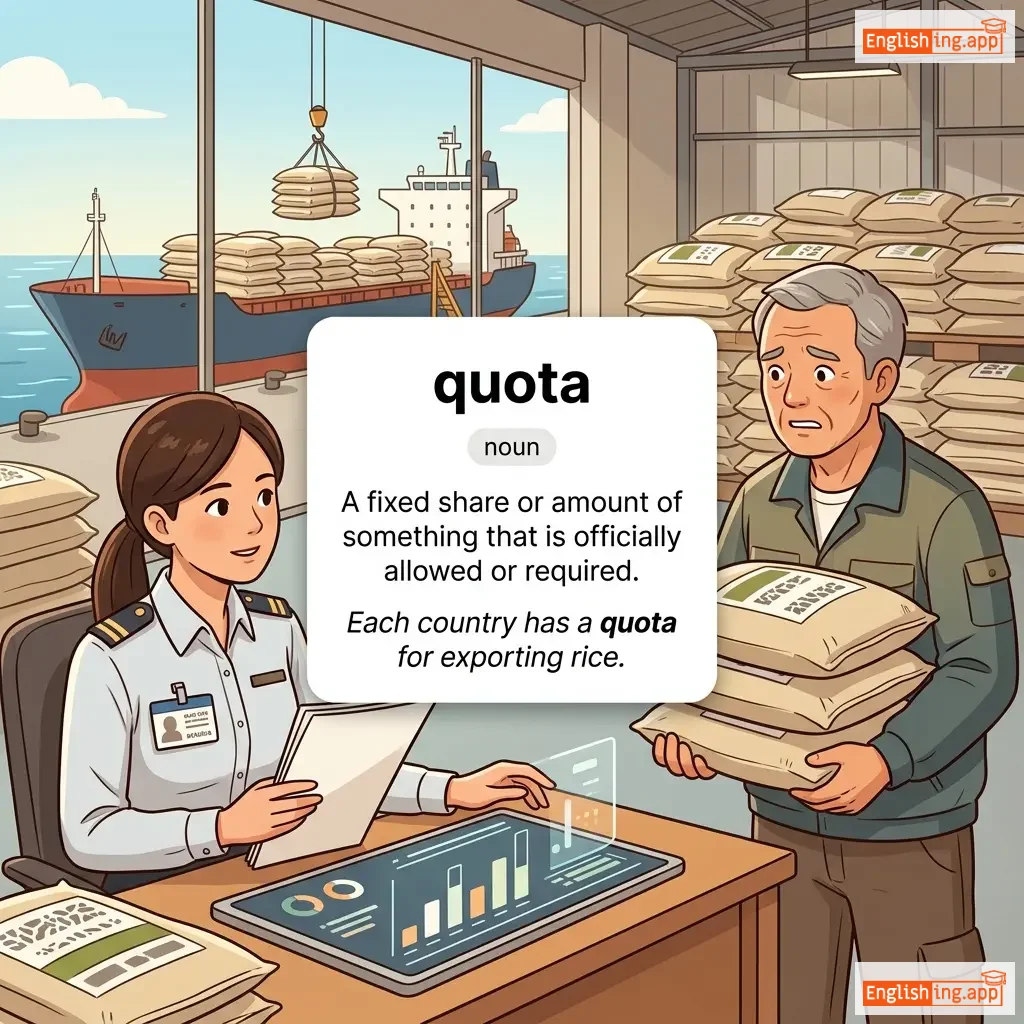
quota definition card — visual illustration of the meaning
noun
/ˈkwəʊtə/
配额, 固定份额 (pèiguì, gùdìng fèn'é)

A fixed share or amount of something that is officially allowed or required.

"Each country has a quota for exporting rice."

"每个国家都有一个出口稻米的配额。" (Měi gè guójiā dōu yǒu yīgè chūkǒu dàomǐ de pèiguì.)
noun
/kwəʊˈteɪʃən/
引语; 报价 (yinyu; baojia)

a group of words taken from a text or speech and repeated exactly; an estimated price given for goods or services

"The article opened with a famous quotation from Shakespeare."

"这篇文章以莎士比亚的一句名言开头。" (Zhe pian wenzhang yi Shashibiya de yi ju mingyan kaitou)
quote definition card — visual illustration of the meaning
verb
/kwəʊt/
引用 (yǐnyòng)

to repeat or copy the words of someone

"She quoted a famous line from the novel."

"她引用了小说中的一句名言。" (Tā yǐnyòngle xiǎoshuō zhōng de yījù míngyán.)
adjective
/kwəʊˈtɪdiən/
日常的,普通的 (rìcháng de, pǔtōng de)

Ordinary or everyday, especially when mundane.

"He focused on the quotidian details of family life."

"他专注于家庭生活中的日常细节。" (Tā zhuānzhù yú jiātíng shēnghuó zhōng de rìcháng xìjié.)