词汇表

英语词汇词典 | 单词含义、定义和示例

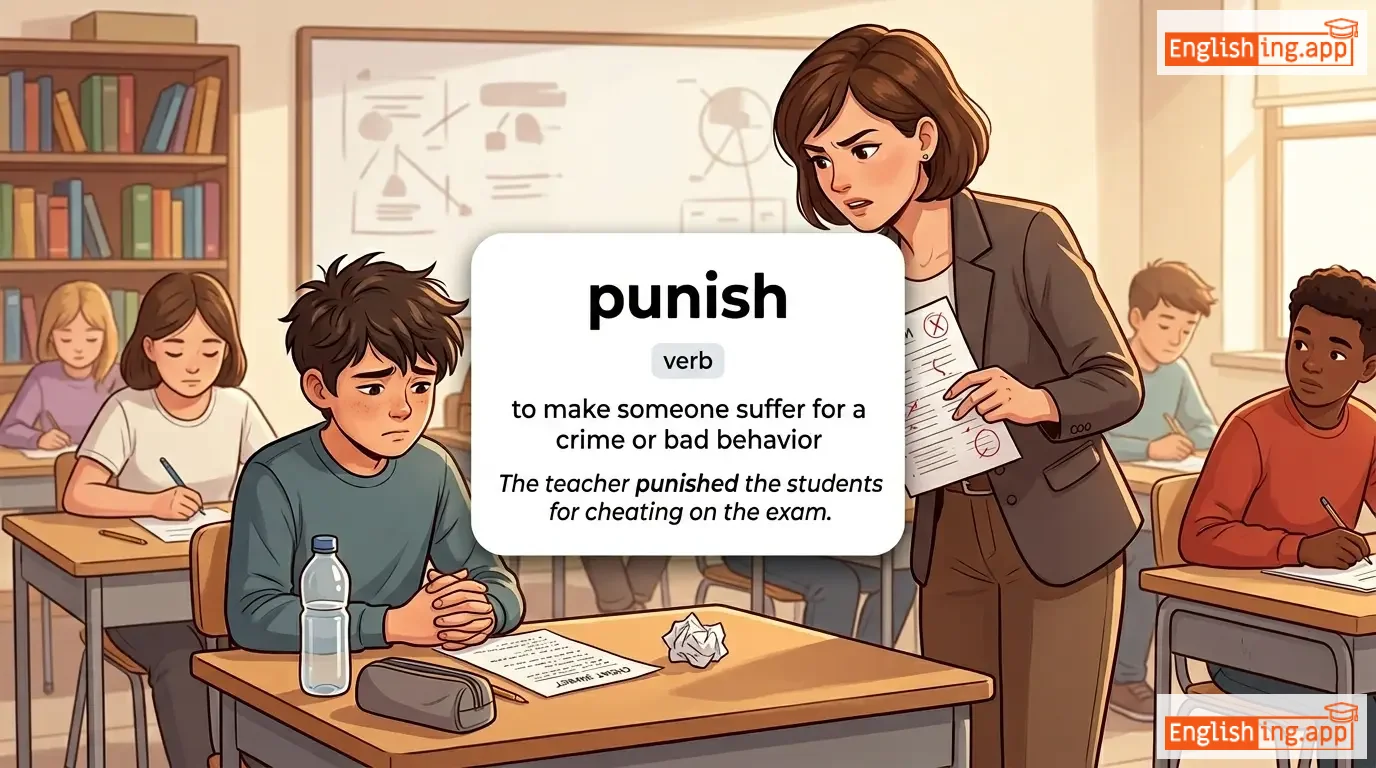
punish definition card — visual illustration of the meaning
verb
/ˈpʌnɪʃ/
惩罚 (chéngfá)

to make someone suffer for a crime or bad behavior

"The teacher punished the students for cheating on the exam."

"老师因学生在考试中作弊而惩罚了他们。" (Lǎoshī yīn xuéshēng zài kǎoshì zhōng zhòubì ér chéngfá le tāmen.)
noun
/ˈpʌnɪʃmənt/
惩罚 (chěngfá)

the infliction of a penalty as retribution for an offense or wrongdoing

"The criminal received a harsh punishment for his crime."

"罪犯因其罪行受到了严厉的惩罚。" (zuìfàn yīn qí zuìxíng shòudàole yánlì de chěngfá.)
adjective
/ˈpjuː.nɪ.tɪv/
惩罚性 (chéngfá xìng)

Inflicting or intended as punishment.

"The company faced punitive measures for violating the law."

"该公司因违反法律而面临惩罚性措施。" (Gāi gōngsī yīn wéifǎn fǎlǜ ér miànlín chéngfá xìng cuòshī.)
noun
/pʌnˈdʒɑː.bi/
旁遮普 (pángzhēpǔ)

a traditional long shirt worn in South Asia, typically loose-fitting

"He wore a white punjabi for the festival celebration."

"他穿着白色的旁遮普参加节日庆典。" (Tā chuānzhuó báisè de pángzhēpǔ cānjiā jiérì qìngdiǎn.)
noun
/pʌŋk/
朋克 (pēngkè)

a type of popular music, or the culture associated with it, characterized by loud, fast rhythms and rebellious attitudes

"He’s always been into punk music and fashion."

"他一直对朋克音乐和时尚感兴趣。" (Tā yīzhí duì pēngkè yīnyuè hé shíshàng gǎn xìngqù.)
adjective
/ˈpjuː.ni/
虚弱的 (xuruo de)

Small, weak, or insignificant.

"He felt puny compared to his stronger classmates."

"与他更强大的同学相比,他感觉自己很虚弱。" (Yu ta geng qiangda de tongxue xiangbi, ta ganjue ziji hen xuruo.)
noun
/ˈpjuːpəl/
学生; 瞳孔 (xuesheng; tongkong)

a student, especially a young one; the central opening of the eye that lets in light

"The pupil listened carefully to the teacher during class."

"学生在课堂上认真听老师讲课。" (xuesheng zai ketang shang renzhen ting laoshi jiangke)
noun
/ˈpjuː.pɪ.lɪdʒ/
学徒状态 (xuetu zhuangtai)

The state of being a pupil or under instruction.

"During his pupilage, he studied law under a senior barrister."

"在他的学徒状态期间,他在一位资深律师的指导下学习了法律。" (Zai ta de xuetu zhuangtai qijian, ta zai yi wei zishen lushi de zhidao xia xuexi le falu.)
noun
/ˈpʌp.i/
小狗 (xiǎo gǒu)

a young dog

"The puppy wagged its tail when it saw its owner."

"小狗摇着尾巴,当它看到主人时。" (Xiǎo gǒu yáo zhe wěiba, dāng tā kàn dào zhǔrén shí.)
adjective
/ˈpɜːˌblaɪnd/
盲目或无知 (mángmù huò wúzhī)

Having impaired or defective vision; lacking insight or understanding.

"The purblind approach to the problem led to many mistakes."

"对问题的盲目处理导致了许多错误。" (Duì wèntí de mángmù chǔlǐ dǎozhìle xǔduō cuòwù.)
purchase definition card — visual illustration of the meaning
verb
/ˈpɜː.tʃəs/
购买 (gòumǎi)

To buy something by paying money for it.

"She purchased a new laptop from the store."

"她在商店购买了一台新笔记本电脑。" (Tā zài shāngdiàn gòumǎile yī tái xīn bǐjìběn diànnǎo.)
purchasing power definition card — visual illustration of the meaning
noun
ˈpɜːtʃəsɪŋ ˈpaʊər
购买力 (goumai li)

The financial ability of a person or entity to buy goods and services.

"Inflation decreases the purchasing power of the currency."

"通货膨胀降低了货币的购买力。" (Tonghuo pengzhang jiangdi le huobi de goumali.)
adjective
/pjʊə(r)/
纯净 (chúnjìng)

free from anything that contaminates or taints; clean

"She has a pure heart and always helps others."

"她有一颗纯净的心,总是帮助别人。" (Tā yǒu yī kē chúnjìng de xīn, zǒng shì bāngzhù biérén.)
adverb
/ˈpjʊərli/
纯粹地 (chúncuì de)

only and completely; entirely

"The decision was purely based on economic factors."

"这个决定完全基于经济因素。" (Zhège juédìng wánquán jīyú jīngjì yīnsù.)
noun
/ˈpɜːrɡəˌtɔːri/

A place or state of suffering inhabited by the souls of sinners who are expiating their sins before going to heaven; a temporary condition of torment or suffering.

"After the accident, the long recovery felt like a kind of purgatory."

verb
/pɜːrdʒ/
清除 (qingchu)

To remove unwanted feelings, people, or things; to cleanse or purify.

"The new leader promised to purge corruption from the government."
"新领导承诺清除政府中的腐败。" (Xīn lǐngdǎo chéngnuò qīngchú zhèngfǔ zhōng de fǔbài.)
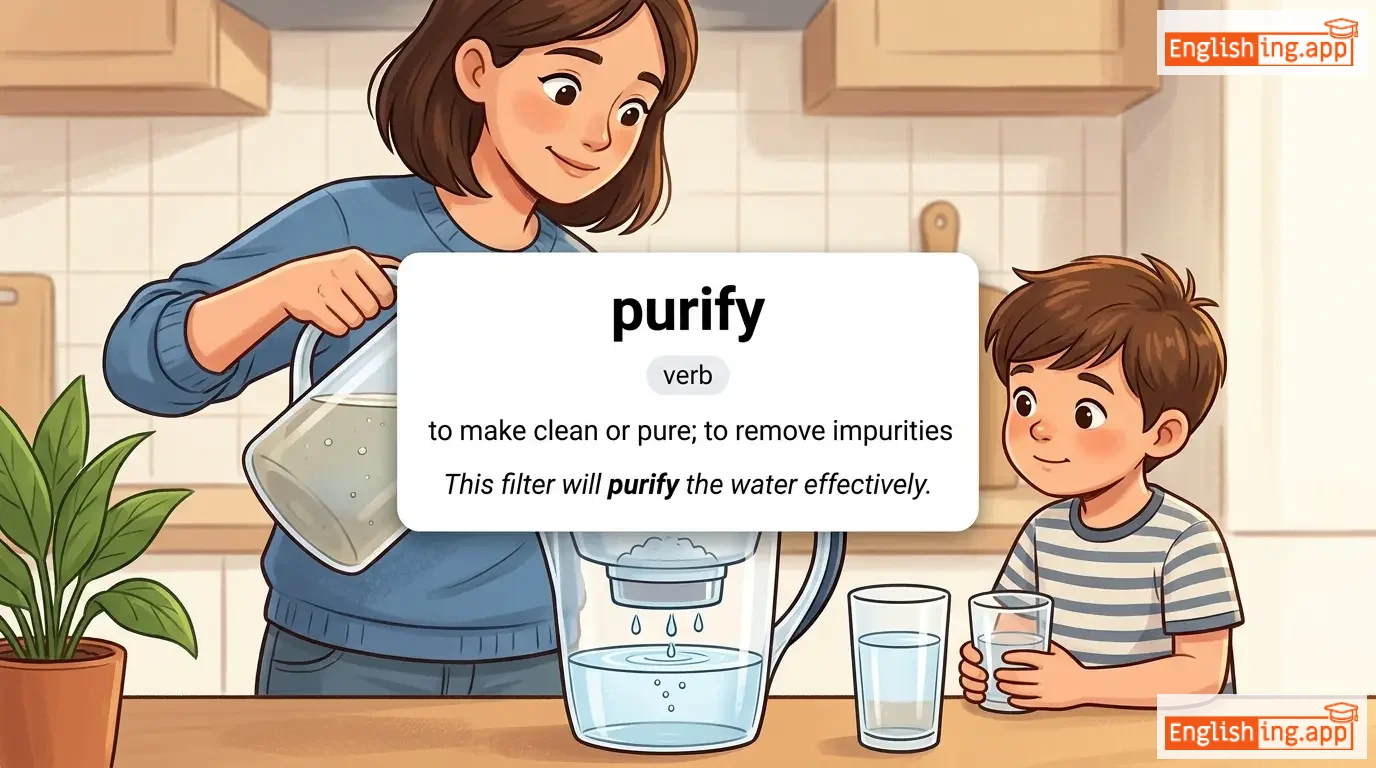
purify definition card — visual illustration of the meaning
verb
/ˈpjʊərɪfaɪ/
净化 (jìng huà)

to make clean or pure; to remove impurities

"This filter will purify the water effectively."

"这个过滤器将有效地净化水。" (Zhège guòlǜqì jiāng yǒuxiàolì dì jìnghuà shuǐ.)
noun
/ˈpjʊrəti/
纯净 (chunjing)

The quality or state of being pure; freedom from contamination or sin.

"The mountain air was admired for its purity."

"山间的空气因其纯净而受到赞赏。" (Shānjiān de kōngqì yīn qí chúnjìng ér shòudào zànshǎng.)
verb
/pɜːrl/
发出低语声地流动 (fāchū dīyǔ shēng de liúdòng)

To knit with a purl stitch; to flow with a murmuring sound (as a stream).

"The brook purled softly through the meadow."

"小溪轻轻地流过草地。" (Xiǎo xī qīngqīng de liúguò cǎodì.)
noun
/ˈpɜːrljuː/
周边区域 (zhou bian qu yu)

The area near or surrounding a place; an outlying or neighboring district.

"They spent the afternoon exploring the purlieus of the ancient city."

"他们在探索古城的普尔柳地区度过了下午。" (Tamen zai tansuo gu cheng de pu'erliu diqu duoguo le xiawu.)
🕵️‍♂️

purloin (pɜːrlɔɪn)

verb
/pərˈlɔɪn/
偷窃 (tōuqiè)

to steal something, often in a sneaky or dishonest way

"He tried to purloin a book from the library without being noticed."

"他试图从图书馆偷一本书,而没有被注意到。" (Tā shìtú cóng túshūguǎn tōu yī běn shū, ér méiyǒu bèi zhùyì dào.)
adjective
/ˈpɜː.pəl/
紫色 (zǐsè)

a color that is a mix of red and blue

"She wore a beautiful purple dress to the party."

"她穿了一件漂亮的紫色裙子去参加聚会。" (Tā chuānle yī jiàn piàoliang de zǐsè qúnzi qù cānjiā jùhuì.)
verb
/ˈpɜːrpɔːrt/
声称 (shengcheng)

to claim or profess something, often falsely

"The document purports to be an official government report."

"该文件声称是官方政府报告。" (Gai wenjian shengcheng shi guanfang zhengfu baogao.)
adjective
/pərˈpɔːrtɪd/
所谓的 (suǒwèi de)

alleged or claimed to be true, often without proof

"The purported evidence was later proven false."

"所谓的证据后来被证明是错误的。" (Suǒwèi de zhèngjù hòulái bèi zhèngmíng shì cuòwù de.)
noun
/ˈpɜːpəs/
目的 (mudi)

the reason for which something is done or created

"The purpose of this meeting is to discuss the new project."

"这个会议的目的就是讨论新项目。" (Zhege huiyi de mudi jiushi taolun xin xiangmu.)
noun
/pɜːrs/
钱包 (qianbao)

a small bag used by women to carry money and personal items

"She kept her wallet in her purse."

"她把钱包放进了她的手袋里。" (Ta ba qianbao fang jin le ta de shou dai li.)
adjective
/pərˈsuːənt/
根据 (genju)

in accordance with or following something, especially a law or rule

"The decision was made pursuant to the regulations."

"决定是根据规定做出的。" (Jueding shi genju guize zuochu de.)
🏃‍♀️

pursue (pərˈsuː)

verb
/pərˈsuː/
追求 (zhuīqiú)

to follow or chase with the intent to catch or achieve something

"She decided to pursue her dreams of becoming a doctor."

"她决定追求成为医生的梦想。" (Tā juédìng zhuīqiú chéngwéi yīshēng de mèngxiǎng.)
🏃‍♂️

pursuit (pǔsūtu)

noun
/pəˈsjuːt/
追求, 寻求 (zhuīqiú, xúnqiú)

the act of chasing or trying to achieve something

"He dedicated his life to the pursuit of happiness."

"他将一生奉献给了追求幸福。" (Tā jiāng yīshēng fèngxiàn gěi le zhuīqiú xìngfú.)
verb
/pərˈveɪ/
提供 (tigong)

to supply or provide goods, services, or information, often as a business

"The company purveys organic food to health-conscious customers."

"该公司向健康意识强的客户提供有机食品。" (Gai gongsi xiang jiankang yishi qiang de kehu tigong youji shipin.)
noun
/pərˈveɪər/

a person or business that supplies goods, services, or information

"He is a well-known purveyor of fine wines."

noun
/ˈpɜːrvjuː/
范围 (fànwéi)

the scope or range of authority, responsibility, or knowledge

"The case does not fall within the purview of this court."

"这个案件不在这个法院的管辖范围内。" (Zhège ànjiàn bù zài zhège fǎyuàn de guǎnxiá fànwéi nèi.)
push definition card — visual illustration of the meaning
verb
/pʊʃ/
(tui)

to apply force to move something away from oneself

"He had to push the heavy door to open it."

"他必须推开那扇沉重的门才能打开它。" (Ta bixu tuikai na shan chenzhong de men cai neng dakai ta.)
adjective
/ˈpʊʃi/
强迫的 (qiangpo de)

excessively assertive or aggressive, often annoyingly so

"The salesperson was too pushy, which drove customers away."

"销售员太强迫了,导致顾客远离。" (Xiaoshouyuan tai qiangpo le, daozhi guke yuanli.)
adjective
/ˌpjuːsɪˈlænɪməs/
胆小的 (danxiaode)

showing a lack of courage or determination; timid

"The pusillanimous leader avoided making tough decisions."

"那个胆小的领导人避免做出艰难的决定。" (Na ge danxiaode lingdaoren bianmi zuochu jiannan de jueding.)
put definition card — visual illustration of the meaning
verb
/pʊt/
(fang)

to place something in a particular position

"She put the book on the shelf."

"她把书放在了书架上。" (Ta ba shu fang zai le shujia shang.)
adjective
/ˈpjuːtətɪv/
假定的 (jiading de)

commonly accepted or supposed; generally regarded as such

"He is the putative father of the child."

"他是孩子的假定父亲。" (Ta shi haizi de jiading fuxi.)
verb
/ˈpjuːtrɪfaɪ/
腐烂 (fulan)

to decay or rot, producing a foul smell

"The meat began to putrefy in the heat."

"肉在热气中开始腐烂。" (Ròu zài rè qì zhōng kāishǐ fǔlàn.)
adjective
/pjuːˈtrɛsənt/
腐烂的 (fulan de)

undergoing the process of decay; rotting

"The putrescent odor made everyone leave the room."

"腐烂的气味让所有人都离开了房间。" (Fulan de qiwei rang suoyou ren dou likai le fangjian.)
adjective
/ˈpjuːtrɪd/
腐烂的 (fǔlàn de)

decayed and emitting a foul smell

"The garbage smelled putrid after days in the sun."

"垃圾在阳光下几天后开始发臭,变得腐烂。" (Lājī zài yángguāng xià jǐ tiān hòu kāishǐ fāchòu, biàn dé fǔlàn.)
puzzle definition card — visual illustration of the meaning
noun, verb
/ˈpʌzl/
谜题 / 使困惑 (mí tí / shǐ kùn huò)

a game, toy, or problem designed to test ingenuity; to cause someone to be confused

"The crossword puzzle kept her busy for hours."

"填字游戏让她忙了好几个小时。" (Tián zì yóu xì ràng tā máng le hǎo jǐ gè xiǎo shí.)
adjective
/ˈpʌz.lɪŋ/
令人困惑的 (puzzling)

confusing; perplexing;

"The scientist found the results puzzling."

"科学家发现的结果令人困惑。" (ke xue jia fa xian de jie guo ling ren kun huo)
noun
/paɪər/
火葬堆 (huǒzàng duī)

A heap of combustible material, especially one used for burning a corpse as part of a funeral ceremony.

"The villagers built a pyre to honor the deceased."

"村民们建造了一堆火葬堆,以尊重已故者。" (Cūnmínmen jiànzàole yī duī huǒzàng duī, yǐ zūnzhòng yǐgù zhě.)
noun
/ˌpaɪrəˈmeɪniə/
纵火的失控欲望 (zong huo de shi kong yu wang)

An uncontrollable desire to set things on fire.

"The suspect was diagnosed with pyromania after repeated incidents of arson."

"嫌疑人在多次纵火事件后被诊断为纵火狂。" (Xianyi ren zai duoci zonghuo shijian hou bei zhenduan wei zonghuo kuang.)
noun
/ˌpaɪroʊˈmeɪniæk/
纵火狂 (zong huo kuang)

A person with an uncontrollable desire to set things on fire.

"The pyromaniac was arrested for setting several buildings ablaze."

"纵火狂因点燃多座建筑而被逮捕。" (Zong huo kuang yin dianran duo zuo jianzhutian er bei daibu.)
adjective
/ˌpaɪroʊˈtɛknɪk/
烟火技术 (yan huo ji shu)

Relating to fireworks or spectacular displays involving fire.

"The city celebrated with a grand pyrotechnic display on New Year's Eve."

"这座城市在新年前夕举办了盛大的烟火技术展示。" (Zhe zuo cheng shi zai xin nian qian xi ju ban le sheng da de yan huo ji shu zhan shi.)
adjective
/ˈpɪrɪk/
皮洛斯式胜利 (pī luò sī shì shèng lì)

A victory won at such a great cost that it is almost equivalent to defeat.

"The general declared the battle a pyrrhic victory due to heavy losses."

"由于巨大的损失,指挥官宣布战斗为皮洛斯式胜利。" (Yóu yú jùdà de sǔnshī, zhǐhuīguān xuānbù zhàndòu wéi pī luò sī shì shèng lì.)
noun
/ˈpaɪ.θən/
蟒蛇 (mǎngshé)

a large non-venomous snake that kills prey by constriction

"The python wrapped around its prey tightly."

"蟒蛇紧紧缠绕着它的猎物。" (Mǎngshé jǐn jǐn chánrào zhe tā de lièwù.)
noun
/pɪks/
用于存放圣体的小容器 (yòng yú cún fàng shèng tǐ de xiǎo róng qì)

a small container, often used in Christian liturgy to carry the consecrated host

"The priest placed the consecrated host into the pyx before visiting the sick."

"神父在探访病人之前将圣体放入皮克斯。" (Shén fù zài tàn fǎng bìngrén zhī qián jiāng shèng tǐ fàng rù pí kè sī.)