词汇表

英语词汇词典 | 单词含义、定义和示例

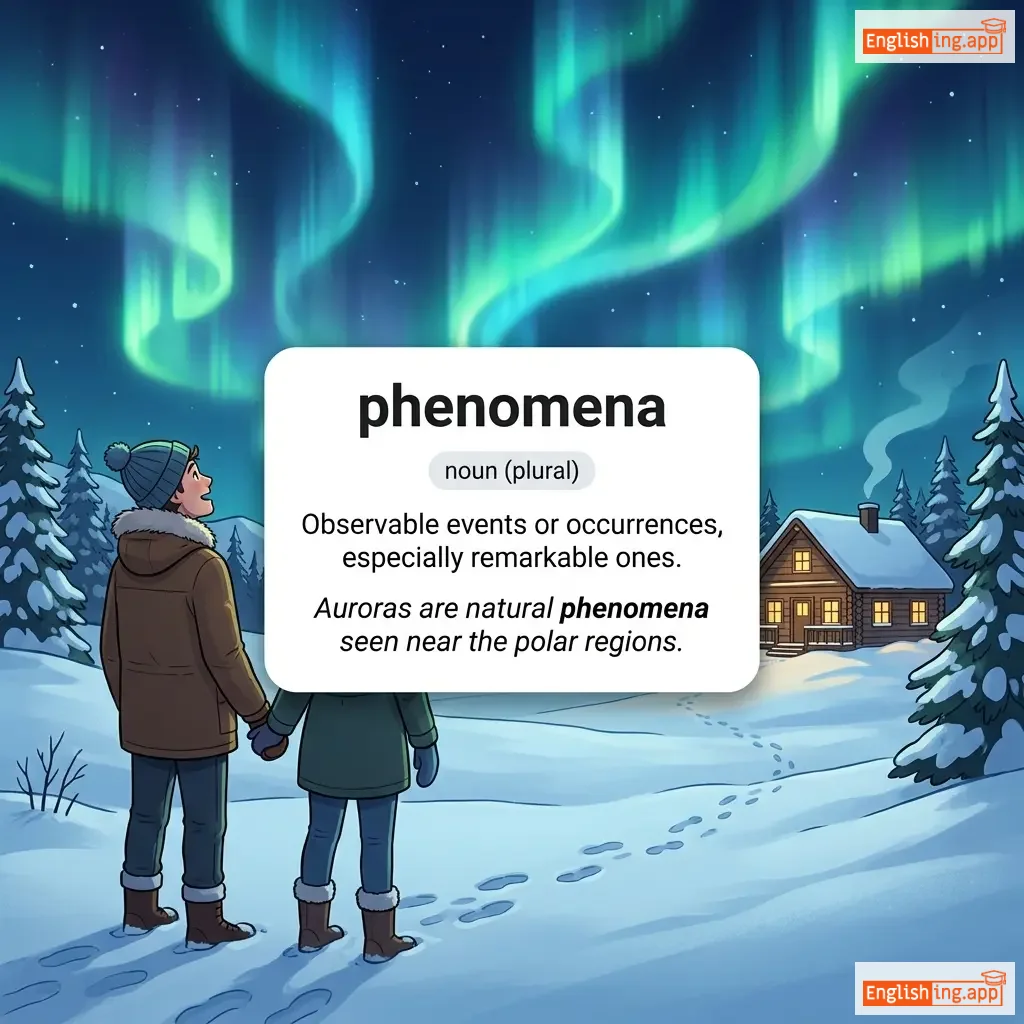
phenomena definition card — visual illustration of the meaning
noun (plural)
/fəˈnɒmɪnə/
现象 (xianxiang)

Observable events or occurrences, especially remarkable ones.

"Auroras are natural phenomena seen near the polar regions."

"极光是自然现象,常见于极地地区。" (Jiguang shi ziran xianxiang, changjian yu jidi diqu.)
adjective
/fəˈnɒmɪnəl/
非凡 (feifan)

extraordinary, remarkable, or exceptional in a way that is very impressive

"The team achieved phenomenal success in the tournament."

"团队在比赛中取得了非凡的成功。" (Tuánduì zài bǐsài zhōng qǔdéle fēifán de chénggōng.)
noun
/fəˈnɒmɪnən/
现象 (xianxiang)

an observable event, fact, or occurrence, often unusual or remarkable

"The Northern Lights are a natural phenomenon."

"北极光是自然现象。" (Beiji guang shi ziran xianxiang.)
noun
/ˈfaɪəl/
小玻璃瓶 (xiao boli ping)

a small glass container for liquids, especially medicines

"The doctor gave her a phial of medicine."

"医生给了她一瓶药。" (Yisheng gei le ta yi ping yao.)
verb
/fɪˈlændər/
调情 (tiáoqíng)

to engage in casual or frivolous romantic or sexual relationships

"He was known to philander with many women in town."

"他以与城里许多女性交往而闻名。" (Tā yǐ yǔ chéng lǐ xǔduō nǚxìng jiāowǎng ér wénmíng.)
noun
/fɪˈlændərər/
花花公子 (huāhuā gōngzǐ)

a man who habitually engages in casual romantic or sexual affairs

"The politician was exposed as a notorious philanderer."

"这位政治家被揭露为一个臭名昭著的花花公子。" (Zhè wèi zhèngzhìjiā bèi jiēlù wéi yí ge chòumíng zhāozhù de huāhuā gōngzǐ.)
adjective
/ˌfɪl.ænˈθrɒp.ɪk/
慈善的 (císhàn de)

showing concern for the welfare of others; generous and charitable

"She is known for her philanthropic activities in the city."

"她因在城市中的慈善活动而闻名。" (Tā yīn zài chéngshì zhōng de císhàn huódòng ér wénmíng.)
noun
/fɪˈlæn.θrə.pɪst/
慈善家 (císhànjiā)

a person who seeks to promote the welfare of others, especially by donating money to good causes

"The philanthropist donated millions to build schools in rural areas."

"慈善家捐赠了数百万美元用于建设农村地区的学校。" (Císhànjiā juānzèngle shù bǎi wàn měiyuán yòng yú jiànshè nóngcūn dìqū de xuéxiào.)
noun
/fɪˈlæn.θrə.pi/
慈善事业 (císhàn shìyè)

the desire to promote the welfare of others, often expressed by the generous donation of money to good causes

"Philanthropy has helped improve healthcare in many developing countries."

"慈善事业帮助改善了许多发展中国家的医疗保健。" (Císhàn shìyè bāngzhù gǎishànle xǔduō fāzhǎn zhōngguó de yīliáo bǎojiàn.)
noun
/fɪˈlæt.əl.ɪst/
集邮家 (jí yóu jiā)

a person who collects or studies postage stamps

"The philatelist spent years building a rare stamp collection."

"这位集邮家花了多年时间建立了一个稀有的邮票收藏。" (Zhè wèi jí yóu jiā huāle duōnián shíjiān jiànlìle yīgè xīyǒu de yóupiào shōucáng.)
noun
/fɪˈlæt.əl.i/
邮票收藏学 (yóupiào shōucáng xué)

the collection and study of postage stamps

"Philately is a hobby enjoyed by people of all ages."

"邮票收藏学是一项各年龄段人群都喜爱的爱好。" (Yóupiào shōucáng xué shì yī xiàng gè niánlíng duàn rénqún dōu xǐ'ài de àihào.)
adjective
/ˌfɪl.hɑːrˈmɒn.ɪk/
与交响乐团有关 (yǔ jiāoxiǎng yuètuán yǒuguān)

relating to a symphony orchestra or its music

"The philharmonic orchestra performed a stunning rendition of Beethoven's Ninth Symphony."

"爱乐乐团演绎了贝多芬第九交响曲的精彩版本。" (Ài yuè yuètuán yǎnyìle bèiduōfēn dì jiǔ jiāoxiǎngqǔ de jīngcǎi bǎnběn.)
noun
/ˈfɪl.ɪ.staɪn/
对文化和艺术漠不关心或敌对的人 (fēi lì shì rén)

a person who is indifferent or hostile to culture and the arts

"He was criticized as a philistine for dismissing modern art."

"他因拒绝现代艺术而被批评为非利士人。" (tā yīn jù jué xiàn dài yì shù ér bèi pī píng wéi fēi lì shì rén)
noun
/ˈfɪl.ə.dʒɪ.nɪst/
一个热爱或钦佩女性的人 (yí gè rè'ài huò qīnpèi nǚxìng de rén)

a person who loves or admires women

"As a known philogynist, he advocated for women's education."

"作为一位著名的菲洛吉尼斯特,他倡导女性的教育。" (Zuòwéi yī wèi zhùmíng de fēiluòjīnìsītè, tā chàngdǎo nǚxìng de jiàoyù.)
noun
/fɪˈlɒl.ə.dʒɪst/
语言学家 (yǔyánxué jiā)

a person who studies languages and their history

"The philologist analyzed ancient texts to understand language evolution."

"语言学家分析了古代文献,以理解语言的演变。" (Yǔyánxué jiā fēn xīle gǔdài wénxiàn, yǐ lǐjiě yǔyán de yǎnbiàn.)
noun
/fɪˈlɒl.ə.dʒi/
研究语言在书面历史资料中的应用; 语言学 (yanjiu yuyan zai shumianshi liushi ziliao zhong de yingyong; yuyanxue)

the study of language in written historical sources; linguistics

"She devoted her career to philology, researching ancient manuscripts."

"她将自己的职业生涯献给了语言学,研究古代手稿。" (Ta jiang ziji de zhiye shengya xian geile yuyanxue, yanjiu gudai shougou.)
noun
/fɪˈlɒsəfə/
哲学家 (zhexuejia)

a person engaged in the study of philosophy or in serious thinking about fundamental questions

"Socrates was a famous philosopher of ancient Greece."

"苏格拉底是古希腊著名的哲学家。" (Sūgélādǐ shì gǔxīlà zhùmíng de zhéxuéjiā.)
adjective
/ˌfɪl.əˈsɒf.ɪ.kəl/
哲学的 (zhexue de)

relating to the study of the fundamental nature of knowledge, reality, and existence

"She maintained a calm and philosophical attitude during the crisis."

"她在危机期间保持了冷静和哲学的态度。" (Ta zai weiji qijian baochi le lengjing he zhexue de taidu.)
verb
/fɪˈlɒs.ə.faɪz/
哲学 (zhexue)

to think or talk about the fundamental nature of knowledge, reality, and existence

"He likes to philosophize about life and its meaning."

"他喜欢谈论生活及其意义。" (Ta xihuan tanlun shenghuo jiqi yiyi.)
noun
/fɪˈlɒs.ə.fi/
哲学 (zhexue)

the study of the fundamental nature of knowledge, reality, and existence

"Her philosophy emphasizes kindness and empathy."

"她的哲学强调善良和同理心。" (Ta de zhexue qiangdiao shanliang he tongli xin.)
phishing definition card — visual illustration of the meaning
noun
/ˈfɪʃ.ɪŋ/
欺诈性信息盗窃 (qī zhà xìng xìn xī dào qiè)

Deceptive technique for stealing personal information unauthorized

"Phishing emails trick users into revealing passwords."

"网络钓鱼电子邮件欺骗用户透露密码。" (wǎng luò diào yú diàn zǐ yóu jiàn qī piàn yòng hù tóu lù mìmǎ.)
phlegmatic definition card — visual illustration of the meaning
adjective
/flɛgˈmæt.ɪk/
冷静的 (lěngjìng de)

having an unemotional and stolidly calm disposition

"Despite the chaos, he remained phlegmatic and composed."

"尽管混乱,他依然保持冷静和平静。" (Jǐnguǎn hùnluàn, tā yīrán bǎochí lěngjìng hé píngjìng.)
noun
/ˈfəʊ.bi.ə/
恐惧症 (kǒngjù zhèng)

an extreme or irrational fear of something

"She has a phobia of heights and avoids tall buildings."

"她有高度恐惧症,避免高楼。" (Tā yǒu gāodù kǒngjù zhèng, bìmiǎn gāolóu.)
noun
/ˈfiː.nɪks/
凤凰鸟 (fenghuang niao)

a mythical bird that is reborn from its ashes; symbol of immortality or renewal

"The legend says the phoenix rises from its ashes every 500 years."

"传说凤凰每500年从自己的灰烬中复生。" (chuánshuō fènghuáng měi 500 nián cóng zìjǐ de huīchén zhōng fùshēng.)
noun
/fəʊn/
电话 (dianhua)

a device for communication, typically used to make calls or send messages

"I need to charge my phone."

"我需要给我的电话充电。" (Wǒ xūyào gěi wǒ de diànhuà chōngdiàn.)
adjective
/fəˈnɛtɪk/
语音的 (yǔyīn de)

relating to the sounds of speech or pronunciation

"The teacher taught the students the phonetic spelling of difficult words."

"老师教学生们困难单词的音标拼写。" (Lǎoshī jiào xuéshēngmen kùnnán dāncí de yīnbiāo pīxiě.)
adjective
/ˈfɒnɪk/
语音的 (yǔyīn de)

relating to speech sounds or their production; connected to phonics

"Children learn phonic rules to read new words accurately."

"孩子们学习语音规则,以准确阅读新单词。" (Háizimen xuéxí yǔyīn guīzé, yǐ zhǔnquè yuèdú xīn dāncí.)
noun
/ˈfoʊ.nə.ɡræm/
音标符号 (yinbiao fuhào)

a written symbol representing a speech sound

"The teacher showed how each phonogram represents a particular sound."

"老师展示了每个音标符号如何代表特定的声音。" (Lǎoshī zhǎnshìle měi gè yīnbiāo fúhào rúhé dàibiǎo tèdìng de shēngyīn.)
noun
/ˌfoʊ.nəˈlɑː.dʒi/
语音学 (yuyinxue)

the study of the sound system of a language

"She is studying phonology to understand how sounds function in English."

"她正在研究语音学,以了解英语中声音的功能。" (Ta zhengzai yanjiu yuyinxue, yi liaojie yingyu zhong shengyin de gongneng.)
adjective
/ˈfoʊni/
虚假, 假冒 (xujia, jiamao)

not genuine; fraudulent or insincere

"He gave a phony smile to hide his true feelings."

"他露出虚假的微笑来掩饰他的真实感情。" (Ta louchu xujia de weixiao lai yanshi tade zhenshi ganqing.)
noun
/ˌfɑːsfəˈrɛsəns/
磷光 (linguang)

the property of emitting light without noticeable heat

"The deep-sea creatures displayed a beautiful phosphorescence."

"深海生物展示了美丽的磷光。" (Shenhai shengwu zhanshi le meili de linguang.)
noun
/ˈfəʊtəʊ/
照片 (zhaopian)

a picture or image captured by a camera

"I took a photo of the sunset."

"我拍了一张日落的照片。" (Wo pai le yi zhang riluo de zhaopian.)
noun, verb
/ˈfəʊtəʊˌkɒpi/
复印 (fuyin)

a copy of a document made using a photocopying machine; to make such a copy

"Please photocopy these documents before the meeting."

"请在会议前复印这些文件。" (qing zai huiyi qian fuyin zhexie wenjian)
adjective
/ˌfoʊtoʊɪˈlɛktrɪk/
光电 (guangdian)

relating to the emission of electrons or other free carriers when light shines on a material

"The photoelectric effect is fundamental in solar panels."

"光电效应在太阳能板中是基础。" (Guangdian xiaoying zai taiyangneng ban zhong shi jichu.)
noun
/ˈfəʊtəɡrɑːf/
照片 (zhàopiàn)

a picture made using a camera

"She took a photograph of the sunset."

"她拍了一张日落的照片。" (Tā pāile yī zhāng rìluò de zhàopiàn.)
noun
/fəˈtɒɡrəfə/
摄影师 (sheying shi)

a person who takes photographs professionally

"The photographer captured the beauty of nature."

"摄影师捕捉到了大自然的美。" (Sheying shi buzhuo dao le daziran de mei.)
noun
/fəˈtɒɡrəfi/
摄影 (sheying)

the art or practice of taking and processing photographs

"She studied photography in college."

"她在大学里学习了摄影。" (Ta zai daxue li xuexi le sheying.)
noun
/ˌfoʊˈtɑːmɪtər/
光度计 (guangduji)

an instrument for measuring the intensity of light

"The scientist used a photometer to measure the light in the laboratory."

"科学家在实验室里使用光度计来测量光线。" (Kēxuéjiā zài shíyànshì lǐ shǐyòng guāngdùjì lái cèliàng guāngxiàn.)
noun
/foʊˈtɑːmɪtri/
光测量科学 (guang ce liang ke xue)

the science of measuring visible light in terms of its perceived brightness to human eyes

"Photometry helps in designing efficient lighting systems."

"光度测量学帮助设计高效的照明系统。" (Guang du ce liang xue bang zhu she ji gao xiao de zhao ming xi tong.)
Photos definition card — visual illustration of the meaning
noun
ˈfoʊtoʊz
照片 (zhàopiàn)

Photographs; pictures taken with a camera.

"Adding photos to a family tree makes it more personal."
"将照片添加到家谱中使它更具个人色彩。" (Jiāng zhàopiàn tiānjiā dào jiāpǔ zhōng shǐ tā gèng jù gèrén sècǎi.)
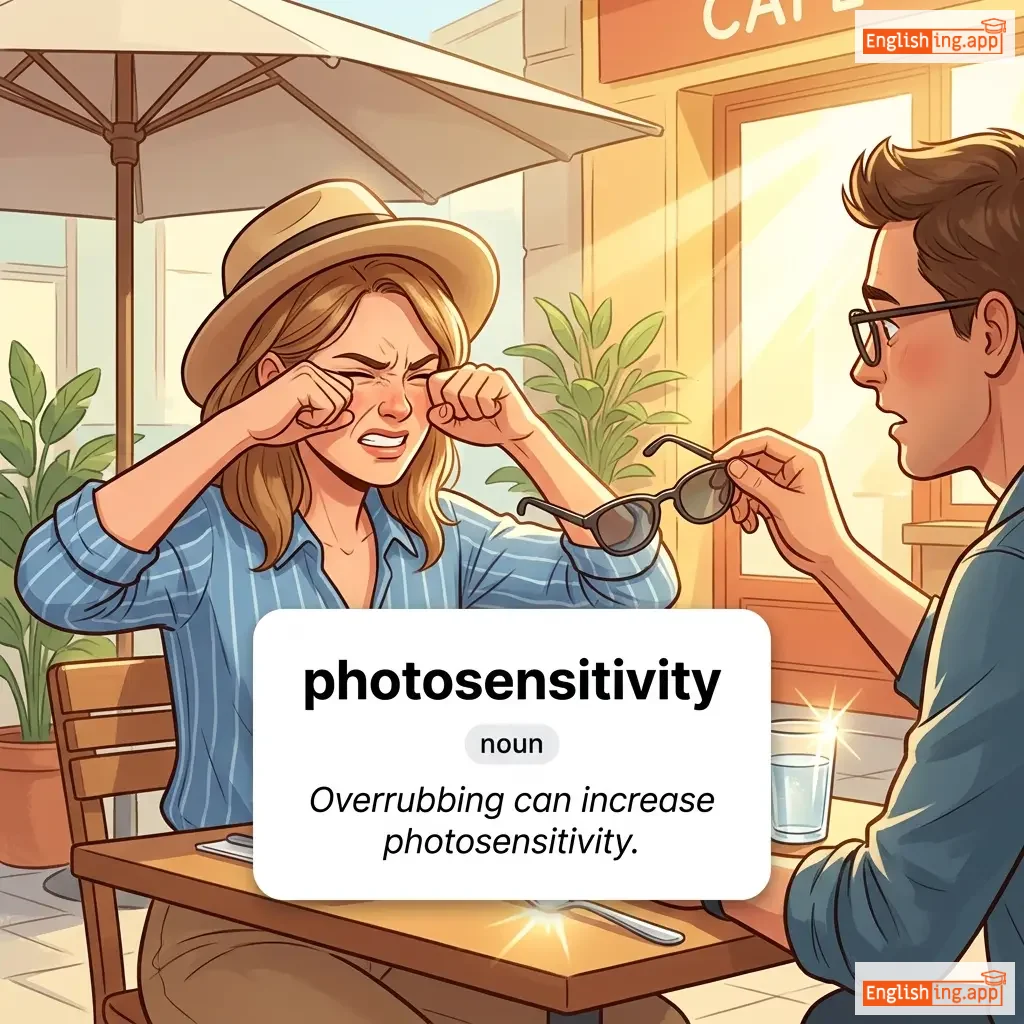
photosensitivity definition card — visual illustration of the meaning
noun
/ˌfəʊ.təʊ.sen.sɪˈtɪv.ɪ.ti/
光敏感性 (guang min gan xing)

Sensitivity to light, especially abnormal sensitivity that may cause discomfort or damage.

"Overrubbing can increase photosensitivity."
"过度摩擦可能增加光敏感性。" (Guo du mo ca ke neng zeng jia guang min gan xing.)
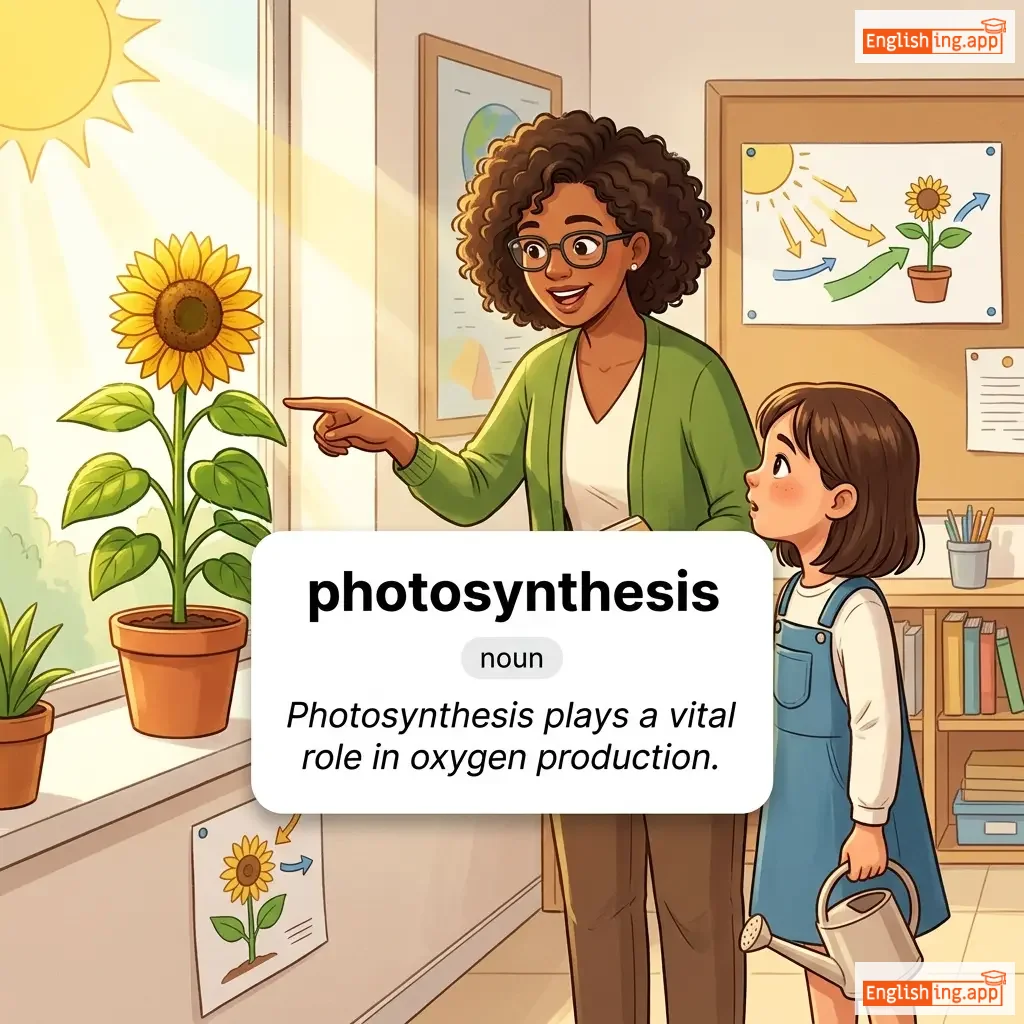
photosynthesis definition card — visual illustration of the meaning
noun
/ˌfoʊ.t̬oʊˈsɪn.θə.sɪs/
光合作用 (guānghézuòyòng)

The process by which green plants and some other organisms use sunlight to synthesize nutrients from carbon dioxide and water.

"Photosynthesis plays a vital role in oxygen production."

"光合作用在氧气生产中发挥着重要作用。" (Guānghézuòyòng zài yǎngqì shēngchǎn zhōng fāhuī zhe zhòngyào zuòyòng.)
photosynthetic efficiency definition card — visual illustration of the meaning
noun
/ˌfəʊtəʊˈsɪnθɛtɪk ɪˈfɪʃənsi/
光合作用效率 (guang he zuo yong xiao lv)

The measure of how effectively plants convert light energy into chemical energy through the process of photosynthesis, directly affecting plant growth and crop yield.

"Improving photosynthetic efficiency can increase crop yields."

"提高光合作用效率可以增加作物产量。" (ti gao guang he zuo yong xiao lv ke yi zeng jia zuo wu chan liang)
noun
/freɪz/
短语 (duǎnyǔ)

a small group of words standing together as a conceptual unit

"He gave a memorable phrase at the conference."

"他在会议上说了一句令人难忘的话。" (Tā zài huìyì shàng shuōle yī jù lìngrén nánwàng de huà.)
phrases definition card — visual illustration of the meaning
noun
freɪzɪz
短语 (duǎn yǔ)

A small group of words standing together as a conceptual unit, typically forming a component of a clause.

"Learn common phrases for daily use."

"学习日常使用的常见短语。" (Xuéxí rìcháng shǐyòng de chángjiàn duǎn yǔ.)
noun
/ˈfaɪləm/
生物分类中的主要类别,高于类,低于界 (shengwu fenlei zhong de zhuyao leibie, gao yu lei, di yu jie)

a primary category in the biological classification of organisms, above class and below kingdom

"Humans belong to the phylum Chordata."

"人类属于脊索动物门。" (Renlei shuyu jisuodongwumen.)
physical definition card — visual illustration of the meaning
adjective
/ˈfɪzɪkəl/
身体的 (shen ti de)

relating to the body or physical things

"He has excellent physical strength."

"他有着出色的身体力量。" (Ta you zhuocheng de shenti liliang.)
🏋️‍♀️

physically (身体上)

adverb
/ˈfɪzɪkəli/
身体上 (shen ti shang)

in a physical manner; relating to the body

"She is physically strong and healthy."

"她身体上很强壮,保持健康。" (Ta shenti shang hen qiangzhuang, baochi jiankang.)
noun
/fɪˈzɪʃən/
医生 (yīshēng)

a person qualified to practice medicine; a doctor

"The physician prescribed some medicine to treat the condition."

"医生开了一些药物来治疗这种病情。" (Yīshēng kāi le yīxiē yàowù lái zhìliáo zhè zhǒng bìngqíng.)
noun
/ˈfɪzɪsɪst/
物理学家 (wùlǐ xuéjiā)

a scientist who studies or specializes in physics

"The physicist explained the theory of relativity to the students."

"物理学家向学生们解释了相对论。" (Wùlǐ xuéjiā xiàng xuéshēngmen jiěshìle xiāngduì lùn.)