词汇表

英语词汇词典 | 单词含义、定义和示例

noun
/ˈnuː.kʌm.ər/
新来者 (xin laizhe)

a person who has recently arrived in a place or joined a group

"The newcomer was warmly welcomed by the team."

"新来者受到了团队的热烈欢迎。" (Xin laizhe shòudàole tuánduì de rèliè huānyíng.)
adverb
/ˈnjuːli/
最近 (zuìjìn)

in a new or recent manner

"She has newly renovated her house."

"她最近重新装修了她的房子。" (Tā zuìjìn chóngxīn zhuāngxiūle tā de fángzi.)
noun
/nuːz/
新闻 (xīnwén)

newly received or noteworthy information, especially about recent events

"The news about the storm spread quickly."

"关于暴风雨的新闻迅速传播。" (Guānyú bàofēngyǔ de xīnwén xùnsù chuánbò.)
noun
/ˈnjuːzˌlɛtər/
时事通讯 (shishixunwen)

a printed or electronic report containing news or information about a company or organization

"The company sends a weekly newsletter to its employees."

"公司每周向员工发送时事通讯。" (Gōngsī měi zhōu xiàng yuángōng fāsòng shíshì xùnwén.)
noun
/ˈnjuːzˌpeɪpər/
报纸 (baozhi)

a printed publication (usually daily or weekly) containing news, articles, advertisements, and correspondence

"I read the newspaper every morning."

"我每天早上读报纸。" (Wo mei tian zao shang du baozhi.)
noun
/nuːt/
蝾螈 (róngyuán)

a small amphibian with a long tail that lives both in water and on land

"The newt swam gracefully in the pond."

"蝾螈优雅地在池塘里游泳。" (róngyuán yōu yǎ dì zài chítáng lǐ yóu yǒng)
adjective
/njuːˈtoʊniən/
与牛顿定律相关 (yu niudun dinglü xiangguan)

relating to the laws of motion and gravitation formulated by Sir Isaac Newton

"The scientist explained the Newtonian laws of motion."

"科学家解释了牛顿的运动定律。" (Kexuejia jieshi le Niudun de yundong dinglü.)
adjective
/nɛkst/
下一个 (xia yige)

immediately following in time, order, or place

"The next train leaves at 9:00 AM."

"下一班火车将在上午9:00出发。" (Xia yiban huoche jiang zai shangwu 9:00 chufa.)
noun
/ˈnɛksəs/
联系 (liánxì)

a connection or series of connections linking two or more things

"The town was a nexus for trade routes in the region."

"这个城市是该地区贸易路线的一个联系点。" (Zhege chengshi shi gai diqu maoyi luxian de yige lianxidian.)
noun
/nɪb/
钢笔尖 (gangbi jian)

the pointed end of a pen used for writing or drawing

"He dipped the nib into the ink before writing."

"他在写字之前把钢笔尖浸入墨水中。" (Tā zài xiězì zhīqián bǎ gāngbǐ jiān rù mòshuǐ zhōng.)
verb
/ˈnɪbəl/
(ken)

to take small bites of food

"The rabbit nibbled on a carrot."

"兔子咬着胡萝卜。" (Tùzi yǎo zhe húluóbo.)
adjective
/naɪs/
友好 (yǒu hǎo)

pleasant, kind, or enjoyable

"She is a very nice person to work with."

"她是一个非常友好的人,和她一起工作很愉快。" (Tā shì yī gè fēicháng yǒu hǎo de rén, hé tā yīqǐ gōngzuò hěn yú kuài.)
adverb
/ˈnaɪsli/
很好地 (hen hao de)

in a pleasant, kind, or satisfactory manner; carefully and appropriately

"She explained the problem nicely so everyone could understand."

"她把问题解释得很好,让大家都明白了。" (ta ba wenti jieshi de hen hao rang dajia dou mingbai le)
noun
/ˈnaɪsəti/
细微之处 (xiwei zhichu)

a fine or subtle detail, or a refined, delicate aspect of something

"The lawyer explained the legal niceties of the case."

"律师解释了案件的法律细节。" (Lüshi jiexile anjian de falu xijie.)
Niche definition card — visual illustration of the meaning
noun
/niːʃ/
合适的位置 (heshi de weizhi)

a comfortable or suitable position in life or employment

"He has found his niche in the marketing industry."

"他在营销行业找到了自己的合适位置。" (Tā zài yíngxiāo hángyè zhǎodàole zìjǐ de héshì wèizhì.)
noun
/ˈnɪkəl/
镍币 (niè bì)

a small coin, typically worth five cents in the United States

"He found a nickel on the ground."

"他在地上找到了一个镍币。" (Tā zài dì shàng zhǎodàole yīgè nièbì.)
noun
/ˈnɪk.neɪm/
昵称 (ni cheng)

a familiar or humorous name given to a person instead of their real name

"His nickname is 'Tiger' because he's so brave."

"他的昵称是'老虎'因为他非常勇敢。" (tā de nìchēng shì 'lǎohǔ' yīnwèi tā fēicháng yǒnggǎn.)
noun
/niːs/
侄女; 外甥女 (zhinv; waishengnv)

the daughter of one's brother or sister

"My niece is studying at the university this year."

"我的侄女今年在大学学习。" (wo de zhinv jinnian zai daxue xuexi)
noun
/naɪˈdʒel.ə/
黑孜然 (hei ziran)

small black seeds with a nutty, slightly bitter flavor, also known as black cumin or black seed

"Sprinkle nigella seeds on top of the bread before baking."

"在面包上撒上黑孜然种子,然后烤制。" (Zai mianbao shang sa shang hei ziran zhongzi, ranhou kao zhi.)
adjective
/ˈnɪɡərdli/
小气 (xiaoqi)

unwilling to spend or give; stingy or miserly

"He was too niggardly to leave a decent tip."

"他太小气,舍不得给个体面的小费。" (Ta tai xiaoqi, shebude gei ge tianmian de xiaofei.)
verb
/ˈnɪɡəl/

to cause slight but persistent annoyance, discomfort, or worry

"A small doubt niggled at her mind."

noun
/naɪt/
夜晚 (ye wan)

the time of darkness between one day and the next, when most people sleep

"She loves going for walks at night."

"她喜欢晚上散步。" (Ta xihuan wanshang sanbu.)
noun
/naɪt kwiːn/
夜来香 (yelai xiang)

a fragrant white flower that blooms at night and releases strong sweet scent

"The night queen flowers filled the garden with their sweet fragrance."

"夜来香花让花园充满了甜美的香气。" (yelai xiang hua rang huayuan chongman le tianmei de xiangqi)
noun
/naɪt ˈdʒæz.mɪn/
夜茉莉 (ye moli)

a fragrant flowering tree that blooms at night with small white flowers

"The night-jasmine tree blooms only after sunset with its tiny white flowers."

"夜茉莉树只在日落后开出它的小白花。" (ye moli shu zhi zai riluo hou kai chu ta de xiao bai hua.)
noun
/ˈnaɪt.fɔːl/
夜幕降临 (yèmù jiànglín)

the time when night begins; dusk

"They decided to return home before nightfall."

"他们决定在夜幕降临之前回家。" (Tāmen juédìng zài yèmù jiànglín zhīqián huíjiā.)
noun
/ˈnaɪ.tɪŋ.ɡeɪl/
夜莺 (yèyīng)

small songbird known for its beautiful singing, especially at night

"The nightingale sang sweetly in the moonlight."

"夜莺在月光下甜美地歌唱。" (yèyīng zài yuèguāng xià tiánměi de gēchàng)
noun
/ˈnaɪtˌmɛər/

a frightening or unpleasant dream; a very distressing experience.

"Last night, she had a terrifying nightmare."

noun
/ˈnaɪɪˌlɪzəm/
虚无主义 (xūwú zhǔyì)

The rejection of all religious and moral principles, often in the belief that life is meaningless.

"The philosopher was criticized for promoting nihilism."

"哲学家因提倡虚无主义而受到批评。" (Zhéxué jiā yīn tíchàng xūwú zhǔyì ér shòudào pīpíng.)
noun
/ˈnaɪəlɪst/
虚无主义者 (xū wú zhǔ yì zhě)

A person who rejects all religious and moral principles, often believing that life is meaningless.

"He was called a nihilist for rejecting all social norms."

"因为拒绝所有社会规范,他被称为虚无主义者。" (Yīnwèi jùjué suǒyǒu shèhuì guīfàn, tā bèi chēng wèi xūwú zhǔyì zhě.)
0️⃣

Nil (nil)

noun
/nɪl/
(ling)

Nothing; zero.

"The score remained nil after the first half."

"在上半场结束后,分数保持为零。" (Zài shàngbànchǎng jiéshù hòu, fēnshù bǎochí wéi líng.)
adjective
/ˈnɪmbəl/
灵活 (línghuó)

Quick and light in movement or thought.

"The dancer’s nimble steps impressed the audience."

"舞者灵活的步伐给观众留下了深刻的印象。" (Wǔzhě línghuó de bùfá gěi guānzhòng liúxià le shēnkè de yìnxiàng.)
noun
/naɪn/
(jiu)

the number that is one more than eight

"She has nine books in her collection."

"她的收藏里有九本书。" (Tā de shōucáng lǐ yǒu jiǔ běn shū.)
noun
/ˈnɪn.i/
傻瓜 (shagua)

a silly or foolish person; someone who lacks common sense

"Don't be such a ninny, use your brain!"

"不要做傻瓜,动动脑子!" (bùyào zuò shǎguā, dòng dòng nǎozi!)
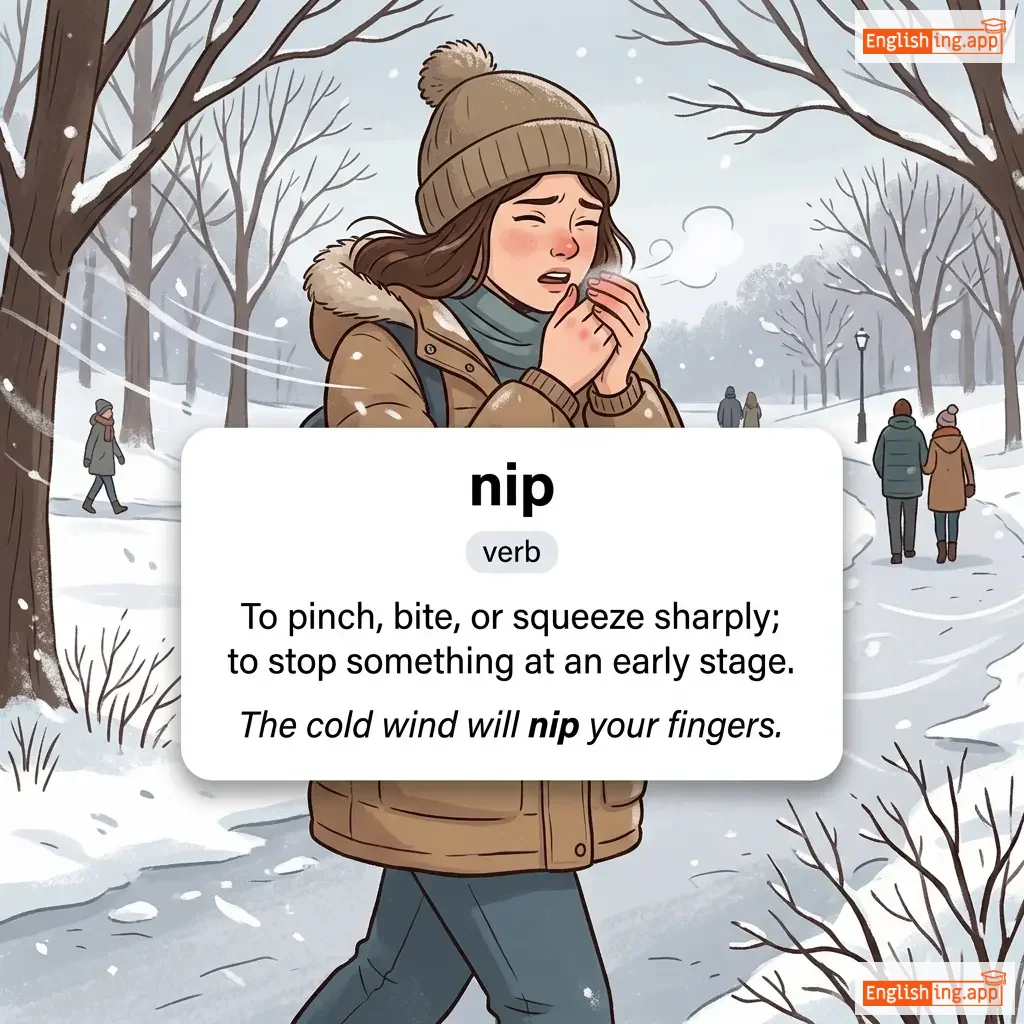
nip definition card — visual illustration of the meaning
verb
/nɪp/
(qia)

To pinch, bite, or squeeze sharply; to stop something at an early stage.

"The cold wind will nip your fingers."

"寒风会掐住你的手指。" (Han feng hui qia zhu ni de shou zhi.)
adjective
/ˈnɪp.i/
寒冷; 刺骨; 快速且灵活的动作 (hanleng; cigu; kuaisu qie linghuo de dongzuo)

cold; chilly; quick and agile in movement

"It's quite nippy outside today, you should wear a jacket."
"今天外面相当寒冷,你应该穿上夹克。" (Jintian waimian xiangdang hanleng, ni yinggai chuanshang jiake.)
🕉️

nirvana

noun
/nɪərˈvɑːnə/

A state of perfect happiness, peace, and freedom from suffering; in Buddhism, the ultimate goal of liberation.

"Meditation helps some people seek nirvana in their lives."

noun
/nɪt/
虱子卵 (shī zi luǎn)

The egg or young form of a louse or other parasitic insect.

"The teacher noticed nits in the child’s hair."

"老师发现了孩子头发里的虱子卵。" (Lǎoshī fāxiànle háizi tóufǎ lǐ de shīzi luǎn.)
verb
/ˈnɪtˌpɪk/

To find and criticize small or unimportant faults in someone or something.

"She tends to nitpick about every little detail."

adverb
/noʊ/
(bu)

used to give a negative response or to show disagreement

"She said no to the invitation."

"她对邀请说了不。" (Tā duì yāoqǐng shuōle bù.)
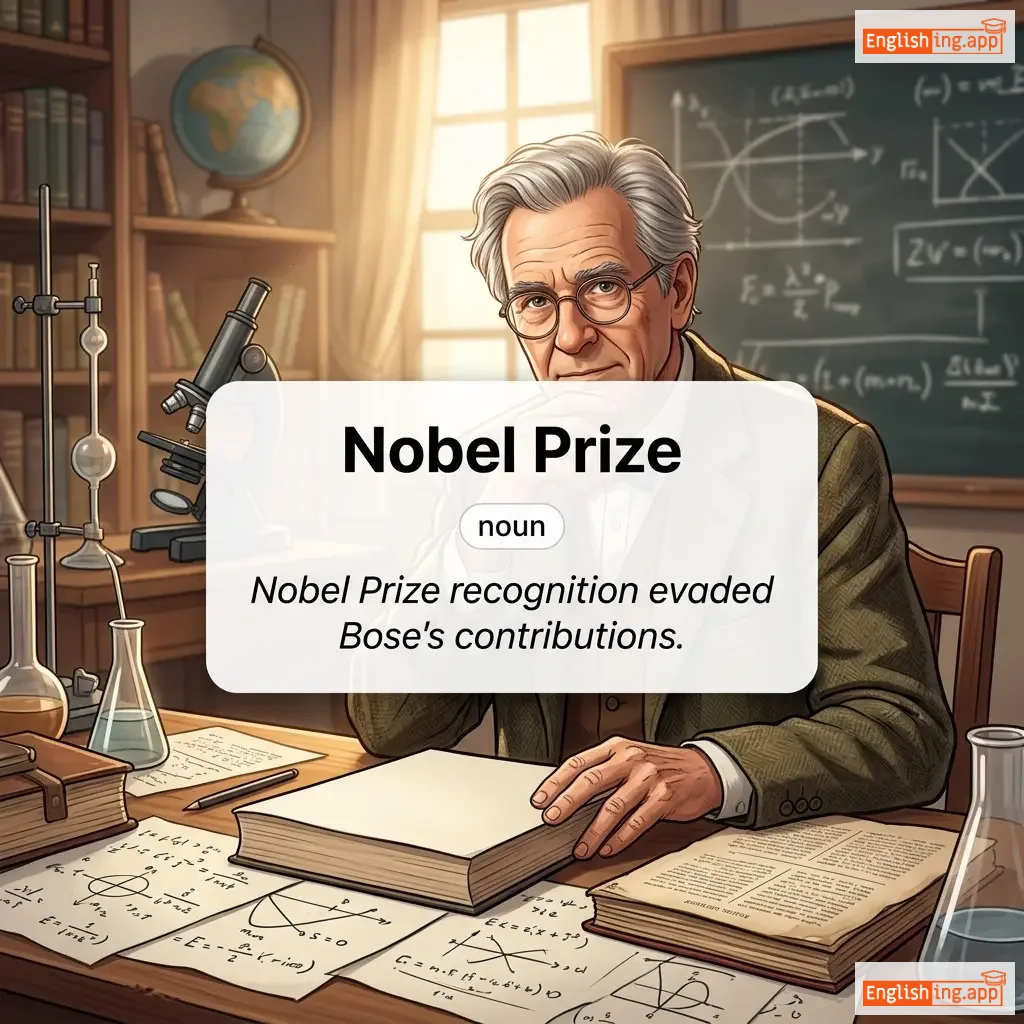
Nobel Prize definition card — visual illustration of the meaning
noun
noʊˈbel praɪz
诺贝尔奖 (nuobeier jiang)

Any of six international prizes awarded annually for outstanding work in physics, chemistry, physiology or medicine, literature, economics, and the promotion of peace.

"Nobel Prize recognition evaded Bose's contributions."

"诺贝尔奖的认可未能体现博斯的贡献。" (nuobeier jiang de ren ke wei neng ti xian bo si de gong xian)
noun
/nəʊˈbɪləti/
高贵 (gaogui)

the quality of being noble in character or the group of people belonging to the aristocracy

"The king praised her for her nobility and courage."

"国王因她的高贵和勇气表扬了她。" (Guówáng yīn tā de gāoguì hé yǒngqì biǎoyángle tā.)
adjective
/ˈnoʊbəl/
具有高尚的个人品质、高道德原则或属于高社会阶层 (Jùyǒu gāoshàng de gèrén pǐnzhì, gāo dàodé yuánzé huò shǔyú gāo shèhuì jiēcéng)

Having or showing fine personal qualities, high moral principles, or being of high social rank.

"He is admired for his noble character and generosity."

"他因其高尚的品格和慷慨而受到钦佩。" (Tā yīn qí gāoshàng de pǐngé hé kāngkǎi ér shòudào qīnpèi.)
🙅‍♂️

nobody (nobody)

pronoun
/ˈnoʊˌbɑːdi/
没有人 (méiyǒu rén)

no person; not anyone

"Nobody came to the party."

"没有人来参加派对。" (Méiyǒu rén lái cānjiā pàiduì.)
adjective
/nɒkˈtɜːrnəl/
夜行性 (yexingxing)

Active at night and sleeping during the day.

"Owls are nocturnal animals that hunt at night."

"猫头鹰是夜行性动物,它们夜间捕猎。" (Maotouying shi yexingxing dongwu, tamen ye jian buli)
nod definition card — visual illustration of the meaning
verb
/nɒd/
点头 (diǎn tóu)

to move your head up and down, especially to show agreement or understanding

"She nodded in agreement with the proposal."

"她在提案中点头表示同意。" (Tā zài tí'àn zhōng diǎntóu biǎoshì tóngyì.)
noun
/nɔɪz/
噪音 (zaoyin)

a sound, especially when it is unwanted, unpleasant, or loud

"The noise from the construction site was unbearable."

"建筑工地的噪音让人无法忍受。" (Jianzhu gongdi de zaoyin rangren wufa renshou.)
adjective
/ˈnɔɪzləs/
无声 (wú shēng)

Completely silent; without any noise.

"The cat made a noiseless leap onto the table."

"猫悄无声息地跳上了桌子。" (Māo qiāo wú shēng xī de tiàoshàngle zhuōzi.)
adverb
/ˈnɔɪzɪli/
喧闹地 (xuan nao di)

in a way that makes a lot of noise; loudly

"The children were playing noisily in the playground."

"孩子们在操场上喧闹地玩耍。" (Haizimen zai caochang shang xuannao di wanshua.)
adjective
/ˈnɔɪsəm/
恶臭 (èchòu)

Having an extremely unpleasant smell; offensive or harmful.

"The dump emitted a noisome odor that spread through the town."

"垃圾场散发出一股令人不悦的气味,弥漫到整个城市。" (Lājī chǎng sànfā chū yī gǔ lìng rén bù yuè de qìwèi, mímàn dào zhěnggè chéngshì.)
adjective
/ˈnɔɪzi/
吵闹 (chaonao)

Making a lot of loud sounds; full of noise.

"The children were noisy during the party."

"孩子们在派对期间很吵闹。" (Háizimen zài pàiduì qījiān hěn chǎonào.)